

Formal Formal channel channel (network) (network) 
of 
of communication 
communication 
BY Prof. Kamlesh Joshi
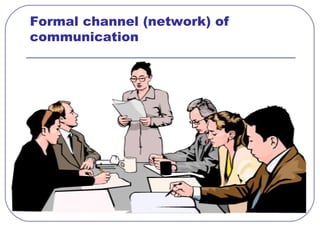
Formal channel (network) of 
communication 
Information flow in modern business 
is like network of arteries in the 
body 
Is controlled by managers or other 
similar persons in the organization 
Movements of information by 
reports, e-mail, records, sales 
presentation, advertising & publicity
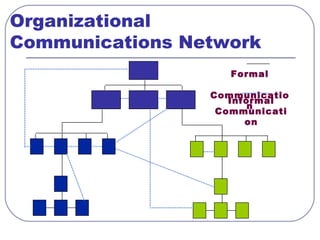
Organizational 
Communications Network 
Formal 
Communicatio 
Infonrmal 
Communicati 
on
Formal channel (network) of 
communication
Advantages of formal channel of 
communication 
Effective communication 
of an organization depends 
heavily on the formal 
channels of communication 
Enables an organization to 
pass on information to its 
various branches smoothly 
Consolidate the organization and 
satisfy the people in managerial 
position
Disadvantages of formal channel of 
communication 
Often it is seen that 
formal channel hinders 
free flow of information. 
Is time consuming as 
compared to informal channel. 
Is expensive.
Informal channel (network) of 
communication 
Parallel to formal network 
Consists primarily of personal 
communication 
Informal channel is like network of 
veins in the body 
Infinitely complex, links all the 
members of the organization. 
For an example: Grapevine
Informal channel (network) of 
communication
Factors for grapevine formation 
When an organization is passing through 
crises, there prevails a feeling of an un 
certainty and lack of sense of direction. 
If the manager discriminates between his 
favorites and non-favorites. 
If employees are not having adequate self-confidence 
.
Types / forms of grapevine 
communication 
 Keith Davis has stated four types of 
grapevine 
1. Single strand chain 
2. Gossip chain 
3. Probability chain 
4. Cluster chain
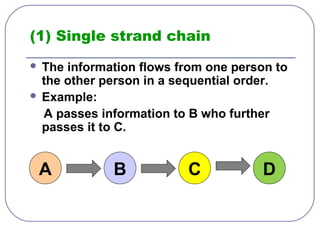
(1) Single strand chain 
 The information flows from one person to 
the other person in a sequential order. 
 Example: 
A passes information to B who further 
passes it to C. 
A B C D
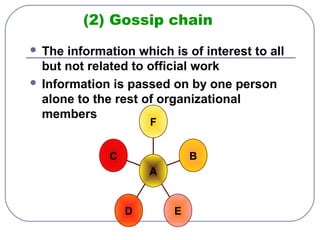
(2) Gossip chain 
 The information which is of interest to all 
but not related to official work 
 Information is passed on by one person 
alone to the rest of organizational 
members 
C 
D E 
B 
F 
A
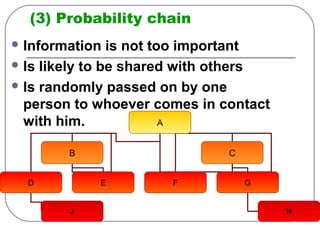
(3) Probability chain 
Information is not too important 
Is likely to be shared with others 
Is randomly passed on by one 
person to whoever comes in contact 
with him. A 
B C 
D E F G 
J H
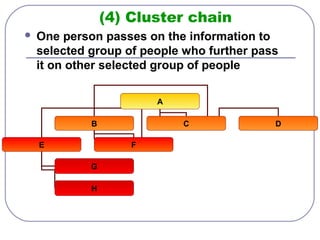
(4) Cluster chain 
 One person passes on the information to 
selected group of people who further pass 
it on other selected group of people 
A 
B C 
E 
D 
F 
G 
H
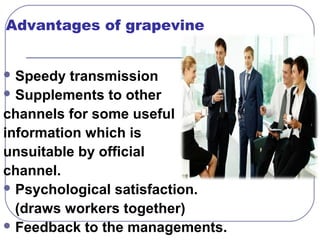
Advantages of grapevine 
Speedy transmission 
Supplements to other 
channels for some useful 
information which is 
unsuitable by official 
channel. 
Psychological satisfaction. 
(draws workers together) 
Feedback to the managements.
Advantages of grapevine 
Without grapevine employees may 
not feel ownership of information 
Management can know employees’ 
thoughts 
Creates a sense of belongings in 
employees 
Most employees rely on it than 
formal comm.
Disadvantages of grapevine 
 Information is less credible 
than formal channel. 
Does not carry complete 
information always. 
People twist the matter 
& spoil the image of 
organization. 
Is rarely the whole truth, 
can harm interest of organization.
Disadvantages of grapevine 
Increase the duration of lunch, tea 
breaks, waste of time. 
Information may get leak at wrong 
time. 
Information may be accurate or 
inaccurate.
How to control grapevine 
Be sensitive to employee 
anxiety. 
Provide important information 
to employee openly, honestly, quickly. 
Generate rumors designed to 
make employees get the information 
they need.
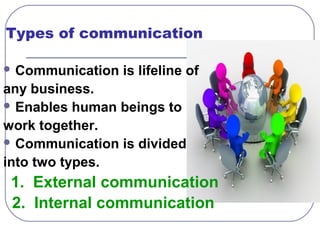
Types of communication 
Communication is lifeline of 
any business. 
Enables human beings to 
work together. 
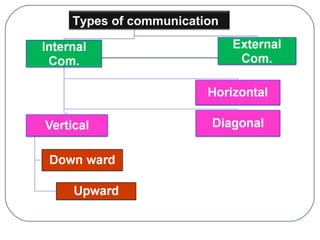
Communication is divided 
into two types. 
1. External communication 
2. Internal communication
Types of communication
(1) External Communication 
External communication covers how 
a person interacts with those out-side 
their own organization. This 
may be with the public, employers, 
community organizations, local 
authorities, job centers, careers 
offices, funding bodies, specialist 
agencies and other training 
providers.
(2) Internal Communication 
Internal communication involves 
the communication that exists 
within a company and can take 
many forms. 
Key to the success of an 
organization is communication 
from within. In order to effectively 
engage in two way relations, 
communication is essential internally.
Internal communication 
The communication that occurs in 
conducting work within a business is 
known as internal communication. 
Includes orders & instruction given by 
supervisor to workers, oral conversations 
among workers, reports prepared by 
workers for sales, production, finance etc. 
Has to move up and down the chain of 
authority as well as side ways between 
persons at the same level of authority
Internal communication 
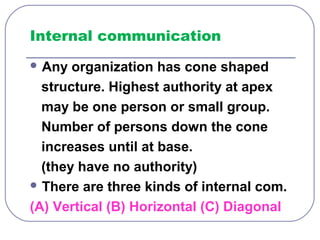
Any organization has cone shaped 
structure. Highest authority at apex 
may be one person or small group. 
Number of persons down the cone 
increases until at base. 
(they have no authority) 
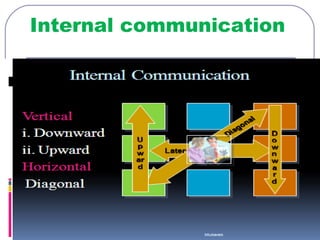
There are three kinds of internal com. 
(A) Vertical (B) Horizontal (C) Diagonal
Internal communication
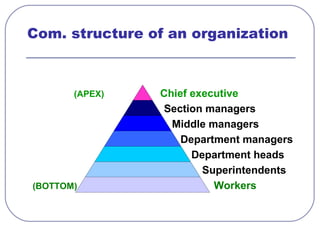
Com. structure of an organization 
(APEX) Chief executive 
Section managers 
Middle managers 
Department managers 
Department heads 
Superintendents 
(BOTTOM) Workers
(A) Vertical communication 
Is made up of upward & downward flow of 
messages. 
Information is transmitted from the top 
management to employees in organization 
Is divided into 
(1) Downward communication 
(2) Upward communication
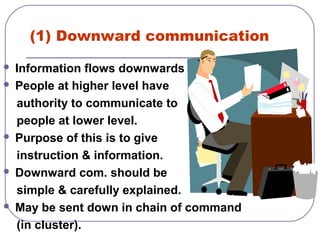
(1) Downward communication 
 Information flows downwards 
 People at higher level have 
authority to communicate to 
people at lower level. 
 Purpose of this is to give 
instruction & information. 
 Downward com. should be 
simple & carefully explained. 
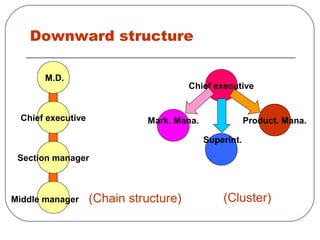
 May be sent down in chain of command 
(in cluster).
Downward structure 
M.D. 
Chief executive 
Section manager 
Middle manager (Chain structure) 
Chief executive 
Mark. Mana. Product. Mana. 
Superint. 
(Cluster)
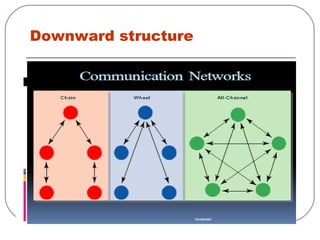
Downward structure
Limitations of downward 
communication 
Distortion / Dilution 
( on the way to lower ) 
Delay 
(many levels, time consuming) 
Filtering 
(important part of message is not 
passed to employees by superiors, 
affect relationship)
(2) Upward communication 
 The function of upward com. is to 
send information, suggestion, 
complaints and grievances of lower 
level workers to managers above 
Success of any organization depends 
on the amount of flow of upward 
communication
Importance of upward com. 
Providing feedback 
Outlet for pent-up emotions 
Constructive suggestions 
Greater harmony & cohesion (unity)
Methods of upwards com. 
Open- door policy 
Regular reporting system 
Committees 
Informal gathering 
Counseling
Limitation of upward com. 
Employees are usually reluctant to 
initiate upward com., may not have 
courage to talk 
Many managers don’t like to be “told” 
by juniors 
Some times workers directly 
approach top managements without 
telling to superiors 
Workers are encouraged to talk freely 
but is interpreted as incompetence
(B) Horizontal / lateral com. 
Between two persons operating at the 
same level 
To maintain co-ordination among 
various departments 
Face to face exchange of views, 
conversation over phone, letters, 
memo, reports, are convenient
(C) Diagonal communication 
 Apart from vertical and horizontal forms of com., 
there is another form which takes unpredictable 
path. 
 Information could at certain stage take on 
upward path then a horizontal direction and 
finally move downward or could even stop at 
certain stages. 
 Allows communication to flow irrespective of 
position or status, without any bonding or rules 
 Could give rise to gossip , grapevine and 
rumors.
 channel (network) of communication

channel (network) of communication

  • 1.
    Formal Formal channelchannel (network) (network) of of communication communication BY Prof. Kamlesh Joshi
  • 2.
    Formal channel (network)of communication Information flow in modern business is like network of arteries in the body Is controlled by managers or other similar persons in the organization Movements of information by reports, e-mail, records, sales presentation, advertising & publicity
  • 3.
    Organizational Communications Network Formal Communicatio Infonrmal Communicati on
  • 4.
    Formal channel (network)of communication
  • 5.
    Advantages of formalchannel of communication Effective communication of an organization depends heavily on the formal channels of communication Enables an organization to pass on information to its various branches smoothly Consolidate the organization and satisfy the people in managerial position
  • 6.
    Disadvantages of formalchannel of communication Often it is seen that formal channel hinders free flow of information. Is time consuming as compared to informal channel. Is expensive.
  • 7.
    Informal channel (network)of communication Parallel to formal network Consists primarily of personal communication Informal channel is like network of veins in the body Infinitely complex, links all the members of the organization. For an example: Grapevine
  • 8.
  • 9.
    Factors for grapevineformation When an organization is passing through crises, there prevails a feeling of an un certainty and lack of sense of direction. If the manager discriminates between his favorites and non-favorites. If employees are not having adequate self-confidence .
  • 10.
    Types / formsof grapevine communication  Keith Davis has stated four types of grapevine 1. Single strand chain 2. Gossip chain 3. Probability chain 4. Cluster chain
  • 11.
    (1) Single strandchain  The information flows from one person to the other person in a sequential order.  Example: A passes information to B who further passes it to C. A B C D
  • 12.
    (2) Gossip chain  The information which is of interest to all but not related to official work  Information is passed on by one person alone to the rest of organizational members C D E B F A
  • 13.
    (3) Probability chain Information is not too important Is likely to be shared with others Is randomly passed on by one person to whoever comes in contact with him. A B C D E F G J H
  • 14.
    (4) Cluster chain  One person passes on the information to selected group of people who further pass it on other selected group of people A B C E D F G H
  • 15.
    Advantages of grapevine Speedy transmission Supplements to other channels for some useful information which is unsuitable by official channel. Psychological satisfaction. (draws workers together) Feedback to the managements.
  • 16.
    Advantages of grapevine Without grapevine employees may not feel ownership of information Management can know employees’ thoughts Creates a sense of belongings in employees Most employees rely on it than formal comm.
  • 17.
    Disadvantages of grapevine  Information is less credible than formal channel. Does not carry complete information always. People twist the matter & spoil the image of organization. Is rarely the whole truth, can harm interest of organization.
  • 18.
    Disadvantages of grapevine Increase the duration of lunch, tea breaks, waste of time. Information may get leak at wrong time. Information may be accurate or inaccurate.
  • 19.
    How to controlgrapevine Be sensitive to employee anxiety. Provide important information to employee openly, honestly, quickly. Generate rumors designed to make employees get the information they need.
  • 20.
    Types of communication Communication is lifeline of any business. Enables human beings to work together. Communication is divided into two types. 1. External communication 2. Internal communication
  • 21.
  • 22.
    (1) External Communication External communication covers how a person interacts with those out-side their own organization. This may be with the public, employers, community organizations, local authorities, job centers, careers offices, funding bodies, specialist agencies and other training providers.
  • 23.
    (2) Internal Communication Internal communication involves the communication that exists within a company and can take many forms. Key to the success of an organization is communication from within. In order to effectively engage in two way relations, communication is essential internally.
  • 24.
    Internal communication Thecommunication that occurs in conducting work within a business is known as internal communication. Includes orders & instruction given by supervisor to workers, oral conversations among workers, reports prepared by workers for sales, production, finance etc. Has to move up and down the chain of authority as well as side ways between persons at the same level of authority
  • 25.
    Internal communication Anyorganization has cone shaped structure. Highest authority at apex may be one person or small group. Number of persons down the cone increases until at base. (they have no authority) There are three kinds of internal com. (A) Vertical (B) Horizontal (C) Diagonal
  • 26.
  • 27.
    Com. structure ofan organization (APEX) Chief executive Section managers Middle managers Department managers Department heads Superintendents (BOTTOM) Workers
  • 28.
    (A) Vertical communication Is made up of upward & downward flow of messages. Information is transmitted from the top management to employees in organization Is divided into (1) Downward communication (2) Upward communication
  • 29.
    (1) Downward communication  Information flows downwards  People at higher level have authority to communicate to people at lower level.  Purpose of this is to give instruction & information.  Downward com. should be simple & carefully explained.  May be sent down in chain of command (in cluster).
  • 30.
    Downward structure M.D. Chief executive Section manager Middle manager (Chain structure) Chief executive Mark. Mana. Product. Mana. Superint. (Cluster)
  • 31.
  • 32.
    Limitations of downward communication Distortion / Dilution ( on the way to lower ) Delay (many levels, time consuming) Filtering (important part of message is not passed to employees by superiors, affect relationship)
  • 33.
    (2) Upward communication  The function of upward com. is to send information, suggestion, complaints and grievances of lower level workers to managers above Success of any organization depends on the amount of flow of upward communication
  • 34.
    Importance of upwardcom. Providing feedback Outlet for pent-up emotions Constructive suggestions Greater harmony & cohesion (unity)
  • 35.
    Methods of upwardscom. Open- door policy Regular reporting system Committees Informal gathering Counseling
  • 36.
    Limitation of upwardcom. Employees are usually reluctant to initiate upward com., may not have courage to talk Many managers don’t like to be “told” by juniors Some times workers directly approach top managements without telling to superiors Workers are encouraged to talk freely but is interpreted as incompetence
  • 37.
    (B) Horizontal /lateral com. Between two persons operating at the same level To maintain co-ordination among various departments Face to face exchange of views, conversation over phone, letters, memo, reports, are convenient
  • 38.
    (C) Diagonal communication  Apart from vertical and horizontal forms of com., there is another form which takes unpredictable path.  Information could at certain stage take on upward path then a horizontal direction and finally move downward or could even stop at certain stages.  Allows communication to flow irrespective of position or status, without any bonding or rules  Could give rise to gossip , grapevine and rumors.