


Active & Passive Voice
• Voice is the form a verb takes to
indicate whether the subject of the
verb performs or receives the
action.
• There are two types of voice: active
voice and passive voice.
Active Voice
• Active Voice – indicates that the
subject of the verb is acting
• Because the subject does or "acts
upon" the verb in such sentences,
the sentences are said to be in the
active voice.
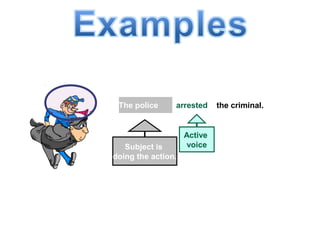
The police arrested the criminal.
Subject is
doing the action.
Active
voice
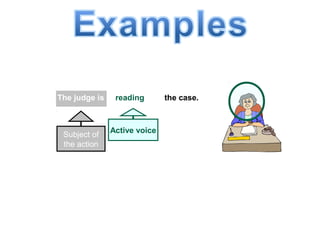
The judge is reading the case.
Subject of
the action
Active voice
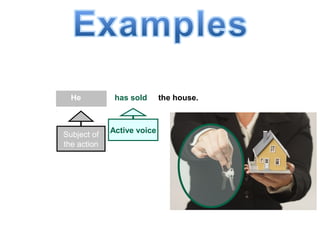
He has sold the house.
Subject of
the action
Active voice
 These examples show that the subject is doing the
verb's action.
 The dog jumped onto the boy.
The dog (subject) is doing the jumping (verb).
 Kristy will give a book report to the class.
Kristy (subject) is doing the giving (verb).
Passive Voice
• In a passive voice sentence, the subject and
object flip-flop. The subject becomes the
passive recipient of the action.
• Because the subject is being "acted upon" (or
is passive), such sentences are said to be in
the passive voice.
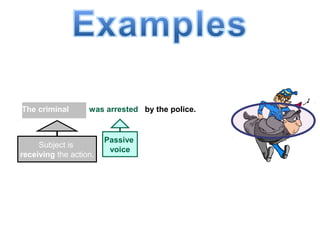
The criminal was arrested by the police.
Subject is
receiving the action.
Passive
voice
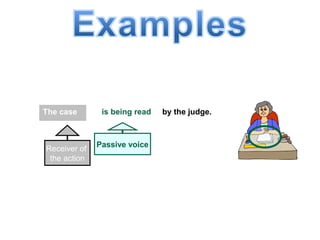
The case is being read by the judge.
Receiver of
the action
Passive voice
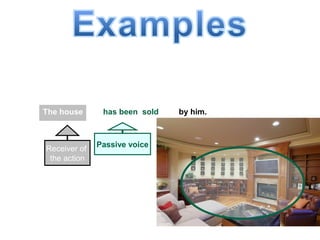
The house has been sold by him.
Receiver of
the action
Passive voice
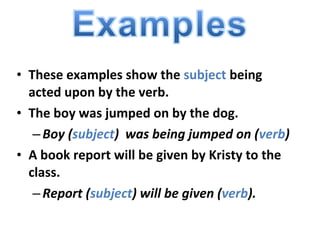
• These examples show the subject being
acted upon by the verb.
• The boy was jumped on by the dog.
–Boy (subject) was being jumped on (verb)
• A book report will be given by Kristy to the
class.
–Report (subject) will be given (verb).
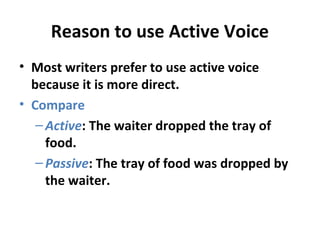
Reason to use Active Voice
• Most writers prefer to use active voice
because it is more direct.
• Compare
–Active: The waiter dropped the tray of
food.
–Passive: The tray of food was dropped by
the waiter.
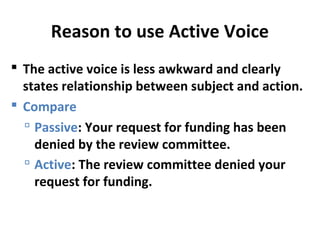
Reason to use Active Voice
 The active voice is less awkward and clearly
states relationship between subject and action.
 Compare
 Passive: Your request for funding has been
denied by the review committee.
 Active: The review committee denied your
request for funding.
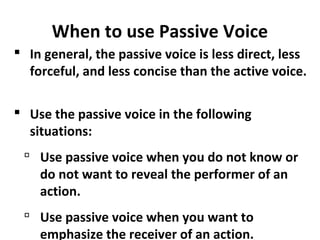
When to use Passive Voice
 In general, the passive voice is less direct, less
forceful, and less concise than the active voice.
 Use the passive voice in the following
situations:
 Use passive voice when you do not know or
do not want to reveal the performer of an
action.
 Use passive voice when you want to
emphasize the receiver of an action.
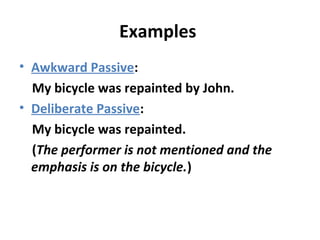
Examples
• Awkward Passive:
My bicycle was repainted by John.
• Deliberate Passive:
My bicycle was repainted.
(The performer is not mentioned and the
emphasis is on the bicycle.)
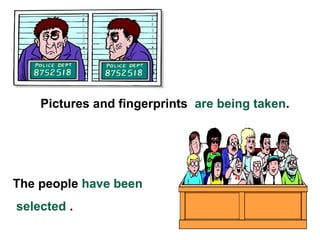
Pictures and fingerprints are being taken.
The people have been
selected .
How to convert Active voice into
Passive voice
• There are twelve tenses in English. All the
sentences of twelve tenses in Active voice
can not be converted into Passive voice.
There are four tenses which can not be
converted into Passive voice which are
 Continuous Future tense.
 Continuous Perfect Present tense.
 Continuous Perfect Past tense.
 Continuous Perfect Future tense.
How to convert Active voice into
Passive voice
• Remaining eight tenses in Active voice can be
converted into Passive voice.
• There are five basic rules to convert Active
into Passive.
1.Convert Object of Active into Subject in
Passive voice.
2.According to tense of Active voice, use
auxiliary verb of Passive voice.
3.Always put the main verb into past participle.
How to convert Active voice into
Passive voice
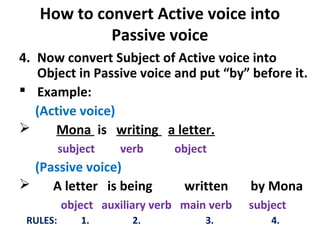
4. Now convert Subject of Active voice into
Object in Passive voice and put “by” before it.
 Example:
(Active voice)
 Mona is writing a letter.
subject verb object
(Passive voice)
 A letter is being written by Mona
object auxiliary verb main verb subject
RULES: 1. 2. 3. 4.
How to convert Active voice into
Passive voice
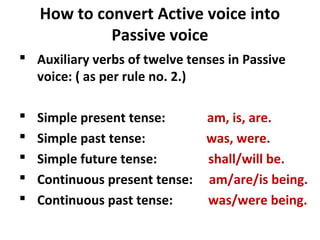
 Auxiliary verbs of twelve tenses in Passive
voice: ( as per rule no. 2.)
 Simple present tense: am, is, are.
 Simple past tense: was, were.
 Simple future tense: shall/will be.
 Continuous present tense: am/are/is being.
 Continuous past tense: was/were being.
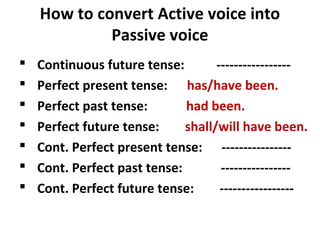
How to convert Active voice into
Passive voice
 Continuous future tense: -----------------
 Perfect present tense: has/have been.
 Perfect past tense: had been.
 Perfect future tense: shall/will have been.
 Cont. Perfect present tense: ----------------
 Cont. Perfect past tense: ----------------
 Cont. Perfect future tense: -----------------
How to convert Active into
Passive
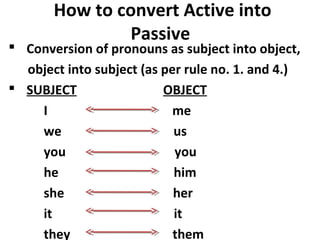
 Conversion of pronouns as subject into object,
object into subject (as per rule no. 1. and 4.)
 SUBJECT OBJECT
I me
we us
you you
he him
she her
it it
they them
Practice 2
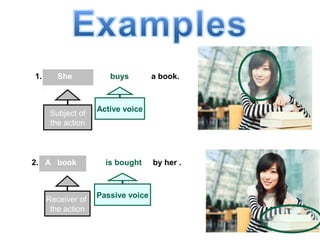
1. She buys a book.
Subject of
the action
Active voice
2. A book is bought by her .
Receiver of
the action
Passive voice
Practice 2
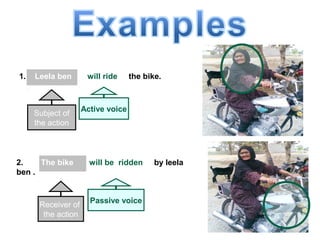
1. Leela ben will ride the bike.
Subject of
the action
Active voice
2. The bike will be ridden by leela
ben .
Receiver of
the action
Passive voice
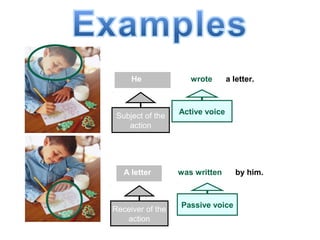
He wrote a letter.
A letter was written by him.
Receiver of the
action
Passive voice
Subject of the
action
Active voice
Practice 2
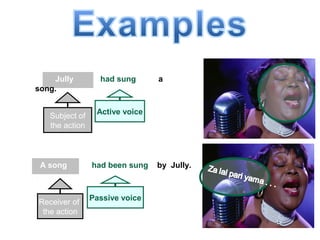
Jully had sung a
song.
Subject of
the action
Active voice
. A song had been sung by Jully.
Receiver of
the action
Passive voice
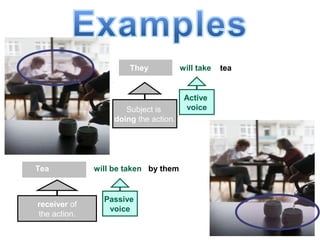
They will take tea
Tea will be taken by them
Subject is
doing the action.
Active
voice
receiver of
the action.
Passive
voice
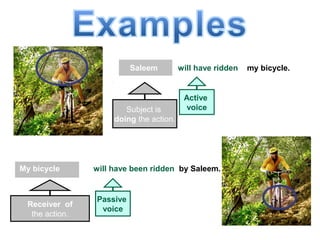
Saleem will have ridden my bicycle.
My bicycle will have been ridden by Saleem.
Subject is
doing the action.
Active
voice
Receiver of
the action.
Passive
voice
12 lesson no. 19 active voice and passive

12 lesson no. 19 active voice and passive

  • 3.
    Active & PassiveVoice • Voice is the form a verb takes to indicate whether the subject of the verb performs or receives the action. • There are two types of voice: active voice and passive voice.
  • 4.
    Active Voice • ActiveVoice – indicates that the subject of the verb is acting • Because the subject does or "acts upon" the verb in such sentences, the sentences are said to be in the active voice.
  • 5.
    The police arrestedthe criminal. Subject is doing the action. Active voice
  • 6.
    The judge isreading the case. Subject of the action Active voice
  • 7.
    He has soldthe house. Subject of the action Active voice
  • 8.
     These examplesshow that the subject is doing the verb's action.  The dog jumped onto the boy. The dog (subject) is doing the jumping (verb).  Kristy will give a book report to the class. Kristy (subject) is doing the giving (verb).
  • 9.
    Passive Voice • Ina passive voice sentence, the subject and object flip-flop. The subject becomes the passive recipient of the action. • Because the subject is being "acted upon" (or is passive), such sentences are said to be in the passive voice.
  • 10.
    The criminal wasarrested by the police. Subject is receiving the action. Passive voice
  • 11.
    The case isbeing read by the judge. Receiver of the action Passive voice
  • 12.
    The house hasbeen sold by him. Receiver of the action Passive voice
  • 13.
    • These examplesshow the subject being acted upon by the verb. • The boy was jumped on by the dog. –Boy (subject) was being jumped on (verb) • A book report will be given by Kristy to the class. –Report (subject) will be given (verb).
  • 14.
    Reason to useActive Voice • Most writers prefer to use active voice because it is more direct. • Compare –Active: The waiter dropped the tray of food. –Passive: The tray of food was dropped by the waiter.
  • 15.
    Reason to useActive Voice  The active voice is less awkward and clearly states relationship between subject and action.  Compare  Passive: Your request for funding has been denied by the review committee.  Active: The review committee denied your request for funding.
  • 16.
    When to usePassive Voice  In general, the passive voice is less direct, less forceful, and less concise than the active voice.  Use the passive voice in the following situations:  Use passive voice when you do not know or do not want to reveal the performer of an action.  Use passive voice when you want to emphasize the receiver of an action.
  • 17.
    Examples • Awkward Passive: Mybicycle was repainted by John. • Deliberate Passive: My bicycle was repainted. (The performer is not mentioned and the emphasis is on the bicycle.)
  • 18.
    Pictures and fingerprintsare being taken. The people have been selected .
  • 19.
    How to convertActive voice into Passive voice • There are twelve tenses in English. All the sentences of twelve tenses in Active voice can not be converted into Passive voice. There are four tenses which can not be converted into Passive voice which are  Continuous Future tense.  Continuous Perfect Present tense.  Continuous Perfect Past tense.  Continuous Perfect Future tense.
  • 20.
    How to convertActive voice into Passive voice • Remaining eight tenses in Active voice can be converted into Passive voice. • There are five basic rules to convert Active into Passive. 1.Convert Object of Active into Subject in Passive voice. 2.According to tense of Active voice, use auxiliary verb of Passive voice. 3.Always put the main verb into past participle.
  • 21.
    How to convertActive voice into Passive voice 4. Now convert Subject of Active voice into Object in Passive voice and put “by” before it.  Example: (Active voice)  Mona is writing a letter. subject verb object (Passive voice)  A letter is being written by Mona object auxiliary verb main verb subject RULES: 1. 2. 3. 4.
  • 22.
    How to convertActive voice into Passive voice  Auxiliary verbs of twelve tenses in Passive voice: ( as per rule no. 2.)  Simple present tense: am, is, are.  Simple past tense: was, were.  Simple future tense: shall/will be.  Continuous present tense: am/are/is being.  Continuous past tense: was/were being.
  • 23.
    How to convertActive voice into Passive voice  Continuous future tense: -----------------  Perfect present tense: has/have been.  Perfect past tense: had been.  Perfect future tense: shall/will have been.  Cont. Perfect present tense: ----------------  Cont. Perfect past tense: ----------------  Cont. Perfect future tense: -----------------
  • 24.
    How to convertActive into Passive  Conversion of pronouns as subject into object, object into subject (as per rule no. 1. and 4.)  SUBJECT OBJECT I me we us you you he him she her it it they them
  • 25.
    Practice 2 1. Shebuys a book. Subject of the action Active voice 2. A book is bought by her . Receiver of the action Passive voice
  • 26.
    Practice 2 1. Leelaben will ride the bike. Subject of the action Active voice 2. The bike will be ridden by leela ben . Receiver of the action Passive voice
  • 27.
    He wrote aletter. A letter was written by him. Receiver of the action Passive voice Subject of the action Active voice
  • 28.
    Practice 2 Jully hadsung a song. Subject of the action Active voice . A song had been sung by Jully. Receiver of the action Passive voice
  • 29.
    They will taketea Tea will be taken by them Subject is doing the action. Active voice receiver of the action. Passive voice
  • 30.
    Saleem will haveridden my bicycle. My bicycle will have been ridden by Saleem. Subject is doing the action. Active voice Receiver of the action. Passive voice