Communication Channel
Sharif Tanvir
Executive, PMD
Amulet Pharmaceuticals Ltd.
Bangladesh
Communication Channel
 Through a modem of communication, be it
face-to-face conversations or an inter-
department memo, information is transmitted
from a manager to a subordinate or vice
versa.
 An important element of the communication
process is the feedback mechanism between
the management and employees.
 In this mechanism, employees inform
managers that they have understood the task
at hand while managers provide employees
with comments and directions on employee's
work.
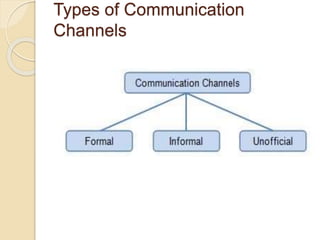
Types of Communication
Channels
Formal Communication
Channels
 A formal communication channel transmits information such
as the goals, policies and procedures of an organization.
Messages in this type of communication channel follow a
chain of command. This means information flows from a
manager to his subordinates and they in turn pass on the
information to the next level of staff.
 An example of a formal communication channel is a
company's newsletter, which gives employees as well as the
clients a clear idea of a company's goals and vision. It also
includes the transfer of information with regard to
memoranda, reports, directions, and scheduled meetings in
the chain of command.
 A business plan, customer satisfaction survey, annual reports,
employer's manual, review meetings are all formal
communication channels.
Informal Communication
Channels
 Within a formal working environment, there always exists an
informal communication network. The strict hierarchical web
of communication cannot function efficiently on its own and
hence there exists a communication channel outside of this
web. While this type of communication channel may disrupt
the chain of command, a good manager needs to find the
fine balance between the formal and informal
communication channel.
 An example of an informal communication channel is
lunchtime at the organization's cafeteria/canteen. Here, in a
relaxed atmosphere, discussions among employees are
encouraged. Also managers walking around, adopting a
hands-on approach to handling employee queries is an
example of an informal communication channel.
 Quality circles, team work, different training programs are
outside of the chain of command and so, fall under the
category of informal communication channels.
Unofficial Communication
Channels
 Good managers will recognize the fact that sometimes
communication that takes place within an organization is
interpersonal. While minutes of a meeting may be a topic of
discussion among employees, sports, politics and TV shows also
share the floor.
 The unofficial communication channel in an organization is the
organization's 'grapevine.' It is through the grapevine that rumors
circulate. Also those engaging in 'grapevine' discussions often form
groups, which translate into friendships outside of the organization.
While the grapevine may have positive implications, more often than
not information circulating in the grapevine is exaggerated and may
cause unnecessary alarm to employees. A good manager should be
privy to information circulating in this unofficial communication
channel and should take positive measures to prevent the flow of
false information.
 An example of an unofficial communication channel is social
gatherings among employees.
Goals of Ethical
Communication
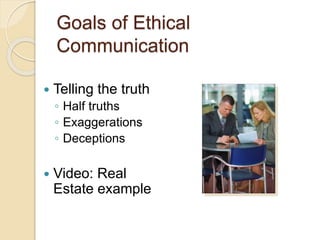
 Telling the truth
◦ Half truths
◦ Exaggerations
◦ Deceptions
 Video: Real
Estate example
Goals of Ethical
Communication
 Labeling Opinions
◦ differentiating between facts
(quantifiable and/or verifiable)
and opinions (beliefs that are
not verified)
◦ stating opinions as if they were
facts is unethical
Goals of Ethical
Communication
 Being Objective
◦ recognize your own biases and keep them
from distorting your message
◦ honest reporting means presenting the
whole picture and relating all facts fairly
 Video:
Advertising example
Goals of Ethical Communication
 Communicating Clearly
◦ use language comprehensible
to average reader
◦ short sentences, simple words,
clear organization
 Example:
performance goals
Goals of Ethical
Communication
 Giving Credit
◦ Referring to originators’
names within the text
◦ Using quotation marks
◦ Documenting sources
◦ Verbal credit for ideas
from peers/subordinates
Tools for doing the right thing
 They say bad habits die hard. It
should also be said that good habits
are a laborious birth. At DDA, doing
the right thing is NOT a matter of
unlearning bad habits, but rather the
articulated and dedicated practice of
doing the right thing.
Example after example abounds of new agencies being
formed by one or two account representatives who steal a
few clients and set up a business of their own. The ease of
doing this is enhanced by the fact that almost by definition,
advertising agencies often don’t really do the marketing or
advertising design and production themselves. Outside
design and production houses, like DDA, serve the
advertising agency industry by providing
in-depth graphic design,photography, video
production,
2D and 3D animation, programming, search marketing,
copywriting, website design, ecommerce and other
services. DDA provides them all.
Any Question ???
Communication channel

Communication channel

  • 1.
    Communication Channel Sharif Tanvir Executive,PMD Amulet Pharmaceuticals Ltd. Bangladesh
  • 2.
    Communication Channel  Througha modem of communication, be it face-to-face conversations or an inter- department memo, information is transmitted from a manager to a subordinate or vice versa.  An important element of the communication process is the feedback mechanism between the management and employees.  In this mechanism, employees inform managers that they have understood the task at hand while managers provide employees with comments and directions on employee's work.
  • 3.
  • 4.
    Formal Communication Channels  Aformal communication channel transmits information such as the goals, policies and procedures of an organization. Messages in this type of communication channel follow a chain of command. This means information flows from a manager to his subordinates and they in turn pass on the information to the next level of staff.  An example of a formal communication channel is a company's newsletter, which gives employees as well as the clients a clear idea of a company's goals and vision. It also includes the transfer of information with regard to memoranda, reports, directions, and scheduled meetings in the chain of command.  A business plan, customer satisfaction survey, annual reports, employer's manual, review meetings are all formal communication channels.
  • 5.
    Informal Communication Channels  Withina formal working environment, there always exists an informal communication network. The strict hierarchical web of communication cannot function efficiently on its own and hence there exists a communication channel outside of this web. While this type of communication channel may disrupt the chain of command, a good manager needs to find the fine balance between the formal and informal communication channel.  An example of an informal communication channel is lunchtime at the organization's cafeteria/canteen. Here, in a relaxed atmosphere, discussions among employees are encouraged. Also managers walking around, adopting a hands-on approach to handling employee queries is an example of an informal communication channel.  Quality circles, team work, different training programs are outside of the chain of command and so, fall under the category of informal communication channels.
  • 6.
    Unofficial Communication Channels  Goodmanagers will recognize the fact that sometimes communication that takes place within an organization is interpersonal. While minutes of a meeting may be a topic of discussion among employees, sports, politics and TV shows also share the floor.  The unofficial communication channel in an organization is the organization's 'grapevine.' It is through the grapevine that rumors circulate. Also those engaging in 'grapevine' discussions often form groups, which translate into friendships outside of the organization. While the grapevine may have positive implications, more often than not information circulating in the grapevine is exaggerated and may cause unnecessary alarm to employees. A good manager should be privy to information circulating in this unofficial communication channel and should take positive measures to prevent the flow of false information.  An example of an unofficial communication channel is social gatherings among employees.
  • 7.
    Goals of Ethical Communication Telling the truth ◦ Half truths ◦ Exaggerations ◦ Deceptions  Video: Real Estate example
  • 8.
    Goals of Ethical Communication Labeling Opinions ◦ differentiating between facts (quantifiable and/or verifiable) and opinions (beliefs that are not verified) ◦ stating opinions as if they were facts is unethical
  • 9.
    Goals of Ethical Communication Being Objective ◦ recognize your own biases and keep them from distorting your message ◦ honest reporting means presenting the whole picture and relating all facts fairly  Video: Advertising example
  • 10.
    Goals of EthicalCommunication  Communicating Clearly ◦ use language comprehensible to average reader ◦ short sentences, simple words, clear organization  Example: performance goals
  • 11.
    Goals of Ethical Communication Giving Credit ◦ Referring to originators’ names within the text ◦ Using quotation marks ◦ Documenting sources ◦ Verbal credit for ideas from peers/subordinates
  • 12.
    Tools for doingthe right thing  They say bad habits die hard. It should also be said that good habits are a laborious birth. At DDA, doing the right thing is NOT a matter of unlearning bad habits, but rather the articulated and dedicated practice of doing the right thing.
  • 13.
    Example after exampleabounds of new agencies being formed by one or two account representatives who steal a few clients and set up a business of their own. The ease of doing this is enhanced by the fact that almost by definition, advertising agencies often don’t really do the marketing or advertising design and production themselves. Outside design and production houses, like DDA, serve the advertising agency industry by providing in-depth graphic design,photography, video production, 2D and 3D animation, programming, search marketing, copywriting, website design, ecommerce and other services. DDA provides them all.
  • 14.