Customer Relationship Management “ Process of creating and maintaining relationships with business customers or consumers” “ A holistic process of identifying, attracting, differentiating, and retaining customers” “ Integrating the firm’s value chain to create enhanced customer value at every step” “ An integrated cross-functional focus on improving customer retention and profitability for the company.”
Customer Relationship Management Bottom-line: The use of information-enabled systems for enhancing individual customer relationships to ensure long-term customer loyalty and retention
CRM Objectives Lifetime Value (LTV) Refers to the net present value of the potential revenue stream for any particular customer over a # of years Starts with current purchase activity then extrapolates to include potential additions from cross-selling, upgrades, total ownership, etc. Customer Ownership Attempts to “own” the lionshare of customer spending and/or “share of mind” in a particular product category Building brand equity, maintaining vigilant customer contact, keeping current with the market trends is critical 5% points increase in customer retention=20-125% increase in profit
Is CRM New? No ! Simply an extension of relationship marketing Builds on customer service and satisfaction concepts Just the latest buzzword for creating customer orientation Bottom-line is still the same Yes ! A shift in corporate philosophy concerning the approach to value delivery Customer-centric approach to value chain New and technology-enhanced processes Focus is not just on bottom-line, but on top-line Goal is to create satisfying experiences across  all  customer contact points
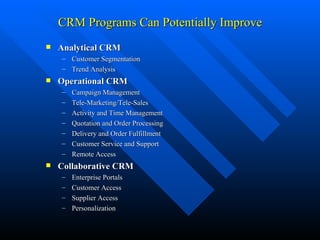
CRM Programs Can Potentially Improve Analytical CRM Customer Segmentation Trend Analysis Operational CRM Campaign Management Tele-Marketing/Tele-Sales Activity and Time Management Quotation and Order Processing Delivery and Order Fulfillment Customer Service and Support Remote Access Collaborative CRM Enterprise Portals Customer Access Supplier Access Personalization
Areas of CRM Activity Sales Force Automation (SFA) Customer Service and Support (CSS) Help Desk Field Service Marketing Automation
Areas of CRM Activity: Sales Force Automation 35-40% of all CRM activity Manages lead generation, tracks movement of leads through the pipeline, allows better usage of customer data, integrates activities across sales channels, simplifies relationship management, forecasts for opportunities (SWOT)  Goldmine  and  SalesLogix  are examples of prepackaged SFA solutions. Ex.  Staples  used SFA to integrate catalog, online, in-store sales efforts directed at its best customers
Areas of CRM Activity:  Customer Service and Support (CSS)   20-25% of CRM Assign, escalate, and track trouble tickets, inquiries, solution attempts through resolution Provides information to support customer call center activity Gleans customer data from those interactions and records it in SFA for later use Remedy ,  Siebel , Vantive, and Clarify are major vendors Ex., 3M Adhesive Products division
Areas of CRM Activity:  Help Desk   15-20% of all CRM Allows individuals to access network database to solve their own problems or find information.  Can be internal or external Offers many bottom-line savings Human Click , Tivoli,  LivePerson , are providers Ex.,  Land’s End Live  allows customers browse FAQ’s but also click a link to talk directly with live representative.
Areas of CRM Activity: Field Service CRM 3-5% of all CRM activity Mobile service technicians can log information about work orders and service calls, as well as access information from the remote site. Can feed information from customer problems into SFA for salesperson leads. Market information can be gathered and logged into central database. Ensures appropriate resource allocation by matching available resources to job requirements Major vendors are RTS, Metrix,  eDispatch
Areas of CRM Activity: Marketing Automation 3-5% of CRM, but growing 5X faster than all others Interfaces with data warehouses and data mining activities to tailor page views, products, and promotions, so that the right offer goes to the right person at the right time. Can interact with SFA to support field sales efforts Provides customized customer interactions critical to segment of one marketing, mass customization, customerization, etc.  www.webgroove.com ,  Epiphany , Oracle, Siebel, and Personify are leaders
New Frontiers in CRM Commercial E-Communities What are people loyal to? Families  Football teams  Schools  Clubs  Cultures  Countries  I.E.: Communities not Corporations
Commercial E-Communities Goal is to create an environment where people get meaningful interactions with the company and other users so that they feel part of the enterprise. Adds human component and engages customers. Creates more stickiness and “ownership” Ex. User Groups for software products (Oracle, Intergraph) Ex.  Dell  /  Sony  technical support communities Can be run internally or by an external organization such as  Sift
Components of Commercial E-Communities Customer-focused transactions Ex. IKEA Stock Query, Amazon rare book finder Community Interactions User product ratings, User alerts/Newswires, Dell technical support Access to Relevant Information Dell technical library, Customer chat rooms, Zero-time search facility Value-added Services Based on Customer Data
New Frontiers in CRM Customerization Mass Customization – Using flexible processes and organizational structures to produce varied and individualized products and services at the price of standard mass-produced offerings. Personalization – Customization of some features of a product or services so that the customer enjoys more convenience, lower costs, or some other benefit. Segment-of-One Marketing – Based on the idea of the firm learning individual reactions to marketing strategies, then treating this customer differently than other customers. Customerization – Mass customization + personalization + segment-of-one, dependent on a web-based or electronic interaction
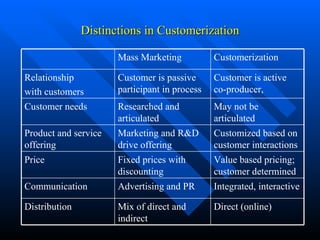
Distinctions in Customerization Direct (online) Mix of direct and indirect Distribution Integrated, interactive Advertising and PR Communication Value based pricing; customer determined Fixed prices with discounting Price Customized based on customer interactions Marketing and R&D drive offering Product and service offering May not be articulated Researched and articulated Customer needs Customer is active co-producer,  Customer is passive participant in process Relationship with customers Customerization Mass Marketing
Making CRM Happen Evaluate products and processes customers’ terms. Analyze the multiple channels through which the company interacts with customers. Examine how the company understands its customers.  Does it keep good data? How does it get that data? Does information flow between functional areas? Provide fingertip access to all information. Analyze human resources and ensure that everyone has an understanding of philosophy of CRM

Crm objectives

  • 1.
    Customer Relationship Management“ Process of creating and maintaining relationships with business customers or consumers” “ A holistic process of identifying, attracting, differentiating, and retaining customers” “ Integrating the firm’s value chain to create enhanced customer value at every step” “ An integrated cross-functional focus on improving customer retention and profitability for the company.”
  • 2.
    Customer Relationship ManagementBottom-line: The use of information-enabled systems for enhancing individual customer relationships to ensure long-term customer loyalty and retention
  • 3.
    CRM Objectives LifetimeValue (LTV) Refers to the net present value of the potential revenue stream for any particular customer over a # of years Starts with current purchase activity then extrapolates to include potential additions from cross-selling, upgrades, total ownership, etc. Customer Ownership Attempts to “own” the lionshare of customer spending and/or “share of mind” in a particular product category Building brand equity, maintaining vigilant customer contact, keeping current with the market trends is critical 5% points increase in customer retention=20-125% increase in profit
  • 4.
    Is CRM New?No ! Simply an extension of relationship marketing Builds on customer service and satisfaction concepts Just the latest buzzword for creating customer orientation Bottom-line is still the same Yes ! A shift in corporate philosophy concerning the approach to value delivery Customer-centric approach to value chain New and technology-enhanced processes Focus is not just on bottom-line, but on top-line Goal is to create satisfying experiences across all customer contact points
  • 5.
    CRM Programs CanPotentially Improve Analytical CRM Customer Segmentation Trend Analysis Operational CRM Campaign Management Tele-Marketing/Tele-Sales Activity and Time Management Quotation and Order Processing Delivery and Order Fulfillment Customer Service and Support Remote Access Collaborative CRM Enterprise Portals Customer Access Supplier Access Personalization
  • 6.
    Areas of CRMActivity Sales Force Automation (SFA) Customer Service and Support (CSS) Help Desk Field Service Marketing Automation
  • 7.
    Areas of CRMActivity: Sales Force Automation 35-40% of all CRM activity Manages lead generation, tracks movement of leads through the pipeline, allows better usage of customer data, integrates activities across sales channels, simplifies relationship management, forecasts for opportunities (SWOT) Goldmine and SalesLogix are examples of prepackaged SFA solutions. Ex. Staples used SFA to integrate catalog, online, in-store sales efforts directed at its best customers
  • 8.
    Areas of CRMActivity: Customer Service and Support (CSS) 20-25% of CRM Assign, escalate, and track trouble tickets, inquiries, solution attempts through resolution Provides information to support customer call center activity Gleans customer data from those interactions and records it in SFA for later use Remedy , Siebel , Vantive, and Clarify are major vendors Ex., 3M Adhesive Products division
  • 9.
    Areas of CRMActivity: Help Desk 15-20% of all CRM Allows individuals to access network database to solve their own problems or find information. Can be internal or external Offers many bottom-line savings Human Click , Tivoli, LivePerson , are providers Ex., Land’s End Live allows customers browse FAQ’s but also click a link to talk directly with live representative.
  • 10.
    Areas of CRMActivity: Field Service CRM 3-5% of all CRM activity Mobile service technicians can log information about work orders and service calls, as well as access information from the remote site. Can feed information from customer problems into SFA for salesperson leads. Market information can be gathered and logged into central database. Ensures appropriate resource allocation by matching available resources to job requirements Major vendors are RTS, Metrix, eDispatch
  • 11.
    Areas of CRMActivity: Marketing Automation 3-5% of CRM, but growing 5X faster than all others Interfaces with data warehouses and data mining activities to tailor page views, products, and promotions, so that the right offer goes to the right person at the right time. Can interact with SFA to support field sales efforts Provides customized customer interactions critical to segment of one marketing, mass customization, customerization, etc. www.webgroove.com , Epiphany , Oracle, Siebel, and Personify are leaders
  • 12.
    New Frontiers inCRM Commercial E-Communities What are people loyal to? Families Football teams Schools Clubs Cultures Countries I.E.: Communities not Corporations
  • 13.
    Commercial E-Communities Goalis to create an environment where people get meaningful interactions with the company and other users so that they feel part of the enterprise. Adds human component and engages customers. Creates more stickiness and “ownership” Ex. User Groups for software products (Oracle, Intergraph) Ex. Dell / Sony technical support communities Can be run internally or by an external organization such as Sift
  • 14.
    Components of CommercialE-Communities Customer-focused transactions Ex. IKEA Stock Query, Amazon rare book finder Community Interactions User product ratings, User alerts/Newswires, Dell technical support Access to Relevant Information Dell technical library, Customer chat rooms, Zero-time search facility Value-added Services Based on Customer Data
  • 15.
    New Frontiers inCRM Customerization Mass Customization – Using flexible processes and organizational structures to produce varied and individualized products and services at the price of standard mass-produced offerings. Personalization – Customization of some features of a product or services so that the customer enjoys more convenience, lower costs, or some other benefit. Segment-of-One Marketing – Based on the idea of the firm learning individual reactions to marketing strategies, then treating this customer differently than other customers. Customerization – Mass customization + personalization + segment-of-one, dependent on a web-based or electronic interaction
  • 16.
    Distinctions in CustomerizationDirect (online) Mix of direct and indirect Distribution Integrated, interactive Advertising and PR Communication Value based pricing; customer determined Fixed prices with discounting Price Customized based on customer interactions Marketing and R&D drive offering Product and service offering May not be articulated Researched and articulated Customer needs Customer is active co-producer, Customer is passive participant in process Relationship with customers Customerization Mass Marketing
  • 17.
    Making CRM HappenEvaluate products and processes customers’ terms. Analyze the multiple channels through which the company interacts with customers. Examine how the company understands its customers. Does it keep good data? How does it get that data? Does information flow between functional areas? Provide fingertip access to all information. Analyze human resources and ensure that everyone has an understanding of philosophy of CRM