
Customer Loyalty


  By: Sameh Abdel Shafy
    Product Specialist
      Lundbeck Saudi
Definition of 'Brand Loyalty'

 When consumers become committed to your brand
  and make repeat purchases over time. Brand loyalty
  is a result of consumer behavior and is affected by a
  person’s preferences. Loyal customers will
  consistently purchase products from their preferred
  brands, regardless of convenience or price.
  Companies will often use different marketing
  strategies to cultivate loyal customers, be it is through
  loyalty programs (i.e. rewards programs) or trials and
  incentives (ex. samples and free gifts).
Key element


 Customer loyalty is widely seen as
 a key determinant of a firm’s
 profitability.
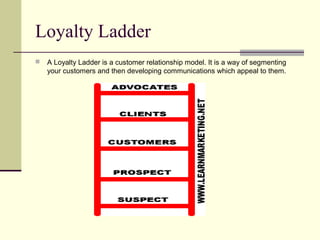
Loyalty Ladder
   A Loyalty Ladder is a customer relationship model. It is a way of segmenting
    your customers and then developing communications which appeal to them.
 Suspect
  A suspect is someone who comes across
  your company’s promotion. They are a
  suspect for your company.
 Prospect
 If the person is interested in your promotion
  they become a prospect. The climb up the
  ladder has begun, its marketing's job to give
  them a "helping hand" to get up the ladder
 Customers
  A customer is someone who purchases either your
  product or service. This stage needs to go well to
  encourage customers to come back and buy from
  you.
 Clients
 Clients are those who come back to the business and
  make ongoing purchases. There is something about
  the firm that they like. Relationship marketing may
  enable you to identify what that is, so that you can
  plan how to get them to the ultimate stage -
  Advocate.
 Advocates
 An advocate promotes your business on your
 behalf. They are so happy about your
 product/service that they not only buy from
 you again and again but also tells others
 about you. An advocate is a valuable asset
 and should be looked after for example
 through loyalty rewards, discounts, freebies
 invites to promotional events and excellent
 customer service.
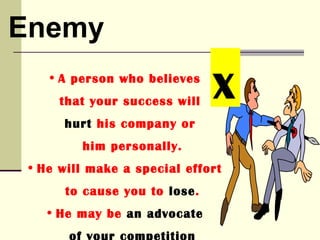
Enemy
    • A person who believes
     that your success will
                              X
      hurt his company or
         him personally.
 • He will make a special effort
      to cause you to lose.
    • He may be an advocate
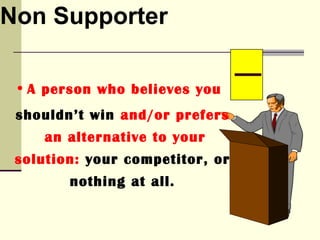
Non Supporter

 • A person who believes you
 shouldn’t win and/or prefers
     an alternative to your
 solution: your competitor, or
        nothing at all.
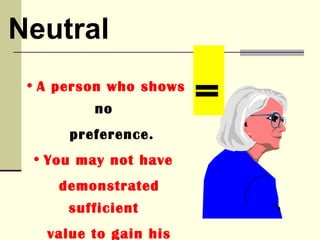
Neutral
 • A person who shows
         no
                        =
      preference.
 • You may not have
     demonstrated
      sufficient
   value to gain his
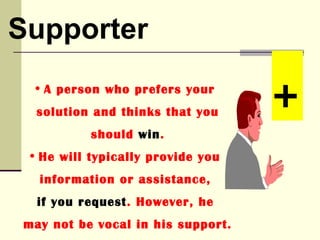
Supporter
 • A person who prefers your
  solution and thinks that you     +
          should win.
 • He will typically provide you
  information or assistance,
  if you request. However, he
may not be vocal in his support.
Advocate
                               .
                                   *
   • A person who believes
             that
    your success is critical
              to
    his company or to him
          personally.
  • He will work to help you
    win by giving feedback,
Reasons for Loyalty
 Psychological;
 Economic;
 Technical/functional;
 Contractual.
Psychological
Customers might also develop a sense of
 loyalty to a certain person working for a
 company. People can build up a good
 relationship with a bank advisor they have
 known for several years and who has always
 fulfilled their expectations. The fact that
 people develop a sense of loyalty can be
 described as a psychological reason to stick
 to a specific product.
Economic
 In business-to-business markets, it might also
 be possible that customer loyalty results from
 the fact that switching to another company
 would lead to the company facing economic
 disadvantages. In this case, loyalty is based
 on economic grounds.
Technical/ functional

 Furthermore, it might be possible that a
 company adjusted and adapted its technical
 procedures to a particular supplier and a
 change would cause immense technical
 problems, thus, technical or functional
 reasons are the grounds for customer loyalty.
Contractual

 A contractual reason for loyalty exists if a
  customer is bound to the company for a
  certain period of time due to a contractual
  agreement and for legal reasons.

 Moda 3 years order.
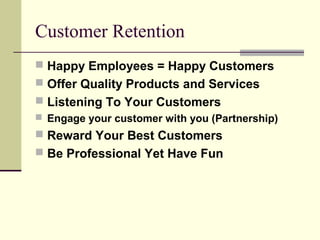
Customer Retention
 Happy Employees = Happy Customers
 Offer Quality Products and Services
 Listening To Your Customers
 Engage your customer with you (Partnership)
 Reward Your Best Customers
 Be Professional Yet Have Fun
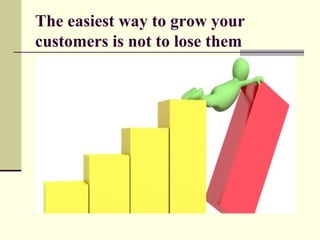
The easiest way to grow your
customers is not to lose them
Definition
An assessment of the product or service quality
  provided by a business that measures how loyal its
  customers are. Customer retention statistics are
  typically expressed as a percentage of long term
  clients,
and they are important to a business since satisfied
  retained customers tend to spend more, cost less
  and make valuable references to new potential
  customers.
 The probability of selling to an existing
  customer is 60-70%.
 The probability of selling to a new prospect is
  5-20% (from Marketing Metrics).
 Research also shows that a 10% increase in
  customer retention results in a 30% increase
  in the value of the company (from Bain and
  Co.)
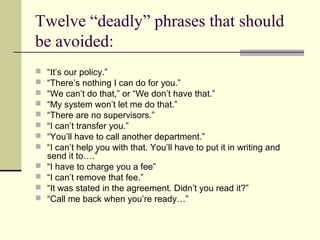
Twelve “deadly” phrases that should
be avoided:
   “It’s our policy.”
   “There’s nothing I can do for you.”
   “We can’t do that,” or “We don’t have that.”
   “My system won’t let me do that.”
   “There are no supervisors.”
   “I can’t transfer you.”
   “You’ll have to call another department.”
   “I can’t help you with that. You’ll have to put it in writing and
    send it to….”
   “I have to charge you a fee”
   “I can’t remove that fee.”
   “It was stated in the agreement. Didn’t you read it?”
   “Call me back when you’re ready…”
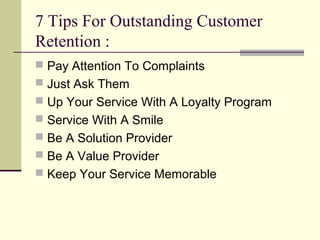
7 Tips For Outstanding Customer
Retention :
 Pay Attention To Complaints
 Just Ask Them
 Up Your Service With A Loyalty Program
 Service With A Smile
 Be A Solution Provider
 Be A Value Provider
 Keep Your Service Memorable
Thank You

Customer loyalty

  • 1.
    Customer Loyalty By: Sameh Abdel Shafy Product Specialist Lundbeck Saudi
  • 2.
    Definition of 'BrandLoyalty'  When consumers become committed to your brand and make repeat purchases over time. Brand loyalty is a result of consumer behavior and is affected by a person’s preferences. Loyal customers will consistently purchase products from their preferred brands, regardless of convenience or price. Companies will often use different marketing strategies to cultivate loyal customers, be it is through loyalty programs (i.e. rewards programs) or trials and incentives (ex. samples and free gifts).
  • 3.
    Key element  Customerloyalty is widely seen as a key determinant of a firm’s profitability.
  • 4.
    Loyalty Ladder  A Loyalty Ladder is a customer relationship model. It is a way of segmenting your customers and then developing communications which appeal to them.
  • 5.
     Suspect A suspect is someone who comes across your company’s promotion. They are a suspect for your company.  Prospect If the person is interested in your promotion they become a prospect. The climb up the ladder has begun, its marketing's job to give them a "helping hand" to get up the ladder
  • 6.
     Customers A customer is someone who purchases either your product or service. This stage needs to go well to encourage customers to come back and buy from you.  Clients Clients are those who come back to the business and make ongoing purchases. There is something about the firm that they like. Relationship marketing may enable you to identify what that is, so that you can plan how to get them to the ultimate stage - Advocate.
  • 7.
     Advocates Anadvocate promotes your business on your behalf. They are so happy about your product/service that they not only buy from you again and again but also tells others about you. An advocate is a valuable asset and should be looked after for example through loyalty rewards, discounts, freebies invites to promotional events and excellent customer service.
  • 8.
    Enemy • A person who believes that your success will X hurt his company or him personally. • He will make a special effort to cause you to lose. • He may be an advocate
  • 9.
    Non Supporter •A person who believes you shouldn’t win and/or prefers an alternative to your solution: your competitor, or nothing at all.
  • 10.
    Neutral • Aperson who shows no = preference. • You may not have demonstrated sufficient value to gain his
  • 11.
    Supporter • Aperson who prefers your solution and thinks that you + should win. • He will typically provide you information or assistance, if you request. However, he may not be vocal in his support.
  • 12.
    Advocate . * • A person who believes that your success is critical to his company or to him personally. • He will work to help you win by giving feedback,
  • 13.
    Reasons for Loyalty Psychological;  Economic;  Technical/functional;  Contractual.
  • 14.
    Psychological Customers might alsodevelop a sense of loyalty to a certain person working for a company. People can build up a good relationship with a bank advisor they have known for several years and who has always fulfilled their expectations. The fact that people develop a sense of loyalty can be described as a psychological reason to stick to a specific product.
  • 15.
    Economic In business-to-businessmarkets, it might also be possible that customer loyalty results from the fact that switching to another company would lead to the company facing economic disadvantages. In this case, loyalty is based on economic grounds.
  • 16.
    Technical/ functional Furthermore,it might be possible that a company adjusted and adapted its technical procedures to a particular supplier and a change would cause immense technical problems, thus, technical or functional reasons are the grounds for customer loyalty.
  • 17.
    Contractual  A contractualreason for loyalty exists if a customer is bound to the company for a certain period of time due to a contractual agreement and for legal reasons.  Moda 3 years order.
  • 18.
    Customer Retention  HappyEmployees = Happy Customers  Offer Quality Products and Services  Listening To Your Customers  Engage your customer with you (Partnership)  Reward Your Best Customers  Be Professional Yet Have Fun
  • 19.
    The easiest wayto grow your customers is not to lose them
  • 20.
    Definition An assessment ofthe product or service quality provided by a business that measures how loyal its customers are. Customer retention statistics are typically expressed as a percentage of long term clients, and they are important to a business since satisfied retained customers tend to spend more, cost less and make valuable references to new potential customers.
  • 21.
     The probabilityof selling to an existing customer is 60-70%.  The probability of selling to a new prospect is 5-20% (from Marketing Metrics).  Research also shows that a 10% increase in customer retention results in a 30% increase in the value of the company (from Bain and Co.)
  • 22.
    Twelve “deadly” phrasesthat should be avoided:  “It’s our policy.”  “There’s nothing I can do for you.”  “We can’t do that,” or “We don’t have that.”  “My system won’t let me do that.”  “There are no supervisors.”  “I can’t transfer you.”  “You’ll have to call another department.”  “I can’t help you with that. You’ll have to put it in writing and send it to….”  “I have to charge you a fee”  “I can’t remove that fee.”  “It was stated in the agreement. Didn’t you read it?”  “Call me back when you’re ready…”
  • 23.
    7 Tips ForOutstanding Customer Retention :  Pay Attention To Complaints  Just Ask Them  Up Your Service With A Loyalty Program  Service With A Smile  Be A Solution Provider  Be A Value Provider  Keep Your Service Memorable
  • 24.