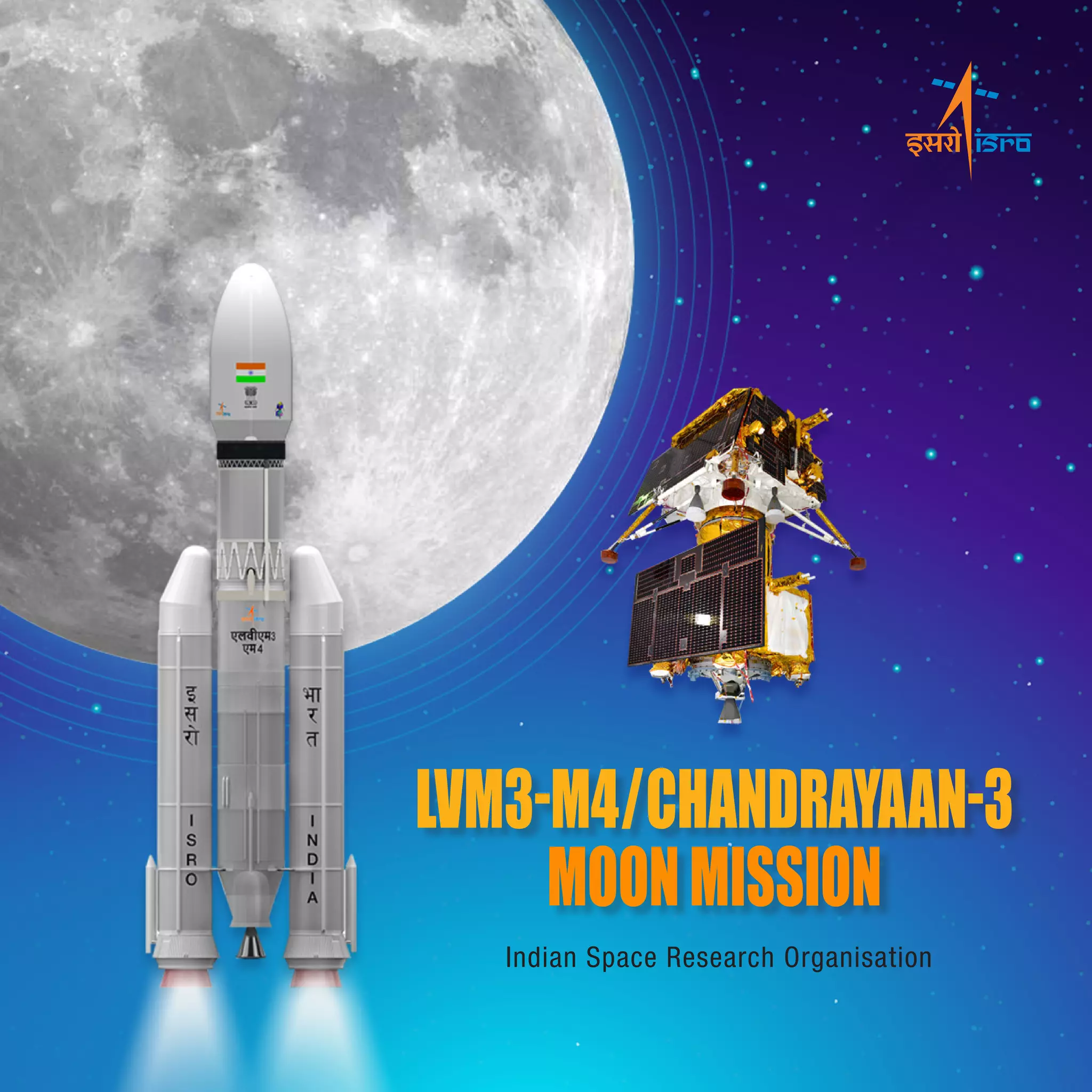
Indian Space Research Organisation
LVM3-M4/CHANDRAYAAN-3
MOONMISSION
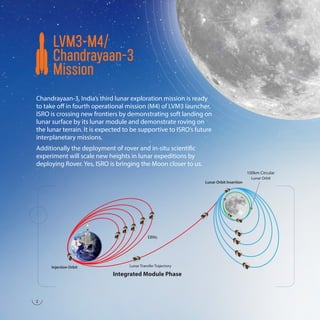
Chandrayaan-3, India’s third lunar exploration mission is ready
to take off in fourth operational mission (M4) of LVM3 launcher.
ISRO is crossing new frontiers by demonstrating soft landing on
lunar surface by its lunar module and demonstrate roving on
the lunar terrain. It is expected to be supportive to ISRO’s future
interplanetary missions.
Additionally the deployment of rover and in-situ scientific
experiment will scale new heights in lunar expeditions by
deploying Rover. Yes, ISRO is bringing the Moon closer to us.
LVM3-M4/
Chandrayaan-3
Mission
2
Integrated Module Phase
EBNs
Lunar Transfer Trajectory
Lunar Orbit Insertion
100x100km
Lunar Orbit
Injection Orbit
3
• Pre-launch Phase
• Launch and Ascent Phase
• Earth-bound Manoeuvre Phase
• Transfer Trajectory Phase
• Lunar Orbit Insertion Phase (LOI)-(Phase-3)
• Moon-bound Manoeuvre Phase (Phase-4)
• PM and Lunar Module Separation (Phase-5)
• De-boost Phase (Phase-6)
• Pre-landing Phase (Phase-7)
• Landing Phase (Phase-8)
• Normal Phase for Lander and Rover (Phase-9)
• Moon Centric Normal Orbit Phase
(100 km circular orbit) - For Propulsion Module
(Phase-10)
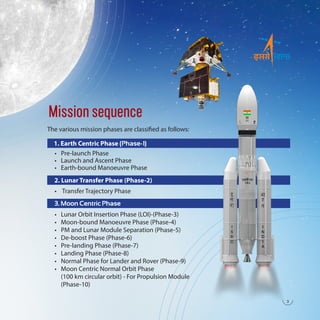
Mission sequence
The various mission phases are classified as follows:
1. Earth Centric Phase (Phase-1)
2. Lunar Transfer Phase (Phase-2)
3. Moon Centric Phase
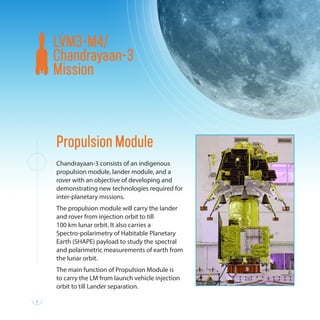
Chandrayaan-3 consists of an indigenous
propulsion module, lander module, and a
rover with an objective of developing and
demonstrating new technologies required for
inter-planetary missions.
The propulsion module will carry the lander
and rover from injection orbit to till
100 km lunar orbit. It also carries a
Spectro-polarimetry of Habitable Planetary
Earth (SHAPE) payload to study the spectral
and polarimetric measurements of earth from
the lunar orbit.
The main function of Propulsion Module is
to carry the LM from launch vehicle injection
orbit to till Lander separation.
Propulsion Module
LVM3-M4/
Chandrayaan-3
Mission
4
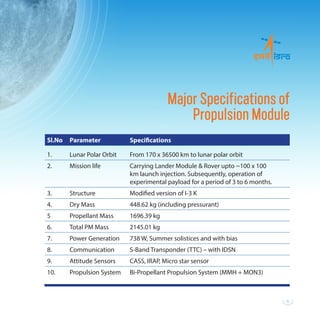
Major Specifications of
Propulsion Module
Sl.No Parameter Specifications
1. Lunar Polar Orbit From 170 x 36500 km to lunar polar orbit
2. Mission life Carrying Lander Module & Rover upto ~100 x 100
km launch injection. Subsequently, operation of
experimental payload for a period of 3 to 6 months.
3. Structure Modified version of I-3 K
4. Dry Mass 448.62 kg (including pressurant)
5. Propellant Mass 1696.39 kg
6. Total PM Mass 2145.01 kg
7. Power Generation 738 W, Summer solistices and with bias
8. Communication S-Band Transponder (TTC) – with IDSN
9. Attitude Sensors CASS, IRAP, Micro star sensor
10. Propulsion System Bi-Propellant Propulsion System (MMH + MON3)
5
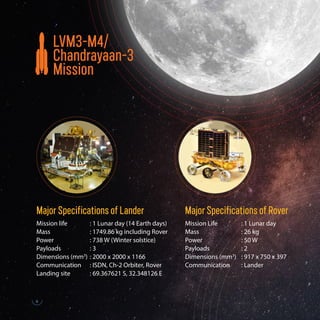
Major Specifications of Lander
Mission life : 1 Lunar day (14 Earth days)
Mass : 1749.86 kg including Rover
Power : 738 W (Winter solstice)
Payloads : 3
Dimensions (mm3
) : 2000 x 2000 x 1166
Communication : ISDN, Ch-2 Orbiter, Rover
Landing site : 69.367621 S, 32.348126 E
Major Specifications of Rover
Mission Life : 1 Lunar day
Mass : 26 kg
Power : 50 W
Payloads : 2
Dimensions (mm3
) : 917 x 750 x 397
Communication : Lander
LVM3-M4/
Chandrayaan-3
Mission
6
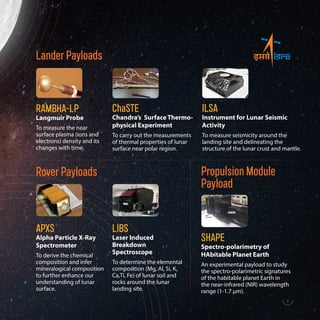
Lander Payloads
Rover Payloads Propulsion Module
Payload
7
RAMBHA-LP
Langmuir Probe
To measure the near
surface plasma (ions and
electrons) density and its
changes with time.
APXS
Alpha Particle X-Ray
Spectrometer
To derive the chemical
composition and infer
mineralogical composition
to further enhance our
understanding of lunar
surface.
LIBS
Laser Induced
Breakdown
Spectroscope
To determine the elemental
composition (Mg, Al, Si, K,
Ca,Ti, Fe) of lunar soil and
rocks around the lunar
landing site.
SHAPE
Spectro-polarimetry of
HAbitable Planet Earth
An experimental payload to study
the spectro-polarimetric signatures
of the habitable planet Earth in
the near-infrared (NIR) wavelength
range (1‑1.7 μm).
ChaSTE
Chandra’s Surface Thermo-
physical Experiment
To carry out the measurements
of thermal properties of lunar
surface near polar region.
ILSA
Instrument for Lunar Seismic
Activity
To measure seismicity around the
landing site and delineating the
structure of the lunar crust and mantle.
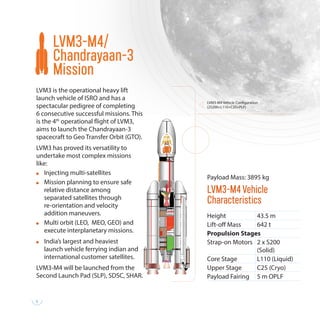
Height 43.5 m
Lift-off Mass 642 t
Propulsion Stages
Strap-on Motors 2 x S200
(Solid)
Core Stage L110 (Liquid)
Upper Stage C25 (Cryo)
Payload Fairing 5 m OPLF
LVM3-M4 Vehicle
Characteristics
Payload Mass: 3895 kg
LVM3-M4 Vehicle Configuration
(2S200+L110+C25+PLF)
LVM3-M4/
Chandrayaan-3
Mission
8
LVM3 is the operational heavy lift
launch vehicle of ISRO and has a
spectacular pedigree of completing
6 consecutive successful missions. This
is the 4th
operational flight of LVM3,
aims to launch the Chandrayaan-3
spacecraft to Geo Transfer Orbit (GTO).
LVM3 has proved its versatility to
undertake most complex missions
like:
Injecting multi-satellites
Mission planning to ensure safe
relative distance among
separated satellites through
re-orientation and velocity
addition maneuvers.
Multi orbit (LEO, MEO, GEO) and
execute interplanetary missions.
India’s largest and heaviest
launch vehicle ferrying indian and
international customer satellites.
LVM3-M4 will be launched from the
Second Launch Pad (SLP), SDSC, SHAR.
LVM3-M4 Mission Specifications
Payload
Accommodation
GTO Apogee 36500 ± 500 km
GTO Perigee 170 ± 3.5 km
Inclination 21.3⁰
Argument of Perigee 178 ± 0.2⁰
Launch Pad SLP
Launch Azimuth 107⁰
LVM3-M4 Stages at a Glance
Stages Strap-Ons
(2 x S200)
Core Stage
(L110)
Upper
Stage
(C25)
Length (m) 26.22 21.4 13.5
Diameter (m) 3.2 4.0 4.0
Propellant
Type
Solid
(HTPB)
Liquid
(UH25 + N2
O4
)
Cryo
(LH2
& LOX)
Propellant
Mass (t)
204.5
(each)
115.8 28.6
9
S200
Ignition
L110
Ignition
S
2
0
0
S
e
p
a
r
a
t
i
o
n
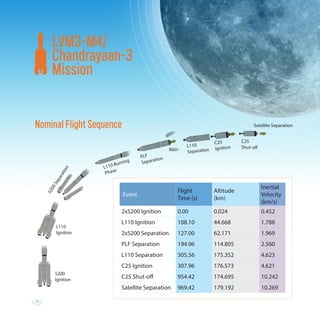
L110 Burning
Phase
PLF
Separation
L110
Separation
C25
Ignition
C25
Shut-off
LVM3-M4/
Chandrayaan-3
Mission
Nominal Flight Sequence
Event
Flight
Time (s)
Altitude
(km)
Inertial
Velocity
(km/s)
2xS200 Ignition 0.00 0.024 0.452
L110 Ignition 108.10 44.668 1.788
2xS200 Separation 127.00 62.171 1.969
PLF Separation 194.96 114.805 2.560
L110 Separation 305.56 175.352 4.623
C25 Ignition 307.96 176.573 4.621
C25 Shut-off 954.42 174.695 10.242
Satellite Separation 969.42 179.192 10.269
10
Satellite Separation
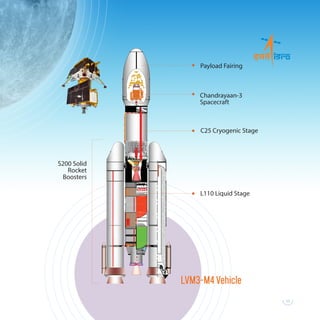
LVM3-M4 Vehicle
S200 Solid
Rocket
Boosters
Payload Fairing
Chandrayaan-3
Spacecraft
C25 Cryogenic Stage
L110 Liquid Stage
11
Capacity Building and Public Outreach (CBPO)
Indian Space Research Organisation
Department of Space, Government of India
Antariksh Bhavan, New BEL Road, Bengaluru-560094, India
Telephone : +91 80 22172119
www.facebook.com/ISRO/
@isro
@isroofficial5866/featured
www.isro.gov.in
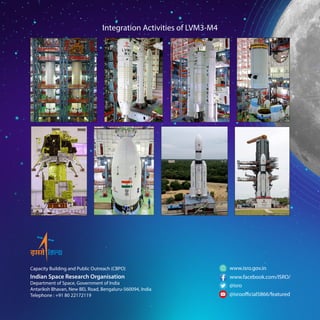
Integration Activities of LVM3-M4

LVM3M4_Chandrayaan3_brochure.pdf

  • 1.
    Indian Space ResearchOrganisation LVM3-M4/CHANDRAYAAN-3 MOONMISSION
  • 2.
    Chandrayaan-3, India’s thirdlunar exploration mission is ready to take off in fourth operational mission (M4) of LVM3 launcher. ISRO is crossing new frontiers by demonstrating soft landing on lunar surface by its lunar module and demonstrate roving on the lunar terrain. It is expected to be supportive to ISRO’s future interplanetary missions. Additionally the deployment of rover and in-situ scientific experiment will scale new heights in lunar expeditions by deploying Rover. Yes, ISRO is bringing the Moon closer to us. LVM3-M4/ Chandrayaan-3 Mission 2 Integrated Module Phase EBNs Lunar Transfer Trajectory Lunar Orbit Insertion 100x100km Lunar Orbit Injection Orbit
  • 3.
    3 • Pre-launch Phase •Launch and Ascent Phase • Earth-bound Manoeuvre Phase • Transfer Trajectory Phase • Lunar Orbit Insertion Phase (LOI)-(Phase-3) • Moon-bound Manoeuvre Phase (Phase-4) • PM and Lunar Module Separation (Phase-5) • De-boost Phase (Phase-6) • Pre-landing Phase (Phase-7) • Landing Phase (Phase-8) • Normal Phase for Lander and Rover (Phase-9) • Moon Centric Normal Orbit Phase (100 km circular orbit) - For Propulsion Module (Phase-10) Mission sequence The various mission phases are classified as follows: 1. Earth Centric Phase (Phase-1) 2. Lunar Transfer Phase (Phase-2) 3. Moon Centric Phase
  • 4.
    Chandrayaan-3 consists ofan indigenous propulsion module, lander module, and a rover with an objective of developing and demonstrating new technologies required for inter-planetary missions. The propulsion module will carry the lander and rover from injection orbit to till 100 km lunar orbit. It also carries a Spectro-polarimetry of Habitable Planetary Earth (SHAPE) payload to study the spectral and polarimetric measurements of earth from the lunar orbit. The main function of Propulsion Module is to carry the LM from launch vehicle injection orbit to till Lander separation. Propulsion Module LVM3-M4/ Chandrayaan-3 Mission 4
  • 5.
    Major Specifications of PropulsionModule Sl.No Parameter Specifications 1. Lunar Polar Orbit From 170 x 36500 km to lunar polar orbit 2. Mission life Carrying Lander Module & Rover upto ~100 x 100 km launch injection. Subsequently, operation of experimental payload for a period of 3 to 6 months. 3. Structure Modified version of I-3 K 4. Dry Mass 448.62 kg (including pressurant) 5. Propellant Mass 1696.39 kg 6. Total PM Mass 2145.01 kg 7. Power Generation 738 W, Summer solistices and with bias 8. Communication S-Band Transponder (TTC) – with IDSN 9. Attitude Sensors CASS, IRAP, Micro star sensor 10. Propulsion System Bi-Propellant Propulsion System (MMH + MON3) 5
  • 6.
    Major Specifications ofLander Mission life : 1 Lunar day (14 Earth days) Mass : 1749.86 kg including Rover Power : 738 W (Winter solstice) Payloads : 3 Dimensions (mm3 ) : 2000 x 2000 x 1166 Communication : ISDN, Ch-2 Orbiter, Rover Landing site : 69.367621 S, 32.348126 E Major Specifications of Rover Mission Life : 1 Lunar day Mass : 26 kg Power : 50 W Payloads : 2 Dimensions (mm3 ) : 917 x 750 x 397 Communication : Lander LVM3-M4/ Chandrayaan-3 Mission 6
  • 7.
    Lander Payloads Rover PayloadsPropulsion Module Payload 7 RAMBHA-LP Langmuir Probe To measure the near surface plasma (ions and electrons) density and its changes with time. APXS Alpha Particle X-Ray Spectrometer To derive the chemical composition and infer mineralogical composition to further enhance our understanding of lunar surface. LIBS Laser Induced Breakdown Spectroscope To determine the elemental composition (Mg, Al, Si, K, Ca,Ti, Fe) of lunar soil and rocks around the lunar landing site. SHAPE Spectro-polarimetry of HAbitable Planet Earth An experimental payload to study the spectro-polarimetric signatures of the habitable planet Earth in the near-infrared (NIR) wavelength range (1‑1.7 μm). ChaSTE Chandra’s Surface Thermo- physical Experiment To carry out the measurements of thermal properties of lunar surface near polar region. ILSA Instrument for Lunar Seismic Activity To measure seismicity around the landing site and delineating the structure of the lunar crust and mantle.
  • 8.
    Height 43.5 m Lift-offMass 642 t Propulsion Stages Strap-on Motors 2 x S200 (Solid) Core Stage L110 (Liquid) Upper Stage C25 (Cryo) Payload Fairing 5 m OPLF LVM3-M4 Vehicle Characteristics Payload Mass: 3895 kg LVM3-M4 Vehicle Configuration (2S200+L110+C25+PLF) LVM3-M4/ Chandrayaan-3 Mission 8 LVM3 is the operational heavy lift launch vehicle of ISRO and has a spectacular pedigree of completing 6 consecutive successful missions. This is the 4th operational flight of LVM3, aims to launch the Chandrayaan-3 spacecraft to Geo Transfer Orbit (GTO). LVM3 has proved its versatility to undertake most complex missions like: Injecting multi-satellites Mission planning to ensure safe relative distance among separated satellites through re-orientation and velocity addition maneuvers. Multi orbit (LEO, MEO, GEO) and execute interplanetary missions. India’s largest and heaviest launch vehicle ferrying indian and international customer satellites. LVM3-M4 will be launched from the Second Launch Pad (SLP), SDSC, SHAR.
  • 9.
    LVM3-M4 Mission Specifications Payload Accommodation GTOApogee 36500 ± 500 km GTO Perigee 170 ± 3.5 km Inclination 21.3⁰ Argument of Perigee 178 ± 0.2⁰ Launch Pad SLP Launch Azimuth 107⁰ LVM3-M4 Stages at a Glance Stages Strap-Ons (2 x S200) Core Stage (L110) Upper Stage (C25) Length (m) 26.22 21.4 13.5 Diameter (m) 3.2 4.0 4.0 Propellant Type Solid (HTPB) Liquid (UH25 + N2 O4 ) Cryo (LH2 & LOX) Propellant Mass (t) 204.5 (each) 115.8 28.6 9
  • 10.
    S200 Ignition L110 Ignition S 2 0 0 S e p a r a t i o n L110 Burning Phase PLF Separation L110 Separation C25 Ignition C25 Shut-off LVM3-M4/ Chandrayaan-3 Mission Nominal FlightSequence Event Flight Time (s) Altitude (km) Inertial Velocity (km/s) 2xS200 Ignition 0.00 0.024 0.452 L110 Ignition 108.10 44.668 1.788 2xS200 Separation 127.00 62.171 1.969 PLF Separation 194.96 114.805 2.560 L110 Separation 305.56 175.352 4.623 C25 Ignition 307.96 176.573 4.621 C25 Shut-off 954.42 174.695 10.242 Satellite Separation 969.42 179.192 10.269 10 Satellite Separation
  • 11.
    LVM3-M4 Vehicle S200 Solid Rocket Boosters PayloadFairing Chandrayaan-3 Spacecraft C25 Cryogenic Stage L110 Liquid Stage 11
  • 12.
    Capacity Building andPublic Outreach (CBPO) Indian Space Research Organisation Department of Space, Government of India Antariksh Bhavan, New BEL Road, Bengaluru-560094, India Telephone : +91 80 22172119 www.facebook.com/ISRO/ @isro @isroofficial5866/featured www.isro.gov.in Integration Activities of LVM3-M4