Chandrayaan-3 represents India's remarkable foray into lunar exploration, featuring a
sophisticated lander module equipped with an array of cutting-edge sensors and electronic
components. Altimeters, Accelerometers, and Gyroscopes collaboratively enhance navigation
and landing accuracy, ensuring secure touchdowns in challenging lunar terrains. The lander
incorporates high-speed Data Processors, Radiation-Resistant Microcontrollers, and efficient
power management systems to withstand lunar conditions and support resource-intensive
scientific investigations. A state-of-the-art scientific payload includes upgraded spectrometers
for precise lunar composition analysis, high-resolution cameras for detailed lunar surface
imaging, and advanced Thermal Sensors to study temperature variations. This mission
underscores India's technological prowess in space exploration, driving advancements in lunar
navigation, landing precision, and comprehensive scientific analysis.
In this spacecraft is sent to the space which passes
near to the moon. It doesn’t gets into the orbit but
merely flies by the moon and leaves
First successful Fly By Mission was launched by
Soviet Union LUNA-1 in January 1959
Spacecraft gets close to the moon and orbits around the
Moon.This is called LunarOrbit. From here, they study
moon’s surface atmosphere
Till date more than 40 orbiter missions have been completed.
First orbiter mission was done by Soviet Union LUNA-10 in year
1966
The main spacecraft will continuous
orbiting around moon but part of
spacecraft gets detached and crash
lands to the moon.
Because it’s “impacting” with Moon
during crash landing these missions
are called impact missions
Why crash landing the time it takes to
crash land while getting close to the
moon surface many instruments take
readings at that time
Chandrayaan -1 was impact mission habit had CHASE
(Chandras Altitudnal Composition Explorer) which is a
mass spectrometer that used to take reading every
four seconds during its descent
The point of impact was named as Jawahar point due to this we found
that there is water on moon surface
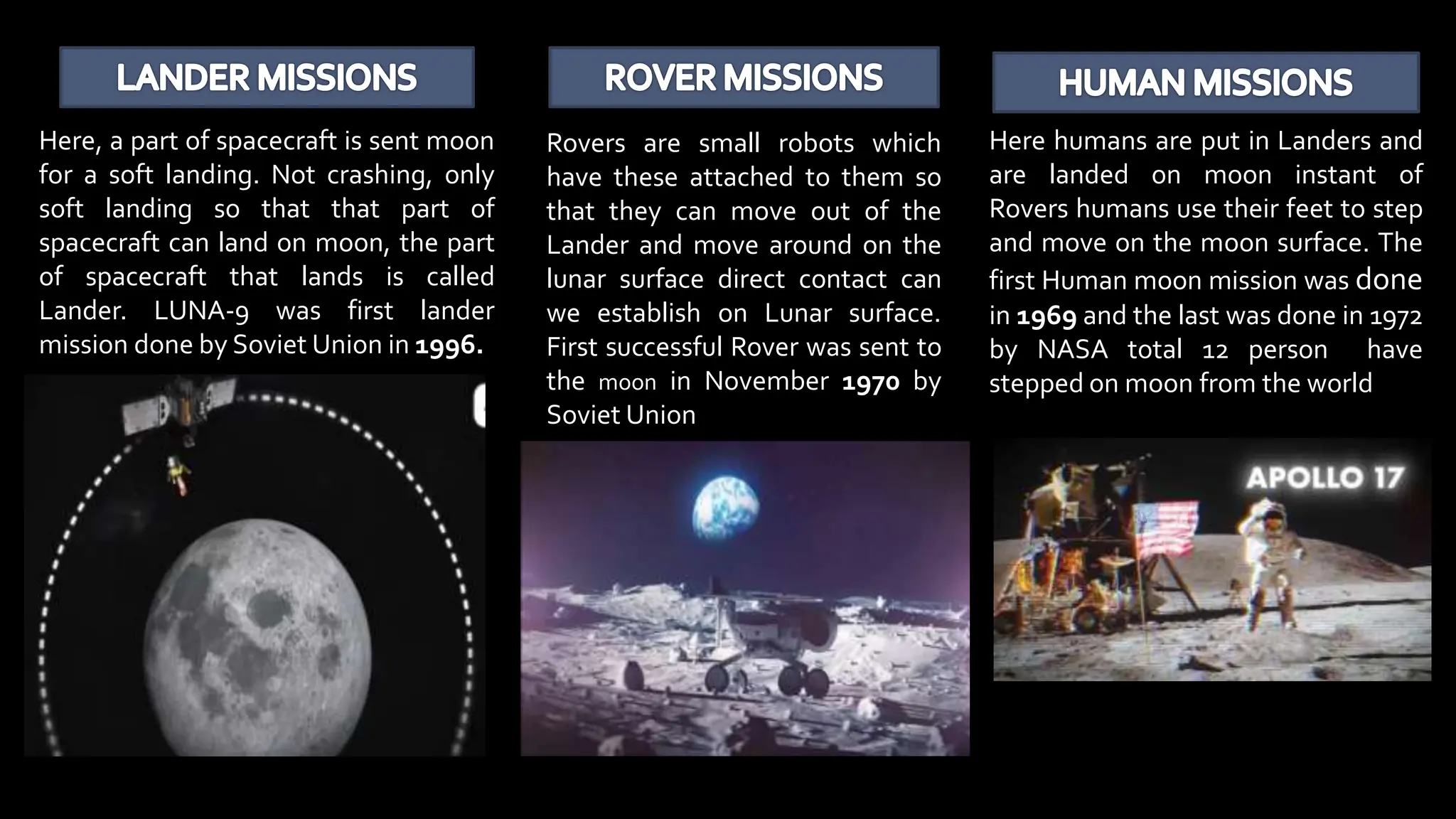
Here, a part of spacecraft is sent moon
for a soft landing. Not crashing, only
soft landing so that that part of
spacecraft can land on moon, the part
of spacecraft that lands is called
Lander. LUNA-9 was first lander
mission done by Soviet Union in 1996.
Rovers are small robots which
have these attached to them so
that they can move out of the
Lander and move around on the
lunar surface direct contact can
we establish on Lunar surface.
First successful Rover was sent to
the moon in November 1970 by
Soviet Union
Here humans are put in Landers and
are landed on moon instant of
Rovers humans use their feet to step
and move on the moon surface. The
first Human moon mission was done
in 1969 and the last was done in 1972
by NASA total 12 person have
stepped on moon from the world
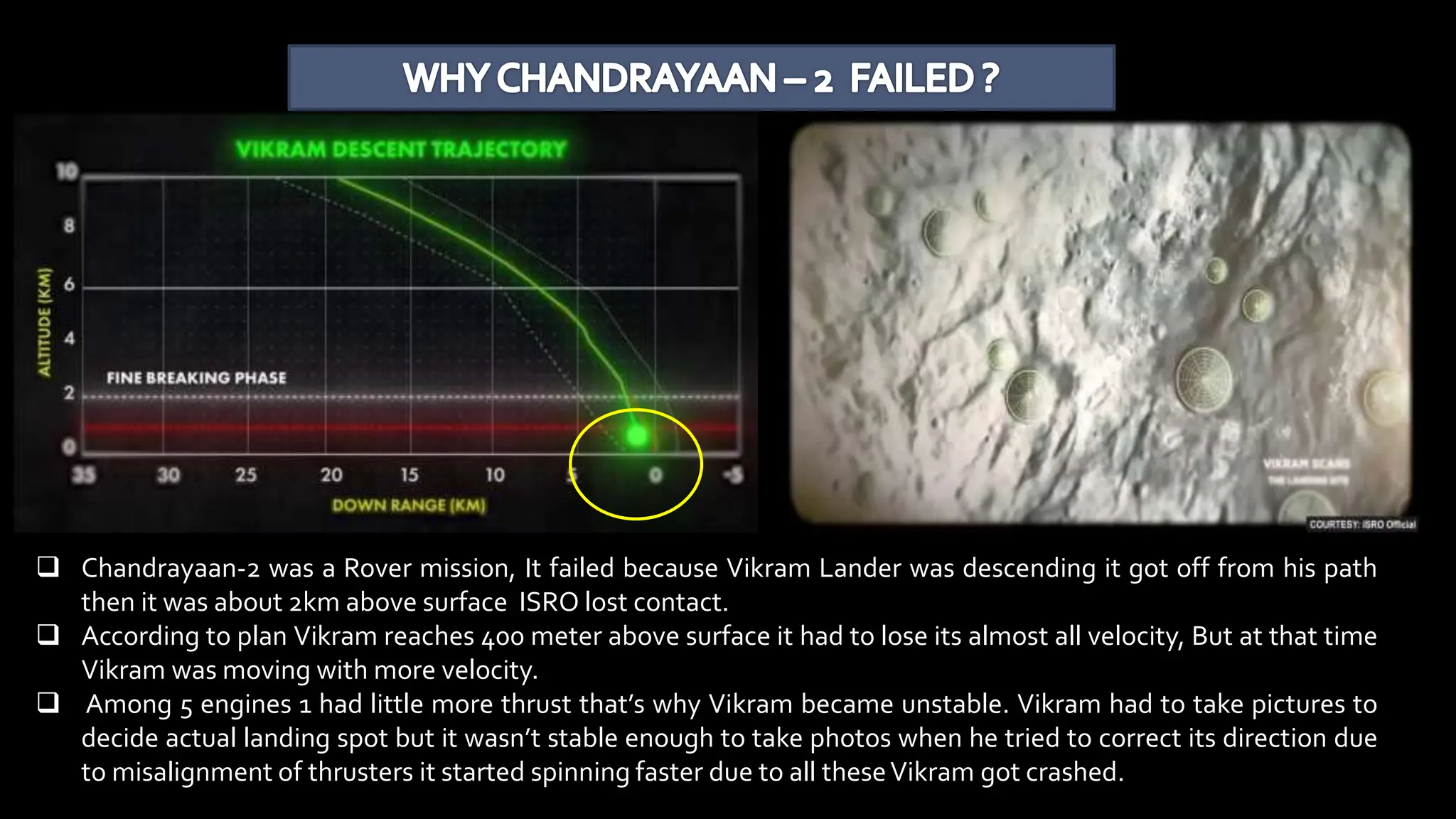
 Chandrayaan-2 was a Rover mission, It failed because Vikram Lander was descending it got off from his path
then it was about 2km above surface ISRO lost contact.
 According to plan Vikram reaches 400 meter above surface it had to lose its almost all velocity, But at that time
Vikram was moving with more velocity.
 Among 5 engines 1 had little more thrust that’s why Vikram became unstable. Vikram had to take pictures to
decide actual landing spot but it wasn’t stable enough to take photos when he tried to correct its direction due
to misalignment of thrusters it started spinning faster due to all theseVikram got crashed.
 The purpose of the purpose of
propulsion module is to take
chandranyaan-3 out of earth
orbit and send towards moon.
 With the help of propulsion
module Lander and Rover will
first get into moons orbit and
then they reach 100 km radius
they will drop for landing.
 Propulsion module will be
orbiting around moons army
nearly six months for
communication purpose and to
take other readings
SHAPE (Spectral Polarimetry of Habitable Planet Earth)
It will search for signatures of small exoplanets in space
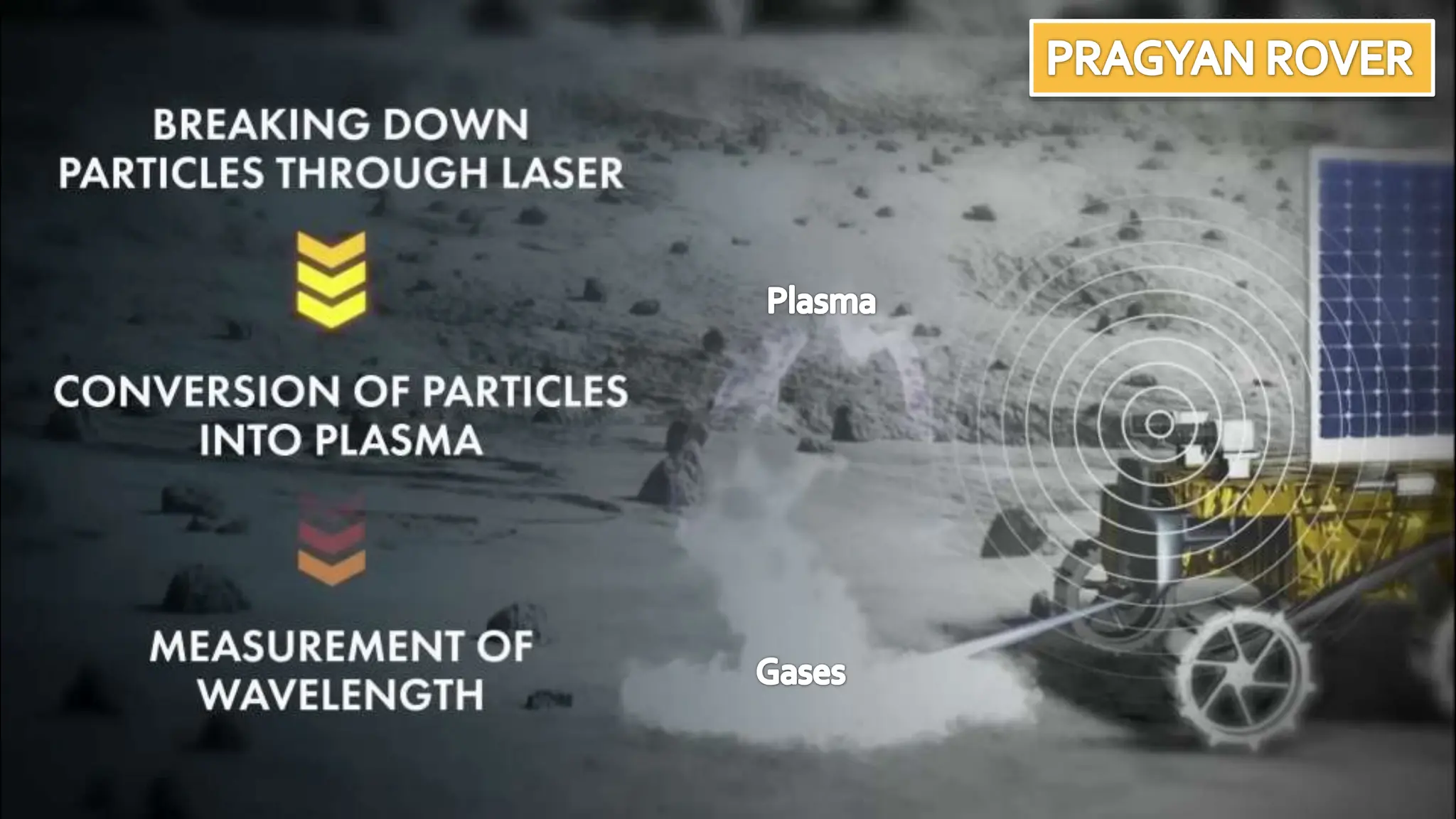
LIBS will analyze the chemical composition of lunar surface at which minerals are found in moon’s soil.
APXS will also break down the rocks and analyze the lunar
soil but using Radioactive source. It is used for big stones.
When these alpha particles and X-rays interact with atoms of moon
surface the electrons of elements present on the surface release
and they start emitting X-rays
Emitted X-rays are observed byAPXS detector to identify different
elements
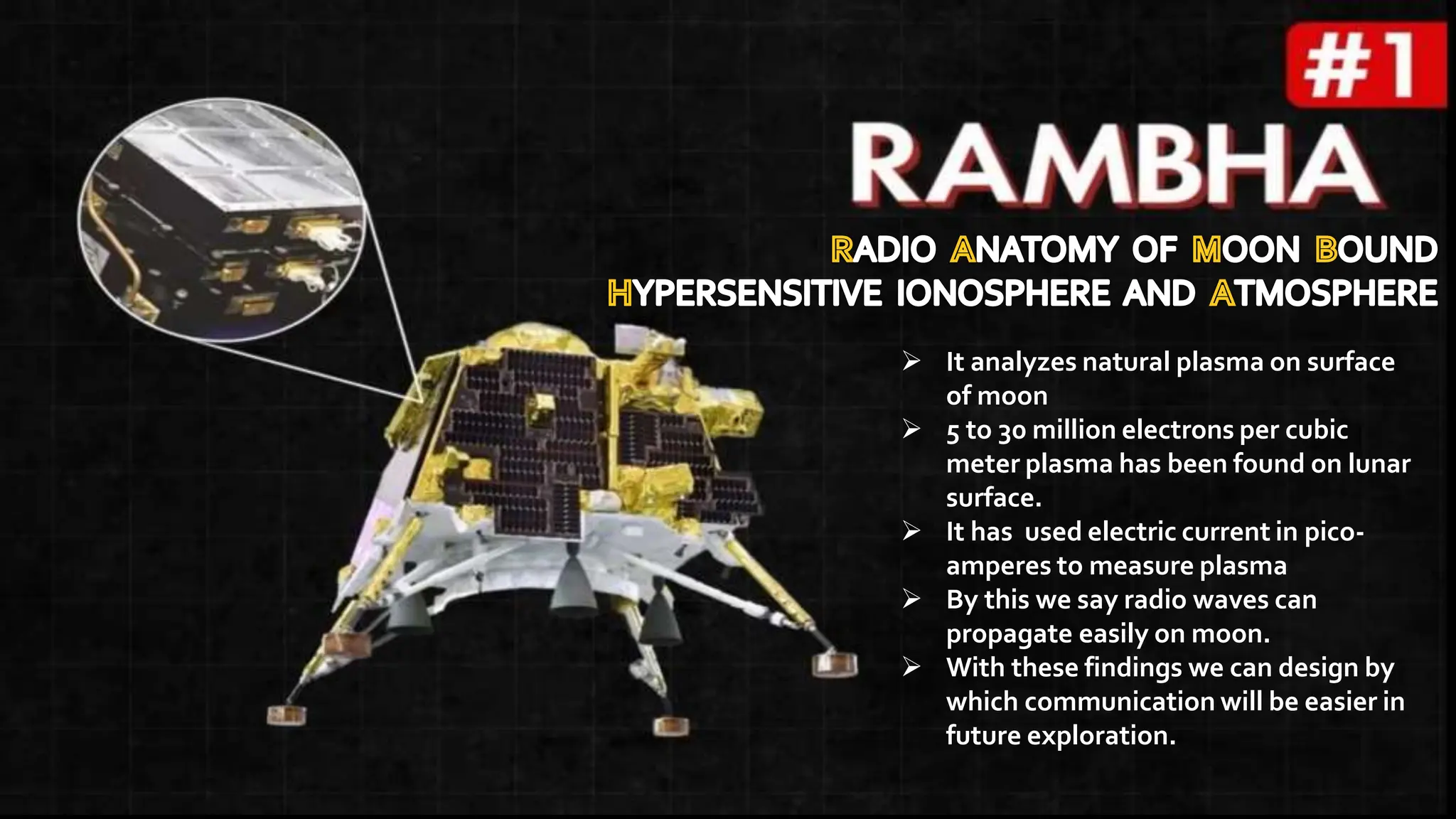
 It analyzes natural plasma on surface
of moon
 5 to 30 million electrons per cubic
meter plasma has been found on lunar
surface.
 It has used electric current in pico-
amperes to measure plasma
 By this we say radio waves can
propagate easily on moon.
 With these findings we can design by
which communication will be easier in
future exploration.
 It will measure thermal
properties and the
temperature at the South
Pole of moon.
 It has ten different sensors
on itself.
 It has been observed that
temperature decreases from
60 degrees to -10 degrees in
depth of 8cm of lunar soil.
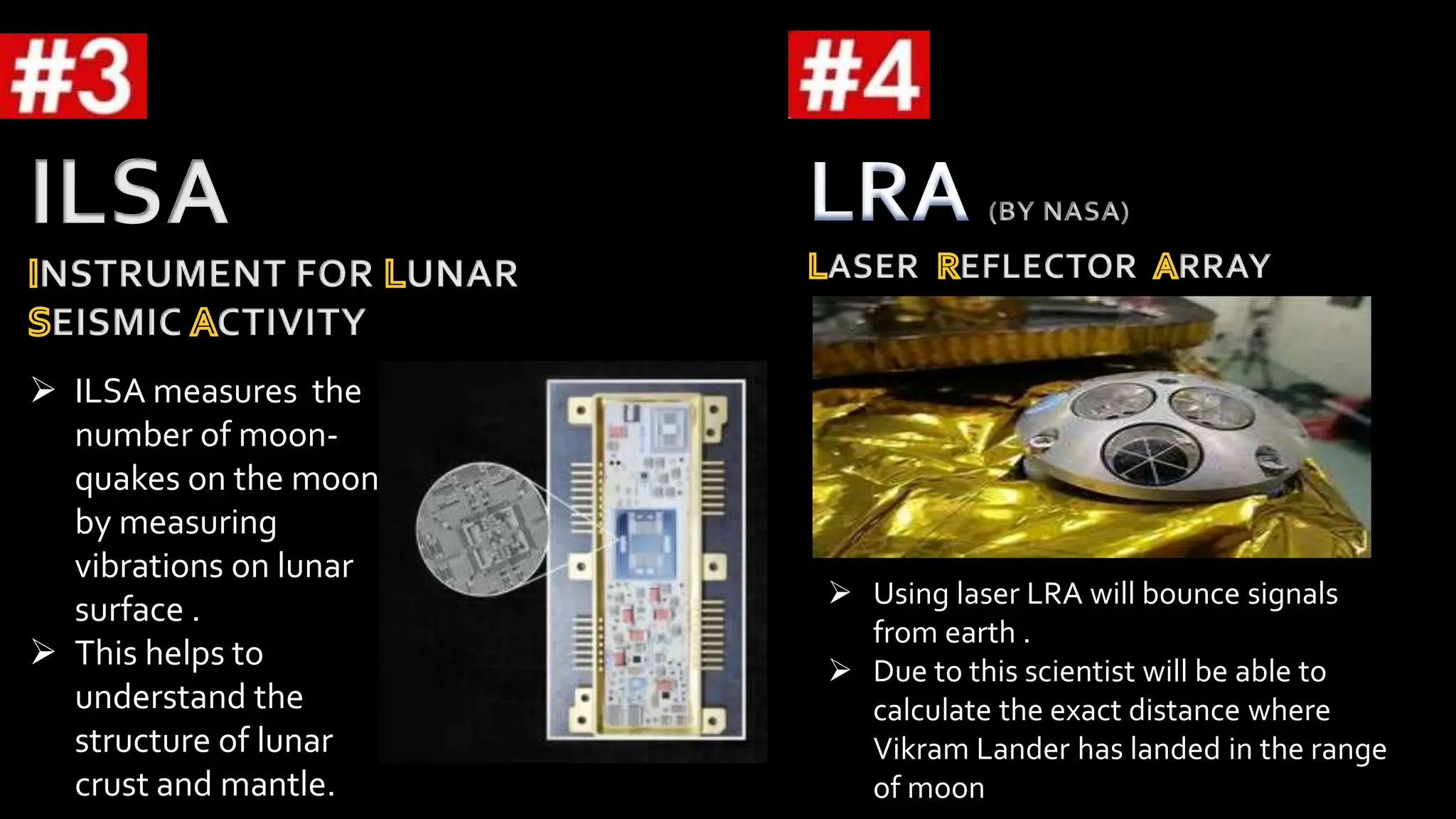
 ILSA measures the
number of moon-
quakes on the moon
by measuring
vibrations on lunar
surface .
 This helps to
understand the
structure of lunar
crust and mantle.
 Using laser LRA will bounce signals
from earth .
 Due to this scientist will be able to
calculate the exact distance where
Vikram Lander has landed in the range
of moon
 Chandrayaan-3 landed on 23th August from that day
Rover got only 14 days to gather all information
because instruments in chandrayaan-3 are not able
to withstand lunar night
 In nights in the moon temperature can drop till -233
degree Celsius and instrument can work at those
conditions
 On 4th September 8:00 AM ISTVikram Lander and
Pragyan Rover went in sleep mode for lunar night
(2-3 days previously) so that instruments can stop
functionality completely and Receivers were kept
ON.
 On September 22 ISRO gave a wakeup call toVikram
Lander pragyan Rover but both did not respond and
most likely in sleep permanently.
 No signals have been received from past days.

Chandrayaan - 3

  • 2.
    Chandrayaan-3 represents India'sremarkable foray into lunar exploration, featuring a sophisticated lander module equipped with an array of cutting-edge sensors and electronic components. Altimeters, Accelerometers, and Gyroscopes collaboratively enhance navigation and landing accuracy, ensuring secure touchdowns in challenging lunar terrains. The lander incorporates high-speed Data Processors, Radiation-Resistant Microcontrollers, and efficient power management systems to withstand lunar conditions and support resource-intensive scientific investigations. A state-of-the-art scientific payload includes upgraded spectrometers for precise lunar composition analysis, high-resolution cameras for detailed lunar surface imaging, and advanced Thermal Sensors to study temperature variations. This mission underscores India's technological prowess in space exploration, driving advancements in lunar navigation, landing precision, and comprehensive scientific analysis.
  • 3.
    In this spacecraftis sent to the space which passes near to the moon. It doesn’t gets into the orbit but merely flies by the moon and leaves First successful Fly By Mission was launched by Soviet Union LUNA-1 in January 1959 Spacecraft gets close to the moon and orbits around the Moon.This is called LunarOrbit. From here, they study moon’s surface atmosphere Till date more than 40 orbiter missions have been completed. First orbiter mission was done by Soviet Union LUNA-10 in year 1966
  • 4.
    The main spacecraftwill continuous orbiting around moon but part of spacecraft gets detached and crash lands to the moon. Because it’s “impacting” with Moon during crash landing these missions are called impact missions Why crash landing the time it takes to crash land while getting close to the moon surface many instruments take readings at that time Chandrayaan -1 was impact mission habit had CHASE (Chandras Altitudnal Composition Explorer) which is a mass spectrometer that used to take reading every four seconds during its descent The point of impact was named as Jawahar point due to this we found that there is water on moon surface
  • 5.
    Here, a partof spacecraft is sent moon for a soft landing. Not crashing, only soft landing so that that part of spacecraft can land on moon, the part of spacecraft that lands is called Lander. LUNA-9 was first lander mission done by Soviet Union in 1996. Rovers are small robots which have these attached to them so that they can move out of the Lander and move around on the lunar surface direct contact can we establish on Lunar surface. First successful Rover was sent to the moon in November 1970 by Soviet Union Here humans are put in Landers and are landed on moon instant of Rovers humans use their feet to step and move on the moon surface. The first Human moon mission was done in 1969 and the last was done in 1972 by NASA total 12 person have stepped on moon from the world
  • 6.
     Chandrayaan-2 wasa Rover mission, It failed because Vikram Lander was descending it got off from his path then it was about 2km above surface ISRO lost contact.  According to plan Vikram reaches 400 meter above surface it had to lose its almost all velocity, But at that time Vikram was moving with more velocity.  Among 5 engines 1 had little more thrust that’s why Vikram became unstable. Vikram had to take pictures to decide actual landing spot but it wasn’t stable enough to take photos when he tried to correct its direction due to misalignment of thrusters it started spinning faster due to all theseVikram got crashed.
  • 9.
     The purposeof the purpose of propulsion module is to take chandranyaan-3 out of earth orbit and send towards moon.  With the help of propulsion module Lander and Rover will first get into moons orbit and then they reach 100 km radius they will drop for landing.  Propulsion module will be orbiting around moons army nearly six months for communication purpose and to take other readings SHAPE (Spectral Polarimetry of Habitable Planet Earth) It will search for signatures of small exoplanets in space
  • 10.
    LIBS will analyzethe chemical composition of lunar surface at which minerals are found in moon’s soil.
  • 12.
    APXS will alsobreak down the rocks and analyze the lunar soil but using Radioactive source. It is used for big stones. When these alpha particles and X-rays interact with atoms of moon surface the electrons of elements present on the surface release and they start emitting X-rays Emitted X-rays are observed byAPXS detector to identify different elements
  • 13.
     It analyzesnatural plasma on surface of moon  5 to 30 million electrons per cubic meter plasma has been found on lunar surface.  It has used electric current in pico- amperes to measure plasma  By this we say radio waves can propagate easily on moon.  With these findings we can design by which communication will be easier in future exploration.
  • 14.
     It willmeasure thermal properties and the temperature at the South Pole of moon.  It has ten different sensors on itself.  It has been observed that temperature decreases from 60 degrees to -10 degrees in depth of 8cm of lunar soil.
  • 15.
     ILSA measuresthe number of moon- quakes on the moon by measuring vibrations on lunar surface .  This helps to understand the structure of lunar crust and mantle.  Using laser LRA will bounce signals from earth .  Due to this scientist will be able to calculate the exact distance where Vikram Lander has landed in the range of moon
  • 16.
     Chandrayaan-3 landedon 23th August from that day Rover got only 14 days to gather all information because instruments in chandrayaan-3 are not able to withstand lunar night  In nights in the moon temperature can drop till -233 degree Celsius and instrument can work at those conditions  On 4th September 8:00 AM ISTVikram Lander and Pragyan Rover went in sleep mode for lunar night (2-3 days previously) so that instruments can stop functionality completely and Receivers were kept ON.  On September 22 ISRO gave a wakeup call toVikram Lander pragyan Rover but both did not respond and most likely in sleep permanently.  No signals have been received from past days.