Date: 29/08/2023
Presented by :- Saikiran Rayudu (23DM010)
Biswaranjan Behera (23DM016)
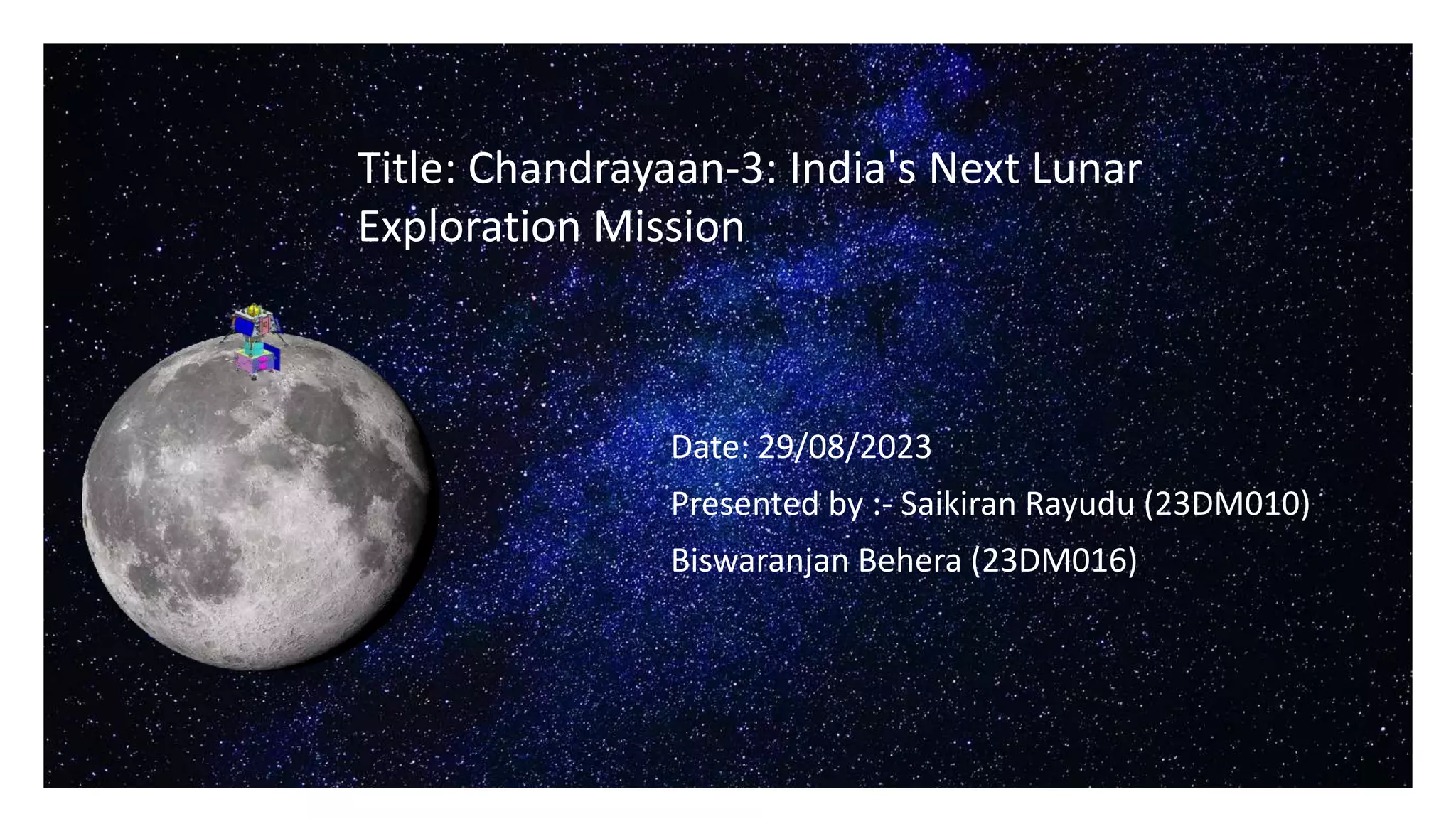
Title: Chandrayaan-3: India's Next Lunar
Exploration Mission
FFINTRODUCTION TO CHANDRAYAAN 3
VBNH
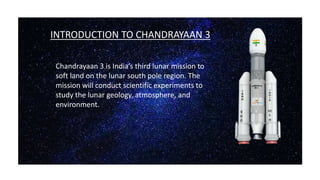
Chandrayaan 3 is India’s third lunar mission to
soft land on the lunar south pole region. The
mission will conduct scientific experiments to
study the lunar geology, atmosphere, and
environment.
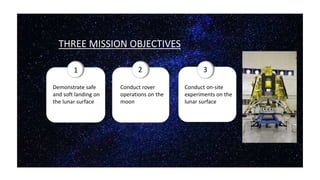
THREE MISSION OBJECTIVES
1 2 3
Demonstrate safe
and soft landing on
the lunar surface
Conduct rover
operations on the
moon
Conduct on-site
experiments on the
lunar surface
MISSION COMPONENTS
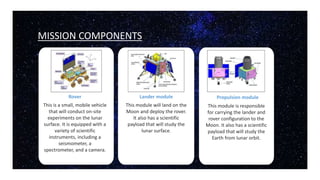
Rover
This is a small, mobile vehicle
that will conduct on-site
experiments on the lunar
surface. It is equipped with a
variety of scientific
instruments, including a
seismometer, a
spectrometer, and a camera.
Lander module
This module will land on the
Moon and deploy the rover.
It also has a scientific
payload that will study the
lunar surface.
Propulsion module
This module is responsible
for carrying the lander and
rover configuration to the
Moon. It also has a scientific
payload that will study the
Earth from lunar orbit.
TRAJECTORY
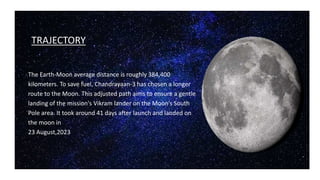
The Earth-Moon average distance is roughly 384,400
kilometers. To save fuel, Chandrayaan-3 has chosen a longer
route to the Moon. This adjusted path aims to ensure a gentle
landing of the mission's Vikram lander on the Moon's South
Pole area. It took around 41 days after launch and landed on
the moon in
23 August,2023
CHANDRAYAAN-3 MIISSION SUCCESS
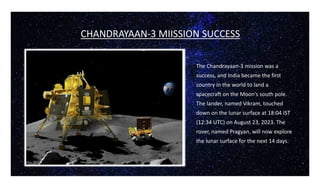
The Chandrayaan-3 mission was a
success, and India became the first
country in the world to land a
spacecraft on the Moon's south pole.
The lander, named Vikram, touched
down on the lunar surface at 18:04 IST
(12:34 UTC) on August 23, 2023. The
rover, named Pragyan, will now explore
the lunar surface for the next 14 days.
CONCLUSION OF CHANDRAYAAN 3
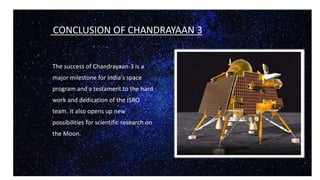
The success of Chandrayaan-3 is a
major milestone for India's space
program and a testament to the hard
work and dedication of the ISRO
team. It also opens up new
possibilities for scientific research on
the Moon.
THANK YOU!

CHANDRAYAAN 3 BY SR & BB.pptx

  • 1.
    Date: 29/08/2023 Presented by:- Saikiran Rayudu (23DM010) Biswaranjan Behera (23DM016) Title: Chandrayaan-3: India's Next Lunar Exploration Mission
  • 2.
    FFINTRODUCTION TO CHANDRAYAAN3 VBNH Chandrayaan 3 is India’s third lunar mission to soft land on the lunar south pole region. The mission will conduct scientific experiments to study the lunar geology, atmosphere, and environment.
  • 3.
    THREE MISSION OBJECTIVES 12 3 Demonstrate safe and soft landing on the lunar surface Conduct rover operations on the moon Conduct on-site experiments on the lunar surface
  • 4.
    MISSION COMPONENTS Rover This isa small, mobile vehicle that will conduct on-site experiments on the lunar surface. It is equipped with a variety of scientific instruments, including a seismometer, a spectrometer, and a camera. Lander module This module will land on the Moon and deploy the rover. It also has a scientific payload that will study the lunar surface. Propulsion module This module is responsible for carrying the lander and rover configuration to the Moon. It also has a scientific payload that will study the Earth from lunar orbit.
  • 5.
    TRAJECTORY The Earth-Moon averagedistance is roughly 384,400 kilometers. To save fuel, Chandrayaan-3 has chosen a longer route to the Moon. This adjusted path aims to ensure a gentle landing of the mission's Vikram lander on the Moon's South Pole area. It took around 41 days after launch and landed on the moon in 23 August,2023
  • 6.
    CHANDRAYAAN-3 MIISSION SUCCESS TheChandrayaan-3 mission was a success, and India became the first country in the world to land a spacecraft on the Moon's south pole. The lander, named Vikram, touched down on the lunar surface at 18:04 IST (12:34 UTC) on August 23, 2023. The rover, named Pragyan, will now explore the lunar surface for the next 14 days.
  • 7.
    CONCLUSION OF CHANDRAYAAN3 The success of Chandrayaan-3 is a major milestone for India's space program and a testament to the hard work and dedication of the ISRO team. It also opens up new possibilities for scientific research on the Moon.
  • 8.