Graduate Report Presentation on
“Urban Heritage Conservation”
ME – TCP, Year – I, Semester – II
Under the subject of
URBAN PLANNING TECHNIQUES AND PRACTICES
(COURSE CODE : 372480)
Prepared by :
VAKHARIA SIDDHI
Enrollment No:
180420748023
Guided by :
Prof. Sejal S hagat
Prof. Zarana H. Gandhi
SARVAJANIK COLLEGE OF ENGINEERING & TECHNOLOGY, SURAT
FACULTY OF CIVIL ENGINEERING
MASTER OF ENGINEERING (TOWN AND COUNTRY PLANNING)
Affiliated with
GUJARAT TECHNOLOGICAL UNIVERSITY
Prof.(Dr.) Jigar K. Sevalia
Faculty & Head
Faculty of Civil Engineering,
SCET
Contents
• Introduction
• Definitions related to Urban Conservation
• Important of Heritage conservation
• Conservation Elements
• Conservation at International Level
• Conservation at National Level
• Constitution Obligation
• Acts for Conservation
• Need of Urban Heritage Conservation
• Heritage walk of Ahmedabad City
• Concluding Remark
• References
NPLANNINGTECHNIQUESAND
PRACTICES
2
Introduction
• Urban Conservation is concerned with those parts of the built
environment that are of architectural or historic significance. This
includes buildings (individually or in groups), localities (streets,
blocks, environments or precincts), special gardens or landscapes,
and other structures.
According to The National trust of Australia, NSW(New South Wales):
• Urban conservation seeks to retain that part of urban environment
whose character is important to the national or local heritage. It also
seeks to enhance that environmental character by ensuring that the
siting, the size and design of any development is complementary to
it.
• Above all, it can be concluded that Conservation is the process of
maintaining and managing change to a heritage asset in a way that
sustains and where appropriate enhances its significance.
NPLANNINGTECHNIQUESAND
PRACTICES
3
AsperTheReportoftheNationalCommissionof
Urbanisation,MinistryofUrbanDevelopment,
GovernmentofIndia,NewDelhi,1988
• The urban conservation would be concern inter-related with
those components of the urban heritage that
1. Possesses architectural, historical and cultural
interest;
2. Have a special or unique quality or charm that
provides distinctiveness either because of its
ambience or because of some distinctive activity
centred on or associated with the place;
3. Constitute a focal point in a city of importance to the
social, psychological or spiritual well-being of its
residents and
4. Elements that enhance the physical environment of
the city
NPLANNINGTECHNIQUESAND
PRACTICES
4
Definitions related to Urban
Conservation (WHCP UNESCO)
1. Conservation
2. Aesthetic
3. Conservation Zone
1. Heritage Areas
2. Heritage Building
4. Heritage Precincts
5. Historical
6. Historical
7. Landmarks
8. Preservation
9. Reconstruction
10. Restoration
11. Urban heritage
12. Heritage Zone
NPLANNINGTECHNIQUESAND
PRACTICES
5
Importance of Heritage conservation
• Heritage buildings basically represent the past history and
culture of a nation. They constitute together the architectural
heritage of an area.
• Heritage buildings are subjected to processes of degradation
with time, which leads to a situation in which they became
not able to fulfil the purpose for which they were built.
• Heritage conservation is important for identifying, recording,
analysing and protecting heritage and cultural resources.
• It plays an important role to define the landmark within the
heritage area as well as to generate economic return and to
support the tourism industry.
NPLANNINGTECHNIQUESAND
PRACTICES
6
Conservation Elements (NCU)
1. Building or groups of buildings of architectural, historical, or cultural interest
2. An intimate or human scale in an area
3. Local set-pieces of significance to the city or region
4. Well-defined central precincts with variety of activities
5. Famous individual districts
6. A unique temple, mosque, church or other monuments as a focal point to the area
7. Squares or major intersections with interesting corner buildings or a special
ambience
8. Waterfront areas (lake or tank)
9. Areas associated with major open spaces j) a street pattern favoring the pedestrian
where the relationship of spaces, tree and provide visual satisfaction or drama
10. Designed environments (Connaught Circus: Delhi)
11. Old town or village centres
12. Major landmarks (man-made or natural )
13. Lines of sight and other vistas of visual significance, including skylines, ridges,
panoramic and other views
14. Well favoured residential areas (high grade facilities ) and
15. Main centres of recreation and tourism
NPLANNINGTECHNIQUESAND
PRACTICES
7
Conservation at International Level
• Firstly, The concept Urban Conservation was adopted for the
first time in 1985 in “The Granada Convention for Protection
of the Architectural Heritage of Europe”.
• In its further efforts, UNESCO has created National
Committees of ICOMOS in every country.
• Each National Committee adopts its own rules of procedure
and elaborates its own programme according to the goals and
aims of ICOMOS.
• Indian chapter of this body works in close cooperation with
INTACH, ASI and other scientific laboratories
NPLANNINGTECHNIQUESAND
PRACTICES
8
Constitutional Obligation for
Heritage Conservation
• Article 49 deals with the protection of monuments and places
and objects of national importance under the directive
principles of state policy, which states that “it shall be the
obligation of the State to protect every monument or place or
object of artistic or historic interest (declared by or under law
made by parliament) to be of national importance, from
spoliation, disfigurement, destruction, removal, disposal or
export, as the case may be”.
NPLANNINGTECHNIQUESAND
PRACTICES
9
Acts and Laws
1. The Indian Treasure Trove Act, 1878
2. The Ancient Monuments Preservation Act, 1904
3. Rajghat Samadhi Act, 1951
4. The Ancient Monuments and Archaeological Sites and
Remains Act, 1958
5. The Ancient Monuments and Archaeological Sites and
Remains Rules, 1959
6. The Antiquities and Art Treasures Act, 1972
7. The Wildlife (Protection) Act, 1972
8. Environment (Protection) Act, 1986 9. Bio-diversity Act,
2002
NPLANNINGTECHNIQUESAND
PRACTICES
10
Need of Urban Heritage
Conservation
• Need for Conservation is continually mirroring the
phenomenon that the cultures are constantly in flux from the
local to the global scale.
• . The need to preserve the cultural property arises not merely
to preserve evidence of the historic past, but in order to forge
a concrete linkage between the past and the present in public
memory.
• . A primary objective for managing heritage is to communicate
its significance and need for its conservation to its host
community and to visitors.
• It brings with it a duty of respect for the heritage values,
interests and equity of the present-day host community,
indigenous custodians or owners of historic property and for
the landscapes and cultures from which that heritage evolved.
NPLANNINGTECHNIQUESAND
PRACTICES
11
Heritage Walk of Ahmedabad
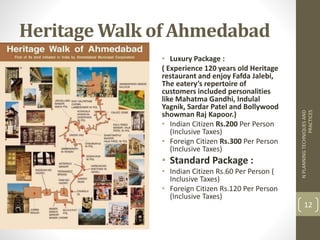
• Luxury Package :
( Experience 120 years old Heritage
restaurant and enjoy Fafda Jalebi,
The eatery’s repertoire of
customers included personalities
like Mahatma Gandhi, Indulal
Yagnik, Sardar Patel and Bollywood
showman Raj Kapoor.)
• Indian Citizen Rs.200 Per Person
(Inclusive Taxes)
• Foreign Citizen Rs.300 Per Person
(Inclusive Taxes)
• Standard Package :
• Indian Citizen Rs.60 Per Person (
Inclusive Taxes)
• Foreign Citizen Rs.120 Per Person
(Inclusive Taxes)
NPLANNINGTECHNIQUESAND
PRACTICES
12
AHMEDABAD MORNING
HERITAGE WALK PACKAGE
• Starting Point:
Swaminarayan Temple,
Kalupur, Off Relief Road,
Ahmedabad
• Number of Pause
Points:20 Points
• Length:2 km
• Duration:2 Hrs. 30 Min.
• Reporting Time:7:30AM
to 7:45AM
AHMEDABAD NIGHT HERITAGE
WALK PACKAGE
• Starting Point:
Siddi Saiyad Mosque,
Opposite Electricity House,
Gheekanta, Lal Daewaja,
Ahmedabad.
• Number of Pause
Points:16 Points
• Length : 2 km
• Reporting Time:8:30PM
to 8:45PM
NPLANNINGTECHNIQUESAND
PRACTICES
13
Heritage Walk of Ahmedabad
• The Ahmedabad Municipal Corporation (AMC) in collaboration with,
Conservation and Research of CRUTA foundation
• They has been conducting the heritage walk since 19th November
1997 as a part of World Heritage Week.
• It is a guided walk of two and a half hours and also a half hour
special slide show covering historical aspects of the city in day times.
• The walk begins from the Swaminarayan Mandir and ends in the
Jumma Masjid, covering in between many pols, havelis, ornamental
facades, workplaces of artisans and number of splendid Hindu and
Jain temples. The guided night walk of the city begins at Managaldas
Haveli in Khadia and takes through some of the most ancient parts
of the city.
• People walk on narrow lanes, old havelis and monuments and
arriving at Manek Chawk.
• There is small room above the gateway leading to Raja no Haziro
wherein one will witness a tradition that dates back to 600 years of
drummers signalling the closing of the city gates at 11 pm every
night.
NPLANNINGTECHNIQUESAND
PRACTICES
14
NPLANNINGTECHNIQUESAND
PRACTICES
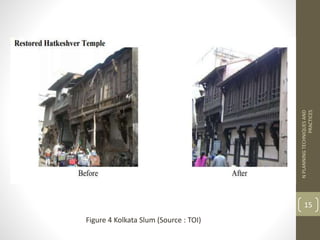
Figure 4 Kolkata Slum (Source : TOI)
15
Concluding Remark
• India as a country cannot afford to miss the opportunities for
economic developments, employment generation and foreign
exchange earnings from cultural-heritage, specifically archaeo-
heritage tourism.
• Acts and Modem management practices would be required to
conserve or preserve and present these enrich historical
heritage, and culture in as possible as same form or conserved
condition and as well as in the form of multimedia and audio-
video presentations, seminars and lectures, regular music and
poetry recitals, reconstruction of the past with light and sound
shows, guided tours and heritage walks, books and publicity
materials.
NPLANNINGTECHNIQUESAND
PRACTICES
16
References
 Constitution of India
 The Report of the National Commission of Urbanisation,
Ministry of Urban Development, Government of India,
New Delhi, 1988.
 The World Heritage Conservation Process, UNESCO
 Agarwal P.K. (1986), ‘Conservation Problem of Victoria
Memorial Building – Preliminary Observation’,
Conservation of Cultural Property in India,
 Collins, R., 1983, Tourism and Heritage Conservation-
The Pacific Experience, Heritage Australia
NPLANNINGTECHNIQUESAND
PRACTICES
17
Thank you…
NPLANNINGTECHNIQUESAND
PRACTICES
18

Urban heritage conservation , India

  • 1.
    Graduate Report Presentationon “Urban Heritage Conservation” ME – TCP, Year – I, Semester – II Under the subject of URBAN PLANNING TECHNIQUES AND PRACTICES (COURSE CODE : 372480) Prepared by : VAKHARIA SIDDHI Enrollment No: 180420748023 Guided by : Prof. Sejal S hagat Prof. Zarana H. Gandhi SARVAJANIK COLLEGE OF ENGINEERING & TECHNOLOGY, SURAT FACULTY OF CIVIL ENGINEERING MASTER OF ENGINEERING (TOWN AND COUNTRY PLANNING) Affiliated with GUJARAT TECHNOLOGICAL UNIVERSITY Prof.(Dr.) Jigar K. Sevalia Faculty & Head Faculty of Civil Engineering, SCET
  • 2.
    Contents • Introduction • Definitionsrelated to Urban Conservation • Important of Heritage conservation • Conservation Elements • Conservation at International Level • Conservation at National Level • Constitution Obligation • Acts for Conservation • Need of Urban Heritage Conservation • Heritage walk of Ahmedabad City • Concluding Remark • References NPLANNINGTECHNIQUESAND PRACTICES 2
  • 3.
    Introduction • Urban Conservationis concerned with those parts of the built environment that are of architectural or historic significance. This includes buildings (individually or in groups), localities (streets, blocks, environments or precincts), special gardens or landscapes, and other structures. According to The National trust of Australia, NSW(New South Wales): • Urban conservation seeks to retain that part of urban environment whose character is important to the national or local heritage. It also seeks to enhance that environmental character by ensuring that the siting, the size and design of any development is complementary to it. • Above all, it can be concluded that Conservation is the process of maintaining and managing change to a heritage asset in a way that sustains and where appropriate enhances its significance. NPLANNINGTECHNIQUESAND PRACTICES 3
  • 4.
    AsperTheReportoftheNationalCommissionof Urbanisation,MinistryofUrbanDevelopment, GovernmentofIndia,NewDelhi,1988 • The urbanconservation would be concern inter-related with those components of the urban heritage that 1. Possesses architectural, historical and cultural interest; 2. Have a special or unique quality or charm that provides distinctiveness either because of its ambience or because of some distinctive activity centred on or associated with the place; 3. Constitute a focal point in a city of importance to the social, psychological or spiritual well-being of its residents and 4. Elements that enhance the physical environment of the city NPLANNINGTECHNIQUESAND PRACTICES 4
  • 5.
    Definitions related toUrban Conservation (WHCP UNESCO) 1. Conservation 2. Aesthetic 3. Conservation Zone 1. Heritage Areas 2. Heritage Building 4. Heritage Precincts 5. Historical 6. Historical 7. Landmarks 8. Preservation 9. Reconstruction 10. Restoration 11. Urban heritage 12. Heritage Zone NPLANNINGTECHNIQUESAND PRACTICES 5
  • 6.
    Importance of Heritageconservation • Heritage buildings basically represent the past history and culture of a nation. They constitute together the architectural heritage of an area. • Heritage buildings are subjected to processes of degradation with time, which leads to a situation in which they became not able to fulfil the purpose for which they were built. • Heritage conservation is important for identifying, recording, analysing and protecting heritage and cultural resources. • It plays an important role to define the landmark within the heritage area as well as to generate economic return and to support the tourism industry. NPLANNINGTECHNIQUESAND PRACTICES 6
  • 7.
    Conservation Elements (NCU) 1.Building or groups of buildings of architectural, historical, or cultural interest 2. An intimate or human scale in an area 3. Local set-pieces of significance to the city or region 4. Well-defined central precincts with variety of activities 5. Famous individual districts 6. A unique temple, mosque, church or other monuments as a focal point to the area 7. Squares or major intersections with interesting corner buildings or a special ambience 8. Waterfront areas (lake or tank) 9. Areas associated with major open spaces j) a street pattern favoring the pedestrian where the relationship of spaces, tree and provide visual satisfaction or drama 10. Designed environments (Connaught Circus: Delhi) 11. Old town or village centres 12. Major landmarks (man-made or natural ) 13. Lines of sight and other vistas of visual significance, including skylines, ridges, panoramic and other views 14. Well favoured residential areas (high grade facilities ) and 15. Main centres of recreation and tourism NPLANNINGTECHNIQUESAND PRACTICES 7
  • 8.
    Conservation at InternationalLevel • Firstly, The concept Urban Conservation was adopted for the first time in 1985 in “The Granada Convention for Protection of the Architectural Heritage of Europe”. • In its further efforts, UNESCO has created National Committees of ICOMOS in every country. • Each National Committee adopts its own rules of procedure and elaborates its own programme according to the goals and aims of ICOMOS. • Indian chapter of this body works in close cooperation with INTACH, ASI and other scientific laboratories NPLANNINGTECHNIQUESAND PRACTICES 8
  • 9.
    Constitutional Obligation for HeritageConservation • Article 49 deals with the protection of monuments and places and objects of national importance under the directive principles of state policy, which states that “it shall be the obligation of the State to protect every monument or place or object of artistic or historic interest (declared by or under law made by parliament) to be of national importance, from spoliation, disfigurement, destruction, removal, disposal or export, as the case may be”. NPLANNINGTECHNIQUESAND PRACTICES 9
  • 10.
    Acts and Laws 1.The Indian Treasure Trove Act, 1878 2. The Ancient Monuments Preservation Act, 1904 3. Rajghat Samadhi Act, 1951 4. The Ancient Monuments and Archaeological Sites and Remains Act, 1958 5. The Ancient Monuments and Archaeological Sites and Remains Rules, 1959 6. The Antiquities and Art Treasures Act, 1972 7. The Wildlife (Protection) Act, 1972 8. Environment (Protection) Act, 1986 9. Bio-diversity Act, 2002 NPLANNINGTECHNIQUESAND PRACTICES 10
  • 11.
    Need of UrbanHeritage Conservation • Need for Conservation is continually mirroring the phenomenon that the cultures are constantly in flux from the local to the global scale. • . The need to preserve the cultural property arises not merely to preserve evidence of the historic past, but in order to forge a concrete linkage between the past and the present in public memory. • . A primary objective for managing heritage is to communicate its significance and need for its conservation to its host community and to visitors. • It brings with it a duty of respect for the heritage values, interests and equity of the present-day host community, indigenous custodians or owners of historic property and for the landscapes and cultures from which that heritage evolved. NPLANNINGTECHNIQUESAND PRACTICES 11
  • 12.
    Heritage Walk ofAhmedabad • Luxury Package : ( Experience 120 years old Heritage restaurant and enjoy Fafda Jalebi, The eatery’s repertoire of customers included personalities like Mahatma Gandhi, Indulal Yagnik, Sardar Patel and Bollywood showman Raj Kapoor.) • Indian Citizen Rs.200 Per Person (Inclusive Taxes) • Foreign Citizen Rs.300 Per Person (Inclusive Taxes) • Standard Package : • Indian Citizen Rs.60 Per Person ( Inclusive Taxes) • Foreign Citizen Rs.120 Per Person (Inclusive Taxes) NPLANNINGTECHNIQUESAND PRACTICES 12
  • 13.
    AHMEDABAD MORNING HERITAGE WALKPACKAGE • Starting Point: Swaminarayan Temple, Kalupur, Off Relief Road, Ahmedabad • Number of Pause Points:20 Points • Length:2 km • Duration:2 Hrs. 30 Min. • Reporting Time:7:30AM to 7:45AM AHMEDABAD NIGHT HERITAGE WALK PACKAGE • Starting Point: Siddi Saiyad Mosque, Opposite Electricity House, Gheekanta, Lal Daewaja, Ahmedabad. • Number of Pause Points:16 Points • Length : 2 km • Reporting Time:8:30PM to 8:45PM NPLANNINGTECHNIQUESAND PRACTICES 13 Heritage Walk of Ahmedabad
  • 14.
    Heritage Walk ofAhmedabad • The Ahmedabad Municipal Corporation (AMC) in collaboration with, Conservation and Research of CRUTA foundation • They has been conducting the heritage walk since 19th November 1997 as a part of World Heritage Week. • It is a guided walk of two and a half hours and also a half hour special slide show covering historical aspects of the city in day times. • The walk begins from the Swaminarayan Mandir and ends in the Jumma Masjid, covering in between many pols, havelis, ornamental facades, workplaces of artisans and number of splendid Hindu and Jain temples. The guided night walk of the city begins at Managaldas Haveli in Khadia and takes through some of the most ancient parts of the city. • People walk on narrow lanes, old havelis and monuments and arriving at Manek Chawk. • There is small room above the gateway leading to Raja no Haziro wherein one will witness a tradition that dates back to 600 years of drummers signalling the closing of the city gates at 11 pm every night. NPLANNINGTECHNIQUESAND PRACTICES 14
  • 15.
  • 16.
    Concluding Remark • Indiaas a country cannot afford to miss the opportunities for economic developments, employment generation and foreign exchange earnings from cultural-heritage, specifically archaeo- heritage tourism. • Acts and Modem management practices would be required to conserve or preserve and present these enrich historical heritage, and culture in as possible as same form or conserved condition and as well as in the form of multimedia and audio- video presentations, seminars and lectures, regular music and poetry recitals, reconstruction of the past with light and sound shows, guided tours and heritage walks, books and publicity materials. NPLANNINGTECHNIQUESAND PRACTICES 16
  • 17.
    References  Constitution ofIndia  The Report of the National Commission of Urbanisation, Ministry of Urban Development, Government of India, New Delhi, 1988.  The World Heritage Conservation Process, UNESCO  Agarwal P.K. (1986), ‘Conservation Problem of Victoria Memorial Building – Preliminary Observation’, Conservation of Cultural Property in India,  Collins, R., 1983, Tourism and Heritage Conservation- The Pacific Experience, Heritage Australia NPLANNINGTECHNIQUESAND PRACTICES 17
  • 18.