CHALLENGES IN NURSING
EDUCATION
Presented By:
DR. INDRAWATI RAO
PRINCIPAL
GOVERNMENT COLLEGE OF NURSING, SURAT
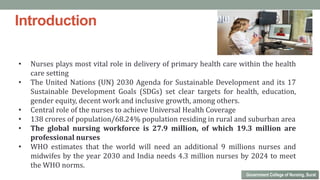
• Nurses plays most vital role in delivery of primary health care within the health
care setting
• The United Nations (UN) 2030 Agenda for Sustainable Development and its 17
Sustainable Development Goals (SDGs) set clear targets for health, education,
gender equity, decent work and inclusive growth, among others.
• Central role of the nurses to achieve Universal Health Coverage
• 138 crores of population/68.24% population residing in rural and suburban area
• The global nursing workforce is 27.9 million, of which 19.3 million are
professional nurses
• WHO estimates that the world will need an additional 9 millions nurses and
midwifes by the year 2030 and India needs 4.3 million nurses by 2024 to meet
the WHO norms.
Introduction
Government College of Nursing, Surat
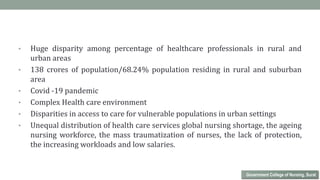
• Huge disparity among percentage of healthcare professionals in rural and
urban areas
• 138 crores of population/68.24% population residing in rural and suburban
area
• Covid -19 pandemic
• Complex Health care environment
• Disparities in access to care for vulnerable populations in urban settings
• Unequal distribution of health care services global nursing shortage, the ageing
nursing workforce, the mass traumatization of nurses, the lack of protection,
the increasing workloads and low salaries.
Government College of Nursing, Surat
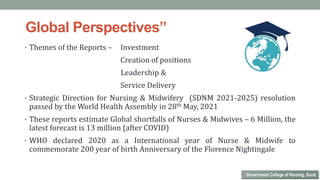
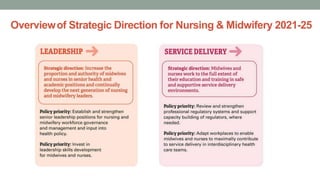
• Themes of the Reports – Investment
Creation of positions
Leadership &
Service Delivery
• Strategic Direction for Nursing & Midwifery (SDNM 2021-2025) resolution
passed by the World Health Assembly in 28th May, 2021
• These reports estimate Global shortfalls of Nurses & Midwives – 6 Million, the
latest forecast is 13 million (after COVID)
• WHO declared 2020 as a International year of Nurse & Midwife to
commemorate 200 year of birth Anniversary of the Florence Nightingale
Government College of Nursing, Surat
Global Perspectives”
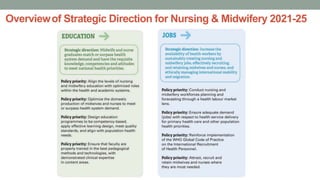
Overviewof Strategic Direction for Nursing & Midwifery 2021-25
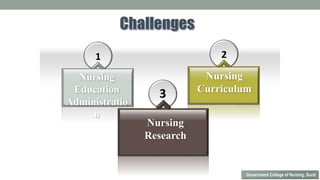
1
3
2
Nursing
Education
Administratio
n
Nursing
Curriculum
Nursing
Research
Government College of Nursing, Surat
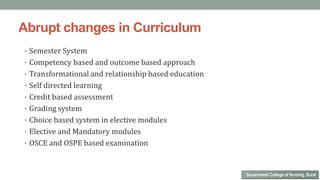
Abrupt changes in Curriculum
• Semester System
• Competency based and outcome based approach
• Transformational and relationship based education
• Self directed learning
• Credit based assessment
• Grading system
• Choice based system in elective modules
• Elective and Mandatory modules
• OSCE and OSPE based examination
Government College of Nursing, Surat
Dealing with Z generation
Government College of Nursing, Surat
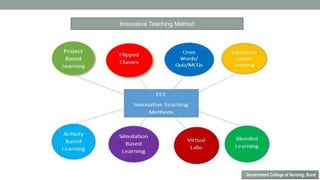
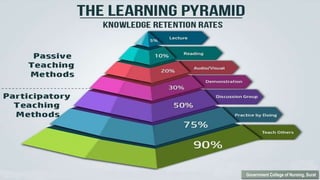
Innovative Teaching Method
Government College of Nursing, Surat
Class room technology
Government College of Nursing, Surat
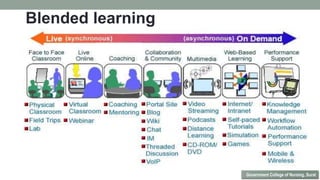
Blended learning
Government College of Nursing, Surat
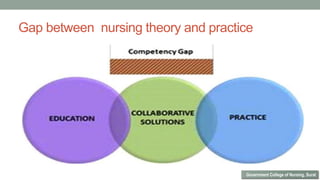
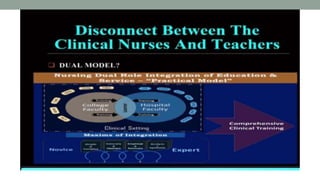
Gap between nursing theory and practice
Government College of Nursing, Surat
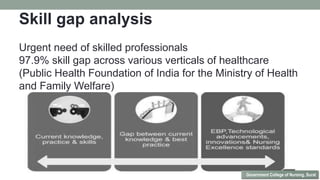
Skill gap analysis
Urgent need of skilled professionals
97.9% skill gap across various verticals of healthcare
(Public Health Foundation of India for the Ministry of Health
and Family Welfare)
Government College of Nursing, Surat
Enhancement of Faculty Development program
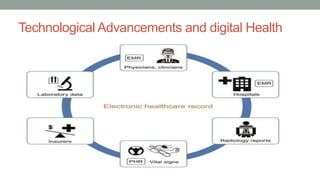
Technological Advancements and digital Health
AI – IN NURSING CARE
• Artificial intelligence (AI) comprises many healthcare technologies
transforming nurses’ roles and enhancing patient care.
• In healthcare, AI typically refers to the ability of computers to
independently convert data into knowledge to guide decisions or
autonomous actions.
• However, precisely defining AI can be challenging because of its breadth of
applications, including risk prediction algorithms, robots, and speech
recognition—all of which augment nursing practice and are on a fast track
to changing healthcare as a whole.
• Nursing AI tools include clinical decision support, mobile health and sensor-
based technologies, and voice assistants and robotics.
AI in Nursing Care
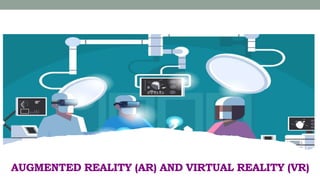
AUGMENTED REALITY (AR) AND VIRTUAL REALITY (VR)
INTEROPERABILITY
TELENURSING
Telenursing is the delivery, management and coordination of care and services
provided via tele communication and information technology within the domain of
nursing.”
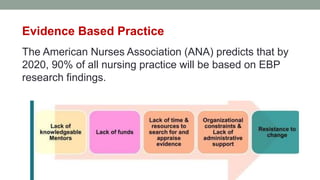
Evidence Based Practice
The American Nurses Association (ANA) predicts that by
2020, 90% of all nursing practice will be based on EBP
research findings.
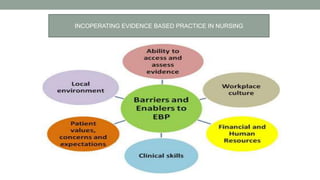
INCOPERATING EVIDENCE BASED PRACTICE IN NURSING
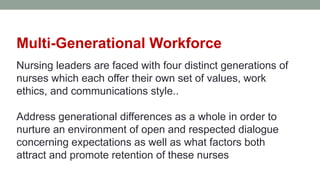
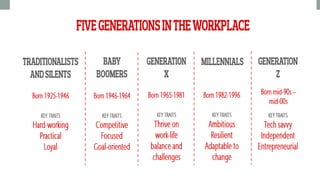
Multi-Generational Workforce
Nursing leaders are faced with four distinct generations of
nurses which each offer their own set of values, work
ethics, and communications style..
Address generational differences as a whole in order to
nurture an environment of open and respected dialogue
concerning expectations as well as what factors both
attract and promote retention of these nurses
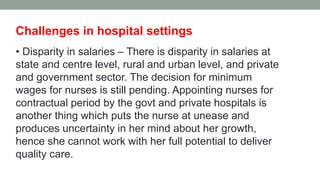
Challenges in hospital settings
• Disparity in salaries – There is disparity in salaries at
state and centre level, rural and urban level, and private
and government sector. The decision for minimum
wages for nurses is still pending. Appointing nurses for
contractual period by the govt and private hospitals is
another thing which puts the nurse at unease and
produces uncertainty in her mind about her growth,
hence she cannot work with her full potential to deliver
quality care.
Challenges in hospital settings
⚫ Criteria of Promotion: There is no certain laid out criteria for
promotion in government as well as private sector. Sometimes
even talented nurses don’t get their due promotion and
incentives due to some internal politics and corruption.
Unfortunately nurses keep low hope of promotion in clinical or
teaching setting and flee to greener pastures.
⚫ Lack of performance based incentives
Challenges in hospital settings
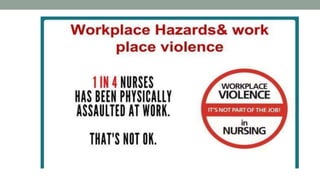
Violence in the workplace
⚫ Nurses are subjected to violence at workplace by caregivers,
relatives and other healthcare employees.
• Incidences of bullying, harassment and abuse are increasing
day by day.
• Employers, victims, nursing leaders and the political system
need to work on united approaches to layout plan for such
circumstances.
⚫ The mean age and work experience of the nurses were 33.5
± 7.5 and 10.85 ± 10.1 years, respectively. The highest
prevalence of verbal, physical, sexist, and racist violence was
from:
Challenges in hospital settings
Nurses migration.....increased staff turn over
• Caste based reservation system
• Poor pay and facilities, No respect or social status
•Increased workload, Lack of Recognition
•Occupational Stress and unfavourable working environment
(bullying)
• Ineffective academic and professional growth
• availability of various incentives, job dissatisfaction, social or
political unrest and less social welfare
Lack of Synchronicity in Team work
*Language barriers
*Distractions
*Physical proximity
*Difference in Personalities
*Workload
*Varying communication styles
*Conflict
*Lack of verification of information
*Shift change
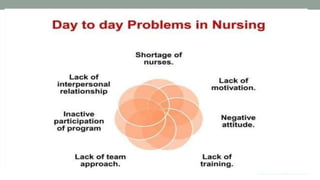
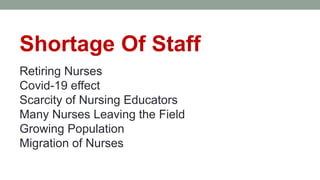
Working Conditions
*Inadequate staffing
*The nurse-patient ratios are usually not met at the
hospitals.
*Long shifts without breaks.
*Too much documentation
*Nurses are prone to experience burnout and fatigue
*Nurses face ethical dilemmas with restricted
resources
*Decline in quality care to patients
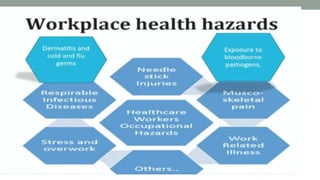
Shortage Of Staff
Retiring Nurses
Covid-19 effect
Scarcity of Nursing Educators
Many Nurses Leaving the Field
Growing Population
Migration of Nurses
Workplace Violence Against Iranian Nurses: A Systematic Review
and Meta-Analysis Azami M. Moslemirad M. YektaKooshali MH,
Rahmati S, Soleymani A, Bigdeli Shamloo MB, Esmaeilpour-
Bandboni M, Khataee M, Khorshidi A, Otaghi
Workplace Violence
Nurses are subjected to violence at workplace by
caregivers, relatives and other healthcare
employees.
Incidences of bullying, harassment and abuse are
increasing day by day.
The mean age and work experience of the nurses
were 33.5 7.5 and 10.85 ± 10.1 years, respectively.
Professional Councils:
• Must restrict themselves to the role of Professional Standard
Setting Bodies (curriculum framework, against which
educational institutions will prepare their own curricula)
• Separate Nursing and Midwifery Councils
Separate Directorate
Education:
• Must be left to the Universities and Colleges.
• Responsibilities of governance, regulation, accreditation, and
funding.
• Must be aligned with general education -NAAC ..
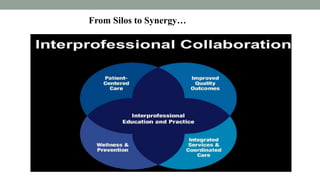
From Silos to Synergy…
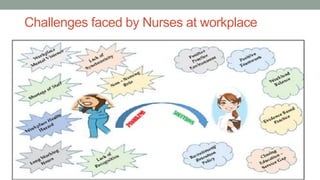
Challenges faced by Nurses at workplace
Managing challenges
• Personal and professional excellence
• honesty
• hardwork
• teamwork
• Professional ethics
• Good communication
• KASH
Managing Challenges
• Well groomed personality- Building a positive image in
the society by appropriately communicating with patients,
caregivers and colleagues, improved dressing sense, and
being skilled in the competencies.
Continuing Research- Sharing of evidence and best
practice by getting involved in research activities with full
enthusiasm and motivation. Regularly participating in
conferences, workshops to update her knowledge and
sharing the knowledge with peers.
Managing challenges
•Partnering with media
• Nursing needs to be advertised positively in media.
•It is not merely hand-holding and emotional experiences with
patients but also involves knowledge-based care that requires
high levels of competency.
• Most of the non nursing people/disciplines are not even aware
that Nursing is a full time programme with well defined curriculum
and council, Ph.D. In Nursing is also available
Managing challenges
Career advancement
• Opportunities for Career advancement and personal
development should be offered under Continuing Nursing
education programs for better clinical skills, promotion, and
competency based recognition.
• Employment process of Nurses in India should include an
exit interview to explore what went wrong during their tenure
and why nurses are leaving or repeatedly changing their
jobs.
Managing challenges
Collective Bargaining between employers and nursing personnel to
regulate salaries, working environment, benefits, and other compensation
needs to be practised. For that each and every nurse should be a
member of a reputed association like TNAI so that negotiations can be
done.
*The nurses voice has yet not been heard due to the historical role of
nurse as handmaiden (not an independent role), limited role in decision
making; largely physicians have all the say in decision making related to
patient care. Nurses should be very clear with their role, have confidence
and should not be insecure and should not have any sense of inferiority
while carrying out their duties.
Managing challenges
Strong Nurses Network
• In these times of social media, nurses should develop strong
network to connect with each from all corners of country, to
speak unanimously for their rights, to spread awareness
about their rights, needs and demands for growth of the
profession.
Managing challenges
Policy making- Advocacy, Lobbying
• Lobbying is the act of attempting to influence decisions
made by officials in the government, most often legislators
or members of regulatory agencies.
• Lobbying is done by many different types of people and
organized groups, including individuals in the private
sector, corporations, fellow legislators or government
officials, or advocacy groups (interest groups).
• Nurses must build new partnerships with other clinicians,
business owners, philanthropists and elected officials.
Developing leadership qualities
*Mentoring and nurturing novice nurses
Senior Nursing professionals’ willingness to guide and
support creates a loving and non-judgmental
environment facilitating nurses to learn and grow.
*Mentorship is indeed a great way to support nursing
profession growth and promote its glory. LLead by
example
Challenges in Nursing Research
*Researcher competencies
*Culture prioritize more on clinical practice
*Ethical issues
*Evidence based practice
*Financial constraints
*Lack of guidance, support & resources
*Ambiguity in relation to research role expectations
*Patient care outcomes
• Summary
• Maintaining moral and ethical standards
• Being honest and hardworking
• Collaboration
• Participating in policy making decisions
• Being updated
• Good communication skills
• Partnering with media
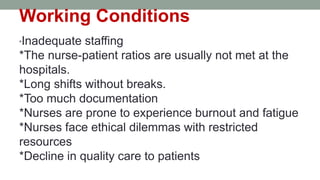
Take home message
Innovation and pedagogy
Happy Nurse Educators.. Students…
Critical thinkers
Quality care
Cost effectiveness
Addresses complex health care needs

Challenges In Nursing Education.pptx

  • 1.
    CHALLENGES IN NURSING EDUCATION PresentedBy: DR. INDRAWATI RAO PRINCIPAL GOVERNMENT COLLEGE OF NURSING, SURAT
  • 2.
    • Nurses playsmost vital role in delivery of primary health care within the health care setting • The United Nations (UN) 2030 Agenda for Sustainable Development and its 17 Sustainable Development Goals (SDGs) set clear targets for health, education, gender equity, decent work and inclusive growth, among others. • Central role of the nurses to achieve Universal Health Coverage • 138 crores of population/68.24% population residing in rural and suburban area • The global nursing workforce is 27.9 million, of which 19.3 million are professional nurses • WHO estimates that the world will need an additional 9 millions nurses and midwifes by the year 2030 and India needs 4.3 million nurses by 2024 to meet the WHO norms. Introduction Government College of Nursing, Surat
  • 3.
    • Huge disparityamong percentage of healthcare professionals in rural and urban areas • 138 crores of population/68.24% population residing in rural and suburban area • Covid -19 pandemic • Complex Health care environment • Disparities in access to care for vulnerable populations in urban settings • Unequal distribution of health care services global nursing shortage, the ageing nursing workforce, the mass traumatization of nurses, the lack of protection, the increasing workloads and low salaries. Government College of Nursing, Surat
  • 4.
    • Themes ofthe Reports – Investment Creation of positions Leadership & Service Delivery • Strategic Direction for Nursing & Midwifery (SDNM 2021-2025) resolution passed by the World Health Assembly in 28th May, 2021 • These reports estimate Global shortfalls of Nurses & Midwives – 6 Million, the latest forecast is 13 million (after COVID) • WHO declared 2020 as a International year of Nurse & Midwife to commemorate 200 year of birth Anniversary of the Florence Nightingale Government College of Nursing, Surat Global Perspectives”
  • 5.
    Overviewof Strategic Directionfor Nursing & Midwifery 2021-25
  • 6.
    Overviewof Strategic Directionfor Nursing & Midwifery 2021-25
  • 7.
  • 8.
    Abrupt changes inCurriculum • Semester System • Competency based and outcome based approach • Transformational and relationship based education • Self directed learning • Credit based assessment • Grading system • Choice based system in elective modules • Elective and Mandatory modules • OSCE and OSPE based examination Government College of Nursing, Surat
  • 9.
    Government College ofNursing, Surat
  • 10.
    Government College ofNursing, Surat
  • 11.
    Dealing with Zgeneration Government College of Nursing, Surat
  • 12.
    Innovative Teaching Method GovernmentCollege of Nursing, Surat
  • 13.
    Class room technology GovernmentCollege of Nursing, Surat
  • 14.
  • 15.
    Government College ofNursing, Surat
  • 16.
    Gap between nursingtheory and practice Government College of Nursing, Surat
  • 17.
    Skill gap analysis Urgentneed of skilled professionals 97.9% skill gap across various verticals of healthcare (Public Health Foundation of India for the Ministry of Health and Family Welfare) Government College of Nursing, Surat
  • 18.
    Enhancement of FacultyDevelopment program
  • 19.
  • 20.
    AI – INNURSING CARE • Artificial intelligence (AI) comprises many healthcare technologies transforming nurses’ roles and enhancing patient care. • In healthcare, AI typically refers to the ability of computers to independently convert data into knowledge to guide decisions or autonomous actions. • However, precisely defining AI can be challenging because of its breadth of applications, including risk prediction algorithms, robots, and speech recognition—all of which augment nursing practice and are on a fast track to changing healthcare as a whole. • Nursing AI tools include clinical decision support, mobile health and sensor- based technologies, and voice assistants and robotics. AI in Nursing Care
  • 21.
    AUGMENTED REALITY (AR)AND VIRTUAL REALITY (VR)
  • 22.
  • 23.
    TELENURSING Telenursing is thedelivery, management and coordination of care and services provided via tele communication and information technology within the domain of nursing.”
  • 25.
    Evidence Based Practice TheAmerican Nurses Association (ANA) predicts that by 2020, 90% of all nursing practice will be based on EBP research findings.
  • 26.
    INCOPERATING EVIDENCE BASEDPRACTICE IN NURSING
  • 27.
    Multi-Generational Workforce Nursing leadersare faced with four distinct generations of nurses which each offer their own set of values, work ethics, and communications style.. Address generational differences as a whole in order to nurture an environment of open and respected dialogue concerning expectations as well as what factors both attract and promote retention of these nurses
  • 30.
    Challenges in hospitalsettings • Disparity in salaries – There is disparity in salaries at state and centre level, rural and urban level, and private and government sector. The decision for minimum wages for nurses is still pending. Appointing nurses for contractual period by the govt and private hospitals is another thing which puts the nurse at unease and produces uncertainty in her mind about her growth, hence she cannot work with her full potential to deliver quality care.
  • 31.
    Challenges in hospitalsettings ⚫ Criteria of Promotion: There is no certain laid out criteria for promotion in government as well as private sector. Sometimes even talented nurses don’t get their due promotion and incentives due to some internal politics and corruption. Unfortunately nurses keep low hope of promotion in clinical or teaching setting and flee to greener pastures. ⚫ Lack of performance based incentives
  • 32.
    Challenges in hospitalsettings Violence in the workplace ⚫ Nurses are subjected to violence at workplace by caregivers, relatives and other healthcare employees. • Incidences of bullying, harassment and abuse are increasing day by day. • Employers, victims, nursing leaders and the political system need to work on united approaches to layout plan for such circumstances. ⚫ The mean age and work experience of the nurses were 33.5 ± 7.5 and 10.85 ± 10.1 years, respectively. The highest prevalence of verbal, physical, sexist, and racist violence was from:
  • 33.
    Challenges in hospitalsettings Nurses migration.....increased staff turn over • Caste based reservation system • Poor pay and facilities, No respect or social status •Increased workload, Lack of Recognition •Occupational Stress and unfavourable working environment (bullying) • Ineffective academic and professional growth • availability of various incentives, job dissatisfaction, social or political unrest and less social welfare
  • 34.
    Lack of Synchronicityin Team work *Language barriers *Distractions *Physical proximity *Difference in Personalities *Workload *Varying communication styles *Conflict *Lack of verification of information *Shift change
  • 36.
    Working Conditions *Inadequate staffing *Thenurse-patient ratios are usually not met at the hospitals. *Long shifts without breaks. *Too much documentation *Nurses are prone to experience burnout and fatigue *Nurses face ethical dilemmas with restricted resources *Decline in quality care to patients
  • 37.
    Shortage Of Staff RetiringNurses Covid-19 effect Scarcity of Nursing Educators Many Nurses Leaving the Field Growing Population Migration of Nurses
  • 40.
    Workplace Violence AgainstIranian Nurses: A Systematic Review and Meta-Analysis Azami M. Moslemirad M. YektaKooshali MH, Rahmati S, Soleymani A, Bigdeli Shamloo MB, Esmaeilpour- Bandboni M, Khataee M, Khorshidi A, Otaghi Workplace Violence Nurses are subjected to violence at workplace by caregivers, relatives and other healthcare employees. Incidences of bullying, harassment and abuse are increasing day by day. The mean age and work experience of the nurses were 33.5 7.5 and 10.85 ± 10.1 years, respectively.
  • 41.
    Professional Councils: • Mustrestrict themselves to the role of Professional Standard Setting Bodies (curriculum framework, against which educational institutions will prepare their own curricula) • Separate Nursing and Midwifery Councils Separate Directorate Education: • Must be left to the Universities and Colleges. • Responsibilities of governance, regulation, accreditation, and funding. • Must be aligned with general education -NAAC ..
  • 42.
    From Silos toSynergy…
  • 43.
    Challenges faced byNurses at workplace
  • 44.
    Managing challenges • Personaland professional excellence • honesty • hardwork • teamwork • Professional ethics • Good communication • KASH
  • 45.
    Managing Challenges • Wellgroomed personality- Building a positive image in the society by appropriately communicating with patients, caregivers and colleagues, improved dressing sense, and being skilled in the competencies. Continuing Research- Sharing of evidence and best practice by getting involved in research activities with full enthusiasm and motivation. Regularly participating in conferences, workshops to update her knowledge and sharing the knowledge with peers.
  • 46.
    Managing challenges •Partnering withmedia • Nursing needs to be advertised positively in media. •It is not merely hand-holding and emotional experiences with patients but also involves knowledge-based care that requires high levels of competency. • Most of the non nursing people/disciplines are not even aware that Nursing is a full time programme with well defined curriculum and council, Ph.D. In Nursing is also available
  • 47.
    Managing challenges Career advancement •Opportunities for Career advancement and personal development should be offered under Continuing Nursing education programs for better clinical skills, promotion, and competency based recognition. • Employment process of Nurses in India should include an exit interview to explore what went wrong during their tenure and why nurses are leaving or repeatedly changing their jobs.
  • 48.
    Managing challenges Collective Bargainingbetween employers and nursing personnel to regulate salaries, working environment, benefits, and other compensation needs to be practised. For that each and every nurse should be a member of a reputed association like TNAI so that negotiations can be done. *The nurses voice has yet not been heard due to the historical role of nurse as handmaiden (not an independent role), limited role in decision making; largely physicians have all the say in decision making related to patient care. Nurses should be very clear with their role, have confidence and should not be insecure and should not have any sense of inferiority while carrying out their duties.
  • 49.
    Managing challenges Strong NursesNetwork • In these times of social media, nurses should develop strong network to connect with each from all corners of country, to speak unanimously for their rights, to spread awareness about their rights, needs and demands for growth of the profession.
  • 50.
    Managing challenges Policy making-Advocacy, Lobbying • Lobbying is the act of attempting to influence decisions made by officials in the government, most often legislators or members of regulatory agencies. • Lobbying is done by many different types of people and organized groups, including individuals in the private sector, corporations, fellow legislators or government officials, or advocacy groups (interest groups). • Nurses must build new partnerships with other clinicians, business owners, philanthropists and elected officials.
  • 51.
    Developing leadership qualities *Mentoringand nurturing novice nurses Senior Nursing professionals’ willingness to guide and support creates a loving and non-judgmental environment facilitating nurses to learn and grow. *Mentorship is indeed a great way to support nursing profession growth and promote its glory. LLead by example
  • 52.
    Challenges in NursingResearch *Researcher competencies *Culture prioritize more on clinical practice *Ethical issues *Evidence based practice *Financial constraints *Lack of guidance, support & resources *Ambiguity in relation to research role expectations *Patient care outcomes
  • 53.
    • Summary • Maintainingmoral and ethical standards • Being honest and hardworking • Collaboration • Participating in policy making decisions • Being updated • Good communication skills • Partnering with media
  • 55.
    Take home message Innovationand pedagogy Happy Nurse Educators.. Students… Critical thinkers Quality care Cost effectiveness Addresses complex health care needs

Editor's Notes

  • #56 Innovation is necessary. We can do it with existing conditions while striving as soon as possible for curriculum revision .