SHRI J G CO-OPERATIVE HOSPITAL
SOCIETY'S COLLEGE OF NURSING
GHATAPRABHA
Thesis Presentation
REG NO:17NM144
MSc (N)-II YEAR
MEDICAL SURGICAL NURSING
Sub Spl:Cardiovascular and thoracic nursing
INTRODUCTION
• If you suffer from hemorrhoids, you are in the company of some famous
people. Napoleon Bonaparte was said to have had hemorrhoids, and some
historians have actually debated whether he lost the Battle of Waterloo
because he was unable to sit on his horse during the battle to lead his army.
In 1978 President Jimmy Carter had to leave a party at the White House
because of hemorrhoidal pain. The pain was so severe that he was
incapacitated and could no longer perform his duties. He had surgery soon

afterward, and returned to the Oval Office. George Brett, a third baseman
for the Kansas City Royals, missed part of the World Series in 1980
because of hemorrhoids. Minor surgery was performed, so he could return
quickly to the game the next day. 1
According to The Merck Manual definition hemorrhoids is Varicosities of
the veins of the hemorrhoidal plexus, often complicated by inflammation,
thrombosis, and bleeding. But a recent definition of hemorrhoids is
“Vascular cushions, consisting of thick submucosa containing both venous
and arterial blood vessels.7
PROBLEM STATEMENT
• “A study to assess the knowledge of
hemorrhoids among KSRTC Bus Drivers
in Gokak taluka , with a view to develop an
information booklet.”
OBJECTIVES
• 1. To assess the knowledge of hemorrhoids among KSRTC bus drivers.
• 2. To find out the association between knowledge of hemorrhoids with
selected demographic variables.
• 3. To develop & distribute information booklet.
HYPOTHESIS
• H1: There will be significant association between knowledge of
Hemorrhoids and selected demographic variables
ASSUMPTION
It is assumed that KSRTC drivers may have some knowledge of hemorrhoids.
• Inclusion criteria:
• KSRTC Bus Drivers who are available at the time of data collection.
• KSRTC Bus Drivers who are willing to participate in the study.
• KSRTC Bus Drivers who are able to understand and read english or
kannada.
• Exclusion criteria
• KSRTC Bus Drivers who are on long leave
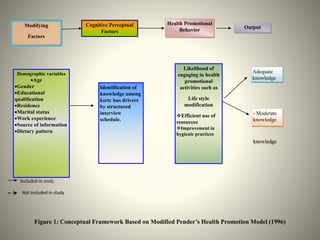
CONCEPTUAL FRAMEWORK
Demographic variables
Age
Gender
Educational
qualification
Residence
Marital status
Work experience
Source of information
Dietary pattern
Identification of
knowledge among
ksrtc bus drivers
by structured
interview
schedule.
Likelihood of
engaging in health
promotional
activities such as
Life style
modification
Efficient use of
resources
Improvement in
hygienic practices
Adequate
knowledge
- Moderate
knowledge
knowledge
Modifying
Factors
Cognitive Perceptual
Factors
Health Promotional
Behavior
Output
Figure 1: Conceptual Framework Based on Modified Pender’s Health Promotion Model (1996)
Included in study
Not included in study
REVIEW OF LITERATURES
• Total 60 literature was included in this study which are related to
occupational hemorrhoids.
METHODOLOGY
• Research Approach: descriptive survey approach
• Research Design: non experimental design
• Setting of the study:The study was undertaken in Gokak Taluk.
• Sample size: 60
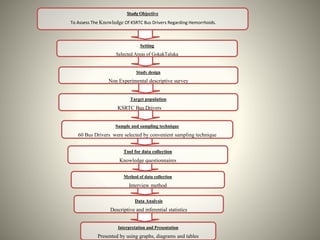
Study Objective
To Assess The Knowledge Of KSRTC Bus Drivers Regarding Hemorrhoids.
Setting
Selected Areas of GokakTaluka
Study design
Non Experimental descriptive survey
Target population
KSRTC Bus Drivers
Sample and sampling technique
60 Bus Drivers were selected by convenient sampling technique
Tool for data collection
Knowledge questionnaires
Method of data collection
Interview method
Data Analysis
Descriptive and inferential statistics
Interpretation and Presentation
Presented by using graphs, diagrams and tables
VARIABLES
• Research variable: Knowledge of KSRTC Bus Drivers regarding
hemorrhoids.
• Demographic variables: Age, education status, source of information, year
of service, religion etc
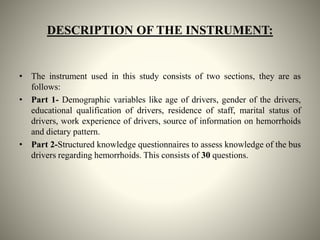
DESCRIPTION OF THE INSTRUMENT:
• The instrument used in this study consists of two sections, they are as
follows:
• Part 1- Demographic variables like age of drivers, gender of the drivers,
educational qualification of drivers, residence of staff, marital status of
drivers, work experience of drivers, source of information on hemorrhoids
and dietary pattern.
• Part 2-Structured knowledge questionnaires to assess knowledge of the bus
drivers regarding hemorrhoids. This consists of 30 questions.
PILOT STUDY REPORT
• A pilot study is a small scale version done in preparation for a main study.
The pilot study was conducted at arbhavi bus stop. The subjects were
selected by purposive sampling. Formal permission was obtained by the
authority. The consent was taken from the participants after explaining the
purpose of the study. The data was collected from the selected samples by
using structured interview schedule by interview method. A concise data
analysis was done by using descriptive and inferential statistics.
VALIDITY OF THE TOOL
• In order to measure the content validity the tool was given to experts from
different field such as 6 Medical Surgical Nursing and 2General Surgeons.
Based on the try out, suggestions given by the expert’s appropriate
modifications and reorganizations of certain items were made accordingly
and the tool was reframed. Later the tool was edited by an English expert
and translated into Kannada by language expert without changing the
meaning of the tool. It was found to be valid and suitable for bus drivers.
RELIABILITY
• Reliability of an instrument is the degree of consistency with which it
measures the attribute it is supposed be measure.
• The reliability of the tool was computed by using split half technique by
Spearman Brown prophecy formula. The reliability obtained for knowledge
tool was r =.89 . Hence, the tool was found to be highly reliable.
PRESENTATION OF DATA
• To begin with ,the data were entered in master sheet for tabulation and
statistical processing.
• The analysis of data is organized and presented under following sections :
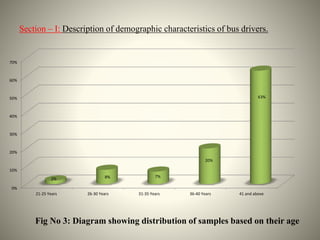
• Section – I: Description of demographic characteristics of bus drivers.
• Section – II: Distribution of Knowledge scores of bus drivers regarding
hemorrhoids.
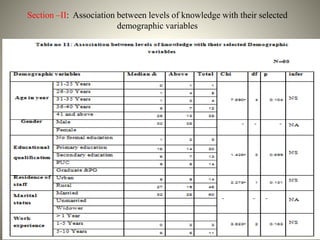
• Section –II: Association between levels of knowledge with their selected
demographic variables.
0%
10%
20%
30%
40%
50%
60%
70%
21-25 Years 26-30 Years 31-35 Years 36-40 Years 41 and above
2% 8% 7%
20%
63%
Fig No 3: Diagram showing distribution of samples based on their age
Section – I: Description of demographic characteristics of bus drivers.
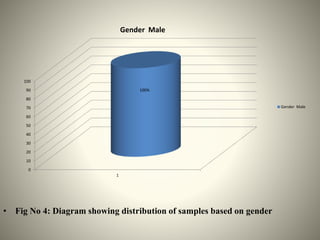
• Fig No 4: Diagram showing distribution of samples based on gender
0
10
20
30
40
50
60
70
80
90
100
1
100%
Gender Male
Gender Male
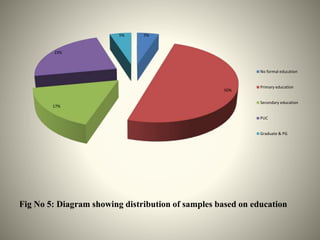
Fig No 5: Diagram showing distribution of samples based on education
5%
50%
17%
23%
5%
No formal education
Primary education
Secondary education
PUC
Graduate & PG
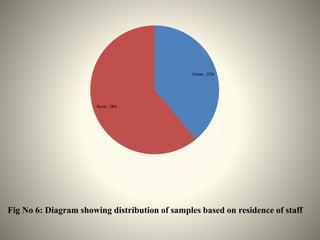
Urban , 22%
Rural , 78%
Fig No 6: Diagram showing distribution of samples based on residence of staff
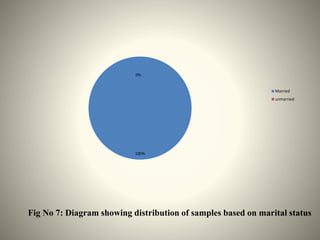
100%
0%
Married
unmarried
Fig No 7: Diagram showing distribution of samples based on marital status
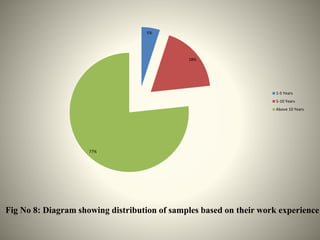
5%
18%
77%
1-5 Years
5-10 Years
Above 10 Years
Fig No 8: Diagram showing distribution of samples based on their work experience
0.00%
5.00%
10.00%
15.00%
20.00%
25.00%
30.00%
35.00%
40.00%
45.00%
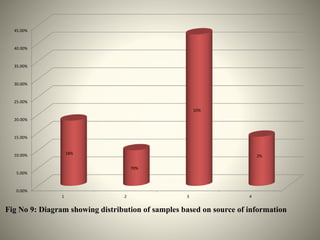
1 2 3 4
18%
70%
10%
2%
Fig No 9: Diagram showing distribution of samples based on source of information
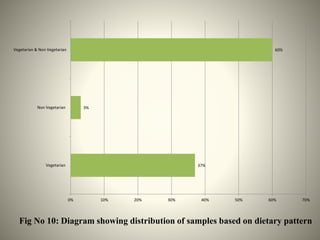
37%
3%
60%
0% 10% 20% 30% 40% 50% 60% 70%
Vegetarian
Non Vegetarian
Vegetarian & Non Vegetarian
Fig No 10: Diagram showing distribution of samples based on dietary pattern
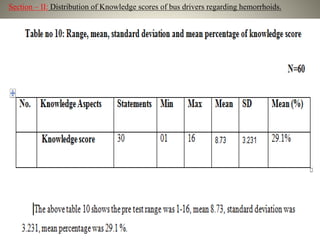
Section – II: Distribution of Knowledge scores of bus drivers regarding hemorrhoids.
0
5
10
15
20
25
30
35
40
45
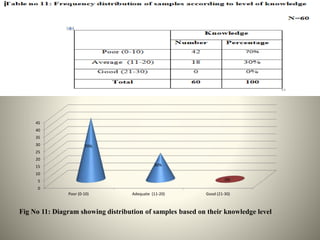
Poor (0-10) Adequate (11-20) Good (21-30)
70%
30%
0%
Fig No 11: Diagram showing distribution of samples based on their knowledge level
0% 5% 10% 15% 20% 25% 30% 35% 40% 45%
Overall
Meaning & Definitions
Incidence
Causes & risk factors
Signs & symptoms
Life style & prevention
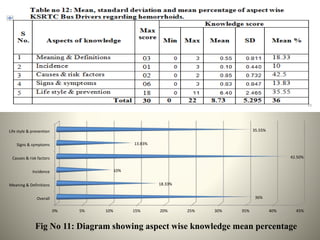
36%
18.33%
10%
42.50%
13.83%
35.55%
Fig No 11: Diagram showing aspect wise knowledge mean percentage
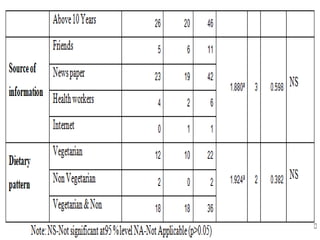
Section –II: Association between levels of knowledge with their selected
demographic variables
SUMMARY
• The primary aim of the present study was to assess the knowledge of ksrtc
bus drivers regarding hemorrhoids
• The conceptual frame work adopted for this study was based on modified
penders health promotion model .
• Review of literature was organized and presented
• The research design selected for this study was non experimental design.
NURSING IMPLICATIONS
• The findings of the present study have
implicated in
• Nursing practice
• Nursing education
• Nursing administration
• Nursing research
RECOMMENDATIONS
• On the basis of the findings of the study, the following recommendations
have been made for further study.
• A study can be conducted on a larger sample in different settings.
• A study to assess the effectiveness of structured teaching programme
regarding Haemorrhoids can be conducted.
CONCLUSION
• The overall knowledge score of the Ksrtc bus drivers revealed that 70%
had poor knowledge, 30% of them had adequate knowledge and none of
them were found to be with good knowledge.
• Mean score percent of knowledge in the aspect of knowledge regarding
meaning & definitions was 18%, knowledge regarding incidence was 10%,
knowledge regarding causes & risk factors was 42.5%, knowledge
regarding signs & symptoms was 13.83% , knowledge regarding life style
& prevention was 35.55% and overall mean percentage was 36%
• This indicates that KSRTC Bus Drivers had poor knowledge compared to
other aspects.
babu.pptx

babu.pptx

  • 1.
    SHRI J GCO-OPERATIVE HOSPITAL SOCIETY'S COLLEGE OF NURSING GHATAPRABHA Thesis Presentation REG NO:17NM144 MSc (N)-II YEAR MEDICAL SURGICAL NURSING Sub Spl:Cardiovascular and thoracic nursing
  • 2.
    INTRODUCTION • If yousuffer from hemorrhoids, you are in the company of some famous people. Napoleon Bonaparte was said to have had hemorrhoids, and some historians have actually debated whether he lost the Battle of Waterloo because he was unable to sit on his horse during the battle to lead his army. In 1978 President Jimmy Carter had to leave a party at the White House because of hemorrhoidal pain. The pain was so severe that he was incapacitated and could no longer perform his duties. He had surgery soon afterward, and returned to the Oval Office. George Brett, a third baseman for the Kansas City Royals, missed part of the World Series in 1980 because of hemorrhoids. Minor surgery was performed, so he could return quickly to the game the next day. 1
  • 3.
    According to TheMerck Manual definition hemorrhoids is Varicosities of the veins of the hemorrhoidal plexus, often complicated by inflammation, thrombosis, and bleeding. But a recent definition of hemorrhoids is “Vascular cushions, consisting of thick submucosa containing both venous and arterial blood vessels.7
  • 4.
    PROBLEM STATEMENT • “Astudy to assess the knowledge of hemorrhoids among KSRTC Bus Drivers in Gokak taluka , with a view to develop an information booklet.”
  • 5.
    OBJECTIVES • 1. Toassess the knowledge of hemorrhoids among KSRTC bus drivers. • 2. To find out the association between knowledge of hemorrhoids with selected demographic variables. • 3. To develop & distribute information booklet.
  • 6.
    HYPOTHESIS • H1: Therewill be significant association between knowledge of Hemorrhoids and selected demographic variables
  • 7.
    ASSUMPTION It is assumedthat KSRTC drivers may have some knowledge of hemorrhoids. • Inclusion criteria: • KSRTC Bus Drivers who are available at the time of data collection. • KSRTC Bus Drivers who are willing to participate in the study. • KSRTC Bus Drivers who are able to understand and read english or kannada. • Exclusion criteria • KSRTC Bus Drivers who are on long leave
  • 8.
  • 9.
    Demographic variables Age Gender Educational qualification Residence Marital status Workexperience Source of information Dietary pattern Identification of knowledge among ksrtc bus drivers by structured interview schedule. Likelihood of engaging in health promotional activities such as Life style modification Efficient use of resources Improvement in hygienic practices Adequate knowledge - Moderate knowledge knowledge Modifying Factors Cognitive Perceptual Factors Health Promotional Behavior Output Figure 1: Conceptual Framework Based on Modified Pender’s Health Promotion Model (1996) Included in study Not included in study
  • 10.
    REVIEW OF LITERATURES •Total 60 literature was included in this study which are related to occupational hemorrhoids.
  • 11.
    METHODOLOGY • Research Approach:descriptive survey approach • Research Design: non experimental design • Setting of the study:The study was undertaken in Gokak Taluk. • Sample size: 60
  • 12.
    Study Objective To AssessThe Knowledge Of KSRTC Bus Drivers Regarding Hemorrhoids. Setting Selected Areas of GokakTaluka Study design Non Experimental descriptive survey Target population KSRTC Bus Drivers Sample and sampling technique 60 Bus Drivers were selected by convenient sampling technique Tool for data collection Knowledge questionnaires Method of data collection Interview method Data Analysis Descriptive and inferential statistics Interpretation and Presentation Presented by using graphs, diagrams and tables
  • 13.
    VARIABLES • Research variable:Knowledge of KSRTC Bus Drivers regarding hemorrhoids. • Demographic variables: Age, education status, source of information, year of service, religion etc
  • 14.
    DESCRIPTION OF THEINSTRUMENT: • The instrument used in this study consists of two sections, they are as follows: • Part 1- Demographic variables like age of drivers, gender of the drivers, educational qualification of drivers, residence of staff, marital status of drivers, work experience of drivers, source of information on hemorrhoids and dietary pattern. • Part 2-Structured knowledge questionnaires to assess knowledge of the bus drivers regarding hemorrhoids. This consists of 30 questions.
  • 15.
    PILOT STUDY REPORT •A pilot study is a small scale version done in preparation for a main study. The pilot study was conducted at arbhavi bus stop. The subjects were selected by purposive sampling. Formal permission was obtained by the authority. The consent was taken from the participants after explaining the purpose of the study. The data was collected from the selected samples by using structured interview schedule by interview method. A concise data analysis was done by using descriptive and inferential statistics.
  • 16.
    VALIDITY OF THETOOL • In order to measure the content validity the tool was given to experts from different field such as 6 Medical Surgical Nursing and 2General Surgeons. Based on the try out, suggestions given by the expert’s appropriate modifications and reorganizations of certain items were made accordingly and the tool was reframed. Later the tool was edited by an English expert and translated into Kannada by language expert without changing the meaning of the tool. It was found to be valid and suitable for bus drivers.
  • 17.
    RELIABILITY • Reliability ofan instrument is the degree of consistency with which it measures the attribute it is supposed be measure. • The reliability of the tool was computed by using split half technique by Spearman Brown prophecy formula. The reliability obtained for knowledge tool was r =.89 . Hence, the tool was found to be highly reliable.
  • 18.
    PRESENTATION OF DATA •To begin with ,the data were entered in master sheet for tabulation and statistical processing. • The analysis of data is organized and presented under following sections : • Section – I: Description of demographic characteristics of bus drivers. • Section – II: Distribution of Knowledge scores of bus drivers regarding hemorrhoids. • Section –II: Association between levels of knowledge with their selected demographic variables.
  • 19.
    0% 10% 20% 30% 40% 50% 60% 70% 21-25 Years 26-30Years 31-35 Years 36-40 Years 41 and above 2% 8% 7% 20% 63% Fig No 3: Diagram showing distribution of samples based on their age Section – I: Description of demographic characteristics of bus drivers.
  • 20.
    • Fig No4: Diagram showing distribution of samples based on gender 0 10 20 30 40 50 60 70 80 90 100 1 100% Gender Male Gender Male
  • 21.
    Fig No 5:Diagram showing distribution of samples based on education 5% 50% 17% 23% 5% No formal education Primary education Secondary education PUC Graduate & PG
  • 22.
    Urban , 22% Rural, 78% Fig No 6: Diagram showing distribution of samples based on residence of staff
  • 23.
    100% 0% Married unmarried Fig No 7:Diagram showing distribution of samples based on marital status
  • 24.
    5% 18% 77% 1-5 Years 5-10 Years Above10 Years Fig No 8: Diagram showing distribution of samples based on their work experience
  • 25.
    0.00% 5.00% 10.00% 15.00% 20.00% 25.00% 30.00% 35.00% 40.00% 45.00% 1 2 34 18% 70% 10% 2% Fig No 9: Diagram showing distribution of samples based on source of information
  • 26.
    37% 3% 60% 0% 10% 20%30% 40% 50% 60% 70% Vegetarian Non Vegetarian Vegetarian & Non Vegetarian Fig No 10: Diagram showing distribution of samples based on dietary pattern
  • 27.
    Section – II:Distribution of Knowledge scores of bus drivers regarding hemorrhoids.
  • 28.
    0 5 10 15 20 25 30 35 40 45 Poor (0-10) Adequate(11-20) Good (21-30) 70% 30% 0% Fig No 11: Diagram showing distribution of samples based on their knowledge level
  • 29.
    0% 5% 10%15% 20% 25% 30% 35% 40% 45% Overall Meaning & Definitions Incidence Causes & risk factors Signs & symptoms Life style & prevention 36% 18.33% 10% 42.50% 13.83% 35.55% Fig No 11: Diagram showing aspect wise knowledge mean percentage
  • 30.
    Section –II: Associationbetween levels of knowledge with their selected demographic variables
  • 32.
    SUMMARY • The primaryaim of the present study was to assess the knowledge of ksrtc bus drivers regarding hemorrhoids • The conceptual frame work adopted for this study was based on modified penders health promotion model . • Review of literature was organized and presented • The research design selected for this study was non experimental design.
  • 33.
    NURSING IMPLICATIONS • Thefindings of the present study have implicated in • Nursing practice • Nursing education • Nursing administration • Nursing research
  • 34.
    RECOMMENDATIONS • On thebasis of the findings of the study, the following recommendations have been made for further study. • A study can be conducted on a larger sample in different settings. • A study to assess the effectiveness of structured teaching programme regarding Haemorrhoids can be conducted.
  • 35.
    CONCLUSION • The overallknowledge score of the Ksrtc bus drivers revealed that 70% had poor knowledge, 30% of them had adequate knowledge and none of them were found to be with good knowledge. • Mean score percent of knowledge in the aspect of knowledge regarding meaning & definitions was 18%, knowledge regarding incidence was 10%, knowledge regarding causes & risk factors was 42.5%, knowledge regarding signs & symptoms was 13.83% , knowledge regarding life style & prevention was 35.55% and overall mean percentage was 36% • This indicates that KSRTC Bus Drivers had poor knowledge compared to other aspects.