INTRODUCTION:
 The field of quality assurance is an old as modern nursing. “FLORENCE
NIGHTINGALE” introduced the concept of quality nursing care in 1855
while attending the soldiers in the hospital during the Crimean war.
 Quality assurance necessitates that institutions and health
professionals render care in a most efficient, effective and economical
manner. This entails a cost benefit analysis to define strategies for
optimum utilization of resources, focus on cost effective methods and
introduce systematic ongoing quality control programmes to
continuously monitor and improve the quality of care rendered.
DEFINITION
 A quality assurance programme is an ongoing systemic process
designed to evaluate and promote excellence in the health care
provided to the clients.
- KOZIER-
 It is a sequential process that involves setting standards of care,
measuring patient care, according to those standards, gathering
data from chart review, observing patient care, interviewing patient
care givers and then making recommendations for improvement.
- F.A.DAVIS-
CONCEPTS
 Quality assurance originated in manufacturing industry. The
idea was to ensure that the product consistently achieved
customer satisfaction.
 quality assurance is dynamic process through which nurses
assume accountability for quality of care they provide.
 It is a guarantee to the society that services provided by nurses
are being regulated by members of profession.
APPROACHES
 General approach:
it involves large governing of persons or agency ability to meet
established criteria or standards at a given time.
 Specific approach:
Quality assurances are methods to evaluate identifies
instances of providers and client interaction.
GENERAL APPROACH
 CREDENTIALING:
Credentialing refers to ways in which professional competence is
ensured and maintained. Three processes are used for credentialing
in nursing. They are accreditation, licensure and certification.
 LICENSURE:
Licensure is a specialized form of credentialing based on laws passed
by a state legislature. A license is a legal document that permits a
person to offer to the public skills and knowledge in a particular
jurisdiction, where such practice would otherwise be unlawful
without a license.
 ACCREDITATION:
State legislative bodies have authority to enact laws controlling
occupational and professional groups. Nursing is one of the groups
operating under state laws that promote the general welfare by
determining minimum standards of education through accreditation
of school of nursing.
 CERTIFICATION
Where as licensure measures entry-level competence, certification
validates specialty knowledge, experience and clinical judgment.
Nursing certification is offered by professional organizations.
SPECIFIC APPROACH
 PEER REVIEW:
Peer review is an organized effort whereby practicing
professionals review the quality and appropriateness of
services ordered or performed by their professional peers.
Peer Review in Nursing is the process by which practicing
Registered Nurses systematically assess, monitor and make
judgments about the quality of nursing care provided by peers,
as measured against professional standards of practice.
ANA,1988
SPECIAL APPROACH
 STANDARD:
Standard is a pre-determined baseline condition or level of
excellence that comprises a model to be followed and
practiced
CLASSIFICATION:
- Normative and empirical standard
- Ends and means standard
- Structure, process and outcome standard
 SOURCES:
•Professional organization, e.g. Associations, TNAI,
•Licensing bodies, e.g. Statutory bodies, INC,
•Institutions/health care agencies, e.g. University Hospitals, Health
Centers.
•Department of institutions, e.g. Department of Nursing.
•Patient care units, e.g. specific patients' unit.
•Government units at National, State and Local Government units.
•Individual e.g. personal standards
NURSING AUDIT
DEFINITION:
Nursing audit is defined as “an evaluation of patient care and
analysis of the written records maintained by nurses in
patients treatment profile”.
TYPES OF NURSING AUDIT:
 Concurrent nursing audit
 Retrospective nursing audit
PURPOSE
 To provide the evidence of the quality of nursing services being
rendered.
 To evaluate nursing administrative, supervise nursing care practice.
 To measure progress.
 Identify problems.
 To promote the maintenance of medical records.
 To increase medico-legal protection..
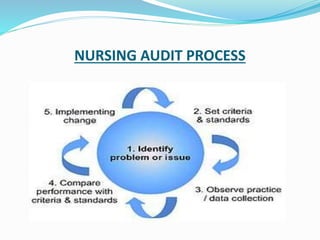
NURSING AUDIT PROCESS
MODEL OF QUALITY ASSURANCE
 ANA MODEL OF QUALITY ASSURANCE:
1) Identify values
2) Identify structure, process and outcome standards and criteria
3) Select measurement
4) Make interpretation
5) Identify course of action
6) Choose action
7) Take action
8) Reevaluate
FACTORS AFFECTING QUALITY ASSURANCE
 Lack of resources
 Personal problems
 Unreasonable patients and attendants
 Improper maintenance
 Absence of accreditation laws
• Legal redress
•Lack of incident review procedures
•Lack of good hospital information system
•Absence of conducting patient satisfaction surveys
FRAMEWORK FOR QUALITY ASSURANCE
Lang (1976):
•Identify and agree values
•Review literature, Known QAP
•Analyze available programmes
•Determine most appropriate QAP
•Establish structure, plans, outcome criteria and standards
•Ratify standards and criteria
 Evaluate current levels of nursing practice against ratified
structures
•Identify and analyze factors contributing to results
•Select appropriate actions to maintain or improve care
•Implement selected actions
•Evaluate QAO
QUALITY ASSURANCE PROCESS
1.Establishment of standards or criteria
2.Identify the information relevant to criteria
3.Determine ways to collect information
4.Collect and analyze the information
5.Compare collected information with established criteria
….
6.Make a judgment about quality
7.Provide information and if necessary, take corrective action
regarding findings of appropriate sources
8.Determine ways to collect the information
IMPACT OF QUALITY ASSURANCE IN
NURSING
 Nurses are accountable for their actions
 Nurses can deliver a high standard of care
 Guaranteeing standards of care to the public
 Nurses are actively involved in audit and consumer relations
 Improves the overall quality of nursing care
 Improves all type of documentation and communication
 Helps in professional growth
 Helps to maintain international standard
 Helps to compare the standard with another institution
 Avoids malpractice and bias
CONCLUSION:
 Quality assurance programme will helps to improve the quality
of nursing care and professional development. Individuals with
the profession must assume responsibility for their
professional actions and be answerable to the recipients for
their care.
BIBLIOGRAPHY
 Kozier, fundamental of nursing, Dorling Kindersley pvt.ltd, second edition,
2006, p.no: 202, 360-361.
 F.A. Davis, legal ethical and political issues in nursing, Davis Company, second
edition, 1994, p.no: 231-244.
 Carol Taylor, fundamental of nursing, Lippincott publications, sixth edition,
2005, p.no: 328-331.
 Dugas, introduction to patient care, saunder publications, fourth publications,
2001, p.no: 97.
 Potter and Perry, fundamental of nursing, Mosby publications, fourth edition,
1997, p.no: 44, 172-176.
JOURNAL:
Nurses of India, July 2006, vol-7, p.no: 9-10.
Nurses of India, July 15, 2008, vol – 9, p.no: 5-6.
Nursing journal of India, august 1999, vol-8, p.no: 173.
NET:
http:// currentnursing.com/nursing management/total
qualitymanagementhealthcare.html
www.indiannursingcouncil.com/qualityassuranceinnursing-standards.

quality assurance in nursing.pdf

  • 2.
    INTRODUCTION:  The fieldof quality assurance is an old as modern nursing. “FLORENCE NIGHTINGALE” introduced the concept of quality nursing care in 1855 while attending the soldiers in the hospital during the Crimean war.  Quality assurance necessitates that institutions and health professionals render care in a most efficient, effective and economical manner. This entails a cost benefit analysis to define strategies for optimum utilization of resources, focus on cost effective methods and introduce systematic ongoing quality control programmes to continuously monitor and improve the quality of care rendered.
  • 3.
    DEFINITION  A qualityassurance programme is an ongoing systemic process designed to evaluate and promote excellence in the health care provided to the clients. - KOZIER-  It is a sequential process that involves setting standards of care, measuring patient care, according to those standards, gathering data from chart review, observing patient care, interviewing patient care givers and then making recommendations for improvement. - F.A.DAVIS-
  • 4.
    CONCEPTS  Quality assuranceoriginated in manufacturing industry. The idea was to ensure that the product consistently achieved customer satisfaction.  quality assurance is dynamic process through which nurses assume accountability for quality of care they provide.  It is a guarantee to the society that services provided by nurses are being regulated by members of profession.
  • 5.
    APPROACHES  General approach: itinvolves large governing of persons or agency ability to meet established criteria or standards at a given time.  Specific approach: Quality assurances are methods to evaluate identifies instances of providers and client interaction.
  • 6.
    GENERAL APPROACH  CREDENTIALING: Credentialingrefers to ways in which professional competence is ensured and maintained. Three processes are used for credentialing in nursing. They are accreditation, licensure and certification.  LICENSURE: Licensure is a specialized form of credentialing based on laws passed by a state legislature. A license is a legal document that permits a person to offer to the public skills and knowledge in a particular jurisdiction, where such practice would otherwise be unlawful without a license.
  • 7.
     ACCREDITATION: State legislativebodies have authority to enact laws controlling occupational and professional groups. Nursing is one of the groups operating under state laws that promote the general welfare by determining minimum standards of education through accreditation of school of nursing.  CERTIFICATION Where as licensure measures entry-level competence, certification validates specialty knowledge, experience and clinical judgment. Nursing certification is offered by professional organizations.
  • 8.
    SPECIFIC APPROACH  PEERREVIEW: Peer review is an organized effort whereby practicing professionals review the quality and appropriateness of services ordered or performed by their professional peers. Peer Review in Nursing is the process by which practicing Registered Nurses systematically assess, monitor and make judgments about the quality of nursing care provided by peers, as measured against professional standards of practice. ANA,1988
  • 9.
    SPECIAL APPROACH  STANDARD: Standardis a pre-determined baseline condition or level of excellence that comprises a model to be followed and practiced CLASSIFICATION: - Normative and empirical standard - Ends and means standard - Structure, process and outcome standard
  • 10.
     SOURCES: •Professional organization,e.g. Associations, TNAI, •Licensing bodies, e.g. Statutory bodies, INC, •Institutions/health care agencies, e.g. University Hospitals, Health Centers. •Department of institutions, e.g. Department of Nursing. •Patient care units, e.g. specific patients' unit. •Government units at National, State and Local Government units. •Individual e.g. personal standards
  • 11.
    NURSING AUDIT DEFINITION: Nursing auditis defined as “an evaluation of patient care and analysis of the written records maintained by nurses in patients treatment profile”. TYPES OF NURSING AUDIT:  Concurrent nursing audit  Retrospective nursing audit
  • 12.
    PURPOSE  To providethe evidence of the quality of nursing services being rendered.  To evaluate nursing administrative, supervise nursing care practice.  To measure progress.  Identify problems.  To promote the maintenance of medical records.  To increase medico-legal protection..
  • 13.
  • 14.
    MODEL OF QUALITYASSURANCE  ANA MODEL OF QUALITY ASSURANCE: 1) Identify values 2) Identify structure, process and outcome standards and criteria 3) Select measurement 4) Make interpretation 5) Identify course of action 6) Choose action 7) Take action 8) Reevaluate
  • 15.
    FACTORS AFFECTING QUALITYASSURANCE  Lack of resources  Personal problems  Unreasonable patients and attendants  Improper maintenance  Absence of accreditation laws
  • 16.
    • Legal redress •Lackof incident review procedures •Lack of good hospital information system •Absence of conducting patient satisfaction surveys
  • 17.
    FRAMEWORK FOR QUALITYASSURANCE Lang (1976): •Identify and agree values •Review literature, Known QAP •Analyze available programmes •Determine most appropriate QAP •Establish structure, plans, outcome criteria and standards •Ratify standards and criteria
  • 18.
     Evaluate currentlevels of nursing practice against ratified structures •Identify and analyze factors contributing to results •Select appropriate actions to maintain or improve care •Implement selected actions •Evaluate QAO
  • 19.
    QUALITY ASSURANCE PROCESS 1.Establishmentof standards or criteria 2.Identify the information relevant to criteria 3.Determine ways to collect information 4.Collect and analyze the information 5.Compare collected information with established criteria
  • 20.
    …. 6.Make a judgmentabout quality 7.Provide information and if necessary, take corrective action regarding findings of appropriate sources 8.Determine ways to collect the information
  • 21.
    IMPACT OF QUALITYASSURANCE IN NURSING  Nurses are accountable for their actions  Nurses can deliver a high standard of care  Guaranteeing standards of care to the public  Nurses are actively involved in audit and consumer relations  Improves the overall quality of nursing care
  • 22.
     Improves alltype of documentation and communication  Helps in professional growth  Helps to maintain international standard  Helps to compare the standard with another institution  Avoids malpractice and bias
  • 23.
    CONCLUSION:  Quality assuranceprogramme will helps to improve the quality of nursing care and professional development. Individuals with the profession must assume responsibility for their professional actions and be answerable to the recipients for their care.
  • 24.
    BIBLIOGRAPHY  Kozier, fundamentalof nursing, Dorling Kindersley pvt.ltd, second edition, 2006, p.no: 202, 360-361.  F.A. Davis, legal ethical and political issues in nursing, Davis Company, second edition, 1994, p.no: 231-244.  Carol Taylor, fundamental of nursing, Lippincott publications, sixth edition, 2005, p.no: 328-331.  Dugas, introduction to patient care, saunder publications, fourth publications, 2001, p.no: 97.  Potter and Perry, fundamental of nursing, Mosby publications, fourth edition, 1997, p.no: 44, 172-176.
  • 25.
    JOURNAL: Nurses of India,July 2006, vol-7, p.no: 9-10. Nurses of India, July 15, 2008, vol – 9, p.no: 5-6. Nursing journal of India, august 1999, vol-8, p.no: 173. NET: http:// currentnursing.com/nursing management/total qualitymanagementhealthcare.html www.indiannursingcouncil.com/qualityassuranceinnursing-standards.