• In the ever-evolving landscape of healthcare, ensuring that future
healthcare professionals are not only competent but also equipped to
confront the emerging challenges is paramount. In pursuit of this noble
goal, Kushma Education Society stands as a beacon of excellence in
healthcare education.
• Established with a visionary outlook to provide high-tech healthcare
education to society, Kushma Education Society envisions a world where
proficient healthcare professionals serve as pillars of support for the
community, dedicating themselves to the welfare of the needy.
KUSHMA EDUCATION SOCIETY (KES)
"Empowering Future Healthcare Leaders: Innovating Education,
Transforming Health"
Kushma Education Society is committed to providing world-
class healthcare education by establishing cutting-edge
healthcare Institutes. Our mission is to equip students with
advanced knowledge, skills, and technology, preparing them to
address global healthcare challenges. We strive to foster a
culture of continuous learning, research, and collaboration to
positively impact the healthcare landscape.
Vision, Mission of KES
Values of KES
1) Education: Encouraging continuous education and the dissemination of knowledge as a
lifelong pursuit.
2) Quality Assurance: Committed to providing high-quality education and ensuring consistency
and reliability in all aspects of our services.
3) Professionalism: Upholding professionalism, ethics, and a strong sense of responsibility in all
interactions within the academic and professional sphere.
4) Motivation: Fostering motivation, inspiring goals, and cultivating dedication to the
advancement of healthcare education.
5) Identity: Nurturing a sense of unity, identity, and inclusiveness within the KES community,
celebrating diversity and individual and collective achievements.
6) Equality: Promoting fairness, inclusivity, and equal opportunities for all students and staff,
irrespective of background, gender, ethnicity, or socioeconomic status.
7) Success: Recognizing and celebrating accomplishments and emphasizing the importance of
making a positive impact in the lives of students, the healthcare sector, and society as a whole.
Objectives of KUSHMA Education Society
K
U
S
H
M
A
nowledge Advancement
tilizing Technology
tudent Empowerment
ealthcare Innovation
entorship & Professional Development Programme
daptive Learning Initiatives
• Knowledge Advancement: To implement a structured program to continuously enhance knowledge
and skills of students and faculty through workshops, seminars, and professional development
opportunities.
• Utilizing Technology: To implement advanced healthcare technology and digital tools to enhance
learning experiences, research capabilities, and practical training for students.
• Student Empowerment: To establish initiatives to cultivate leadership qualities, communication
skills, and teamwork among students, preparing them to be confident and effective contributors in
the healthcare sector.
• Healthcare Innovation: To create an innovation hub within the institution to encourage students
and faculty to collaborate and innovate in healthcare-related projects, fostering creative solutions to
healthcare challenges.
• Mentorship & Professional Development Programme: To implement a structured mentorship
program connecting students with healthcare professionals, fostering guidance, career advice, and
personal development to enhance their readiness for the healthcare industry.
• Adaptive Learning Initiatives: To integrate adaptive learning methodologies and personalized
education approaches, tailoring the learning experience to individual student needs and optimizing
comprehension and application of healthcare knowledge.
Objectives of KUSHMA Education Society
KUSHMA EDUCATION SOCIETY
PATRONS & STAFF
KUSHMA EDUCATION SOCIETY
As the President of Kushma Education
Society, Dr. Abhishek Patil brings to the
fore an extraordinary vision. His
objective is clear and compelling: to
prepare future healthcare professionals
who possess the requisite skills,
knowledge, and resilience to face the
multifaceted challenges that lie ahead in
the realm of healthcare.
Dr. Abhishek Patil
President
KUSHMA EDUCATION SOCIETY
Qualification: MBBS in Lugansk State
Medical University, Ukraine
MD in Shri B M Patil Medical
College, Vijayapura
Experience :Served as Consultant
Physician at SDM Hospital,
Dharwad & HCG Cancer
Hospital, Hubli
Managing Director (MD),
Sanjeevini Specialty Hospital
& Heart Care Center, Hubli
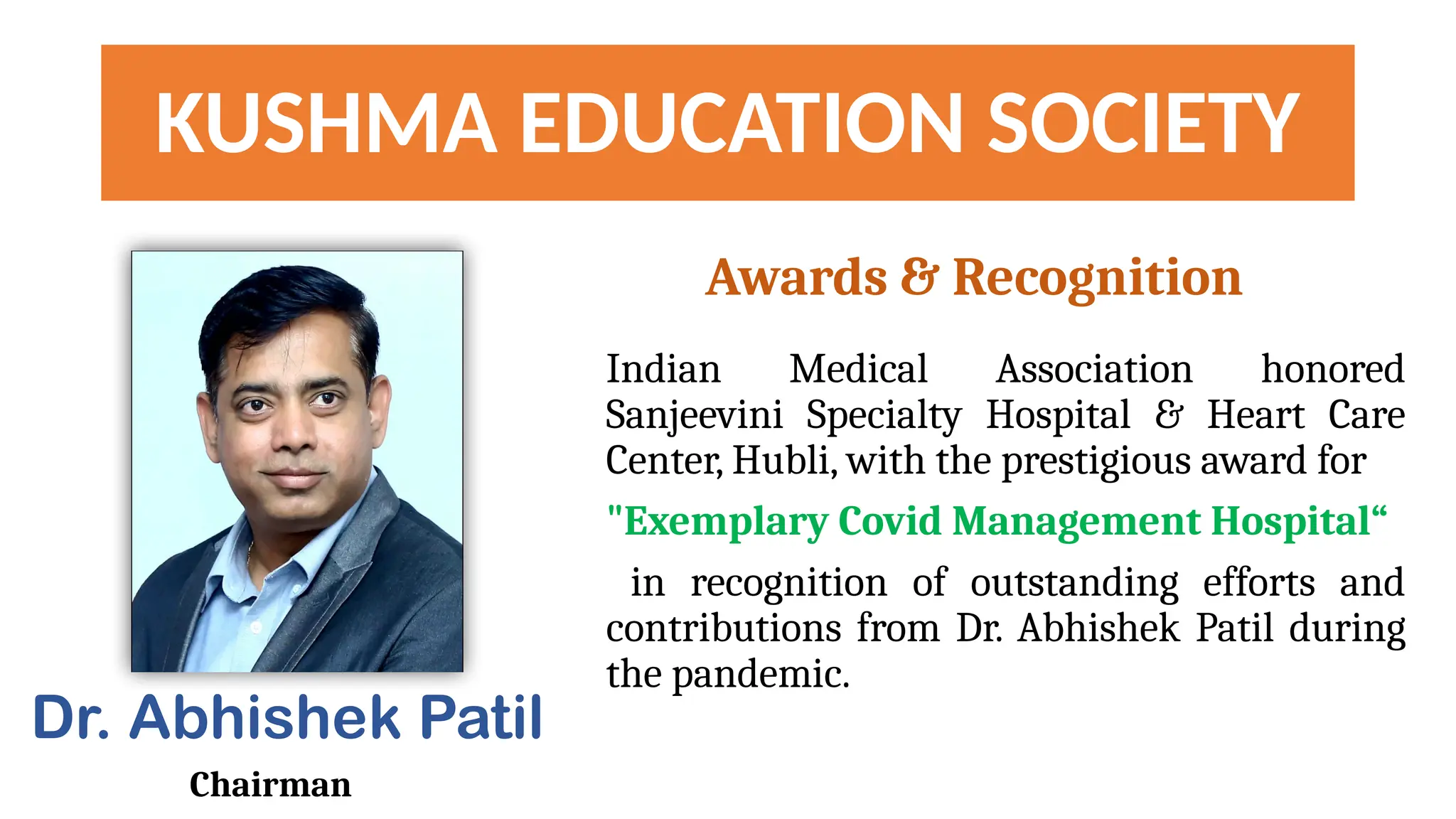
Dr. Abhishek Patil
Chairman
KUSHMA EDUCATION SOCIETY
Chairperson: H J Patil Foundation, Hubli
Projects :Preventive Healthcare
Checking & Training (PHCT)
project in collaboration with
Government of Karnataka in
Rural parts of Karnataka
Dr. Abhishek Patil
Chairman
KUSHMA EDUCATION SOCIETY
Indian Medical Association honored
Sanjeevini Specialty Hospital & Heart Care
Center, Hubli, with the prestigious award for
"Exemplary Covid Management Hospital“
in recognition of outstanding efforts and
contributions from Dr. Abhishek Patil during
the pandemic.
Dr. Abhishek Patil
Chairman
Awards & Recognition
KUSHMA EDUCATION SOCIETY
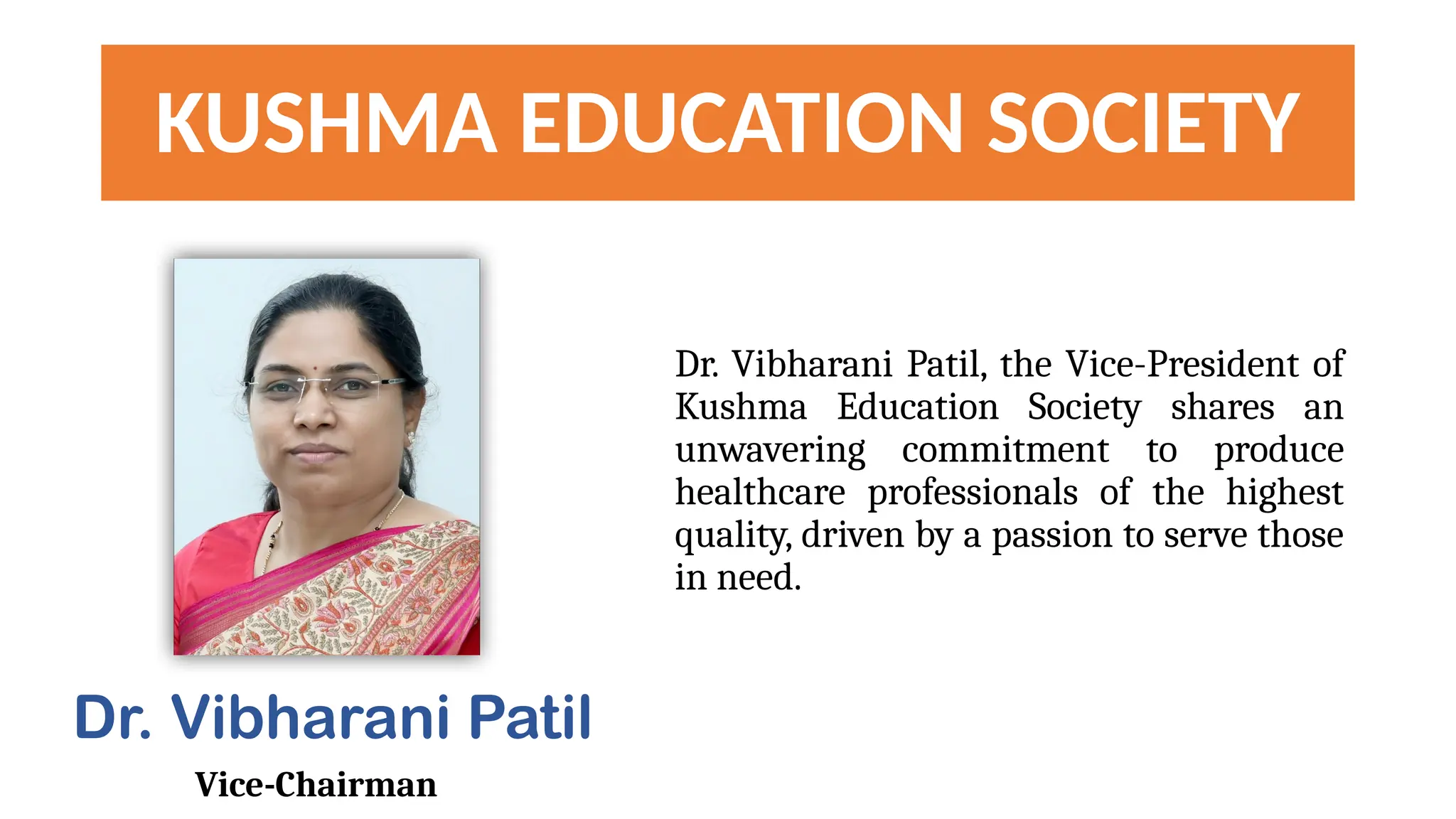
Dr. Vibharani Patil, the Vice-President of
Kushma Education Society shares an
unwavering commitment to produce
healthcare professionals of the highest
quality, driven by a passion to serve those
in need.
Dr. Vibharani Patil
Vice-Chairman
KUSHMA EDUCATION SOCIETY
Qualification: BHMS in RGUHS, Bangalore
Experience :Serving as Consultant
Physician at Sanjeevini
Specialty Hospital & Heart
Care Center, Hubli
Her vision aligns seamlessly with the mission
of Kushma Education Society, focusing on
developing individuals who not only excel in
their respective healthcare fields but also
demonstrate a profound dedication to
providing quality care to the society they serve.
Vice-Chairman
Dr. Vibharani Patil
Shri. Kushal V Avalakki
Secretary
Shri. Sheetal M Patil
Treasurer
Smt. Savita R Shedshale
Member
Member
Smt. Bharati M Patil Smt. Sulakshana S. Patil
Member
Complementing this academic
leadership is the proficient and skilled
Mrs. Anita Karigar, the CEO of Kushma
College of Nursing. Mrs. Karigar, an
adept administrator with a wealth of
experience in managing healthcare
institutes, brings a dynamic approach
to the efficient functioning of the
institution.
Mrs. Anita Karigar
Chief Executive Officer (CEO)
Mrs. Anita Karigar
Chief Executive Officer (CEO)
Qualification: MBA from Manipal University
Experience :a total 15 Years of
Administrative Experience
Achievements : Since 2011 Administered
20+ Health Institutions in
& around Karnataka
Her prowess in organizational management and
keen eye for detail contribute significantly to the
smooth and effective administration of the college,
ensuring a conducive environment for both
students and faculty alike.
Affiliated to Recognized by
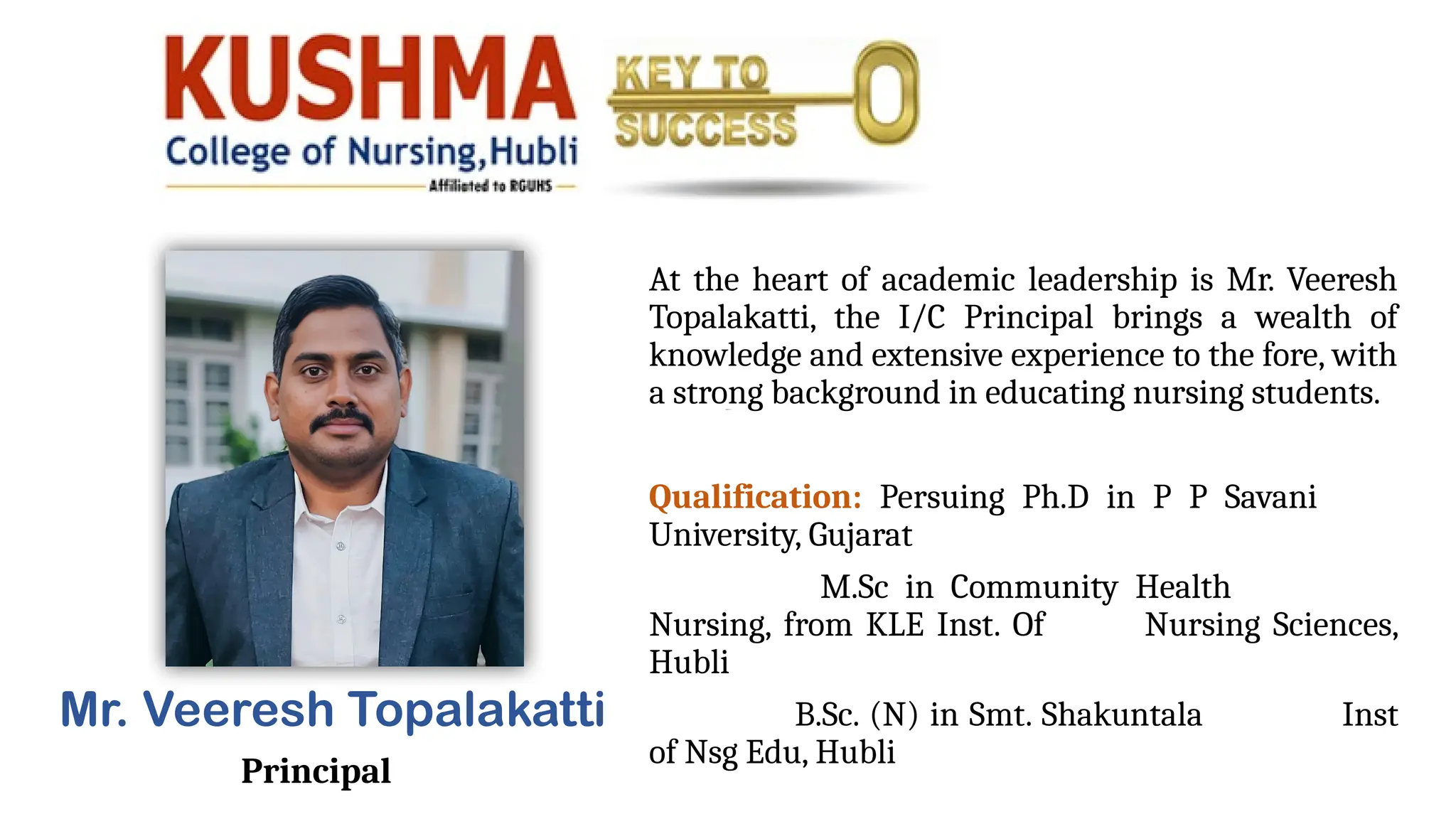
At the heart of academic leadership is Mr. Veeresh
Topalakatti, the I/C Principal brings a wealth of
knowledge and extensive experience to the fore, with
a strong background in educating nursing students.
Qualification: Persuing Ph.D in P P Savani
University, Gujarat
M.Sc in Community Health
Nursing, from KLE Inst. Of Nursing Sciences,
Hubli
B.Sc. (N) in Smt. Shakuntala Inst
of Nsg Edu, Hubli
Mr. Veeresh Topalakatti
Principal
Mr. Veeresh Topalakatti
Principal
Experience : a total of 16 year Academic
Experience in Nursing Education
Awards : “Best Academician Award” in
Uka Tarsadia University, Gujarat
“Best Teacher” Award in Smt.
Shakuntala Inst of Nsg Edu Hubli
Publication :
-Published Nursing Textbook under P V Publisher,
Punjab.
-Published Various Research Articles in Journals
-Selected as Resource Person for International &
National Seminars
Ms. Victoriya Kalpal
Asst. Professor
Qualification : M.Sc in OBG Nursingfrom Shreya
CON, Dharwad (2019-21)
B.Sc. (N) from H D Devegowda CON,
Hassan (2004-08)
Experience : 10 Years after UG
03 Years after PG
Possesses exceptional clinical expertise and
proficiency in her field.
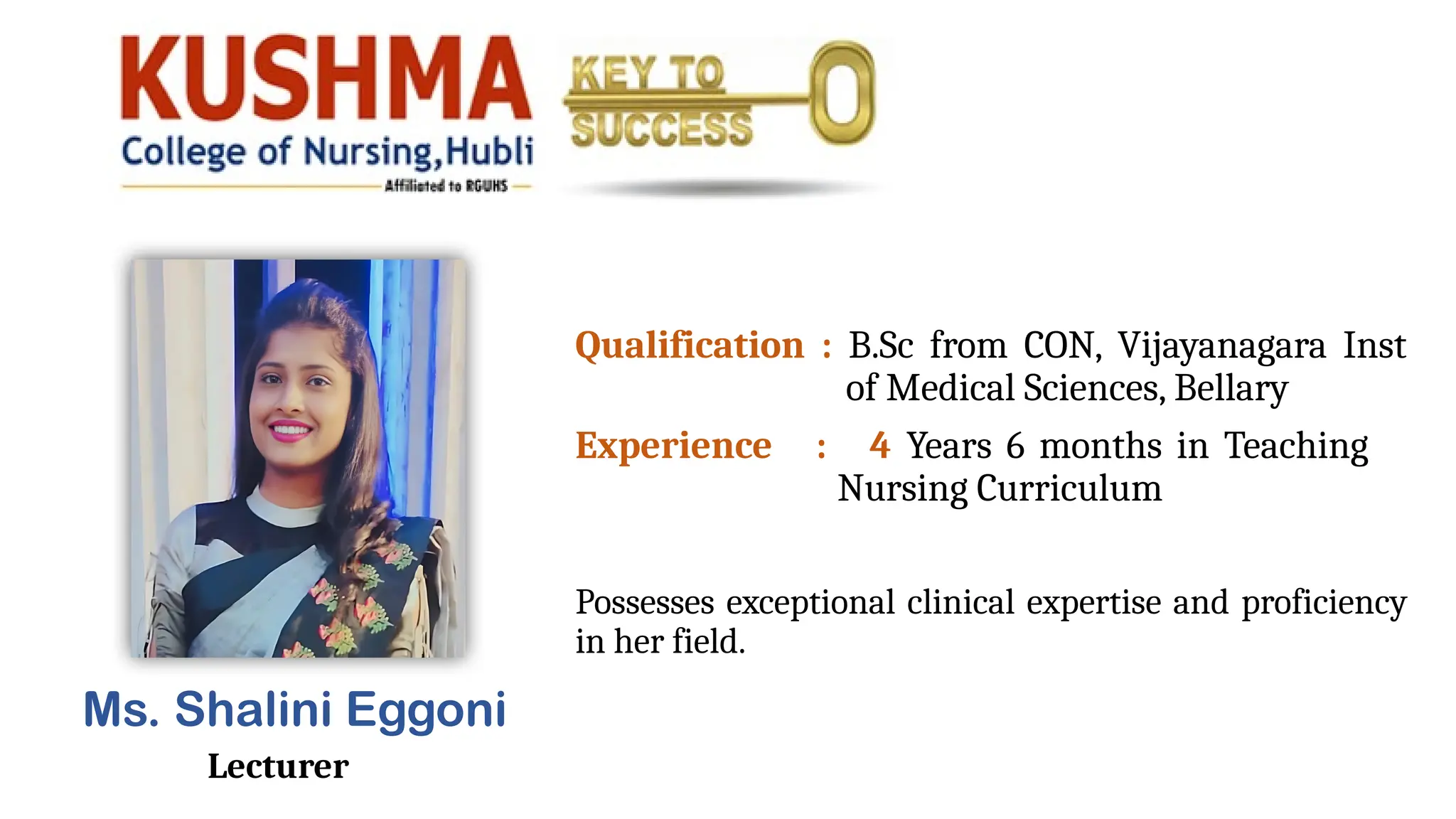
Ms. Shalini Eggoni
Lecturer
Qualification : B.Sc from CON, Vijayanagara Inst
of Medical Sciences, Bellary
Experience : 4 Years 6 months in Teaching
Nursing Curriculum
Possesses exceptional clinical expertise and proficiency
in her field.
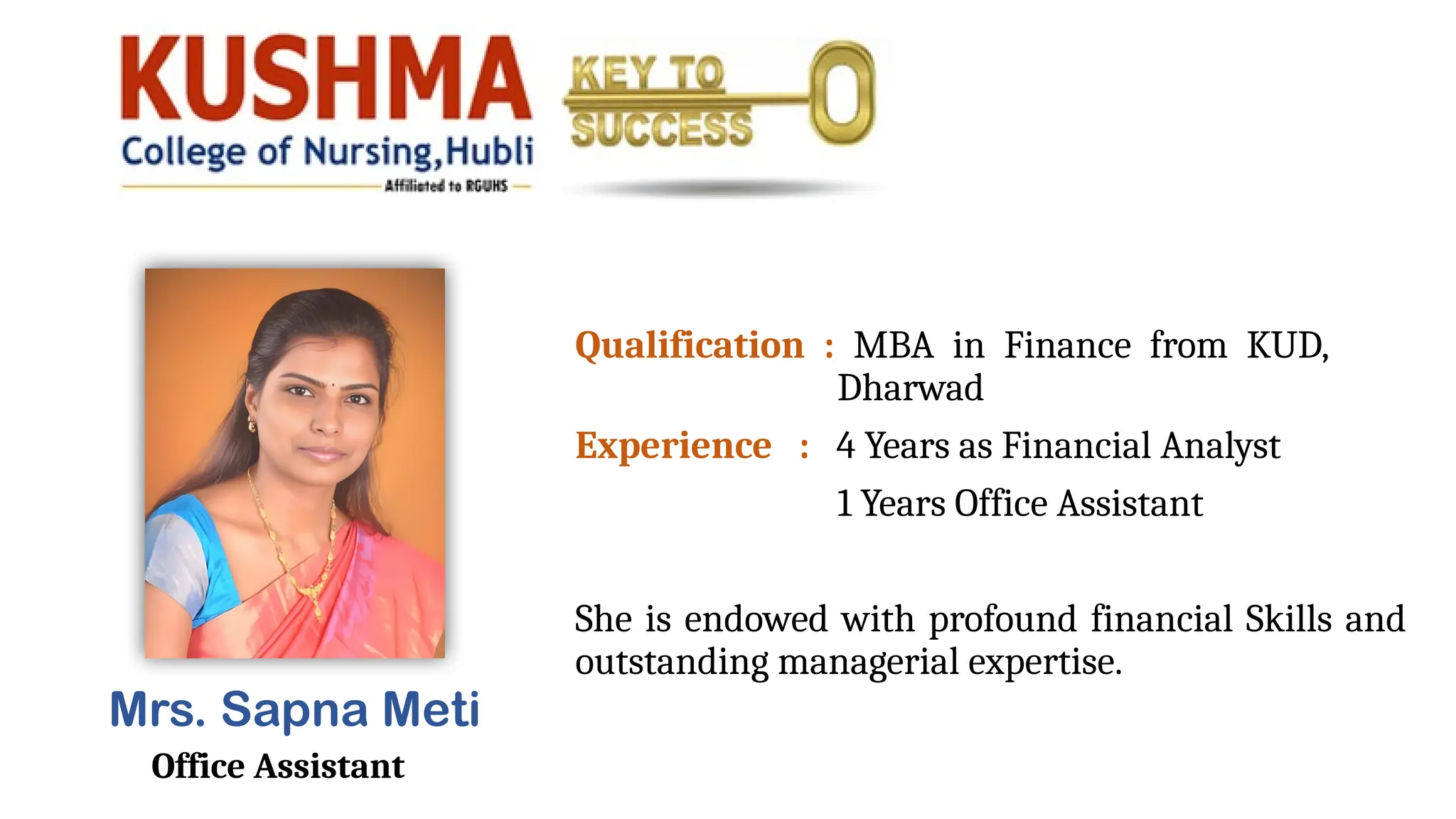
Mrs. Sapna Meti
Office Assistant
Qualification : MBA in Finance from KUD,
Dharwad
Experience : 4 Years as Financial Analyst
1 Years Office Assistant
She is endowed with profound financial Skills and
outstanding managerial expertise.
ORIENTATION TO B.Sc. NURSING COURSE
Presented by,
Mr. Veereshkumar Topalakatti. M.Sc. (N), Persuing Ph.D.
Principal, Kushma College of Nursing, Hubli
Curriculum Implementation: Overall Plan
Duration of the Program : 08 Semester
1st
to 7th
Semester : 26 Weeks / Semester
Semester Instruction : 20 Weeks
Vacation, Holidays, : 06 Weeks
Examination and
Preparatory Holidays
8th
Semester : 22 Weeks
Vacation, Holidays, : 04 Weeks
Examination and
Preparatory Holidays
Program Structure
I SEMESTER
Theory
1. Communicative English
2. Applied Anatomy
3. Applied Physiology
4. Applied Sociology
5. Applied Psychology
6. *Nursing Foundation I
Mandatory Module
• First Aid Module (Nursing Foundation I)
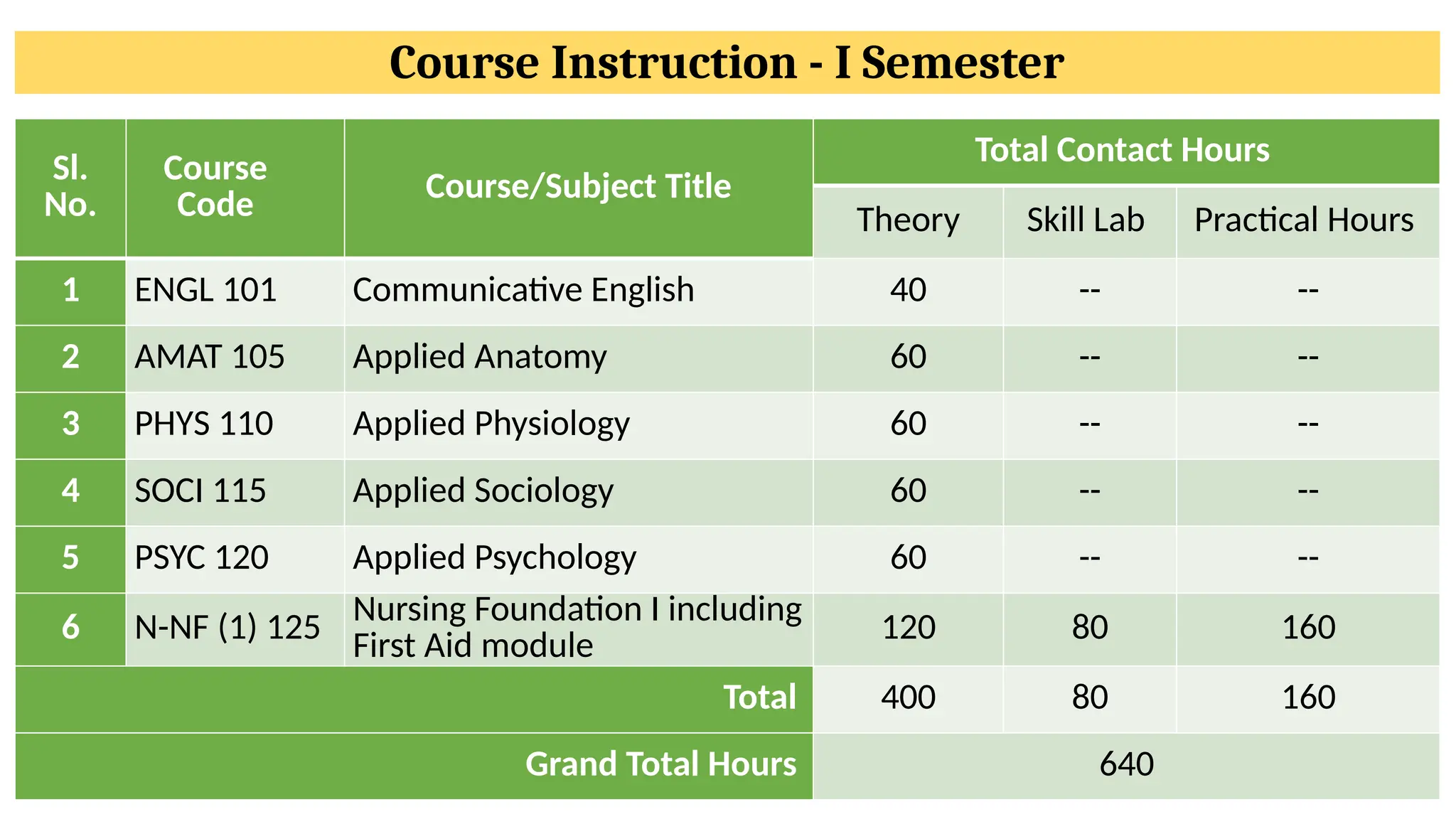
Course Instruction - I Semester
Sl.
No.
Course
Code Course/Subject Title
Total Contact Hours
Theory Skill Lab Practical Hours
1 ENGL 101 Communicative English 40 -- --
2 AMAT 105 Applied Anatomy 60 -- --
3 PHYS 110 Applied Physiology 60 -- --
4 SOCI 115 Applied Sociology 60 -- --
5 PSYC 120 Applied Psychology 60 -- --
6 N-NF (1) 125 Nursing Foundation I including
First Aid module
120 80 160
Total 400 80 160
Grand Total Hours 640
Scheme of Examination - I Semester
Sl.
No. Course
Assessment (Marks)
Internal
End
Semester
College
Exam
End Semester
University
Exam
Hours Total
Marks
Theory
1 Communicative English 25 25 -- 2 50
2
Applied Anatomy & Applied
Physiology 25 -- 75 3 100
3
Applied Sociology & Applied
Psychology
25 -- 75 3 100
4 Nursing Foundations I * 25 -- -- -- --
Practical
5 Nursing Foundations I * 25 -- -- -- --
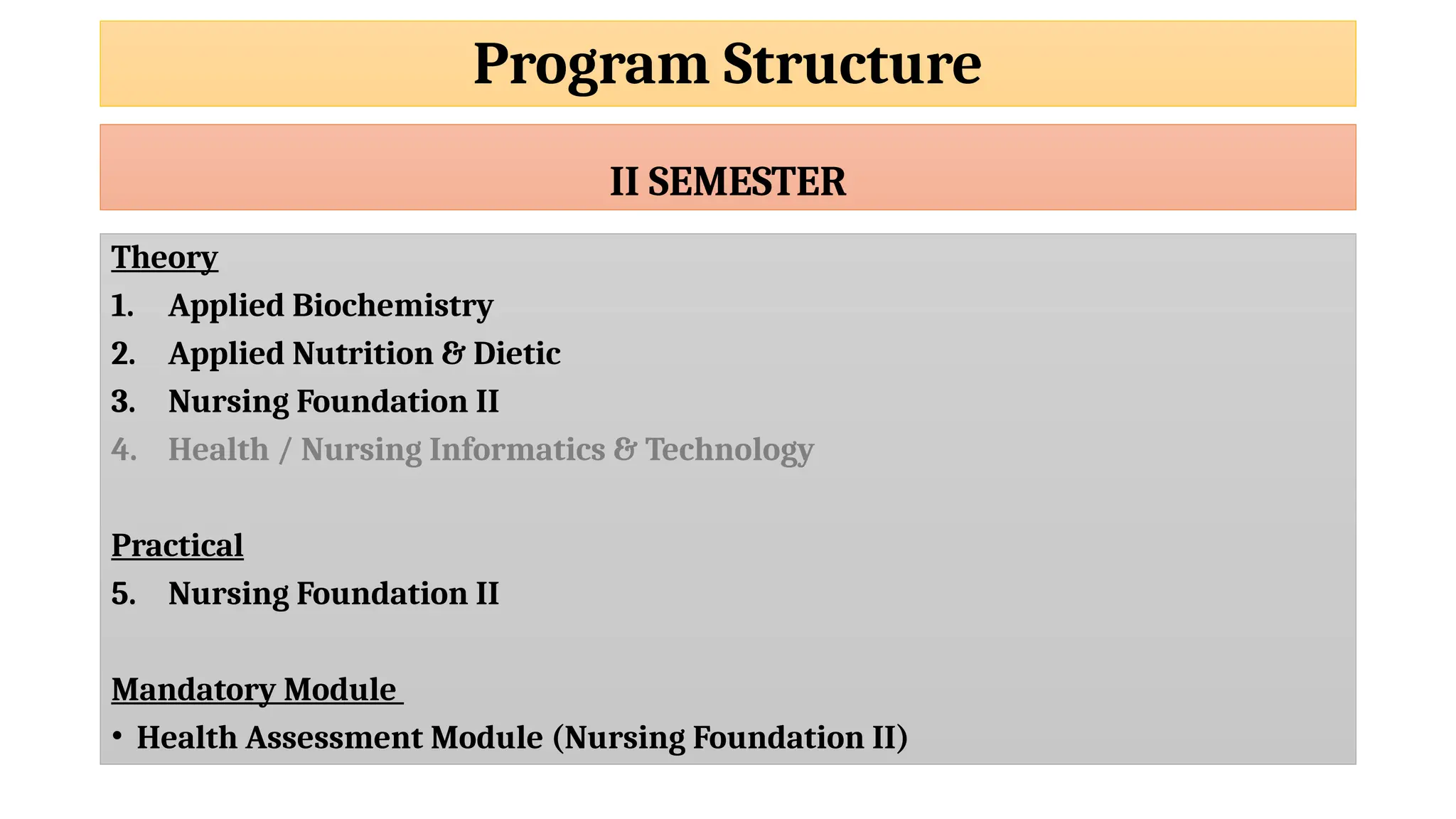
Program Structure
II SEMESTER
Theory
1. Applied Biochemistry
2. Applied Nutrition & Dietic
3. Nursing Foundation II
4. Health / Nursing Informatics & Technology
Practical
5. Nursing Foundation II
Mandatory Module
• Health Assessment Module (Nursing Foundation II)
Course Instruction - II Semester
Sl.
No.
Course
Code Course/Subject Title
Total Contact Hours
Theory Skill Lab Practical Hours
1 BIOC 135 Applied Biochemistry 40 -- --
2 NUTR 140 Applied Nutrition and
Dietetics
60 -- --
3 N-NF (II) 125 Nursing Foundation II including
Health Assessment module
120 120 320
4
HNIT 145 Health/Nursing Informatics &
Technology 40 40 --
Total 260 160 320
Grand Total Hours 740
Scheme of Examination - II Semester
Sl.
No. Course
Assessment (Marks)
Internal
End
Semester
College
Exam
End
Semester
University
Exam
Hours
Total
Marks
Theory
1
Applied Biochemistry & Applied
Nutrition and Dietetics 25 75 3 100
2 Nursing Foundation I & II 25 -- 75 3 100
3
Health/Nursing Informatics &
Technology 25 25 -- 2 50
Practical
4 Nursing Foundations I & II 50 -- 50 -- 100
Program Structure
III SEMESTER
Theory
1. Applied Microbiology & Infection Control including Safety
2. Pharmacology I
3. Pathology I
4. Adult Health Nursing I
Practical
5. Adult Health Nursing I
Mandatory Module
• BLS / BCLS Module (Adult Health Nursing I)
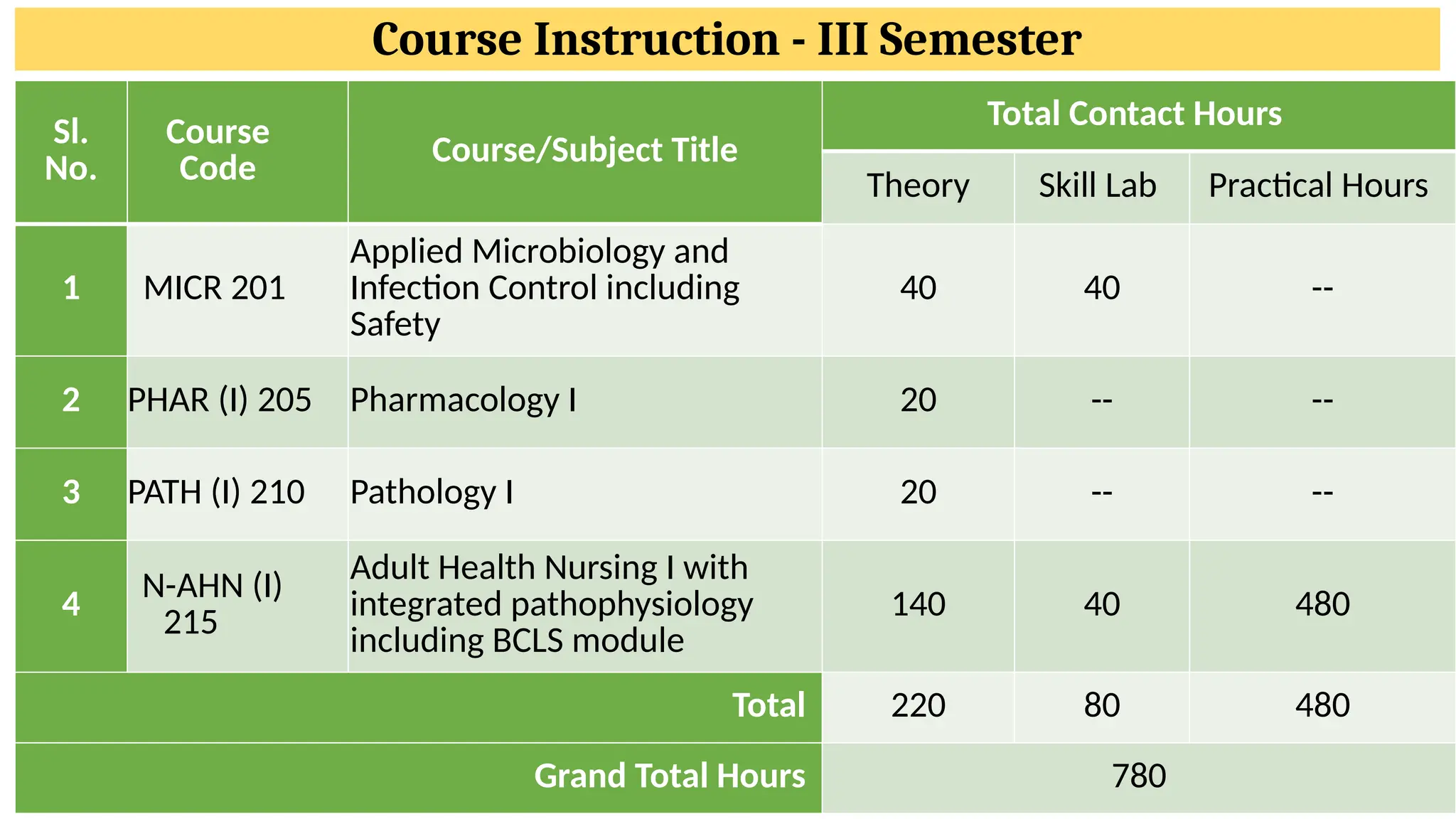
Course Instruction - III Semester
Sl.
No.
Course
Code Course/Subject Title
Total Contact Hours
Theory Skill Lab Practical Hours
1 MICR 201
Applied Microbiology and
Infection Control including
Safety
40 40 --
2 PHAR (I) 205 Pharmacology I 20 -- --
3 PATH (I) 210 Pathology I 20 -- --
4
N-AHN (I)
215
Adult Health Nursing I with
integrated pathophysiology
including BCLS module
140 40 480
Total 220 80 480
Grand Total Hours 780
Scheme of Examination - III Semester
Sl.
No. Course
Assessment (Marks)
Internal
End
Semester
College
Exam
End
Semester
University
Exam
Hours
Total
Marks
Theory
1
Applied Microbiology and
Infection Control including Safety 25 -- 75 3 100
2 Pharmacology I & Pathology I *25 -- -- -- --
3 Adult Health Nursing I 25 -- 75 3 100
Practical
4 Adult Health Nursing I 50 -- 50 -- 100
Program Structure
IV SEMESTER
Theory
1. Pharmacology II
2. Pathology II & Genetics
3. Adult Health Nursing II with integrated Pathophysiology including Geriatric
Nursing
4. Professionalism, Professional Values & Ethics including Bio-ethics
Practical
5. Adult Health Nursing II
Mandatory Module
• Fundamentals of Prescribing Module (Pharmacology II)
• Palliative Care Module (Adult Health Nursing II)
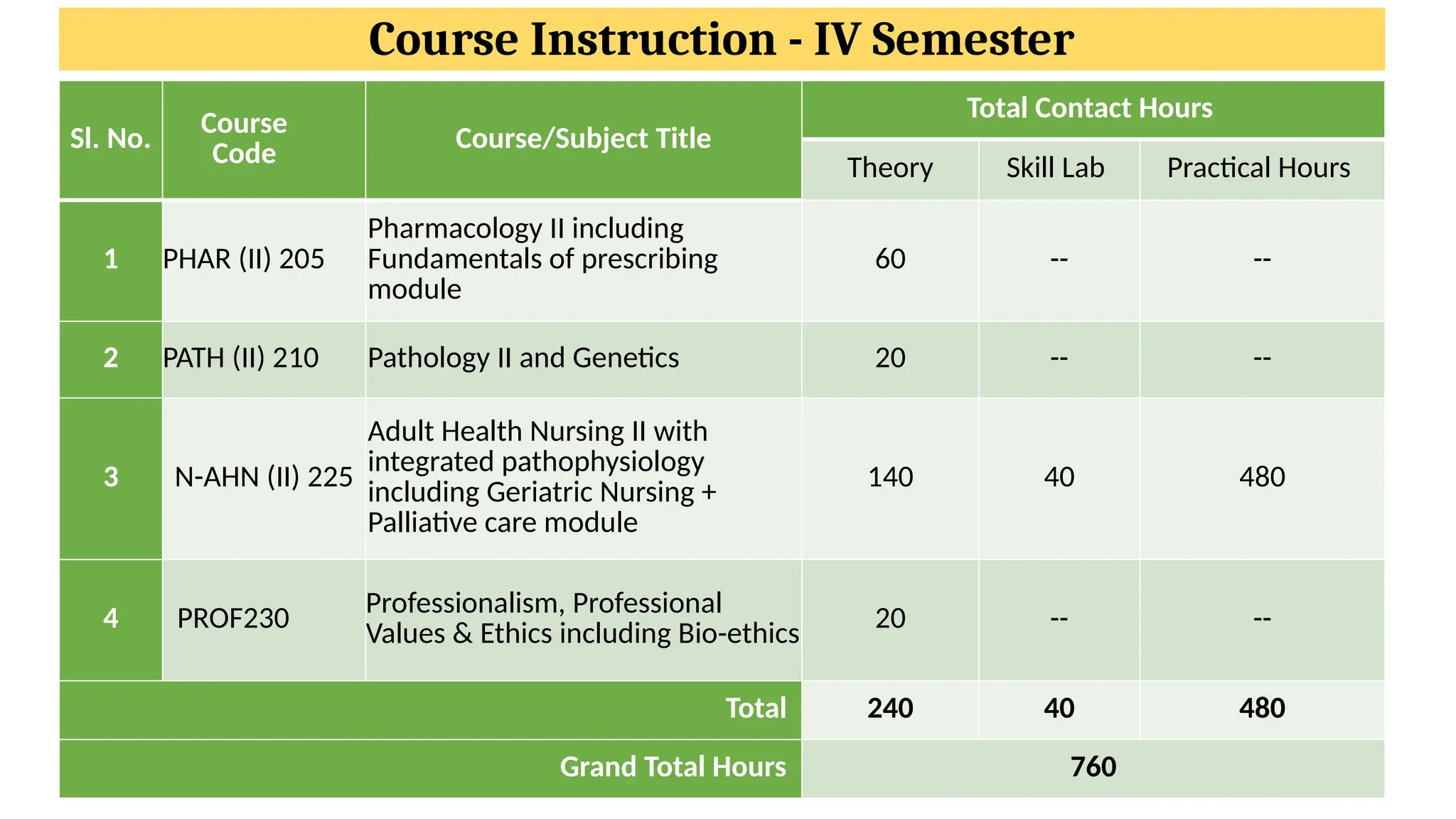
Course Instruction - IV Semester
Sl. No. Course
Code Course/Subject Title
Total Contact Hours
Theory Skill Lab Practical Hours
1 PHAR (II) 205
Pharmacology II including
Fundamentals of prescribing
module
60 -- --
2 PATH (II) 210 Pathology II and Genetics 20 -- --
3 N-AHN (II) 225
Adult Health Nursing II with
integrated pathophysiology
including Geriatric Nursing +
Palliative care module
140 40 480
4 PROF230 Professionalism, Professional
Values & Ethics including Bio-ethics 20 -- --
Total 240 40 480
Grand Total Hours 760
Scheme of Examination - IV Semester
Sl.
No. Course
Assessment (Marks)
Internal
End
Semester
College
Exam
End
Semester
University
Exam
Hours
Total
Marks
Theory
1
Pharmacology & Pathology
(I& II) and Genetics
25 -- 75 3 100
2 Adult Health Nursing II 25 -- 75 3 100
3
Professionalism, Professional
Values & Ethics including Bio-
ethics
25 25 -- 2 50
Practical
4 Adult Health Nursing II 50 -- 50 -- 100
Program Structure
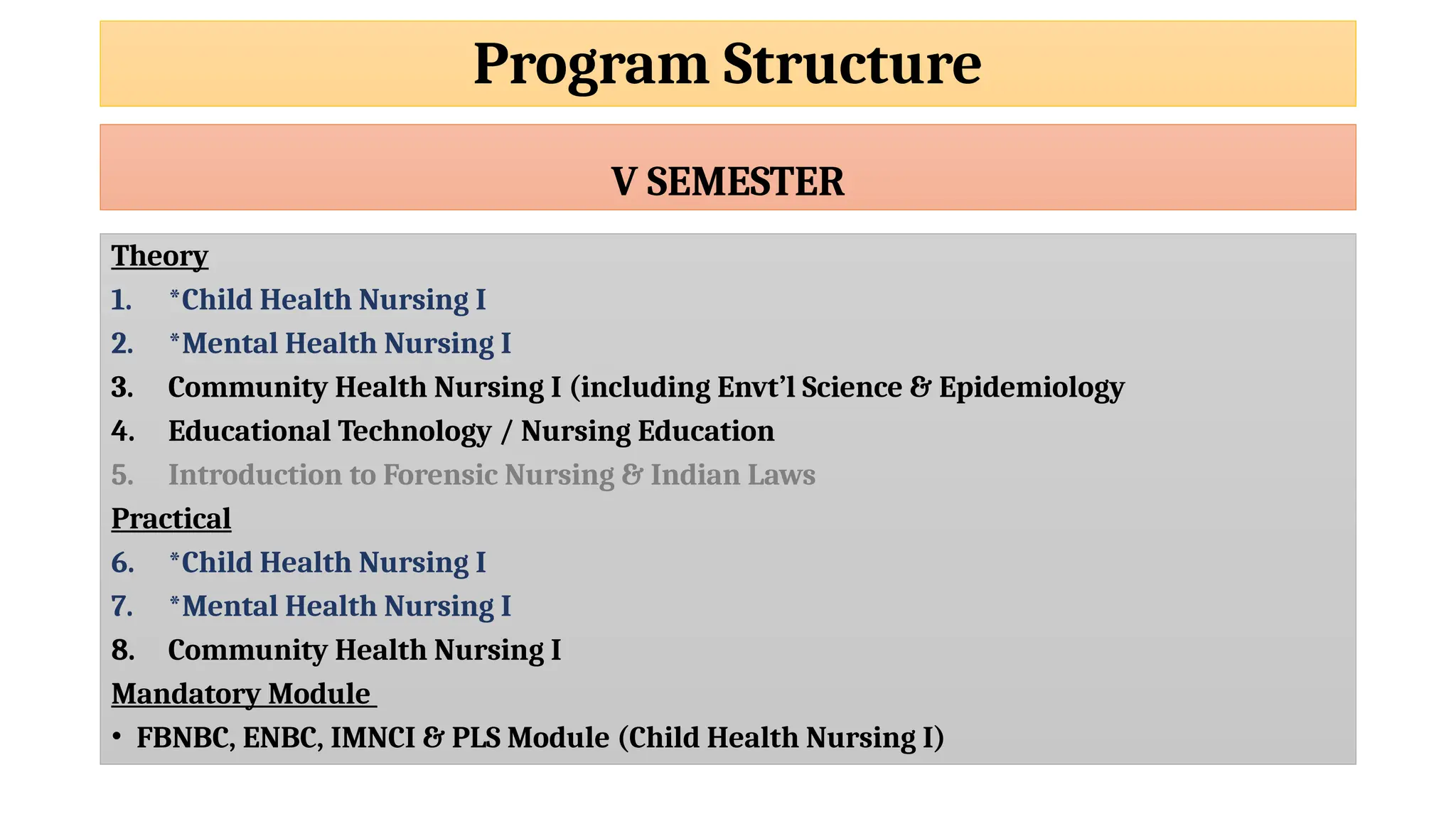
V SEMESTER
Theory
1. *Child Health Nursing I
2. *Mental Health Nursing I
3. Community Health Nursing I (including Envt’l Science & Epidemiology
4. Educational Technology / Nursing Education
5. Introduction to Forensic Nursing & Indian Laws
Practical
6. *Child Health Nursing I
7. *Mental Health Nursing I
8. Community Health Nursing I
Mandatory Module
• FBNBC, ENBC, IMNCI & PLS Module (Child Health Nursing I)
Course Instruction - V Semester
Sl.
No. Course Code Course/Subject Title
Total Contact Hours
Theory Skill Lab Practical Hours
1 N-CHN(I)301 Child Health Nursing I 60 40 160
2 N-MHN(I)305
Mental Health Nursing I
60 -- 80
3 N-COMH(I)310
Community Health Nursing I
(including Envt’l Science &
Epidemiology 100 -- 160
4 EDUC315
Educational Technology /
Nursing Education 40 40 --
5 N-FORN320 Introduction to Forensic Nursing
& Indian Laws
20 -- --
Total 280 80 400
Grand Total Hours 760
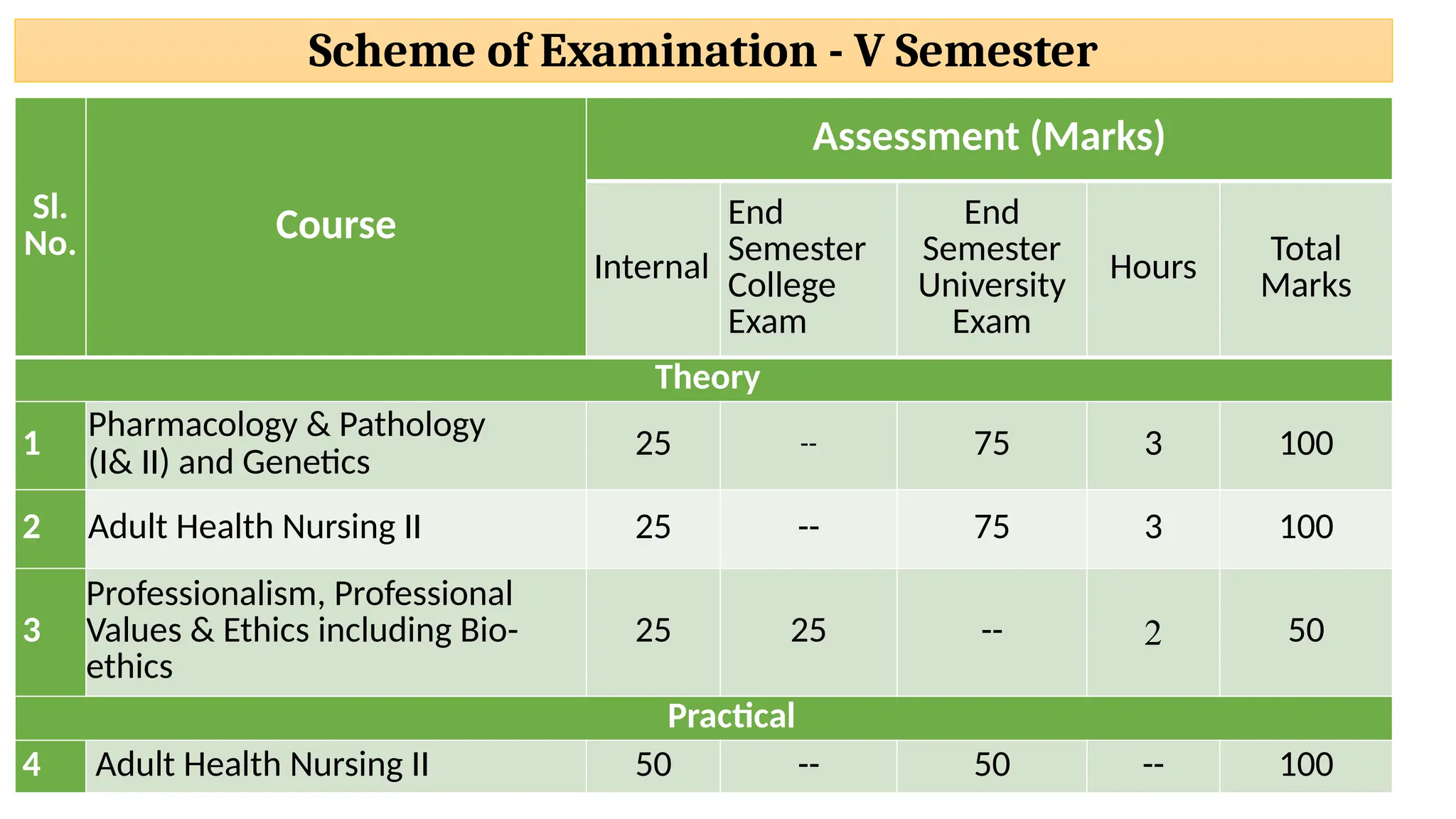
Scheme of Examination - V Semester
Sl.
No. Course
Assessment (Marks)
Internal
End
Semester
College
Exam
End
Semester
University
Exam
Hours Total
Marks
Theory
1
Pharmacology & Pathology
(I& II) and Genetics
25 -- 75 3 100
2 Adult Health Nursing II 25 -- 75 3 100
3
Professionalism, Professional
Values & Ethics including Bio-
ethics
25 25 -- 2 50
Practical
4 Adult Health Nursing II 50 -- 50 -- 100
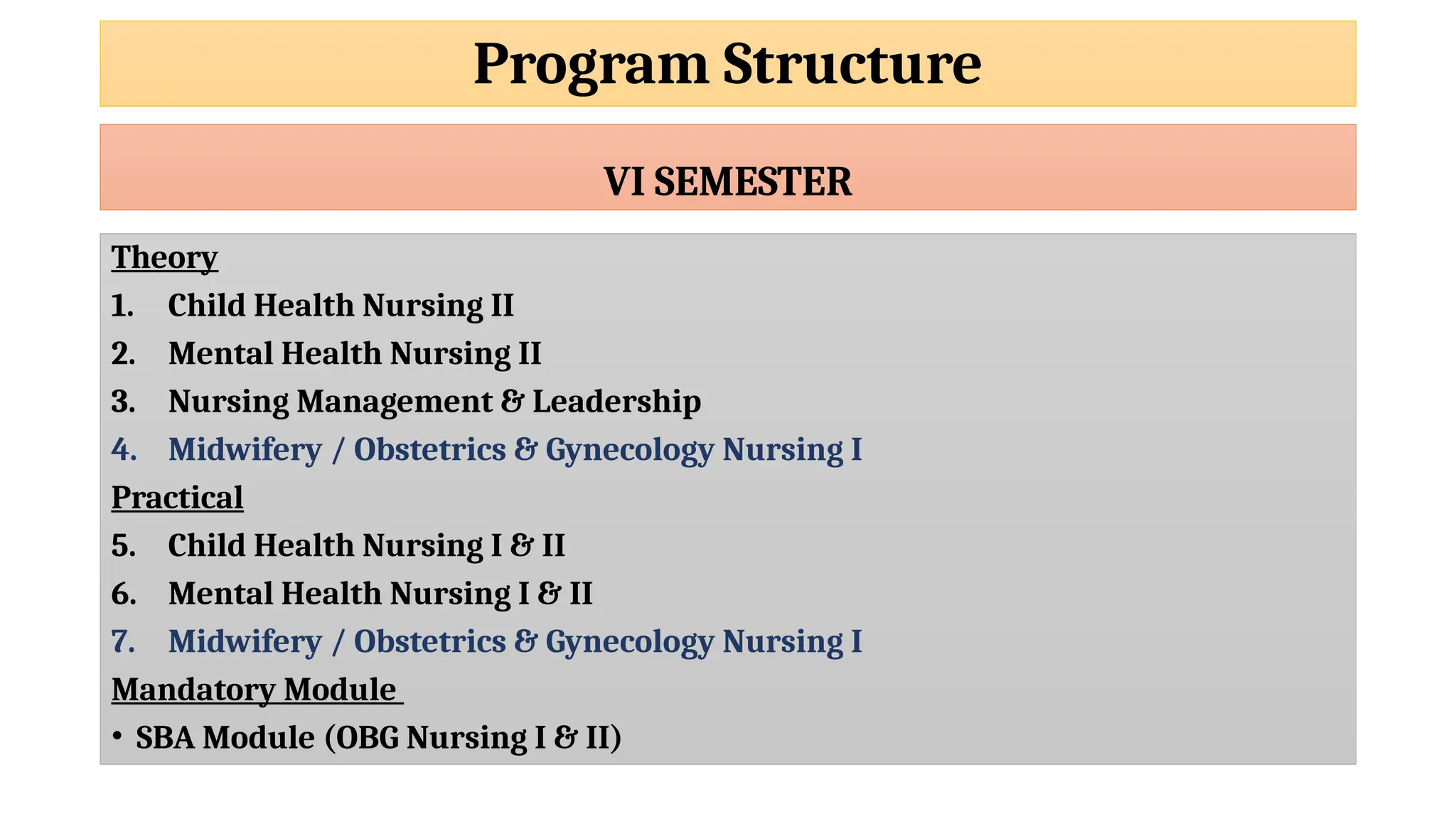
Program Structure
VI SEMESTER
Theory
1. Child Health Nursing II
2. Mental Health Nursing II
3. Nursing Management & Leadership
4. Midwifery / Obstetrics & Gynecology Nursing I
Practical
5. Child Health Nursing I & II
6. Mental Health Nursing I & II
7. Midwifery / Obstetrics & Gynecology Nursing I
Mandatory Module
• SBA Module (OBG Nursing I & II)
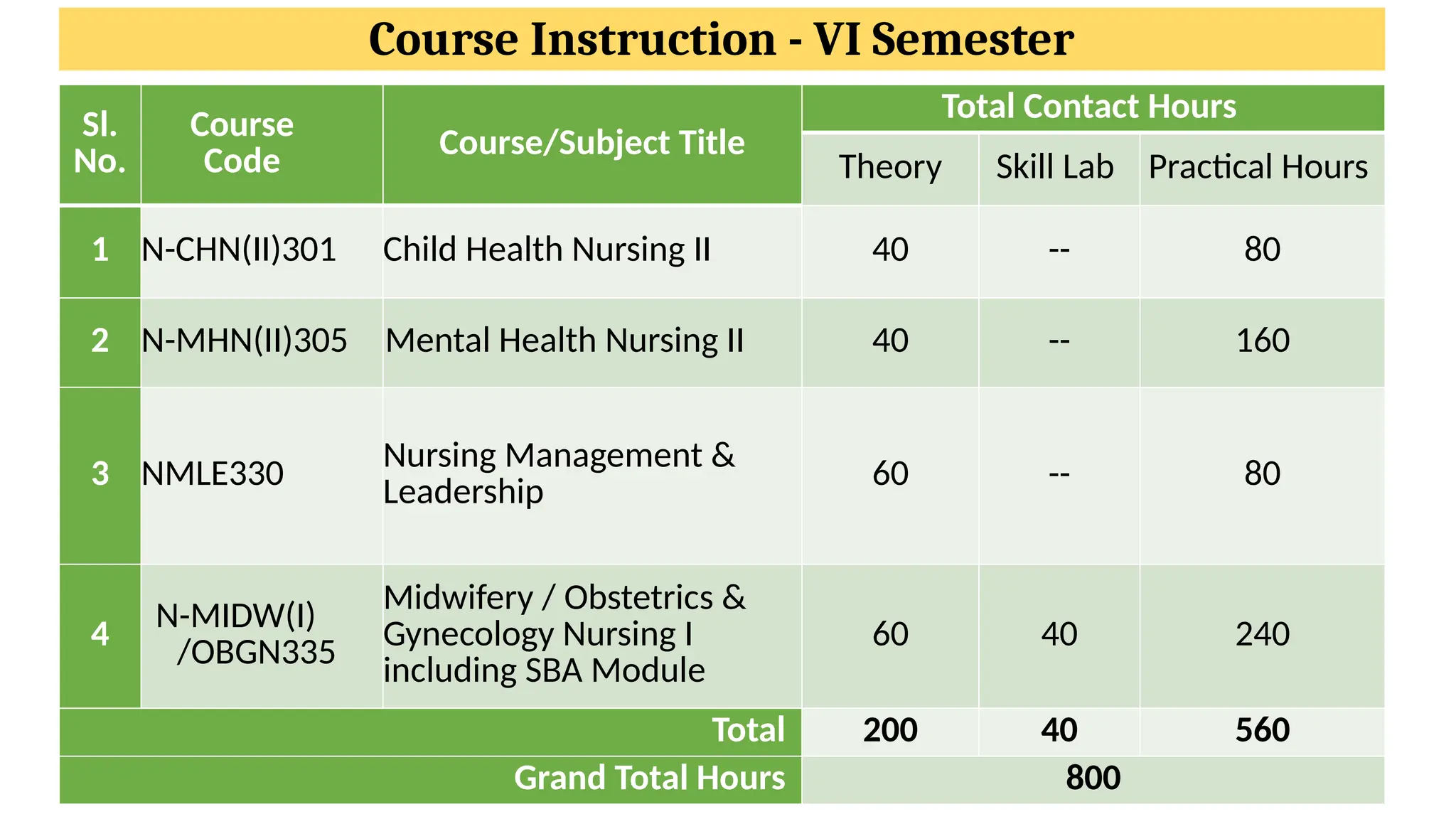
Course Instruction - VI Semester
Sl.
No.
Course
Code
Course/Subject Title
Total Contact Hours
Theory Skill Lab Practical Hours
1 N-CHN(II)301 Child Health Nursing II 40 -- 80
2 N-MHN(II)305 Mental Health Nursing II 40 -- 160
3 NMLE330 Nursing Management &
Leadership
60 -- 80
4
N-MIDW(I)
/OBGN335
Midwifery / Obstetrics &
Gynecology Nursing I
including SBA Module
60 40 240
Total 200 40 560
Grand Total Hours 800
Scheme of Examination - VI Semester
Sl.
No. Course
Assessment (Marks)
Internal
End
Semester
College
Exam
End Semester
University
Exam
Hours Total Marks
Theory
1 Child Health Nursing I & II 25 -- 75 3 100
2 Mental Health Nursing I & II 25 -- 75 3 100
3 Nursing Management & Leadership 25 -- 75 3 100
4
Midwifery / Obstetrics & Gynecology
Nursing I 25 -- -- -- --
Practical
5 Child Health Nursing I & II 50 -- 50 -- 100
6 Mental Health Nursing I & II 50 -- 50 -- 100
7
Midwifery / Obstetrics & Gynecology
Nursing I 25
Program Structure
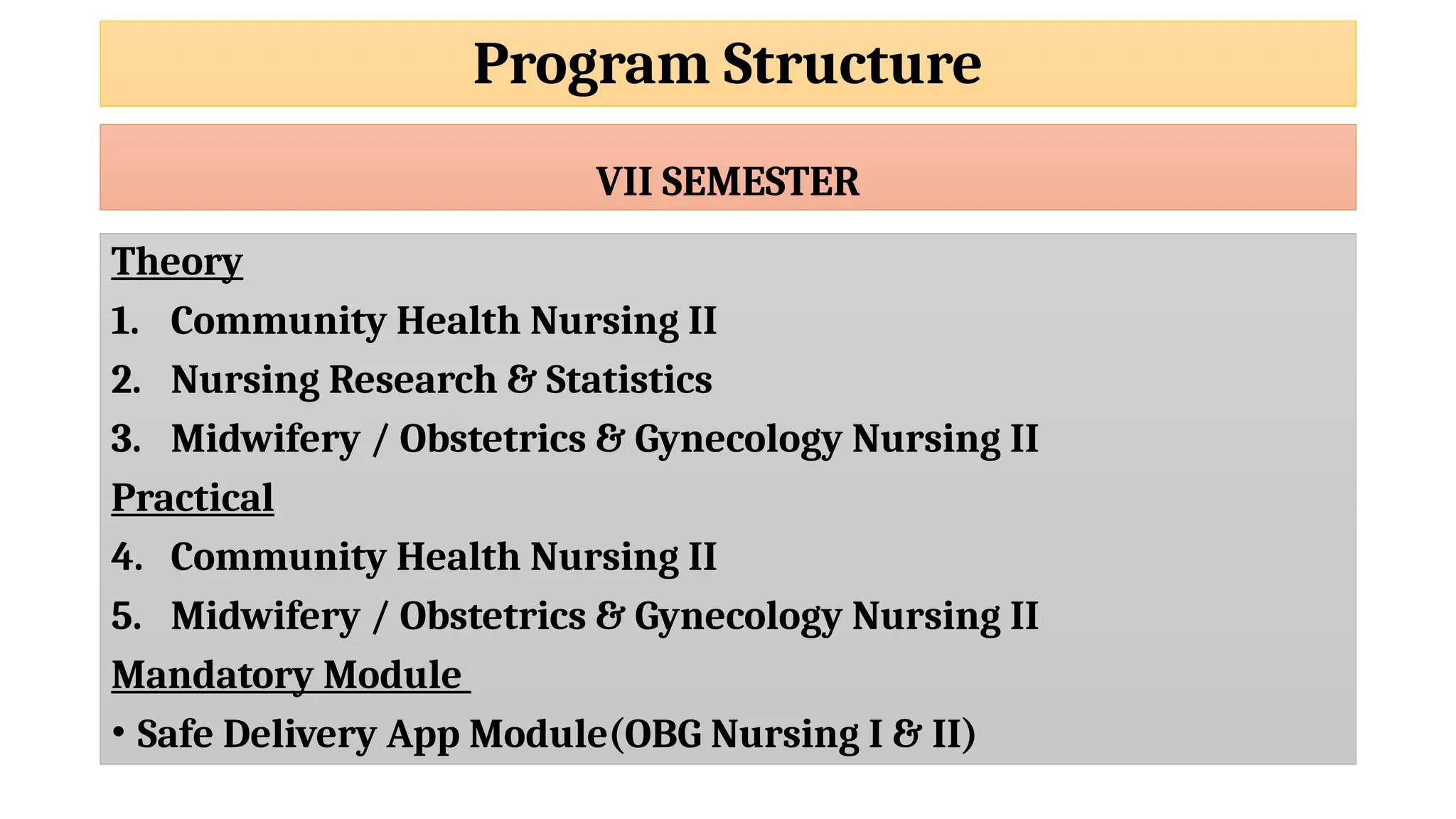
VII SEMESTER
Theory
1. Community Health Nursing II
2. Nursing Research & Statistics
3. Midwifery / Obstetrics & Gynecology Nursing II
Practical
4. Community Health Nursing II
5. Midwifery / Obstetrics & Gynecology Nursing II
Mandatory Module
• Safe Delivery App Module(OBG Nursing I & II)
Course Instruction - VII Semester
Sl.
No.
Course
Code
Course/Subject Title
Total Contact Hours
Theory Skill Lab Practical Hours
1 N-COMH(II)401 Community Health Nursing II 100 -- 160
2 NRST405 Nursing Research & Statistics 40 80 --
3 N-MIDW(II)
/OBGN410
Midwifery / Obstetrics &
Gynecology Nursing II
including Safe Delivery app
module
60 40 320
Total 200 120 480
Grand Total Hours 800
Scheme of Examination - VII Semester
Sl.
No.
Course
Assessment (Marks)
Interna
l
End
Semester
College
Exam
End
Semester
University
Exam
Hours Total
Marks
Theory
1 Community Health Nursing II 25 -- 75 3 100
2 Nursing Research & Statistics 25 -- 75 3 100
3
Midwifery / Obstetrics &
Gynecology Nursing I & II
including Safe Delivery app
module
25 -- 75 3 100
Practical
5 Community Health Nursing II 50 -- 50 -- 100
6 Midwifery / Obstetrics &
Gynecology Nursing I & II
50 -- 50 -- 100
Program Structure
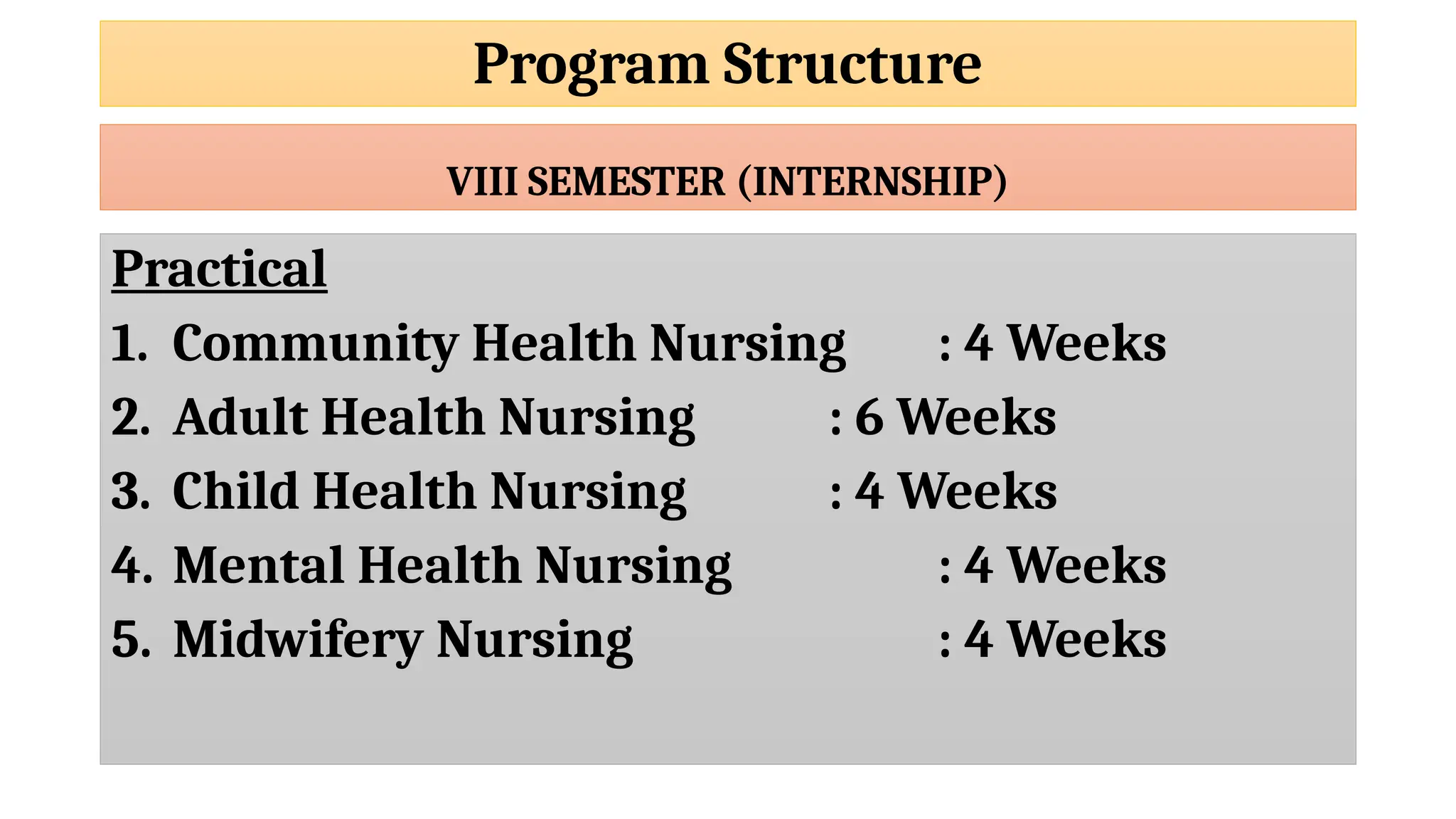
VIII SEMESTER (INTERNSHIP)
Practical
1. Community Health Nursing : 4 Weeks
2. Adult Health Nursing : 6 Weeks
3. Child Health Nursing : 4 Weeks
4. Mental Health Nursing : 4 Weeks
5. Midwifery Nursing : 4 Weeks
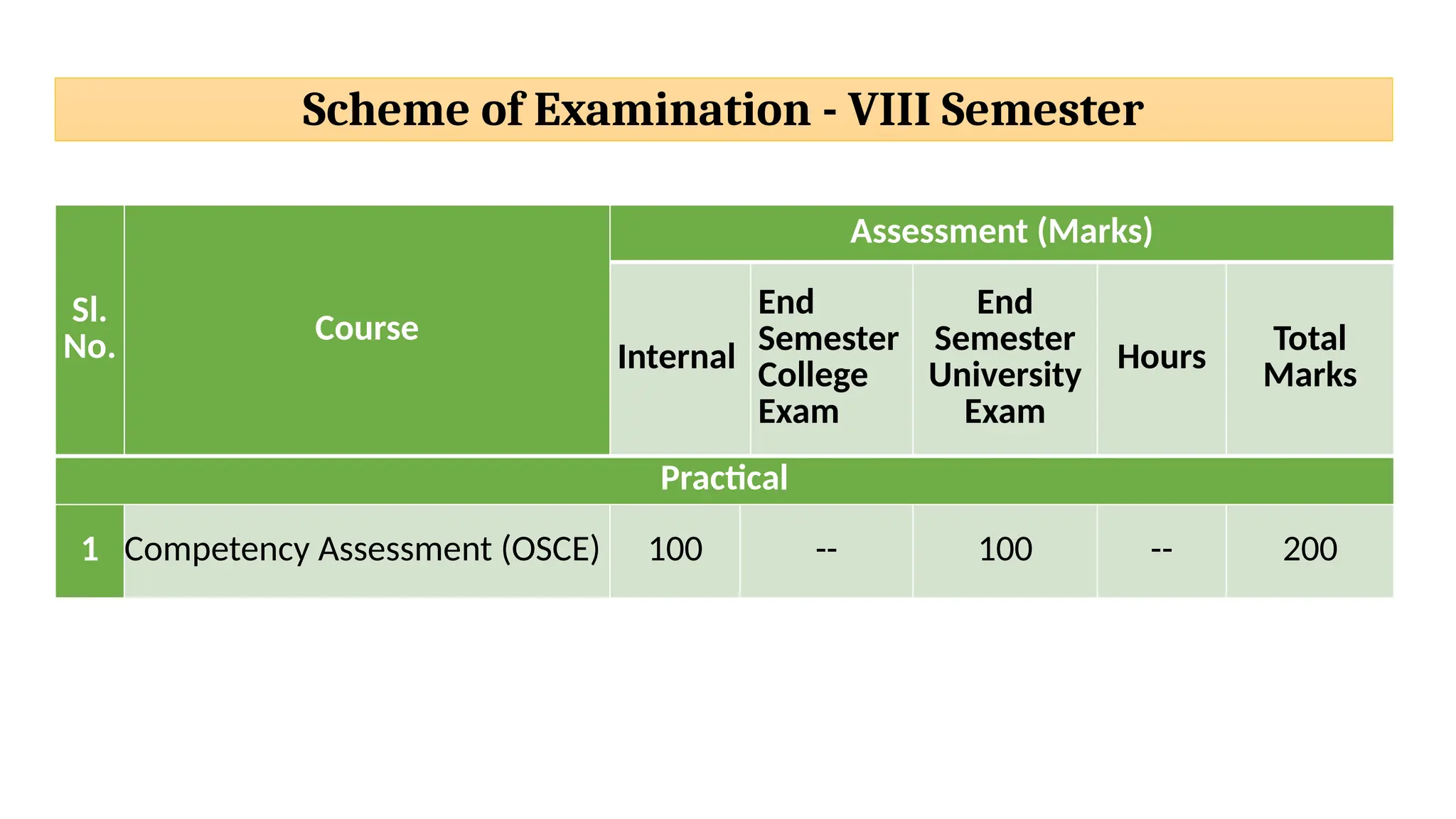
Scheme of Examination - VIII Semester
Sl.
No. Course
Assessment (Marks)
Internal
End
Semester
College
Exam
End
Semester
University
Exam
Hours
Total
Marks
Practical
1 Competency Assessment (OSCE) 100 -- 100 -- 200
Blueprint, Weightage
&
Question paper pattern
Applied Anatomy
Applied Anatomy
1. University Examination:
Note: Applied Anatomy & Applied Physiology are together.
Applied Anatomy is section A & Applied physiology is section B
Subject
Assessment (Marks)
Internal University Exam Total Marks
Applied Anatomy 13 37 50
Applied Anatomy
2. Weightage to Types / Forms of Question:
Sl.
No
Type of Questions
No. of
Questions
Marks for
each
question
Total
Marks
1 Long Essays (LE) 01 10 10
2 Short Essays (SE) 03 05 15
3 Short Answers (SA) 03 02 06
4 Multiple Choice Questions (MCQs) 06 01 06
Total 13 - 37
Applied Anatomy
3. Blueprint of Question Paper:
Unit
No.
Topics
Hours
Allotted
Marks allocated for
each unit as per
allotted hours
Final Marks
Allotted
1
Introduction to anatomical terms and organization of
the human body
8 05 05
2 The Respiratory System 6 04
14
3 The Digestive System 6 04
4 The Circulatory and Lymphatic system* 6 04
5 The Endocrine system 4 02
6 The Sensory organs 4 02
18
7 The Musculoskeletal system* 10 06
8 The Renal system 5 03
9 The Reproductive system 5 03
10 The Nervous system 6 04
Total Hours / Marks 60 37 37
Total No. of Questions to be included in Question Paper 13
Applied Anatomy
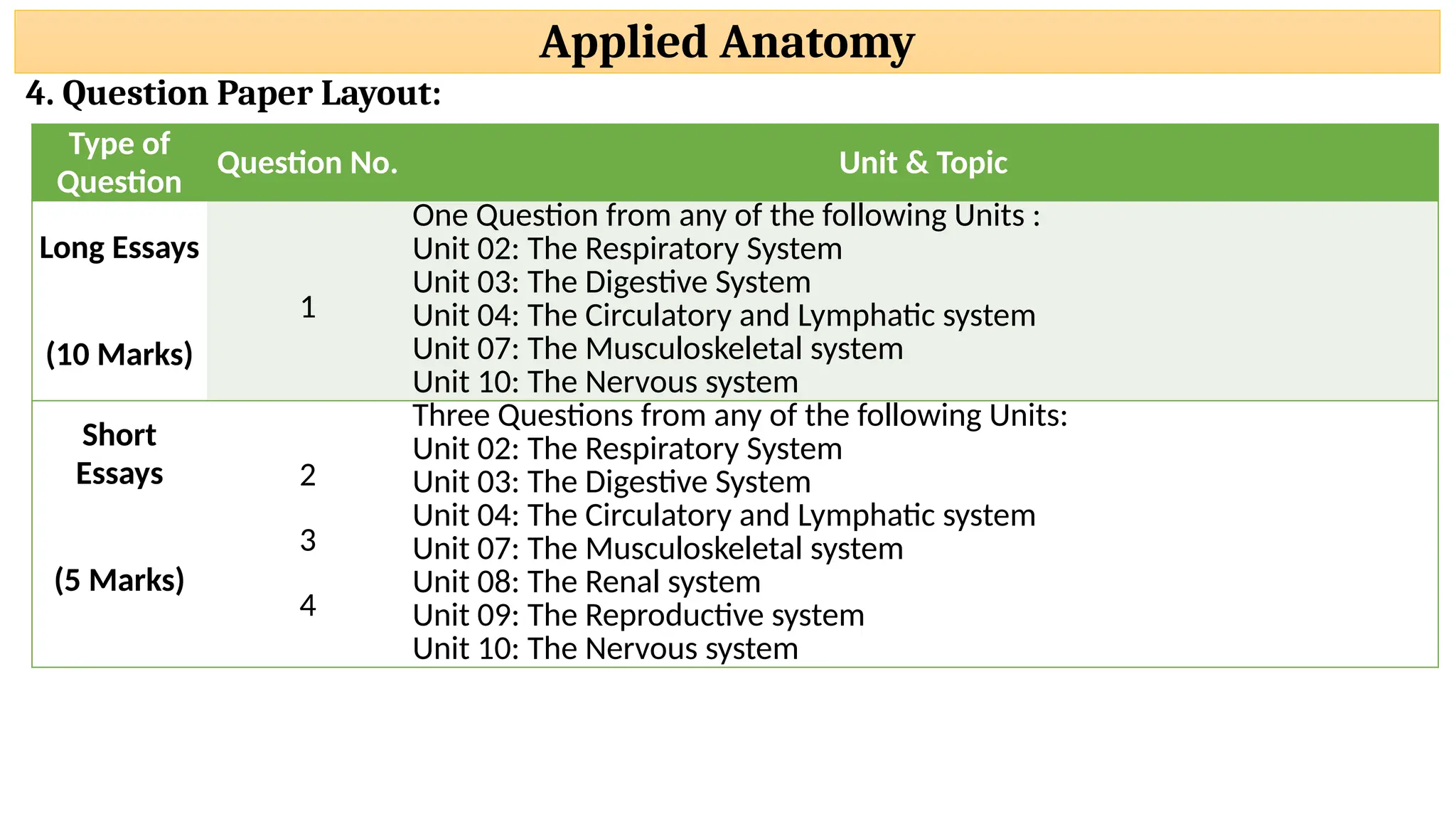
4. Question Paper Layout:
Type of
Question
Question No. Unit & Topic
Long Essays
(10 Marks)
1
One Question from any of the following Units :
Unit 02: The Respiratory System
Unit 03: The Digestive System
Unit 04: The Circulatory and Lymphatic system
Unit 07: The Musculoskeletal system
Unit 10: The Nervous system
Short
Essays
(5 Marks)
2
3
4
Three Questions from any of the following Units:
Unit 02: The Respiratory System
Unit 03: The Digestive System
Unit 04: The Circulatory and Lymphatic system
Unit 07: The Musculoskeletal system
Unit 08: The Renal system
Unit 09: The Reproductive system
Unit 10: The Nervous system
Applied Anatomy
4. Question Paper Layout:
Type of Question Question No. Unit & Topic
Short Answers
(2 Marks )
5
6
7
Three Questions from any of the following Units:
Unit 01: Introduction to anatomical terms and organization of the
human body
Unit 05: The Endocrine system
Unit 06: The Sensory organs
Unit 08: The Renal system
Unit 10: The Nervous system
MCQs
(1 Mark)
8
9
10
11
12
13
Six Questions from any of the following Units:
Unit 01: Introduction to anatomical terms and organization of the
human body
Unit 06: The Sensory organs
Unit 07: The Musculoskeletal system
Unit 08: The Renal system
Unit 09: The Reproductive system
Unit 10: The Nervous system
Applied Anatomy
Question Paper
1. Applied Anatomy QP.pdf
Blueprint, Weightage
&
Question paper pattern
Applied Physiology
Applied Physiology
1. University Examination:
Note: Applied Anatomy & Applied Physiology are together.
Applied Anatomy is section A & Applied physiology is section B
Subject
Assessment (Marks)
Internal University Exam Total Marks
Applied Physiology 12 38 50
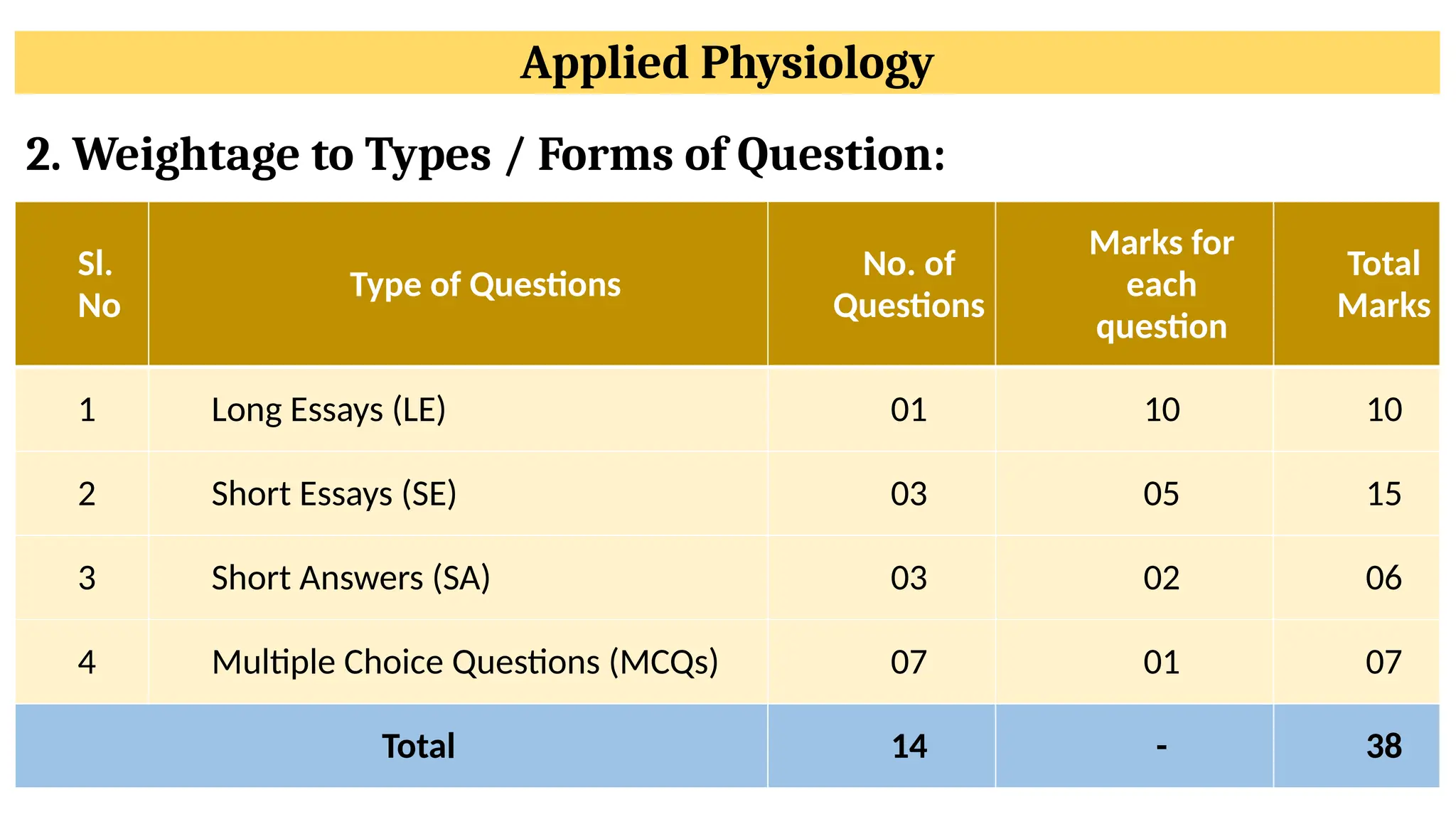
Applied Physiology
2. Weightage to Types / Forms of Question:
Sl.
No
Type of Questions
No. of
Questions
Marks for
each
question
Total
Marks
1 Long Essays (LE) 01 10 10
2 Short Essays (SE) 03 05 15
3 Short Answers (SA) 03 02 06
4 Multiple Choice Questions (MCQs) 07 01 07
Total 14 - 38
Applied Physiology
3. Blueprint of Question Paper:
Unit
No.
Topics
Hours
allotted
Marks allocated for
each unit as per
allotted hours
Final
Marks
Allotted
1 General Physiology – Basic Concepts 4 3
13
2 Respiratory System 6 4
3 Digestive System 8 5
4 Circulatory and Lymphatic System 6 4
07
5 Blood 5 3
6 The Endocrine System 5 3
04
7 The Sensory Organs 4 2
8 Musculoskeletal System 6 4
8
9 Renal System 4 3
10 The Reproductive System 4 2
6
11 Nervous System 8 5
Total hours / Marks 60 38 38
Total No. of Questions to be included in Question Paper 14
Applied Physiology
4. Question Paper Layout:
Type of
Question
Question No. Unit & Topic
Long
Essays
(10 Marks)
1
One Question from any of the following Units :
Unit 02: Respiratory System
Unit 03: Digestive System
Unit 08: Musculoskeletal System
Unit 11: Nervous System
Short
Essays
(5 Marks)
2
3
4
Three Questions from any of the following Units:
Unit 02: Respiratory System
Unit 03: Digestive System
Unit 04: Circulatory and Lymphatic System
Unit 05: Blood
Unit 08: Musculoskeletal System
Unit 09: Renal System
Unit 10: The Reproductive System
Unit 11: Nervous System
Applied Physiology
4. Question Paper Layout:
Type of Question Question No. Unit & Topic
Short Answers
(2 Marks )
5
6
7
Three Questions from any of the following Units:
Unit 06: Endocrine System
Unit 07: The Sensory Organs
Unit 09: Renal System
Unit 10: The Reproductive System
Unit 11: Nervous System
MCQs
(1 Mark)
8
9
10
11
12
13
14
Seven Questions from any of the following Units:
Unit 01: General Physiology – Basic Concepts
Unit 04: Circulatory and Lymphatic System
Unit 05: Blood
Unit 09: Renal System
Unit 10: The Reproductive System
Unit 11: Nervous System
Applied Physiology
Question Paper
2. Applied Physiology QP.pdf
Blueprint, Weightage
&
Question paper pattern
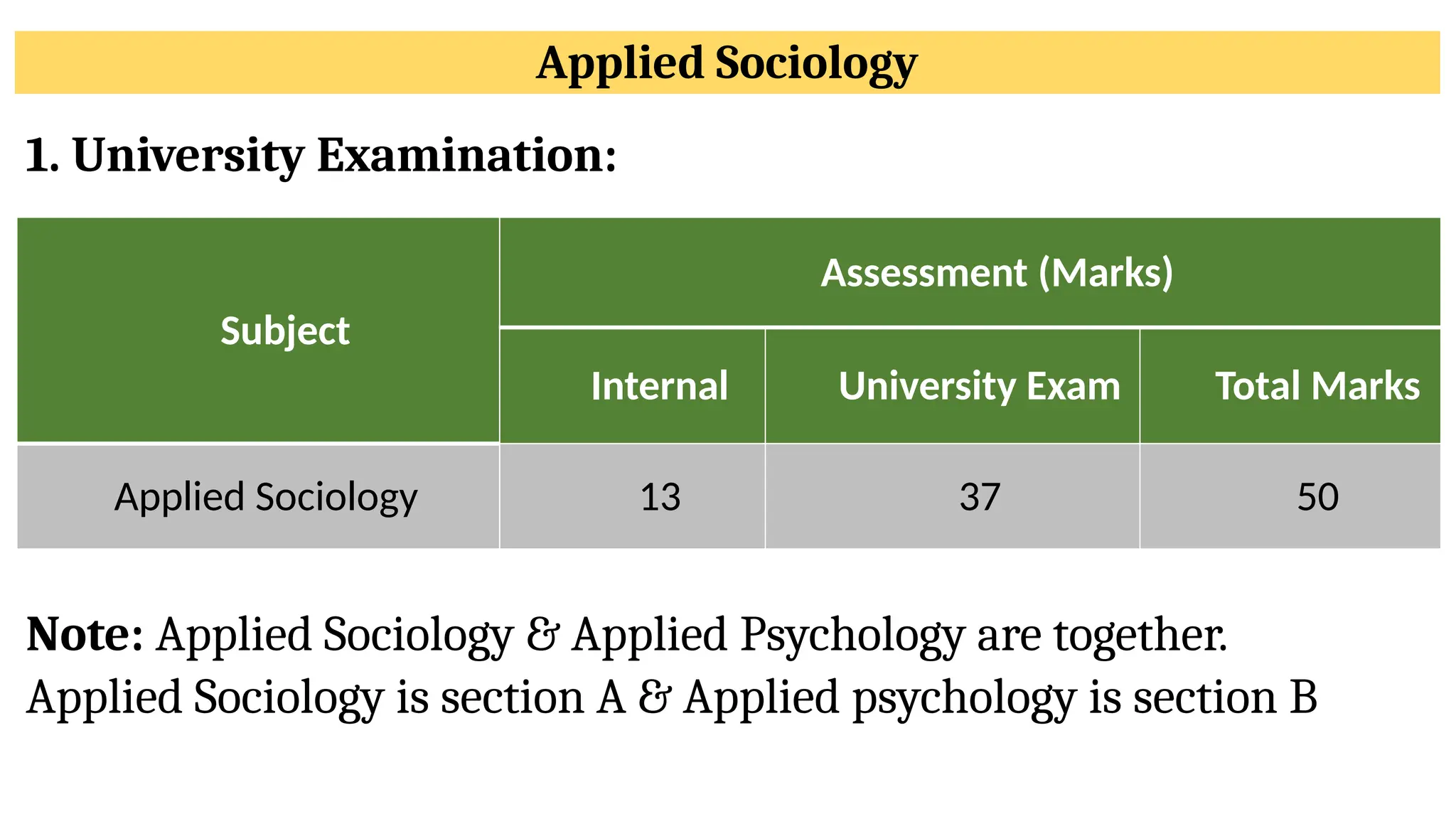
Applied Sociology
Applied Sociology
1. University Examination:
Note: Applied Sociology & Applied Psychology are together.
Applied Sociology is section A & Applied psychology is section B
Subject
Assessment (Marks)
Internal University Exam Total Marks
Applied Sociology 13 37 50
Applied Sociology
2. Weightage to Types / Forms of Question:
Sl.
No
Type of Questions
No. of
Questions
Marks for
each
question
Total
Marks
1 Long Essays (LE) 01 10 10
2 Short Essays (SE) 03 05 15
3 Short Answers (SA) 03 02 06
4 Multiple Choice Questions (MCQs) 06 01 06
Total 13 - 37
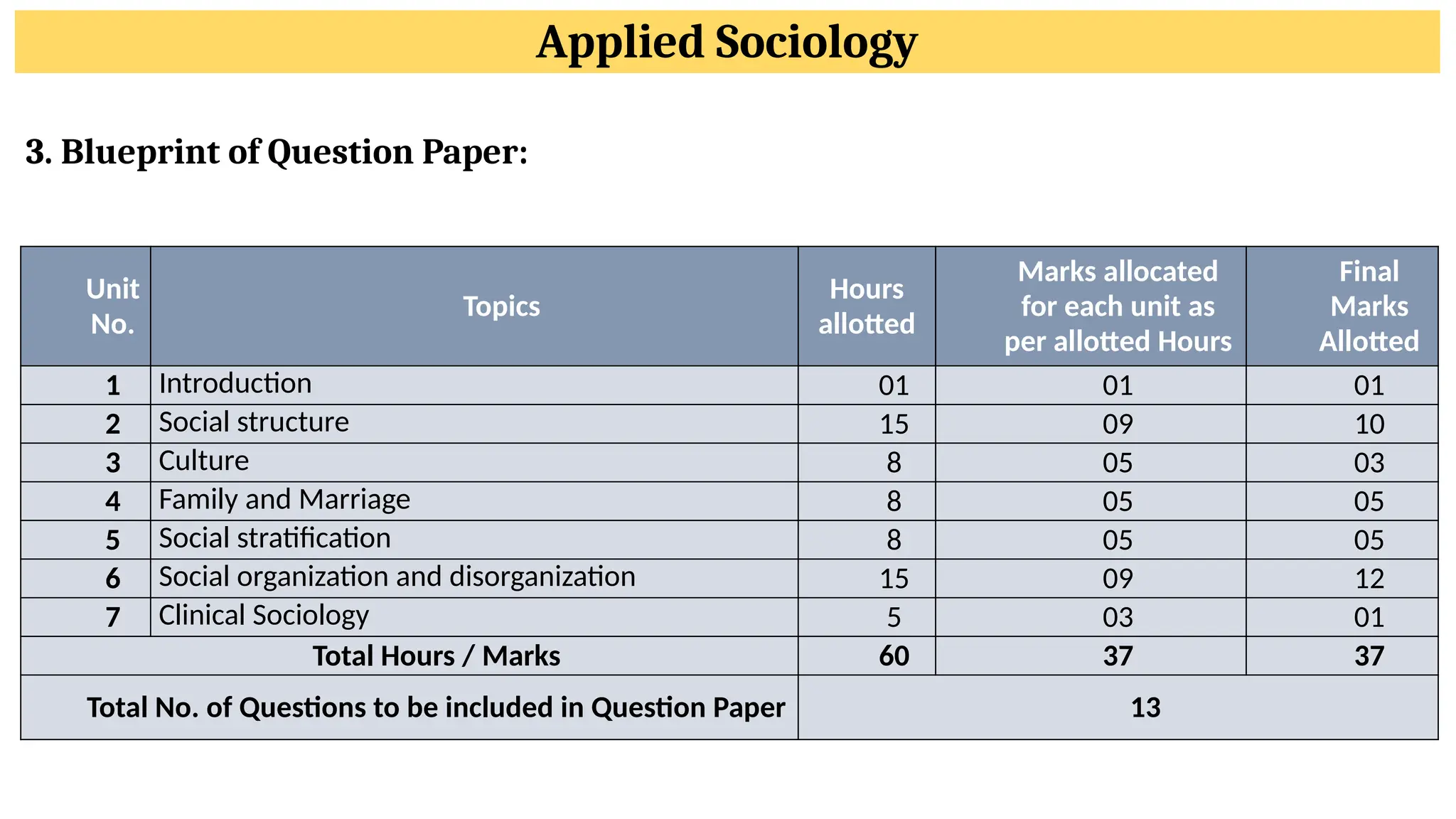
Applied Sociology
3. Blueprint of Question Paper:
Unit
No.
Topics
Hours
allotted
Marks allocated
for each unit as
per allotted Hours
Final
Marks
Allotted
1 Introduction 01 01 01
2 Social structure 15 09 10
3 Culture 8 05 03
4 Family and Marriage 8 05 05
5 Social stratification 8 05 05
6 Social organization and disorganization 15 09 12
7 Clinical Sociology 5 03 01
Total Hours / Marks 60 37 37
Total No. of Questions to be included in Question Paper 13
Applied Sociology
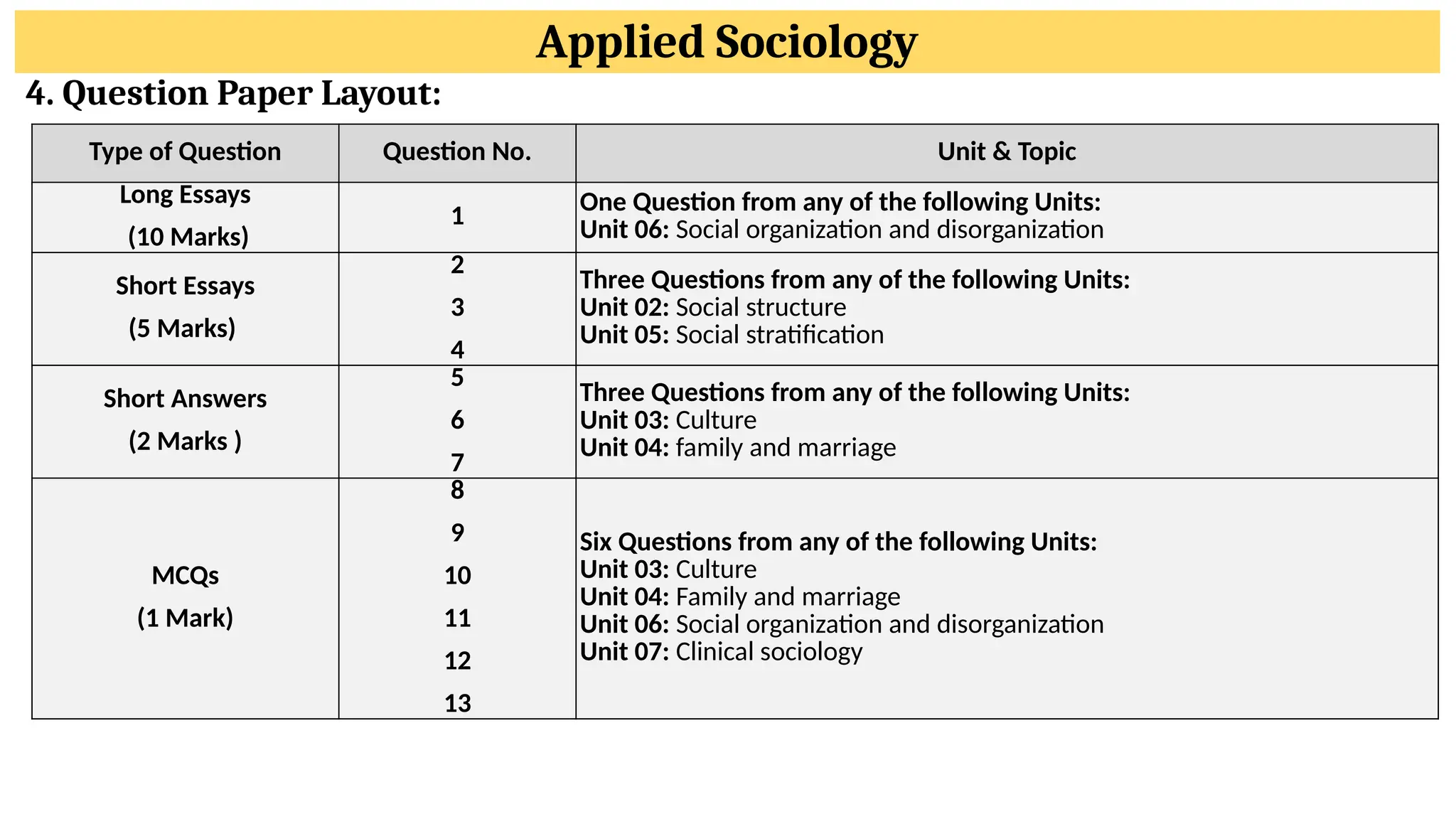
4. Question Paper Layout:
Type of Question Question No. Unit & Topic
Long Essays
(10 Marks)
1
One Question from any of the following Units:
Unit 06: Social organization and disorganization
Short Essays
(5 Marks)
2
3
4
Three Questions from any of the following Units:
Unit 02: Social structure
Unit 05: Social stratification
Short Answers
(2 Marks )
5
6
7
Three Questions from any of the following Units:
Unit 03: Culture
Unit 04: family and marriage
MCQs
(1 Mark)
8
9
10
11
12
13
Six Questions from any of the following Units:
Unit 03: Culture
Unit 04: Family and marriage
Unit 06: Social organization and disorganization
Unit 07: Clinical sociology
Applied Sociology
Question Paper
3. Applied Sociology QP.pdf
Blueprint, Weightage
&
Question paper pattern
Applied Psychology
Applied Psychology
1. University Examination:
Note: Applied Sociology & Applied Psychology are together.
Applied Sociology is section A & Applied psychology is section B
Subject
Assessment (Marks)
Internal University Exam Total Marks
Applied Psychology 12 38 50
Applied Psychology
2. Weightage to Types / Forms of Question:
Sl.
No
Type of Questions
No. of
Questions
Marks for
each
question
Total
Marks
1 Long Essays (LE) 01 10 10
2 Short Essays (SE) 03 05 15
3 Short Answers (SA) 03 02 06
4 Multiple Choice Questions (MCQs) 07 01 07
Total 14 - 38
Applied Psychology
3. Blueprint of Question Paper:
Unit
No.
Topics
Hours
allotted
Marks allocated for
each unit as per
allotted Hours
Final
Marks
Allotted
1 Introduction 2 01 01
2 Biological basis of behavior- Introduction 3 02 02
3 Mental health and mental hygiene 5 04 05
4 Developmental psychology 5 03 05
5 Personality 4 02 02
6 Cognitive process 14 09 10
7 Motivation and emotional processes 6 04 04
8 Psychological assessment and tests - Introduction 4 02 01
9 Application of soft skills 12 08 06
10 Self-empowerment 5 03 02
Total Marks 60 38 38
Total No. of Questions to be included in Question Paper 14
Applied Psychology
4. Question Paper Layout:
Type of Question Question No. Unit & Topic
Long Essays
(10 Marks)
1
One Question from any of the following Units :
Unit 06: Cognitive process
Short Essays
(5 Marks)
2
3
4
Three Questions from any of the following Units :
Unit 03: Mental health and mental hygiene
Unit 04: Developmental psychology
Unit 09: Application of soft skills
Short Answers
(2 Marks )
5
6
7
Three Questions from any of the following Units :
Unit 05: Personality
Unit 07: Motivation and emotional processes
Unit 10: Self-empowerment
MCQs
(1 Mark)
8, 9
10
11
12
13
14
Seven Questions from any of the following Units :
Unit 01: Introduction
Unit 02: Biological basis of behavior-Introduction
Unit 07: Motivation and emotional processes
Unit 08: Psychological assessment and tests-Introduction
Unit 09: Application of soft skills
Applied Psychology
Question Paper
4. Applied Psychology QP.pdf
Blueprint, Weightage
&
Question paper pattern
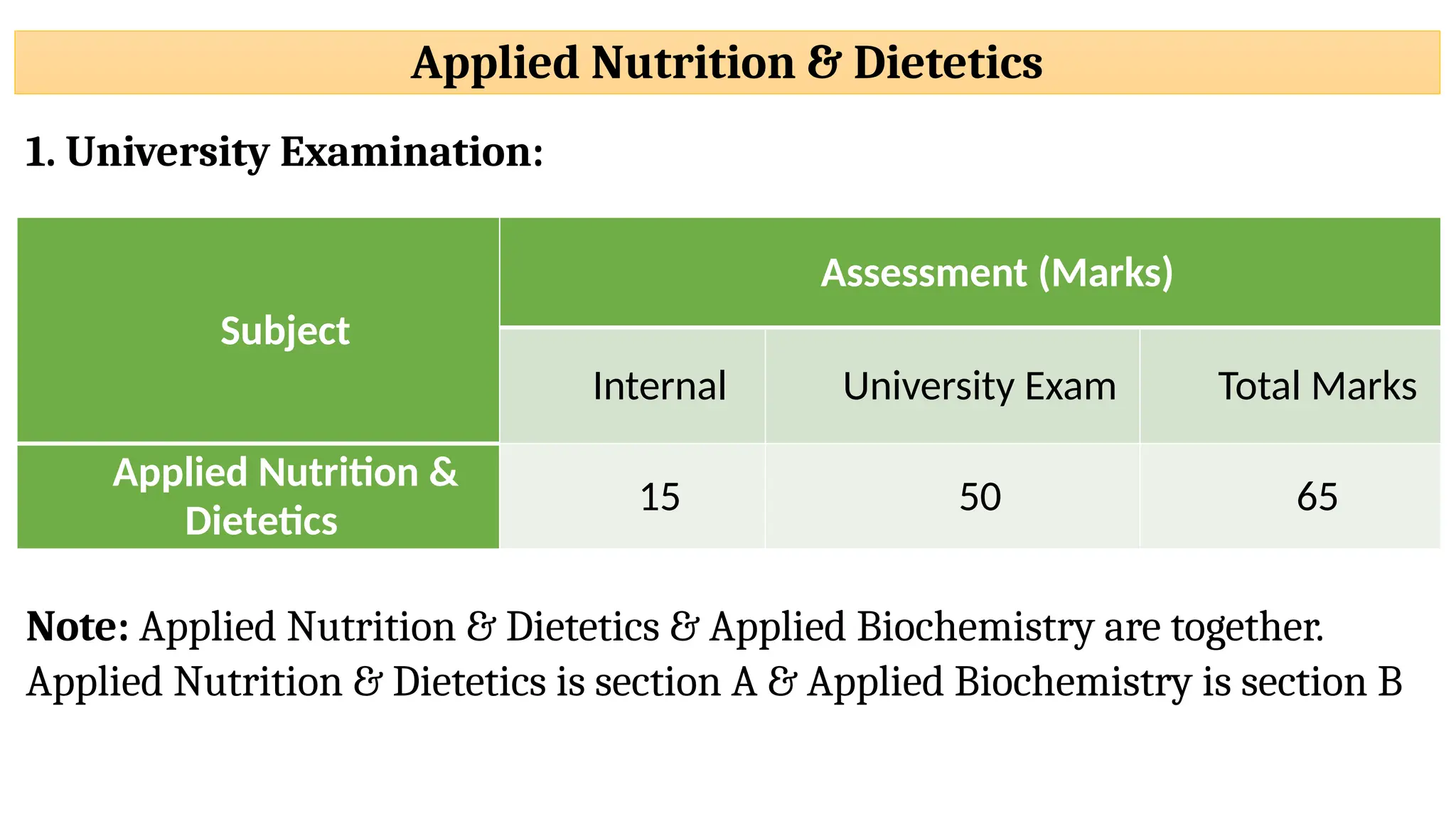
Applied Nutrition & Dietetics
1. University Examination:
Note: Applied Nutrition & Dietetics & Applied Biochemistry are together.
Applied Nutrition & Dietetics is section A & Applied Biochemistry is section B
Subject
Assessment (Marks)
Internal University Exam Total Marks
Applied Nutrition &
Dietetics
15 50 65
Applied Nutrition & Dietetics
2. Weightage to Types / Forms of Question:
Sl.
No
Type of Questions
No. of
Questions
Marks for
each
question
Total
Marks
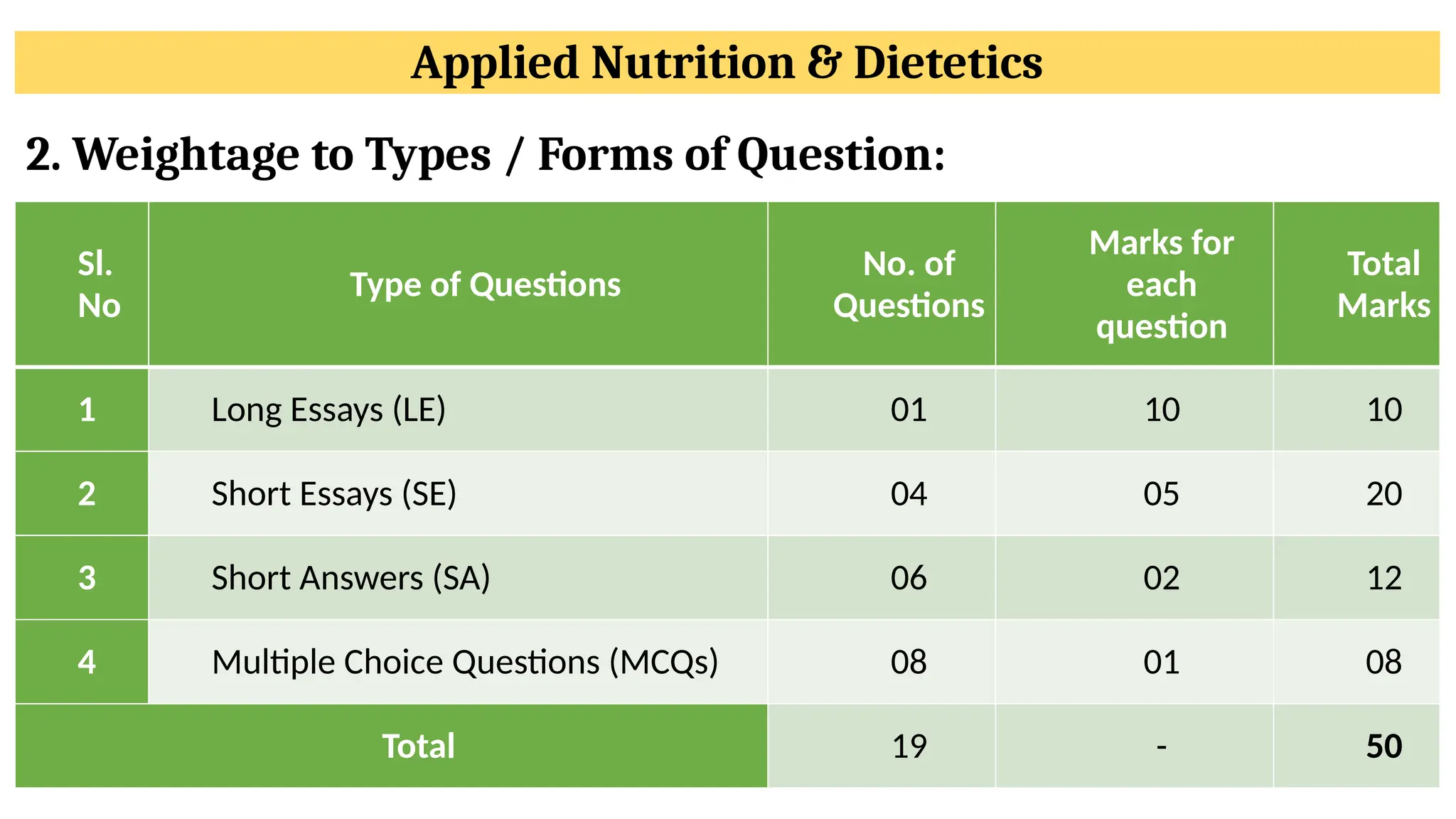
1 Long Essays (LE) 01 10 10
2 Short Essays (SE) 04 05 20
3 Short Answers (SA) 06 02 12
4 Multiple Choice Questions (MCQs) 08 01 08
Total 19 - 50
Applied Nutrition & Dietetics
3. Blueprint of Question Paper:
Unit
No.
Topics Hours Allotted
Final Marks
Allotted
1 Introduction to Nutrition 02 1
2 Carbohydrates 03 2
3 Proteins 03 2
4 Fats 02 1
5 Vitamins 03 2
6 Minerals 03 1
7 Balanced Diet 07 11
8 Nutritional Deficiency Disorders 06 10
9 Therapeutic Diets 04 4
10 Cookery Rules & Preservation of Nutrients 03 5
11 Nutritional Assessment & Nutrition Education 04 5
12 National Nutrition Programs & Role of Nurse 03 4
13 Food Safety 02 2
Total Hours / Marks 45 50
Blueprint, Weightage
&
Question paper pattern
Applied Biochemistry
1. University Examination:
Note: Applied Nutrition & Dietetics & Applied Biochemistry are together.
Applied Nutrition & Dietetics is section A & Applied Biochemistry is section B
Subject
Assessment (Marks)
Internal University Exam Total Marks
Applied Biochemistry 10 25 35
Applied Biochemistry
2. Weightage to Types / Forms of Question:
Sl.
No
Type of Questions
No. of
Questions
Marks for
each
question
Total
Marks
1 Long Essays (LE) -- -- --
2 Short Essays (SE) 03 05 15
3 Short Answers (SA) 03 02 06
4 Multiple Choice Questions (MCQs) 04 01 04
Total 10 - 25
Applied Biochemistry
3. Blueprint of Question Paper:
Unit
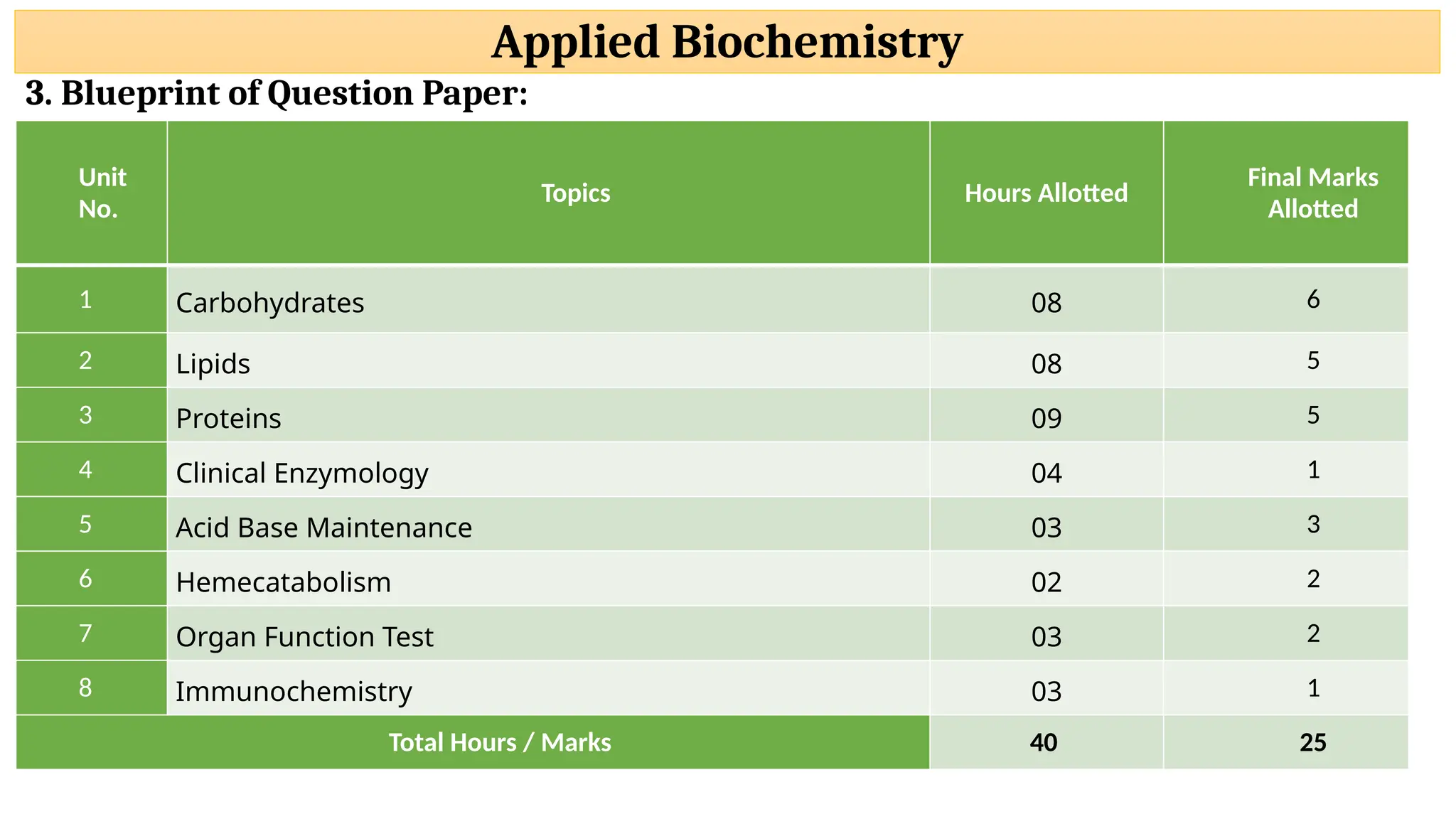
No.
Topics Hours Allotted
Final Marks
Allotted
1 Carbohydrates 08 6
2 Lipids 08 5
3 Proteins 09 5
4 Clinical Enzymology 04 1
5 Acid Base Maintenance 03 3
6 Hemecatabolism 02 2
7 Organ Function Test 03 2
8 Immunochemistry 03 1
Total Hours / Marks 40 25
Applied Biochemistry
4. Question Paper Layout:
Type of
Question
Question No. Unit & Topic
Short Essays
(5 Marks)
1 Unit 01: Carbohydrates
2 Unit 02: Lipids
3 Unit 03: Proteins
Short Answers
(2 Marks)
4 Unit 04: Acid Base Maintenance
5 Unit 05: Heme Catabolism
6 Unit 06: Organ Function Test
MCQ’s
(1 Marks)
7 Unit 01: Carbohydrates
8 Unit 04: Acid Base Maintenance
9 Unit 05: Heme Catabolism
10 Unit 08: Immunochemistry

Applied Anatomy
Question Paper
1. Applied Anatomy QP.pdf
Follow us:
• Facebook: kushma.nursing
• Facebook Page: kushma.nursing1
• Instagram: kushma.nursing
• Twitter: kushma_nursing

Orientation Program to Nursing at KES....

  • 2.
    • In theever-evolving landscape of healthcare, ensuring that future healthcare professionals are not only competent but also equipped to confront the emerging challenges is paramount. In pursuit of this noble goal, Kushma Education Society stands as a beacon of excellence in healthcare education. • Established with a visionary outlook to provide high-tech healthcare education to society, Kushma Education Society envisions a world where proficient healthcare professionals serve as pillars of support for the community, dedicating themselves to the welfare of the needy. KUSHMA EDUCATION SOCIETY (KES)
  • 3.
    "Empowering Future HealthcareLeaders: Innovating Education, Transforming Health" Kushma Education Society is committed to providing world- class healthcare education by establishing cutting-edge healthcare Institutes. Our mission is to equip students with advanced knowledge, skills, and technology, preparing them to address global healthcare challenges. We strive to foster a culture of continuous learning, research, and collaboration to positively impact the healthcare landscape. Vision, Mission of KES
  • 4.
    Values of KES 1)Education: Encouraging continuous education and the dissemination of knowledge as a lifelong pursuit. 2) Quality Assurance: Committed to providing high-quality education and ensuring consistency and reliability in all aspects of our services. 3) Professionalism: Upholding professionalism, ethics, and a strong sense of responsibility in all interactions within the academic and professional sphere. 4) Motivation: Fostering motivation, inspiring goals, and cultivating dedication to the advancement of healthcare education. 5) Identity: Nurturing a sense of unity, identity, and inclusiveness within the KES community, celebrating diversity and individual and collective achievements. 6) Equality: Promoting fairness, inclusivity, and equal opportunities for all students and staff, irrespective of background, gender, ethnicity, or socioeconomic status. 7) Success: Recognizing and celebrating accomplishments and emphasizing the importance of making a positive impact in the lives of students, the healthcare sector, and society as a whole.
  • 5.
    Objectives of KUSHMAEducation Society K U S H M A nowledge Advancement tilizing Technology tudent Empowerment ealthcare Innovation entorship & Professional Development Programme daptive Learning Initiatives
  • 6.
    • Knowledge Advancement:To implement a structured program to continuously enhance knowledge and skills of students and faculty through workshops, seminars, and professional development opportunities. • Utilizing Technology: To implement advanced healthcare technology and digital tools to enhance learning experiences, research capabilities, and practical training for students. • Student Empowerment: To establish initiatives to cultivate leadership qualities, communication skills, and teamwork among students, preparing them to be confident and effective contributors in the healthcare sector. • Healthcare Innovation: To create an innovation hub within the institution to encourage students and faculty to collaborate and innovate in healthcare-related projects, fostering creative solutions to healthcare challenges. • Mentorship & Professional Development Programme: To implement a structured mentorship program connecting students with healthcare professionals, fostering guidance, career advice, and personal development to enhance their readiness for the healthcare industry. • Adaptive Learning Initiatives: To integrate adaptive learning methodologies and personalized education approaches, tailoring the learning experience to individual student needs and optimizing comprehension and application of healthcare knowledge. Objectives of KUSHMA Education Society
  • 7.
  • 8.
    KUSHMA EDUCATION SOCIETY Asthe President of Kushma Education Society, Dr. Abhishek Patil brings to the fore an extraordinary vision. His objective is clear and compelling: to prepare future healthcare professionals who possess the requisite skills, knowledge, and resilience to face the multifaceted challenges that lie ahead in the realm of healthcare. Dr. Abhishek Patil President
  • 9.
    KUSHMA EDUCATION SOCIETY Qualification:MBBS in Lugansk State Medical University, Ukraine MD in Shri B M Patil Medical College, Vijayapura Experience :Served as Consultant Physician at SDM Hospital, Dharwad & HCG Cancer Hospital, Hubli Managing Director (MD), Sanjeevini Specialty Hospital & Heart Care Center, Hubli Dr. Abhishek Patil Chairman
  • 10.
    KUSHMA EDUCATION SOCIETY Chairperson:H J Patil Foundation, Hubli Projects :Preventive Healthcare Checking & Training (PHCT) project in collaboration with Government of Karnataka in Rural parts of Karnataka Dr. Abhishek Patil Chairman
  • 11.
    KUSHMA EDUCATION SOCIETY IndianMedical Association honored Sanjeevini Specialty Hospital & Heart Care Center, Hubli, with the prestigious award for "Exemplary Covid Management Hospital“ in recognition of outstanding efforts and contributions from Dr. Abhishek Patil during the pandemic. Dr. Abhishek Patil Chairman Awards & Recognition
  • 12.
    KUSHMA EDUCATION SOCIETY Dr.Vibharani Patil, the Vice-President of Kushma Education Society shares an unwavering commitment to produce healthcare professionals of the highest quality, driven by a passion to serve those in need. Dr. Vibharani Patil Vice-Chairman
  • 13.
    KUSHMA EDUCATION SOCIETY Qualification:BHMS in RGUHS, Bangalore Experience :Serving as Consultant Physician at Sanjeevini Specialty Hospital & Heart Care Center, Hubli Her vision aligns seamlessly with the mission of Kushma Education Society, focusing on developing individuals who not only excel in their respective healthcare fields but also demonstrate a profound dedication to providing quality care to the society they serve. Vice-Chairman Dr. Vibharani Patil
  • 14.
    Shri. Kushal VAvalakki Secretary Shri. Sheetal M Patil Treasurer Smt. Savita R Shedshale Member Member Smt. Bharati M Patil Smt. Sulakshana S. Patil Member
  • 15.
    Complementing this academic leadershipis the proficient and skilled Mrs. Anita Karigar, the CEO of Kushma College of Nursing. Mrs. Karigar, an adept administrator with a wealth of experience in managing healthcare institutes, brings a dynamic approach to the efficient functioning of the institution. Mrs. Anita Karigar Chief Executive Officer (CEO)
  • 16.
    Mrs. Anita Karigar ChiefExecutive Officer (CEO) Qualification: MBA from Manipal University Experience :a total 15 Years of Administrative Experience Achievements : Since 2011 Administered 20+ Health Institutions in & around Karnataka Her prowess in organizational management and keen eye for detail contribute significantly to the smooth and effective administration of the college, ensuring a conducive environment for both students and faculty alike.
  • 18.
  • 19.
    At the heartof academic leadership is Mr. Veeresh Topalakatti, the I/C Principal brings a wealth of knowledge and extensive experience to the fore, with a strong background in educating nursing students. Qualification: Persuing Ph.D in P P Savani University, Gujarat M.Sc in Community Health Nursing, from KLE Inst. Of Nursing Sciences, Hubli B.Sc. (N) in Smt. Shakuntala Inst of Nsg Edu, Hubli Mr. Veeresh Topalakatti Principal
  • 20.
    Mr. Veeresh Topalakatti Principal Experience: a total of 16 year Academic Experience in Nursing Education Awards : “Best Academician Award” in Uka Tarsadia University, Gujarat “Best Teacher” Award in Smt. Shakuntala Inst of Nsg Edu Hubli Publication : -Published Nursing Textbook under P V Publisher, Punjab. -Published Various Research Articles in Journals -Selected as Resource Person for International & National Seminars
  • 21.
    Ms. Victoriya Kalpal Asst.Professor Qualification : M.Sc in OBG Nursingfrom Shreya CON, Dharwad (2019-21) B.Sc. (N) from H D Devegowda CON, Hassan (2004-08) Experience : 10 Years after UG 03 Years after PG Possesses exceptional clinical expertise and proficiency in her field.
  • 22.
    Ms. Shalini Eggoni Lecturer Qualification: B.Sc from CON, Vijayanagara Inst of Medical Sciences, Bellary Experience : 4 Years 6 months in Teaching Nursing Curriculum Possesses exceptional clinical expertise and proficiency in her field.
  • 23.
    Mrs. Sapna Meti OfficeAssistant Qualification : MBA in Finance from KUD, Dharwad Experience : 4 Years as Financial Analyst 1 Years Office Assistant She is endowed with profound financial Skills and outstanding managerial expertise.
  • 24.
    ORIENTATION TO B.Sc.NURSING COURSE Presented by, Mr. Veereshkumar Topalakatti. M.Sc. (N), Persuing Ph.D. Principal, Kushma College of Nursing, Hubli
  • 26.
    Curriculum Implementation: OverallPlan Duration of the Program : 08 Semester 1st to 7th Semester : 26 Weeks / Semester Semester Instruction : 20 Weeks Vacation, Holidays, : 06 Weeks Examination and Preparatory Holidays 8th Semester : 22 Weeks Vacation, Holidays, : 04 Weeks Examination and Preparatory Holidays
  • 27.
    Program Structure I SEMESTER Theory 1.Communicative English 2. Applied Anatomy 3. Applied Physiology 4. Applied Sociology 5. Applied Psychology 6. *Nursing Foundation I Mandatory Module • First Aid Module (Nursing Foundation I)
  • 28.
    Course Instruction -I Semester Sl. No. Course Code Course/Subject Title Total Contact Hours Theory Skill Lab Practical Hours 1 ENGL 101 Communicative English 40 -- -- 2 AMAT 105 Applied Anatomy 60 -- -- 3 PHYS 110 Applied Physiology 60 -- -- 4 SOCI 115 Applied Sociology 60 -- -- 5 PSYC 120 Applied Psychology 60 -- -- 6 N-NF (1) 125 Nursing Foundation I including First Aid module 120 80 160 Total 400 80 160 Grand Total Hours 640
  • 29.
    Scheme of Examination- I Semester Sl. No. Course Assessment (Marks) Internal End Semester College Exam End Semester University Exam Hours Total Marks Theory 1 Communicative English 25 25 -- 2 50 2 Applied Anatomy & Applied Physiology 25 -- 75 3 100 3 Applied Sociology & Applied Psychology 25 -- 75 3 100 4 Nursing Foundations I * 25 -- -- -- -- Practical 5 Nursing Foundations I * 25 -- -- -- --
  • 30.
    Program Structure II SEMESTER Theory 1.Applied Biochemistry 2. Applied Nutrition & Dietic 3. Nursing Foundation II 4. Health / Nursing Informatics & Technology Practical 5. Nursing Foundation II Mandatory Module • Health Assessment Module (Nursing Foundation II)
  • 31.
    Course Instruction -II Semester Sl. No. Course Code Course/Subject Title Total Contact Hours Theory Skill Lab Practical Hours 1 BIOC 135 Applied Biochemistry 40 -- -- 2 NUTR 140 Applied Nutrition and Dietetics 60 -- -- 3 N-NF (II) 125 Nursing Foundation II including Health Assessment module 120 120 320 4 HNIT 145 Health/Nursing Informatics & Technology 40 40 -- Total 260 160 320 Grand Total Hours 740
  • 32.
    Scheme of Examination- II Semester Sl. No. Course Assessment (Marks) Internal End Semester College Exam End Semester University Exam Hours Total Marks Theory 1 Applied Biochemistry & Applied Nutrition and Dietetics 25 75 3 100 2 Nursing Foundation I & II 25 -- 75 3 100 3 Health/Nursing Informatics & Technology 25 25 -- 2 50 Practical 4 Nursing Foundations I & II 50 -- 50 -- 100
  • 33.
    Program Structure III SEMESTER Theory 1.Applied Microbiology & Infection Control including Safety 2. Pharmacology I 3. Pathology I 4. Adult Health Nursing I Practical 5. Adult Health Nursing I Mandatory Module • BLS / BCLS Module (Adult Health Nursing I)
  • 34.
    Course Instruction -III Semester Sl. No. Course Code Course/Subject Title Total Contact Hours Theory Skill Lab Practical Hours 1 MICR 201 Applied Microbiology and Infection Control including Safety 40 40 -- 2 PHAR (I) 205 Pharmacology I 20 -- -- 3 PATH (I) 210 Pathology I 20 -- -- 4 N-AHN (I) 215 Adult Health Nursing I with integrated pathophysiology including BCLS module 140 40 480 Total 220 80 480 Grand Total Hours 780
  • 35.
    Scheme of Examination- III Semester Sl. No. Course Assessment (Marks) Internal End Semester College Exam End Semester University Exam Hours Total Marks Theory 1 Applied Microbiology and Infection Control including Safety 25 -- 75 3 100 2 Pharmacology I & Pathology I *25 -- -- -- -- 3 Adult Health Nursing I 25 -- 75 3 100 Practical 4 Adult Health Nursing I 50 -- 50 -- 100
  • 36.
    Program Structure IV SEMESTER Theory 1.Pharmacology II 2. Pathology II & Genetics 3. Adult Health Nursing II with integrated Pathophysiology including Geriatric Nursing 4. Professionalism, Professional Values & Ethics including Bio-ethics Practical 5. Adult Health Nursing II Mandatory Module • Fundamentals of Prescribing Module (Pharmacology II) • Palliative Care Module (Adult Health Nursing II)
  • 37.
    Course Instruction -IV Semester Sl. No. Course Code Course/Subject Title Total Contact Hours Theory Skill Lab Practical Hours 1 PHAR (II) 205 Pharmacology II including Fundamentals of prescribing module 60 -- -- 2 PATH (II) 210 Pathology II and Genetics 20 -- -- 3 N-AHN (II) 225 Adult Health Nursing II with integrated pathophysiology including Geriatric Nursing + Palliative care module 140 40 480 4 PROF230 Professionalism, Professional Values & Ethics including Bio-ethics 20 -- -- Total 240 40 480 Grand Total Hours 760
  • 38.
    Scheme of Examination- IV Semester Sl. No. Course Assessment (Marks) Internal End Semester College Exam End Semester University Exam Hours Total Marks Theory 1 Pharmacology & Pathology (I& II) and Genetics 25 -- 75 3 100 2 Adult Health Nursing II 25 -- 75 3 100 3 Professionalism, Professional Values & Ethics including Bio- ethics 25 25 -- 2 50 Practical 4 Adult Health Nursing II 50 -- 50 -- 100
  • 39.
    Program Structure V SEMESTER Theory 1.*Child Health Nursing I 2. *Mental Health Nursing I 3. Community Health Nursing I (including Envt’l Science & Epidemiology 4. Educational Technology / Nursing Education 5. Introduction to Forensic Nursing & Indian Laws Practical 6. *Child Health Nursing I 7. *Mental Health Nursing I 8. Community Health Nursing I Mandatory Module • FBNBC, ENBC, IMNCI & PLS Module (Child Health Nursing I)
  • 40.
    Course Instruction -V Semester Sl. No. Course Code Course/Subject Title Total Contact Hours Theory Skill Lab Practical Hours 1 N-CHN(I)301 Child Health Nursing I 60 40 160 2 N-MHN(I)305 Mental Health Nursing I 60 -- 80 3 N-COMH(I)310 Community Health Nursing I (including Envt’l Science & Epidemiology 100 -- 160 4 EDUC315 Educational Technology / Nursing Education 40 40 -- 5 N-FORN320 Introduction to Forensic Nursing & Indian Laws 20 -- -- Total 280 80 400 Grand Total Hours 760
  • 41.
    Scheme of Examination- V Semester Sl. No. Course Assessment (Marks) Internal End Semester College Exam End Semester University Exam Hours Total Marks Theory 1 Pharmacology & Pathology (I& II) and Genetics 25 -- 75 3 100 2 Adult Health Nursing II 25 -- 75 3 100 3 Professionalism, Professional Values & Ethics including Bio- ethics 25 25 -- 2 50 Practical 4 Adult Health Nursing II 50 -- 50 -- 100
  • 42.
    Program Structure VI SEMESTER Theory 1.Child Health Nursing II 2. Mental Health Nursing II 3. Nursing Management & Leadership 4. Midwifery / Obstetrics & Gynecology Nursing I Practical 5. Child Health Nursing I & II 6. Mental Health Nursing I & II 7. Midwifery / Obstetrics & Gynecology Nursing I Mandatory Module • SBA Module (OBG Nursing I & II)
  • 43.
    Course Instruction -VI Semester Sl. No. Course Code Course/Subject Title Total Contact Hours Theory Skill Lab Practical Hours 1 N-CHN(II)301 Child Health Nursing II 40 -- 80 2 N-MHN(II)305 Mental Health Nursing II 40 -- 160 3 NMLE330 Nursing Management & Leadership 60 -- 80 4 N-MIDW(I) /OBGN335 Midwifery / Obstetrics & Gynecology Nursing I including SBA Module 60 40 240 Total 200 40 560 Grand Total Hours 800
  • 44.
    Scheme of Examination- VI Semester Sl. No. Course Assessment (Marks) Internal End Semester College Exam End Semester University Exam Hours Total Marks Theory 1 Child Health Nursing I & II 25 -- 75 3 100 2 Mental Health Nursing I & II 25 -- 75 3 100 3 Nursing Management & Leadership 25 -- 75 3 100 4 Midwifery / Obstetrics & Gynecology Nursing I 25 -- -- -- -- Practical 5 Child Health Nursing I & II 50 -- 50 -- 100 6 Mental Health Nursing I & II 50 -- 50 -- 100 7 Midwifery / Obstetrics & Gynecology Nursing I 25
  • 45.
    Program Structure VII SEMESTER Theory 1.Community Health Nursing II 2. Nursing Research & Statistics 3. Midwifery / Obstetrics & Gynecology Nursing II Practical 4. Community Health Nursing II 5. Midwifery / Obstetrics & Gynecology Nursing II Mandatory Module • Safe Delivery App Module(OBG Nursing I & II)
  • 46.
    Course Instruction -VII Semester Sl. No. Course Code Course/Subject Title Total Contact Hours Theory Skill Lab Practical Hours 1 N-COMH(II)401 Community Health Nursing II 100 -- 160 2 NRST405 Nursing Research & Statistics 40 80 -- 3 N-MIDW(II) /OBGN410 Midwifery / Obstetrics & Gynecology Nursing II including Safe Delivery app module 60 40 320 Total 200 120 480 Grand Total Hours 800
  • 47.
    Scheme of Examination- VII Semester Sl. No. Course Assessment (Marks) Interna l End Semester College Exam End Semester University Exam Hours Total Marks Theory 1 Community Health Nursing II 25 -- 75 3 100 2 Nursing Research & Statistics 25 -- 75 3 100 3 Midwifery / Obstetrics & Gynecology Nursing I & II including Safe Delivery app module 25 -- 75 3 100 Practical 5 Community Health Nursing II 50 -- 50 -- 100 6 Midwifery / Obstetrics & Gynecology Nursing I & II 50 -- 50 -- 100
  • 48.
    Program Structure VIII SEMESTER(INTERNSHIP) Practical 1. Community Health Nursing : 4 Weeks 2. Adult Health Nursing : 6 Weeks 3. Child Health Nursing : 4 Weeks 4. Mental Health Nursing : 4 Weeks 5. Midwifery Nursing : 4 Weeks
  • 49.
    Scheme of Examination- VIII Semester Sl. No. Course Assessment (Marks) Internal End Semester College Exam End Semester University Exam Hours Total Marks Practical 1 Competency Assessment (OSCE) 100 -- 100 -- 200
  • 50.
  • 51.
    Applied Anatomy 1. UniversityExamination: Note: Applied Anatomy & Applied Physiology are together. Applied Anatomy is section A & Applied physiology is section B Subject Assessment (Marks) Internal University Exam Total Marks Applied Anatomy 13 37 50
  • 52.
    Applied Anatomy 2. Weightageto Types / Forms of Question: Sl. No Type of Questions No. of Questions Marks for each question Total Marks 1 Long Essays (LE) 01 10 10 2 Short Essays (SE) 03 05 15 3 Short Answers (SA) 03 02 06 4 Multiple Choice Questions (MCQs) 06 01 06 Total 13 - 37
  • 53.
    Applied Anatomy 3. Blueprintof Question Paper: Unit No. Topics Hours Allotted Marks allocated for each unit as per allotted hours Final Marks Allotted 1 Introduction to anatomical terms and organization of the human body 8 05 05 2 The Respiratory System 6 04 14 3 The Digestive System 6 04 4 The Circulatory and Lymphatic system* 6 04 5 The Endocrine system 4 02 6 The Sensory organs 4 02 18 7 The Musculoskeletal system* 10 06 8 The Renal system 5 03 9 The Reproductive system 5 03 10 The Nervous system 6 04 Total Hours / Marks 60 37 37 Total No. of Questions to be included in Question Paper 13
  • 54.
    Applied Anatomy 4. QuestionPaper Layout: Type of Question Question No. Unit & Topic Long Essays (10 Marks) 1 One Question from any of the following Units : Unit 02: The Respiratory System Unit 03: The Digestive System Unit 04: The Circulatory and Lymphatic system Unit 07: The Musculoskeletal system Unit 10: The Nervous system Short Essays (5 Marks) 2 3 4 Three Questions from any of the following Units: Unit 02: The Respiratory System Unit 03: The Digestive System Unit 04: The Circulatory and Lymphatic system Unit 07: The Musculoskeletal system Unit 08: The Renal system Unit 09: The Reproductive system Unit 10: The Nervous system
  • 55.
    Applied Anatomy 4. QuestionPaper Layout: Type of Question Question No. Unit & Topic Short Answers (2 Marks ) 5 6 7 Three Questions from any of the following Units: Unit 01: Introduction to anatomical terms and organization of the human body Unit 05: The Endocrine system Unit 06: The Sensory organs Unit 08: The Renal system Unit 10: The Nervous system MCQs (1 Mark) 8 9 10 11 12 13 Six Questions from any of the following Units: Unit 01: Introduction to anatomical terms and organization of the human body Unit 06: The Sensory organs Unit 07: The Musculoskeletal system Unit 08: The Renal system Unit 09: The Reproductive system Unit 10: The Nervous system
  • 56.
    Applied Anatomy Question Paper 1.Applied Anatomy QP.pdf
  • 57.
    Blueprint, Weightage & Question paperpattern Applied Physiology
  • 58.
    Applied Physiology 1. UniversityExamination: Note: Applied Anatomy & Applied Physiology are together. Applied Anatomy is section A & Applied physiology is section B Subject Assessment (Marks) Internal University Exam Total Marks Applied Physiology 12 38 50
  • 59.
    Applied Physiology 2. Weightageto Types / Forms of Question: Sl. No Type of Questions No. of Questions Marks for each question Total Marks 1 Long Essays (LE) 01 10 10 2 Short Essays (SE) 03 05 15 3 Short Answers (SA) 03 02 06 4 Multiple Choice Questions (MCQs) 07 01 07 Total 14 - 38
  • 60.
    Applied Physiology 3. Blueprintof Question Paper: Unit No. Topics Hours allotted Marks allocated for each unit as per allotted hours Final Marks Allotted 1 General Physiology – Basic Concepts 4 3 13 2 Respiratory System 6 4 3 Digestive System 8 5 4 Circulatory and Lymphatic System 6 4 07 5 Blood 5 3 6 The Endocrine System 5 3 04 7 The Sensory Organs 4 2 8 Musculoskeletal System 6 4 8 9 Renal System 4 3 10 The Reproductive System 4 2 6 11 Nervous System 8 5 Total hours / Marks 60 38 38 Total No. of Questions to be included in Question Paper 14
  • 61.
    Applied Physiology 4. QuestionPaper Layout: Type of Question Question No. Unit & Topic Long Essays (10 Marks) 1 One Question from any of the following Units : Unit 02: Respiratory System Unit 03: Digestive System Unit 08: Musculoskeletal System Unit 11: Nervous System Short Essays (5 Marks) 2 3 4 Three Questions from any of the following Units: Unit 02: Respiratory System Unit 03: Digestive System Unit 04: Circulatory and Lymphatic System Unit 05: Blood Unit 08: Musculoskeletal System Unit 09: Renal System Unit 10: The Reproductive System Unit 11: Nervous System
  • 62.
    Applied Physiology 4. QuestionPaper Layout: Type of Question Question No. Unit & Topic Short Answers (2 Marks ) 5 6 7 Three Questions from any of the following Units: Unit 06: Endocrine System Unit 07: The Sensory Organs Unit 09: Renal System Unit 10: The Reproductive System Unit 11: Nervous System MCQs (1 Mark) 8 9 10 11 12 13 14 Seven Questions from any of the following Units: Unit 01: General Physiology – Basic Concepts Unit 01: General Physiology – Basic Concepts Unit 04: Circulatory and Lymphatic System Unit 05: Blood Unit 09: Renal System Unit 10: The Reproductive System Unit 11: Nervous System
  • 63.
    Applied Physiology Question Paper 2.Applied Physiology QP.pdf
  • 64.
    Blueprint, Weightage & Question paperpattern Applied Sociology
  • 65.
    Applied Sociology 1. UniversityExamination: Note: Applied Sociology & Applied Psychology are together. Applied Sociology is section A & Applied psychology is section B Subject Assessment (Marks) Internal University Exam Total Marks Applied Sociology 13 37 50
  • 66.
    Applied Sociology 2. Weightageto Types / Forms of Question: Sl. No Type of Questions No. of Questions Marks for each question Total Marks 1 Long Essays (LE) 01 10 10 2 Short Essays (SE) 03 05 15 3 Short Answers (SA) 03 02 06 4 Multiple Choice Questions (MCQs) 06 01 06 Total 13 - 37
  • 67.
    Applied Sociology 3. Blueprintof Question Paper: Unit No. Topics Hours allotted Marks allocated for each unit as per allotted Hours Final Marks Allotted 1 Introduction 01 01 01 2 Social structure 15 09 10 3 Culture 8 05 03 4 Family and Marriage 8 05 05 5 Social stratification 8 05 05 6 Social organization and disorganization 15 09 12 7 Clinical Sociology 5 03 01 Total Hours / Marks 60 37 37 Total No. of Questions to be included in Question Paper 13
  • 68.
    Applied Sociology 4. QuestionPaper Layout: Type of Question Question No. Unit & Topic Long Essays (10 Marks) 1 One Question from any of the following Units: Unit 06: Social organization and disorganization Short Essays (5 Marks) 2 3 4 Three Questions from any of the following Units: Unit 02: Social structure Unit 05: Social stratification Short Answers (2 Marks ) 5 6 7 Three Questions from any of the following Units: Unit 03: Culture Unit 04: family and marriage MCQs (1 Mark) 8 9 10 11 12 13 Six Questions from any of the following Units: Unit 03: Culture Unit 04: Family and marriage Unit 06: Social organization and disorganization Unit 07: Clinical sociology
  • 69.
    Applied Sociology Question Paper 3.Applied Sociology QP.pdf
  • 70.
    Blueprint, Weightage & Question paperpattern Applied Psychology
  • 71.
    Applied Psychology 1. UniversityExamination: Note: Applied Sociology & Applied Psychology are together. Applied Sociology is section A & Applied psychology is section B Subject Assessment (Marks) Internal University Exam Total Marks Applied Psychology 12 38 50
  • 72.
    Applied Psychology 2. Weightageto Types / Forms of Question: Sl. No Type of Questions No. of Questions Marks for each question Total Marks 1 Long Essays (LE) 01 10 10 2 Short Essays (SE) 03 05 15 3 Short Answers (SA) 03 02 06 4 Multiple Choice Questions (MCQs) 07 01 07 Total 14 - 38
  • 73.
    Applied Psychology 3. Blueprintof Question Paper: Unit No. Topics Hours allotted Marks allocated for each unit as per allotted Hours Final Marks Allotted 1 Introduction 2 01 01 2 Biological basis of behavior- Introduction 3 02 02 3 Mental health and mental hygiene 5 04 05 4 Developmental psychology 5 03 05 5 Personality 4 02 02 6 Cognitive process 14 09 10 7 Motivation and emotional processes 6 04 04 8 Psychological assessment and tests - Introduction 4 02 01 9 Application of soft skills 12 08 06 10 Self-empowerment 5 03 02 Total Marks 60 38 38 Total No. of Questions to be included in Question Paper 14
  • 74.
    Applied Psychology 4. QuestionPaper Layout: Type of Question Question No. Unit & Topic Long Essays (10 Marks) 1 One Question from any of the following Units : Unit 06: Cognitive process Short Essays (5 Marks) 2 3 4 Three Questions from any of the following Units : Unit 03: Mental health and mental hygiene Unit 04: Developmental psychology Unit 09: Application of soft skills Short Answers (2 Marks ) 5 6 7 Three Questions from any of the following Units : Unit 05: Personality Unit 07: Motivation and emotional processes Unit 10: Self-empowerment MCQs (1 Mark) 8, 9 10 11 12 13 14 Seven Questions from any of the following Units : Unit 01: Introduction Unit 02: Biological basis of behavior-Introduction Unit 07: Motivation and emotional processes Unit 08: Psychological assessment and tests-Introduction Unit 09: Application of soft skills
  • 75.
    Applied Psychology Question Paper 4.Applied Psychology QP.pdf
  • 76.
    Blueprint, Weightage & Question paperpattern Applied Nutrition & Dietetics
  • 77.
    Applied Nutrition &Dietetics 1. University Examination: Note: Applied Nutrition & Dietetics & Applied Biochemistry are together. Applied Nutrition & Dietetics is section A & Applied Biochemistry is section B Subject Assessment (Marks) Internal University Exam Total Marks Applied Nutrition & Dietetics 15 50 65
  • 78.
    Applied Nutrition &Dietetics 2. Weightage to Types / Forms of Question: Sl. No Type of Questions No. of Questions Marks for each question Total Marks 1 Long Essays (LE) 01 10 10 2 Short Essays (SE) 04 05 20 3 Short Answers (SA) 06 02 12 4 Multiple Choice Questions (MCQs) 08 01 08 Total 19 - 50
  • 79.
    Applied Nutrition &Dietetics 3. Blueprint of Question Paper: Unit No. Topics Hours Allotted Final Marks Allotted 1 Introduction to Nutrition 02 1 2 Carbohydrates 03 2 3 Proteins 03 2 4 Fats 02 1 5 Vitamins 03 2 6 Minerals 03 1 7 Balanced Diet 07 11 8 Nutritional Deficiency Disorders 06 10 9 Therapeutic Diets 04 4 10 Cookery Rules & Preservation of Nutrients 03 5 11 Nutritional Assessment & Nutrition Education 04 5 12 National Nutrition Programs & Role of Nurse 03 4 13 Food Safety 02 2 Total Hours / Marks 45 50
  • 80.
    Blueprint, Weightage & Question paperpattern Applied Biochemistry
  • 81.
    Applied Biochemistry 1. UniversityExamination: Note: Applied Nutrition & Dietetics & Applied Biochemistry are together. Applied Nutrition & Dietetics is section A & Applied Biochemistry is section B Subject Assessment (Marks) Internal University Exam Total Marks Applied Biochemistry 10 25 35
  • 82.
    Applied Biochemistry 2. Weightageto Types / Forms of Question: Sl. No Type of Questions No. of Questions Marks for each question Total Marks 1 Long Essays (LE) -- -- -- 2 Short Essays (SE) 03 05 15 3 Short Answers (SA) 03 02 06 4 Multiple Choice Questions (MCQs) 04 01 04 Total 10 - 25
  • 83.
    Applied Biochemistry 3. Blueprintof Question Paper: Unit No. Topics Hours Allotted Final Marks Allotted 1 Carbohydrates 08 6 2 Lipids 08 5 3 Proteins 09 5 4 Clinical Enzymology 04 1 5 Acid Base Maintenance 03 3 6 Hemecatabolism 02 2 7 Organ Function Test 03 2 8 Immunochemistry 03 1 Total Hours / Marks 40 25
  • 84.
    Applied Biochemistry 4. QuestionPaper Layout: Type of Question Question No. Unit & Topic Short Essays (5 Marks) 1 Unit 01: Carbohydrates 2 Unit 02: Lipids 3 Unit 03: Proteins Short Answers (2 Marks) 4 Unit 04: Acid Base Maintenance 5 Unit 05: Heme Catabolism 6 Unit 06: Organ Function Test MCQ’s (1 Marks) 7 Unit 01: Carbohydrates 8 Unit 04: Acid Base Maintenance 9 Unit 05: Heme Catabolism 10 Unit 08: Immunochemistry
  • 85.
    Applied Anatomy Question Paper 1.Applied Anatomy QP.pdf
  • 86.
    Follow us: • Facebook:kushma.nursing • Facebook Page: kushma.nursing1 • Instagram: kushma.nursing • Twitter: kushma_nursing