Recommendations for the screening of adherence to oral
bisphosphonates
IOF-ECTS Working Group
• Richard Eastell & Adolfo Diez-Perez (co-chairs)
• KE Naylor, B Abrahamsen, D Agnusdei, ML Brandi, C Cooper, E
Dennison, EF Eriksen, DT Gold, N Guañabens, P Hadji, M
Hiligsmann, R Horne, R Josse, JA Kanis, B Obermayer-Pietsch,
D Prieto-Alhambra, JY Reginster, R Rizzoli, S Silverman, MC
Zillikens
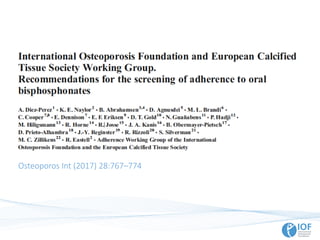
Osteoporos Int (2017) 28:767–774
BACKGROUND I
• Bisphosphonates (BPs) are considered a first-line treatment of
osteoporosis
• Adherence to BPs has been reported at 50% or below after
one year1-3
• Low adherence results in lack of efficacy (no or limited
decrease in fracture risk) and reduced cost effectiveness4
1. Cramer JA, et al (2007). Osteoporos Int 18(8):1023–1031; 2. Kothawala P, et al (2007). Mayo Clin Proc 82(12):1493–1501; 3. Kanis JA, et al (2012).
Osteoporos Int 23(1):213–221; 4. Hiligsmann M et al (2010). Calcif Tissue Int 86(3):202–210
BACKGROUND II
• Bone turnover markers (BTM) reflect the tissue effect of BPs1
• Measurement of BTM has been proposed for monitoring
treatment2
• Serum CTX and PINP have been recommended as reference
markers of bone turnover1
1. Vasikaran S et al (2011). Osteoporos Int 22(2): 391–420; 2. Kanis JA et al (2013) Osteoporos Int 24(1):23–57
Question to be addressed:
Can the bone turnover markers PINP and CTX be used to
identify low adherence in patients with postmenopausal
osteoporosis initiating oral bisphosphonates for
osteoporosis?
WORKING GROUP ON ADHERENCE OF THE IOF AND
THE ECTS
METHODS: THE TRIO STUDY (I)
• The TRIO Study1
was specifically addressing the question raised
by the Working Group
• RCT of 172 postmenopausal women with osteoporosis
• Effect of Aln, Ris and Ibn on BTM
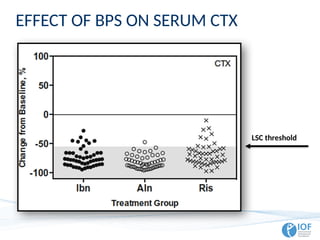
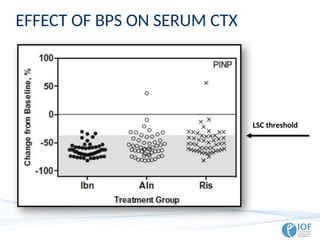
• Proportion of cases with decreases in BTM beyond the LSC (2-
tailed) at three months
1. Naylor KE et al (2016) . Osteoporos Int 27(1):21–31
METHODS: THE TRIO STUDY (II)
• Blood sampling at baseline and several times after starting BPs
• Adherence evaluated by the Medication Event Monitoring
System (MEMS) caps
• Represent a benchmark for measuring the effect of treatment
on BTM
1. Naylor KE et al (2016) . Osteoporos Int 27(1):21–31
EFFECT OF BPS ON SERUM CTX
LSC threshold
EFFECT OF BPS ON SERUM CTX
LSC threshold
PERFORMANCE OF BTMS FOR
SCREENING
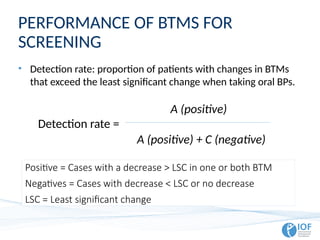
• Detection rate: proportion of patients with changes in BTMs
that exceed the least significant change when taking oral BPs.
Detection rate =
A (positive)
A (positive) + C (negative)
Positive = Cases with a decrease > LSC in one or both BTM
Negatives = Cases with decrease < LSC or no decrease
LSC = Least significant change
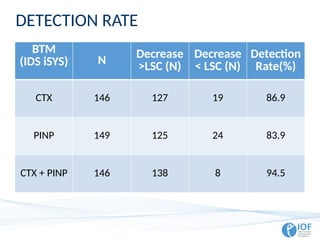
BTM
(IDS iSYS) N Decrease
>LSC (N)
Decrease
< LSC (N)
Detection
Rate(%)
CTX 146 127 19 86.9
PINP 149 125 24 83.9
CTX + PINP 146 138 8 94.5
DETECTION RATE
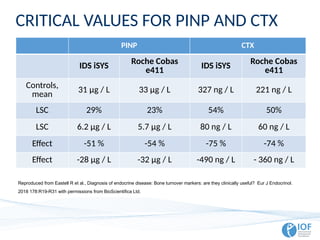
CRITICAL VALUES FOR PINP AND CTX
PINP CTX
IDS iSYS Roche Cobas
e411
IDS iSYS Roche Cobas
e411
Controls,
mean
31 μg / L 33 μg / L 327 ng / L 221 ng / L
LSC 29% 23% 54% 50%
LSC 6.2 μg / L 5.7 μg / L 80 ng / L 60 ng / L
Effect -51 % -54 % -75 % -74 %
Effect -28 μg / L -32 μg / L -490 ng / L - 360 ng / L
Reproduced from Eastell R et al., Diagnosis of endocrine disease: Bone turnover markers: are they clinically useful? Eur J Endocrinol.
2018 178:R19-R31 with permissions from BioScientifica Ltd.
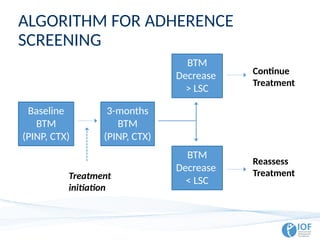
ALGORITHM FOR ADHERENCE
SCREENING
Baseline
BTM
(PINP, CTX)
3-months
BTM
(PINP, CTX)
BTM
Decrease
> LSC
BTM
Decrease
< LSC
Treatment
initiation
Reassess
Treatment
Continue
Treatment
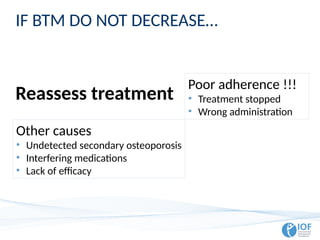
IF BTM DO NOT DECREASE…
Reassess treatment
Other causes
• Undetected secondary osteoporosis
• Interfering medications
• Lack of efficacy
Poor adherence !!!
• Treatment stopped
• Wrong administration
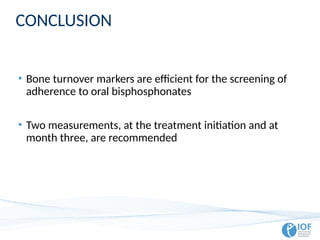
• Bone turnover markers are efficient for the screening of
adherence to oral bisphosphonates
• Two measurements, at the treatment initiation and at
month three, are recommended
CONCLUSION
The educational slide kit was made possible through an
unrestricted grant from
ACKNOWLEDGMENT
Our vision is a world without fragility fractures,
in which healthy mobility is a reality for all.
Join us

oral bisphosphonates_group Discussion.pptx

  • 1.
    Recommendations for thescreening of adherence to oral bisphosphonates
  • 2.
    IOF-ECTS Working Group •Richard Eastell & Adolfo Diez-Perez (co-chairs) • KE Naylor, B Abrahamsen, D Agnusdei, ML Brandi, C Cooper, E Dennison, EF Eriksen, DT Gold, N Guañabens, P Hadji, M Hiligsmann, R Horne, R Josse, JA Kanis, B Obermayer-Pietsch, D Prieto-Alhambra, JY Reginster, R Rizzoli, S Silverman, MC Zillikens
  • 3.
  • 4.
    BACKGROUND I • Bisphosphonates(BPs) are considered a first-line treatment of osteoporosis • Adherence to BPs has been reported at 50% or below after one year1-3 • Low adherence results in lack of efficacy (no or limited decrease in fracture risk) and reduced cost effectiveness4 1. Cramer JA, et al (2007). Osteoporos Int 18(8):1023–1031; 2. Kothawala P, et al (2007). Mayo Clin Proc 82(12):1493–1501; 3. Kanis JA, et al (2012). Osteoporos Int 23(1):213–221; 4. Hiligsmann M et al (2010). Calcif Tissue Int 86(3):202–210
  • 5.
    BACKGROUND II • Boneturnover markers (BTM) reflect the tissue effect of BPs1 • Measurement of BTM has been proposed for monitoring treatment2 • Serum CTX and PINP have been recommended as reference markers of bone turnover1 1. Vasikaran S et al (2011). Osteoporos Int 22(2): 391–420; 2. Kanis JA et al (2013) Osteoporos Int 24(1):23–57
  • 6.
    Question to beaddressed: Can the bone turnover markers PINP and CTX be used to identify low adherence in patients with postmenopausal osteoporosis initiating oral bisphosphonates for osteoporosis? WORKING GROUP ON ADHERENCE OF THE IOF AND THE ECTS
  • 7.
    METHODS: THE TRIOSTUDY (I) • The TRIO Study1 was specifically addressing the question raised by the Working Group • RCT of 172 postmenopausal women with osteoporosis • Effect of Aln, Ris and Ibn on BTM • Proportion of cases with decreases in BTM beyond the LSC (2- tailed) at three months 1. Naylor KE et al (2016) . Osteoporos Int 27(1):21–31
  • 8.
    METHODS: THE TRIOSTUDY (II) • Blood sampling at baseline and several times after starting BPs • Adherence evaluated by the Medication Event Monitoring System (MEMS) caps • Represent a benchmark for measuring the effect of treatment on BTM 1. Naylor KE et al (2016) . Osteoporos Int 27(1):21–31
  • 9.
    EFFECT OF BPSON SERUM CTX LSC threshold
  • 10.
    EFFECT OF BPSON SERUM CTX LSC threshold
  • 11.
    PERFORMANCE OF BTMSFOR SCREENING • Detection rate: proportion of patients with changes in BTMs that exceed the least significant change when taking oral BPs. Detection rate = A (positive) A (positive) + C (negative) Positive = Cases with a decrease > LSC in one or both BTM Negatives = Cases with decrease < LSC or no decrease LSC = Least significant change
  • 12.
    BTM (IDS iSYS) NDecrease >LSC (N) Decrease < LSC (N) Detection Rate(%) CTX 146 127 19 86.9 PINP 149 125 24 83.9 CTX + PINP 146 138 8 94.5 DETECTION RATE
  • 13.
    CRITICAL VALUES FORPINP AND CTX PINP CTX IDS iSYS Roche Cobas e411 IDS iSYS Roche Cobas e411 Controls, mean 31 μg / L 33 μg / L 327 ng / L 221 ng / L LSC 29% 23% 54% 50% LSC 6.2 μg / L 5.7 μg / L 80 ng / L 60 ng / L Effect -51 % -54 % -75 % -74 % Effect -28 μg / L -32 μg / L -490 ng / L - 360 ng / L Reproduced from Eastell R et al., Diagnosis of endocrine disease: Bone turnover markers: are they clinically useful? Eur J Endocrinol. 2018 178:R19-R31 with permissions from BioScientifica Ltd.
  • 14.
    ALGORITHM FOR ADHERENCE SCREENING Baseline BTM (PINP,CTX) 3-months BTM (PINP, CTX) BTM Decrease > LSC BTM Decrease < LSC Treatment initiation Reassess Treatment Continue Treatment
  • 15.
    IF BTM DONOT DECREASE… Reassess treatment Other causes • Undetected secondary osteoporosis • Interfering medications • Lack of efficacy Poor adherence !!! • Treatment stopped • Wrong administration
  • 16.
    • Bone turnovermarkers are efficient for the screening of adherence to oral bisphosphonates • Two measurements, at the treatment initiation and at month three, are recommended CONCLUSION
  • 17.
    The educational slidekit was made possible through an unrestricted grant from ACKNOWLEDGMENT
  • 18.
    Our vision isa world without fragility fractures, in which healthy mobility is a reality for all. Join us