A STUDY TO EVALUATE THE EFFECTIVENESS OF
PLANNED TEACHING PROGRAM ON KNOWLEDGE
REGARDING STEM CELL THERAPY AMONG
STUDENT NURSES AT SELECTED NURSING
INSTITUTION, HUBBALLI, KARNATAKA.
Presented by :
MS. R SANDHYA DEVI
M.Sc Nursing 2nd year
Department of Medical Surgical Nursing,
KLES’ Institute of Nursing Sciences, Hubli.
• Stem cells are autologous cells having a long
term self-renewal ability that regenerates and
differentiates into various cells, tissues, organs
and systems in the human body.
• Stem-cell therapy is the use of stem cells to
treat or prevent a disease or condition..
• Stem cell therapy is an emerging therapeutic
modality and is believed to be one of the
greatest untapped resources currently available
for the prevention and treatment of many
diseases.
NEED FOR THE STUDY
2
• As it is a new approach in medical science most
of the patients and their relatives are unaware
about this clinical entity. The nurses also lack
adequate knowledge about this new innovative
approach.
• Nurses’ knowledge on stem cells and their
attitude towards stem cell application in
medical setting are very important as these
could affect the decision on providing
appropriate stem cell-based treatments for
many diseases including cancer and
cardiovascular diseases.
NEED FOR THE STUDY –Contd
3
• To assess the level of knowledge of student nurses
regarding stem cell therapy before the planned teaching
program by self administered structured knowledge
questionnaire.
• To assess the level of knowledge of student nurses
regarding stem cell therapy after the planned teaching
program by self administered structured knowledge
questionnaire.
• To assess the effectiveness of planned teaching program
regarding stem cell therapy in terms of gain in
knowledge among the student nurses.
• To find out an association between the pretest
knowledge scores with their selected demographic
variables.
• To find out the relationship between Patient
Satisfaction & Selected Sociodemographic variables.
OBJECTIVES
4
• Effectiveness: It refers to determine the extent
to which the structured teaching program has
achieved the desired effect as measured by the
gain in post test knowledge scores.
• Knowledge: It refers to the correct response to
questions included in the structured knowledge
questionnaire regarding stem cell therapy and
expressed in terms of knowledge scores.
• Stem Cell Therapy: It is the use of stem cells
i.e., Umbilical cord stem cells, embryonic stem
cell & Adult stem cells to treat or prevent a
disease or condition.
OPERATIONAL DEFINITIONS
5
• Planned Teaching Programme : It refers to the
written / verbal material on stem cell therapy
which includes – General information on stem
cells, characteristics of stem cells, types of stem
cells, sources of stem cells, potential uses of
stem cells, definition of stem cell therapy,
advantages & disadvantage of stem cell therapy,
procedure of stem therapy, Complications of
stem cell therapy, centers of stem cell therapy in
India, legal implications & nurses role in stem
cell therapy and is developed by the investigator
and validated by the experts in the field of
Nursing & Medicine.
OPERATIONAL DEFINITIONS - contd
6
• Student Nurses: It refers to the final year
Basic B.Sc Nursing & GNM students of a
selected Nursing Institutions.
• Socio-Demographic Variables: It refers to age,
gender, religion, type of family, Professional
education, habitat & source of information
regarding stem cell therapy.
• Selected Nursing Institution: It refers to KLES
Institute of Nursing Sciences, Hubballi.
7
OPERATIONAL DEFINITIONS - contd
• H1 : The mean post test knowledge scores of the
student nurses receiving planned teaching
program on knowledge regarding stem cell
therapy will be significantly higher than the
mean pre-test knowledge scores at 0.05 level of
Significance.
• H2 : There will be a statistical association
between pre-test knowledge scores and selected
socio demographic variables at 0.05 level of
significance.
HYPOTHESES
8
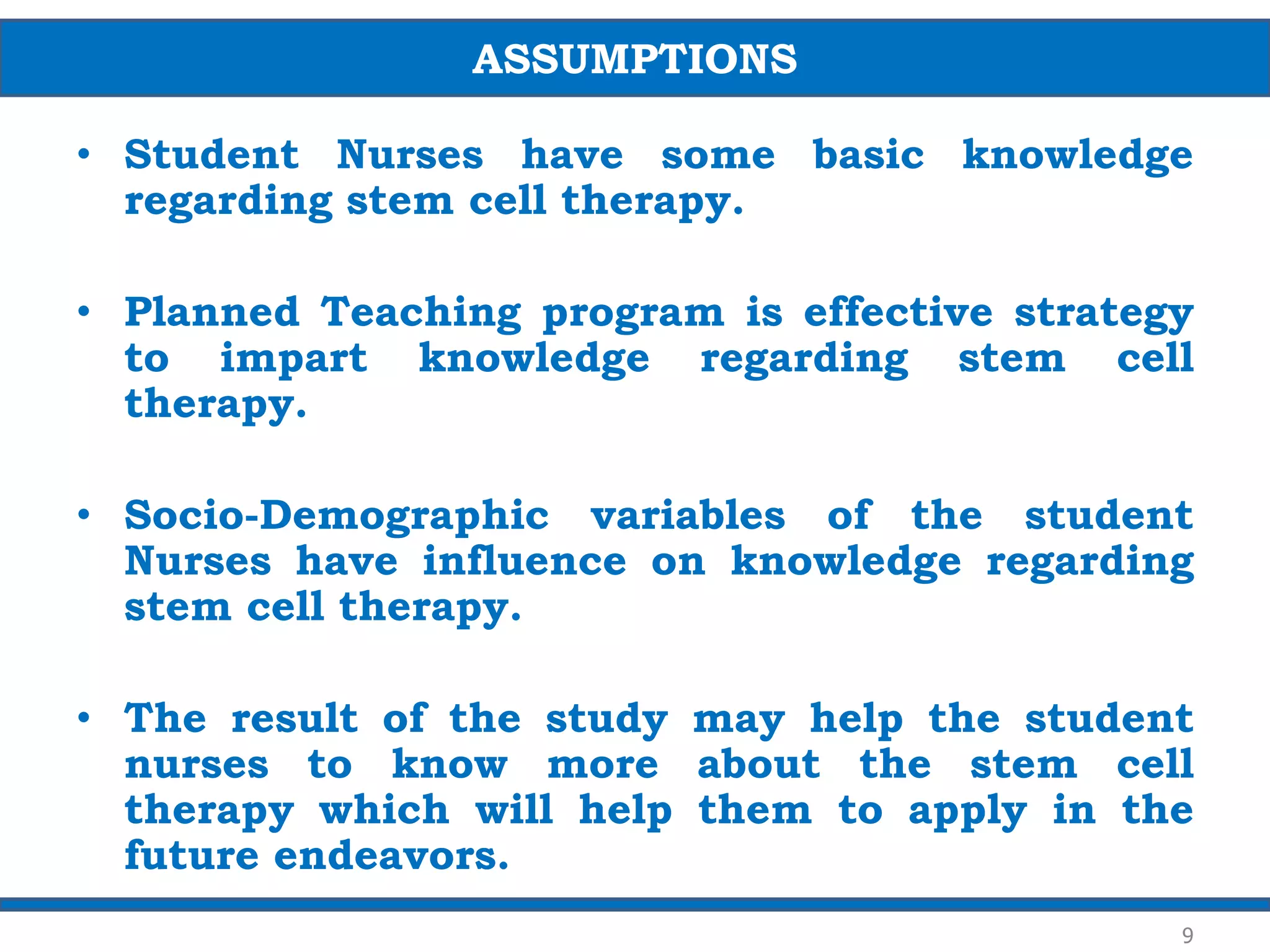
• Student Nurses have some basic knowledge
regarding stem cell therapy.
• Planned Teaching program is effective strategy
to impart knowledge regarding stem cell
therapy.
• Socio-Demographic variables of the student
Nurses have influence on knowledge regarding
stem cell therapy.
• The result of the study may help the student
nurses to know more about the stem cell
therapy which will help them to apply in the
future endeavors.
ASSUMPTIONS
9
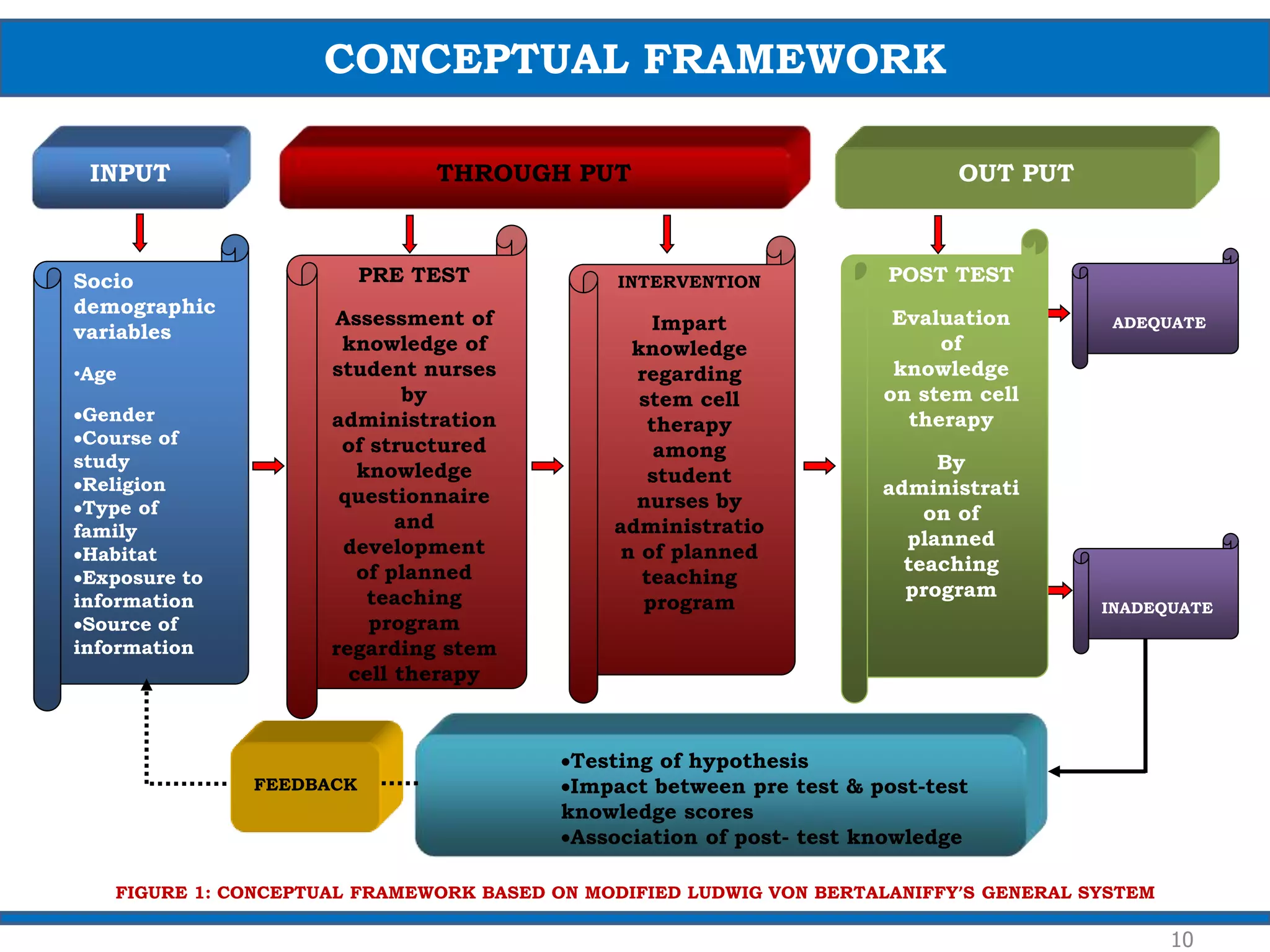
CONCEPTUAL FRAMEWORK
10
INPUT THROUGH PUT OUT PUT
Testing of hypothesis
Impact between pre test & post-test
knowledge scores
Association of post- test knowledge
FEEDBACK
Socio
demographic
variables
•Age
Gender
Course of
study
Religion
Type of
family
Habitat
Exposure to
information
Source of
information
PRE TEST
Assessment of
knowledge of
student nurses
by
administration
of structured
knowledge
questionnaire
and
development
of planned
teaching
program
regarding stem
cell therapy
INTERVENTION
Impart
knowledge
regarding
stem cell
therapy
among
student
nurses by
administratio
n of planned
teaching
program
ADEQUATE
INADEQUATE
POST TEST
Evaluation
of
knowledge
on stem cell
therapy
By
administrati
on of
planned
teaching
program
FIGURE 1: CONCEPTUAL FRAMEWORK BASED ON MODIFIED LUDWIG VON BERTALANIFFY’S GENERAL SYSTEM
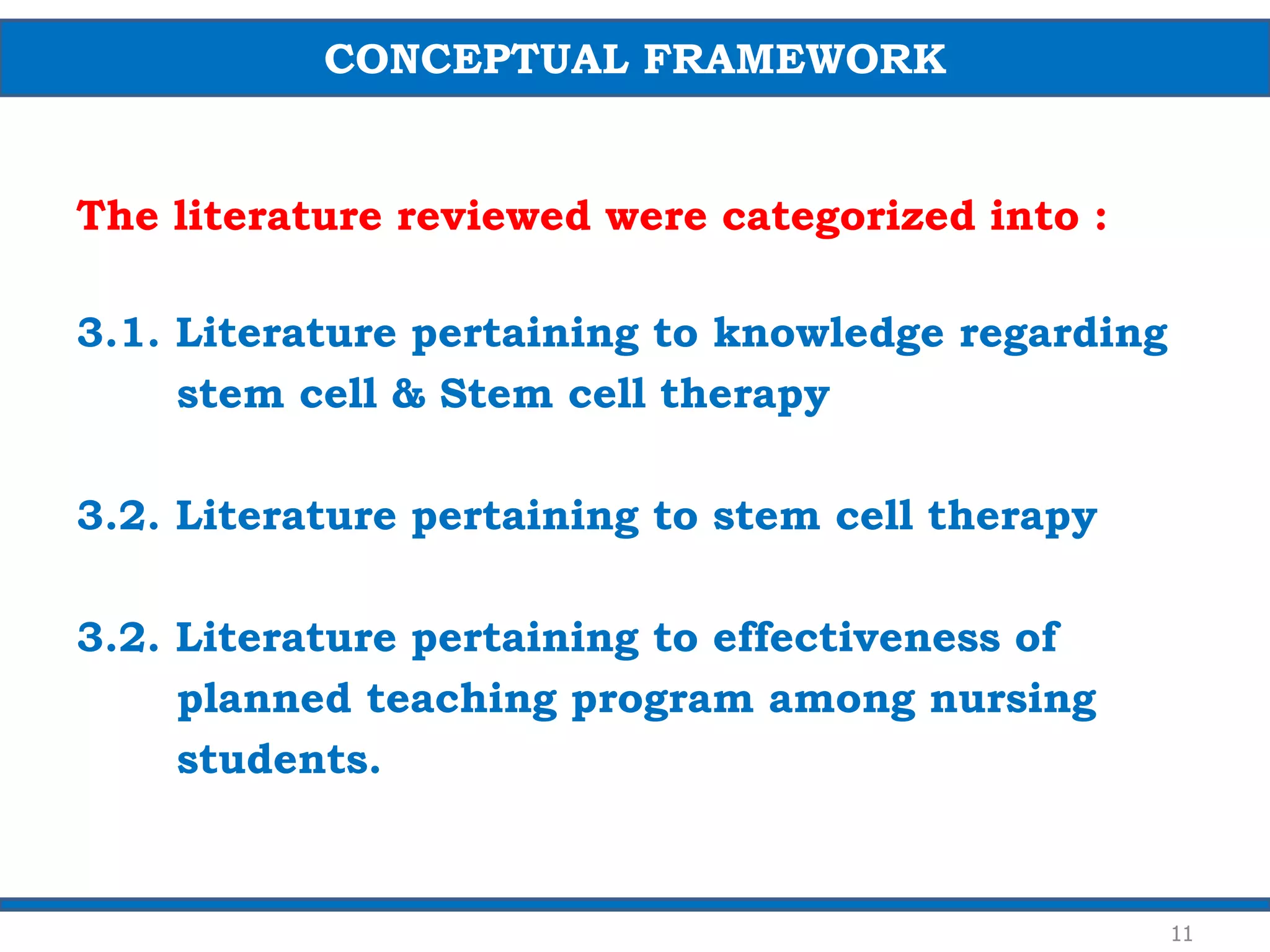
The literature reviewed were categorized into :
3.1. Literature pertaining to knowledge regarding
stem cell & Stem cell therapy
3.2. Literature pertaining to stem cell therapy
3.2. Literature pertaining to effectiveness of
planned teaching program among nursing
students.
11
CONCEPTUAL FRAMEWORK
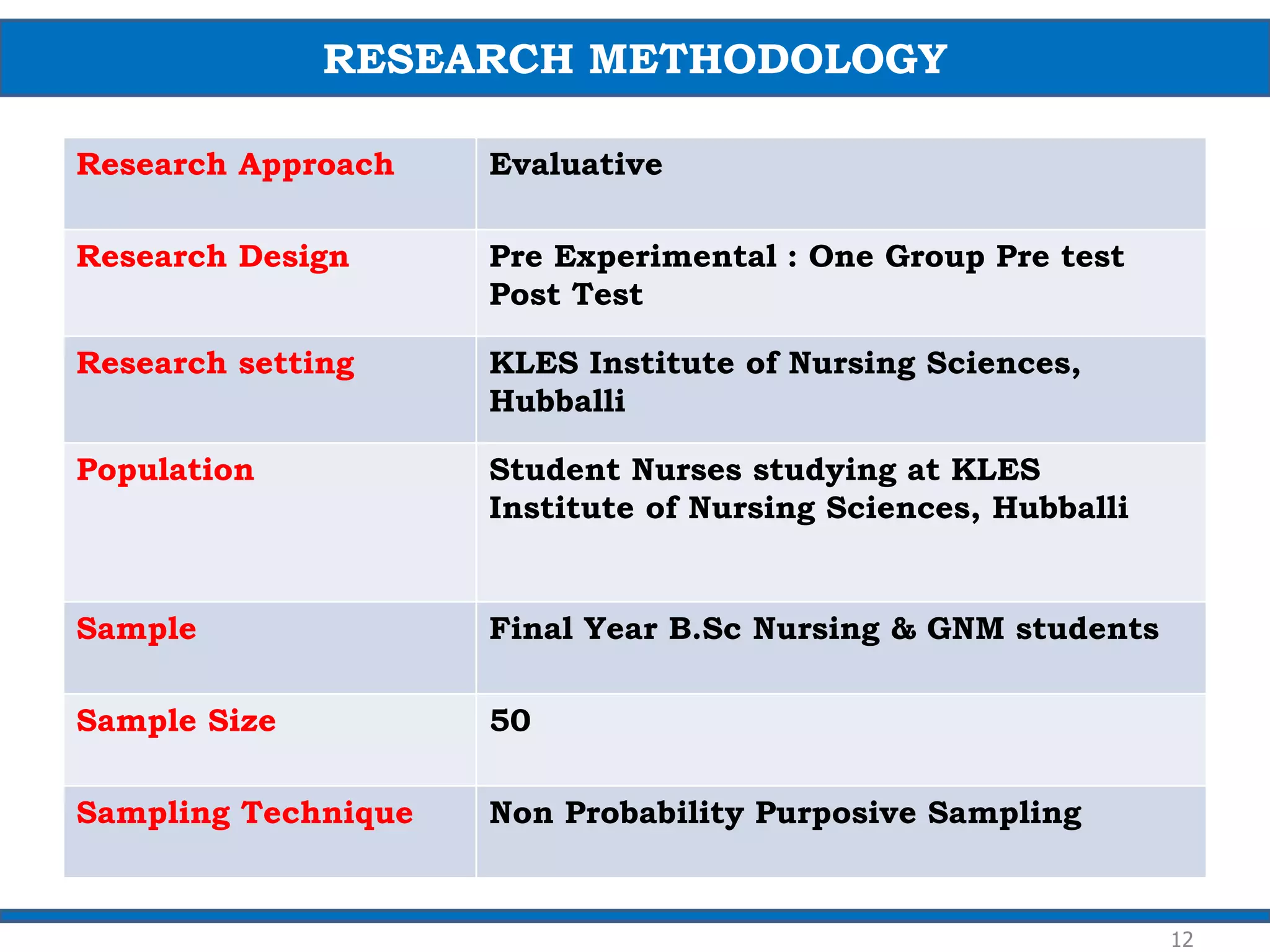
Research Approach Evaluative
Research Design Pre Experimental : One Group Pre test
Post Test
Research setting KLES Institute of Nursing Sciences,
Hubballi
Population Student Nurses studying at KLES
Institute of Nursing Sciences, Hubballi
Sample Final Year B.Sc Nursing & GNM students
Sample Size 50
Sampling Technique Non Probability Purposive Sampling
12
RESEARCH METHODOLOGY
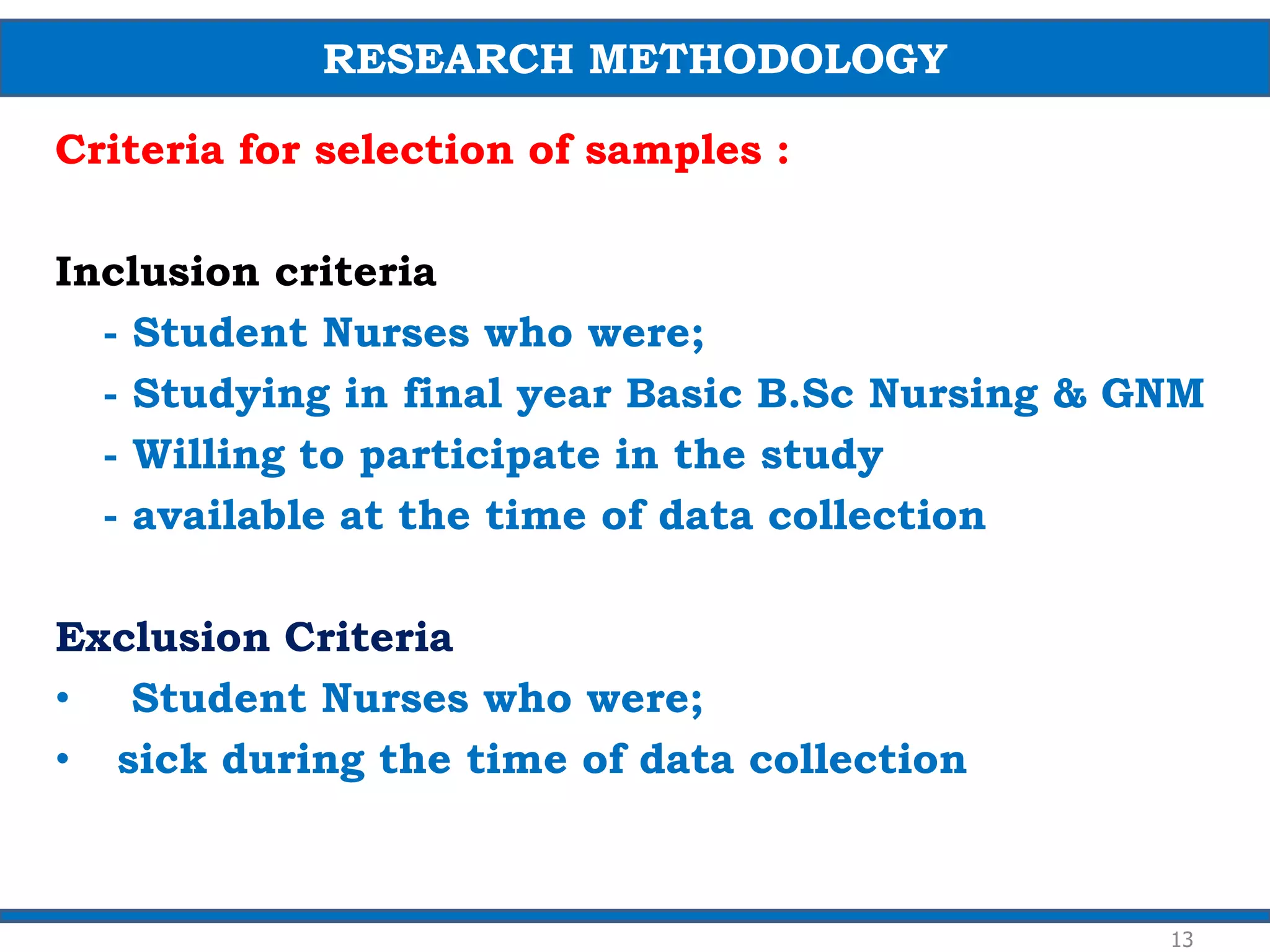
Criteria for selection of samples :
Inclusion criteria
- Student Nurses who were;
- Studying in final year Basic B.Sc Nursing & GNM
- Willing to participate in the study
- available at the time of data collection
Exclusion Criteria
• Student Nurses who were;
• sick during the time of data collection
13
RESEARCH METHODOLOGY
The tool consists of structured knowledge questionnaire on :
• Section I: Items on socio-demographic data of student nurses
with 8 variables that include age, gender, course of study,
religion, type of family, habitat, and exposure to information &
source of information related to stem cell therapy.
• Section II: Items on structured knowledge questionnaire
• Part A): Items on knowledge regarding stem cell: definition,
types & sources
• Part B): Items on knowledge regarding stem cell properties,
role, advantage & disadvantage.
• Part C): Items on knowledge regarding stem cell therapy –
introduction, definition & indication
• Part D): Items on knowledge regarding stem cell therapy –
bone marrow & umbilical cord blood & complications
• Part E): Items on knowledge regarding stem cell therapy –
procedure & role of nurse.
14
DESCRIPTION OF THE TOOL
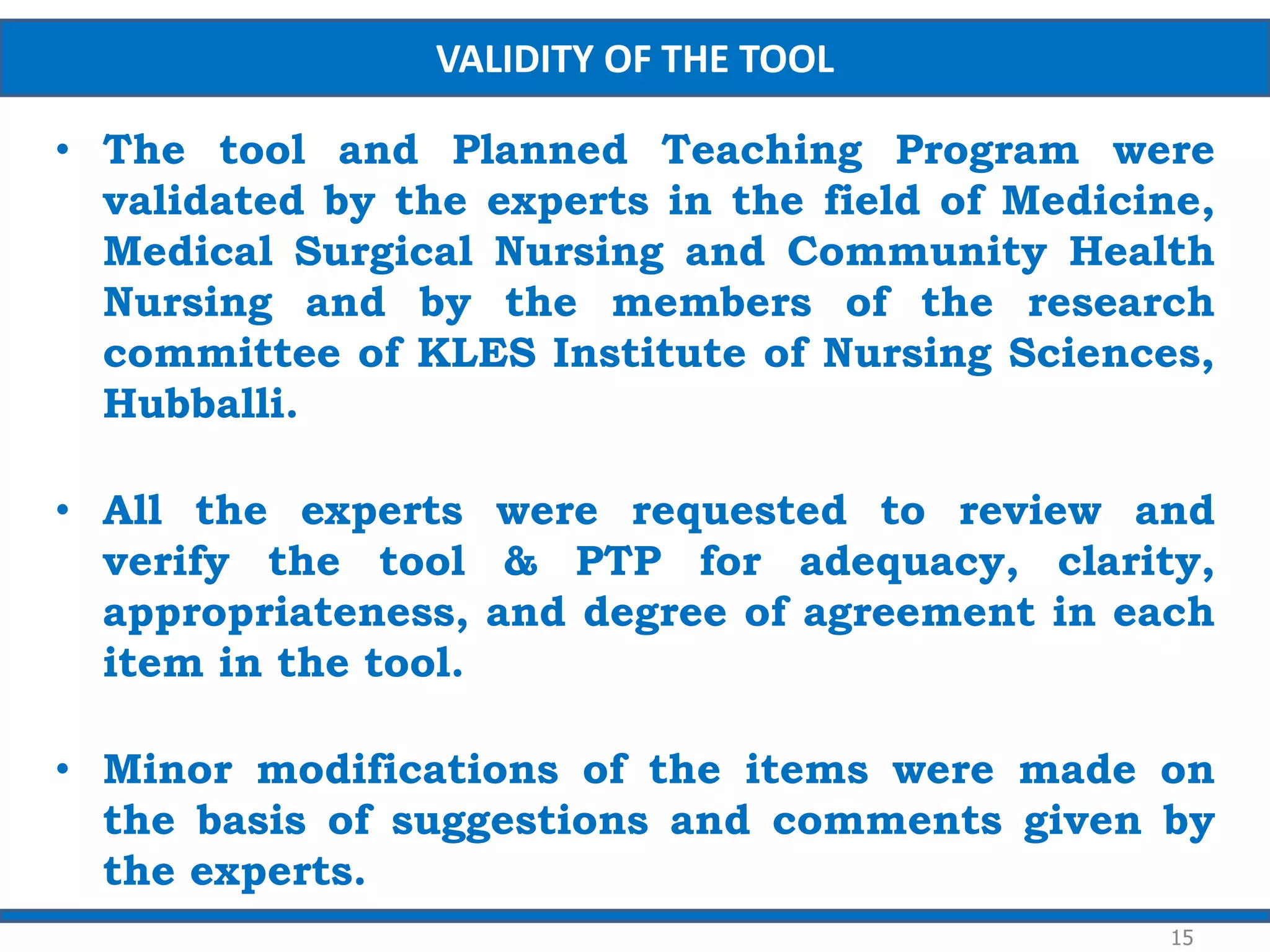
• The tool and Planned Teaching Program were
validated by the experts in the field of Medicine,
Medical Surgical Nursing and Community Health
Nursing and by the members of the research
committee of KLES Institute of Nursing Sciences,
Hubballi.
• All the experts were requested to review and
verify the tool & PTP for adequacy, clarity,
appropriateness, and degree of agreement in each
item in the tool.
• Minor modifications of the items were made on
the basis of suggestions and comments given by
the experts.
15
VALIDITY OF THE TOOL
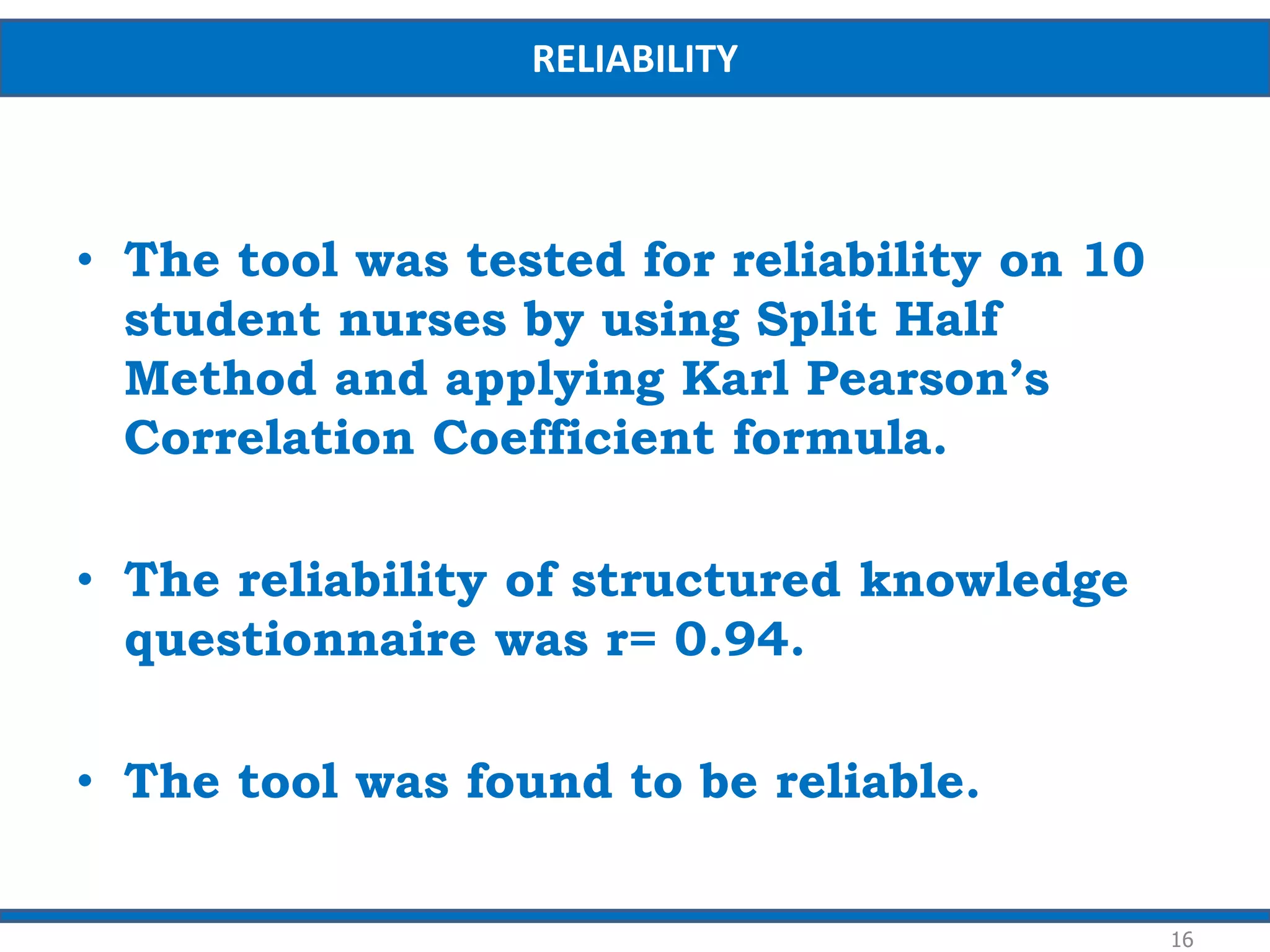
• The tool was tested for reliability on 10
student nurses by using Split Half
Method and applying Karl Pearson’s
Correlation Coefficient formula.
• The reliability of structured knowledge
questionnaire was r= 0.94.
• The tool was found to be reliable.
16
RELIABILITY
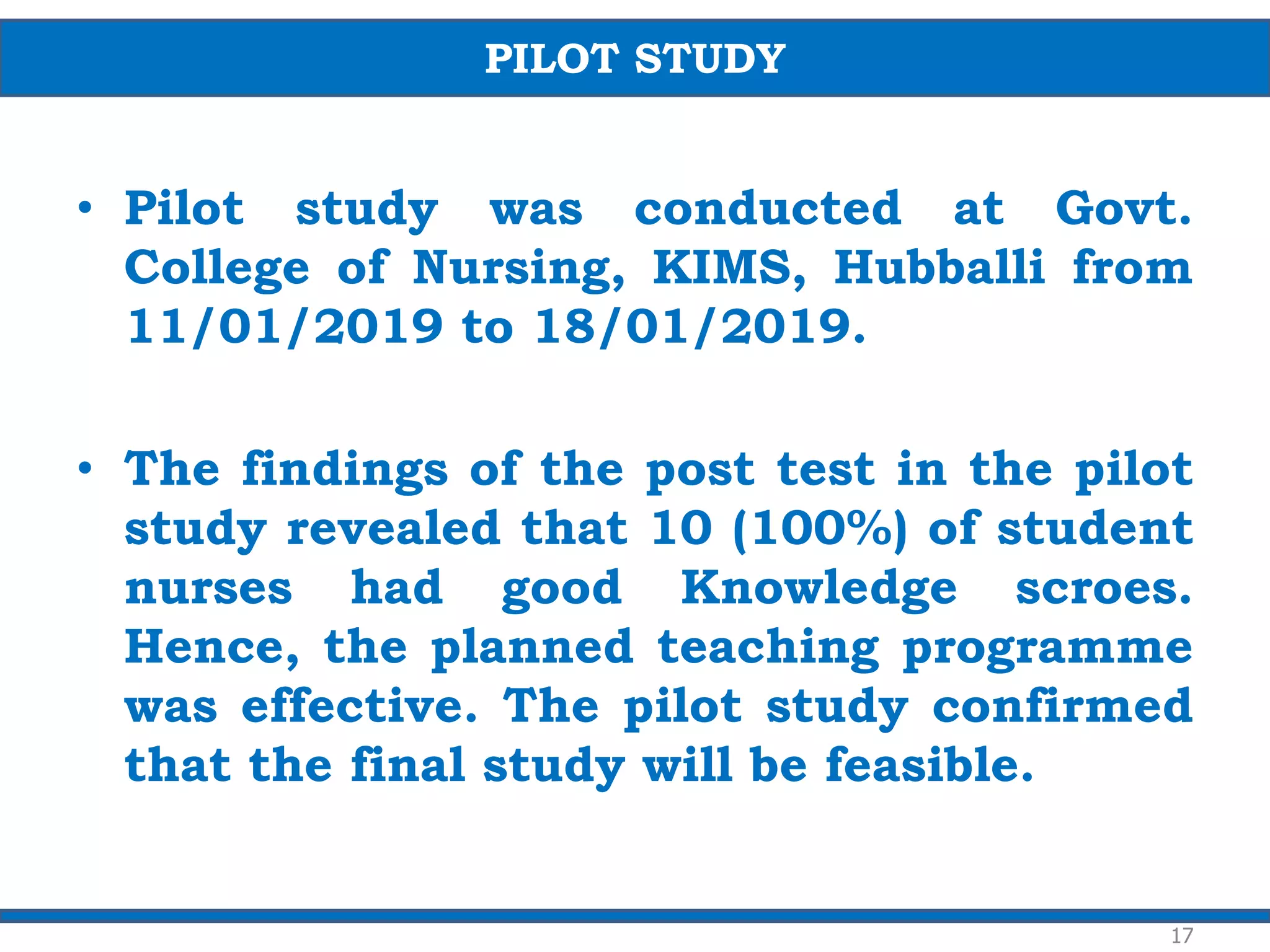
• Pilot study was conducted at Govt.
College of Nursing, KIMS, Hubballi from
11/01/2019 to 18/01/2019.
• The findings of the post test in the pilot
study revealed that 10 (100%) of student
nurses had good Knowledge scroes.
Hence, the planned teaching programme
was effective. The pilot study confirmed
that the final study will be feasible.
17
PILOT STUDY
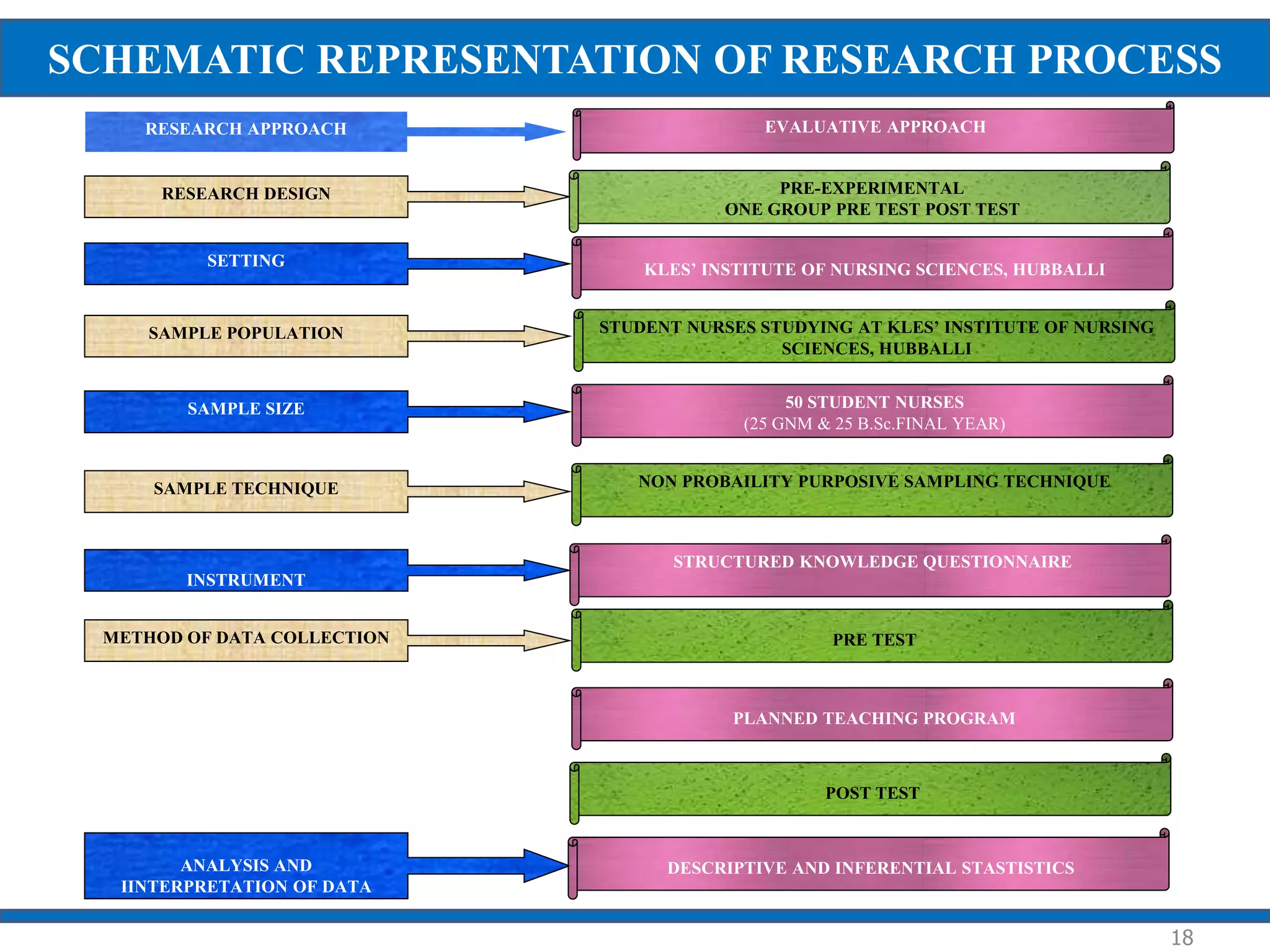
18
RESEARCH APPROACH EVALUATIVE APPROACH
RESEARCH DESIGN PRE-EXPERIMENTAL
ONE GROUP PRE TEST POST TEST
SETTING
SAMPLE POPULATION
SAMPLE SIZE
SAMPLE TECHNIQUE
INSTRUMENT
METHOD OF DATA COLLECTION
ANALYSIS AND
IINTERPRETATION OF DATA
KLES’ INSTITUTE OF NURSING SCIENCES, HUBBALLI
STUDENT NURSES STUDYING AT KLES’ INSTITUTE OF NURSING
SCIENCES, HUBBALLI
50 STUDENT NURSES
(25 GNM & 25 B.Sc.FINAL YEAR)
NON PROBAILITY PURPOSIVE SAMPLING TECHNIQUE
STRUCTURED KNOWLEDGE QUESTIONNAIRE
PRE TEST
PLANNED TEACHING PROGRAM
POST TEST
DESCRIPTIVE AND INFERENTIAL STASTISTICS
SCHEMATIC REPRESENTATION OF RESEARCH PROCESS
19
RESULTS
1. DISTRIBUTION OF SAMPLE CHARACTERISTICS ACCORDING TO SOCIO DEMOGRAPHIC
VARIABLES
Graph 1: The cone graph represents percentage distribution of subjects
according to their age group
20
RESULTS
Graph 2: The bar graph represents percentage distribution of subjects
according to their gender

Stem Therapy.ppt

  • 1.
    A STUDY TOEVALUATE THE EFFECTIVENESS OF PLANNED TEACHING PROGRAM ON KNOWLEDGE REGARDING STEM CELL THERAPY AMONG STUDENT NURSES AT SELECTED NURSING INSTITUTION, HUBBALLI, KARNATAKA. Presented by : MS. R SANDHYA DEVI M.Sc Nursing 2nd year Department of Medical Surgical Nursing, KLES’ Institute of Nursing Sciences, Hubli.
  • 2.
    • Stem cellsare autologous cells having a long term self-renewal ability that regenerates and differentiates into various cells, tissues, organs and systems in the human body. • Stem-cell therapy is the use of stem cells to treat or prevent a disease or condition.. • Stem cell therapy is an emerging therapeutic modality and is believed to be one of the greatest untapped resources currently available for the prevention and treatment of many diseases. NEED FOR THE STUDY 2
  • 3.
    • As itis a new approach in medical science most of the patients and their relatives are unaware about this clinical entity. The nurses also lack adequate knowledge about this new innovative approach. • Nurses’ knowledge on stem cells and their attitude towards stem cell application in medical setting are very important as these could affect the decision on providing appropriate stem cell-based treatments for many diseases including cancer and cardiovascular diseases. NEED FOR THE STUDY –Contd 3
  • 4.
    • To assessthe level of knowledge of student nurses regarding stem cell therapy before the planned teaching program by self administered structured knowledge questionnaire. • To assess the level of knowledge of student nurses regarding stem cell therapy after the planned teaching program by self administered structured knowledge questionnaire. • To assess the effectiveness of planned teaching program regarding stem cell therapy in terms of gain in knowledge among the student nurses. • To find out an association between the pretest knowledge scores with their selected demographic variables. • To find out the relationship between Patient Satisfaction & Selected Sociodemographic variables. OBJECTIVES 4
  • 5.
    • Effectiveness: Itrefers to determine the extent to which the structured teaching program has achieved the desired effect as measured by the gain in post test knowledge scores. • Knowledge: It refers to the correct response to questions included in the structured knowledge questionnaire regarding stem cell therapy and expressed in terms of knowledge scores. • Stem Cell Therapy: It is the use of stem cells i.e., Umbilical cord stem cells, embryonic stem cell & Adult stem cells to treat or prevent a disease or condition. OPERATIONAL DEFINITIONS 5
  • 6.
    • Planned TeachingProgramme : It refers to the written / verbal material on stem cell therapy which includes – General information on stem cells, characteristics of stem cells, types of stem cells, sources of stem cells, potential uses of stem cells, definition of stem cell therapy, advantages & disadvantage of stem cell therapy, procedure of stem therapy, Complications of stem cell therapy, centers of stem cell therapy in India, legal implications & nurses role in stem cell therapy and is developed by the investigator and validated by the experts in the field of Nursing & Medicine. OPERATIONAL DEFINITIONS - contd 6
  • 7.
    • Student Nurses:It refers to the final year Basic B.Sc Nursing & GNM students of a selected Nursing Institutions. • Socio-Demographic Variables: It refers to age, gender, religion, type of family, Professional education, habitat & source of information regarding stem cell therapy. • Selected Nursing Institution: It refers to KLES Institute of Nursing Sciences, Hubballi. 7 OPERATIONAL DEFINITIONS - contd
  • 8.
    • H1 :The mean post test knowledge scores of the student nurses receiving planned teaching program on knowledge regarding stem cell therapy will be significantly higher than the mean pre-test knowledge scores at 0.05 level of Significance. • H2 : There will be a statistical association between pre-test knowledge scores and selected socio demographic variables at 0.05 level of significance. HYPOTHESES 8
  • 9.
    • Student Nurseshave some basic knowledge regarding stem cell therapy. • Planned Teaching program is effective strategy to impart knowledge regarding stem cell therapy. • Socio-Demographic variables of the student Nurses have influence on knowledge regarding stem cell therapy. • The result of the study may help the student nurses to know more about the stem cell therapy which will help them to apply in the future endeavors. ASSUMPTIONS 9
  • 10.
    CONCEPTUAL FRAMEWORK 10 INPUT THROUGHPUT OUT PUT Testing of hypothesis Impact between pre test & post-test knowledge scores Association of post- test knowledge FEEDBACK Socio demographic variables •Age Gender Course of study Religion Type of family Habitat Exposure to information Source of information PRE TEST Assessment of knowledge of student nurses by administration of structured knowledge questionnaire and development of planned teaching program regarding stem cell therapy INTERVENTION Impart knowledge regarding stem cell therapy among student nurses by administratio n of planned teaching program ADEQUATE INADEQUATE POST TEST Evaluation of knowledge on stem cell therapy By administrati on of planned teaching program FIGURE 1: CONCEPTUAL FRAMEWORK BASED ON MODIFIED LUDWIG VON BERTALANIFFY’S GENERAL SYSTEM
  • 11.
    The literature reviewedwere categorized into : 3.1. Literature pertaining to knowledge regarding stem cell & Stem cell therapy 3.2. Literature pertaining to stem cell therapy 3.2. Literature pertaining to effectiveness of planned teaching program among nursing students. 11 CONCEPTUAL FRAMEWORK
  • 12.
    Research Approach Evaluative ResearchDesign Pre Experimental : One Group Pre test Post Test Research setting KLES Institute of Nursing Sciences, Hubballi Population Student Nurses studying at KLES Institute of Nursing Sciences, Hubballi Sample Final Year B.Sc Nursing & GNM students Sample Size 50 Sampling Technique Non Probability Purposive Sampling 12 RESEARCH METHODOLOGY
  • 13.
    Criteria for selectionof samples : Inclusion criteria - Student Nurses who were; - Studying in final year Basic B.Sc Nursing & GNM - Willing to participate in the study - available at the time of data collection Exclusion Criteria • Student Nurses who were; • sick during the time of data collection 13 RESEARCH METHODOLOGY
  • 14.
    The tool consistsof structured knowledge questionnaire on : • Section I: Items on socio-demographic data of student nurses with 8 variables that include age, gender, course of study, religion, type of family, habitat, and exposure to information & source of information related to stem cell therapy. • Section II: Items on structured knowledge questionnaire • Part A): Items on knowledge regarding stem cell: definition, types & sources • Part B): Items on knowledge regarding stem cell properties, role, advantage & disadvantage. • Part C): Items on knowledge regarding stem cell therapy – introduction, definition & indication • Part D): Items on knowledge regarding stem cell therapy – bone marrow & umbilical cord blood & complications • Part E): Items on knowledge regarding stem cell therapy – procedure & role of nurse. 14 DESCRIPTION OF THE TOOL
  • 15.
    • The tooland Planned Teaching Program were validated by the experts in the field of Medicine, Medical Surgical Nursing and Community Health Nursing and by the members of the research committee of KLES Institute of Nursing Sciences, Hubballi. • All the experts were requested to review and verify the tool & PTP for adequacy, clarity, appropriateness, and degree of agreement in each item in the tool. • Minor modifications of the items were made on the basis of suggestions and comments given by the experts. 15 VALIDITY OF THE TOOL
  • 16.
    • The toolwas tested for reliability on 10 student nurses by using Split Half Method and applying Karl Pearson’s Correlation Coefficient formula. • The reliability of structured knowledge questionnaire was r= 0.94. • The tool was found to be reliable. 16 RELIABILITY
  • 17.
    • Pilot studywas conducted at Govt. College of Nursing, KIMS, Hubballi from 11/01/2019 to 18/01/2019. • The findings of the post test in the pilot study revealed that 10 (100%) of student nurses had good Knowledge scroes. Hence, the planned teaching programme was effective. The pilot study confirmed that the final study will be feasible. 17 PILOT STUDY
  • 18.
    18 RESEARCH APPROACH EVALUATIVEAPPROACH RESEARCH DESIGN PRE-EXPERIMENTAL ONE GROUP PRE TEST POST TEST SETTING SAMPLE POPULATION SAMPLE SIZE SAMPLE TECHNIQUE INSTRUMENT METHOD OF DATA COLLECTION ANALYSIS AND IINTERPRETATION OF DATA KLES’ INSTITUTE OF NURSING SCIENCES, HUBBALLI STUDENT NURSES STUDYING AT KLES’ INSTITUTE OF NURSING SCIENCES, HUBBALLI 50 STUDENT NURSES (25 GNM & 25 B.Sc.FINAL YEAR) NON PROBAILITY PURPOSIVE SAMPLING TECHNIQUE STRUCTURED KNOWLEDGE QUESTIONNAIRE PRE TEST PLANNED TEACHING PROGRAM POST TEST DESCRIPTIVE AND INFERENTIAL STASTISTICS SCHEMATIC REPRESENTATION OF RESEARCH PROCESS
  • 19.
    19 RESULTS 1. DISTRIBUTION OFSAMPLE CHARACTERISTICS ACCORDING TO SOCIO DEMOGRAPHIC VARIABLES Graph 1: The cone graph represents percentage distribution of subjects according to their age group
  • 20.
    20 RESULTS Graph 2: Thebar graph represents percentage distribution of subjects according to their gender