Institutionalizing
Water Accounting
Overview
Dr Amgad Elmahdi
Head of MENA Region-IWMI
3rd June 2020
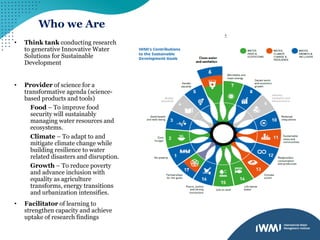
Who we Are
• Think tank conducting research
to generative Innovative Water
Solutions for Sustainable
Development
• Provider of science for a
transformative agenda (science-
based products and tools)
Food – To improve food
security will sustainably
managing water resources and
ecosystems.
Climate – To adapt to and
mitigate climate change while
building resilience to water
related disasters and disruption.
Growth – To reduce poverty
and advance inclusion with
equality as agriculture
transforms, energy transitions
and urbanization intensifies.
• Facilitator of learning to
strengthen capacity and achieve
uptake of research findings
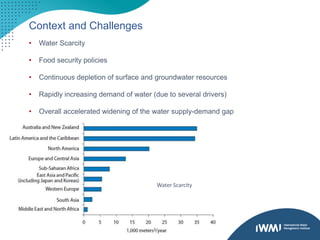
Context and Challenges
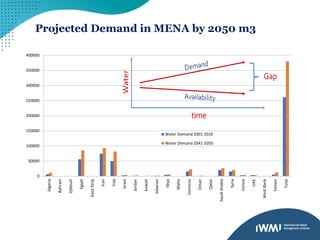
• Water Scarcity
• Food security policies
• Continuous depletion of surface and groundwater resources
• Rapidly increasing demand of water (due to several drivers)
• Overall accelerated widening of the water supply-demand gap
Water Scarcity
Projected Demand in MENA by 2050 m3
0
50000
100000
150000
200000
250000
300000
350000
400000
Algeria
Bahrain
Djibouti
Egypt
GazaStrip
Iran
Iraq
Israel
Jordan
kuwait
lebanon
libya
Malta
morocco
Oman
Qatar
SaudiArabia
Syria
tunisia
UAE
WestBank
Yemen
Total
Water Demand 2001-2010
Water Demand 2041-2050
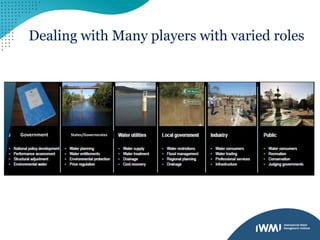
Dealing with Many players with varied roles
Government States/Governorates
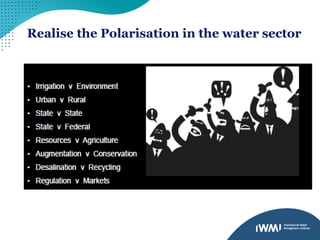
Realise the Polarisation in the water sector
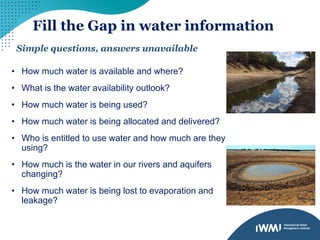
Fill the Gap in water information
Simple questions, answers unavailable
• How much water is available and where?
• What is the water availability outlook?
• How much water is being used?
• How much water is being allocated and delivered?
• Who is entitled to use water and how much are they
using?
• How much is the water in our rivers and aquifers
changing?
• How much water is being lost to evaporation and
leakage?
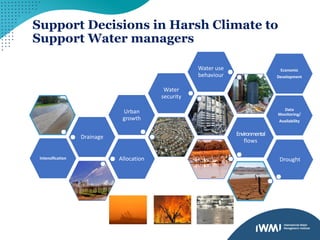
Support Decisions in Harsh Climate to
Support Water managers
Drainage
Urban
growth
Water
security
Water use
behaviour
Environmental
flows
Allocation DroughtIntensification
Economic
Development
Data
Monitoring/
Availability
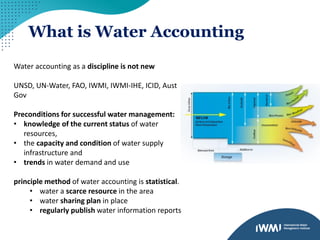
What is Water Accounting
Water accounting as a discipline is not new
UNSD, UN-Water, FAO, IWMI, IWMI-IHE, ICID, Aust
Gov
Preconditions for successful water management:
• knowledge of the current status of water
resources,
• the capacity and condition of water supply
infrastructure and
• trends in water demand and use
principle method of water accounting is statistical.
• water a scarce resource in the area
• water sharing plan in place
• regularly publish water information reports
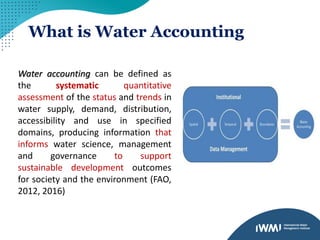
What is Water Accounting
Water accounting can be defined as
the systematic quantitative
assessment of the status and trends in
water supply, demand, distribution,
accessibility and use in specified
domains, producing information that
informs water science, management
and governance to support
sustainable development outcomes
for society and the environment (FAO,
2012, 2016)
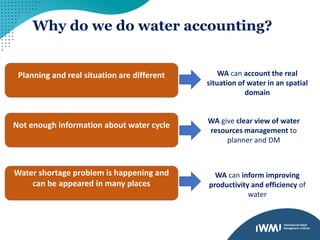
Why do we do water accounting?
Planning and real situation are different WA can account the real
situation of water in an spatial
domain
Water shortage problem is happening and
can be appeared in many places
WA can inform improving
productivity and efficiency of
water
Not enough information about water cycle WA give clear view of water
resources management to
planner and DM
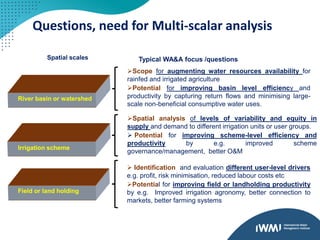
Questions, need for Multi-scalar analysis
River basin or watershed
Irrigation scheme
Field or land holding
Scope for augmenting water resources availability for
rainfed and irrigated agriculture
Potential for improving basin level efficiency and
productivity by capturing return flows and minimising large-
scale non-beneficial consumptive water uses.
Spatial analysis of levels of variability and equity in
supply and demand to different irrigation units or user groups.
 Potential for improving scheme-level efficiency and
productivity by e.g. improved scheme
governance/management, better O&M
 Identification and evaluation different user-level drivers
e.g. profit, risk minimisation, reduced labour costs etc
Potential for improving field or landholding productivity
by e.g. Improved irrigation agronomy, better connection to
markets, better farming systems
Spatial scales Typical WA&A focus /questions
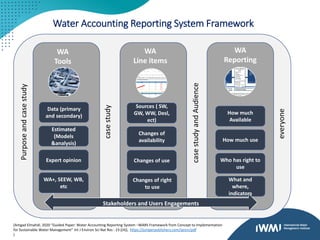
Water Accounting Reporting System Framework
WA
Reporting
WA
Line items
WA
Tools
How much
Available
How much use
Who has right to
use
What and
where,
indicators
Sources ( SW,
GW, WW, Desl,
ect)
Changes of
availability
Changes of use
Changes of right
to use
Data (primary
and secondary)
Estimated
(Models
&analysis)
WA+, SEEW, WB,
etc
Expert opinion
Purposeandcasestudy
casestudy
casestudyandAudience
everyone
(Amgad Elmahdi, 2020 “Guided Paper: Water Accounting Reporting System –WARS Framework from Concept to Implementation
for Sustainable Water Management” Int J Environ Sci Nat Res : 23 ((4)), https://juniperpublishers.com/ijesnr/pdf
)
Stakeholders and Users Engagements
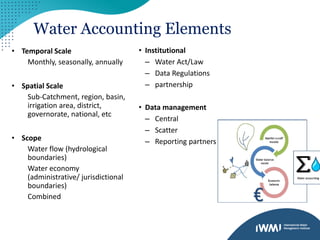
Water Accounting Elements
• Temporal Scale
Monthly, seasonally, annually
• Spatial Scale
Sub-Catchment, region, basin,
irrigation area, district,
governorate, national, etc
• Scope
Water flow (hydrological
boundaries)
Water economy
(administrative/ jurisdictional
boundaries)
Combined
• Institutional
– Water Act/Law
– Data Regulations
– partnership
• Data management
– Central
– Scatter
– Reporting partners
Private
Sectors
Ministry
ofwater
Institutions
Other
Ministries
WaterResourcesPlan
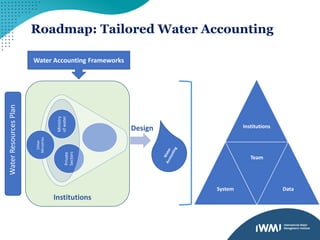
Institutions
System
Team
Data
Water Accounting Frameworks
Design
Roadmap: Tailored Water Accounting
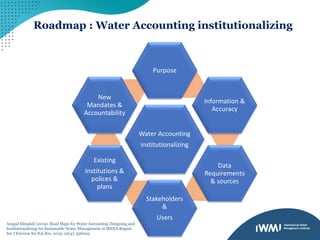
Roadmap : Water Accounting institutionalizing
Water Accounting
institutionalizing
Purpose
Information &
Accuracy
Data
Requirements
& sources
Stakeholders
&
Users
Existing
Institutions &
polices &
plans
New
Mandates &
Accountability
Amgad Elmahdi (2019). Road Maps for Water Accounting Designing and
Institutionalizing for Sustainable Water Management in MENA Region.
Int J Environ Sci Nat Res. 2019; 22(4): 556092)
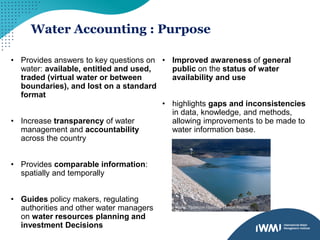
Water Accounting : Purpose
• Provides answers to key questions on
water: available, entitled and used,
traded (virtual water or between
boundaries), and lost on a standard
format
• Increase transparency of water
management and accountability
across the country
• Provides comparable information:
spatially and temporally
• Guides policy makers, regulating
authorities and other water managers
on water resources planning and
investment Decisions
• Improved awareness of general
public on the status of water
availability and use
• highlights gaps and inconsistencies
in data, knowledge, and methods,
allowing improvements to be made to
water information base.
Photo: Thomson reservoir (Alison Pouliot)
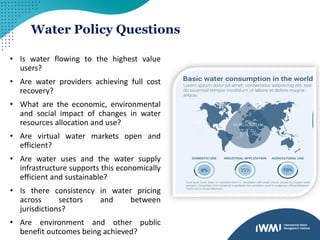
Water Policy Questions
• Is water flowing to the highest value
users?
• Are water providers achieving full cost
recovery?
• What are the economic, environmental
and social impact of changes in water
resources allocation and use?
• Are virtual water markets open and
efficient?
• Are water uses and the water supply
infrastructure supports this economically
efficient and sustainable?
• Is there consistency in water pricing
across sectors and between
jurisdictions?
• Are environment and other public
benefit outcomes being achieved?
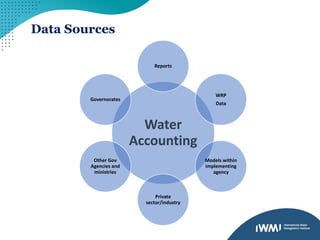
Water
Accounting
Reports
WRP
Data
Models within
implementing
agency
Private
sector/industry
Other Gov
Agencies and
ministries
Governorates
Data Sources
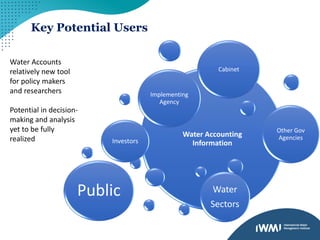
Key Potential Users
Water Accounting
Information
Implementing
Agency
Cabinet
Other Gov
Agencies
Water
Sectors
Investors
Public
Water Accounts
relatively new tool
for policy makers
and researchers
Potential in decision-
making and analysis
yet to be fully
realized
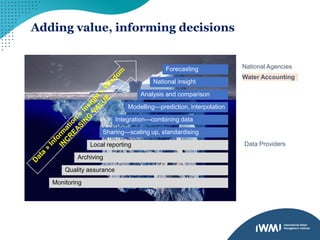
Adding value, informing decisions
Monitoring
Quality assurance
Archiving
Local reporting
Sharing—scaling up, standardising
Integration—combining data
Modelling—prediction, interpolation
Analysis and comparison
National insight
Forecasting
Data Providers
National Agencies
Water Accounting
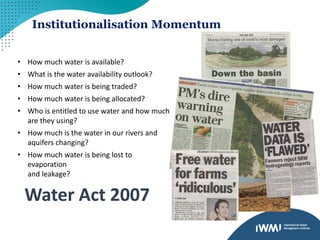
Institutionalisation Momentum
Water Act 2007
• How much water is available?
• What is the water availability outlook?
• How much water is being traded?
• How much water is being allocated?
• Who is entitled to use water and how much
are they using?
• How much is the water in our rivers and
aquifers changing?
• How much water is being lost to
evaporation
and leakage?
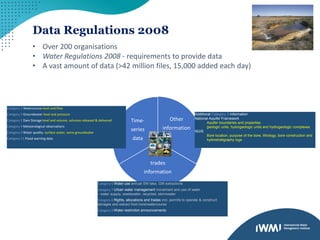
Other
information
trades
information
Time-
series
data
Data Regulations 2008
Category 5 Water use annual SW take, GW extractions
Category 7 Urban water management movement and use of water
– water supply, wastewater, recycled, stormwater
Category 6 Rights, allocations and trades incl. permits to operate & construct
storages and extract from bore/watercourse
Category 8 Water restriction announcements
Category 1 Watercourse level and flow
Category 2 Groundwater level and pressure
Category 3 Dam Storage level and volume, volumes released & delivered
Category 4 Meteorological observations
Category 9 Water quality- surface water, some groundwater
Category 11 Flood warning data
Additional Category 2 information
National Aquifer Framework
Aquifer boundaries and properties
geologic units, hydrogeologic units and hydrogeologic complexes
NGIS
Bore location, purpose of the bore, lithology, bore construction and
hydrostratigraphy logs
• Over 200 organisations
• Water Regulations 2008 - requirements to provide data
• A vast amount of data (>42 million files, 15,000 added each day)
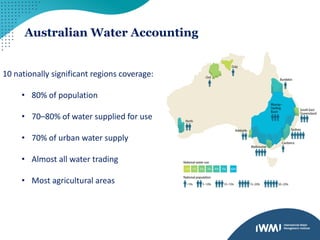
10 nationally significant regions coverage:
• 80% of population
• 70–80% of water supplied for use
• 70% of urban water supply
• Almost all water trading
• Most agricultural areas
Australian Water Accounting
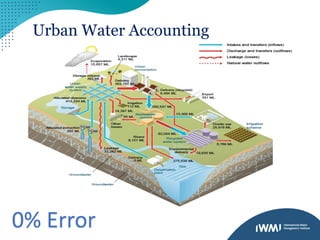
Urban Water Accounting
0% Error
Take home messages
• Water Accounting (tailored, integrated, detailed,
standardised)
• Data need to be institutionalised
• Provides data checking and quality control for other
products
• It is a collective action
• Answers customers and other stakeholder questions
on water resources management and planning
• We have to empower the water managers and users
• Investments are needed
Thank You
Dr Amgad Elmahdi
Head of MENA Region
A.Elmahdi@cgiar.org
Next Week:
WA Reporting and Team

Institutionalizing Water Accounting - Overview

  • 1.
    Institutionalizing Water Accounting Overview Dr AmgadElmahdi Head of MENA Region-IWMI 3rd June 2020
  • 2.
    Who we Are •Think tank conducting research to generative Innovative Water Solutions for Sustainable Development • Provider of science for a transformative agenda (science- based products and tools) Food – To improve food security will sustainably managing water resources and ecosystems. Climate – To adapt to and mitigate climate change while building resilience to water related disasters and disruption. Growth – To reduce poverty and advance inclusion with equality as agriculture transforms, energy transitions and urbanization intensifies. • Facilitator of learning to strengthen capacity and achieve uptake of research findings
  • 3.
    Context and Challenges •Water Scarcity • Food security policies • Continuous depletion of surface and groundwater resources • Rapidly increasing demand of water (due to several drivers) • Overall accelerated widening of the water supply-demand gap Water Scarcity
  • 4.
    Projected Demand inMENA by 2050 m3 0 50000 100000 150000 200000 250000 300000 350000 400000 Algeria Bahrain Djibouti Egypt GazaStrip Iran Iraq Israel Jordan kuwait lebanon libya Malta morocco Oman Qatar SaudiArabia Syria tunisia UAE WestBank Yemen Total Water Demand 2001-2010 Water Demand 2041-2050
  • 5.
    Dealing with Manyplayers with varied roles Government States/Governorates
  • 6.
    Realise the Polarisationin the water sector
  • 7.
    Fill the Gapin water information Simple questions, answers unavailable • How much water is available and where? • What is the water availability outlook? • How much water is being used? • How much water is being allocated and delivered? • Who is entitled to use water and how much are they using? • How much is the water in our rivers and aquifers changing? • How much water is being lost to evaporation and leakage?
  • 8.
    Support Decisions inHarsh Climate to Support Water managers Drainage Urban growth Water security Water use behaviour Environmental flows Allocation DroughtIntensification Economic Development Data Monitoring/ Availability
  • 9.
    What is WaterAccounting Water accounting as a discipline is not new UNSD, UN-Water, FAO, IWMI, IWMI-IHE, ICID, Aust Gov Preconditions for successful water management: • knowledge of the current status of water resources, • the capacity and condition of water supply infrastructure and • trends in water demand and use principle method of water accounting is statistical. • water a scarce resource in the area • water sharing plan in place • regularly publish water information reports
  • 10.
    What is WaterAccounting Water accounting can be defined as the systematic quantitative assessment of the status and trends in water supply, demand, distribution, accessibility and use in specified domains, producing information that informs water science, management and governance to support sustainable development outcomes for society and the environment (FAO, 2012, 2016)
  • 11.
    Why do wedo water accounting? Planning and real situation are different WA can account the real situation of water in an spatial domain Water shortage problem is happening and can be appeared in many places WA can inform improving productivity and efficiency of water Not enough information about water cycle WA give clear view of water resources management to planner and DM
  • 12.
    Questions, need forMulti-scalar analysis River basin or watershed Irrigation scheme Field or land holding Scope for augmenting water resources availability for rainfed and irrigated agriculture Potential for improving basin level efficiency and productivity by capturing return flows and minimising large- scale non-beneficial consumptive water uses. Spatial analysis of levels of variability and equity in supply and demand to different irrigation units or user groups.  Potential for improving scheme-level efficiency and productivity by e.g. improved scheme governance/management, better O&M  Identification and evaluation different user-level drivers e.g. profit, risk minimisation, reduced labour costs etc Potential for improving field or landholding productivity by e.g. Improved irrigation agronomy, better connection to markets, better farming systems Spatial scales Typical WA&A focus /questions
  • 13.
    Water Accounting ReportingSystem Framework WA Reporting WA Line items WA Tools How much Available How much use Who has right to use What and where, indicators Sources ( SW, GW, WW, Desl, ect) Changes of availability Changes of use Changes of right to use Data (primary and secondary) Estimated (Models &analysis) WA+, SEEW, WB, etc Expert opinion Purposeandcasestudy casestudy casestudyandAudience everyone (Amgad Elmahdi, 2020 “Guided Paper: Water Accounting Reporting System –WARS Framework from Concept to Implementation for Sustainable Water Management” Int J Environ Sci Nat Res : 23 ((4)), https://juniperpublishers.com/ijesnr/pdf ) Stakeholders and Users Engagements
  • 14.
    Water Accounting Elements •Temporal Scale Monthly, seasonally, annually • Spatial Scale Sub-Catchment, region, basin, irrigation area, district, governorate, national, etc • Scope Water flow (hydrological boundaries) Water economy (administrative/ jurisdictional boundaries) Combined • Institutional – Water Act/Law – Data Regulations – partnership • Data management – Central – Scatter – Reporting partners
  • 15.
  • 16.
    Roadmap : WaterAccounting institutionalizing Water Accounting institutionalizing Purpose Information & Accuracy Data Requirements & sources Stakeholders & Users Existing Institutions & polices & plans New Mandates & Accountability Amgad Elmahdi (2019). Road Maps for Water Accounting Designing and Institutionalizing for Sustainable Water Management in MENA Region. Int J Environ Sci Nat Res. 2019; 22(4): 556092)
  • 17.
    Water Accounting :Purpose • Provides answers to key questions on water: available, entitled and used, traded (virtual water or between boundaries), and lost on a standard format • Increase transparency of water management and accountability across the country • Provides comparable information: spatially and temporally • Guides policy makers, regulating authorities and other water managers on water resources planning and investment Decisions • Improved awareness of general public on the status of water availability and use • highlights gaps and inconsistencies in data, knowledge, and methods, allowing improvements to be made to water information base. Photo: Thomson reservoir (Alison Pouliot)
  • 18.
    Water Policy Questions •Is water flowing to the highest value users? • Are water providers achieving full cost recovery? • What are the economic, environmental and social impact of changes in water resources allocation and use? • Are virtual water markets open and efficient? • Are water uses and the water supply infrastructure supports this economically efficient and sustainable? • Is there consistency in water pricing across sectors and between jurisdictions? • Are environment and other public benefit outcomes being achieved?
  • 19.
  • 20.
    Key Potential Users WaterAccounting Information Implementing Agency Cabinet Other Gov Agencies Water Sectors Investors Public Water Accounts relatively new tool for policy makers and researchers Potential in decision- making and analysis yet to be fully realized
  • 21.
    Adding value, informingdecisions Monitoring Quality assurance Archiving Local reporting Sharing—scaling up, standardising Integration—combining data Modelling—prediction, interpolation Analysis and comparison National insight Forecasting Data Providers National Agencies Water Accounting
  • 22.
    Institutionalisation Momentum Water Act2007 • How much water is available? • What is the water availability outlook? • How much water is being traded? • How much water is being allocated? • Who is entitled to use water and how much are they using? • How much is the water in our rivers and aquifers changing? • How much water is being lost to evaporation and leakage?
  • 23.
    Other information trades information Time- series data Data Regulations 2008 Category5 Water use annual SW take, GW extractions Category 7 Urban water management movement and use of water – water supply, wastewater, recycled, stormwater Category 6 Rights, allocations and trades incl. permits to operate & construct storages and extract from bore/watercourse Category 8 Water restriction announcements Category 1 Watercourse level and flow Category 2 Groundwater level and pressure Category 3 Dam Storage level and volume, volumes released & delivered Category 4 Meteorological observations Category 9 Water quality- surface water, some groundwater Category 11 Flood warning data Additional Category 2 information National Aquifer Framework Aquifer boundaries and properties geologic units, hydrogeologic units and hydrogeologic complexes NGIS Bore location, purpose of the bore, lithology, bore construction and hydrostratigraphy logs • Over 200 organisations • Water Regulations 2008 - requirements to provide data • A vast amount of data (>42 million files, 15,000 added each day)
  • 24.
    10 nationally significantregions coverage: • 80% of population • 70–80% of water supplied for use • 70% of urban water supply • Almost all water trading • Most agricultural areas Australian Water Accounting
  • 25.
  • 26.
    Take home messages •Water Accounting (tailored, integrated, detailed, standardised) • Data need to be institutionalised • Provides data checking and quality control for other products • It is a collective action • Answers customers and other stakeholder questions on water resources management and planning • We have to empower the water managers and users • Investments are needed
  • 27.
    Thank You Dr AmgadElmahdi Head of MENA Region A.Elmahdi@cgiar.org Next Week: WA Reporting and Team