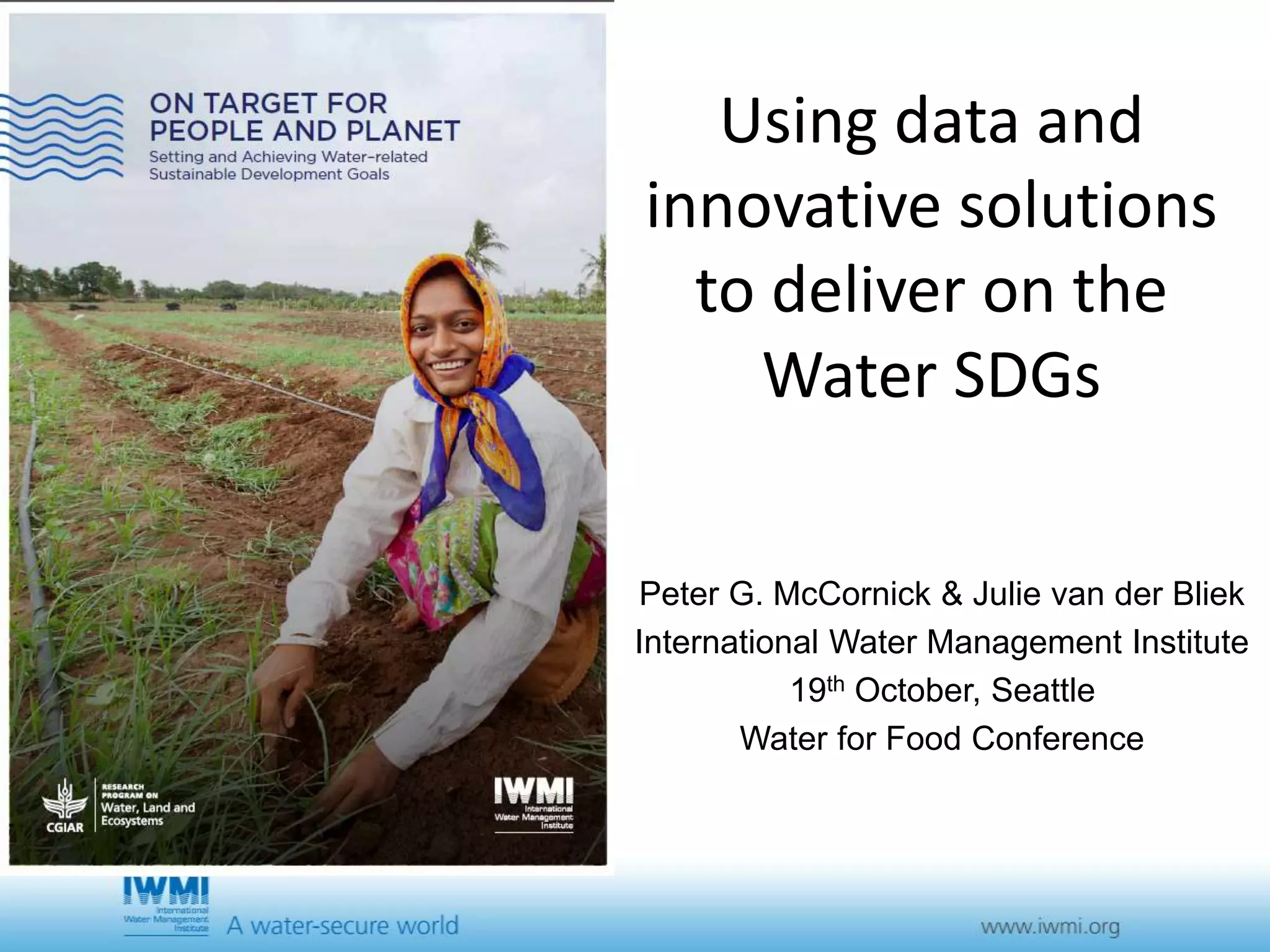
Using data and 
innovative solutions 
to deliver on the 
Water SDGs 
Peter G. McCornick & Julie van der Bliek 
International Water Management Institute 
19th October, Seattle 
Water for Food Conference
Water SDG 
(final proposal OWG, 19 July 2014) 
Goal 6. Ensure availability and sustainable management of water and sanitation for all 
6.1 by 2030, achieve universal and equitable access to safe and affordable drinking water for all 
6.2 by 2030, achieve access to adequate and equitable sanitation and hygiene for all, and end open defecation, paying 
special attention to the needs of women and girls and those in vulnerable situations 
6.3 by 2030, improve water quality by reducing pollution, eliminating dumping and minimizing release of hazardous chemicals and 
materials, halving the proportion of untreated wastewater, and increasing recycling and safe reuse by x% globally 
6.4 by 2030, substantially increase water-use efficiency across all sectors and ensure sustainable withdrawals and 
supply of freshwater to address water scarcity, and substantially reduce the number of people suffering from water 
scarcity 
6.5 by 2030 implement integrated water resources management at all levels, including through transboundary cooperation 
as appropriate 
6.6 by 2020 protect and restore water-related ecosystems, including mountains, forests, wetlands, rivers, aquifers and lakes 
6.A by 2030, expand international cooperation and capacity-building support to developing countries in water and 
sanitation related activities and programmes, including water harvesting, desalination, water efficiency, wastewater treatment, 
recycling and reuse technologies 
6.B support and strengthen the participation of local communities for improving water and sanitation management
Links to other SDGs 
Goal 2. End hunger, achieve food security and improved nutrition, and promote 
sustainable agriculture 
Goal 7. Ensure access to affordable, reliable, sustainable, and modern energy for all 
Goal 11. Make cities and human settlements inclusive, safe, resilient and 
sustainable 
Goal 12. Ensure sustainable consumption and production patterns 
Goal 13. Take urgent action to combat climate change and its impacts 
Goal 15.Protect, restore and promote sustainable use of terrestrial ecosystems, 
sustainably manage forests, combat desertification, and halt and reverse land 
degradation and halt biodiversity loss
How does the science community contribute to the 
SDG process 
 Next steps in the SDG process: setting national 
targets, achieving those targets in countries, 
measuring progress 
 Explore contributions of science community through 
evidence-based support 
 Contextual realities in low- and middle-income 
countries in Africa and Asia
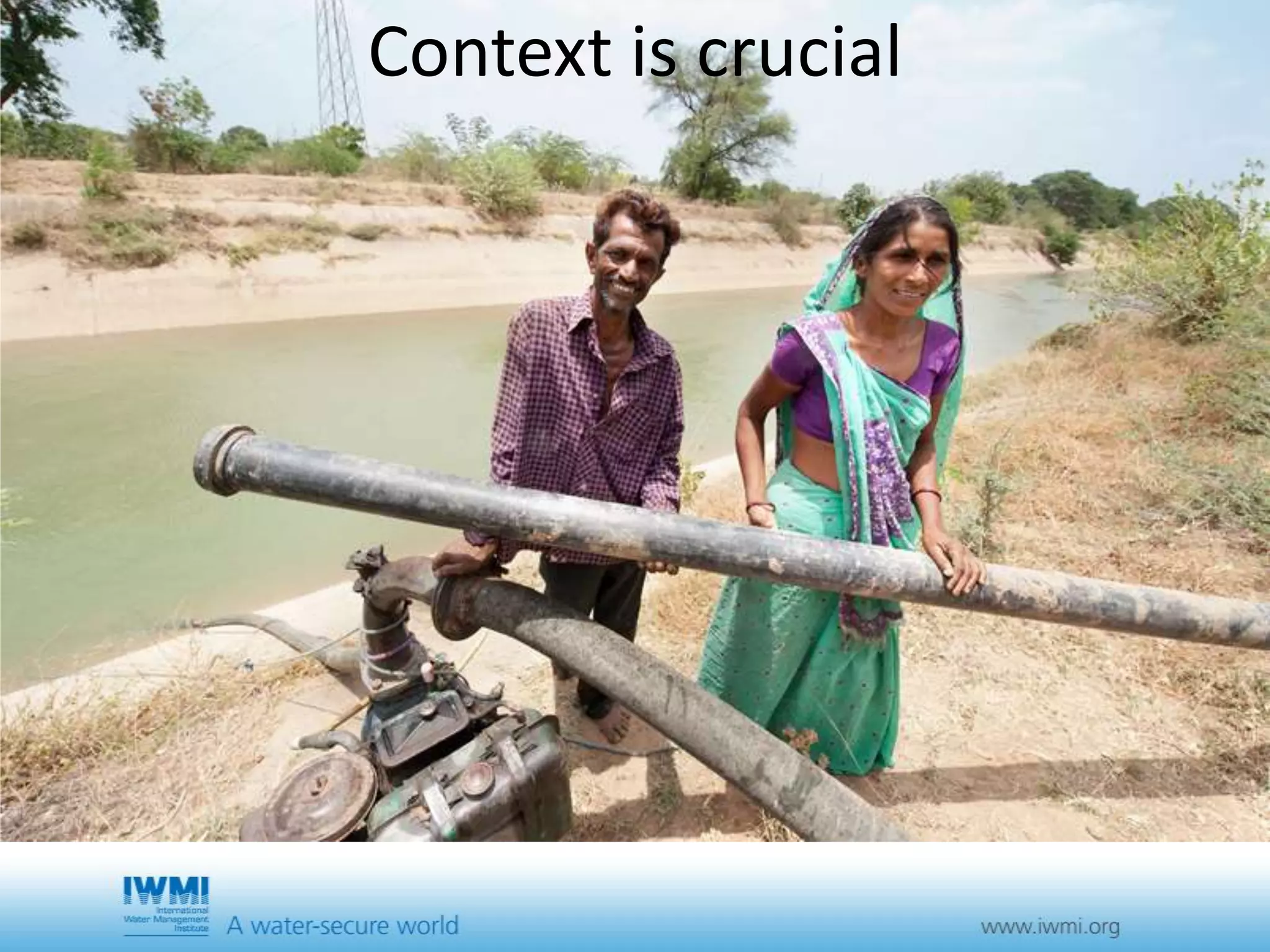
Context is crucial
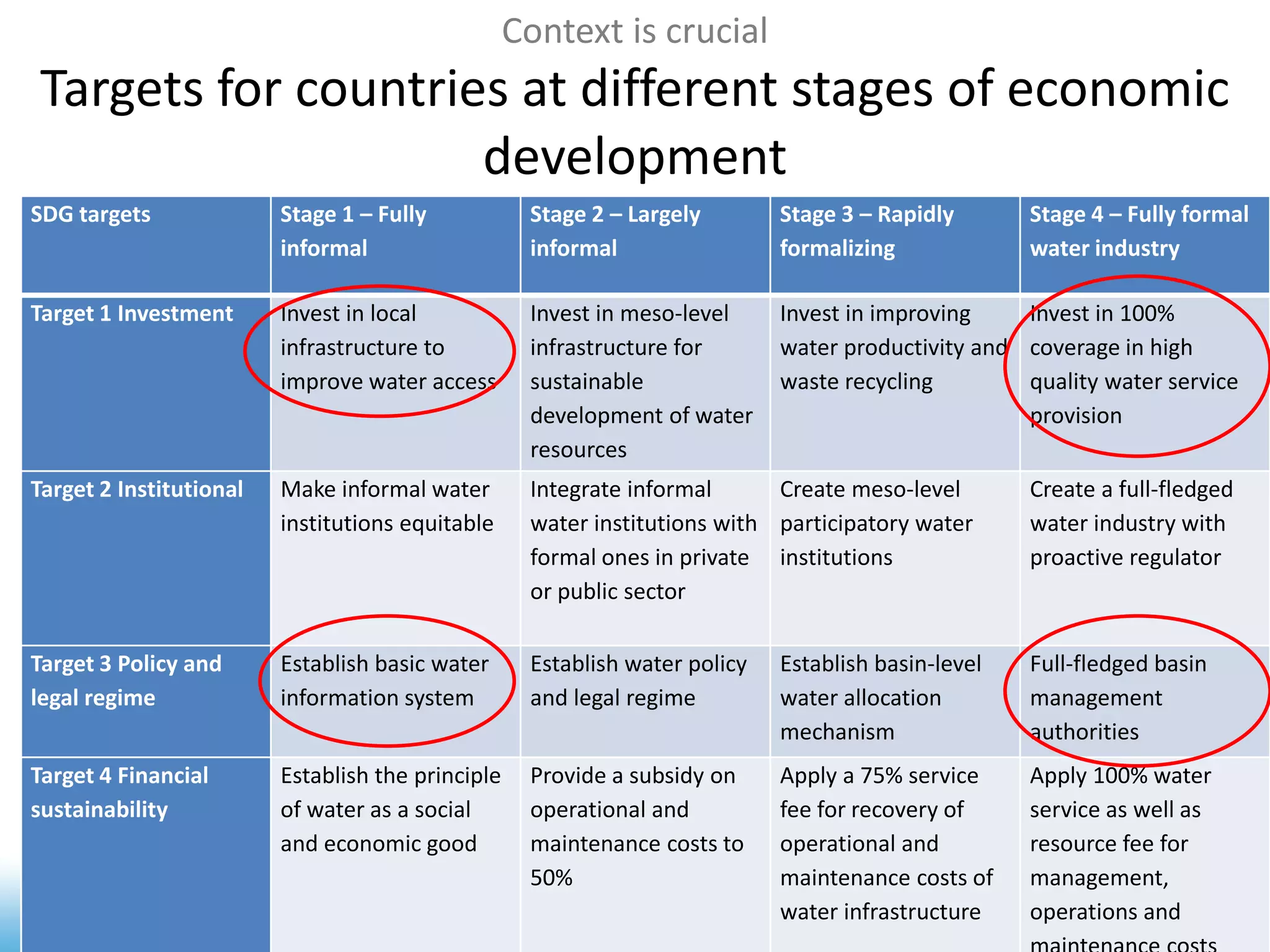
Context is crucial 
Targets for countries at different stages of economic 
development 
SDG targets Stage 1 – Fully 
informal 
Stage 2 – Largely 
informal 
Stage 3 – Rapidly 
formalizing 
Stage 4 – Fully formal 
water industry 
Target 1 Investment Invest in local 
infrastructure to 
improve water access 
Invest in meso-level 
infrastructure for 
sustainable 
development of water 
resources 
Invest in improving 
water productivity and 
waste recycling 
Invest in 100% 
coverage in high 
quality water service 
provision 
Target 2 Institutional Make informal water 
institutions equitable 
Integrate informal 
water institutions with 
formal ones in private 
or public sector 
Create meso-level 
participatory water 
institutions 
Create a full-fledged 
water industry with 
proactive regulator 
Target 3 Policy and 
legal regime 
Establish basic water 
information system 
Establish water policy 
and legal regime 
Establish basin-level 
water allocation 
mechanism 
Full-fledged basin 
management 
authorities 
Target 4 Financial 
sustainability 
Establish the principle 
of water as a social 
and economic good 
Provide a subsidy on 
operational and 
maintenance costs to 
50% 
Apply a 75% service 
fee for recovery of 
operational and 
maintenance costs of 
water infrastructure 
Apply 100% water 
service as well as 
resource fee for 
management, 
operations and 
maintenance costs
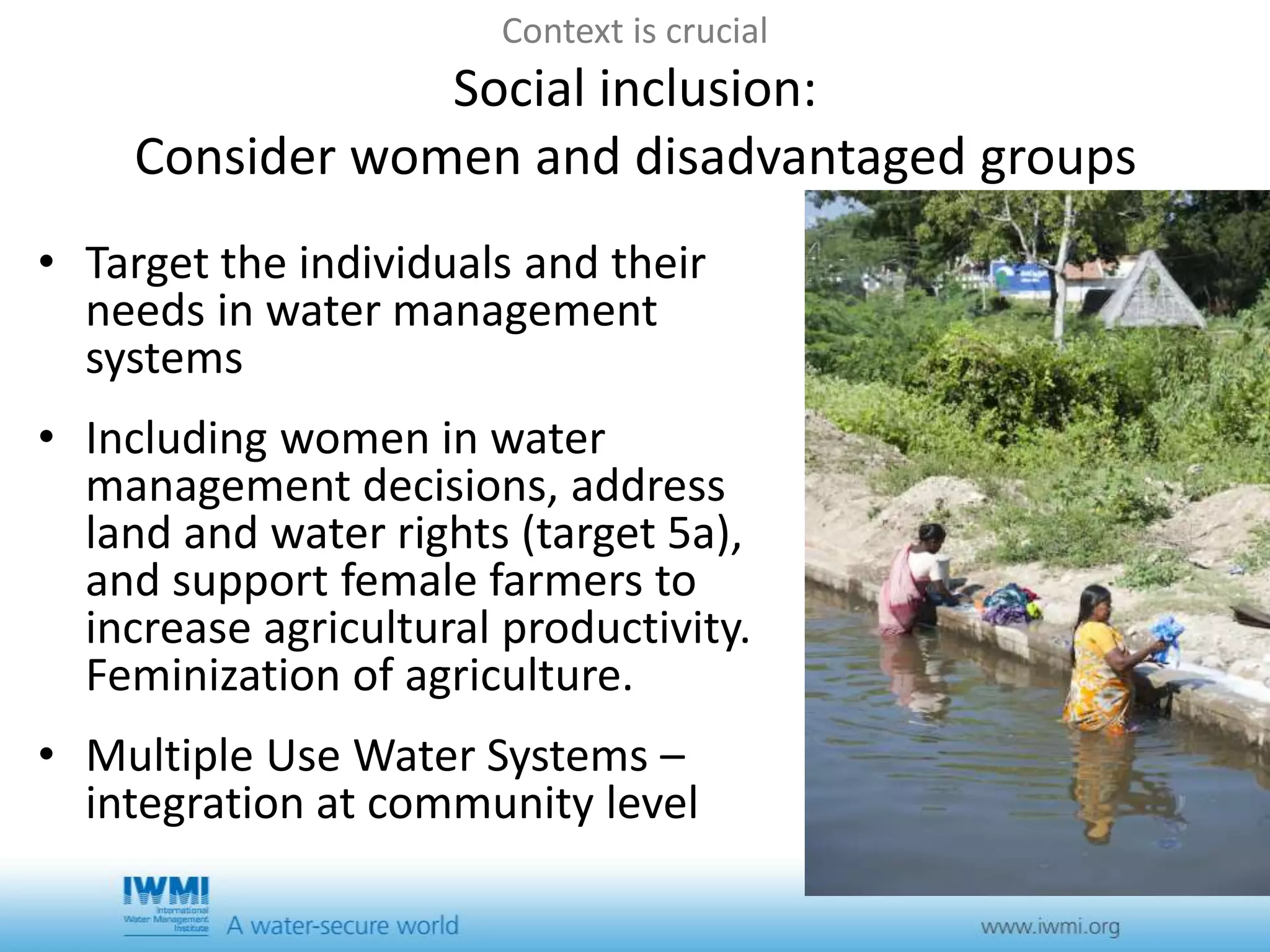
Context is crucial 
Social inclusion: 
Consider women and disadvantaged groups 
• Target the individuals and their 
needs in water management 
systems 
• Including women in water 
management decisions, address 
land and water rights (target 5a), 
and support female farmers to 
increase agricultural productivity. 
Feminization of agriculture. 
• Multiple Use Water Systems – 
integration at community level
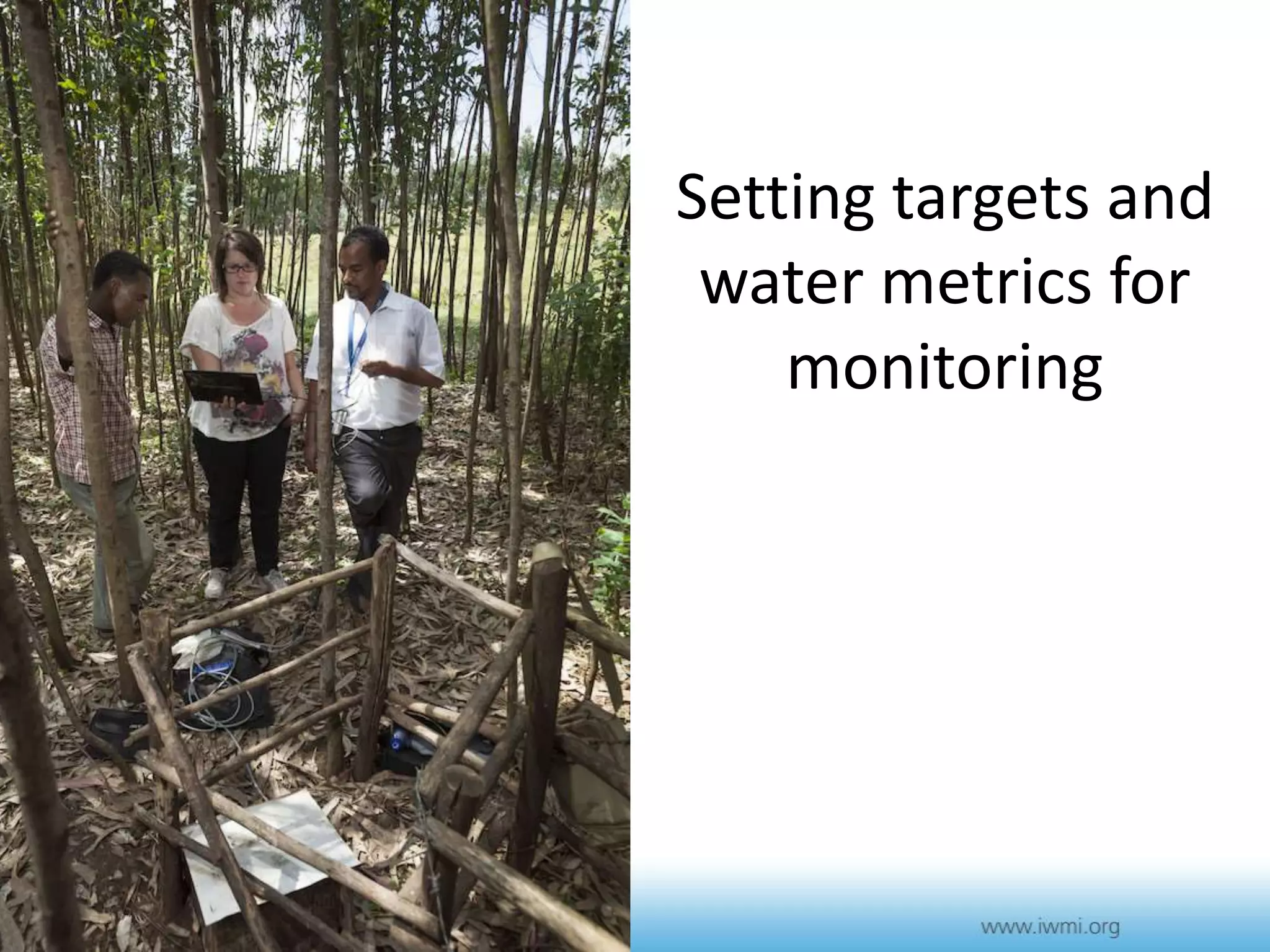
Setting targets and 
water metrics for 
monitoring
Water Metrics: 
Suite of indicators 
• A suite of indicators, rather than a single indicator 
such as water productivity, should be used for 
monitoring the progress towards the water SDG 
for all users, while also maintaining healthy 
ecosystems. 
• Use of specific indicators (water use efficiency or 
water productivity) masks complexity and trade-offs 
required to achieve development outcomes
Water Metrics: 
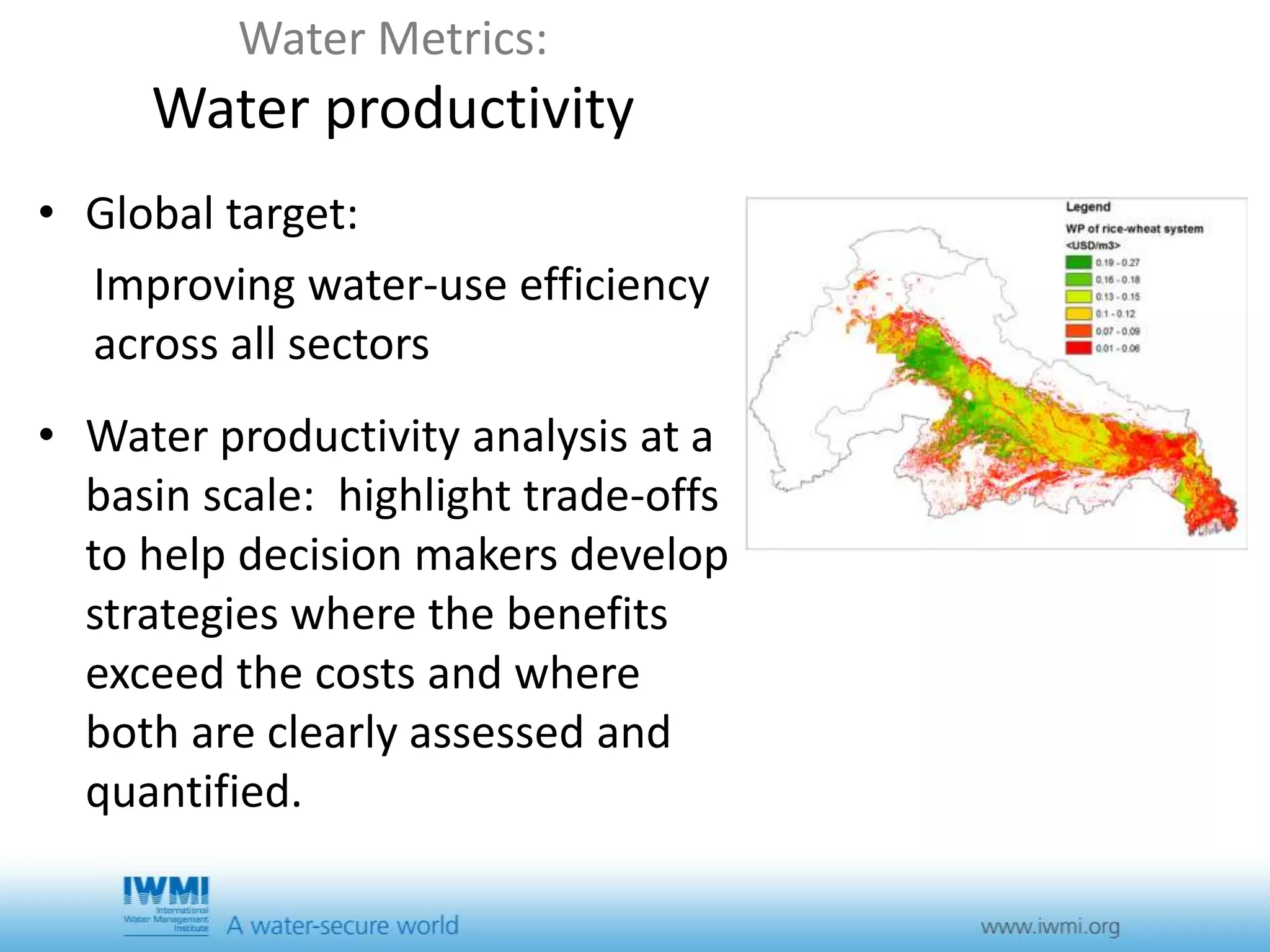
Water productivity 
• Global target: 
Improving water-use efficiency 
across all sectors 
• Water productivity analysis at a 
basin scale: highlight trade-offs 
to help decision makers develop 
strategies where the benefits 
exceed the costs and where 
both are clearly assessed and 
quantified.
Water Metrics: 
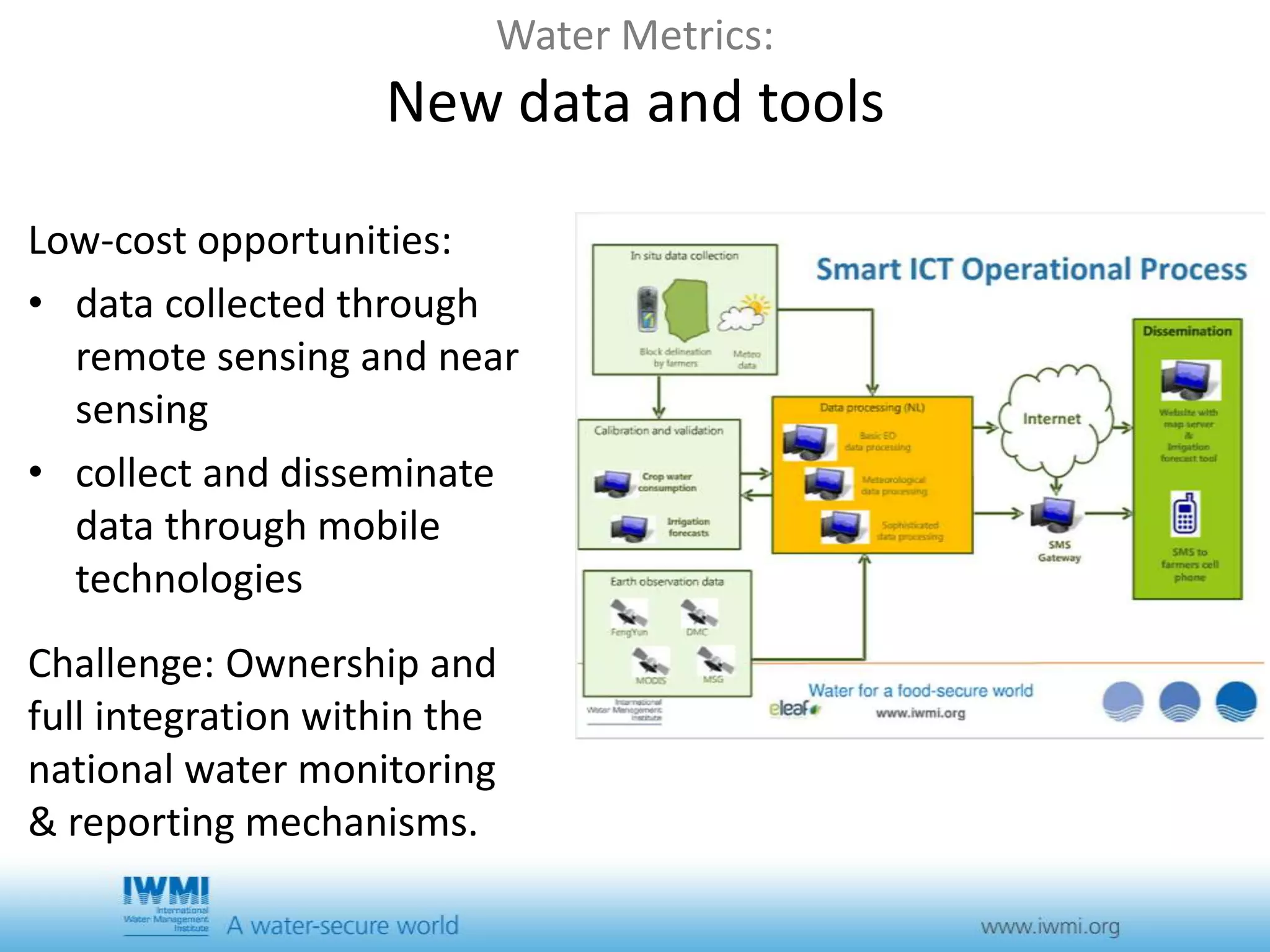
New data and tools 
Low-cost opportunities: 
• data collected through 
remote sensing and near 
sensing 
• collect and disseminate 
data through mobile 
technologies 
Challenge: Ownership and 
full integration within the 
national water monitoring 
& reporting mechanisms.
Water Metrics: 
Water accounting 
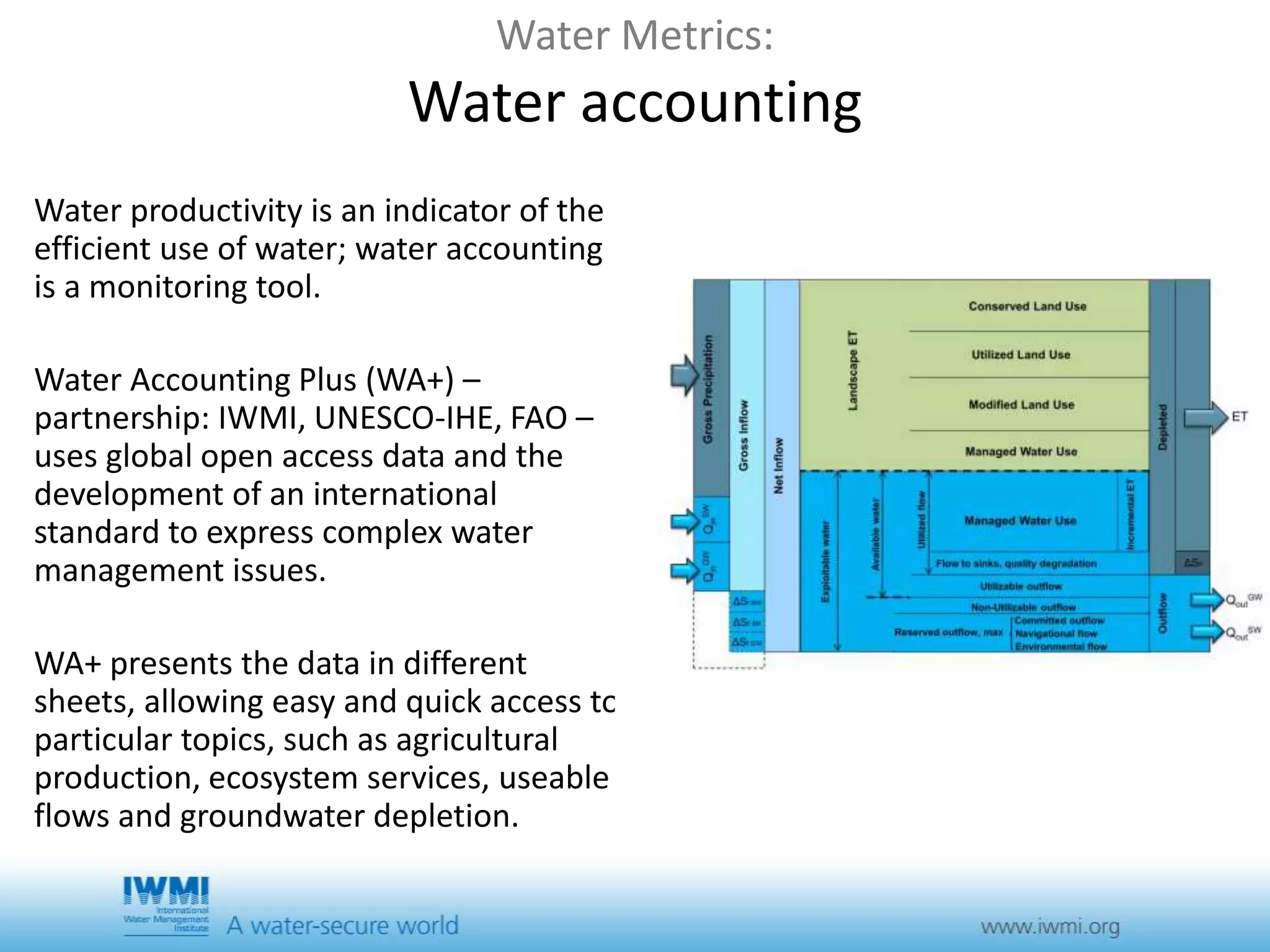
Water productivity is an indicator of the 
efficient use of water; water accounting 
is a monitoring tool. 
Water Accounting Plus (WA+) – 
partnership: IWMI, UNESCO-IHE, FAO – 
uses global open access data and the 
development of an international 
standard to express complex water 
management issues. 
WA+ presents the data in different 
sheets, allowing easy and quick access to 
particular topics, such as agricultural 
production, ecosystem services, useable 
flows and groundwater depletion.
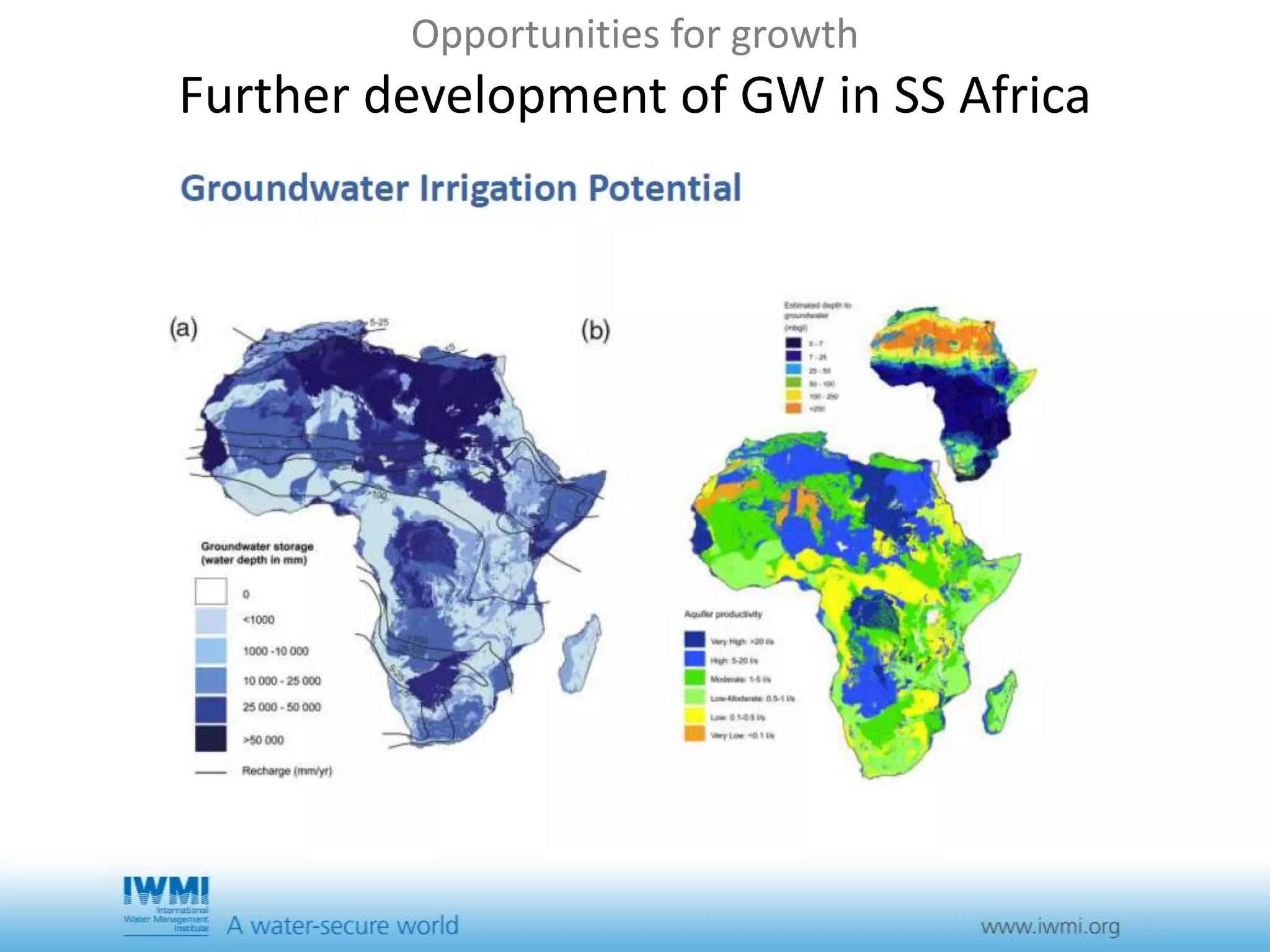
Opportunities for growth 
Further development of GW in SS Africa
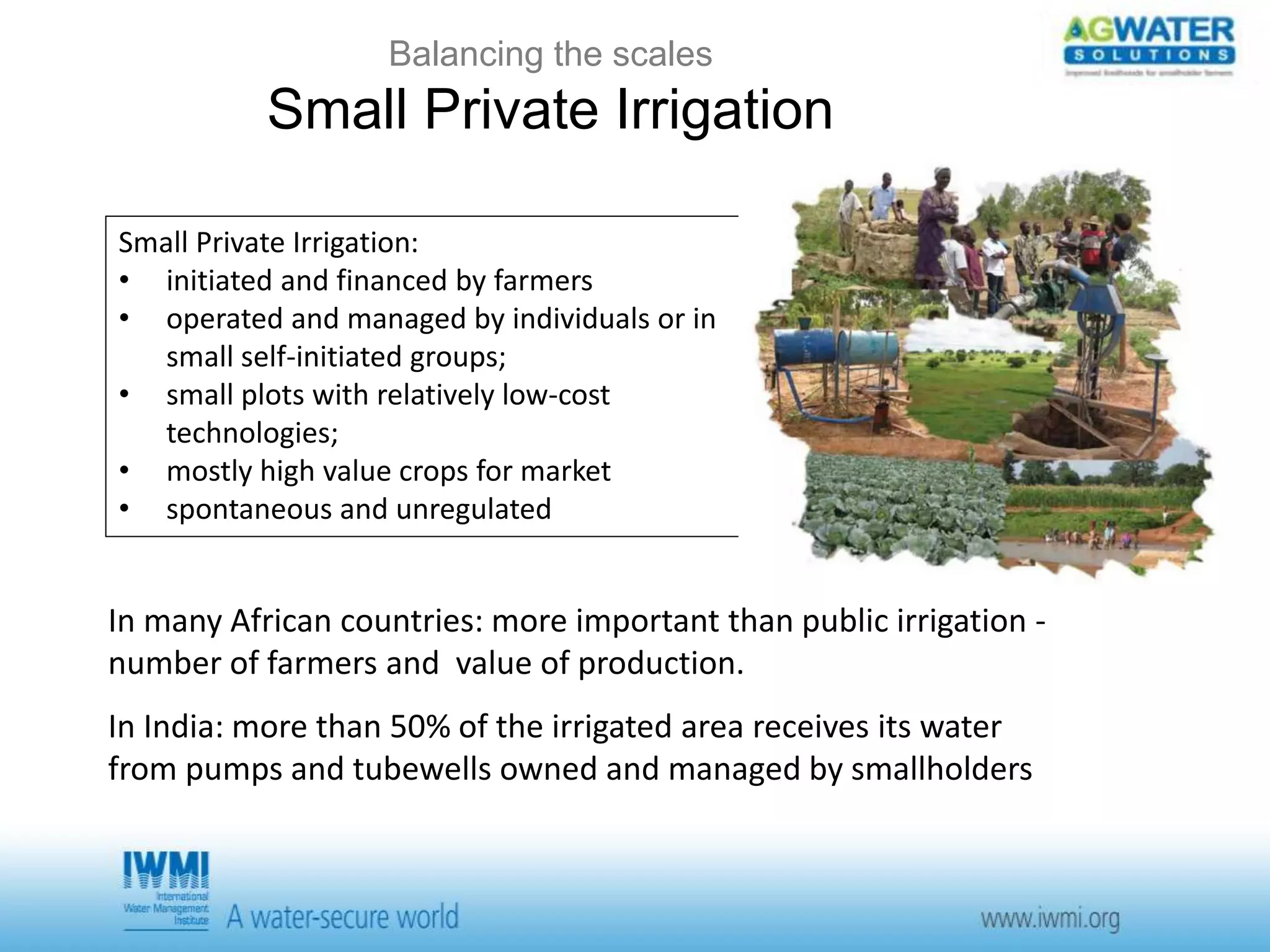
Balancing the scales 
Small Private Irrigation 
Small Private Irrigation: 
• initiated and financed by farmers 
• operated and managed by individuals or in 
small self-initiated groups; 
• small plots with relatively low-cost 
technologies; 
• mostly high value crops for market 
• spontaneous and unregulated 
In many African countries: more important than public irrigation - 
number of farmers and value of production. 
In India: more than 50% of the irrigated area receives its water 
from pumps and tubewells owned and managed by smallholders
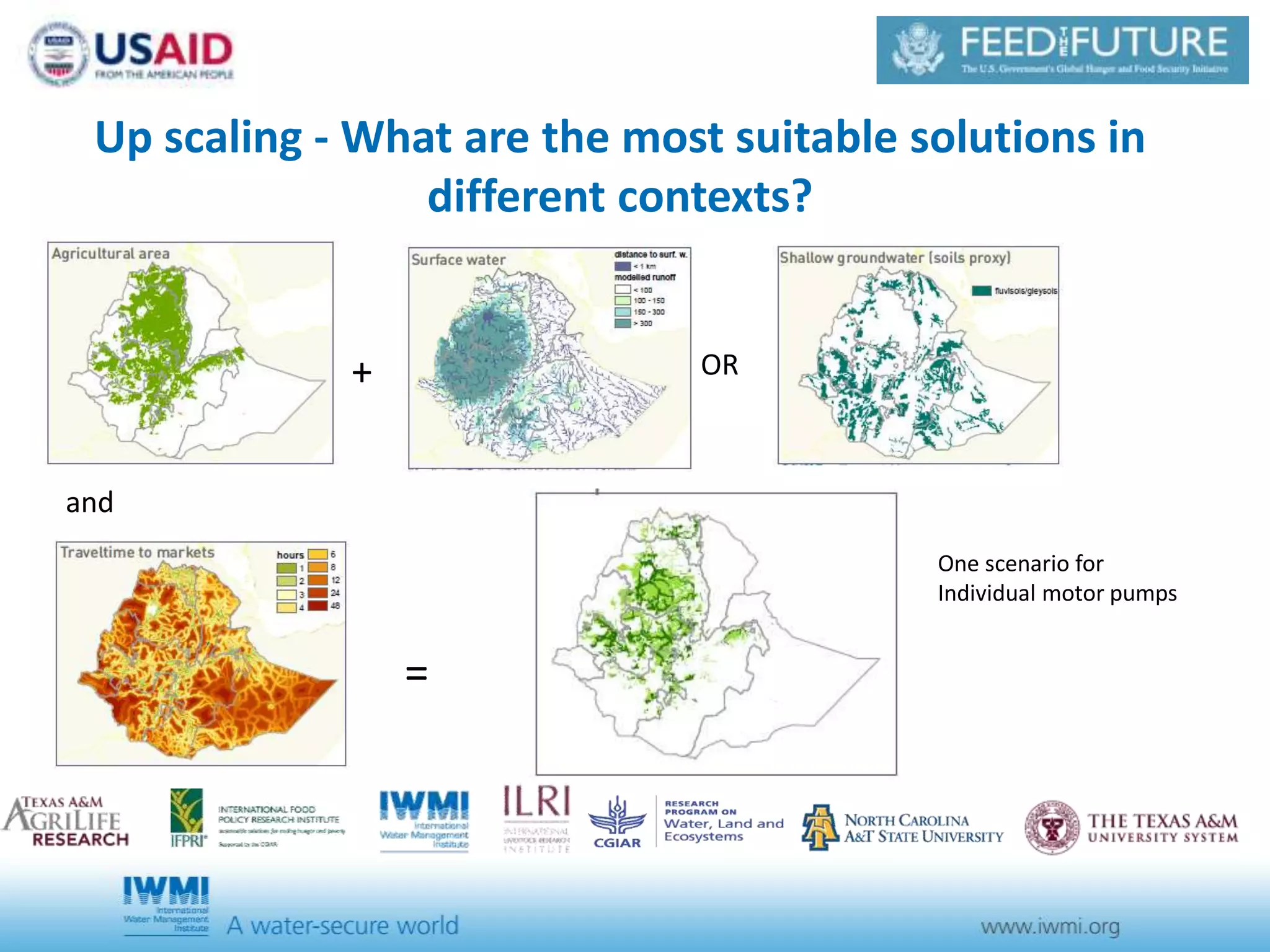
Suitability domains example: WLT 
Up scaling - What are the most suitable solutions in 
different contexts? 
+ OR 
and 
= 
One scenario for 
Individual motor pumps
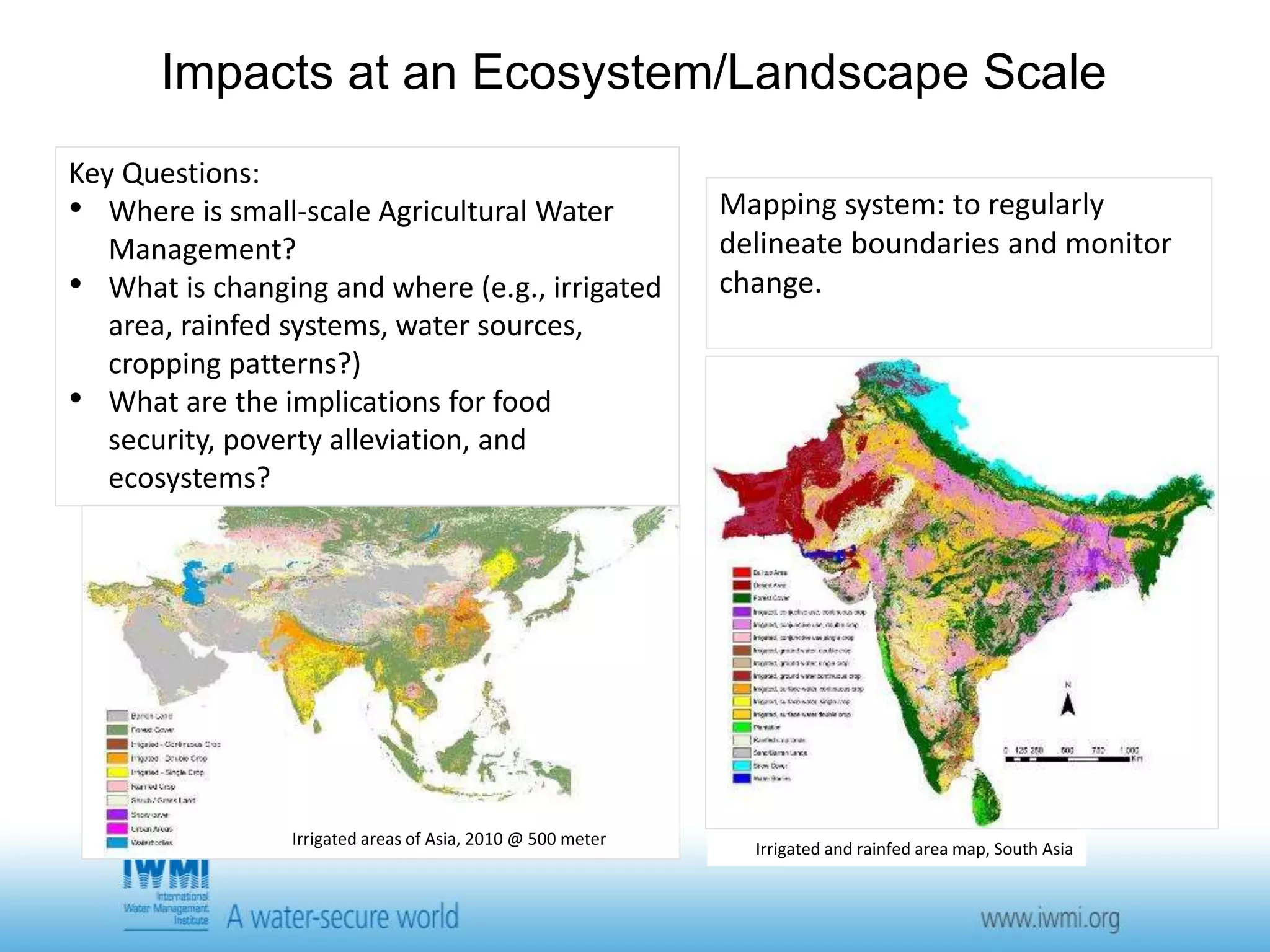
Impacts at an Ecosystem/Landscape Scale 
Irrigated areas of Asia, 2010 @ 500 meter 
Mapping system: to regularly 
delineate boundaries and monitor 
change. 
Irrigated and rainfed area map, South Asia 
Key Questions: 
• Where is small-scale Agricultural Water 
Management? 
• What is changing and where (e.g., irrigated 
area, rainfed systems, water sources, 
cropping patterns?) 
• What are the implications for food 
security, poverty alleviation, and 
ecosystems?
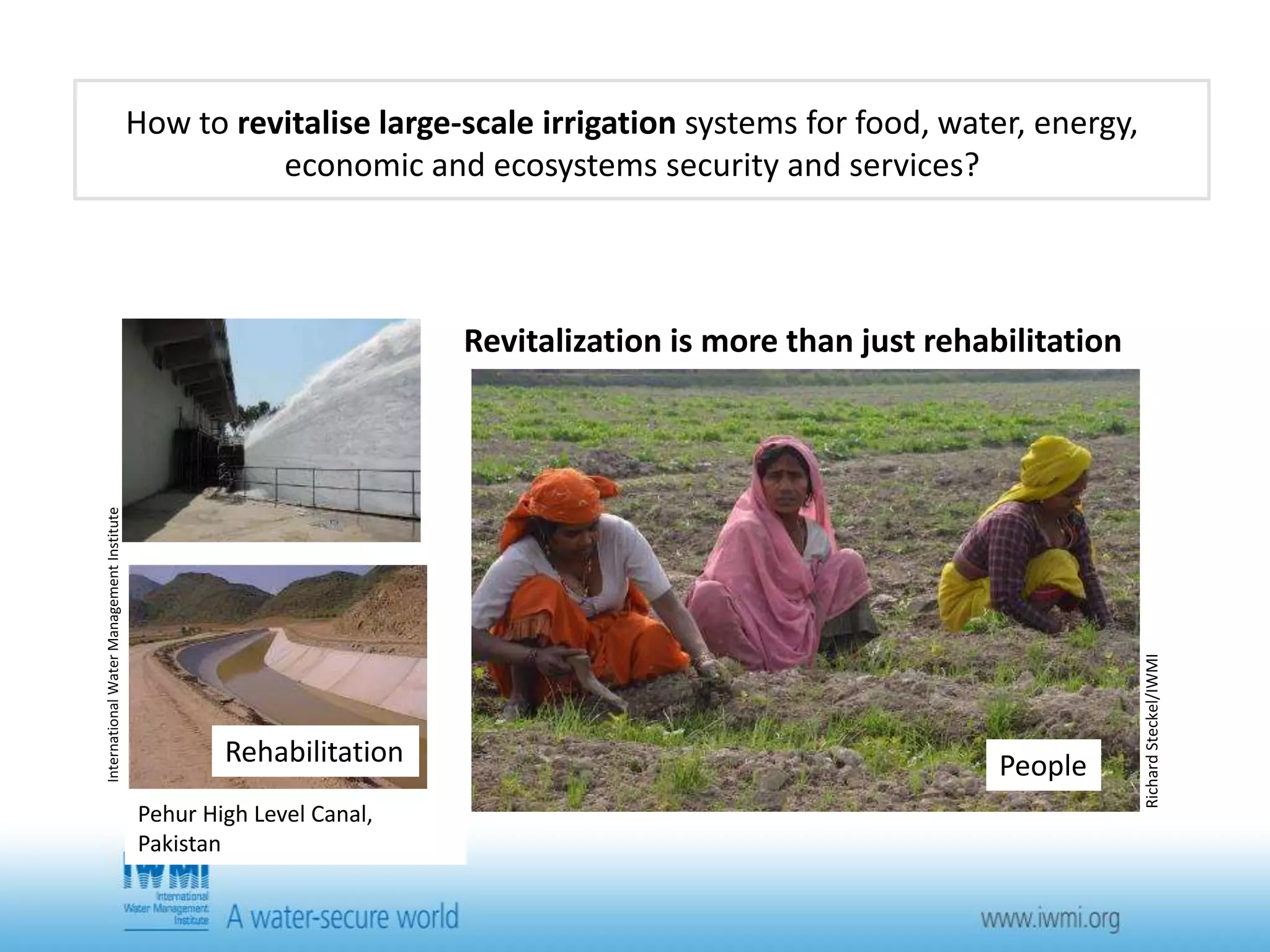
How to revitalise large-scale irrigation systems for food, water, energy, 
economic and ecosystems security and services? 
Rehabilitation 
Revitalization is more than just rehabilitation 
International Water Management Institute 
Pehur High Level Canal, 
Pakistan 
David Molden/IWMI 
Productivity 
Functioning Ecosystems 
Hamish John Appleby/IWMI 
Richard Steckel/IWMI 
People
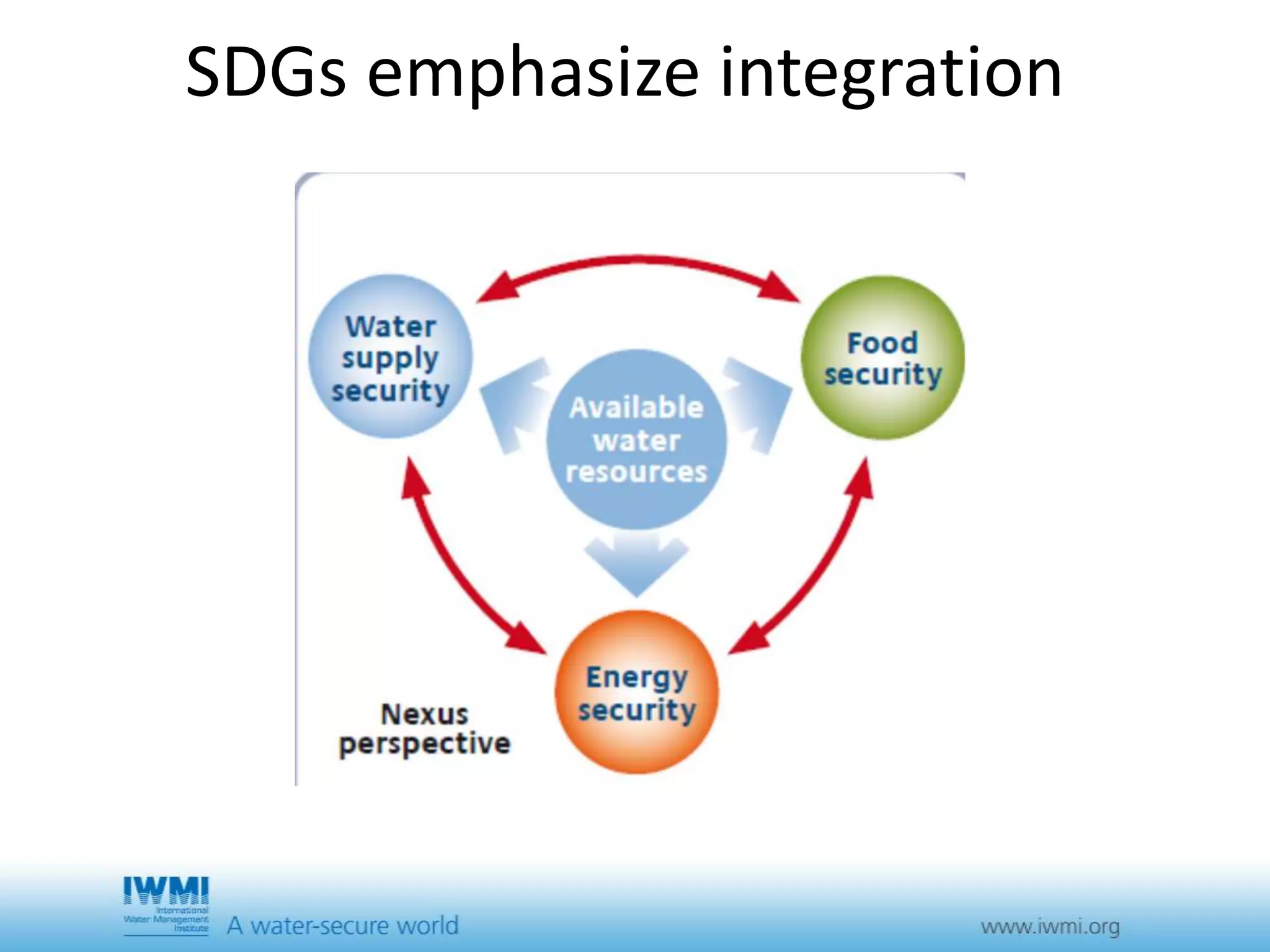
SDGs emphasize integration
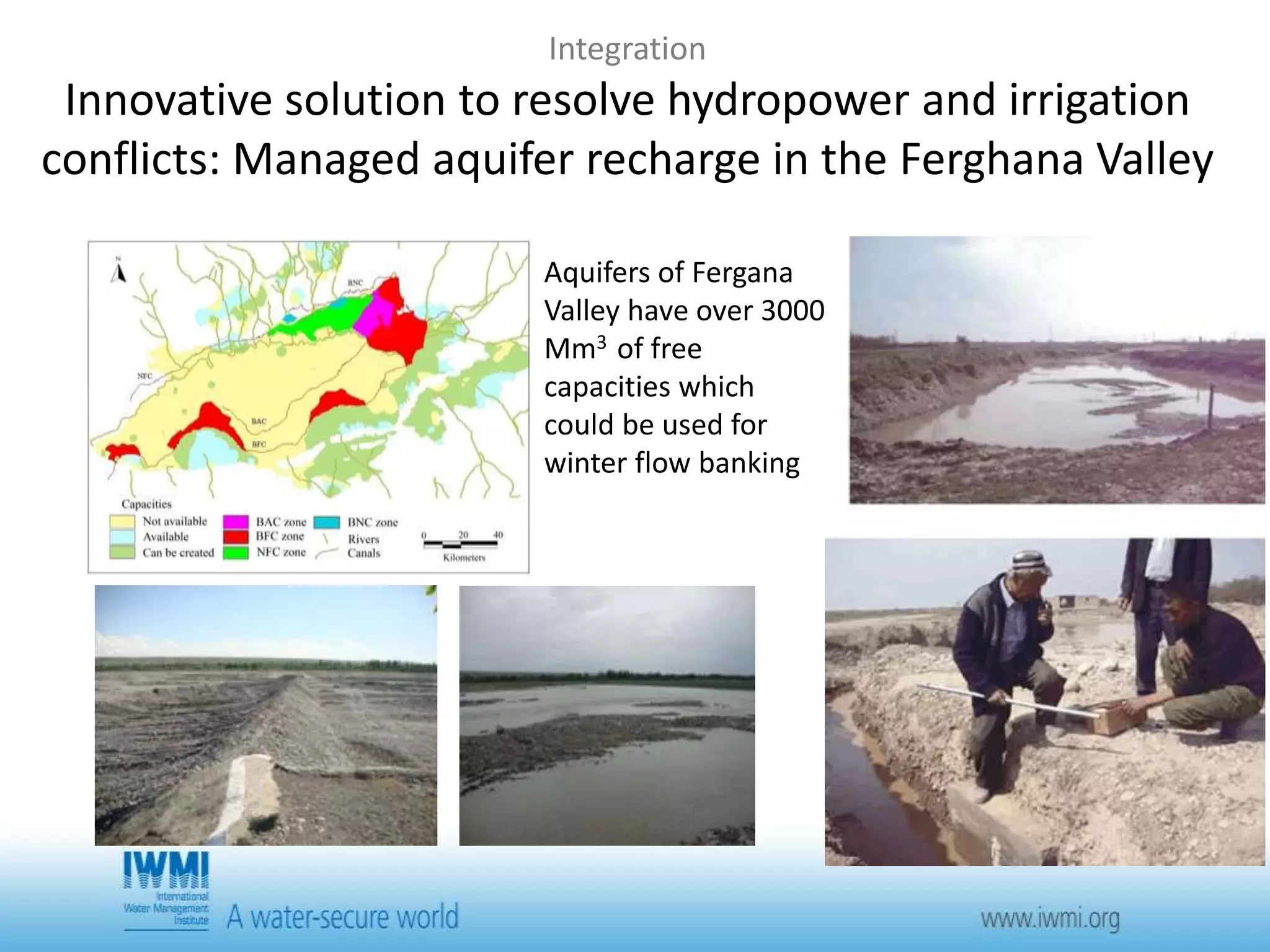
Integration 
Innovative solution to resolve hydropower and irrigation 
conflicts: Managed aquifer recharge in the Ferghana Valley 
Aquifers of Fergana 
Valley have over 3000 
Mm3 of free 
capacities which 
could be used for 
winter flow banking
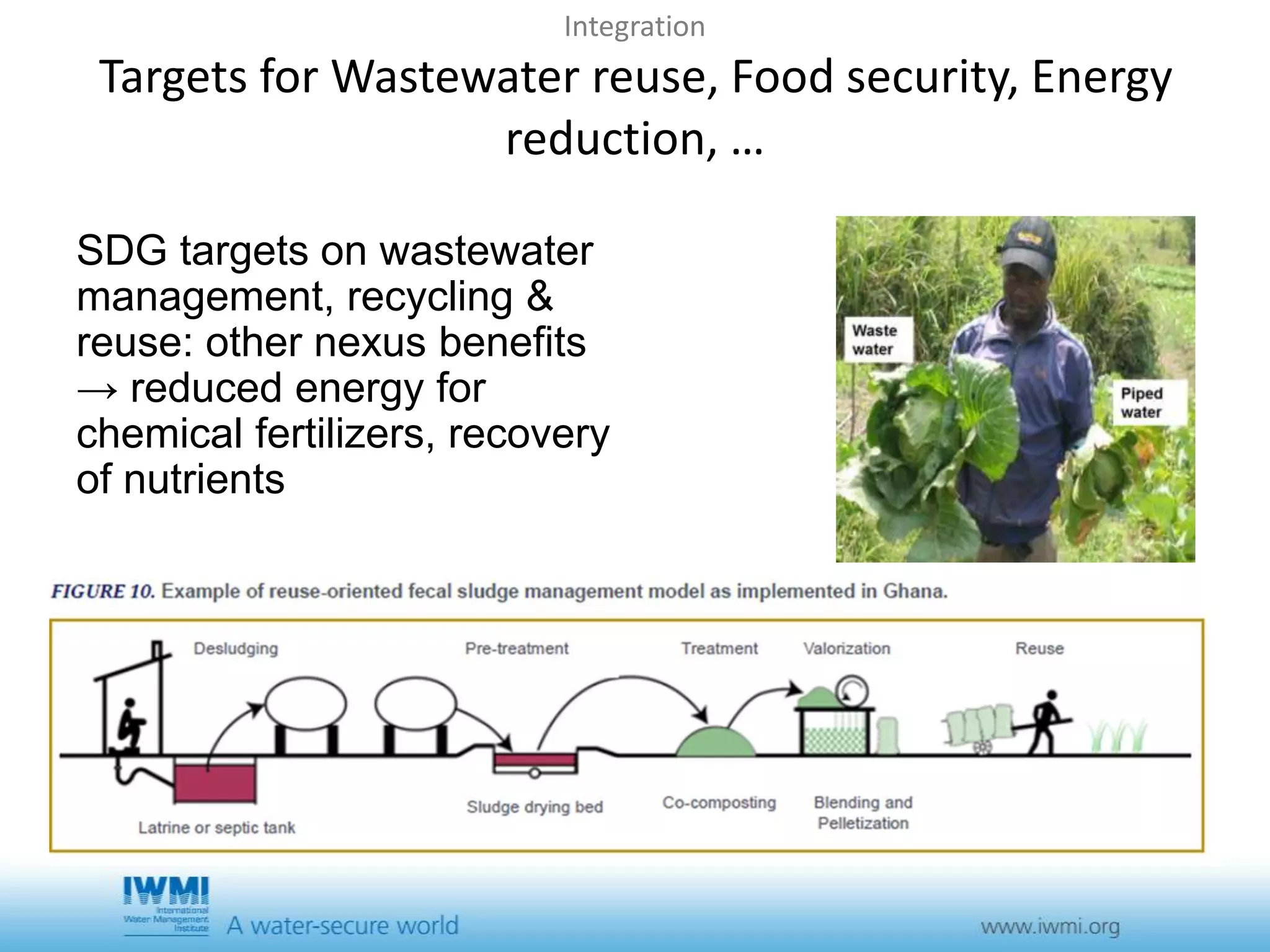
Integration 
Targets for Wastewater reuse, Food security, Energy 
reduction, … 
SDG targets on wastewater 
management, recycling & 
reuse: other nexus benefits 
→ reduced energy for 
chemical fertilizers, recovery 
of nutrients
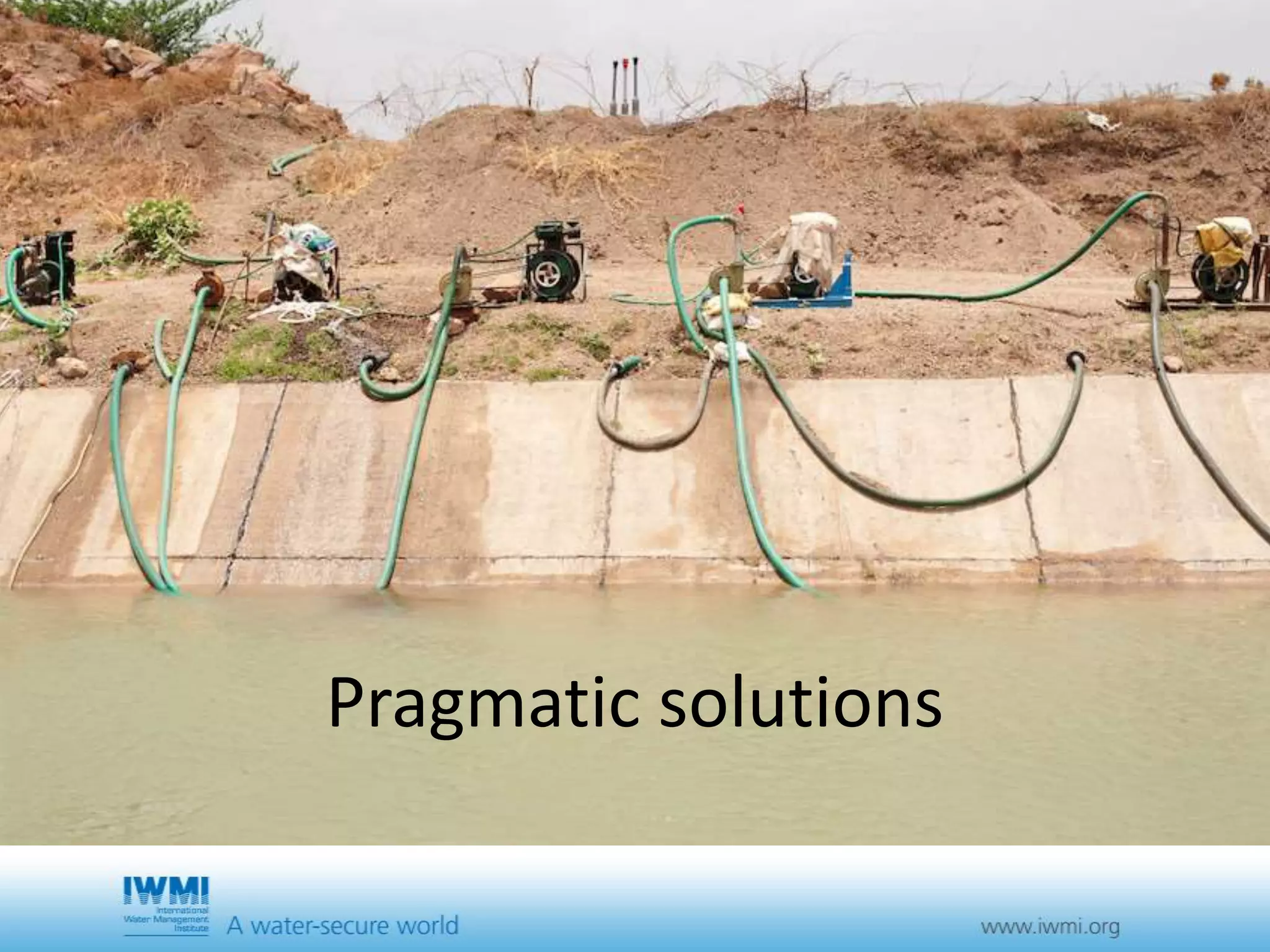
Pragmatic solutions
Pragmatic Solutions 
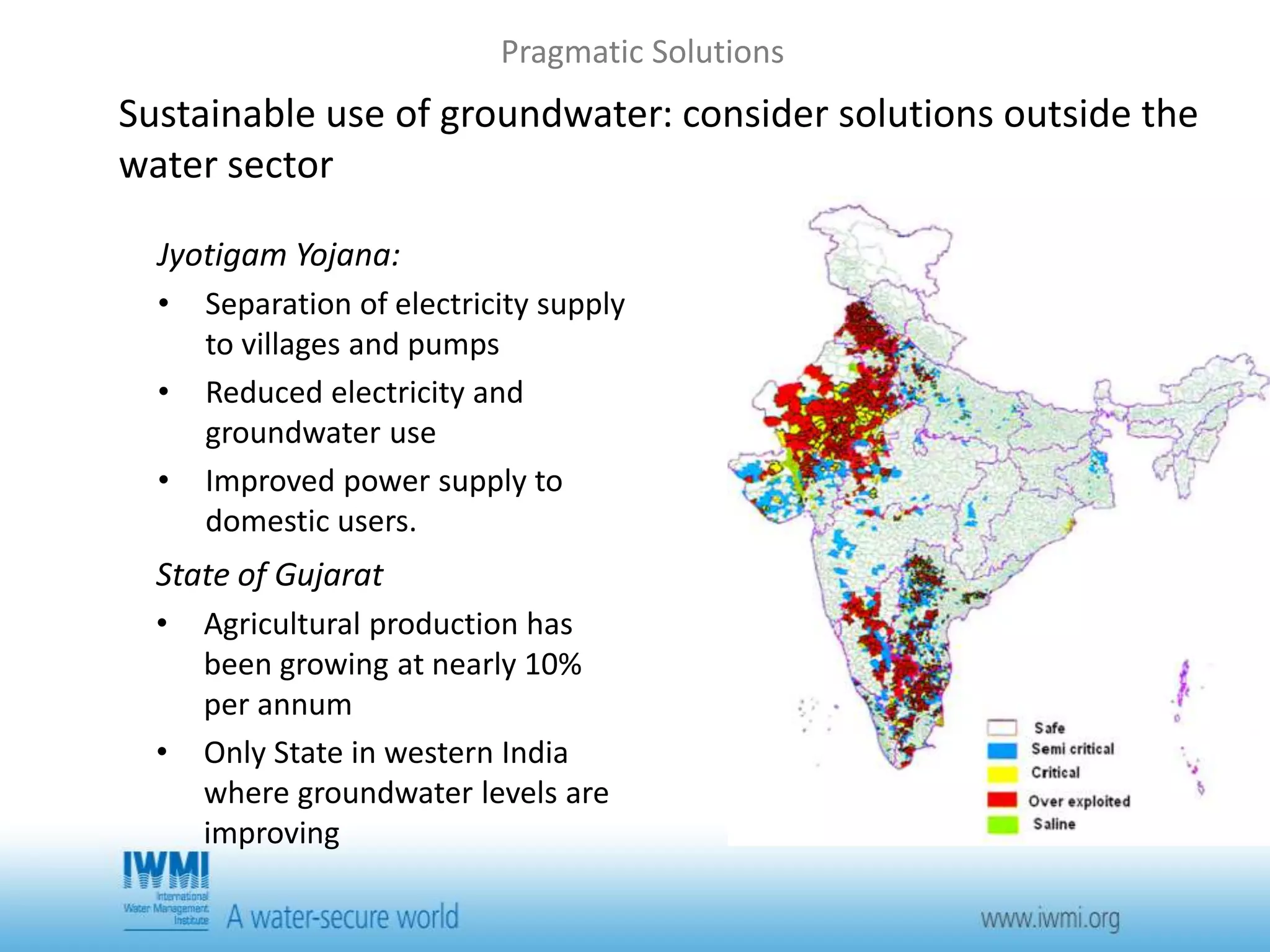
Sustainable use of groundwater: consider solutions outside the 
water sector 
Jyotigam Yojana: 
• Separation of electricity supply 
to villages and pumps 
• Reduced electricity and 
groundwater use 
• Improved power supply to 
domestic users. 
State of Gujarat 
• Agricultural production has 
been growing at nearly 10% 
per annum 
• Only State in western India 
where groundwater levels are 
improving
Pragmatic Solutions 
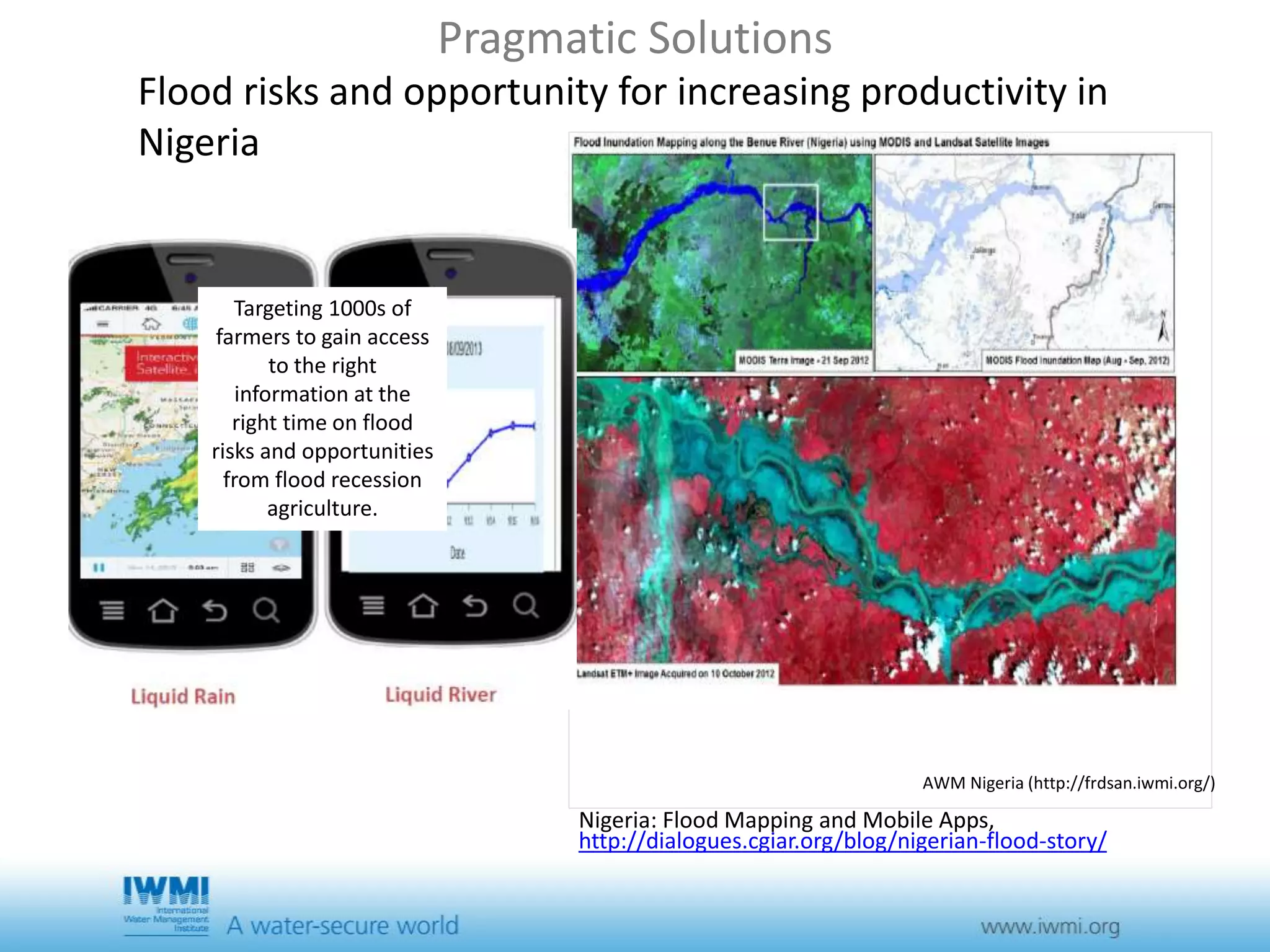
Flood risks and opportunity for increasing productivity in 
Nigeria 
AWM Nigeria (http://frdsan.iwmi.org/) 
Nigeria: Flood Mapping and Mobile Apps, 
http://dialogues.cgiar.org/blog/nigerian-flood-story/ 
Targeting 1000s of 
farmers to gain access 
to the right 
information at the 
right time on flood 
risks and opportunities 
from flood recession 
agriculture.
Overarching messages 
• Partnerships: Achieving all water-related goals will require 
a broad partnership within the water sector and beyond – 
and including the science community 
• Opportunities for Growth: The emphasis should be on 
facilitating a sustainable and equitable growth path. 
• Balancing the Scales: large scale investments in water 
resources and agriculture need to complement, rather than 
undermine, small-scale producers 
• Integration: thinking across sectors and out of the ‘sectoral 
boxes’ has produced practical solutions
How does the science community contribute to the 
SDG process 
 Finalize the SDGs 
 Next steps in the SDG process: setting national 
targets, achieving those targets in countries, 
measuring progress 
 Explore contributions of science community through 
evidence-based support 
 Contextual realities in low- and middle-income 
countries in Africa and Asia

Using data and innovative solutions to deliver on the Water SDGs

  • 1.
    Using data and innovative solutions to deliver on the Water SDGs Peter G. McCornick & Julie van der Bliek International Water Management Institute 19th October, Seattle Water for Food Conference
  • 2.
    Water SDG (finalproposal OWG, 19 July 2014) Goal 6. Ensure availability and sustainable management of water and sanitation for all 6.1 by 2030, achieve universal and equitable access to safe and affordable drinking water for all 6.2 by 2030, achieve access to adequate and equitable sanitation and hygiene for all, and end open defecation, paying special attention to the needs of women and girls and those in vulnerable situations 6.3 by 2030, improve water quality by reducing pollution, eliminating dumping and minimizing release of hazardous chemicals and materials, halving the proportion of untreated wastewater, and increasing recycling and safe reuse by x% globally 6.4 by 2030, substantially increase water-use efficiency across all sectors and ensure sustainable withdrawals and supply of freshwater to address water scarcity, and substantially reduce the number of people suffering from water scarcity 6.5 by 2030 implement integrated water resources management at all levels, including through transboundary cooperation as appropriate 6.6 by 2020 protect and restore water-related ecosystems, including mountains, forests, wetlands, rivers, aquifers and lakes 6.A by 2030, expand international cooperation and capacity-building support to developing countries in water and sanitation related activities and programmes, including water harvesting, desalination, water efficiency, wastewater treatment, recycling and reuse technologies 6.B support and strengthen the participation of local communities for improving water and sanitation management
  • 3.
    Links to otherSDGs Goal 2. End hunger, achieve food security and improved nutrition, and promote sustainable agriculture Goal 7. Ensure access to affordable, reliable, sustainable, and modern energy for all Goal 11. Make cities and human settlements inclusive, safe, resilient and sustainable Goal 12. Ensure sustainable consumption and production patterns Goal 13. Take urgent action to combat climate change and its impacts Goal 15.Protect, restore and promote sustainable use of terrestrial ecosystems, sustainably manage forests, combat desertification, and halt and reverse land degradation and halt biodiversity loss
  • 4.
    How does thescience community contribute to the SDG process  Next steps in the SDG process: setting national targets, achieving those targets in countries, measuring progress  Explore contributions of science community through evidence-based support  Contextual realities in low- and middle-income countries in Africa and Asia
  • 5.
  • 6.
    Context is crucial Targets for countries at different stages of economic development SDG targets Stage 1 – Fully informal Stage 2 – Largely informal Stage 3 – Rapidly formalizing Stage 4 – Fully formal water industry Target 1 Investment Invest in local infrastructure to improve water access Invest in meso-level infrastructure for sustainable development of water resources Invest in improving water productivity and waste recycling Invest in 100% coverage in high quality water service provision Target 2 Institutional Make informal water institutions equitable Integrate informal water institutions with formal ones in private or public sector Create meso-level participatory water institutions Create a full-fledged water industry with proactive regulator Target 3 Policy and legal regime Establish basic water information system Establish water policy and legal regime Establish basin-level water allocation mechanism Full-fledged basin management authorities Target 4 Financial sustainability Establish the principle of water as a social and economic good Provide a subsidy on operational and maintenance costs to 50% Apply a 75% service fee for recovery of operational and maintenance costs of water infrastructure Apply 100% water service as well as resource fee for management, operations and maintenance costs
  • 7.
    Context is crucial Social inclusion: Consider women and disadvantaged groups • Target the individuals and their needs in water management systems • Including women in water management decisions, address land and water rights (target 5a), and support female farmers to increase agricultural productivity. Feminization of agriculture. • Multiple Use Water Systems – integration at community level
  • 8.
    Setting targets and water metrics for monitoring
  • 9.
    Water Metrics: Suiteof indicators • A suite of indicators, rather than a single indicator such as water productivity, should be used for monitoring the progress towards the water SDG for all users, while also maintaining healthy ecosystems. • Use of specific indicators (water use efficiency or water productivity) masks complexity and trade-offs required to achieve development outcomes
  • 10.
    Water Metrics: Waterproductivity • Global target: Improving water-use efficiency across all sectors • Water productivity analysis at a basin scale: highlight trade-offs to help decision makers develop strategies where the benefits exceed the costs and where both are clearly assessed and quantified.
  • 11.
    Water Metrics: Newdata and tools Low-cost opportunities: • data collected through remote sensing and near sensing • collect and disseminate data through mobile technologies Challenge: Ownership and full integration within the national water monitoring & reporting mechanisms.
  • 12.
    Water Metrics: Wateraccounting Water productivity is an indicator of the efficient use of water; water accounting is a monitoring tool. Water Accounting Plus (WA+) – partnership: IWMI, UNESCO-IHE, FAO – uses global open access data and the development of an international standard to express complex water management issues. WA+ presents the data in different sheets, allowing easy and quick access to particular topics, such as agricultural production, ecosystem services, useable flows and groundwater depletion.
  • 13.
    Opportunities for growth Further development of GW in SS Africa
  • 14.
    Balancing the scales Small Private Irrigation Small Private Irrigation: • initiated and financed by farmers • operated and managed by individuals or in small self-initiated groups; • small plots with relatively low-cost technologies; • mostly high value crops for market • spontaneous and unregulated In many African countries: more important than public irrigation - number of farmers and value of production. In India: more than 50% of the irrigated area receives its water from pumps and tubewells owned and managed by smallholders
  • 15.
    Suitability domains example:WLT Up scaling - What are the most suitable solutions in different contexts? + OR and = One scenario for Individual motor pumps
  • 16.
    Impacts at anEcosystem/Landscape Scale Irrigated areas of Asia, 2010 @ 500 meter Mapping system: to regularly delineate boundaries and monitor change. Irrigated and rainfed area map, South Asia Key Questions: • Where is small-scale Agricultural Water Management? • What is changing and where (e.g., irrigated area, rainfed systems, water sources, cropping patterns?) • What are the implications for food security, poverty alleviation, and ecosystems?
  • 17.
    How to revitaliselarge-scale irrigation systems for food, water, energy, economic and ecosystems security and services? Rehabilitation Revitalization is more than just rehabilitation International Water Management Institute Pehur High Level Canal, Pakistan David Molden/IWMI Productivity Functioning Ecosystems Hamish John Appleby/IWMI Richard Steckel/IWMI People
  • 18.
  • 19.
    Integration Innovative solutionto resolve hydropower and irrigation conflicts: Managed aquifer recharge in the Ferghana Valley Aquifers of Fergana Valley have over 3000 Mm3 of free capacities which could be used for winter flow banking
  • 20.
    Integration Targets forWastewater reuse, Food security, Energy reduction, … SDG targets on wastewater management, recycling & reuse: other nexus benefits → reduced energy for chemical fertilizers, recovery of nutrients
  • 21.
  • 22.
    Pragmatic Solutions Sustainableuse of groundwater: consider solutions outside the water sector Jyotigam Yojana: • Separation of electricity supply to villages and pumps • Reduced electricity and groundwater use • Improved power supply to domestic users. State of Gujarat • Agricultural production has been growing at nearly 10% per annum • Only State in western India where groundwater levels are improving
  • 23.
    Pragmatic Solutions Floodrisks and opportunity for increasing productivity in Nigeria AWM Nigeria (http://frdsan.iwmi.org/) Nigeria: Flood Mapping and Mobile Apps, http://dialogues.cgiar.org/blog/nigerian-flood-story/ Targeting 1000s of farmers to gain access to the right information at the right time on flood risks and opportunities from flood recession agriculture.
  • 24.
    Overarching messages •Partnerships: Achieving all water-related goals will require a broad partnership within the water sector and beyond – and including the science community • Opportunities for Growth: The emphasis should be on facilitating a sustainable and equitable growth path. • Balancing the Scales: large scale investments in water resources and agriculture need to complement, rather than undermine, small-scale producers • Integration: thinking across sectors and out of the ‘sectoral boxes’ has produced practical solutions
  • 25.
    How does thescience community contribute to the SDG process  Finalize the SDGs  Next steps in the SDG process: setting national targets, achieving those targets in countries, measuring progress  Explore contributions of science community through evidence-based support  Contextual realities in low- and middle-income countries in Africa and Asia

Editor's Notes

  • #13 Water productivity is an indicator of the efficient use of water; water accounting is a monitoring tool. Quantified water accounts can be used to set management targets and subsequently monitor these targets. Water Accounting Plus (WA+) – partnership: IWMI, UNESCO-IHE, FAO – uses global open access data and the development of an international standard to express complex water management issues. WA+ presents the data in different sheets, allowing easy and quick access to particular topics, such as agricultural production, ecosystem services, useable flows and groundwater depletion. Resource sheet is shown here.
  • #17 More slide details if needed: Where is irrigation (surface and groundwater)? Where is small scale irrigation? What is changing and where (e.g., irrigated area, rainfed systems, water sources, cropping patterns?) What are the implications for food security, poverty alleviation, and supporting functioning ecosystem?
  • #18 Pehur Highl Level Canal