COMMUNICATION SKILLS 
STUDENT 
NAME: 
PATEL JAY K. 
ENROLLMENT 
No.: 
130390119058 
FACULTY NAME=PARIXIT PANDIYA
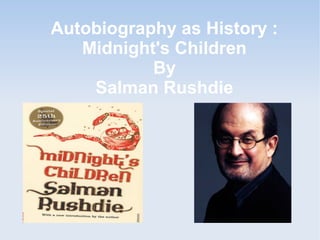
Autobiography as History : 
Midnight's Children 
By 
Salman Rushdie
The Author 
 Born in Bombay in June, 1947 
 Studied in Cathedral School, Bombay 
 Left for England in 1961 
 Completed schooling at Rugby 
 Degree in History from King's College, 
Cambridge 
 Worked with a multimedia theatre group and an 
advertising company
The Book 
 The tale of Saleem Sinai – an 
individual born at the exact instant of 
India's independence 
 The tale of post-colonial India 
 Connection between the two – 
allegorical and literal. e
The Themes 
 Magical Realism 
”characterized by an equal acceptance of the 
ordinary and the extraordinary” 
 One Hundred Years of Solitude by Gabriel 
García Márquez – a classic of this Genre 
 Autofiction – Fictional (?) Autobiography 
 Life narrative presented as metaphor for a 
nation's journey 
 Trivializing/Personalizing History
Salman and Saleem 
• Saleem Sinai born on 15th August 1947; Salman 
Rushdie born on 19th June, 1947 
• “It was a family joke that the British left only two 
months after my arrival” 
• Very similar parent profiles 
• Like Saleem, Rushdie's maternal grandfather 
was officially Muslim, but was an agnostic
Salman and Saleem 
• When Salman was a child, the Rushdie family 
lived in a colonialist estate called Windsor 
Villa – which probably served as a model for 
Methwold's Estate 
• Like Saleem, Salman had a nanny called 
Mary. 
• The young Salman Rushdie also believed he 
was the center of the universe. 
• “Being the only son and eldest child in a 
middle-class Indian family does make you 
tend to think that the world revolved around 
you”
Salman and Saleem 
• One major difference – Rushdie was sent to 
England at the age of 14 and has lived in 
England ever since 
• Saleem Sinai lived all his life in the sub-continent. 
• Saleem's Indianness is a function of Rushdie's 
Britishness 
• Previous political novels Waiting for the 
Mahatma and Kanthapura were focussed on 
the village/town than the nation
Autobiography as History 
 Saleem's personal story inextricably linked to 
the story of India 
 Various narrative devices used to establish this 
connection 
 Timing and Circumstances of births used as 
powerful metaphors 
 Traits of individual matched with the nation 
 Various historical events linked with Saleem's 
friends and family
Birth Pangs 
 "I had been mysteriously handcuffed to history, 
my destinies indissolubly chained to those of 
my country" 
 But that's not all! 
 1000 other children born at the same instant – 
represent India's post-independence generation 
and the power it had
(More) 
Birth Pangs 
 Saleem's child born at midnight of the day 
when Emergency was imposed in India 
 Parvati's 13-day labour => the 13 day of 
political turmoil preceding Emergency 
 Nightmarish parallels between the travails of 
India and Parvati
”come on Parvati, push, push, push and while 
Parvati pushed in the ghetto, J . P. Narayan and 
Morarji Desai. . . . were forcing Mrs. Gandhi to 
push. . . . the Prime Minister was giving birth to 
a child of her own. . . . suspension of civil rights, 
and censorship-of-the-press, and armoured-units-on- 
special-alert, and arrest-of-subversive-elements.”
The Individual..and the Collective 
 Only individuals in typical Historical texts – 
Kings and Emperors. 
 What about the common man? 
 Attempt to present history through the 
autobiography of a comman man
 ”I have watched the mountains being born ; I 
have seen Emperors die . . . I saw that Isa, that 
Christ, when he came to Kashmir. Smile, smile, 
it is your history I am keeping in my head.” 
 Tai is accorded the central place in the 
narrative.
History Comes Home 
 Rushdie shows history's momentous – often 
violent – events as having trivial causes linked 
to his family and friends. 
 Language riots in Bombay 
 Emergency imposed by the Widow 
 Murder of Homi Catrack by the husband of Lila 
Sabarmati (remember the Nanavati case?) 
 Theft of the Prophet's Hair
History Comes Home 
 Family members and friends are closely linked 
to historical/political figures 
 Salim's uncle Zulfikar is a Pakistani General 
who helps Ayub Khan seize power 
 Salim's mother first married to Shaikh 
Abdullah's right hand man
The Magic in Reality 
 Fantastical occurrences included in the real 
world and presented as normal events 
 The powers of Salim and other midnight's 
children 
 Narlikar's luminescent ashes and Ahmed's 
fading skin 
 The view of history centered around Salim and 
his family
The Magic In Reality 
 ”I was born in the city of Bombay...once upon a 
time.” 
 Is the presence of 'magical' events a metaphor 
for the role of religion in the Indian society? 
 Is it present to pander to the West's view of 
India as a country of tantriks and yogis?
Points to Ponder 
 The troubles of Salim and Midnight Children 
symbolize the troubles of post-independence 
India 
 Rushdie blames the system. 
 But what did the children, with their special 
powers and abilities do to change/overcome the 
system? 
 Does this inaction symbolizes our lethargy to 
carve our own destiny?
Thank You 
Questions?

Midnight's children book

  • 1.
    COMMUNICATION SKILLS STUDENT NAME: PATEL JAY K. ENROLLMENT No.: 130390119058 FACULTY NAME=PARIXIT PANDIYA
  • 2.
    Autobiography as History: Midnight's Children By Salman Rushdie
  • 3.
    The Author Born in Bombay in June, 1947  Studied in Cathedral School, Bombay  Left for England in 1961  Completed schooling at Rugby  Degree in History from King's College, Cambridge  Worked with a multimedia theatre group and an advertising company
  • 4.
    The Book The tale of Saleem Sinai – an individual born at the exact instant of India's independence  The tale of post-colonial India  Connection between the two – allegorical and literal. e
  • 5.
    The Themes Magical Realism ”characterized by an equal acceptance of the ordinary and the extraordinary”  One Hundred Years of Solitude by Gabriel García Márquez – a classic of this Genre  Autofiction – Fictional (?) Autobiography  Life narrative presented as metaphor for a nation's journey  Trivializing/Personalizing History
  • 6.
    Salman and Saleem • Saleem Sinai born on 15th August 1947; Salman Rushdie born on 19th June, 1947 • “It was a family joke that the British left only two months after my arrival” • Very similar parent profiles • Like Saleem, Rushdie's maternal grandfather was officially Muslim, but was an agnostic
  • 7.
    Salman and Saleem • When Salman was a child, the Rushdie family lived in a colonialist estate called Windsor Villa – which probably served as a model for Methwold's Estate • Like Saleem, Salman had a nanny called Mary. • The young Salman Rushdie also believed he was the center of the universe. • “Being the only son and eldest child in a middle-class Indian family does make you tend to think that the world revolved around you”
  • 8.
    Salman and Saleem • One major difference – Rushdie was sent to England at the age of 14 and has lived in England ever since • Saleem Sinai lived all his life in the sub-continent. • Saleem's Indianness is a function of Rushdie's Britishness • Previous political novels Waiting for the Mahatma and Kanthapura were focussed on the village/town than the nation
  • 9.
    Autobiography as History  Saleem's personal story inextricably linked to the story of India  Various narrative devices used to establish this connection  Timing and Circumstances of births used as powerful metaphors  Traits of individual matched with the nation  Various historical events linked with Saleem's friends and family
  • 10.
    Birth Pangs "I had been mysteriously handcuffed to history, my destinies indissolubly chained to those of my country"  But that's not all!  1000 other children born at the same instant – represent India's post-independence generation and the power it had
  • 11.
    (More) Birth Pangs  Saleem's child born at midnight of the day when Emergency was imposed in India  Parvati's 13-day labour => the 13 day of political turmoil preceding Emergency  Nightmarish parallels between the travails of India and Parvati
  • 12.
    ”come on Parvati,push, push, push and while Parvati pushed in the ghetto, J . P. Narayan and Morarji Desai. . . . were forcing Mrs. Gandhi to push. . . . the Prime Minister was giving birth to a child of her own. . . . suspension of civil rights, and censorship-of-the-press, and armoured-units-on- special-alert, and arrest-of-subversive-elements.”
  • 13.
    The Individual..and theCollective  Only individuals in typical Historical texts – Kings and Emperors.  What about the common man?  Attempt to present history through the autobiography of a comman man
  • 14.
     ”I havewatched the mountains being born ; I have seen Emperors die . . . I saw that Isa, that Christ, when he came to Kashmir. Smile, smile, it is your history I am keeping in my head.”  Tai is accorded the central place in the narrative.
  • 15.
    History Comes Home  Rushdie shows history's momentous – often violent – events as having trivial causes linked to his family and friends.  Language riots in Bombay  Emergency imposed by the Widow  Murder of Homi Catrack by the husband of Lila Sabarmati (remember the Nanavati case?)  Theft of the Prophet's Hair
  • 16.
    History Comes Home  Family members and friends are closely linked to historical/political figures  Salim's uncle Zulfikar is a Pakistani General who helps Ayub Khan seize power  Salim's mother first married to Shaikh Abdullah's right hand man
  • 17.
    The Magic inReality  Fantastical occurrences included in the real world and presented as normal events  The powers of Salim and other midnight's children  Narlikar's luminescent ashes and Ahmed's fading skin  The view of history centered around Salim and his family
  • 18.
    The Magic InReality  ”I was born in the city of Bombay...once upon a time.”  Is the presence of 'magical' events a metaphor for the role of religion in the Indian society?  Is it present to pander to the West's view of India as a country of tantriks and yogis?
  • 19.
    Points to Ponder  The troubles of Salim and Midnight Children symbolize the troubles of post-independence India  Rushdie blames the system.  But what did the children, with their special powers and abilities do to change/overcome the system?  Does this inaction symbolizes our lethargy to carve our own destiny?
  • 20.