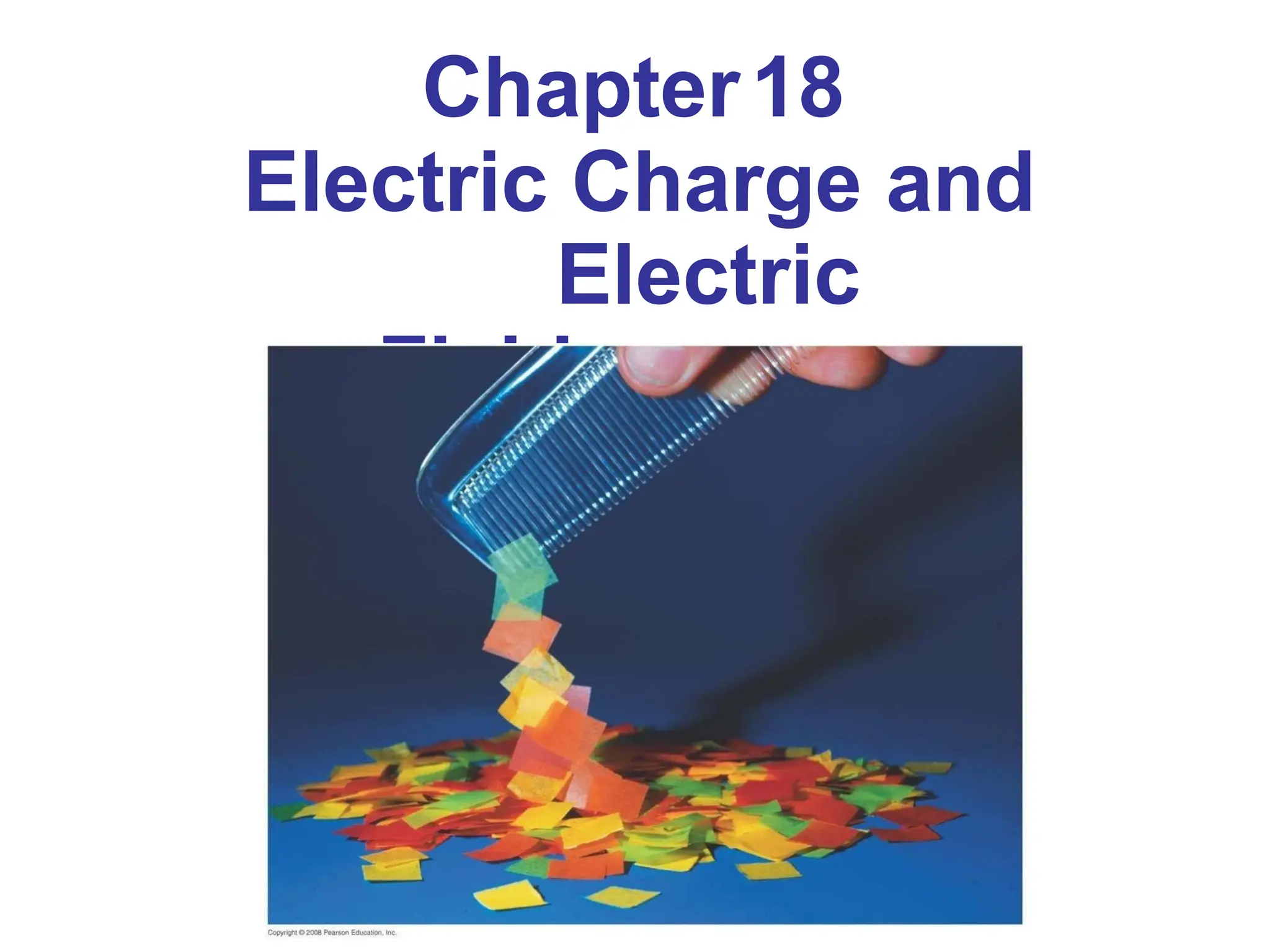
Chapter18
Electric Charge and
Electric
Field
2
Atoms & Electricity
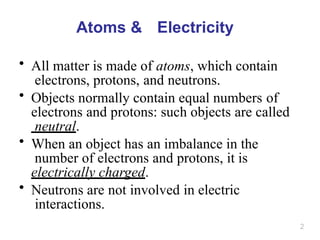
• All matter is made of atoms, which contain
electrons, protons, and neutrons.
• Objects normally contain equal numbers of
electrons and protons: such objects are called
neutral.
• When an object has an imbalance in the
number of electrons and protons, it is
electrically charged.
• Neutrons are not involved in electric
interactions.
3
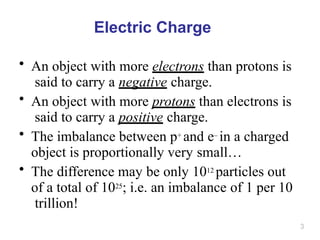
Electric Charge
• An object with more electrons than protons is
said to carry a negative charge.
• An object with more protons than electrons is
said to carry a positive charge.
• The imbalance between p+ and e– in a charged
object is proportionally very small…
• The difference may be only 1012 particles out
of a total of 1025; i.e. an imbalance of 1 per 10
trillion!
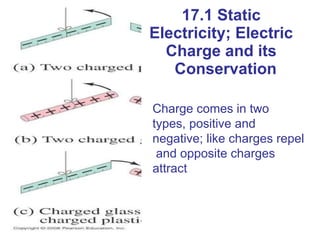
Charge comes in two
types, positive and
negative; like charges repel
and opposite charges
attract
17.1 Static
Electricity; Electric
Charge and its
Conservation
5
Electric Charge
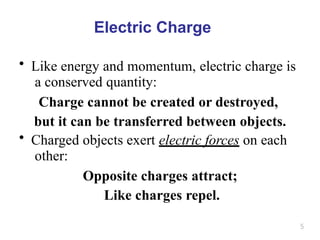
• Like energy and momentum, electric charge is
a conserved quantity:
Charge cannot be created or destroyed,
but it can be transferred between objects.
• Charged objects exert electric forces on each
other:
Opposite charges attract;
Like charges repel.
Electric charge is conserved – the arithmetic
sum of the total charge cannot change in any
interaction.
17.1 Static Electricity; Electric
Charge and its Conservation
7
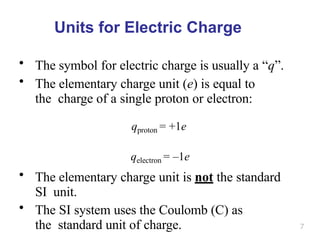
Units for Electric Charge
• The symbol for electric charge is usually a “q”.
• The elementary charge unit (e) is equal to
the charge of a single proton or electron:
qproton = +1e
qelectron = –1e
• The elementary charge unit is not the standard
SI unit.
• The SI system uses the Coulomb (C) as
the standard unit of charge.
8
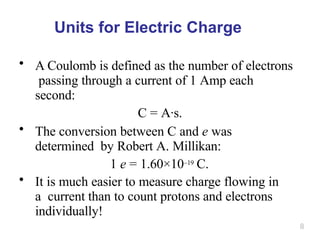
Units for Electric Charge
• A Coulomb is defined as the number of electrons
passing through a current of 1 Amp each
second:
C = A·s.
• The conversion between C and e was
determined by Robert A. Millikan:
1 e = 1.60×10⁻¹⁹ C.
• It is much easier to measure charge flowing in
a current than to count protons and electrons
individually!
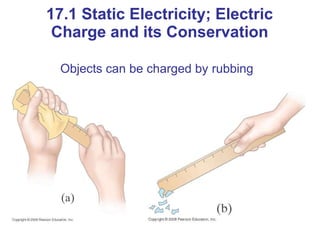
Objects can be charged by rubbing
17.1 Static Electricity; Electric
Charge and its Conservation
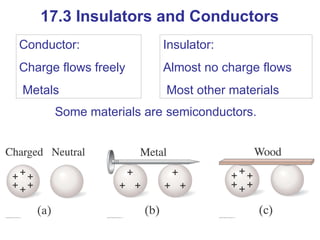
Conductor:
Charge flows freely
Metals
Insulator:
Almost no charge flows
Most other materials
Some materials are semiconductors.
17.3 Insulators and Conductors
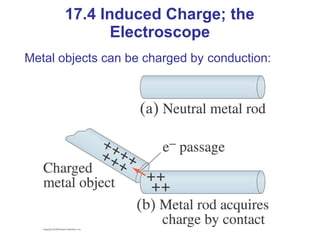
Metal objects can be charged by conduction:
17.4 Induced Charge; the
Electroscope
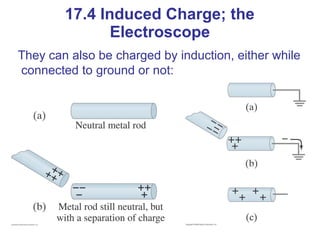
They can also be charged by induction, either while
connected to ground or not:
17.4 Induced Charge; the
Electroscope
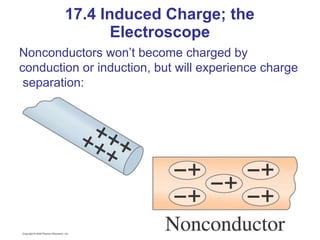
Nonconductors won’t become charged by
conduction or induction, but will experience charge
separation:
17.4 Induced Charge; the
Electroscope
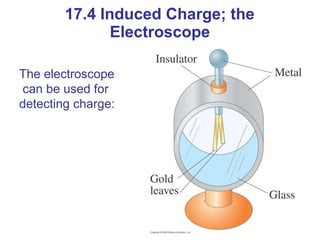
The electroscope
can be used for
detecting charge:
17.4 Induced Charge; the
Electroscope
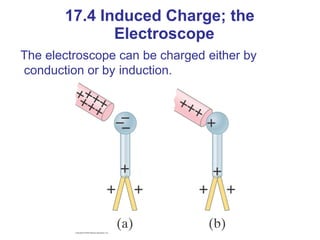
The electroscope can be charged either by
conduction or by induction.
17.4 Induced Charge; the
Electroscope
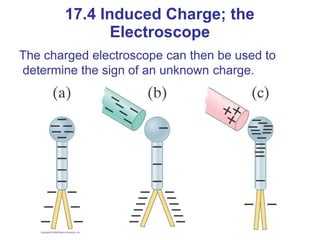
The charged electroscope can then be used to
determine the sign of an unknown charge.
17.4 Induced Charge; the
Electroscope
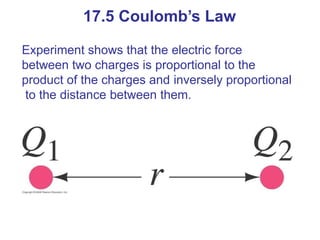
Experiment shows that the electric force
between two charges is proportional to the
product of the charges and inversely proportional
to the distance between them.
17.5 Coulomb’s Law
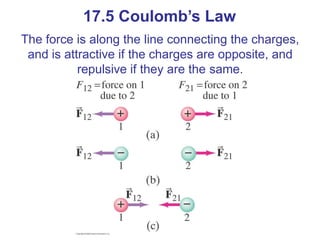
The force is along the line connecting the charges,
and is attractive if the charges are opposite, and
repulsive if they are the same.
17.5 Coulomb’s Law
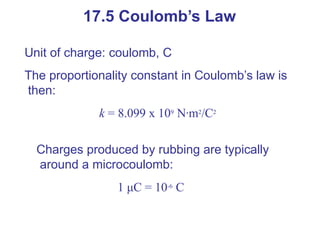
Unit of charge: coulomb, C
The proportionality constant in Coulomb’s law is
then:
k = 8.099 x 10⁹
N·m2
/C2
Charges produced by rubbing are typically
around a microcoulomb:
1 μC = 10-6
C
17.5 Coulomb’s Law
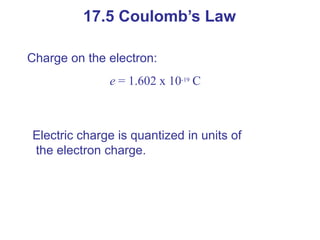
Charge on the electron:
e = 1.602 x 10⁻¹⁹
C
Electric charge is quantized in units of
the electron charge.
17.5 Coulomb’s Law
17.5 Coulomb’s Law
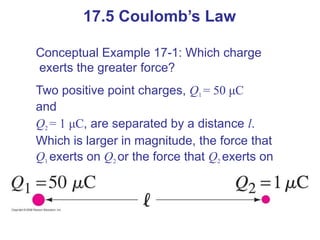
Conceptual Example 17-1: Which charge
exerts the greater force?
Two positive point charges, Q1 = 50 μC
and
Q2 = 1 μC, are separated by a distance l.
Which is larger in magnitude, the force that
Q1 exerts on Q2 or the force that Q2 exerts on
Q1?
17.5 Coulomb’s Law
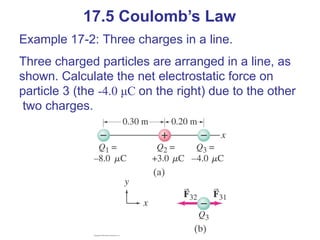
Example 17-2: Three charges in a line.
Three charged particles are arranged in a line, as
shown. Calculate the net electrostatic force on
particle 3 (the -4.0 μC on the right) due to the other
two charges.
17.5 Coulomb’s Law
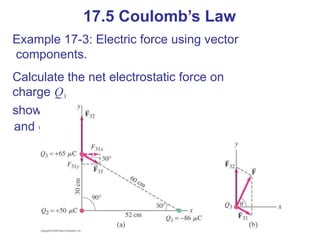
Example 17-3: Electric force using vector
components.
Calculate the net electrostatic force on
charge Q3
shown in the figure due to the charges Q1
and Q2.
17.5 Coulomb’s Law
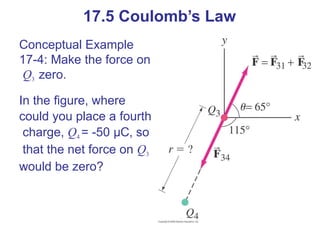
Conceptual Example
17-4: Make the force on
Q3 zero.
In the figure, where
could you place a fourth
charge, Q4 = -50 μC, so
that the net force on Q3
would be zero?
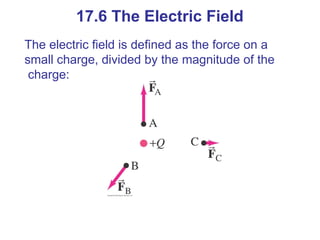
The electric field is defined as the force on a
small charge, divided by the magnitude of the
charge:
17.6 The Electric Field
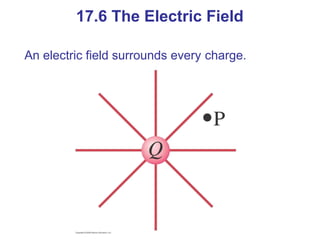
An electric field surrounds every charge.
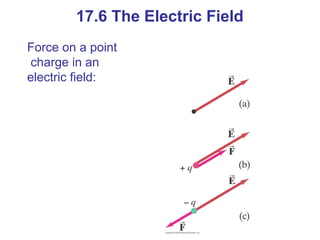
Force on a point
charge in an
electric field:
17.6 The Electric Field
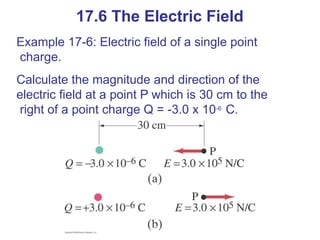
Example 17-6: Electric field of a single point
charge.
Calculate the magnitude and direction of the
electric field at a point P which is 30 cm to the
right of a point charge Q = -3.0 x 10⁻⁶ C.
17.6 The Electric Field
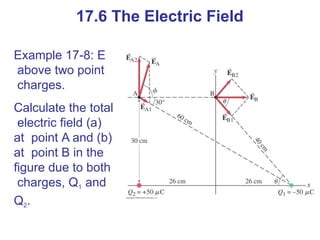
Example 17-8: E
above two point
charges.
Calculate the total
electric field (a)
at point A and (b)
at point B in the
figure due to both
charges, Q1 and
Q2.
Problem solving in electrostatics: electric forces
and electric fields
2.Draw a diagram; show all charges, with signs,
and electric fields and forces with directions
3.Calculate forces using Coulomb’s law
4.Add forces vectorially to get result
5.Check your answer!
17.6 The Electric Field
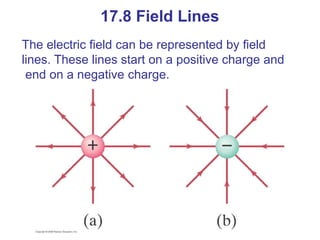
The electric field can be represented by field
lines. These lines start on a positive charge and
end on a negative charge.
17.8 Field Lines
The number of field lines starting (ending) on a
positive (negative) charge is proportional to
the magnitude of the charge.
The electric field is stronger where the field
lines are closer together.
17.8 Field Lines
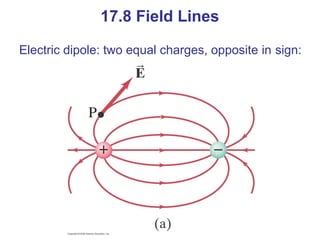
Electric dipole: two equal charges, opposite in sign:
17.8 Field Lines
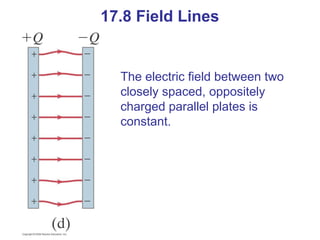
The electric field between two
closely spaced, oppositely
charged parallel plates is
constant.
17.8 Field Lines
Summary of field lines:
2.Field lines indicate the direction of the field;
the field is tangent to the line.
3.The magnitude of the field is proportional to
the density of the lines.
4.Field lines start on positive charges and end
on negative charges; the number is
proportional to the magnitude of the charge.
17.8 Field Lines
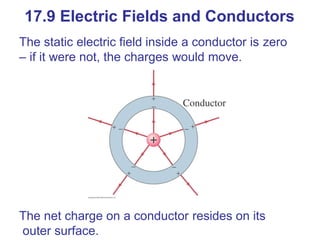
The static electric field inside a conductor is zero
– if it were not, the charges would move.
The net charge on a conductor resides on its
outer surface.
17.9 Electric Fields and Conductors
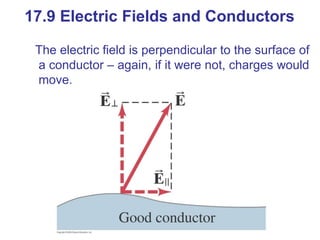
The electric field is perpendicular to the surface of
a conductor – again, if it were not, charges would
move.
17.9 Electric Fields and Conductors
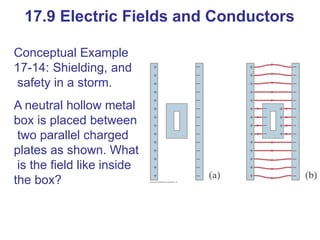
Conceptual Example
17-14: Shielding, and
safety in a storm.
A neutral hollow metal
box is placed between
two parallel charged
plates as shown. What
is the field like inside
the box?
17.10 Motion of a Charged Particle in
an Electric Field
The force on an object of charge q in an
electric field E is given by:
F = qE
Therefore, if we know the mass and
charge of a particle, we can describe its
subsequent motion in an electric field.
17.10 Motion of a Charged Particle in
an Electric Field
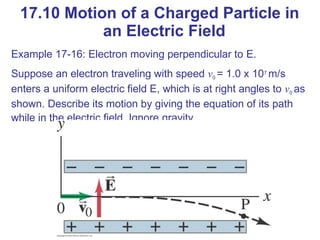
Example 17-16: Electron moving perpendicular to E.
Suppose an electron traveling with speed v0 = 1.0 x 10⁷ m/s
enters a uniform electric field E, which is at right angles to v0 as
shown. Describe its motion by giving the equation of its path
while in the electric field. Ignore gravity.

Electric Charge And Electric Field PHYSics

  • 1.
  • 2.
    2 Atoms & Electricity •All matter is made of atoms, which contain electrons, protons, and neutrons. • Objects normally contain equal numbers of electrons and protons: such objects are called neutral. • When an object has an imbalance in the number of electrons and protons, it is electrically charged. • Neutrons are not involved in electric interactions.
  • 3.
    3 Electric Charge • Anobject with more electrons than protons is said to carry a negative charge. • An object with more protons than electrons is said to carry a positive charge. • The imbalance between p+ and e– in a charged object is proportionally very small… • The difference may be only 1012 particles out of a total of 1025; i.e. an imbalance of 1 per 10 trillion!
  • 4.
    Charge comes intwo types, positive and negative; like charges repel and opposite charges attract 17.1 Static Electricity; Electric Charge and its Conservation
  • 5.
    5 Electric Charge • Likeenergy and momentum, electric charge is a conserved quantity: Charge cannot be created or destroyed, but it can be transferred between objects. • Charged objects exert electric forces on each other: Opposite charges attract; Like charges repel.
  • 6.
    Electric charge isconserved – the arithmetic sum of the total charge cannot change in any interaction. 17.1 Static Electricity; Electric Charge and its Conservation
  • 7.
    7 Units for ElectricCharge • The symbol for electric charge is usually a “q”. • The elementary charge unit (e) is equal to the charge of a single proton or electron: qproton = +1e qelectron = –1e • The elementary charge unit is not the standard SI unit. • The SI system uses the Coulomb (C) as the standard unit of charge.
  • 8.
    8 Units for ElectricCharge • A Coulomb is defined as the number of electrons passing through a current of 1 Amp each second: C = A·s. • The conversion between C and e was determined by Robert A. Millikan: 1 e = 1.60×10⁻¹⁹ C. • It is much easier to measure charge flowing in a current than to count protons and electrons individually!
  • 9.
    Objects can becharged by rubbing 17.1 Static Electricity; Electric Charge and its Conservation
  • 10.
    Conductor: Charge flows freely Metals Insulator: Almostno charge flows Most other materials Some materials are semiconductors. 17.3 Insulators and Conductors
  • 11.
    Metal objects canbe charged by conduction: 17.4 Induced Charge; the Electroscope
  • 12.
    They can alsobe charged by induction, either while connected to ground or not: 17.4 Induced Charge; the Electroscope
  • 13.
    Nonconductors won’t becomecharged by conduction or induction, but will experience charge separation: 17.4 Induced Charge; the Electroscope
  • 14.
    The electroscope can beused for detecting charge: 17.4 Induced Charge; the Electroscope
  • 15.
    The electroscope canbe charged either by conduction or by induction. 17.4 Induced Charge; the Electroscope
  • 16.
    The charged electroscopecan then be used to determine the sign of an unknown charge. 17.4 Induced Charge; the Electroscope
  • 17.
    Experiment shows thatthe electric force between two charges is proportional to the product of the charges and inversely proportional to the distance between them. 17.5 Coulomb’s Law
  • 18.
    The force isalong the line connecting the charges, and is attractive if the charges are opposite, and repulsive if they are the same. 17.5 Coulomb’s Law
  • 19.
    Unit of charge:coulomb, C The proportionality constant in Coulomb’s law is then: k = 8.099 x 10⁹ N·m2 /C2 Charges produced by rubbing are typically around a microcoulomb: 1 μC = 10-6 C 17.5 Coulomb’s Law
  • 20.
    Charge on theelectron: e = 1.602 x 10⁻¹⁹ C Electric charge is quantized in units of the electron charge. 17.5 Coulomb’s Law
  • 21.
    17.5 Coulomb’s Law ConceptualExample 17-1: Which charge exerts the greater force? Two positive point charges, Q1 = 50 μC and Q2 = 1 μC, are separated by a distance l. Which is larger in magnitude, the force that Q1 exerts on Q2 or the force that Q2 exerts on Q1?
  • 22.
    17.5 Coulomb’s Law Example17-2: Three charges in a line. Three charged particles are arranged in a line, as shown. Calculate the net electrostatic force on particle 3 (the -4.0 μC on the right) due to the other two charges.
  • 23.
    17.5 Coulomb’s Law Example17-3: Electric force using vector components. Calculate the net electrostatic force on charge Q3 shown in the figure due to the charges Q1 and Q2.
  • 24.
    17.5 Coulomb’s Law ConceptualExample 17-4: Make the force on Q3 zero. In the figure, where could you place a fourth charge, Q4 = -50 μC, so that the net force on Q3 would be zero?
  • 25.
    The electric fieldis defined as the force on a small charge, divided by the magnitude of the charge: 17.6 The Electric Field
  • 26.
    17.6 The ElectricField An electric field surrounds every charge.
  • 27.
    Force on apoint charge in an electric field: 17.6 The Electric Field
  • 28.
    17.6 The ElectricField Example 17-6: Electric field of a single point charge. Calculate the magnitude and direction of the electric field at a point P which is 30 cm to the right of a point charge Q = -3.0 x 10⁻⁶ C.
  • 29.
    17.6 The ElectricField Example 17-8: E above two point charges. Calculate the total electric field (a) at point A and (b) at point B in the figure due to both charges, Q1 and Q2.
  • 30.
    Problem solving inelectrostatics: electric forces and electric fields 2.Draw a diagram; show all charges, with signs, and electric fields and forces with directions 3.Calculate forces using Coulomb’s law 4.Add forces vectorially to get result 5.Check your answer! 17.6 The Electric Field
  • 31.
    The electric fieldcan be represented by field lines. These lines start on a positive charge and end on a negative charge. 17.8 Field Lines
  • 32.
    The number offield lines starting (ending) on a positive (negative) charge is proportional to the magnitude of the charge. The electric field is stronger where the field lines are closer together. 17.8 Field Lines
  • 33.
    Electric dipole: twoequal charges, opposite in sign: 17.8 Field Lines
  • 34.
    The electric fieldbetween two closely spaced, oppositely charged parallel plates is constant. 17.8 Field Lines
  • 35.
    Summary of fieldlines: 2.Field lines indicate the direction of the field; the field is tangent to the line. 3.The magnitude of the field is proportional to the density of the lines. 4.Field lines start on positive charges and end on negative charges; the number is proportional to the magnitude of the charge. 17.8 Field Lines
  • 36.
    The static electricfield inside a conductor is zero – if it were not, the charges would move. The net charge on a conductor resides on its outer surface. 17.9 Electric Fields and Conductors
  • 37.
    The electric fieldis perpendicular to the surface of a conductor – again, if it were not, charges would move. 17.9 Electric Fields and Conductors
  • 38.
    17.9 Electric Fieldsand Conductors Conceptual Example 17-14: Shielding, and safety in a storm. A neutral hollow metal box is placed between two parallel charged plates as shown. What is the field like inside the box?
  • 39.
    17.10 Motion ofa Charged Particle in an Electric Field The force on an object of charge q in an electric field E is given by: F = qE Therefore, if we know the mass and charge of a particle, we can describe its subsequent motion in an electric field.
  • 40.
    17.10 Motion ofa Charged Particle in an Electric Field Example 17-16: Electron moving perpendicular to E. Suppose an electron traveling with speed v0 = 1.0 x 10⁷ m/s enters a uniform electric field E, which is at right angles to v0 as shown. Describe its motion by giving the equation of its path while in the electric field. Ignore gravity.