The Atom Chapter 8 Great Idea: All of the matter around us is made of atoms, the chemical building blocks of our world
Chapter Outline The Smallest Pieces The Structure of the Atom When Matter Meets Light The Periodic Table of the Elements
The Smallest Pieces
The Smallest Pieces Democritus Cut matter to reach smallest piece Called “the atom” or “uncuttable” All material formed from atoms
Dividing a Bar of Gold
Elements John Dalton Father of modern atomic theory Cannot break down elements Elements composed of atoms Example: Water molecule is 1 oxygen atom and 2 hydrogen atoms
Envisioning Atoms
Are Atoms Real? Evidence for the reality of atoms Behavior of a gas Chemical combinations Radioactivity Brownian motion X-ray crystallography Atomic-scale microscopy
The Behavior of a Gas Bernoulli  Atoms have mass and velocity and thus kinetic energy Decreasing volume increases pressure  Increasing temperature increases pressure
The Behavior of Gases
Chemical Combinations Dalton applied law of definite proportions Elements combine in a specific ratio of weights Ex: Water is 8 parts oxygen to 1 part hydrogen
Chemical Combinations  (cont.) Ratio of weights is a small whole number Ex: 12 lbs carbon can combine with either 16 lbs or 32 lbs of oxygen Implication: some units of elements are fundamentally indivisible
Radioactivity Radioactivity Discovered in 1896 Phosphors flash when hit by radiation 1903 demonstration of the twinkling caused by this effect
Brownian Motion Brownian motion: erratic, jiggling motion Pollen grains suspended in water Einstein: motion is random collisions of atoms Predicted particle movement Perrin tested and confirmed Einstein’s predictions
X-ray Crystallography Developed in 1912 Demonstrates arrangement of atoms in crystals
Discovering Chemical  Elements Electrolysis Mendeleev Current periodic table 112 elements 92 found in nature
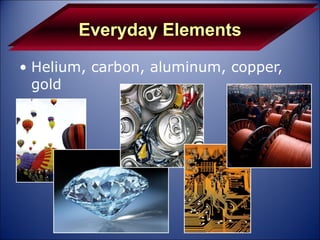
Helium, carbon, aluminum, copper, gold Everyday Elements
The Structure of the Atom
The Structure of the Atom Joseph Thomson identified electron Negatively charged Smaller and lighter than smallest atom Atoms are NOT fundamental building blocks, but are made up of smaller more fundamental particles
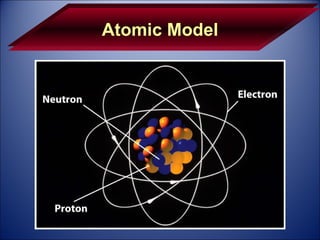
The Atomic Nucleus Ernest Rutherford determined atomic structure Concluded Atom has nucleus at center surrounded by electrons Later discoveries found nucleus is composed of protons and neutrons
Rutherford’s Experiment
Important  Terms Related  to Atoms
Why the Rutherford Atom  Couldn’t Work Why? Object in circular orbit is accelerating Accelerated electrical charge emits electromagnetic radiation Electrons giving off energy while orbiting Result: electrons spin toward nucleus and eventually atom ceases to exist Rutherford atom exists <1min
The Nuclear Regulatory Commission Logo: highly stylized atomic model
When Matter Meets Light
Niels Bohr
The Bohr Atom First working model of atom  Energy levels for electrons Specific distances from nucleus Electrons exist with no radiation Electrons cannot exist between allowed distances (energy levels)
Bohr Atom
Electron Energy Levels
Atomic Model
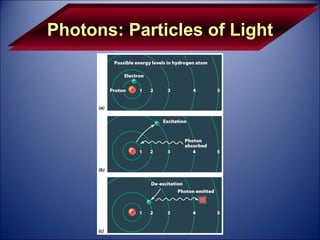
Photons: Particles of Light Photon absorbed Used to move electron to a higher energy state Photon emitted as electron moves to lower energy state
Photons: Particles of Light
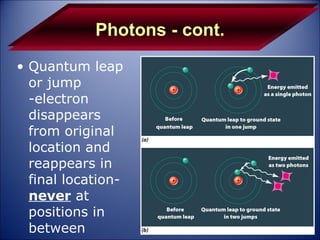
Photons - cont. Quantum leap or jump -electron disappears from original location and reappears in final location- never  at positions in between
Energy in Bohr Atom Energy required to leave ground state Absorb photon Heat  Increases collisions
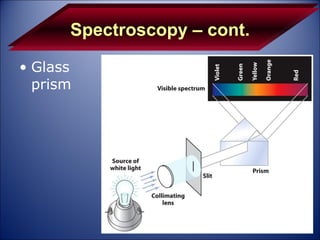
Spectroscopy Atoms emit and absorb different photons Depends on differences between energy levels Each atom has distinct set of photons Spectrum: all photons emitted by an atom Used for identification
Na, K, and Li – Give  Distinctive Colors to a Flame
Spectroscopy – cont. Glass prism
Spectroscopy – cont. Line spectra for H, Na, and Ne
The Periodic Table of the Elements
The Science of Life Spectra of life’s chemical reactions Used to determine how enzymes work Used to identify pollutants emitted from automobile exhaust pipes
Science in the Making Helium Discovery Properties
Technology Lasers Produce a beam of light
Action of a Laser
Lasers Have Many Uses
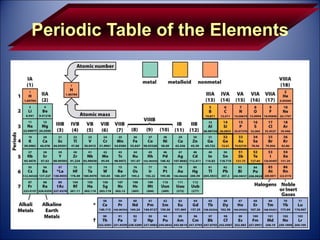
Periodic Table of the Elements Systematizes elements Columns contain similar elements Alkali metals: soft, silvery metals Noble gases: colorless, odorless, and inert
Periodic Table of the Elements
Why the Periodic Table Works: Electron Shells Patterns mirror arrangement of electrons in  shells Pauli exclusion principle   First shell 2 electrons, second shell 8, etc.
Electron Representation

Ch08

  • 1.
    The Atom Chapter8 Great Idea: All of the matter around us is made of atoms, the chemical building blocks of our world
  • 2.
    Chapter Outline TheSmallest Pieces The Structure of the Atom When Matter Meets Light The Periodic Table of the Elements
  • 3.
  • 4.
    The Smallest PiecesDemocritus Cut matter to reach smallest piece Called “the atom” or “uncuttable” All material formed from atoms
  • 5.
  • 6.
    Elements John DaltonFather of modern atomic theory Cannot break down elements Elements composed of atoms Example: Water molecule is 1 oxygen atom and 2 hydrogen atoms
  • 7.
  • 8.
    Are Atoms Real?Evidence for the reality of atoms Behavior of a gas Chemical combinations Radioactivity Brownian motion X-ray crystallography Atomic-scale microscopy
  • 9.
    The Behavior ofa Gas Bernoulli Atoms have mass and velocity and thus kinetic energy Decreasing volume increases pressure Increasing temperature increases pressure
  • 10.
  • 11.
    Chemical Combinations Daltonapplied law of definite proportions Elements combine in a specific ratio of weights Ex: Water is 8 parts oxygen to 1 part hydrogen
  • 12.
    Chemical Combinations (cont.) Ratio of weights is a small whole number Ex: 12 lbs carbon can combine with either 16 lbs or 32 lbs of oxygen Implication: some units of elements are fundamentally indivisible
  • 13.
    Radioactivity Radioactivity Discoveredin 1896 Phosphors flash when hit by radiation 1903 demonstration of the twinkling caused by this effect
  • 14.
    Brownian Motion Brownianmotion: erratic, jiggling motion Pollen grains suspended in water Einstein: motion is random collisions of atoms Predicted particle movement Perrin tested and confirmed Einstein’s predictions
  • 15.
    X-ray Crystallography Developedin 1912 Demonstrates arrangement of atoms in crystals
  • 16.
    Discovering Chemical Elements Electrolysis Mendeleev Current periodic table 112 elements 92 found in nature
  • 17.
    Helium, carbon, aluminum,copper, gold Everyday Elements
  • 18.
  • 19.
    The Structure ofthe Atom Joseph Thomson identified electron Negatively charged Smaller and lighter than smallest atom Atoms are NOT fundamental building blocks, but are made up of smaller more fundamental particles
  • 20.
    The Atomic NucleusErnest Rutherford determined atomic structure Concluded Atom has nucleus at center surrounded by electrons Later discoveries found nucleus is composed of protons and neutrons
  • 21.
  • 22.
    Important TermsRelated to Atoms
  • 23.
    Why the RutherfordAtom Couldn’t Work Why? Object in circular orbit is accelerating Accelerated electrical charge emits electromagnetic radiation Electrons giving off energy while orbiting Result: electrons spin toward nucleus and eventually atom ceases to exist Rutherford atom exists <1min
  • 24.
    The Nuclear RegulatoryCommission Logo: highly stylized atomic model
  • 25.
  • 26.
  • 27.
    The Bohr AtomFirst working model of atom Energy levels for electrons Specific distances from nucleus Electrons exist with no radiation Electrons cannot exist between allowed distances (energy levels)
  • 28.
  • 29.
  • 30.
  • 31.
    Photons: Particles ofLight Photon absorbed Used to move electron to a higher energy state Photon emitted as electron moves to lower energy state
  • 32.
  • 33.
    Photons - cont.Quantum leap or jump -electron disappears from original location and reappears in final location- never at positions in between
  • 34.
    Energy in BohrAtom Energy required to leave ground state Absorb photon Heat Increases collisions
  • 35.
    Spectroscopy Atoms emitand absorb different photons Depends on differences between energy levels Each atom has distinct set of photons Spectrum: all photons emitted by an atom Used for identification
  • 36.
    Na, K, andLi – Give Distinctive Colors to a Flame
  • 37.
  • 38.
    Spectroscopy – cont.Line spectra for H, Na, and Ne
  • 39.
    The Periodic Tableof the Elements
  • 40.
    The Science ofLife Spectra of life’s chemical reactions Used to determine how enzymes work Used to identify pollutants emitted from automobile exhaust pipes
  • 41.
    Science in theMaking Helium Discovery Properties
  • 42.
  • 43.
  • 44.
  • 45.
    Periodic Table ofthe Elements Systematizes elements Columns contain similar elements Alkali metals: soft, silvery metals Noble gases: colorless, odorless, and inert
  • 46.
    Periodic Table ofthe Elements
  • 47.
    Why the PeriodicTable Works: Electron Shells Patterns mirror arrangement of electrons in shells Pauli exclusion principle First shell 2 electrons, second shell 8, etc.
  • 48.