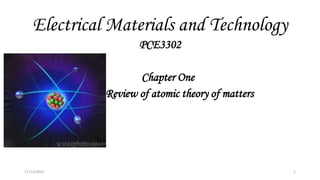
Electrical Materials and Technology
PCE3302
Chapter One
Review of atomic theory of matters
11/13/2022 1
Introduction
 Selection of appropriate material for the intended purpose depends on the
knowledge of properties of materials. i.e.,
 Physical properties
 Electrical
 Mechanical
 Thermal and
 Chemical
 These properties of materials depend on the atomic structure of that material.
11/13/2022 2
Atomic Structure
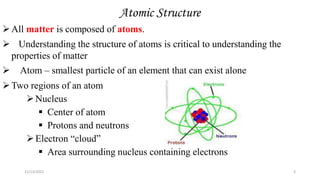
All matter is composed of atoms.
 Understanding the structure of atoms is critical to understanding the
properties of matter
 Atom – smallest particle of an element that can exist alone
Two regions of an atom
Nucleus
 Center of atom
 Protons and neutrons
Electron “cloud”
 Area surrounding nucleus containing electrons
11/13/2022 3
cont’d…………
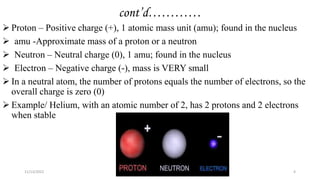
 Proton – Positive charge (+), 1 atomic mass unit (amu); found in the nucleus
 amu -Approximate mass of a proton or a neutron
 Neutron – Neutral charge (0), 1 amu; found in the nucleus
 Electron – Negative charge (-), mass is VERY small
 In a neutral atom, the number of protons equals the number of electrons, so the
overall charge is zero (0)
 Example/ Helium, with an atomic number of 2, has 2 protons and 2 electrons
when stable
11/13/2022 4
Counting Atoms
Atomic Number
 Number of protons in nucleus
 The number of protons determines identity of the element!!
 Mass Number (Atomic Mass)
 Number of protons + neutrons
Units are g/mol
11/13/2022 5
Atomic model
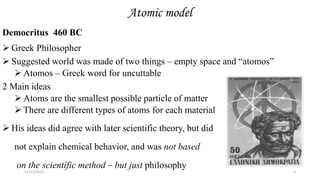
Democritus 460 BC
 Greek Philosopher
 Suggested world was made of two things – empty space and “atomos”
 Atomos – Greek word for uncuttable
2 Main ideas
 Atoms are the smallest possible particle of matter
 There are different types of atoms for each material
 His ideas did agree with later scientific theory, but did
not explain chemical behavior, and was not based
on the scientific method – but just philosophy
11/13/2022 6
Cont’d……
John Dalton’s Atomic Theory (1766 - 1844)
 Dalton was an English school teacher who performed
many experiments on atoms.
 All matter is made of atoms.
 Atoms of one element are all the same.
 Atoms cannot be broken down into smaller parts
 Compounds form by combining atoms
11/13/2022 7
Dalton’s Early Atomic Mode
“Billiard Ball” model
He envisioned atoms as solid, hard spheres, like billiard(pool) balls
So he used wooden balls to model them
11/13/2022 8
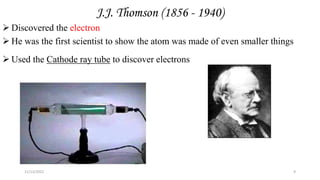
J.J. Thomson (1856 - 1940)
 Discovered the electron
 He was the first scientist to show the atom was made of even smaller things
 Used the Cathode ray tube to discover electrons
1897
11/13/2022 9
Thomson’s Experiment
Cathode ray tube
11/13/2022 10
Voltage source
Vacuum tube
Metal Disks
cont’d………
11/13/2022 11
Voltage source
cont’d………
11/13/2022 12
Voltage source
cont’d………
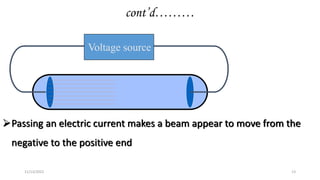
Passing an electric current makes a beam appear to move from the
negative to the positive end
11/13/2022 13
Voltage source
cont’d………
Passing an electric current makes a beam appear to move from the
negative to the positive end
11/13/2022 14
Voltage source
cont’d………
By adding an electric field
11/13/2022 15
+
-
Voltage source
cont’d………
 Adding an electric field cause the beam to move toward the positive plate.
 Thomson concluded the beam was made of negative moving pieces.
11/13/2022 16
+
-
Voltage source
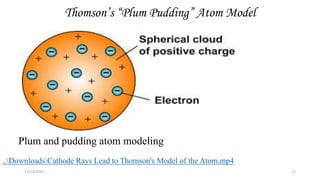
Thomson’s “Plum Pudding” Atom Model
Plum and pudding atom modeling
..DownloadsCathode Rays Lead to Thomson's Model of the Atom.mp4
11/13/2022 17
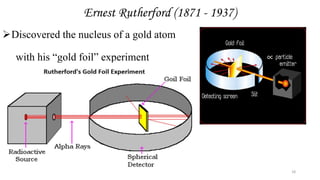
Ernest Rutherford (1871 - 1937)
Discovered the nucleus of a gold atom
with his “gold foil” experiment
11/13/2022 18
cont’d………
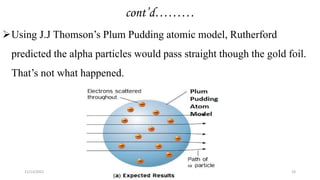
Using J.J Thomson’s Plum Pudding atomic model, Rutherford
predicted the alpha particles would pass straight though the gold foil.
That’s not what happened.
11/13/2022 19
cont’d………
Gold Foil Experiment Results
Most alpha particles go straight through the gold foil A few alpha
particles are sharply deflected
11/13/2022 20
Rutherford’s Conclusion
The atom is mostly empty space.
There is a small, dense center with a positive charge.
Rutherford discovered the nucleus in atoms
11/13/2022 21
cont’d………
Rutherford’s Atomic Model
11/13/2022 22
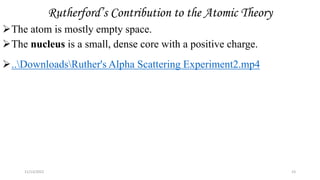
Rutherford’s Contribution to the Atomic Theory
The atom is mostly empty space.
The nucleus is a small, dense core with a positive charge.
..DownloadsRuther's Alpha Scattering Experiment2.mp4
11/13/2022 23
Bohr Model (1871 - 1937)
In 1913, the Danish scientist Niels Bohr proposed an improvement.
In his model, he placed each electron in a specific energy level.
According to Bohr’s atomic model, electrons move in definite orbits
around the nucleus, much like planets circle the sun.
These orbits, or energy levels, are located at certain distances from the
nucleus.
11/13/2022 24
Cont’d…….
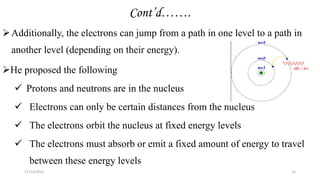
Additionally, the electrons can jump from a path in one level to a path in
another level (depending on their energy).
He proposed the following
 Protons and neutrons are in the nucleus
 Electrons can only be certain distances from the nucleus
 The electrons orbit the nucleus at fixed energy levels
 The electrons must absorb or emit a fixed amount of energy to travel
between these energy levels
11/13/2022 25
Atomic bonding
Chemical bonds :-forces that hold together atoms when they combine
 produce by interaction of electrons in outer levels of two or more atoms
 can form by sharing or transferring electrons
 All atoms will try to achieve a stable octet
Two Major Types of Bonding
Ionic Bonding
 Form when electrons are transferred from one atom to another
 Forms ionic compounds ,
 Transfer of e- 11/13/2022 26
Ionic Bonding
 Two neutral atoms close to each can undergo an ionization process in
order to obtain a full valence shell
 Due to ionization, electrons are transferred from one atom to the
other
 The atom giving up the electron becomes positively charged (cation)
 The atom taking up the electron becomes negatively charged (anion)
 The ions are bonded due to coulombic forces of attraction
 Generally, metallic atoms donate electrons to non-metallic atoms
 Examples: NaCl, KCl, MgBr2 etc.
11/13/2022 27
Ionic Bonding
Ionic bond between sodium and chloride forming NaCl
11/13/2022 28
Covalent Bonding
 The outer electron levels of atoms, which are close to each other, can
interact
 The interaction leads to a sharing of electrons between the atoms
 One pair of electrons shared => single covalent bond
 Two pairs of electrons shared => double covalent bond and so on
 The shared electrons are said to be delocalized i.e. they do not belong
to any particular atom
 Generally, between non-metallic atoms
Examples: H2, CO2, C6H12O6 and other molecules
polar molecule :- have covalent bonds between but atoms do not share
electrons equally
11/13/2022 29
Cont’d….
Single hydrogen atom (left) and two hydrogen atoms forming a covalent
bond with a shared electron pair (right)
11/13/2022 30
Metallic bonds
 Atoms come together, electrons from outer shell of atoms share space
with neighboring atoms.
 The electrons can move freely within the atom orbitals.
 Sharing of ‘free’ electrons among a lattice of positively charged ions
(An array of positive ions in a sea of electrons)
 Electrostatic attractive forces between delocalized electrons and
positively charged metal ions.
 Between metallic atoms
 Examples: Ni, Fe and other metals
11/13/2022 31
Cont’d….
 The outer electrons are so weakly bound to metal atoms that they are free
to roam across the entire metal.
 This results in a lattice of positively ions in a sea of communal electrons
11/13/2022 32
Energy Bands
Electrons try to occupy the
lowest energy band possible
Not every energy level is a
legal state for an electron to
occupy
These legal states tend to
arrange themselves in bands
Allowed
Energy
States
Disallowed
Energy
States
Increasing
Electron
Energy
Energy Bands
}
}
Energy Bands
11/13/2022 34
EC
EV
Valence Band
Conduction Band
Last filled energy
band at T=0K
First unfilled energy
band at T=0K
Band Diagrams
Band Diagram Representation
Energy plotted as a function of position
EC  Conduction band
 Lowest energy state for a free electron
EV  Valence band
 Highest energy state for filled outer shells
EG  Band gap
 Difference in energy levels between EC and EV
 No electrons (e-) in the bandgap (only above EC or below EV)
 EG = 1.12eV in Silicon
11/13/2022 35
EG
EC
EV
Increasing electron energy
Increasing voltage
Energy Bands In Solids
Explains and distinguish between conductors, insulators and semi
conductors
 Conduction Band – small energy can remove an electron from an atom
 Valence Band – Below the conduction band
 Filled Band- Near the nucleus
 Insulators- Conduction band is empty but valence is almost
completely filled+ wide energy gap between the two bands (Poor
conductivity)
 Conductors- Overlapping of both conduction and valence bands
 Conduction es move almost twice as fast as holes
11/13/2022 36
Example 1
Aluminum (Al) (no periodic table)
Protons = 13
Electrons =
Neutrons = 14
Atomic Number =
Atomic Mass =
11/13/2022 37
Quantization of Energy
 Energy is quantized in some systems, meaning that the system can
have only certain energies and not a continuum of energies, unlike the
classical case
The quantum view of the atom
Observation: An atom will only absorb or release light at discrete
frequencies
Explanation:
 Absorption or emission of light is caused by electron energy
transitions within the atom
 The energy carried by light is connected with its frequency.
 Electrons are only allowed to move between discrete energy levels in
the atom
11/13/2022 38
Quantization
Classical Physics:
Quantities are continuous.
Quantum Physics:
Some quantities are limited
to a discrete set of values.
Example: charge, Q = N.e
Light is also quantized
 Light seems to carry energy in discrete packets
 We call these packets photons
 In this sense, light behaves like a particle
 But light also has many wave-like properties
 Particle-wave duality: it is both at the same time!
The photoelectric effect
 Metal plate illuminated by a light beam
 If UV light is used, electrons are emitted
 If visible light is used, no electrons are emitted no matter how bright
the light
11/13/2022 40
Cont’d…..
Explanation:
 A minimum amount of energy is needed to remove an electron from
the metal
 The energy of UV light must be greater than the energy of visible light
 Energy and frequency are related by
E = hn
where h is called Plank’s constant
h = 6.625 x 10⁻³⁴ J s
11/13/2022 41
Cont’d……
Reading Assignment
Schrödinger Equation
11/13/2022 42

Mat ch-1.pptx

  • 1.
    Electrical Materials andTechnology PCE3302 Chapter One Review of atomic theory of matters 11/13/2022 1
  • 2.
    Introduction  Selection ofappropriate material for the intended purpose depends on the knowledge of properties of materials. i.e.,  Physical properties  Electrical  Mechanical  Thermal and  Chemical  These properties of materials depend on the atomic structure of that material. 11/13/2022 2
  • 3.
    Atomic Structure All matteris composed of atoms.  Understanding the structure of atoms is critical to understanding the properties of matter  Atom – smallest particle of an element that can exist alone Two regions of an atom Nucleus  Center of atom  Protons and neutrons Electron “cloud”  Area surrounding nucleus containing electrons 11/13/2022 3
  • 4.
    cont’d…………  Proton –Positive charge (+), 1 atomic mass unit (amu); found in the nucleus  amu -Approximate mass of a proton or a neutron  Neutron – Neutral charge (0), 1 amu; found in the nucleus  Electron – Negative charge (-), mass is VERY small  In a neutral atom, the number of protons equals the number of electrons, so the overall charge is zero (0)  Example/ Helium, with an atomic number of 2, has 2 protons and 2 electrons when stable 11/13/2022 4
  • 5.
    Counting Atoms Atomic Number Number of protons in nucleus  The number of protons determines identity of the element!!  Mass Number (Atomic Mass)  Number of protons + neutrons Units are g/mol 11/13/2022 5
  • 6.
    Atomic model Democritus 460BC  Greek Philosopher  Suggested world was made of two things – empty space and “atomos”  Atomos – Greek word for uncuttable 2 Main ideas  Atoms are the smallest possible particle of matter  There are different types of atoms for each material  His ideas did agree with later scientific theory, but did not explain chemical behavior, and was not based on the scientific method – but just philosophy 11/13/2022 6
  • 7.
    Cont’d…… John Dalton’s AtomicTheory (1766 - 1844)  Dalton was an English school teacher who performed many experiments on atoms.  All matter is made of atoms.  Atoms of one element are all the same.  Atoms cannot be broken down into smaller parts  Compounds form by combining atoms 11/13/2022 7
  • 8.
    Dalton’s Early AtomicMode “Billiard Ball” model He envisioned atoms as solid, hard spheres, like billiard(pool) balls So he used wooden balls to model them 11/13/2022 8
  • 9.
    J.J. Thomson (1856- 1940)  Discovered the electron  He was the first scientist to show the atom was made of even smaller things  Used the Cathode ray tube to discover electrons 1897 11/13/2022 9
  • 10.
    Thomson’s Experiment Cathode raytube 11/13/2022 10 Voltage source Vacuum tube Metal Disks
  • 11.
  • 12.
  • 13.
    cont’d……… Passing an electriccurrent makes a beam appear to move from the negative to the positive end 11/13/2022 13 Voltage source
  • 14.
    cont’d……… Passing an electriccurrent makes a beam appear to move from the negative to the positive end 11/13/2022 14 Voltage source
  • 15.
    cont’d……… By adding anelectric field 11/13/2022 15 + - Voltage source
  • 16.
    cont’d………  Adding anelectric field cause the beam to move toward the positive plate.  Thomson concluded the beam was made of negative moving pieces. 11/13/2022 16 + - Voltage source
  • 17.
    Thomson’s “Plum Pudding”Atom Model Plum and pudding atom modeling ..DownloadsCathode Rays Lead to Thomson's Model of the Atom.mp4 11/13/2022 17
  • 18.
    Ernest Rutherford (1871- 1937) Discovered the nucleus of a gold atom with his “gold foil” experiment 11/13/2022 18
  • 19.
    cont’d……… Using J.J Thomson’sPlum Pudding atomic model, Rutherford predicted the alpha particles would pass straight though the gold foil. That’s not what happened. 11/13/2022 19
  • 20.
    cont’d……… Gold Foil ExperimentResults Most alpha particles go straight through the gold foil A few alpha particles are sharply deflected 11/13/2022 20
  • 21.
    Rutherford’s Conclusion The atomis mostly empty space. There is a small, dense center with a positive charge. Rutherford discovered the nucleus in atoms 11/13/2022 21
  • 22.
  • 23.
    Rutherford’s Contribution tothe Atomic Theory The atom is mostly empty space. The nucleus is a small, dense core with a positive charge. ..DownloadsRuther's Alpha Scattering Experiment2.mp4 11/13/2022 23
  • 24.
    Bohr Model (1871- 1937) In 1913, the Danish scientist Niels Bohr proposed an improvement. In his model, he placed each electron in a specific energy level. According to Bohr’s atomic model, electrons move in definite orbits around the nucleus, much like planets circle the sun. These orbits, or energy levels, are located at certain distances from the nucleus. 11/13/2022 24
  • 25.
    Cont’d……. Additionally, the electronscan jump from a path in one level to a path in another level (depending on their energy). He proposed the following  Protons and neutrons are in the nucleus  Electrons can only be certain distances from the nucleus  The electrons orbit the nucleus at fixed energy levels  The electrons must absorb or emit a fixed amount of energy to travel between these energy levels 11/13/2022 25
  • 26.
    Atomic bonding Chemical bonds:-forces that hold together atoms when they combine  produce by interaction of electrons in outer levels of two or more atoms  can form by sharing or transferring electrons  All atoms will try to achieve a stable octet Two Major Types of Bonding Ionic Bonding  Form when electrons are transferred from one atom to another  Forms ionic compounds ,  Transfer of e- 11/13/2022 26
  • 27.
    Ionic Bonding  Twoneutral atoms close to each can undergo an ionization process in order to obtain a full valence shell  Due to ionization, electrons are transferred from one atom to the other  The atom giving up the electron becomes positively charged (cation)  The atom taking up the electron becomes negatively charged (anion)  The ions are bonded due to coulombic forces of attraction  Generally, metallic atoms donate electrons to non-metallic atoms  Examples: NaCl, KCl, MgBr2 etc. 11/13/2022 27
  • 28.
    Ionic Bonding Ionic bondbetween sodium and chloride forming NaCl 11/13/2022 28
  • 29.
    Covalent Bonding  Theouter electron levels of atoms, which are close to each other, can interact  The interaction leads to a sharing of electrons between the atoms  One pair of electrons shared => single covalent bond  Two pairs of electrons shared => double covalent bond and so on  The shared electrons are said to be delocalized i.e. they do not belong to any particular atom  Generally, between non-metallic atoms Examples: H2, CO2, C6H12O6 and other molecules polar molecule :- have covalent bonds between but atoms do not share electrons equally 11/13/2022 29
  • 30.
    Cont’d…. Single hydrogen atom(left) and two hydrogen atoms forming a covalent bond with a shared electron pair (right) 11/13/2022 30
  • 31.
    Metallic bonds  Atomscome together, electrons from outer shell of atoms share space with neighboring atoms.  The electrons can move freely within the atom orbitals.  Sharing of ‘free’ electrons among a lattice of positively charged ions (An array of positive ions in a sea of electrons)  Electrostatic attractive forces between delocalized electrons and positively charged metal ions.  Between metallic atoms  Examples: Ni, Fe and other metals 11/13/2022 31
  • 32.
    Cont’d….  The outerelectrons are so weakly bound to metal atoms that they are free to roam across the entire metal.  This results in a lattice of positively ions in a sea of communal electrons 11/13/2022 32
  • 33.
    Energy Bands Electrons tryto occupy the lowest energy band possible Not every energy level is a legal state for an electron to occupy These legal states tend to arrange themselves in bands Allowed Energy States Disallowed Energy States Increasing Electron Energy Energy Bands } }
  • 34.
    Energy Bands 11/13/2022 34 EC EV ValenceBand Conduction Band Last filled energy band at T=0K First unfilled energy band at T=0K
  • 35.
    Band Diagrams Band DiagramRepresentation Energy plotted as a function of position EC  Conduction band  Lowest energy state for a free electron EV  Valence band  Highest energy state for filled outer shells EG  Band gap  Difference in energy levels between EC and EV  No electrons (e-) in the bandgap (only above EC or below EV)  EG = 1.12eV in Silicon 11/13/2022 35 EG EC EV Increasing electron energy Increasing voltage
  • 36.
    Energy Bands InSolids Explains and distinguish between conductors, insulators and semi conductors  Conduction Band – small energy can remove an electron from an atom  Valence Band – Below the conduction band  Filled Band- Near the nucleus  Insulators- Conduction band is empty but valence is almost completely filled+ wide energy gap between the two bands (Poor conductivity)  Conductors- Overlapping of both conduction and valence bands  Conduction es move almost twice as fast as holes 11/13/2022 36
  • 37.
    Example 1 Aluminum (Al)(no periodic table) Protons = 13 Electrons = Neutrons = 14 Atomic Number = Atomic Mass = 11/13/2022 37
  • 38.
    Quantization of Energy Energy is quantized in some systems, meaning that the system can have only certain energies and not a continuum of energies, unlike the classical case The quantum view of the atom Observation: An atom will only absorb or release light at discrete frequencies Explanation:  Absorption or emission of light is caused by electron energy transitions within the atom  The energy carried by light is connected with its frequency.  Electrons are only allowed to move between discrete energy levels in the atom 11/13/2022 38
  • 39.
    Quantization Classical Physics: Quantities arecontinuous. Quantum Physics: Some quantities are limited to a discrete set of values. Example: charge, Q = N.e
  • 40.
    Light is alsoquantized  Light seems to carry energy in discrete packets  We call these packets photons  In this sense, light behaves like a particle  But light also has many wave-like properties  Particle-wave duality: it is both at the same time! The photoelectric effect  Metal plate illuminated by a light beam  If UV light is used, electrons are emitted  If visible light is used, no electrons are emitted no matter how bright the light 11/13/2022 40
  • 41.
    Cont’d….. Explanation:  A minimumamount of energy is needed to remove an electron from the metal  The energy of UV light must be greater than the energy of visible light  Energy and frequency are related by E = hn where h is called Plank’s constant h = 6.625 x 10⁻³⁴ J s 11/13/2022 41
  • 42.