Nature-based
Religion and
Environmentalism
Liz Reed
Overview
Nature-based religions of the past
Modern religions
Environmentalism as a religion
What this topic addresses
the struggle to redefine or reconceive of our
connection to the natural world or animals.
How these religions have effected, for better or
for worse, the development of our modern-day
perception of environmentalism.
Stoic Pantheism
 Nature and God are identical
 Preaches to live in “harmony” with nature, not necessarily to
respect or worship anything nonhuman… more focused on
being “rational”
 Nature “wishes” us to live rationally
 To theists, there is something more worth worshipping than the
world and to pantheists, there isn’t. The world isn’t created for
our special benefit
 However, this is to blame for “humanisitc arrogance,” for it only
claims that nothing matters but the human mind.
 Things as they are are perfect, things as they shall be are
perfect.
Romantic Pantheism
The universe is a living unity that could be
known through the imagination
Imagination>reason
“Love of nature”
Look through “the eyes of imagination” and
see each part of Nature’s significance
Those who know the Unity will never want
to poison the seas or cut down trees
The Past and Present: Indian religious
traditions
 “we are a part of nature, not a transcendent
species with no responsibilities to the natural
world.”
 The collapse of the Civil Rights movement, the
concern with Vietnam and the war, the escape to
drugs, the rise of power movements and the
return to Mother Earth can all be understood as
desperate efforts of groups of people to flee
abstract articulations of belief and superficial
values and find authenticity wherever it could be
found. (Deloria 51)
 This is the point people began an developing an
intense interest in Indians
“Thinking in Time and Space”
Nature of the world is discerned from a
spatial point of view
The structure of American Indians religious
traditions is taken directly from the world
around them, from their relationships with
other forms of life.
Context=all important for understanding reality
Continued…
 Places where revelations are experienced are
remembered and set aside as locations for rituals
and ceremonials to reconnect with the spirits.
 It’s not what people believed to be true, but what
they experienced to be true.
 Regardless of what happens to the people, the
sacred lands remain as permanent fixtures in
their cultural/religious understanding.
 “Value judgments involve present community
realities and not a reliance on part of future
golden ages toward which the community is
moving or from which the community has veered”
(67)
Tribal religions
Made up of attitudes, beliefs, and practices
that coordinate with the lands the people
live on.
Ex: Hopi people of Arizona needed rain
dance to ensure farming
The correlation between place and religion
is strong
Differences with Christianity
To Indians, the creation is all good, and
there was no “fall” of man.
Christian idea that man receives
domination over the rest of creation.
Accepting the story of creation in Genesis
as “historical fact”
Americans seeking the
experience
Even if Americans have no contact with
Indians, they are trying to seek a
meaningful life through the footsteps of
tribes and trying to come to “grips with this
land”
Sense of “reconnecting with Nature and
the necessities” like in Thoreau
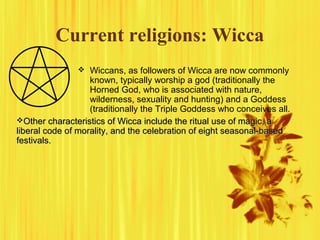
Current religions: Wicca
 Wiccans, as followers of Wicca are now commonly
known, typically worship a god (traditionally the
Horned God, who is associated with nature,
wilderness, sexuality and hunting) and a Goddess
(traditionally the Triple Goddess who conceives all.
Other characteristics of Wicca include the ritual use of magic, aOther characteristics of Wicca include the ritual use of magic, a
liberal code of morality, and the celebration of eight seasonal-basedliberal code of morality, and the celebration of eight seasonal-based
festivals.festivals.
Rise of popularity in the ‘70s
 In 1974, The Council of American Witches took pains to
establish Wicca’s credentials as an environmentally sensitive
religion.
 “Wicca’s seizure of the position of the most ‘environmental’
religion was well timed. Environmentalism was trendy… Many
Christian were ambivalent toward the environmental
movement, in some cases because they chose to see it as a
competing religion--a pagan religion.” (Clifton 52)
 Environmentalism still threatens to become either a false
religion or else a distraction from ministering to human
suffering--assuming, of course, that humanity is seen as outside
of nature
 The question: Is nature being worshipped, or is It the Gods ofThe question: Is nature being worshipped, or is It the Gods of
nature being worshipped?nature being worshipped?
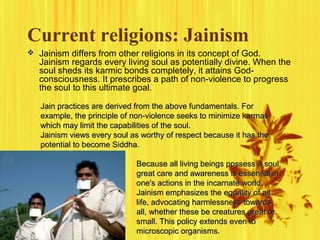
Current religions: Jainism
 Jainism differs from other religions in its concept of God.
Jainism regards every living soul as potentially divine. When the
soul sheds its karmic bonds completely, it attains God-
consciousness. It prescribes a path of non-violence to progress
the soul to this ultimate goal.
Jain practices are derived from the above fundamentals. ForJain practices are derived from the above fundamentals. For
example, the principle of non-violence seeks to minimize karmasexample, the principle of non-violence seeks to minimize karmas
which may limit the capabilities of the soul.which may limit the capabilities of the soul.
Jainism views every soul as worthy of respect because it has theJainism views every soul as worthy of respect because it has the
potential to become Siddha.potential to become Siddha.
Because all living beings possess a soul,Because all living beings possess a soul,
great care and awareness is essential ingreat care and awareness is essential in
one's actions in the incarnate world.one's actions in the incarnate world.
Jainism emphasizes the equality of allJainism emphasizes the equality of all
life, advocating harmlessness towardslife, advocating harmlessness towards
all, whether these be creatures great orall, whether these be creatures great or
small. This policy extends even tosmall. This policy extends even to
microscopic organisms.microscopic organisms.
Environmentalism as religion?
 From Faith in Nature by Thomas Dunlap (edited by our
favorite, William Cronon)
 “Environmentalism does share common characteristics
with the human belief systems and institutions that we
typically label with the word religion” (xi)
 Complex series of morals for ethical action
 Certain landscapes are celebrated as sacred/emotions
inspire similar feelings associated with cathedrals and
sacred texts
 (Think back to Leopold’s “Land Ethic”)
Continued…
Religion=most important places where
human being explore the deepest
meanings of their lives and the ulitmate
mysteries of the universe (xiv)
Therefore, environmentalism isn’t
necessarily the antithesis of religion,
but rather, just another way to find
meaning.
The point?
 Environmentalism has a future
 It has developed in response to real problems and
human needs
 The balance between faith an knowledge, intellect and
emotion, ignorance and mystery
 “Environmentalism addresses the alienation in
modern society in a modern context, finding the
sacred in a material world and a way of personal
knowledge and engagement with the world on
the basis of objective knowledge.” (149)
 The balance between the individual and
community… much like the land ethic.
Bibliography
Faith in Nature by Thomas Dunlap
Spirit and the Environment edited by
Davide Cooper and Joy A. Palmer
God is Red by Vine Deloria
Her Hidden Children by Chas Clifton

Nature-based religions

  • 1.
  • 2.
    Overview Nature-based religions ofthe past Modern religions Environmentalism as a religion What this topic addresses the struggle to redefine or reconceive of our connection to the natural world or animals. How these religions have effected, for better or for worse, the development of our modern-day perception of environmentalism.
  • 3.
    Stoic Pantheism  Natureand God are identical  Preaches to live in “harmony” with nature, not necessarily to respect or worship anything nonhuman… more focused on being “rational”  Nature “wishes” us to live rationally  To theists, there is something more worth worshipping than the world and to pantheists, there isn’t. The world isn’t created for our special benefit  However, this is to blame for “humanisitc arrogance,” for it only claims that nothing matters but the human mind.  Things as they are are perfect, things as they shall be are perfect.
  • 4.
    Romantic Pantheism The universeis a living unity that could be known through the imagination Imagination>reason “Love of nature” Look through “the eyes of imagination” and see each part of Nature’s significance Those who know the Unity will never want to poison the seas or cut down trees
  • 5.
    The Past andPresent: Indian religious traditions  “we are a part of nature, not a transcendent species with no responsibilities to the natural world.”  The collapse of the Civil Rights movement, the concern with Vietnam and the war, the escape to drugs, the rise of power movements and the return to Mother Earth can all be understood as desperate efforts of groups of people to flee abstract articulations of belief and superficial values and find authenticity wherever it could be found. (Deloria 51)  This is the point people began an developing an intense interest in Indians
  • 6.
    “Thinking in Timeand Space” Nature of the world is discerned from a spatial point of view The structure of American Indians religious traditions is taken directly from the world around them, from their relationships with other forms of life. Context=all important for understanding reality
  • 7.
    Continued…  Places whererevelations are experienced are remembered and set aside as locations for rituals and ceremonials to reconnect with the spirits.  It’s not what people believed to be true, but what they experienced to be true.  Regardless of what happens to the people, the sacred lands remain as permanent fixtures in their cultural/religious understanding.  “Value judgments involve present community realities and not a reliance on part of future golden ages toward which the community is moving or from which the community has veered” (67)
  • 8.
    Tribal religions Made upof attitudes, beliefs, and practices that coordinate with the lands the people live on. Ex: Hopi people of Arizona needed rain dance to ensure farming The correlation between place and religion is strong
  • 9.
    Differences with Christianity ToIndians, the creation is all good, and there was no “fall” of man. Christian idea that man receives domination over the rest of creation. Accepting the story of creation in Genesis as “historical fact”
  • 10.
    Americans seeking the experience Evenif Americans have no contact with Indians, they are trying to seek a meaningful life through the footsteps of tribes and trying to come to “grips with this land” Sense of “reconnecting with Nature and the necessities” like in Thoreau
  • 11.
    Current religions: Wicca Wiccans, as followers of Wicca are now commonly known, typically worship a god (traditionally the Horned God, who is associated with nature, wilderness, sexuality and hunting) and a Goddess (traditionally the Triple Goddess who conceives all. Other characteristics of Wicca include the ritual use of magic, aOther characteristics of Wicca include the ritual use of magic, a liberal code of morality, and the celebration of eight seasonal-basedliberal code of morality, and the celebration of eight seasonal-based festivals.festivals.
  • 12.
    Rise of popularityin the ‘70s  In 1974, The Council of American Witches took pains to establish Wicca’s credentials as an environmentally sensitive religion.  “Wicca’s seizure of the position of the most ‘environmental’ religion was well timed. Environmentalism was trendy… Many Christian were ambivalent toward the environmental movement, in some cases because they chose to see it as a competing religion--a pagan religion.” (Clifton 52)  Environmentalism still threatens to become either a false religion or else a distraction from ministering to human suffering--assuming, of course, that humanity is seen as outside of nature  The question: Is nature being worshipped, or is It the Gods ofThe question: Is nature being worshipped, or is It the Gods of nature being worshipped?nature being worshipped?
  • 13.
    Current religions: Jainism Jainism differs from other religions in its concept of God. Jainism regards every living soul as potentially divine. When the soul sheds its karmic bonds completely, it attains God- consciousness. It prescribes a path of non-violence to progress the soul to this ultimate goal. Jain practices are derived from the above fundamentals. ForJain practices are derived from the above fundamentals. For example, the principle of non-violence seeks to minimize karmasexample, the principle of non-violence seeks to minimize karmas which may limit the capabilities of the soul.which may limit the capabilities of the soul. Jainism views every soul as worthy of respect because it has theJainism views every soul as worthy of respect because it has the potential to become Siddha.potential to become Siddha. Because all living beings possess a soul,Because all living beings possess a soul, great care and awareness is essential ingreat care and awareness is essential in one's actions in the incarnate world.one's actions in the incarnate world. Jainism emphasizes the equality of allJainism emphasizes the equality of all life, advocating harmlessness towardslife, advocating harmlessness towards all, whether these be creatures great orall, whether these be creatures great or small. This policy extends even tosmall. This policy extends even to microscopic organisms.microscopic organisms.
  • 14.
    Environmentalism as religion? From Faith in Nature by Thomas Dunlap (edited by our favorite, William Cronon)  “Environmentalism does share common characteristics with the human belief systems and institutions that we typically label with the word religion” (xi)  Complex series of morals for ethical action  Certain landscapes are celebrated as sacred/emotions inspire similar feelings associated with cathedrals and sacred texts  (Think back to Leopold’s “Land Ethic”)
  • 15.
    Continued… Religion=most important placeswhere human being explore the deepest meanings of their lives and the ulitmate mysteries of the universe (xiv) Therefore, environmentalism isn’t necessarily the antithesis of religion, but rather, just another way to find meaning.
  • 16.
    The point?  Environmentalismhas a future  It has developed in response to real problems and human needs  The balance between faith an knowledge, intellect and emotion, ignorance and mystery  “Environmentalism addresses the alienation in modern society in a modern context, finding the sacred in a material world and a way of personal knowledge and engagement with the world on the basis of objective knowledge.” (149)  The balance between the individual and community… much like the land ethic.
  • 17.
    Bibliography Faith in Natureby Thomas Dunlap Spirit and the Environment edited by Davide Cooper and Joy A. Palmer God is Red by Vine Deloria Her Hidden Children by Chas Clifton