Ch 23 Section I The Earth
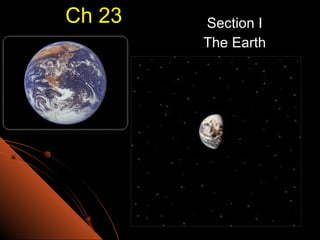
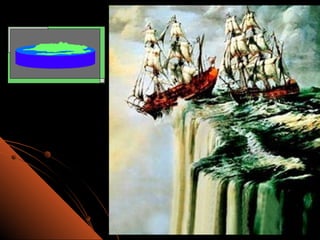
Properties of the Earth people used to think that Earth was flat and at the centre of the universe
 
Earth is a round 3-dimensional  sphere
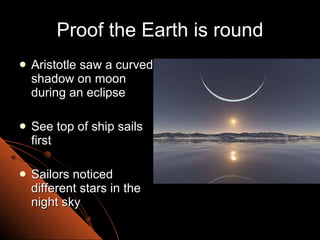
Proof the Earth is round Aristotle saw a curved shadow on moon during an eclipse See top of ship sails first Sailors noticed different stars in the night sky
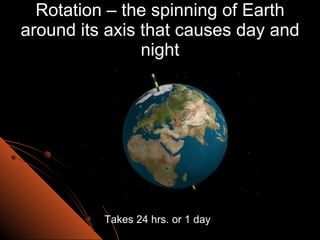
Axis – imaginary vertical line around which earth spins
Rotation – the spinning of Earth around its axis that causes day and night Takes 24 hrs. or 1 day
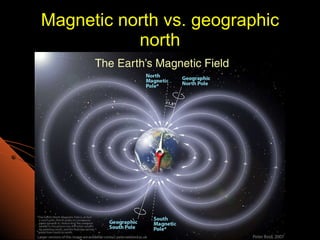
Earth has a magnetic field with north and south poles
Caused by:  1- the movement of material in core  2- Earth’s rotation Protects us from harmful solar radiation by trapping charged particles
Magnetic north vs. geographic north
Revolution – Earth’s yearly orbit around the sun
Revolution vs. rotation Revolution – trip around Sun Earth orbits around the Sun Earth is a satellite of the Sun Rotation – spinning on axis Cause of night/day
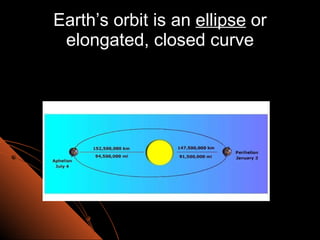
Earth’s orbit is an  ellipse  or elongated, closed curve
The  Sun is not centered in the ellipse Perihelion : closest point (winter) Aphelion : furthest point (summer)
Distance from Sun Earth closest Jan. 3: 147 million kilometers Earth furthest July 4: 152 million kilometers Small difference 5 million kilometers so… Earth is exposed to almost the same amount of Sun year round
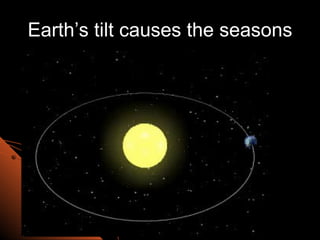
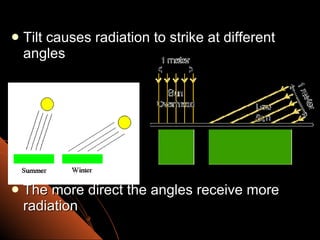
Earth’s tilt causes the seasons
Tilt causes radiation to strike at different angles  The more direct the angles receive more radiation
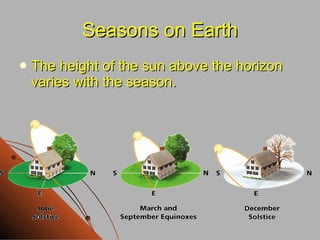
Seasons on Earth The height of the sun above the horizon varies with the season.
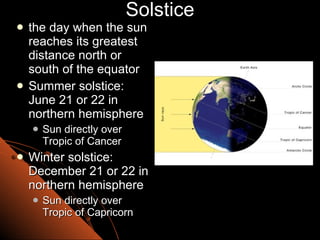
Solstice the day when the sun reaches its greatest distance north or south of the equator Summer solstice: June 21 or 22 in northern hemisphere Sun directly over Tropic of Cancer Winter solstice: December 21 or 22 in northern hemisphere Sun directly over Tropic of Capricorn
Equinox the day when the sun is directly over Earth’s equator Daytime and nighttime hours are equal all over the world
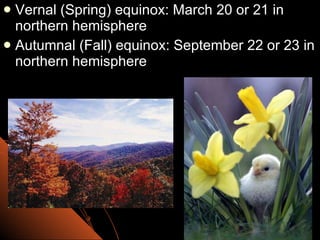
Vernal (Spring) equinox: March 20 or 21 in northern hemisphere Autumnal (Fall) equinox: September 22 or 23 in northern hemisphere
 
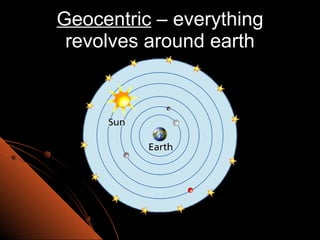
Geocentric  – everything revolves around earth
Heliocentric  – everything revolves around the sun
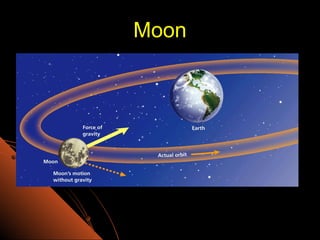
Moon
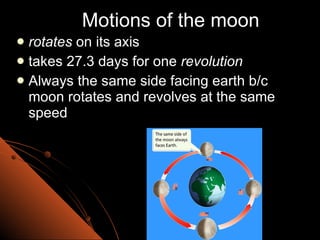
Motions of the moon rotates  on its axis takes 27.3 days for one  revolution Always the same side facing earth b/c moon rotates and revolves at the same speed
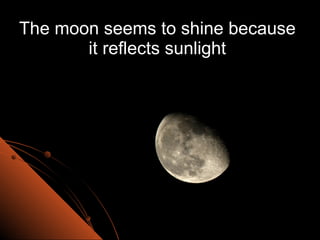
The moon seems to shine because it reflects sunlight
Games/activities http://www.sciencenetlinks.com/interactives/moon/moon_challenge/moon_challenge.html http:// www.engagingscience.org/games/onlinegames/games.html http://aspire.cosmic-ray.org/labs/moon/lunar_phases_main.html
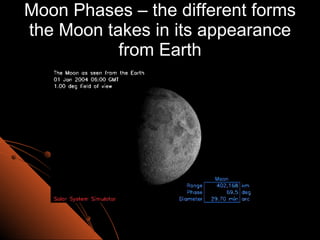
Moon Phases – the different forms the Moon takes in its appearance from Earth
New Moon – when the moon is between earth and the sun and cannot be seen
Waxing phases more of the illuminated half of the moon that can be seen each night after the new moon
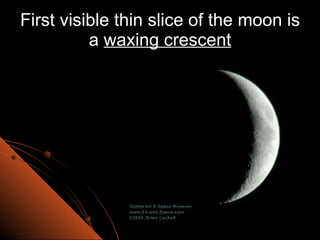
First visible thin slice of the moon is a  waxing crescent
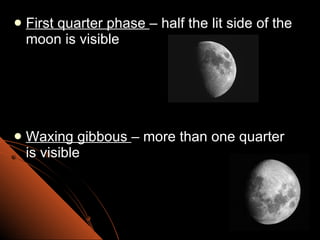
First quarter phase  – half the lit side of the moon is visible Waxing gibbous  – more than one quarter is visible
All of the Moon’s lit side is visible during a full moon
Waning phases  – less of the illuminated half of the Moon is visible after the full moon.
Waning gibbous  – starts after a full moon where more than half of the lit side is still visible. Third quarter  - half the Moon’s lit side is visible
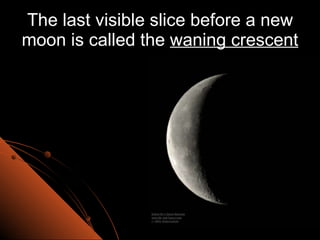
The last visible slice before a new moon is called the  waning crescent
Phases of the Moon
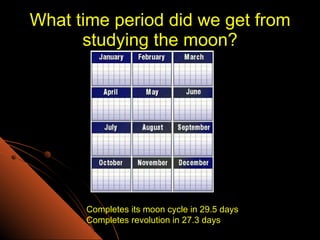
What time period did we get from studying the moon? Completes its moon cycle in 29.5 days Completes revolution in 27.3 days
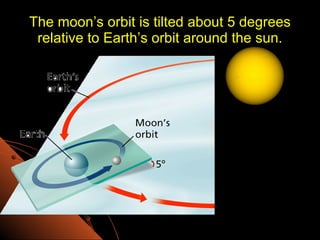
The moon’s orbit is tilted about 5 degrees relative to Earth’s orbit around the sun.
visuals http://www.ioncmaste.ca/homepage/resources/web_resources/CSA_Astro9/files/multimedia/unit3/phases_moon/phases_moon.html
Eclipses – when the Earth or the moon casts a shadow on the other
Solar Eclipse the moon moves directly between the Earth and the Sun, shadowing part of the Earth
Penumbra – experiences a partial eclipse Umbra – experiences a total eclipse
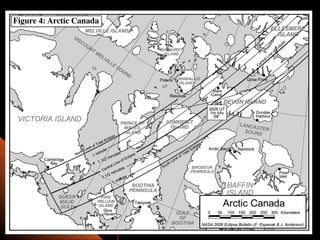
A total solar eclipse is visible only on a small area of Earth The  corona  is the silvery part
 
 
Lunar Eclipse – when Earth’s shadow falls on the moon What color does the moon turn during as eclipse?
Does not occur every month because the moon’s orbit is tilted to earth’s orbit.
NASA - Total Lunar Eclipse: February 20, 2008
The moon is 3,476 km in diameter, a little less than the distance across the contiguous United States.
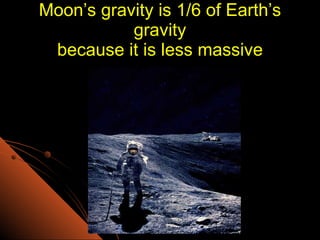
Moon’s gravity is 1/6 of Earth’s gravity because it is less massive
The Moon’s surface has many depressions, or craters. formed from meteorites, asteroids, and comets
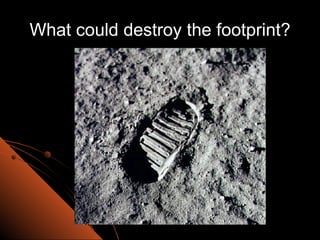
What could destroy the footprint?
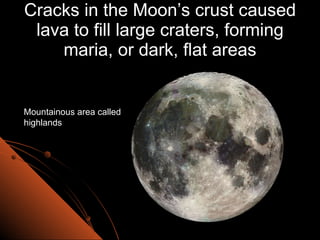
Cracks in the Moon’s crust caused lava to fill large craters, forming maria, or dark, flat areas Mountainous area called highlands
http:// stardate.org/pdfs/teachers/ObservingTheMoon.pdf Shows marias
Regolith  is the broken rock material  on the moon’s surface. Moon rocks are similar to ours and have tiny crystals of pure iron.
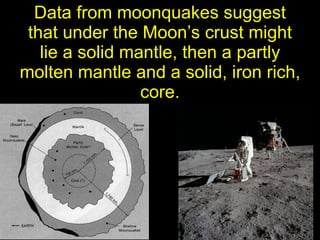
Data from moonquakes suggest that under the Moon’s crust might lie a solid mantle, then a partly molten mantle and a solid, iron rich, core.
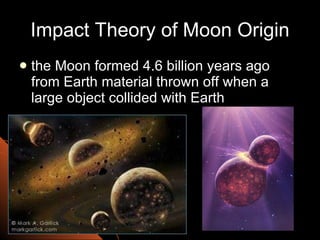
Impact Theory of Moon Origin the Moon formed 4.6 billion years ago from Earth material thrown off when a large object collided with Earth
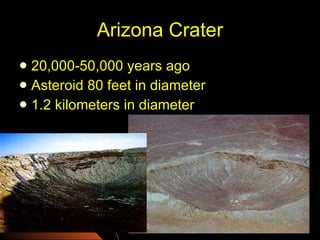
Impact Basins or craters, are depressions left by objects striking the Moon (or anything else!!!!!)
Arizona Crater 20,000-50,000 years ago Asteroid 80 feet in diameter 1.2 kilometers in diameter
Chicxulub, Mexico Now covered by the Yucatan Penninsula Asteroid 6 mi (10 km) Crater diameter 110 miles (180 km) 65 million years ago Cretaceous period
Albedo reflectance
Albedo of 0
Albedo of 1
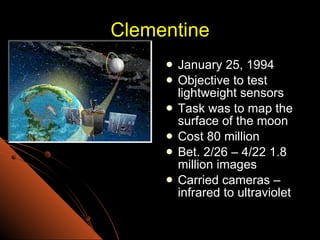
Clementine January 25, 1994 Objective to test lightweight sensors Task was to map the surface of the moon Cost 80 million Bet. 2/26 – 4/22 1.8 million images Carried cameras – infrared to ultraviolet
Clementine Northside Farside Nearside Southside
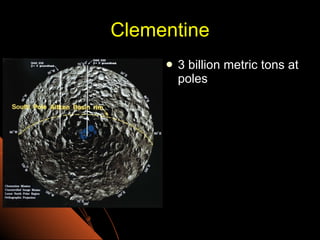
Clementine 3 billion metric tons at poles
Lunar Prospector Desk sized 1998 Confirmed impact theory
Graphic Organizer rotates revolves causing causing Earth
Graphic Organizer rotates revolves causing causing Earth On its axis Night and day Around the Sun years

Ch 23