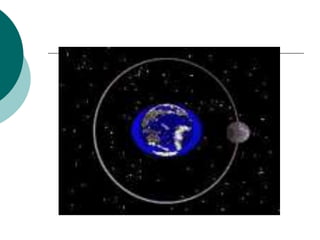
The Sun-Earth-Moon System
Will it go ‘round in circles?
Earth’s Rotation
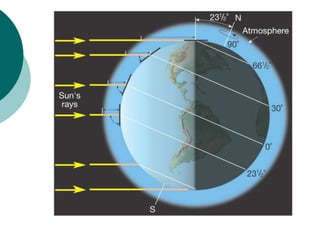
 Earth rotates on an imaginary axis
that runs through its pole.
 Earth’s axis is tilted 23.5o to the
ecliptic, the plane in which Earth
orbits the Sun.
 Earth’s rotation gives us our day.
Earth makes one complete rotation
in 24hrs, 15o every hour.
Evidence of Earth’s Rotation
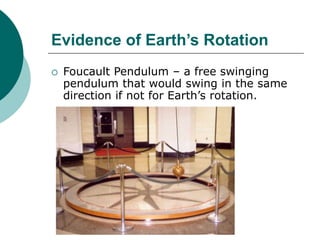
 Foucault Pendulum – a free swinging
pendulum that would swing in the same
direction if not for Earth’s rotation.
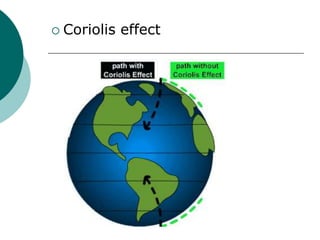
 Coriolis effect
Daily Motion and Stars
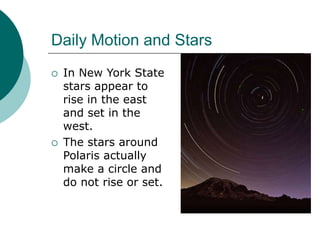
 In New York State
stars appear to
rise in the east
and set in the
west.
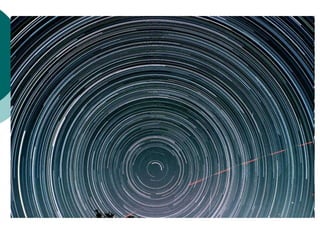
 The stars around
Polaris actually
make a circle and
do not rise or set.
Earth’s Rotation and Time
 Earth rotates 360o every 24 hours.
 Therefore, Earth rotates at a rate of
360o/24 hours = 15o every hour.
 Earth is divided into 24 time zones.
 Because Earth rotates
counterclockwise, east is later and
west is earlier.
 When it is 4pm in Chicago it is 5pm
in New York City.
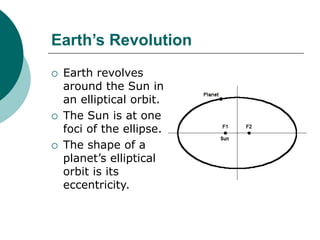
Earth’s Revolution
 Earth revolves
around the Sun in
an elliptical orbit.
 The Sun is at one
foci of the ellipse.
 The shape of a
planet’s elliptical
orbit is its
eccentricity.
Proximity to Sun
 The closer a planet is to the Sun in
its orbit the faster it moves.
 Also planets closest to the Sun
revolve faster than planets farther
away. In other words closer planets
have a shorter year.
 Mercury’s year is 88 days, Earth’s is
365.
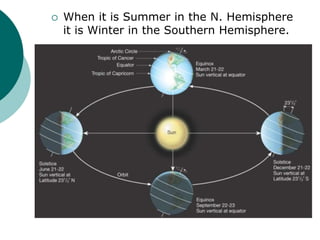
Earth’s Revolution and Seasons
 In most places on Earth the climate
changes throughout the year.
 This is due to Earth’s movement as it
revolves around the Sun.
 The orientation of Earth’s axis
changes with relation to the Sun
throughout the year and the altitude
of the sun in the sky changes
because of this.
 This gives us our seasons.
 When it is Summer in the N. Hemisphere
it is Winter in the Southern Hemisphere.
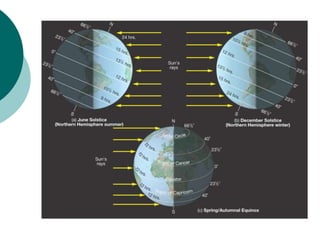
Length of Day
 The length of our day in New York
depends on the season we are in.
 It is approximately 16 hours at the
Summer Solstice and only 9 hours
at the Winter Solstice.
 At the Equinoxes it is even at 12
hours of day and 12 hours of night.
 The Equator always has 12 and 12.
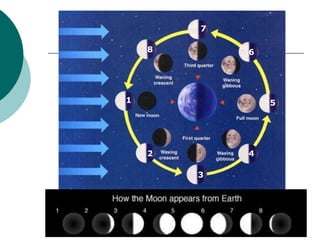
Phases of the Moon
 Although it appears bright in the
night sky, the Moon produces no
light of its own.
 The light we see is reflected from
the Sun.
 Due to the Moon’s revolution around
Earth we see that light as different
shapes called phases.
1
2
8
7
6
5
4
3
Waxing and Waning
 After the new Moon, for the next two
weeks its phases are waxing.
 This means the illuminated side of the
Moon increases each day.
 Half way through its orbit is the full moon.
 For the next two weeks its phases are
waning.
 This means the illuminated side of the
Moon decreases each day.
Eclipses
 The movement of the Earth and
Moon in relation to the Sun cause
solar and lunar eclipses.
 During an eclipse, either the Earth
or the Moon move in front of the
Sun blocking the light and casting a
shadow in space.
 Eclipses only occur when the Sun,
Earth and Moon are in a straight
line.
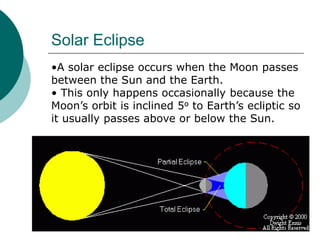
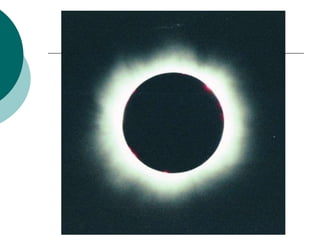
Solar Eclipse
•A solar eclipse occurs when the Moon passes
between the Sun and the Earth.
• This only happens occasionally because the
Moon’s orbit is inclined 5o to Earth’s ecliptic so
it usually passes above or below the Sun.
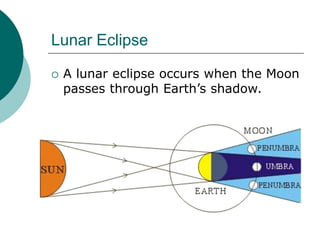
Lunar Eclipse
 A lunar eclipse occurs when the Moon
passes through Earth’s shadow.
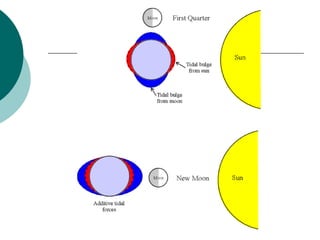
Tides
 A tide is the daily rise and fall of
oceans that cover about 70% of
Earth.
 Tides are the result of gravitational
forces of the Moon and to a lesser
extent the Sun.
 The cycle of tides is about 12hrs.
and 25min. from high tide to high
tide or low tide to low tide.
sunearthmoonsystem PPT notes.ppt

sunearthmoonsystem PPT notes.ppt

  • 1.
    The Sun-Earth-Moon System Willit go ‘round in circles?
  • 2.
    Earth’s Rotation  Earthrotates on an imaginary axis that runs through its pole.  Earth’s axis is tilted 23.5o to the ecliptic, the plane in which Earth orbits the Sun.  Earth’s rotation gives us our day. Earth makes one complete rotation in 24hrs, 15o every hour.
  • 4.
    Evidence of Earth’sRotation  Foucault Pendulum – a free swinging pendulum that would swing in the same direction if not for Earth’s rotation.
  • 5.
  • 6.
    Daily Motion andStars  In New York State stars appear to rise in the east and set in the west.  The stars around Polaris actually make a circle and do not rise or set.
  • 8.
    Earth’s Rotation andTime  Earth rotates 360o every 24 hours.  Therefore, Earth rotates at a rate of 360o/24 hours = 15o every hour.  Earth is divided into 24 time zones.  Because Earth rotates counterclockwise, east is later and west is earlier.  When it is 4pm in Chicago it is 5pm in New York City.
  • 9.
    Earth’s Revolution  Earthrevolves around the Sun in an elliptical orbit.  The Sun is at one foci of the ellipse.  The shape of a planet’s elliptical orbit is its eccentricity.
  • 10.
    Proximity to Sun The closer a planet is to the Sun in its orbit the faster it moves.  Also planets closest to the Sun revolve faster than planets farther away. In other words closer planets have a shorter year.  Mercury’s year is 88 days, Earth’s is 365.
  • 11.
    Earth’s Revolution andSeasons  In most places on Earth the climate changes throughout the year.  This is due to Earth’s movement as it revolves around the Sun.  The orientation of Earth’s axis changes with relation to the Sun throughout the year and the altitude of the sun in the sky changes because of this.  This gives us our seasons.
  • 12.
     When itis Summer in the N. Hemisphere it is Winter in the Southern Hemisphere.
  • 13.
    Length of Day The length of our day in New York depends on the season we are in.  It is approximately 16 hours at the Summer Solstice and only 9 hours at the Winter Solstice.  At the Equinoxes it is even at 12 hours of day and 12 hours of night.  The Equator always has 12 and 12.
  • 15.
    Phases of theMoon  Although it appears bright in the night sky, the Moon produces no light of its own.  The light we see is reflected from the Sun.  Due to the Moon’s revolution around Earth we see that light as different shapes called phases.
  • 16.
  • 17.
    Waxing and Waning After the new Moon, for the next two weeks its phases are waxing.  This means the illuminated side of the Moon increases each day.  Half way through its orbit is the full moon.  For the next two weeks its phases are waning.  This means the illuminated side of the Moon decreases each day.
  • 18.
    Eclipses  The movementof the Earth and Moon in relation to the Sun cause solar and lunar eclipses.  During an eclipse, either the Earth or the Moon move in front of the Sun blocking the light and casting a shadow in space.  Eclipses only occur when the Sun, Earth and Moon are in a straight line.
  • 19.
    Solar Eclipse •A solareclipse occurs when the Moon passes between the Sun and the Earth. • This only happens occasionally because the Moon’s orbit is inclined 5o to Earth’s ecliptic so it usually passes above or below the Sun.
  • 21.
    Lunar Eclipse  Alunar eclipse occurs when the Moon passes through Earth’s shadow.
  • 22.
    Tides  A tideis the daily rise and fall of oceans that cover about 70% of Earth.  Tides are the result of gravitational forces of the Moon and to a lesser extent the Sun.  The cycle of tides is about 12hrs. and 25min. from high tide to high tide or low tide to low tide.