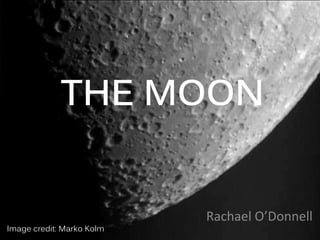
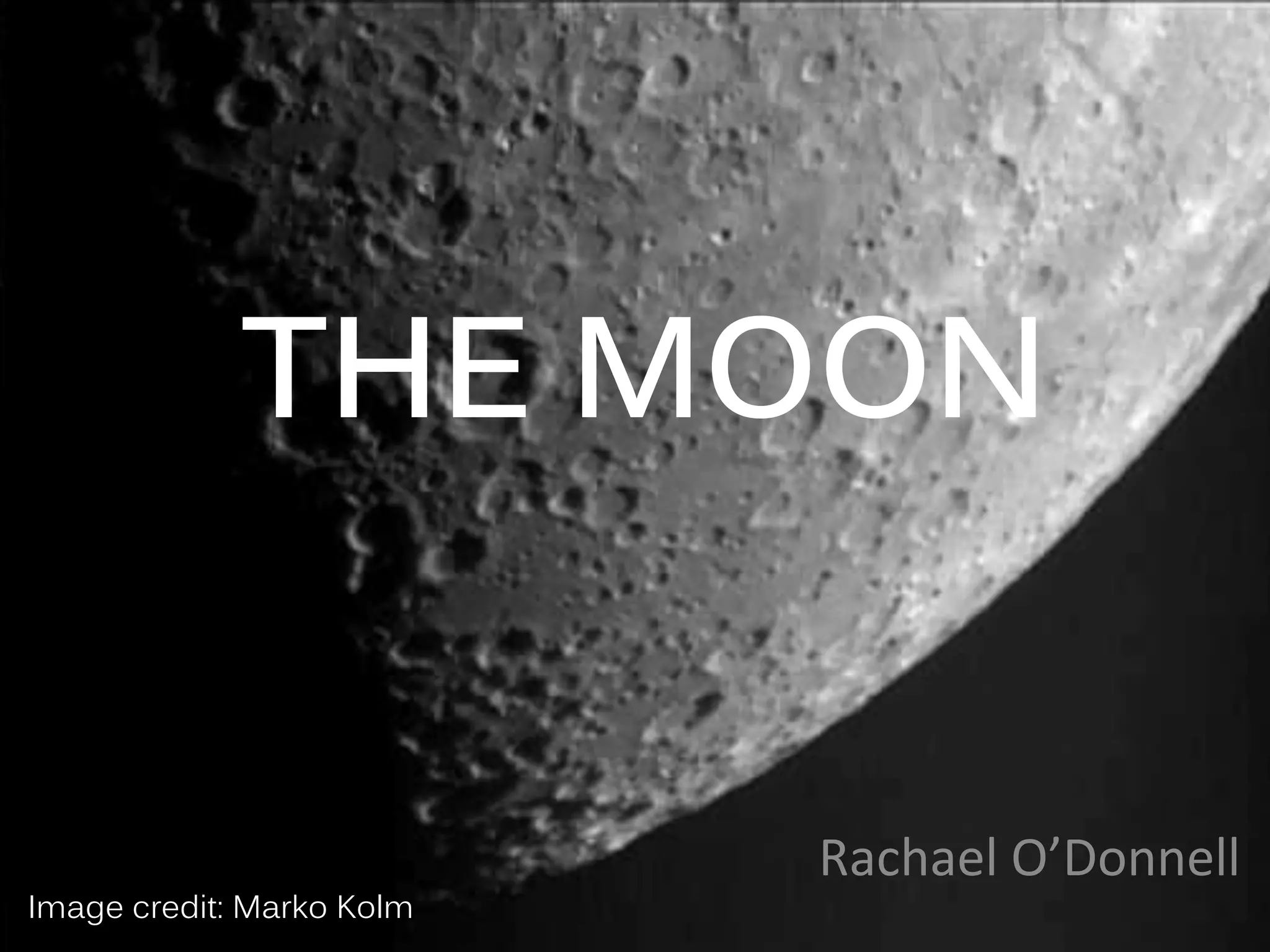
THE MOON
Rachael O’Donnell
Image credit: Marko Kolm
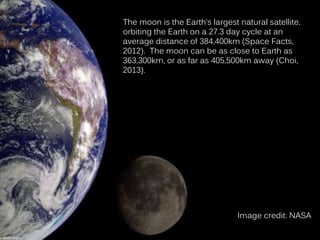
The moon is the Earth’s largest natural satellite,
orbiting the Earth on a 27.3 day cycle at an
average distance of 384,400km (Space Facts,
2012). The moon can be as close to Earth as
363,300km, or as far as 405,500km away (Choi,
2013).
Image credit: NASA
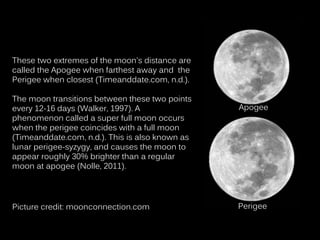
Apogee
Perigee
These two extremes of the moon's distance are
called the Apogee when farthest away and the
Perigee when closest (Timeanddate.com, n.d.).
The moon transitions between these two points
every 12-16 days (Walker, 1997). A
phenomenon called a super full moon occurs
when the perigee coincides with a full moon
(Timeanddate.com, n.d.). This is also known as
lunar perigee-syzygy, and causes the moon to
appear roughly 30% brighter than a regular
moon at apogee (Nolle, 2011).
Picture credit: moonconnection.com
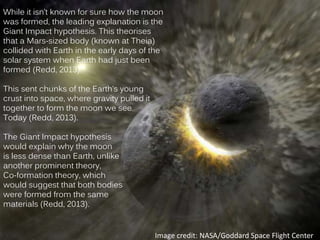
While it isn’t known for sure how the moon
was formed, the leading explanation is the
Giant Impact hypothesis. This theorises
that a Mars-sized body (known at Theia)
collided with Earth in the early days of the
solar system when Earth had just been
formed (Redd, 2013).
This sent chunks of the Earth’s young
crust into space, where gravity pulled it
together to form the moon we see
Today (Redd, 2013).
The Giant Impact hypothesis
would explain why the moon
is less dense than Earth, unlike
another prominent theory,
Co-formation theory, which
would suggest that both bodies
were formed from the same
materials (Redd, 2013).
Image credit: NASA/Goddard Space Flight Center
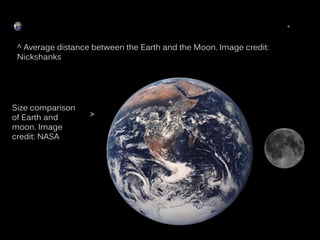
^ Average distance between the Earth and the Moon. Image credit:
Nickshanks
Size comparison
of Earth and
moon. Image
credit: NASA
>
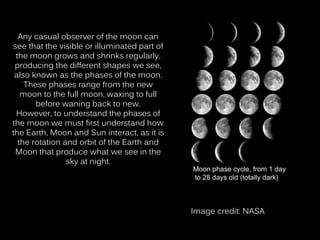
Any casual observer of the moon can
see that the visible or illuminated part of
the moon grows and shrinks regularly,
producing the different shapes we see,
also known as the phases of the moon.
These phases range from the new
moon to the full moon, waxing to full
before waning back to new.
However, to understand the phases of
the moon we must first understand how
the Earth, Moon and Sun interact, as it is
the rotation and orbit of the Earth and
Moon that produce what we see in the
sky at night.
Image credit: NASA
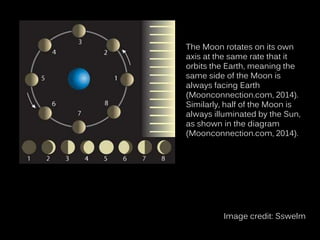
The Moon rotates on its own
axis at the same rate that it
orbits the Earth, meaning the
same side of the Moon is
always facing Earth
(Moonconnection.com, 2014).
Similarly, half of the Moon is
always illuminated by the Sun,
as shown in the diagram
(Moonconnection.com, 2014).
Image credit: Sswelm
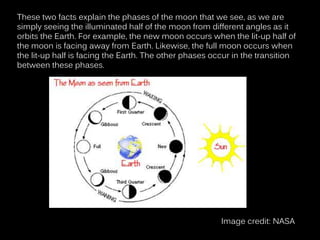
These two facts explain the phases of the moon that we see, as we are
simply seeing the illuminated half of the moon from different angles as it
orbits the Earth. For example, the new moon occurs when the lit-up half of
the moon is facing away from Earth. Likewise, the full moon occurs when
the lit-up half is facing the Earth. The other phases occur in the transition
between these phases.
Image credit: NASA
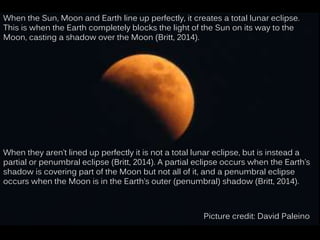
When the Sun, Moon and Earth line up perfectly, it creates a total lunar eclipse.
This is when the Earth completely blocks the light of the Sun on its way to the
Moon, casting a shadow over the Moon (Britt, 2014).
When they aren’t lined up perfectly it is not a total lunar eclipse, but is instead a
partial or penumbral eclipse (Britt, 2014). A partial eclipse occurs when the Earth’s
shadow is covering part of the Moon but not all of it, and a penumbral eclipse
occurs when the Moon is in the Earth’s outer (penumbral) shadow (Britt, 2014).
Picture credit: David Paleino
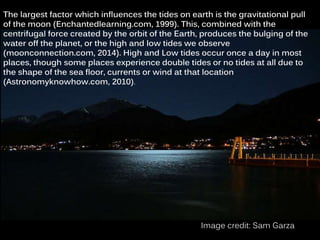
The largest factor which influences the tides on earth is the gravitational pull
of the moon (Enchantedlearning.com, 1999). This, combined with the
centrifugal force created by the orbit of the Earth, produces the bulging of the
water off the planet, or the high and low tides we observe
(moonconnection.com, 2014). High and Low tides occur once a day in most
places, though some places experience double tides or no tides at all due to
the shape of the sea floor, currents or wind at that location
(Astronomyknowhow.com, 2010).
Image credit: Sam Garza
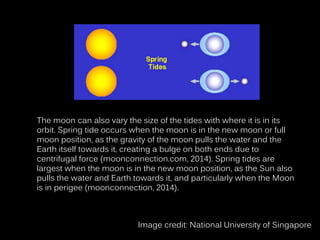
The moon can also vary the size of the tides with where it is in its
orbit. Spring tide occurs when the moon is in the new moon or full
moon position, as the gravity of the moon pulls the water and the
Earth itself towards it, creating a bulge on both ends due to
centrifugal force (moonconnection.com, 2014). Spring tides are
largest when the moon is in the new moon position, as the Sun also
pulls the water and Earth towards it, and particularly when the Moon
is in perigee (moonconnection, 2014).
Image credit: National University of Singapore
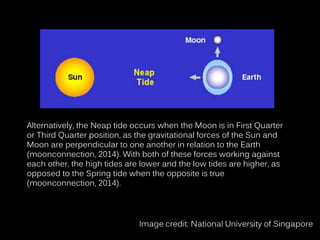
Alternatively, the Neap tide occurs when the Moon is in First Quarter
or Third Quarter position, as the gravitational forces of the Sun and
Moon are perpendicular to one another in relation to the Earth
(moonconnection, 2014). With both of these forces working against
each other, the high tides are lower and the low tides are higher, as
opposed to the Spring tide when the opposite is true
(moonconnection, 2014).
Reference List
Astronomyknowhow.com,. (2010). Tides explained. Retrieved 2 June 2014, from
http://www.astronomyknowhow.com/moon-tides.htm
Britt, R. (2014). Lunar Eclipses: What Are They; When is the Next One?. Space.com. Retrieved
6 June 2014, from http://www.space.com/15689-lunar-eclipses.html
Choi, C. (2013). Earth's Moon: Formation, Composition and Orbit. Space.com. Retrieved 2 June
2014, from http://www.space.com/55-earths-moon-formation-composition-and-orbit.html
Enchantedlearning.com,. (1999). Tides- The Moon. Retrieved 6 June 2014, from
http://www.enchantedlearning.com/subjects/astronomy/moon/Tides.shtml
Garza, S. (2006). Full moon reflecting off the ocean in Juneau, Alaska. Retrieved from
http://upload.wikimedia.org/wikipedia/commons/thumb/6/69/Moon_reflecting_
off_the_ocean_in_Juneau.jpg/800px-Moon_reflecting_off_the_ocean_in_Juneau.jpg
Kolm, M. (2001). Surface of the moon. Retrieved from
http://www.weasner.com/etx/observations/images/kolm-mx5-2.jpg
Moonconnection,. (2014). Apogee and Perigee. Retrieved from
http://www.moonconnection.com/images/apogee_perigee.jpg
Moonconnection.com,. (2014). Moon Phases / Lunar Phases Explained.
Retrieved 2 June 2014, from
http://www.moonconnection.com/moon_phases.phtml
Moonconnection.com,. (2014). The Ocean's Tides Explained. Retrieved 2 June
2014, from http://www.moonconnection.com/tides.phtml
NASA,. (1998). The Moon as seen from Earth. Retrieved from
http://starchild.gsfc.nasa.gov/Images/StarChild/icons/moon_from_earth.gif
NASA,. (2005). Moon Earth Comparison. Retrieved from
http://upload.wikimedia.org/wikipedia/commons/f/f6/Moon_Earth_
Comparison.png
NASA,. (2014). Moon Phase Cycle. Retrieved from
http://spaceplace.nasa.gov/oreo-moon/en/Moon_phases_all_L.en.png
NASA,. (n.d.). The Earth and Moon. Retrieved from
http://lh4.ggpht.com/_FJH0hYZmVtc/Ss5D1
4CRCI/AAAAAAAADpk/M8Ka0bpOBz8/The-Earth-and-Moon
4%5B4%5D.jpg?imgmax=800
NASA/Goddard Space Flight Center,. (2012). Evolution of the Moon. Retrieved from
http://svs.gsfc.nasa.gov/goto?10930
National University of Singapore,. (2014). Spring and Neap Tides 1. Retrieved from
http://www.math.nus.edu.sg/aslaksen/gem-projects/hm/0102-1
phase/SUNMOONONTIDES_files/image001.jpg
Nickshanks (username),. (2006). Earth-Moon. Retrieved from
http://upload.wikimedia.org/wikipedia/commons/thumb/e/ef/Earth-Moon.png/800px
Earth-Moon.png
Nolle, R. (2011). SuperMoon: What It Is, What It Means. Astropro.com. Retrieved 1 June
2014, from http://www.astropro.com/features/articles/supermoon/
Paleino, D. (2011). Total lunar eclipse. Retrieved from
http://i.space.com/images/i/000/010/260/iFF/paleino-lunar-eclipse-june-2011
1.jpg?1308170842
Redd, N. (2013). How Was the Moon Formed?. Space.com. Retrieved 3 June 2014, from
http://www.space.com/19275-moon-formation.html
Space Facts,. (2012). Moon Facts - Interesting Facts about the Moon (Luna). Retrieved 2
June 2014, from http://space-facts.com/the-moon/
Sswelm (username),. (2008). Mond Phasen Combined. Retrieved from
http://upload.wikimedia.org/wikipedia/commons/f/fa/Mond_Phasen_Combined.jpg
Timeanddate.com,. (n.d.). Super Moon – Super Full Moon. Retrieved 2 June 2014, from
http://www.timeanddate.com/astronomy/moon/super-full-moon.html
Walker, J. (1997). Lunar Perigee and Apogee Calculator. Fourmilab.ch. Retrieved 1 June
2014, from https://www.fourmilab.ch/earthview/pacalc.html

Introduction to the moon

  • 1.
  • 2.
    The moon isthe Earth’s largest natural satellite, orbiting the Earth on a 27.3 day cycle at an average distance of 384,400km (Space Facts, 2012). The moon can be as close to Earth as 363,300km, or as far as 405,500km away (Choi, 2013). Image credit: NASA
  • 3.
    Apogee Perigee These two extremesof the moon's distance are called the Apogee when farthest away and the Perigee when closest (Timeanddate.com, n.d.). The moon transitions between these two points every 12-16 days (Walker, 1997). A phenomenon called a super full moon occurs when the perigee coincides with a full moon (Timeanddate.com, n.d.). This is also known as lunar perigee-syzygy, and causes the moon to appear roughly 30% brighter than a regular moon at apogee (Nolle, 2011). Picture credit: moonconnection.com
  • 4.
    While it isn’tknown for sure how the moon was formed, the leading explanation is the Giant Impact hypothesis. This theorises that a Mars-sized body (known at Theia) collided with Earth in the early days of the solar system when Earth had just been formed (Redd, 2013). This sent chunks of the Earth’s young crust into space, where gravity pulled it together to form the moon we see Today (Redd, 2013). The Giant Impact hypothesis would explain why the moon is less dense than Earth, unlike another prominent theory, Co-formation theory, which would suggest that both bodies were formed from the same materials (Redd, 2013). Image credit: NASA/Goddard Space Flight Center
  • 5.
    ^ Average distancebetween the Earth and the Moon. Image credit: Nickshanks Size comparison of Earth and moon. Image credit: NASA >
  • 6.
    Any casual observerof the moon can see that the visible or illuminated part of the moon grows and shrinks regularly, producing the different shapes we see, also known as the phases of the moon. These phases range from the new moon to the full moon, waxing to full before waning back to new. However, to understand the phases of the moon we must first understand how the Earth, Moon and Sun interact, as it is the rotation and orbit of the Earth and Moon that produce what we see in the sky at night. Image credit: NASA
  • 7.
    The Moon rotateson its own axis at the same rate that it orbits the Earth, meaning the same side of the Moon is always facing Earth (Moonconnection.com, 2014). Similarly, half of the Moon is always illuminated by the Sun, as shown in the diagram (Moonconnection.com, 2014). Image credit: Sswelm
  • 8.
    These two factsexplain the phases of the moon that we see, as we are simply seeing the illuminated half of the moon from different angles as it orbits the Earth. For example, the new moon occurs when the lit-up half of the moon is facing away from Earth. Likewise, the full moon occurs when the lit-up half is facing the Earth. The other phases occur in the transition between these phases. Image credit: NASA
  • 9.
    When the Sun,Moon and Earth line up perfectly, it creates a total lunar eclipse. This is when the Earth completely blocks the light of the Sun on its way to the Moon, casting a shadow over the Moon (Britt, 2014). When they aren’t lined up perfectly it is not a total lunar eclipse, but is instead a partial or penumbral eclipse (Britt, 2014). A partial eclipse occurs when the Earth’s shadow is covering part of the Moon but not all of it, and a penumbral eclipse occurs when the Moon is in the Earth’s outer (penumbral) shadow (Britt, 2014). Picture credit: David Paleino
  • 10.
    The largest factorwhich influences the tides on earth is the gravitational pull of the moon (Enchantedlearning.com, 1999). This, combined with the centrifugal force created by the orbit of the Earth, produces the bulging of the water off the planet, or the high and low tides we observe (moonconnection.com, 2014). High and Low tides occur once a day in most places, though some places experience double tides or no tides at all due to the shape of the sea floor, currents or wind at that location (Astronomyknowhow.com, 2010). Image credit: Sam Garza
  • 11.
    The moon canalso vary the size of the tides with where it is in its orbit. Spring tide occurs when the moon is in the new moon or full moon position, as the gravity of the moon pulls the water and the Earth itself towards it, creating a bulge on both ends due to centrifugal force (moonconnection.com, 2014). Spring tides are largest when the moon is in the new moon position, as the Sun also pulls the water and Earth towards it, and particularly when the Moon is in perigee (moonconnection, 2014). Image credit: National University of Singapore
  • 12.
    Alternatively, the Neaptide occurs when the Moon is in First Quarter or Third Quarter position, as the gravitational forces of the Sun and Moon are perpendicular to one another in relation to the Earth (moonconnection, 2014). With both of these forces working against each other, the high tides are lower and the low tides are higher, as opposed to the Spring tide when the opposite is true (moonconnection, 2014).
  • 13.
    Reference List Astronomyknowhow.com,. (2010).Tides explained. Retrieved 2 June 2014, from http://www.astronomyknowhow.com/moon-tides.htm Britt, R. (2014). Lunar Eclipses: What Are They; When is the Next One?. Space.com. Retrieved 6 June 2014, from http://www.space.com/15689-lunar-eclipses.html Choi, C. (2013). Earth's Moon: Formation, Composition and Orbit. Space.com. Retrieved 2 June 2014, from http://www.space.com/55-earths-moon-formation-composition-and-orbit.html Enchantedlearning.com,. (1999). Tides- The Moon. Retrieved 6 June 2014, from http://www.enchantedlearning.com/subjects/astronomy/moon/Tides.shtml Garza, S. (2006). Full moon reflecting off the ocean in Juneau, Alaska. Retrieved from http://upload.wikimedia.org/wikipedia/commons/thumb/6/69/Moon_reflecting_ off_the_ocean_in_Juneau.jpg/800px-Moon_reflecting_off_the_ocean_in_Juneau.jpg Kolm, M. (2001). Surface of the moon. Retrieved from http://www.weasner.com/etx/observations/images/kolm-mx5-2.jpg Moonconnection,. (2014). Apogee and Perigee. Retrieved from http://www.moonconnection.com/images/apogee_perigee.jpg
  • 14.
    Moonconnection.com,. (2014). MoonPhases / Lunar Phases Explained. Retrieved 2 June 2014, from http://www.moonconnection.com/moon_phases.phtml Moonconnection.com,. (2014). The Ocean's Tides Explained. Retrieved 2 June 2014, from http://www.moonconnection.com/tides.phtml NASA,. (1998). The Moon as seen from Earth. Retrieved from http://starchild.gsfc.nasa.gov/Images/StarChild/icons/moon_from_earth.gif NASA,. (2005). Moon Earth Comparison. Retrieved from http://upload.wikimedia.org/wikipedia/commons/f/f6/Moon_Earth_ Comparison.png NASA,. (2014). Moon Phase Cycle. Retrieved from http://spaceplace.nasa.gov/oreo-moon/en/Moon_phases_all_L.en.png NASA,. (n.d.). The Earth and Moon. Retrieved from http://lh4.ggpht.com/_FJH0hYZmVtc/Ss5D1 4CRCI/AAAAAAAADpk/M8Ka0bpOBz8/The-Earth-and-Moon 4%5B4%5D.jpg?imgmax=800
  • 15.
    NASA/Goddard Space FlightCenter,. (2012). Evolution of the Moon. Retrieved from http://svs.gsfc.nasa.gov/goto?10930 National University of Singapore,. (2014). Spring and Neap Tides 1. Retrieved from http://www.math.nus.edu.sg/aslaksen/gem-projects/hm/0102-1 phase/SUNMOONONTIDES_files/image001.jpg Nickshanks (username),. (2006). Earth-Moon. Retrieved from http://upload.wikimedia.org/wikipedia/commons/thumb/e/ef/Earth-Moon.png/800px Earth-Moon.png Nolle, R. (2011). SuperMoon: What It Is, What It Means. Astropro.com. Retrieved 1 June 2014, from http://www.astropro.com/features/articles/supermoon/ Paleino, D. (2011). Total lunar eclipse. Retrieved from http://i.space.com/images/i/000/010/260/iFF/paleino-lunar-eclipse-june-2011 1.jpg?1308170842 Redd, N. (2013). How Was the Moon Formed?. Space.com. Retrieved 3 June 2014, from http://www.space.com/19275-moon-formation.html Space Facts,. (2012). Moon Facts - Interesting Facts about the Moon (Luna). Retrieved 2 June 2014, from http://space-facts.com/the-moon/
  • 16.
    Sswelm (username),. (2008).Mond Phasen Combined. Retrieved from http://upload.wikimedia.org/wikipedia/commons/f/fa/Mond_Phasen_Combined.jpg Timeanddate.com,. (n.d.). Super Moon – Super Full Moon. Retrieved 2 June 2014, from http://www.timeanddate.com/astronomy/moon/super-full-moon.html Walker, J. (1997). Lunar Perigee and Apogee Calculator. Fourmilab.ch. Retrieved 1 June 2014, from https://www.fourmilab.ch/earthview/pacalc.html