Chapter 22 Exploring Space
Electromagnetic Radiation What is it ??? Radio waves Visible light Gamma rays X-rays Ultraviolet light Infrared waves Microwaves
Electromagnetic Spectrum
Frequency Forms of electromagnetic radiation differ in their frequencies. Frequency :  # of wave crests that pass a given point per unit of time. The shorter the wavelength, the higher the frequency.
Speed of Light 300,000 km/s ALL electromagnetic waves travel at this speed in a vacuum (where there is no matter)
First to Use a Telescope to Study the Sky Galileo in 1600’s
Optical Telescope Use light to produce magnified images. Refracting telescope:  convex lenses Reflecting telescope:  concave mirror.
Observatory Where optical telescopes are located.
Edwin P. Hubble Discovered:  Universe is Expanding Hubble Space Telescope named after him.
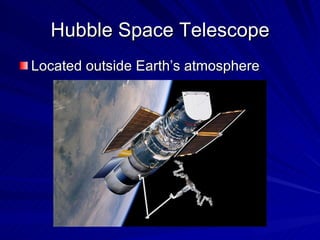
Hubble Space Telescope Located outside Earth’s atmosphere
Hubble Telescope
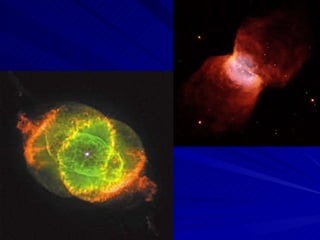
Hubble Pictures


Radio Telescope Studies radio waves that travel through space. Useful 24 hours a day.
Early Space Missions Allowed astronomers to study space in ways not possible using telescopes. Made possible by rockets.
Satellite Any object that  revolves around  another object  in an orbit In 1957 the former Soviet Union  launched first artificial satellite:  Sputnik I.
Satellites Today Thousands of artificial satellites orbit Earth Used for: communication and weather forecasting.
Space Probes Do not orbit Earth Travel through space.
Space Probes:  Pioneer 10 Launched 1972 1 st  manmade object  to travel through  asteroid belt. Transmitter  failed in 2003 Passed Pluto
Space Probes:  Voyager I & II Launched by U.S. in 1977 Expected to collect data until 2020
Saturn Taken by Voyager II 1981
Images from Voyager Space Probes Voyager 2:  1981 Rings of Saturn
Images from Voyager Space Probes -  Voyager 2 -  1989 -  Neptune
Voyager 1990 By 1990, Voyager 1 was farther from the Sun than Pluto, and approximately 4 billion miles from the Earth. Thus, NASA gave Voyager 1 one last assignment and had the craft take the first ever pictures of the planets from “outside” the solar system. This is a compilation of those shots.
Images from Voyager Space Probes
Space Probe:  Galileo Launched in 1989 Reached Jupiter in 1995 Released smaller probe to approach Jupiter. Studied Europa and Io (Jupiter’s moons)
Moon Quest Yuri Gagarin:  1 st  man in space (Soviet) Project Mercury:  began U.S. mission to put a man in space. 1961:  Alan Shepard:  1 st  U.S. man in space 1962:  John Glenn:  1 st  U.S. citizen to orbit Earth
Men in Space Yuri Gagarin 1 st  man to orbit  Earth
Men in Space Alan Shepherd John Glenn
Project Gemini Teams of 2 astronauts in the same Gemini spacecraft orbited Earth.  One Gemini team met and connected with another spacecraft in orbit.
Robotic Probes Sent to the Moon Ranger Surveyor:  landed on moon in 1966 Lunar Orbiter:  took pictures of moon’s surface
Project Apollo 1969:  Apollo II landed on the Moon Neil Armstrong:  1 st  person to step on Moon
Space Stations 1973:  U.S. launched Skylab Fell out of orbit in 1979
Space Stations Mir Soviet Union Dr. Valery Polyakov spent 438 days in space studying the long-term effects of weightlessness.
International Space Station Effort of 16 nations 3 phases Should be completed by 2006
Missions to Mars Mars Global Surveyor:  orbited Mars and took pictures. Pathfinder:  descended to surface of Mars Mars Odyssey:  mapping surface of Mars Spirit and Opportunity:  rovers launched in 2003:  goal to analyze surface of mars Future plans:  Phoenix 2008
Cassini Launched 1997 Destination:  Saturn

Ch 22 2

  • 1.
  • 2.
    Electromagnetic Radiation Whatis it ??? Radio waves Visible light Gamma rays X-rays Ultraviolet light Infrared waves Microwaves
  • 3.
  • 4.
    Frequency Forms ofelectromagnetic radiation differ in their frequencies. Frequency : # of wave crests that pass a given point per unit of time. The shorter the wavelength, the higher the frequency.
  • 5.
    Speed of Light300,000 km/s ALL electromagnetic waves travel at this speed in a vacuum (where there is no matter)
  • 6.
    First to Usea Telescope to Study the Sky Galileo in 1600’s
  • 7.
    Optical Telescope Uselight to produce magnified images. Refracting telescope: convex lenses Reflecting telescope: concave mirror.
  • 8.
    Observatory Where opticaltelescopes are located.
  • 9.
    Edwin P. HubbleDiscovered: Universe is Expanding Hubble Space Telescope named after him.
  • 10.
    Hubble Space TelescopeLocated outside Earth’s atmosphere
  • 11.
  • 12.
  • 13.
  • 14.
  • 15.
  • 16.
  • 17.
  • 18.
    Radio Telescope Studiesradio waves that travel through space. Useful 24 hours a day.
  • 19.
    Early Space MissionsAllowed astronomers to study space in ways not possible using telescopes. Made possible by rockets.
  • 20.
    Satellite Any objectthat revolves around another object in an orbit In 1957 the former Soviet Union launched first artificial satellite: Sputnik I.
  • 21.
    Satellites Today Thousandsof artificial satellites orbit Earth Used for: communication and weather forecasting.
  • 22.
    Space Probes Donot orbit Earth Travel through space.
  • 23.
    Space Probes: Pioneer 10 Launched 1972 1 st manmade object to travel through asteroid belt. Transmitter failed in 2003 Passed Pluto
  • 24.
    Space Probes: Voyager I & II Launched by U.S. in 1977 Expected to collect data until 2020
  • 25.
    Saturn Taken byVoyager II 1981
  • 26.
    Images from VoyagerSpace Probes Voyager 2: 1981 Rings of Saturn
  • 27.
    Images from VoyagerSpace Probes - Voyager 2 - 1989 - Neptune
  • 28.
    Voyager 1990 By1990, Voyager 1 was farther from the Sun than Pluto, and approximately 4 billion miles from the Earth. Thus, NASA gave Voyager 1 one last assignment and had the craft take the first ever pictures of the planets from “outside” the solar system. This is a compilation of those shots.
  • 29.
    Images from VoyagerSpace Probes
  • 30.
    Space Probe: Galileo Launched in 1989 Reached Jupiter in 1995 Released smaller probe to approach Jupiter. Studied Europa and Io (Jupiter’s moons)
  • 31.
    Moon Quest YuriGagarin: 1 st man in space (Soviet) Project Mercury: began U.S. mission to put a man in space. 1961: Alan Shepard: 1 st U.S. man in space 1962: John Glenn: 1 st U.S. citizen to orbit Earth
  • 32.
    Men in SpaceYuri Gagarin 1 st man to orbit Earth
  • 33.
    Men in SpaceAlan Shepherd John Glenn
  • 34.
    Project Gemini Teamsof 2 astronauts in the same Gemini spacecraft orbited Earth. One Gemini team met and connected with another spacecraft in orbit.
  • 35.
    Robotic Probes Sentto the Moon Ranger Surveyor: landed on moon in 1966 Lunar Orbiter: took pictures of moon’s surface
  • 36.
    Project Apollo 1969: Apollo II landed on the Moon Neil Armstrong: 1 st person to step on Moon
  • 37.
    Space Stations 1973: U.S. launched Skylab Fell out of orbit in 1979
  • 38.
    Space Stations MirSoviet Union Dr. Valery Polyakov spent 438 days in space studying the long-term effects of weightlessness.
  • 39.
    International Space StationEffort of 16 nations 3 phases Should be completed by 2006
  • 40.
    Missions to MarsMars Global Surveyor: orbited Mars and took pictures. Pathfinder: descended to surface of Mars Mars Odyssey: mapping surface of Mars Spirit and Opportunity: rovers launched in 2003: goal to analyze surface of mars Future plans: Phoenix 2008
  • 41.
    Cassini Launched 1997Destination: Saturn