Measurement & Conversions
Measurement in SI SI (System International) Used by scientists throughout the world to communicate results. Metric system Uses multiples of 10 SI Base Units Quantity Unit Used in SI (symbol) Length or distance meter (m) Volume or capacity liter (L) Mass gram (g) Density gram per cubic centimeter (g/cm 3 ) Time second (s) Temperature degrees Celsius (°C)
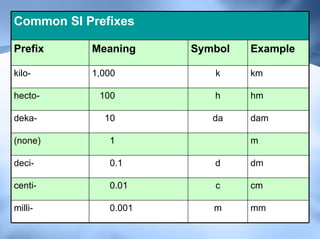
Common SI Prefixes Prefix Meaning Symbol Example kilo- 1,000 k km hecto- 100 h hm deka- 10 da dam (none) 1 m deci- 0.1 d dm centi- 0.01 c cm milli- 0.001 m mm
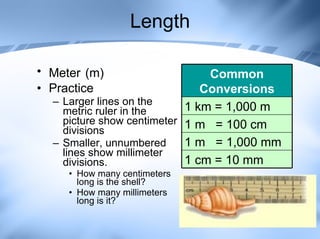
Length Meter   (m) Practice Larger lines on the metric ruler in the picture show centimeter divisions Smaller, unnumbered lines show millimeter divisions. How many centimeters long is the shell?  How many millimeters long is it?  Common Conversions 1 km = 1,000 m 1 m  = 100 cm 1 m  = 1,000 mm 1 cm = 10 mm
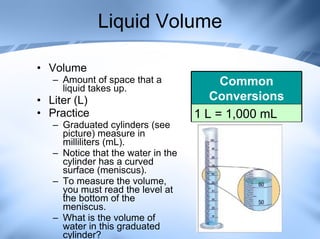
Liquid Volume Volume Amount of space that a liquid takes up. Liter (L) Practice Graduated cylinders (see picture) measure in milliliters (mL). Notice that the water in the cylinder has a curved surface (meniscus).  To measure the volume, you must read the level at the bottom of the meniscus.  What is the volume of water in this graduated cylinder?  Common Conversions 1 L = 1,000 mL
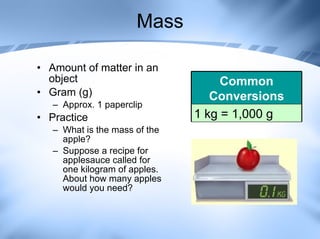
Mass Amount of matter in an object Gram (g) Approx. 1 paperclip Practice What is the mass of the apple? Suppose a recipe for applesauce called for one kilogram of apples. About how many apples would you need?  Common Conversions 1 kg = 1,000 g
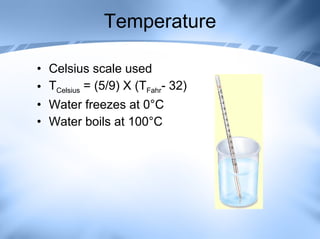
Temperature Celsius scale used T Celsius  = (5/9) X (T Fahr - 32) Water freezes at 0°C Water boils at 100°C
Converting Between Units in SI Simply move the decimal point 2 Questions to Ask In which direction did I move the decimal point? How many places did I move the decimal point?
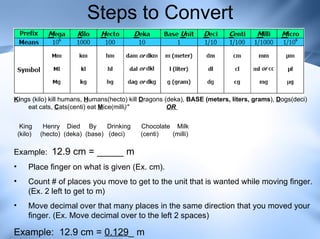
Steps to Convert K i ngs (kilo) kill humans,  H umans(hecto) kill  D ragons (deka),  BASE (meters, liters, grams ),  D ogs(deci) eat cats,  C ats(centi) eat  M ice(milli )"  OR  King  Henry  Died  By  Drinking  Chocolate  Milk (kilo)  (hecto)  (deka)  (base)  (deci)  (centi)  (milli) Example:  12.9 cm = _____ m Place finger on what is given (Ex. cm). Count # of places you move to get to the unit that is wanted while moving finger. (Ex. 2 left to get to m) Move decimal over that many places in the same direction that you moved your finger. (Ex. Move decimal over to the left 2 spaces) Example:  12.9 cm =  0.129 _ m
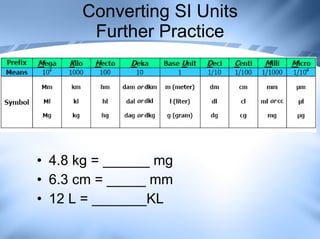
Converting SI Units Further Practice 4.8 kg = ______ mg  6.3 cm = _____ mm 12 L = _______KL
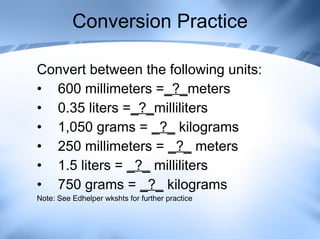
Conversion Practice Convert between the following units: 600 millimeters = _?_ meters  0.35 liters = _?_ milliliters  1,050 grams =  _?_  kilograms 250 millimeters =  _?_  meters 1.5 liters =  _?_  milliliters 750 grams =  _?_  kilograms Note: See Edhelper wkshts for further practice
Metric System Summary Metric (SI) units are used almost entirely throughout science and will be used in this course! Length—units are meters Volume—units are liters Mass—grams Prefixes in order of largest to smallest (k) (h) (da) (d) (c) (m) kilo hecto deca Base deci centi milli 1000 100 10 [meter] 0.1 0.01 0.001 [liter] [gram]
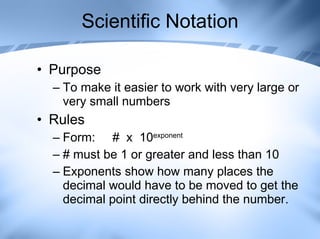
Scientific Notation Purpose To make it easier to work with very large or very small numbers Rules Form:  #  x  10 exponent # must be 1 or greater and less than 10 Exponents show how many places the decimal would have to be moved to get the decimal point directly behind the number.
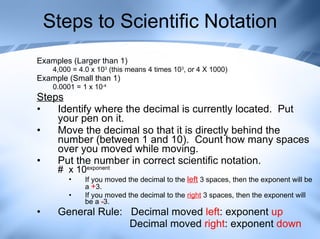
Steps to Scientific Notation Examples (Larger than 1) 4,000 = 4.0 x 10 3  (this means 4 times 10 3 , or 4 X 1000) Example (Small than 1) 0.0001 = 1 x 10 -4 Steps Identify where the decimal is currently located.  Put your pen on it. Move the decimal so that it is directly behind the number (between 1 and 10).  Count how many spaces over you moved while moving. Put the number in correct scientific notation.  #  x 10 exponent If you moved the decimal to the  left  3 spaces, then the exponent will be a  + 3. If you moved the decimal to the  right  3 spaces, then the exponent will be a  - 3. General Rule:  Decimal moved  left : exponent  up   Decimal moved  right : exponent  down
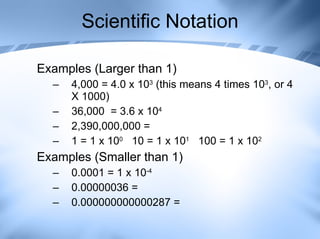
Scientific Notation Examples (Larger than 1) 4,000 = 4.0 x 10 3  (this means 4 times 10 3 , or 4 X 1000) 36,000  = 3.6 x 10 4 2,390,000,000 = 1 = 1 x 10 0   10 = 1 x 10 1   100 = 1 x 10 2 Examples (Smaller than 1) 0.0001 = 1 x 10 -4 0.00000036 = 0.000000000000287 =
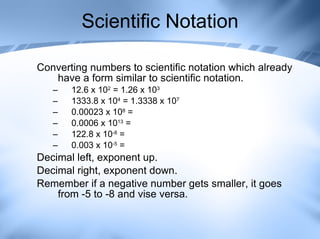
Scientific Notation Converting numbers to scientific notation which already have a form similar to scientific notation. 12.6 x 10 2  = 1.26 x 10 3 1333.8 x 10 4  = 1.3338 x 10 7 0.00023 x 10 8  =  0.0006 x 10 13  =  122.8 x 10 -8  = 0.003 x 10 -5  =  Decimal left, exponent up.  Decimal right, exponent down. Remember if a negative number gets smaller, it goes from -5 to -8 and vise versa.
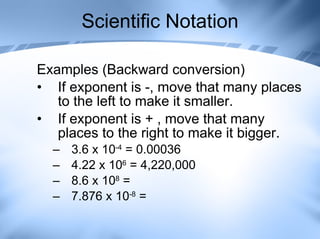
Scientific Notation Examples (Backward conversion) If exponent is -, move that many places to the left to make it smaller.  If exponent is + , move that many places to the right to make it bigger. 3.6 x 10 -4  = 0.00036 4.22 x 10 6  = 4,220,000 8.6 x 10 8  =  7.876 x 10 -8  =

Measurement & conversions

  • 1.
  • 2.
    Measurement in SISI (System International) Used by scientists throughout the world to communicate results. Metric system Uses multiples of 10 SI Base Units Quantity Unit Used in SI (symbol) Length or distance meter (m) Volume or capacity liter (L) Mass gram (g) Density gram per cubic centimeter (g/cm 3 ) Time second (s) Temperature degrees Celsius (°C)
  • 3.
    Common SI PrefixesPrefix Meaning Symbol Example kilo- 1,000 k km hecto- 100 h hm deka- 10 da dam (none) 1 m deci- 0.1 d dm centi- 0.01 c cm milli- 0.001 m mm
  • 4.
    Length Meter (m) Practice Larger lines on the metric ruler in the picture show centimeter divisions Smaller, unnumbered lines show millimeter divisions. How many centimeters long is the shell? How many millimeters long is it? Common Conversions 1 km = 1,000 m 1 m = 100 cm 1 m = 1,000 mm 1 cm = 10 mm
  • 5.
    Liquid Volume VolumeAmount of space that a liquid takes up. Liter (L) Practice Graduated cylinders (see picture) measure in milliliters (mL). Notice that the water in the cylinder has a curved surface (meniscus). To measure the volume, you must read the level at the bottom of the meniscus. What is the volume of water in this graduated cylinder? Common Conversions 1 L = 1,000 mL
  • 6.
    Mass Amount ofmatter in an object Gram (g) Approx. 1 paperclip Practice What is the mass of the apple? Suppose a recipe for applesauce called for one kilogram of apples. About how many apples would you need? Common Conversions 1 kg = 1,000 g
  • 7.
    Temperature Celsius scaleused T Celsius = (5/9) X (T Fahr - 32) Water freezes at 0°C Water boils at 100°C
  • 8.
    Converting Between Unitsin SI Simply move the decimal point 2 Questions to Ask In which direction did I move the decimal point? How many places did I move the decimal point?
  • 9.
    Steps to ConvertK i ngs (kilo) kill humans, H umans(hecto) kill D ragons (deka), BASE (meters, liters, grams ), D ogs(deci) eat cats, C ats(centi) eat M ice(milli )" OR King Henry Died By Drinking Chocolate Milk (kilo) (hecto) (deka) (base) (deci) (centi) (milli) Example: 12.9 cm = _____ m Place finger on what is given (Ex. cm). Count # of places you move to get to the unit that is wanted while moving finger. (Ex. 2 left to get to m) Move decimal over that many places in the same direction that you moved your finger. (Ex. Move decimal over to the left 2 spaces) Example: 12.9 cm = 0.129 _ m
  • 10.
    Converting SI UnitsFurther Practice 4.8 kg = ______ mg 6.3 cm = _____ mm 12 L = _______KL
  • 11.
    Conversion Practice Convertbetween the following units: 600 millimeters = _?_ meters 0.35 liters = _?_ milliliters 1,050 grams = _?_ kilograms 250 millimeters = _?_ meters 1.5 liters = _?_ milliliters 750 grams = _?_ kilograms Note: See Edhelper wkshts for further practice
  • 12.
    Metric System SummaryMetric (SI) units are used almost entirely throughout science and will be used in this course! Length—units are meters Volume—units are liters Mass—grams Prefixes in order of largest to smallest (k) (h) (da) (d) (c) (m) kilo hecto deca Base deci centi milli 1000 100 10 [meter] 0.1 0.01 0.001 [liter] [gram]
  • 13.
    Scientific Notation PurposeTo make it easier to work with very large or very small numbers Rules Form: # x 10 exponent # must be 1 or greater and less than 10 Exponents show how many places the decimal would have to be moved to get the decimal point directly behind the number.
  • 14.
    Steps to ScientificNotation Examples (Larger than 1) 4,000 = 4.0 x 10 3 (this means 4 times 10 3 , or 4 X 1000) Example (Small than 1) 0.0001 = 1 x 10 -4 Steps Identify where the decimal is currently located. Put your pen on it. Move the decimal so that it is directly behind the number (between 1 and 10). Count how many spaces over you moved while moving. Put the number in correct scientific notation. # x 10 exponent If you moved the decimal to the left 3 spaces, then the exponent will be a + 3. If you moved the decimal to the right 3 spaces, then the exponent will be a - 3. General Rule: Decimal moved left : exponent up Decimal moved right : exponent down
  • 15.
    Scientific Notation Examples(Larger than 1) 4,000 = 4.0 x 10 3 (this means 4 times 10 3 , or 4 X 1000) 36,000 = 3.6 x 10 4 2,390,000,000 = 1 = 1 x 10 0 10 = 1 x 10 1 100 = 1 x 10 2 Examples (Smaller than 1) 0.0001 = 1 x 10 -4 0.00000036 = 0.000000000000287 =
  • 16.
    Scientific Notation Convertingnumbers to scientific notation which already have a form similar to scientific notation. 12.6 x 10 2 = 1.26 x 10 3 1333.8 x 10 4 = 1.3338 x 10 7 0.00023 x 10 8 = 0.0006 x 10 13 = 122.8 x 10 -8 = 0.003 x 10 -5 = Decimal left, exponent up. Decimal right, exponent down. Remember if a negative number gets smaller, it goes from -5 to -8 and vise versa.
  • 17.
    Scientific Notation Examples(Backward conversion) If exponent is -, move that many places to the left to make it smaller. If exponent is + , move that many places to the right to make it bigger. 3.6 x 10 -4 = 0.00036 4.22 x 10 6 = 4,220,000 8.6 x 10 8 = 7.876 x 10 -8 =