Ch. 7 “Activating Students as
Owners of Their Own
Learning”
EDS 846/Dr. Faucett
by-Tamara Linares
Evidence of Research on Impact of
Activating Students
Student Self-Assessment
Study of 20 teachers in Portugal has
concluded that students who were taught to
self-assess were able to learn information
within 20 weeks instead of the normal 38
weeks.
How this happened is unclear but the
researchers attribute this to self-regulation.
Evidence of Research on Impact of
Activating Students
What is Self-Regulated Learning?- based on
on learning goals, student is able to coordinate
cognitive resources, emotions and actions
2 BIG QUESTION ARE:
1. Do learners have necessary knowledge,
skills and strategies to reach goal? ...OR...
2. Do learners have necessary skills but
does not use them in classrooms?
Metacognition vs. Motivation
There has been a lot of research about
M & M since the 1970s
What is Metacognition? Anybody?
Anybody? (John Flavell-pg. 148)(let’s
read together)
What is Motivation? Anybody?
Everybody?
Metacognition
What one knows (metacognitive
knowledge)
What one can do (metacognitive skills)
What one knows about own abilities
(metacognitive experience)
Metacognition
Research shows clearly “the most
effective learners are selfregulating”...AND...training students
in metacognition raises their
performance
These skills are ONLY useful if
students are motivated to use them
Motivation
When students fail to learn-We blame their
lack of motivation
If students don’t learn-It is the teacher’s
fault for not being a good motivator
Here is something new....................
Let motivation be a consequence of
achievement (Mihaly Csikszentmihalyipsychologist at the University of Chicago)
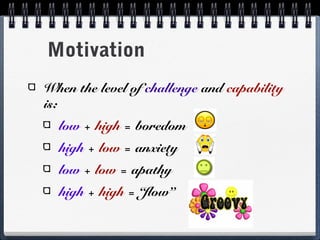
Motivation
When the level of challenge and capability
is:
low + high = boredom
high + low = anxiety
low + low = apathy
high + high = “flow”
Motivation
A study of 84 math classrooms from
5th-12th grades found that when
students were provided constructive
feedback by teachers, the students were
more focused on learning rather than
performance. (Deevers, 2006)
Which comes first Learning or
Performance?
Motivation
Students are motivated
when...
when goals are specific
within reach
challenging
Assessments
Assessments can improve instruction
(how?)
Assessments can impact learner’s
-desire to learn
-willingness to learn
-capacity to learn
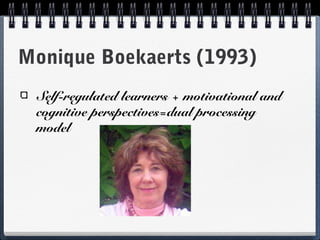
Monique Boekaerts (1993)
Self-regulated learners + motivational and
cognitive perspectives=dual processing
model
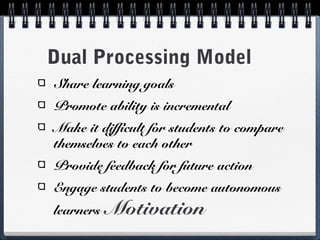
Dual Processing Model
Share learning goals
Promote ability is incremental
Make it difficult for students to compare
themselves to each other
Provide feedback for future action
Engage students to become autonomous
learners

Motivation
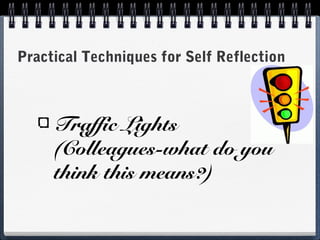
Practical Techniques for Self Reflection

Traffic Lights
(Colleagues-what do you
think this means?)
Practical Techniques for Self Reflection
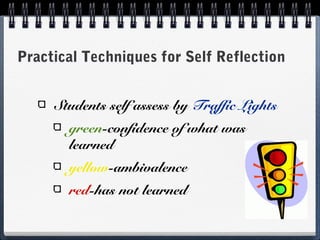
Students self assess by Traffic Lights
green-confidence of what was
learned
yellow-ambivalence
red-has not learned
Practical Techniques for Self Reflection

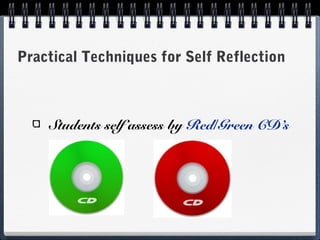
Students self assess by Red/Green CD’s
Practical Techniques for Self Reflection

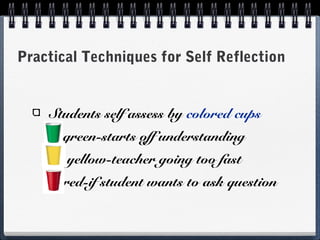
Students self assess by colored cups
green-starts off understanding
yellow-teacher going too fast
red-if student wants to ask question
Practical Techniques for Self Reflection

Students self assess by
learning portfolios
display latest and best
WIKI’s
Practical Techniques for Self Reflection
Students self assess by learning logs
Today I learned...
I was surprised by...
I was interested in...
One thing I am not sure about...
What I liked most was...
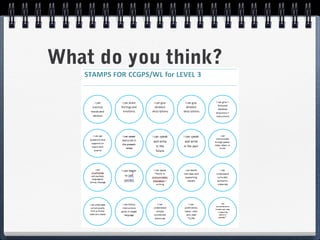
What do you think?
What do you do?
Conclusion…
•

Only learners create learning!!!

•

Teachers are simply facilitators of
learning.

•

All students can own their learning.

•

They simply need to be taught by
educating the teacher.

•

Help us help them.

Eds846 efa ch7

  • 1.
    Ch. 7 “ActivatingStudents as Owners of Their Own Learning” EDS 846/Dr. Faucett by-Tamara Linares
  • 2.
    Evidence of Researchon Impact of Activating Students Student Self-Assessment Study of 20 teachers in Portugal has concluded that students who were taught to self-assess were able to learn information within 20 weeks instead of the normal 38 weeks. How this happened is unclear but the researchers attribute this to self-regulation.
  • 3.
    Evidence of Researchon Impact of Activating Students What is Self-Regulated Learning?- based on on learning goals, student is able to coordinate cognitive resources, emotions and actions 2 BIG QUESTION ARE: 1. Do learners have necessary knowledge, skills and strategies to reach goal? ...OR... 2. Do learners have necessary skills but does not use them in classrooms?
  • 4.
    Metacognition vs. Motivation Therehas been a lot of research about M & M since the 1970s What is Metacognition? Anybody? Anybody? (John Flavell-pg. 148)(let’s read together) What is Motivation? Anybody? Everybody?
  • 6.
    Metacognition What one knows(metacognitive knowledge) What one can do (metacognitive skills) What one knows about own abilities (metacognitive experience)
  • 7.
    Metacognition Research shows clearly“the most effective learners are selfregulating”...AND...training students in metacognition raises their performance These skills are ONLY useful if students are motivated to use them
  • 9.
    Motivation When students failto learn-We blame their lack of motivation If students don’t learn-It is the teacher’s fault for not being a good motivator Here is something new.................... Let motivation be a consequence of achievement (Mihaly Csikszentmihalyipsychologist at the University of Chicago)
  • 10.
    Motivation When the levelof challenge and capability is: low + high = boredom high + low = anxiety low + low = apathy high + high = “flow”
  • 11.
    Motivation A study of84 math classrooms from 5th-12th grades found that when students were provided constructive feedback by teachers, the students were more focused on learning rather than performance. (Deevers, 2006) Which comes first Learning or Performance?
  • 12.
    Motivation Students are motivated when... whengoals are specific within reach challenging
  • 13.
    Assessments Assessments can improveinstruction (how?) Assessments can impact learner’s -desire to learn -willingness to learn -capacity to learn
  • 14.
    Monique Boekaerts (1993) Self-regulatedlearners + motivational and cognitive perspectives=dual processing model
  • 15.
    Dual Processing Model Sharelearning goals Promote ability is incremental Make it difficult for students to compare themselves to each other Provide feedback for future action Engage students to become autonomous learners Motivation
  • 16.
    Practical Techniques forSelf Reflection Traffic Lights (Colleagues-what do you think this means?)
  • 17.
    Practical Techniques forSelf Reflection Students self assess by Traffic Lights green-confidence of what was learned yellow-ambivalence red-has not learned
  • 18.
    Practical Techniques forSelf Reflection Students self assess by Red/Green CD’s
  • 19.
    Practical Techniques forSelf Reflection Students self assess by colored cups green-starts off understanding yellow-teacher going too fast red-if student wants to ask question
  • 20.
    Practical Techniques forSelf Reflection Students self assess by learning portfolios display latest and best WIKI’s
  • 21.
    Practical Techniques forSelf Reflection Students self assess by learning logs Today I learned... I was surprised by... I was interested in... One thing I am not sure about... What I liked most was...
  • 22.
  • 23.
  • 24.
    Conclusion… • Only learners createlearning!!! • Teachers are simply facilitators of learning. • All students can own their learning. • They simply need to be taught by educating the teacher. • Help us help them.