Rural
Development…
for rich and for poor
EU rural development
Developing country rural
development
Jorge Nunez
CEU
Master course Economics
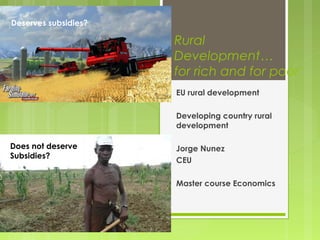
Deserves subsidies?
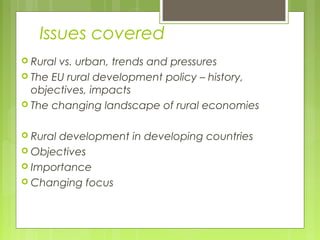
Does not deserve
Subsidies?
Issues covered
 Rural vs. urban, trends and pressures
 The EU rural development policy – history,
objectives, impacts
 The changing landscape of rural economies
 Rural development in developing countries
 Objectives
 Importance
 Changing focus
GLOBAL CHALLENGES
 Population is growing
 Urbanisation speeding up: Every day urban areas
grow by almost 150,000 new people, either due to
migration or births. Between 2011 and 2050, the
world urban population is projected to rise by 72%
i.e. from 3.6 billion to 6.3 billion and increase the
population share in urban areas from 52% in 2011 to
67% in 2050.
 Urbanisation in last 40 years is equivalent to the
urbanization achieved in the preceding 4000 years.
 Since 2009 share of urban pop. Larger than rural.
 Urban and rural areas are competing for resources,
e.g. water and land.
Challenges
 For all:
 Feeding world population
 Reduce the environmental impacts of production,
retain and enhance soil fertility
 Reduce food waste an improve food allocation
across social groups and countries
 Adapting to climate change
 Higher energy prices
 Poor countries:
 Guarantee balanced nutrition
 Rich countries:
 Avoiding rural depopulation
 Create non farm opportunities
 “Landscaping”
EU rural development policy
 It is the second pillar of the CAP
 Originally exclusively a farm restructuring support and
support for the food industry modernisation (very
important in new MS)
 Policy to promote specific objectives such as organic
faming
 Over the years more holistic – targeting rural economy
not only farms (but clashed with EU structural funds)
 European Commission publishes in 1988 “The Future of
Rural Society” calling for a more global (holistic)
Approach to rural development (rural economies
depend of many sectors).
 Growing internal and external pressures:
 Overproduction and rising costs
 GATT (WTO) pressures
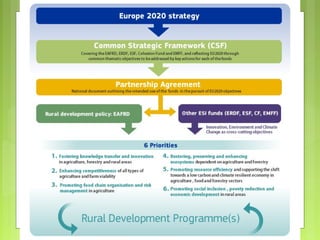
EU Rural Development
 It is a policy in constant reforms
 It has 40 years history, but It is still defining its role
 The objectives and priorities are changing
 It success depends largely on non financial, non
regulatory aspects:
 Understanding problems in the ground
 Planning
 Coordination
 Collaboration
Characteristics
 Rural development policy covers all of the EU rural
areas, rich and poor
 Despite repeated reforms still focuses mainly on
agriculture.
 It has forestry and and other rural business
programmes, but underutilised.
 It is generally believed that the rural areas are
predominantly agricultural, poor and are losing
population
 While agriculture plays a very important role as
predominant land user, it has declined significantly
for the economy and employment. In fact, even in
the predominantly rural areas employment in
agriculture is around 13 % with both industry and
services being more important (EU 25).
Areas of Natural Constraint
Scheme (ANCs) (old LFAs)
 Environmental programme: remoteness, difficult
topography and poor soil conditions
 In the past very weakly justified – a lot to socio-
cultural programmes in rich areas.
 The Council agreed to better definitions and finally
increased focus for the new period 2014-2020
 Before the LFA area distribution seemed “political”
rather than needs based in nature, and the flat
rate nature of payments may have created an
element of over-compensation in areas where
disadvantages compared to non-LFAs were
minimal, and one of under-compensation in the
most severely disadvantaged regions.
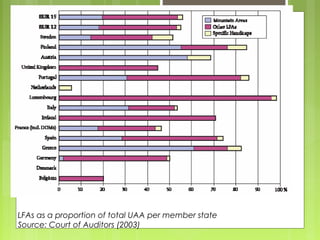
LFAs as a proportion of total UAA per member state
Source: Court of Auditors (2003)
Agri Environment
 Introduced by Commissioner Fishler copying
Austrian system….
 But criticised as actually finances existing farming
practices…
 In some areas though, it has reduced pollution.
However, in many cases taken up by farmers that
already did it and not by those who did not.
 New CAP tries to link normal payments to
something similar, but is weaker -> Cross
compliance and green payments.
Diversification
 Still linked with farming activities
 Otherwise it would clash with EU social funds
 However, some areas where RD is possible, other
funds are not available… restricting choice.
LEADER programme
 Successful but complex experiment to develop
rural areas
 But has little political support, as no strong
beneficiary group in it
Developing countries
 Developing world: 5.5 billion people - 3 billion live in
rural areas, nearly half of humanity.
 2.5 billion are in households involved in agriculture,
and 1.5 billion are in smallholder households
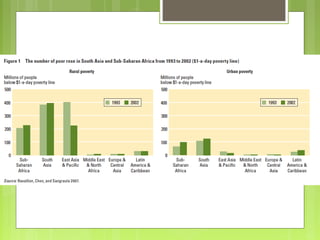
 Rural poverty fuels rapid urbanisation leading to
urban slums (often worse than rural poverty)
 Developing country poverty HAS declined, 80% of
the decline from rural poverty reduction not
caused by migration – but imbalanced, mainly
South East Asia
Is agriculture
the main development tool?
 No, but agriculture is a precursor for development
 In many developing countries there is a
comparative advantage that can help to lay the
ground for further development. Is a source of
capital.
 It is important as a basis – but we need to create
the right environment for moving further:
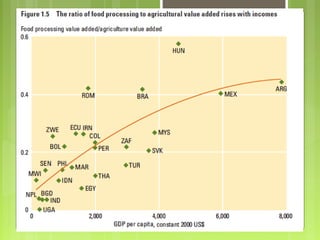
 Processing, packaging, high value goods (see
Thailand)
 Remember tariff escalation impact on development
 Use rural development to educate the next
generation – of engineers!
Agriculture has been neglected
 The role of agriculture in development has been
neglected.
 There has been a push towards urbanisation and
low value industrialisation after the green revolution
in Asia, neglecting R&D in agriculture.
 Lack of land ownership, the development of large
exploitations and land grab has affected the
environment and generated poverty.
Steps needed in agriculture
 Property rights need to be clear – otherwise:
 Land degradation
 No borrowing possible, as there is no collateral
 -> poverty
 Training (extension services)
 Creating credits systems for small farmers –
microcredit systems (see Grameen Bank)
 Increase in research and development in
agriculture
 Infrastructure improvement – water access
 Reduction in trade barriers, tariff escalation and
reasonable non-tariff barriers (e.g. SPS)
Foreign
investment
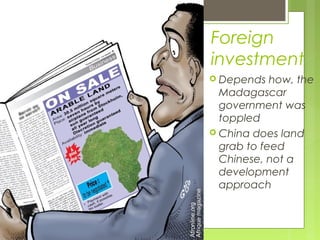
 Depends how, the
Madagascar
government was
toppled
 China does land
grab to feed
Chinese, not a
development
approach
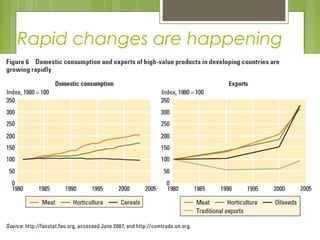
Rapid changes are happening
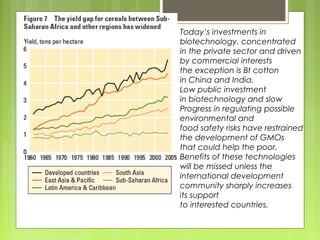
Today’s investments in
biotechnology, concentrated
in the private sector and driven
by commercial interests
the exception is Bt cotton
in China and India.
Low public investment
in biotechnology and slow
Progress in regulating possible
environmental and
food safety risks have restrained
the development of GMOs
that could help the poor.
Benefits of these technologies
will be missed unless the
international development
community sharply increases
its support
to interested countries.
FOOD SECURITY impacts on
Socio-political instability
 Green revolution brought an elimination of food
scarcity at global level… and complacency
 Low investment in agriculture
 Urbanisation and climate change have hit now
hard
 Food prices increased and has led to many
concerns on food safety
0
5
10
15
20
25
50
100
150
200
250
1/1990
1/1991
1/1992
1/1993
1/1994
1/1995
1/1996
1/1997
1/1998
1/1999
1/2000
1/2001
1/2002
1/2003
1/2004
1/2005
1/2006
1/2007
1/2008
1/2009
1/2010
1/2011
1/2012
6mo.laggedstd.dev.
FAORealFoodPriceIndex(2002-4=100)
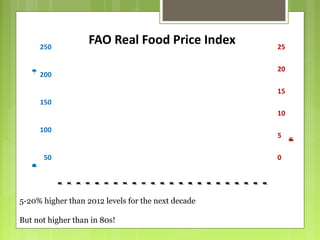
FAO Real Food Price Index
5-20% higher than 2012 levels for the next decade
But not higher than in 80s!
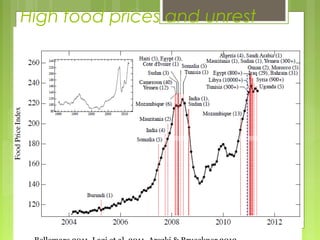
High food prices and unrest
 Food security worries can spark public protest
when mixed w/sense of broader injustices.
 But not everywhere
 Barrett et al:
 Unrest is linked with social injustices in countries
 Should we interfere in markets, or is the issue
somewhere else.
 Markets send signals, signals create effects of
production, if we cancel price signals (global food
stocks, for example), how will production react?
 Is climate change increasing risks, or decreasing risks…
both… for next lectures….

Ceu lecture 4

  • 1.
    Rural Development… for rich andfor poor EU rural development Developing country rural development Jorge Nunez CEU Master course Economics Deserves subsidies? Does not deserve Subsidies?
  • 2.
    Issues covered  Ruralvs. urban, trends and pressures  The EU rural development policy – history, objectives, impacts  The changing landscape of rural economies  Rural development in developing countries  Objectives  Importance  Changing focus
  • 3.
    GLOBAL CHALLENGES  Populationis growing  Urbanisation speeding up: Every day urban areas grow by almost 150,000 new people, either due to migration or births. Between 2011 and 2050, the world urban population is projected to rise by 72% i.e. from 3.6 billion to 6.3 billion and increase the population share in urban areas from 52% in 2011 to 67% in 2050.  Urbanisation in last 40 years is equivalent to the urbanization achieved in the preceding 4000 years.  Since 2009 share of urban pop. Larger than rural.  Urban and rural areas are competing for resources, e.g. water and land.
  • 4.
    Challenges  For all: Feeding world population  Reduce the environmental impacts of production, retain and enhance soil fertility  Reduce food waste an improve food allocation across social groups and countries  Adapting to climate change  Higher energy prices  Poor countries:  Guarantee balanced nutrition  Rich countries:  Avoiding rural depopulation  Create non farm opportunities  “Landscaping”
  • 5.
    EU rural developmentpolicy  It is the second pillar of the CAP  Originally exclusively a farm restructuring support and support for the food industry modernisation (very important in new MS)  Policy to promote specific objectives such as organic faming  Over the years more holistic – targeting rural economy not only farms (but clashed with EU structural funds)  European Commission publishes in 1988 “The Future of Rural Society” calling for a more global (holistic) Approach to rural development (rural economies depend of many sectors).  Growing internal and external pressures:  Overproduction and rising costs  GATT (WTO) pressures
  • 6.
    EU Rural Development It is a policy in constant reforms  It has 40 years history, but It is still defining its role  The objectives and priorities are changing  It success depends largely on non financial, non regulatory aspects:  Understanding problems in the ground  Planning  Coordination  Collaboration
  • 8.
    Characteristics  Rural developmentpolicy covers all of the EU rural areas, rich and poor  Despite repeated reforms still focuses mainly on agriculture.  It has forestry and and other rural business programmes, but underutilised.  It is generally believed that the rural areas are predominantly agricultural, poor and are losing population  While agriculture plays a very important role as predominant land user, it has declined significantly for the economy and employment. In fact, even in the predominantly rural areas employment in agriculture is around 13 % with both industry and services being more important (EU 25).
  • 9.
    Areas of NaturalConstraint Scheme (ANCs) (old LFAs)  Environmental programme: remoteness, difficult topography and poor soil conditions  In the past very weakly justified – a lot to socio- cultural programmes in rich areas.  The Council agreed to better definitions and finally increased focus for the new period 2014-2020  Before the LFA area distribution seemed “political” rather than needs based in nature, and the flat rate nature of payments may have created an element of over-compensation in areas where disadvantages compared to non-LFAs were minimal, and one of under-compensation in the most severely disadvantaged regions.
  • 10.
    LFAs as aproportion of total UAA per member state Source: Court of Auditors (2003)
  • 11.
    Agri Environment  Introducedby Commissioner Fishler copying Austrian system….  But criticised as actually finances existing farming practices…  In some areas though, it has reduced pollution. However, in many cases taken up by farmers that already did it and not by those who did not.  New CAP tries to link normal payments to something similar, but is weaker -> Cross compliance and green payments.
  • 12.
    Diversification  Still linkedwith farming activities  Otherwise it would clash with EU social funds  However, some areas where RD is possible, other funds are not available… restricting choice. LEADER programme  Successful but complex experiment to develop rural areas  But has little political support, as no strong beneficiary group in it
  • 14.
    Developing countries  Developingworld: 5.5 billion people - 3 billion live in rural areas, nearly half of humanity.  2.5 billion are in households involved in agriculture, and 1.5 billion are in smallholder households  Rural poverty fuels rapid urbanisation leading to urban slums (often worse than rural poverty)  Developing country poverty HAS declined, 80% of the decline from rural poverty reduction not caused by migration – but imbalanced, mainly South East Asia
  • 16.
    Is agriculture the maindevelopment tool?  No, but agriculture is a precursor for development  In many developing countries there is a comparative advantage that can help to lay the ground for further development. Is a source of capital.  It is important as a basis – but we need to create the right environment for moving further:  Processing, packaging, high value goods (see Thailand)  Remember tariff escalation impact on development  Use rural development to educate the next generation – of engineers!
  • 18.
    Agriculture has beenneglected  The role of agriculture in development has been neglected.  There has been a push towards urbanisation and low value industrialisation after the green revolution in Asia, neglecting R&D in agriculture.  Lack of land ownership, the development of large exploitations and land grab has affected the environment and generated poverty.
  • 19.
    Steps needed inagriculture  Property rights need to be clear – otherwise:  Land degradation  No borrowing possible, as there is no collateral  -> poverty  Training (extension services)  Creating credits systems for small farmers – microcredit systems (see Grameen Bank)  Increase in research and development in agriculture  Infrastructure improvement – water access  Reduction in trade barriers, tariff escalation and reasonable non-tariff barriers (e.g. SPS)
  • 20.
    Foreign investment  Depends how,the Madagascar government was toppled  China does land grab to feed Chinese, not a development approach
  • 21.
  • 22.
    Today’s investments in biotechnology,concentrated in the private sector and driven by commercial interests the exception is Bt cotton in China and India. Low public investment in biotechnology and slow Progress in regulating possible environmental and food safety risks have restrained the development of GMOs that could help the poor. Benefits of these technologies will be missed unless the international development community sharply increases its support to interested countries.
  • 25.
    FOOD SECURITY impactson Socio-political instability  Green revolution brought an elimination of food scarcity at global level… and complacency  Low investment in agriculture  Urbanisation and climate change have hit now hard  Food prices increased and has led to many concerns on food safety
  • 26.
  • 27.
    High food pricesand unrest
  • 28.
     Food securityworries can spark public protest when mixed w/sense of broader injustices.  But not everywhere  Barrett et al:  Unrest is linked with social injustices in countries  Should we interfere in markets, or is the issue somewhere else.  Markets send signals, signals create effects of production, if we cancel price signals (global food stocks, for example), how will production react?  Is climate change increasing risks, or decreasing risks… both… for next lectures….