National and global food security:
what roles for trade and trade policies?

    Kym Anderson and Will Martin
     University of Adelaide and World Bank
          kym.anderson@adelaide.edu.au
            Wmartin1@worldbank.org

  Forum on Refram ing the Food Security Agenda

            Adelaide, 13 February 2012
Take-away messages
  Food security is primarily a consumption issue, but
  also a prod’n issue globally, esp. in long run

  Global agric prod’n would be more efficient, int’l
  food prices less volatile, & food security greater, if
  governments reduced trade policy interventions
    And invested more in Agric research and development

  Current food security concerns (SR price spikes,
  LR slowing crop yield growth) provide reform
  opportunities: don’t waste a crisis!
What is food security?
What is meant by ‘food security’?
 Rests on three pillars:
   availability, access, & utilization
 At the national level, food security is primarily an
 access issue
   FAO’s ideal “when all people, at all times, have physical, social and
   economic access to sufficient, safe & nutritious food which meets
   their dietary needs and food preferences for an active & healthy life”
 But globally, food security is also a production
 issue, as supply affects price, and price affects
 access
Causes of household food insecurity
 Poverty
 High food prices
   Most poor people are rural– but net food buyers
 Inadequate policies to ensure access
   eg social safety nets
 Lack of education/nutrition knowledge
 National food prodn has no direct impact
   There is an indirect effect: higher farm incomes
   and higher wages help poor people afford food
Short-run vs long run FS concerns
Current political interest stems mainly from recent
food price spikes (around trend level)
  Have they pushed more people into poverty?
Longer-run concerns have more to do with higher
trend levels of prices, due to:
  rapid income growth in developing countries, growth
  of biofuel demand, & declining yield growth
Both SR and LR concerns often are addressed by
trade policy responses
  Yet SR and LR global food security concerns are
  often exacerbated by trade policies
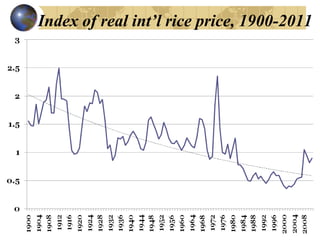
Index of real int’l rice price, 1900-2011
SR: Higher food prices raise poverty
 2008 price spike raised global poverty by
 roughly 100 million people

 2010 price increase led by wheat raised
 poverty by 44 million people
   68 million people falling into poverty
   24 million people rising out of poverty
    • Net sellers gaining from higher prices
What of the future?
 Will the experience of the 20th century
 repeat?
   Downtrend in real food prices, with technological
   improvements outpacing growth in population
   and incomes
   and with occasional, self-correcting price spikes
 Or should we expect high, even rising int’l
 food prices & with greater volatility?
What policies need reforming to improve
SR and LR global food security?
  Sound policy responses depend on
  understanding the causes

  Need to reflect on causes of recent SR price
  spikes and potential reversal of long-run
  downward price trend of 20th century
Causes of global food security concerns
  Food demand factors:
    Short-term , m aybe one-off : hedging against
    wobbles in financial and housing markets
    New , but interm ittent : biofuel subsidies and
    mandates (for energy security)
     • adding hugely to global grain, oilseed & sugar demand,
     • Potential source of volatility
    Long-term , continuing : Rapid income growth in
    Asia is expanding demand for livestock products,
    hence also for feedgrains and oilseeds
     • as well as for minerals and energy raw materials
    Long-term , prospective: carbon taxes on fossil
    fuel use — or direct support of biofuels — will add
    to demand for renewables including biofuels
Causes of food security concerns (2)
  Food supply factors:
    Short-term :
     • drought/floods/wildfires
     • Reductions in policy stocks
    Long-term , continuing :
     • Slowdown in growth of agric R&D
       investment has reduced crop TFP growth
     • Climate change may slow crop yield
       growth and raise both the mean and
       variance of int’l food prices
Trade policy responses
Trade policies and price spikes
When international prices spike
  Exporters restrict exports & importers lower tariffs
   • to protect domestic consumers
When international prices decline
  Importers raise tariffs & many exporters pay subsidies
   • to protect farmers
Each increases volatility in world markets
  Collectively ineffective in stabilizing domestic prices
Export restrictions make importers less
willing to rely on world markets
Self-sufficiency policies: long run impacts
  Protection of import-competing foods raises availability
  but may reduce access of the poor
  In a multi-country trading world, national income highest
  when specialization → comparative advantage
    eg cash crops may boost farm income more than staple foods, esp.
    as commercial farming grows with econ. development
  Import restraints raise food prices & prejudice access
    Raising productivity may increase farm incomes and increase
    access to food
  Food stamps or direct cash e-transfers to targeted poor
  households can more-efficiently ensure access
    And even more so with better education about nutrition
Will growth in emerging economies
     push up int’l food prices?
China’s impact so far has been much less on int’l
prices for food than for minerals and energy
   But partly because of gradual removal of
   agric disincentives over past 3 decades
True also of India, plus Green Revolution
contributed to its food self sufficiency from 1960s
  and raised real incomes of the poor
If large developing countries choose not to protect
agriculture, they could well become larger agric
importers- and make their poor people better off
Potential policy responses
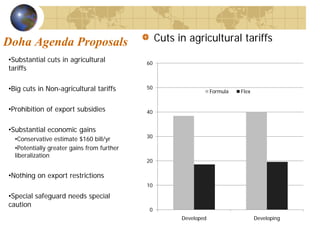
Doha Agenda Proposals                            Cuts in agricultural tariffs
•Substantial cuts in agricultural           60
tariffs

•Big cuts in Non-agricultural tariffs       50
                                                                   Formula   Flex


•Prohibition of export subsidies            40


•Substantial economic gains
                                            30
  •Conservative estimate $160 bill/yr
  •Potentially greater gains from further
  liberalization
                                            20

•Nothing on export restrictions
                                            10

•Special safeguard needs special
caution
                                            0
                                                       Developed                    Developing
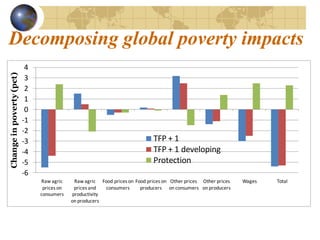
Decomposing global poverty impacts
                           4
Change in poverty (pct)


                           3
                           2
                           1
                           0
                          -1
                          -2
                          -3                                                  TFP + 1
                          -4                                                  TFP + 1 developing
                          -5                                                  Protection
                          -6
                               Raw agric      Raw agric Food prices on Food prices on Other prices Other prices   Wages   Total
                                prices on     prices and  consumers      producers on consumers on producers
                               consumers     productivity
                                            on producers
How can Austn agriculture contribute?
 Invest more in R&D all along value chain
   Support R&D in developing countries
   Develop varieties more suited to changing climate
 Press government to re-start WTO’s Doha round
 Anticipate consumer demand for environmentally
 sustainable production/processing/transporting
 Demand better water market institutions/policies
 Hedge against price & exchange rate fluctuations
Conclusions
 Food security is primarily determined by
 whether poor people have access to food
  Good trade policies improve access to food
 and avoid exaggerating price volatility
   and help feed the world’s 9 billion people in 2050
 Recent experience of high and volatile prices
 suggests a need to combine open trade
 regimes with strong support to R&D
Thanks!
Anderson, K. and S. Nelgen, “Trade Barrier Volatility and
Agricultural Price Stabilization”, World Development Jan. 2012
Martin, W. and K. Anderson, “Export Restrictions and Price
Insulation During Commodity Price Booms”, American Journal
of Agric Econ 94(2), Jan. 2012
Anderson, K. and A. Strutt, “Agriculture and Food Security in
Asia by 2030”, Background Paper for Asian Development Bank
Institute’s project on ASEAN, China and India: A Balanced,
Sustainable, Resilient Growth Pole (forthcoming 2012)
Ivanic, M. and W. Martin, “Global Poverty Consequences of
Growth and Industrialization to 2050”, World Bank
(forthcoming 2012)
Martin, W. And Mattoo, A. Unfinished Business: the WTO’s
Doha Agenda, CEPR and World Bank.

National and global food security, Dr Will Martin

  • 1.
    National and globalfood security: what roles for trade and trade policies? Kym Anderson and Will Martin University of Adelaide and World Bank kym.anderson@adelaide.edu.au Wmartin1@worldbank.org Forum on Refram ing the Food Security Agenda Adelaide, 13 February 2012
  • 2.
    Take-away messages Food security is primarily a consumption issue, but also a prod’n issue globally, esp. in long run Global agric prod’n would be more efficient, int’l food prices less volatile, & food security greater, if governments reduced trade policy interventions And invested more in Agric research and development Current food security concerns (SR price spikes, LR slowing crop yield growth) provide reform opportunities: don’t waste a crisis!
  • 3.
    What is foodsecurity?
  • 4.
    What is meantby ‘food security’? Rests on three pillars: availability, access, & utilization At the national level, food security is primarily an access issue FAO’s ideal “when all people, at all times, have physical, social and economic access to sufficient, safe & nutritious food which meets their dietary needs and food preferences for an active & healthy life” But globally, food security is also a production issue, as supply affects price, and price affects access
  • 5.
    Causes of householdfood insecurity Poverty High food prices Most poor people are rural– but net food buyers Inadequate policies to ensure access eg social safety nets Lack of education/nutrition knowledge National food prodn has no direct impact There is an indirect effect: higher farm incomes and higher wages help poor people afford food
  • 6.
    Short-run vs longrun FS concerns Current political interest stems mainly from recent food price spikes (around trend level) Have they pushed more people into poverty? Longer-run concerns have more to do with higher trend levels of prices, due to: rapid income growth in developing countries, growth of biofuel demand, & declining yield growth Both SR and LR concerns often are addressed by trade policy responses Yet SR and LR global food security concerns are often exacerbated by trade policies
  • 7.
    Index of realint’l rice price, 1900-2011
  • 8.
    SR: Higher foodprices raise poverty 2008 price spike raised global poverty by roughly 100 million people 2010 price increase led by wheat raised poverty by 44 million people 68 million people falling into poverty 24 million people rising out of poverty • Net sellers gaining from higher prices
  • 9.
    What of thefuture? Will the experience of the 20th century repeat? Downtrend in real food prices, with technological improvements outpacing growth in population and incomes and with occasional, self-correcting price spikes Or should we expect high, even rising int’l food prices & with greater volatility?
  • 10.
    What policies needreforming to improve SR and LR global food security? Sound policy responses depend on understanding the causes Need to reflect on causes of recent SR price spikes and potential reversal of long-run downward price trend of 20th century
  • 11.
    Causes of globalfood security concerns Food demand factors: Short-term , m aybe one-off : hedging against wobbles in financial and housing markets New , but interm ittent : biofuel subsidies and mandates (for energy security) • adding hugely to global grain, oilseed & sugar demand, • Potential source of volatility Long-term , continuing : Rapid income growth in Asia is expanding demand for livestock products, hence also for feedgrains and oilseeds • as well as for minerals and energy raw materials Long-term , prospective: carbon taxes on fossil fuel use — or direct support of biofuels — will add to demand for renewables including biofuels
  • 12.
    Causes of foodsecurity concerns (2) Food supply factors: Short-term : • drought/floods/wildfires • Reductions in policy stocks Long-term , continuing : • Slowdown in growth of agric R&D investment has reduced crop TFP growth • Climate change may slow crop yield growth and raise both the mean and variance of int’l food prices
  • 13.
  • 14.
    Trade policies andprice spikes When international prices spike Exporters restrict exports & importers lower tariffs • to protect domestic consumers When international prices decline Importers raise tariffs & many exporters pay subsidies • to protect farmers Each increases volatility in world markets Collectively ineffective in stabilizing domestic prices Export restrictions make importers less willing to rely on world markets
  • 15.
    Self-sufficiency policies: longrun impacts Protection of import-competing foods raises availability but may reduce access of the poor In a multi-country trading world, national income highest when specialization → comparative advantage eg cash crops may boost farm income more than staple foods, esp. as commercial farming grows with econ. development Import restraints raise food prices & prejudice access Raising productivity may increase farm incomes and increase access to food Food stamps or direct cash e-transfers to targeted poor households can more-efficiently ensure access And even more so with better education about nutrition
  • 16.
    Will growth inemerging economies push up int’l food prices? China’s impact so far has been much less on int’l prices for food than for minerals and energy But partly because of gradual removal of agric disincentives over past 3 decades True also of India, plus Green Revolution contributed to its food self sufficiency from 1960s and raised real incomes of the poor If large developing countries choose not to protect agriculture, they could well become larger agric importers- and make their poor people better off
  • 17.
  • 18.
    Doha Agenda Proposals Cuts in agricultural tariffs •Substantial cuts in agricultural 60 tariffs •Big cuts in Non-agricultural tariffs 50 Formula Flex •Prohibition of export subsidies 40 •Substantial economic gains 30 •Conservative estimate $160 bill/yr •Potentially greater gains from further liberalization 20 •Nothing on export restrictions 10 •Special safeguard needs special caution 0 Developed Developing
  • 19.
    Decomposing global povertyimpacts 4 Change in poverty (pct) 3 2 1 0 -1 -2 -3 TFP + 1 -4 TFP + 1 developing -5 Protection -6 Raw agric Raw agric Food prices on Food prices on Other prices Other prices Wages Total prices on prices and consumers producers on consumers on producers consumers productivity on producers
  • 20.
    How can Austnagriculture contribute? Invest more in R&D all along value chain Support R&D in developing countries Develop varieties more suited to changing climate Press government to re-start WTO’s Doha round Anticipate consumer demand for environmentally sustainable production/processing/transporting Demand better water market institutions/policies Hedge against price & exchange rate fluctuations
  • 21.
    Conclusions Food securityis primarily determined by whether poor people have access to food Good trade policies improve access to food and avoid exaggerating price volatility and help feed the world’s 9 billion people in 2050 Recent experience of high and volatile prices suggests a need to combine open trade regimes with strong support to R&D
  • 22.
    Thanks! Anderson, K. andS. Nelgen, “Trade Barrier Volatility and Agricultural Price Stabilization”, World Development Jan. 2012 Martin, W. and K. Anderson, “Export Restrictions and Price Insulation During Commodity Price Booms”, American Journal of Agric Econ 94(2), Jan. 2012 Anderson, K. and A. Strutt, “Agriculture and Food Security in Asia by 2030”, Background Paper for Asian Development Bank Institute’s project on ASEAN, China and India: A Balanced, Sustainable, Resilient Growth Pole (forthcoming 2012) Ivanic, M. and W. Martin, “Global Poverty Consequences of Growth and Industrialization to 2050”, World Bank (forthcoming 2012) Martin, W. And Mattoo, A. Unfinished Business: the WTO’s Doha Agenda, CEPR and World Bank.