Migration, Agriculture, and
Rural Development in
Developing Countries
The Imperative of
Agriculture progress and
Rural Development
M.Arslan
BS Economics Akhuwat College Kasur.
1. Rural Migration and Urbanization
• High rates of migration from rural areas to urban centers in Africa, Asia,
and Latin America are fueled by economic stagnation in rural regions.
• Despite urbanization, around 3.1 billion people lived in rural areas in
developing countries in 2013, with many in extreme poverty.
• More than 60% of the population in low- and lower-middle-income
countries is rural.
• Countries like Ethiopia, Nepal, Niger, Rwanda, and Uganda are over 80%
rural, with economies heavily reliant on agriculture.
• The agricultural sector is critical for economic development, especially in
rural-based societies like sub-Saharan Africa and South Asia.
2. Agricultural Sector Challenges and Importance
• Over two-thirds of the world’s poorest people live in rural areas, primarily
relying on subsistence farming focused on survival.
• Economic development in rural areas is essential to reduce poverty, address
inequality, and manage rapid population growth.
• Historical Perspective: Agriculture was traditionally viewed as a sector
supporting industrial growth by providing cheap food and labor.
• Modern Consensus: Agriculture plays an essential role in economic
development, especially for low-income countries, as it can directly
contribute to national progress.
3. Framework for Agricultural Transformation
• Goals:
o Increase agricultural output and productivity for small farmers to
ensure food security and support urban growth.
o Transition traditional, low-productivity farms to high-productivity
commercial farms.
o Consider the socio-economic rationale behind farmers’ behaviors and
the need to mitigate risks.
o Balance economic incentives with necessary institutional reforms for
effective agricultural development.
o Expand off-farm employment and improve social services like
education and healthcare to support rural development.
o Strengthen food security at the national level.
• Strategies for Transformation:
o Output Growth: Use technology, institutional reform, and price
incentives to boost small farmers’ productivity.
o Rising Domestic Demand: Foster agricultural demand through urban
development.
o Rural Development Activities: Encourage non-agricultural, labor-
intensive activities to create employment and support local
economies.
4. Seven Key Questions for Agricultural and Rural Development
• How to increase agricultural productivity to benefit small farmers and
ensure food surplus?
• What processes enable traditional farms to evolve into commercial
enterprises?
• How to assess and support the seemingly cautious or resistant behaviors of
small farmers?
• How do farmers manage high risks, and what policies can help mitigate
these risks?
• Are incentives enough to increase output, or are structural changes also
needed?
• Does improving agricultural productivity suffice, or is there a need for
broader rural development?
• How to enhance food security effectively?
5. Regional Agrarian Characteristics
• Africa: Primarily agriculture-based economies with high poverty and
traditional farming practices.
• Asia: Agriculturally transforming economies with densely populated areas
and smaller farm holdings.
• Latin America: Urbanized economies with large-scale commercial farms and
significant inequality between large and small farms.
• Rural development varies across these regions due to differing agricultural,
economic, and social structures.
6. Integrated Rural Development (IRD)
• Definition: IRD is a comprehensive approach to rural development involving
agricultural advancement, infrastructure, rural nonfarm industries, and
sustained capacity building.
• Objectives:
o Increase agricultural productivity, provide infrastructure, promote
rural industries, and improve living standards in rural areas.
o Support rural economies to be self-sustaining and resilient to
economic pressures.
7. Traditional Subsistence Agriculture and Transition to Commercial
Farming
• Majority of the extreme poor in developing countries work in agriculture,
often in traditional subsistence farming.
• Transition to commercial farming requires not only economic but also
social, institutional, and structural support for small-scale farmers.
8. Case Study: Agricultural Extension for Women in Africa
• Women play a critical role in African agriculture, yet many policies assume
farmers are men.
• Addressing this oversight is essential for effective agricultural policies and
rural development.
9.2 Agricultural Growth: Past Progress and Current
Challenges Trends in Agricultural Productivity.
Trends in Agricultural Productivity and Economic Development
1. Agricultural Growth in Developing vs. Developed Regions
• Agricultural production has kept pace with global population growth,
countering some predictions of widespread food shortages.
• Growth Rates:
o Between 1980-2004, the developing world saw faster growth in
agricultural output (2.6% per year) compared to the developed world
(0.9% per year).
o Developing countries' share of global agricultural GDP increased from
56% to 65%, while their share of non-agricultural GDP remained
lower (21%).
2. Successful Agricultural Programs and Innovations
• Various programs have successfully boosted agricultural productivity and
reduced hunger:
o Asia: Green Revolution, containment of wheat rusts.
o Sub-Saharan Africa: Improved maize, pest-resistant cassavas.
o Bangladesh: Use of shallow tubewells for rice, homestead food
production.
o East Asia: Hybrid rice and mung bean improvements.
o India: Pearl millet, sorghum advancements, dairy marketing for
smallholders.
o China and Vietnam: Land tenure reforms.
o Burkina Faso: Cotton sector reforms.
o Kenya: Market improvements.
3. Comparative Agricultural Output (1970-2010)
• Developing countries showed significant agricultural growth from 1970 to
2010.
• OECD countries also saw growth, but transition countries lagged behind.
• Despite global progress, Africa's agricultural output growth struggled to
keep up with population increases.
4. Labor Force in Agriculture
• In low-income countries, agriculture employs a large share of the labor
force, often between 80-90%.
• Economic Development Trends:
o As GDP per capita increases, both the share of labor and GDP from
agriculture tend to decline.
o Exceptions exist where agriculture employment declines significantly
without major GDP growth, as seen in Brazil and Nigeria.
5. Regional Differences in Agricultural Productivity (1960-2005)
• Asia: Nearly tripled cereal yields per hectare.
• Latin America: Achieved significant production gains.
• China: Reduced hunger through agricultural improvements.
• South Asia: Showed productivity gains, but hunger reportedly rose in India
recently.
• Sub-Saharan Africa: Saw modest yield improvements, but limited access to
modern agricultural inputs has led to a poverty trap for subsistence
farmers.
6. Challenges in African Agriculture
• Population pressure has made traditional farming practices unsustainable,
leading to soil degradation.
• Financial constraints prevent subsistence farmers from accessing improved
seeds, fertilizers, and modern tools, creating a cycle of poverty and low
productivity.
Agricultural Transformation and Rural Development (Famine in Africa)
Recurrent Famines and Food Shortages in Africa:
• Regions Affected: The Sahel, Horn of Africa, and other parts of sub-Saharan
Africa have experienced repeated famines.
o Example: The 2011 drought in the Horn of Africa affected over 13
million people.
o The 1973–1974 Sahel famine caused hundreds of thousands of deaths.
o 1980s-1990s: At least 22 African countries faced severe famine.
o 2000s: Famine affected regions from Mauritania to Mozambique.
• Current Malnutrition Crisis:
o Over 270 million people in Africa suffer from malnutrition.
o High rates of malnutrition, particularly in southern Somalia, where
child malnutrition exceeds 50% in some regions.
The Green Revolution and Agricultural Development:
• Green Revolution in Africa: Calls for a renewed focus on agricultural
development similar to Asia's Green Revolution.
o AGRA (Alliance for a Green Revolution in Africa), chaired by Kofi
Annan, supports agricultural transformation.
o NERICA Varieties (New Rice for Africa) developed in Benin have
shown positive outcomes in some countries but have not been
universally successful.
• Challenges to Green Revolution Replication:
o Institutional and social transformation is essential, not just technical
advances.
o High food prices (e.g., 2007–2008 and 2011 crises) have exposed
vulnerabilities in food systems.
Food Price Crisis:
• Food Prices: Food prices have risen since the 2000s after falling during the
20th century.
o Causes: Increased demand for food (particularly meat), biofuels
production, energy prices, and climate change.
o Impact: Rising prices disproportionately affect developing nations.
o Prediction: Food prices will likely stay high in the long term due to
structural challenges.
Famine in the Horn of Africa (2011):
• Causes:
o Severe drought, worsened by La Niña (weather patterns disrupting
seasonal rains).
o Governance issues in Somalia and conflict from militant groups like
Al-Shabaab hindered relief efforts.
o Rising food prices exacerbated poverty, with food prices tripling in
Somalia.
• Famine Definition (UN):
o Over 30% of children suffering from malnutrition.
o Death rates of more than 2 adults/4 children per 10,000 people per
day.
o Access to fewer than 2,100 kilocalories of food and 4 liters of water
per person daily.
International and Government Response:
• Global Aid Efforts: International aid organizations struggle to deliver aid
due to governance issues and conflict.
o WFP (World Food Program) faced obstruction by Al-Shabaab
militants.
o Food aid risks undermining local agriculture, causing food markets to
collapse.
• Entitlement Issue (Amartya Sen):
o Famine often results not from a lack of food but from lack of access to
it due to poverty and market failures.
o Sen’s concept of entitlements: People’s command over commodities
(ability to purchase food) is crucial for preventing famine.
o Example: In the 1943 Bengal famine, food was available but
unaffordable for many.
Market Failures in Agriculture:
• Market Failures:
o Environmental externalities, information asymmetries, monopoly
power in input supply.
o Public goods like agricultural research and extension services require
government support.
o Missing markets and poor infrastructure hinder rural growth.
• Government's Role:
o Governments must intervene to correct market failures.
o Poverty alleviation: Many poor are farmers, but poverty traps (lack of
credit, education, and infrastructure) hinder progress.
o Government policies should focus on creating a supportive
environment for agricultural development.
o Historical misguided policies (e.g., import substitution, exchange rate
overvaluation) neglected agriculture, leading to inefficiencies.
Poverty Traps:
• Challenges for Farmers:
o Lack of collateral: Farmers cannot secure credit.
o Missing markets: Farmers cannot access insurance or affordable
inputs.
o Social exclusion: Ethnic, caste, or gender inequalities further hinder
access to resources.
• Poverty Transmission:
o Poverty prevents farmers from benefiting from trade liberalization
and globalization.
o Poor farmers often lack the means to escape poverty without external
assistance.
Role of Government in Agricultural Growth:
• Governments should:
o Provide credit, infrastructure, and market access to poor farmers.
o Support rural development to ensure that agricultural growth
benefits the poor.
o Ensure inclusive growth, as excluding the poor limits overall
economic growth and development.
• Agricultural Growth and Poverty Reduction:
o Sustainable agricultural growth can reduce poverty by involving the
poor in the growth process, improving their livelihoods, and fostering
inclusive economic development.
9.3 The Structure of Agrarian Systems in the Developing World
Three Systems of Agriculture.
Three Systems of Agriculture
Understanding agricultural systems in developing countries and their economic
aspects is crucial for the transition from subsistence to commercial agriculture.
Alain de Janvry and his colleagues, in the 2008 World Development Report,
propose categorizing global agriculture into three systems:
1. Agriculture-Based Countries
• Key Characteristics:
o Agriculture remains a major source of economic growth (32% of GDP
on average).
o More than two-thirds of the poor in these countries live in rural
areas.
o Sub-Saharan Africa (82% of rural population) and countries like Laos
and Senegal fall into this category.
o Agriculture is a key part of economic development but is heavily
reliant on labor-intensive farming.
2. Transforming Countries
• Key Characteristics:
o Agriculture contributes less to GDP (7% on average).
o The majority of the population (2.2 billion people) still live in rural
areas, but rural poverty is high (close to 80%).
o Most countries in South and East Asia, North Africa, and the Middle
East, such as Guatemala, are in this category.
o Rural-to-urban migration is increasing, and agriculture plays a less
significant role in economic output.
3. Urbanized Countries
• Key Characteristics:
o Rural-urban migration is widespread, and nearly half of the poor are
now living in cities.
o Agriculture contributes very little to GDP growth.
o Found in Latin America, the Caribbean, Eastern Europe, and Central
Asia.
o These countries face the challenge of integrating the rural poor into
urban economies, often with limited success.
Agricultural Productivity Variations
• Land Productivity: Varies dramatically across countries. For example, the
U.S. has much higher grain yields per hectare than India or the DRC. This
reflects differences in technology, land management, and capital
investment.
• Labor Productivity: The U.S. also has much higher value added per
agricultural worker compared to lower-income countries, like India or
Congo.
Regional Disparities
• In countries like India, regions exhibit different agricultural conditions,
ranging from modernized areas (Punjab) to less developed ones (Bihar).
Even in higher-income countries like Mexico, rural poverty and dependence
on agriculture persist in certain regions.
Traditional and Peasant Agriculture in Latin America, Asia, and Africa
• Latin America:
o Latin America is characterized by a dual agricultural structure:
Latifundios (large landholdings) and Minifundios (small farms).
Latifundios often have high land inequality, with a few large
landowners controlling significant resources, and minifundios often
remain inefficient.
o Land Inequality: High land Gini coefficients (e.g., Brazil 0.77) reflect
high inequality in land distribution, which affects social and political
organization.
o Family and Medium-Size Farms: Efficient family and medium-sized
farms often have higher productivity than latifundios or minifundios.
• Asia and Africa:
o Asia: Characterized by fragmented, small land parcels with high
population density, leading to low average farm sizes.
o Africa: Historical land availability has led to different patterns of land
distribution, and countries in Africa exhibit varying levels of
agricultural development.
o Economic Dualism: In regions like Latin America, the shift from large
estates to more family-oriented and efficient medium-size farms is
critical for agricultural growth.
Land Distribution Patterns
• Land Lorenz Curves & Gini Coefficients:
o Land inequality is often measured using Land Gini coefficients, which
show the concentration of landholdings.
o In many developing countries, land sizes are shrinking as land is
subdivided.
Agrarian Patterns in Latin America
• Latifundio-Minifundio System:
o Latifundios (large farms) are inefficient due to high transaction costs
and low productivity.
o Minifundios (small farms) are often economically unproductive but
are crucial for subsistence farming.
o Medium-sized and Family Farms: Efficient in terms of land use and
labor, they contribute significantly to agricultural output in countries
like Brazil and Uruguay.
• Inefficiency in Large Farms:
o Latifundios often remain underutilized as landowners prioritize
political power over agricultural productivity.
o Smaller farms tend to be more efficient because they leverage family
labor, which is cheaper than hired labor.
Latin America's Agricultural Development
• Challenges:
o Despite growth in non-traditional exports (e.g., fruits, wines), rural
inequality remains high.
o Historical legacies of colonialism (e.g., exploitation of indigenous
people) continue to affect land distribution and economic
development.
o The latifundio-minifundio system is still dominant in some parts of
the region, contributing to poverty and social inequality.
• Progress:
o Countries like Chile have experienced success in agricultural
diversification (e.g., fruits, aquaculture).
o Brazil's sugarcane-based biofuels and soybean production contribute
to agricultural growth.
• Ongoing Challenges:
o Regions with extreme poverty often remain locked in cycles of
inequality, exacerbated by limited access to credit and political
participation.
o Rural-to-urban migration has left rural areas with aging, female-
dominated, and often indigenous populations, which limits economic
mobility.
Agricultural Transformation and Rural Development in Asia and Africa
Land Fragmentation and Socio-Economic Issues in Asia:
1. Problem of Land Fragmentation:
a. Average Farm Size (Example countries):
i. Thailand: 3.4 hectares
ii. Pakistan: 3.1 hectares
iii. India: 1.4 hectares
iv. Bangladesh: 0.6 hectares
b. Trend: Farm sizes have been shrinking over time due to population
growth and land scarcity.
2. Land Inequality:
a. Gini Coefficients for Land Distribution:
i. India: 0.448
ii. Bangladesh: 0.483
iii. Thailand: 0.467
iv. Pakistan: 0.540
b. Despite more equitable distribution than in Latin America, inequality
still exists.
3. Historical Forces Shaping Land Ownership:
a. Colonial Rule:
i. European powers (British, French, Dutch) introduced private
property rights, disrupting traditional communal land
ownership.
ii. Impact: Breakup of village cohesion and informal land rights.
b. Monetization:
i. The rise of moneylenders, who gained power by offering loans
with high interest rates. Peasants often had to forfeit land
when they couldn’t repay, leading to further fragmentation.
c. Population Growth: Increased land pressure, leading to smaller
holdings and worsened poverty.
4. Impact of Sharecropping and Land Ownership:
a. Sharecropping: Widespread in Asia, especially in India (48%),
Indonesia (60%), and the Philippines (79%). It is less common in
Latin America.
b. Landlords: Often absentee and not involved in agricultural work.
Sharecroppers work the land and share profits with the landlord.
c. Moneylender Role: Moneylenders took advantage of land as collateral
for loans. Defaults often resulted in the peasants losing their land.
5. Consequences of Fragmentation:
a. Peasants, with shrinking landholdings, often fall below subsistence
levels.
b. Chronic Poverty: Many peasants become tenant farmers or landless
laborers.
c. Rural to urban migration leads to slums and worsening living
conditions for many.
6. Example Countries with Fragmentation:
a. India, Indonesia, Philippines: Population growth led to a dramatic
increase in land fragmentation, reducing farm size to below 1 hectare
in some areas.
b. Result: Growing chronic poverty and displacement of peasants.
7. Land Reforms and Productivity:
a. Post-Independence Impact: Areas with landlord-based land tenure
had lower productivity and investment in health and education than
regions where land rights were given directly to cultivators.
Subsistence Agriculture and Extensive Cultivation in Africa:
1. Characteristics of Traditional African Agriculture:
a. Subsistence Farming: Most farms produce primarily for family
consumption, with limited market-oriented crops (e.g., cocoa, tea,
sugar in certain regions).
b. Shifting Cultivation: Used to manage small plots of land, with soil
fertility maintained by letting land lie fallow for recovery.
c. Land Access: Villages traditionally had communal land access rights,
with rights often restricted to members of the community.
2. Challenges to Productivity:
a. Limited Tools: Traditional tools such as hoes and knives lead to low
productivity.
b. Shifting Cultivation: While effective in the past, increasing population
densities make it unsustainable, as land is depleted faster than it can
recover.
c. Labor Scarcity: Labor is in high demand during planting and weeding
seasons, while there is underemployment during other periods of the
year.
3. Historical Factors Affecting Agricultural Output:
a. Low Productivity: Due to traditional farming methods and limited
technology.
b. Population Growth: Increasing population pressures lead to smaller
farms and reduced availability of fertile land for shifting cultivation.
4. Transition to Sedentary Cultivation:
a. As population density increases, shifting cultivation is replaced by
permanent cultivation on smaller plots.
b. This shift increases the need for external inputs like fertilizers and
irrigation.
5. Land Degradation:
a. Deforestation and Soil Erosion: In response to the growing population
and need for land, the natural environment is increasingly degraded.
b. Challenges: The introduction of modern farming inputs, such as
fertilizers and irrigation, remains limited in many regions, especially
in sub-Saharan Africa.
6. Key Issues Facing African Agriculture:
a. Low Fertilizer Use: African farmers use less than 10 kg of fertilizer
per hectare compared to over 100 kg in South Asia.
b. Irrigation Deficit: Only 4% of cropland is irrigated in sub-Saharan
Africa, compared to much higher percentages in South and East Asia.
c. Unreliable Rainfall: Combined with poor soil quality, this makes
agriculture increasingly unsustainable.
7. Recent Developments:
a. Efforts to improve soil and water management, and expand the use of
fertilizers and irrigation, are critical to improving productivity in the
region.
b. There is a growing need for agroforestry practices to help replenish
soil fertility.
8. Food Security Challenges:
a. Africa has struggled to increase food production at a pace sufficient to
keep up with its population growth, resulting in declining per capita
food consumption and increased reliance on food imports.
Summary of Major Issues:
• Asia: Land fragmentation, inequality, and exploitation by moneylenders are
key issues. Population growth and colonial legacies have made the situation
worse, leading to shrinking farm sizes and rising poverty.
• Africa: Subsistence agriculture and shifting cultivation have historically
been the dominant farming systems, but increasing population pressures
and environmental degradation are causing these systems to break down.
There is an urgent need for improved agricultural technologies, soil
management, and irrigation to increase productivity and food security.
9.4 The Important Role of Women
Introduction to Women's Role in Agriculture:
• Overlooked Contribution: Women play a crucial, yet often overlooked, role
in agricultural production in developing regions, especially in Africa and
Asia.
• Subsistence Farming: In many African societies, nearly all tasks related to
subsistence food production are performed by women, including sowing,
weeding, harvesting, and preparing crops for consumption or storage.
Tasks and Labor Distribution in African Agriculture:
1. Division of Labor:
a. Men's Role: In some regions, men cut trees and bushes to prepare
land, while their wives handle all subsequent activities.
b. Women's Role: Tasks such as planting, weeding, harvesting, and
preparing crops for storage or immediate consumption are typically
performed by women.
c. Time and Labor: Women contribute the majority (60-80%) of
agricultural labor in Africa and Asia, while men often engage in cash
crop production or seek income outside the household.
2. Research Findings (Ester Boserup):
a. Women typically perform 70%-80% of agricultural tasks in certain
studies on African women’s labor.
b. This work is often carried out using primitive tools and requires
intense labor over extended periods.
3. Gendered Time Poverty:
a. Women’s “time poverty” is a consequence of their extensive work
both within the household and in the fields. They often spend more
time than men on work that is unpaid and not always recognized.
Women's Contributions Beyond Agricultural Labor:
1. Diversified Roles:
a. Cash Crop Production: Women contribute significantly to weeding
and transplanting cash crops, though the control and profits from
commercial crops are generally in men’s hands.
b. Livestock: Women often raise and market livestock, which can
provide additional income for the household.
c. Cottage Industries: Women are involved in household production for
sale, including homemade beer, food processing, handicrafts, and
textiles.
d. Firewood and Water Collection: Women spend time collecting
firewood and water, which can take several hours a day, often from
distant sources.
2. Household Food Security:
a. Women play a central role in ensuring food security through the
production of vegetables for household consumption, diversifying
income sources, and raising livestock.
b. These contributions help mitigate the impact of food price
fluctuations and reduce the household’s dependence on cash
purchases.
3. Financial Risk and Household Economics:
a. Resource Constraints: Women often face financial limitations and,
when credit is unavailable, they resort to less efficient production
methods, leading to stagnation in productivity.
b. Female-Headed Households: In female-headed households, the lack of
resources is particularly pronounced, leading to higher vulnerability
and reduced income opportunities.
Challenges and Gender Inequality in Agricultural Development:
1. Impact of Commercialization:
a. As agriculture becomes more commercialized, women’s roles and
economic status are often diminished. The focus on cash cropping
diverts household resources (e.g., land, inputs) from women’s food
crops to market-oriented crops controlled by men.
b. Credit Access: Women typically face barriers to accessing agricultural
credit, further entrenching their economic disadvantage.
2. Disparities in Agricultural Programs:
a. Exclusion from Programs: Women are often excluded from
government agricultural extension programs, which are usually
directed towards men.
b. Land Reform: Land reforms that distribute land titles to male heads
of households can reduce women’s income and status within the
family.
c. Training: When women are involved in agricultural training, it is
often limited to low-productivity tasks, reinforcing traditional gender
roles.
Economic Inefficiencies Due to Gender Inequality:
1. Labor and Resource Misallocation:
a. Studies show that when resources like labor and fertilizers are
allocated unequally between men’s and women’s plots within the
same household, productivity can be significantly reduced.
b. For example, research in Burkina Faso revealed that plots controlled
by women had lower yields due to less optimal allocation of resources
(e.g., labor, fertilizers) compared to plots controlled by men.
2. Efficiency Losses:
a. Gender inequality in resource allocation leads to significant
inefficiency in agricultural production. Misallocation of labor and
inputs reduces overall output and potential economic gains.
Policy Implications:
1. Inclusive Agricultural Policy:
a. Empowering Women: To achieve agricultural success, policies must
target women’s productivity and ensure gender-specific needs are
addressed in development strategies.
b. Direct Resources to Women: Studies show that when resources are
placed directly under women’s control, agricultural projects are more
successful. Programs that depend on women’s unpaid labor are often
ineffective.
2. Impact of Male-Controlled Resources:
a. Providing men with control over cash crop revenues can increase
their bargaining power, sometimes to the detriment of women’s
economic position and family welfare.
b. Evidence suggests that income controlled by women is more likely to
be invested in children’s health and education, underscoring the
importance of empowering women for broader socio-economic
benefits.
3. Recommendations for Gender-Sensitive Programs:
a. Integration into Extension Programs: Women must have equal access
to agricultural inputs, credit, and training to enhance productivity.
b. Adjusting Land Reforms: Ensure that land reforms include provisions
for women’s rights to land ownership.
c. Support Female Entrepreneurs: Foster women's engagement in non-
farm activities and empower them to access markets and credit to
diversify income sources.
4. Social Justice and Efficiency:
a. Beyond social justice concerns, gender equity in agriculture can lead
to better economic outcomes, as reallocating resources to support
women’s agricultural work can result in higher efficiency and
productivity across households.
9.5 The Microeconomics of Farmer Behavior and Agricultural Development.
Evolution of Agricultural Production
Agricultural production evolves through three main stages:
1. Traditional (Peasant) Farming:
a. Characteristics: Low productivity, subsistence-based, and minimal
technology use. Predominant in many regions of Africa.
b. Structure: The majority of the produce is for family consumption,
with little or no surplus for sale.
c. Challenges: Dependence on manual labor, low investment in capital,
and the law of diminishing returns in the use of land.
d. Risks: Highly vulnerable to climate changes like irregular rainfall,
land appropriation, and the exploitation by moneylenders.
e. Socioeconomic Conditions: Low productivity, labor underutilization,
and risk-averse behaviors dominate in these settings.
2. Diversified or Mixed Family Agriculture:
a. Characteristics: Small-scale farms producing for both self-
consumption and sale in the market. Common in parts of Asia.
b. Economic Changes: Farmers diversify their crops to reduce risk, but
still face challenges in moving beyond subsistence farming.
3. Modern Commercial Farming:
a. Characteristics: High productivity, specialized production geared
towards the commercial market. Predominantly found in developed
countries and urbanized developing economies.
b. Economic Changes: Farms focus on specialization and increased
efficiency, leading to more capital-intensive farming practices.
Agricultural Modernization and Social Transformation
• Transitioning from subsistence to diversified or specialized farming
involves not just changes in farming methods, but also social, political, and
institutional shifts in rural societies.
• Without these broader changes, inequality between wealthy landholders and
the impoverished masses (tenant farmers, smallholders, and landless
laborers) may worsen.
Subsistence Farming: Risk Aversion, Uncertainty, and Survival
1. Characteristics of Subsistence Farms:
a. Focus: Primarily for family consumption, with minimal surplus for
market exchange.
b. Staple Crops: Common crops include cassava, wheat, sorghum, rice,
and maize.
c. Low Productivity: Traditional methods and tools result in low output.
d. Labor: High labor intensity but often underemployment during the
off-seasons.
e. Challenges: Farmers face risks such as crop failure due to unreliable
rainfall, land appropriation, and financial distress due to debts.
2. Economic Rationale Behind Subsistence Farming:
a. The neoclassical theory of production argues that labor is the variable
input while land and capital are fixed.
b. Diminishing marginal productivity explains low productivity—
additional labor results in less incremental output due to land
constraints.
c. The theory, however, fails to account for why farmers resist
technological innovations. This resistance is not necessarily irrational
but reflects the high risk and uncertainty associated with potential
crop failures.
3. Risk Aversion in Subsistence Farming:
a. Main Goal: Survival rather than maximizing income.
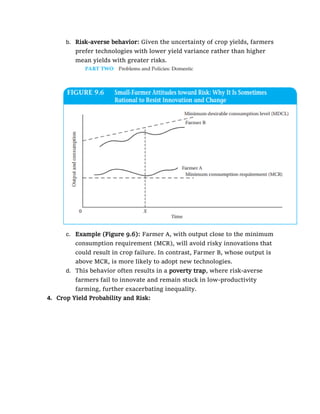
b. Risk-averse behavior: Given the uncertainty of crop yields, farmers
prefer technologies with lower yield variance rather than higher
mean yields with greater risks.
c. Example (Figure 9.6): Farmer A, with output close to the minimum
consumption requirement (MCR), will avoid risky innovations that
could result in crop failure. In contrast, Farmer B, whose output is
above MCR, is more likely to adopt new technologies.
d. This behavior often results in a poverty trap, where risk-averse
farmers fail to innovate and remain stuck in low-productivity
farming, further exacerbating inequality.
4. Crop Yield Probability and Risk:
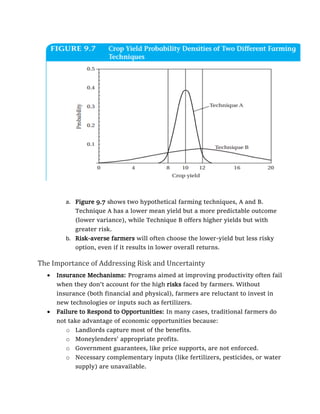
a. Figure 9.7 shows two hypothetical farming techniques, A and B.
Technique A has a lower mean yield but a more predictable outcome
(lower variance), while Technique B offers higher yields but with
greater risk.
b. Risk-averse farmers will often choose the lower-yield but less risky
option, even if it results in lower overall returns.
The Importance of Addressing Risk and Uncertainty
• Insurance Mechanisms: Programs aimed at improving productivity often fail
when they don't account for the high risks faced by farmers. Without
insurance (both financial and physical), farmers are reluctant to invest in
new technologies or inputs such as fertilizers.
• Failure to Respond to Opportunities: In many cases, traditional farmers do
not take advantage of economic opportunities because:
o Landlords capture most of the benefits.
o Moneylenders' appropriate profits.
o Government guarantees, like price supports, are not enforced.
o Necessary complementary inputs (like fertilizers, pesticides, or water
supply) are unavailable.
• Expropriation Risk: Farmers may reduce investment in land improvements
(like fertilization) if they fear the land could be expropriated, leading to
underinvestment in productive practices.
The Economics of Sharecropping and Interlocking Factor Markets
Sharecropping in Rural Economies:
• Sharecropping is a common practice where a peasant farmer works the land
of a landlord in exchange for a share of the food output (e.g., rice or wheat).
• The landlord’s share can range from less than a third to more than two-
thirds of the output, influenced by factors like labor availability and
provided inputs (e.g., credit, seeds, tools).
• Risk Aversion & Inefficiency: In regions with high land inequality, peasants
may prefer sharecropping due to risk aversion, as it reduces financial
uncertainty compared to fixed rent contracts. However, sharecropping often
leads to inefficiency due to poor incentives for hard work.
Inefficiency in Sharecropping:
• Alfred Marshall’s Perspective: Sharecroppers are paid only a fraction of
their marginal product of labor (e.g., in a 50-50 sharecropping system, the
sharecropper gets only 50% of their value marginal product of labor),
leading to lower effort and reduced output compared to a farm owner
working his own land.
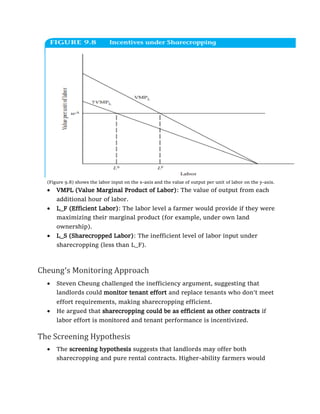
(Figure 9.8) shows the labor input on the x-axis and the value of output per unit of labor on the y-axis.
• VMPL (Value Marginal Product of Labor): The value of output from each
additional hour of labor.
• L_F (Efficient Labor): The labor level a farmer would provide if they were
maximizing their marginal product (for example, under own land
ownership).
• L_S (Sharecropped Labor): The inefficient level of labor input under
sharecropping (less than L_F).
Cheung’s Monitoring Approach
• Steven Cheung challenged the inefficiency argument, suggesting that
landlords could monitor tenant effort and replace tenants who don’t meet
effort requirements, making sharecropping efficient.
• He argued that sharecropping could be as efficient as other contracts if
labor effort is monitored and tenant performance is incentivized.
The Screening Hypothesis
• The screening hypothesis suggests that landlords may offer both
sharecropping and pure rental contracts. Higher-ability farmers would
prefer rental contracts, allowing landlords to screen tenants and ensure
they get the most productive labor.
Shaban’s Evidence on Sharecropping
• Radwan Ali Shaban’s empirical work on sharecropping found that
sharecroppers use fewer inputs and produce less output than when they
farm their own land, supporting the Marshallian view that sharecropping is
inefficient.
Efficiency Despite Inefficiency (Risk and Inequality)
• A final argument is that sharecropping could be efficient in risky
environments due to the balance of risks between landlords and tenants.
Landlords mitigate the risk of tenants underperforming, and tenants reduce
the risk of paying fixed rent in bad years.
• In situations with high land inequality and uncertainty, sharecropping
represents a compromise that is “as efficient as we can get.”
Tenancy Reform and Efficiency
• Well-designed tenancy reforms (e.g., in West Bengal, India) that provide
tenants with larger shares of produce and security of tenure can increase
work effort and overall efficiency.
• Land reform that gives ownership to the tiller can also improve incentives,
increase investments, and provide superior outcomes.
Interlocking Factor Markets
• Sharecropping often occurs in the context of interlocking factor markets,
where the landlord is also the tenant’s employer, lender, and buyer.
o This interlinked structure can provide the landlord with monopoly or
monopsony power, making it difficult for peasants to find better
terms or enter competitive markets.
o Interlocking markets can restrict entry, limit competition, and
maintain the landlord’s dominance in the system.
Land Reform and Tenant Welfare
• In cases of interlocking factor markets, land reform (breaking the landlord’s
dominance and giving tenants more autonomy) is often the only reliable
way to improve tenant welfare.
The Transition to Mixed or Diversified Farming
Diversified Farming as an Intermediate Step
• Diversified farming is a transitional phase where a mix of staple crops and
cash crops (fruits, vegetables, coffee, tea) is cultivated, along with simple
animal husbandry.
• This stage helps absorb disguised unemployment during slack seasons when
labor is underutilized.
o During parts of the year when staple crops are not in season, new
crops can be grown using idle land and available family labor.
Improving Labor Productivity in Diversified Farming
• Labor-saving devices (small tractors, mechanical seeders, animal-operated
plows) can be used to reduce labor demand during peak seasons and
increase efficiency.
• Better inputs (seeds, fertilizers, irrigation) can raise yields for staple crops,
freeing up land for cash crops.
Economic Benefits of Diversified Farming
• Diversification allows farmers to reduce risk by spreading production across
various crops and minimizes the impact of crop failure.
• It helps farmers achieve a marketable surplus, which can be used for
household consumption or reinvested in farm improvements.
• With diversified farming, farmers gain greater income security, reducing
the vulnerability of pure subsistence agriculture.
Barriers and Opportunities for Diversified Farming
• The success of diversified farming depends on access to credit, fertilizers,
water, and markets.
• Farmers respond well to economic incentives when conditions are
favorable, showing a willingness to innovate and adopt new farming
techniques.
• Social learning can play a crucial role, as farmers often learn new practices
from their peers (e.g., in Ghana, pineapple cultivation spread through
farmer networks).
From Divergence to Specialization: Modern Commercial Farming
Commercial Farming: The Final Stage
• Specialized commercial farming is the final stage of agricultural
transformation, common in industrialized countries.
• In this stage, the goal is maximum profit through high per-hectare yields
and technological advancements (e.g., irrigation, fertilizers, pesticides).
Features of Specialized Farms
• Capital-intensive methods (e.g., large machinery) and economies of scale
are central to specialized farming, enabling large-scale, efficient production.
• Farms can range from small, high-tech vegetable farms to vast grain fields.
• The emphasis is on market-driven production, where the primary focus is
maximizing profit rather than household consumption.
The Role of Corporations
• Large agribusiness corporations often manage the largest specialized farms,
particularly in developed countries, although this model is also emerging in
some middle-income countries like Brazil.
Challenges for Small Farmers
• While specialization is a viable path for large-scale operations, small-scale
farmers, particularly in developing countries, face challenges related to risk
management, market access, and coordination failures.
Difficulties in Transitioning to Specialization
• In many low-income countries, small-scale mixed farming still
predominates, and a shift to specialized commercial farming may be
difficult due to underlying structural issues.
• To encourage specialization, solutions must address access to resources,
technology, and markets for smallholders.
Smallholder Development as an Immediate Goal
• A focus on improving smallholder mixed farming can raise incomes,
increase productivity, and absorb underutilized labor, facilitating rural
development and progress toward more specialized farming systems.

AGRI Transformation&Rural Development Chp 9 Notes BY Arslan.pdf

  • 1.
    Migration, Agriculture, and RuralDevelopment in Developing Countries The Imperative of Agriculture progress and Rural Development M.Arslan BS Economics Akhuwat College Kasur.
  • 2.
    1. Rural Migrationand Urbanization • High rates of migration from rural areas to urban centers in Africa, Asia, and Latin America are fueled by economic stagnation in rural regions. • Despite urbanization, around 3.1 billion people lived in rural areas in developing countries in 2013, with many in extreme poverty. • More than 60% of the population in low- and lower-middle-income countries is rural. • Countries like Ethiopia, Nepal, Niger, Rwanda, and Uganda are over 80% rural, with economies heavily reliant on agriculture. • The agricultural sector is critical for economic development, especially in rural-based societies like sub-Saharan Africa and South Asia. 2. Agricultural Sector Challenges and Importance • Over two-thirds of the world’s poorest people live in rural areas, primarily relying on subsistence farming focused on survival. • Economic development in rural areas is essential to reduce poverty, address inequality, and manage rapid population growth. • Historical Perspective: Agriculture was traditionally viewed as a sector supporting industrial growth by providing cheap food and labor. • Modern Consensus: Agriculture plays an essential role in economic development, especially for low-income countries, as it can directly contribute to national progress. 3. Framework for Agricultural Transformation • Goals: o Increase agricultural output and productivity for small farmers to ensure food security and support urban growth. o Transition traditional, low-productivity farms to high-productivity commercial farms. o Consider the socio-economic rationale behind farmers’ behaviors and the need to mitigate risks. o Balance economic incentives with necessary institutional reforms for effective agricultural development.
  • 3.
    o Expand off-farmemployment and improve social services like education and healthcare to support rural development. o Strengthen food security at the national level. • Strategies for Transformation: o Output Growth: Use technology, institutional reform, and price incentives to boost small farmers’ productivity. o Rising Domestic Demand: Foster agricultural demand through urban development. o Rural Development Activities: Encourage non-agricultural, labor- intensive activities to create employment and support local economies. 4. Seven Key Questions for Agricultural and Rural Development • How to increase agricultural productivity to benefit small farmers and ensure food surplus? • What processes enable traditional farms to evolve into commercial enterprises? • How to assess and support the seemingly cautious or resistant behaviors of small farmers? • How do farmers manage high risks, and what policies can help mitigate these risks? • Are incentives enough to increase output, or are structural changes also needed? • Does improving agricultural productivity suffice, or is there a need for broader rural development? • How to enhance food security effectively? 5. Regional Agrarian Characteristics • Africa: Primarily agriculture-based economies with high poverty and traditional farming practices. • Asia: Agriculturally transforming economies with densely populated areas and smaller farm holdings. • Latin America: Urbanized economies with large-scale commercial farms and significant inequality between large and small farms. • Rural development varies across these regions due to differing agricultural, economic, and social structures.
  • 4.
    6. Integrated RuralDevelopment (IRD) • Definition: IRD is a comprehensive approach to rural development involving agricultural advancement, infrastructure, rural nonfarm industries, and sustained capacity building. • Objectives: o Increase agricultural productivity, provide infrastructure, promote rural industries, and improve living standards in rural areas. o Support rural economies to be self-sustaining and resilient to economic pressures. 7. Traditional Subsistence Agriculture and Transition to Commercial Farming • Majority of the extreme poor in developing countries work in agriculture, often in traditional subsistence farming. • Transition to commercial farming requires not only economic but also social, institutional, and structural support for small-scale farmers. 8. Case Study: Agricultural Extension for Women in Africa • Women play a critical role in African agriculture, yet many policies assume farmers are men. • Addressing this oversight is essential for effective agricultural policies and rural development. 9.2 Agricultural Growth: Past Progress and Current Challenges Trends in Agricultural Productivity. Trends in Agricultural Productivity and Economic Development 1. Agricultural Growth in Developing vs. Developed Regions • Agricultural production has kept pace with global population growth, countering some predictions of widespread food shortages. • Growth Rates:
  • 5.
    o Between 1980-2004,the developing world saw faster growth in agricultural output (2.6% per year) compared to the developed world (0.9% per year). o Developing countries' share of global agricultural GDP increased from 56% to 65%, while their share of non-agricultural GDP remained lower (21%). 2. Successful Agricultural Programs and Innovations • Various programs have successfully boosted agricultural productivity and reduced hunger: o Asia: Green Revolution, containment of wheat rusts. o Sub-Saharan Africa: Improved maize, pest-resistant cassavas. o Bangladesh: Use of shallow tubewells for rice, homestead food production. o East Asia: Hybrid rice and mung bean improvements. o India: Pearl millet, sorghum advancements, dairy marketing for smallholders. o China and Vietnam: Land tenure reforms. o Burkina Faso: Cotton sector reforms. o Kenya: Market improvements. 3. Comparative Agricultural Output (1970-2010) • Developing countries showed significant agricultural growth from 1970 to 2010. • OECD countries also saw growth, but transition countries lagged behind. • Despite global progress, Africa's agricultural output growth struggled to keep up with population increases. 4. Labor Force in Agriculture • In low-income countries, agriculture employs a large share of the labor force, often between 80-90%. • Economic Development Trends: o As GDP per capita increases, both the share of labor and GDP from agriculture tend to decline. o Exceptions exist where agriculture employment declines significantly without major GDP growth, as seen in Brazil and Nigeria.
  • 6.
    5. Regional Differencesin Agricultural Productivity (1960-2005) • Asia: Nearly tripled cereal yields per hectare. • Latin America: Achieved significant production gains. • China: Reduced hunger through agricultural improvements. • South Asia: Showed productivity gains, but hunger reportedly rose in India recently. • Sub-Saharan Africa: Saw modest yield improvements, but limited access to modern agricultural inputs has led to a poverty trap for subsistence farmers. 6. Challenges in African Agriculture • Population pressure has made traditional farming practices unsustainable, leading to soil degradation. • Financial constraints prevent subsistence farmers from accessing improved seeds, fertilizers, and modern tools, creating a cycle of poverty and low productivity. Agricultural Transformation and Rural Development (Famine in Africa) Recurrent Famines and Food Shortages in Africa: • Regions Affected: The Sahel, Horn of Africa, and other parts of sub-Saharan Africa have experienced repeated famines. o Example: The 2011 drought in the Horn of Africa affected over 13 million people. o The 1973–1974 Sahel famine caused hundreds of thousands of deaths. o 1980s-1990s: At least 22 African countries faced severe famine. o 2000s: Famine affected regions from Mauritania to Mozambique. • Current Malnutrition Crisis: o Over 270 million people in Africa suffer from malnutrition. o High rates of malnutrition, particularly in southern Somalia, where child malnutrition exceeds 50% in some regions. The Green Revolution and Agricultural Development:
  • 7.
    • Green Revolutionin Africa: Calls for a renewed focus on agricultural development similar to Asia's Green Revolution. o AGRA (Alliance for a Green Revolution in Africa), chaired by Kofi Annan, supports agricultural transformation. o NERICA Varieties (New Rice for Africa) developed in Benin have shown positive outcomes in some countries but have not been universally successful. • Challenges to Green Revolution Replication: o Institutional and social transformation is essential, not just technical advances. o High food prices (e.g., 2007–2008 and 2011 crises) have exposed vulnerabilities in food systems. Food Price Crisis: • Food Prices: Food prices have risen since the 2000s after falling during the 20th century. o Causes: Increased demand for food (particularly meat), biofuels production, energy prices, and climate change. o Impact: Rising prices disproportionately affect developing nations. o Prediction: Food prices will likely stay high in the long term due to structural challenges. Famine in the Horn of Africa (2011): • Causes: o Severe drought, worsened by La Niña (weather patterns disrupting seasonal rains). o Governance issues in Somalia and conflict from militant groups like Al-Shabaab hindered relief efforts. o Rising food prices exacerbated poverty, with food prices tripling in Somalia. • Famine Definition (UN): o Over 30% of children suffering from malnutrition. o Death rates of more than 2 adults/4 children per 10,000 people per day.
  • 8.
    o Access tofewer than 2,100 kilocalories of food and 4 liters of water per person daily. International and Government Response: • Global Aid Efforts: International aid organizations struggle to deliver aid due to governance issues and conflict. o WFP (World Food Program) faced obstruction by Al-Shabaab militants. o Food aid risks undermining local agriculture, causing food markets to collapse. • Entitlement Issue (Amartya Sen): o Famine often results not from a lack of food but from lack of access to it due to poverty and market failures. o Sen’s concept of entitlements: People’s command over commodities (ability to purchase food) is crucial for preventing famine. o Example: In the 1943 Bengal famine, food was available but unaffordable for many. Market Failures in Agriculture: • Market Failures: o Environmental externalities, information asymmetries, monopoly power in input supply. o Public goods like agricultural research and extension services require government support. o Missing markets and poor infrastructure hinder rural growth. • Government's Role: o Governments must intervene to correct market failures. o Poverty alleviation: Many poor are farmers, but poverty traps (lack of credit, education, and infrastructure) hinder progress. o Government policies should focus on creating a supportive environment for agricultural development. o Historical misguided policies (e.g., import substitution, exchange rate overvaluation) neglected agriculture, leading to inefficiencies.
  • 9.
    Poverty Traps: • Challengesfor Farmers: o Lack of collateral: Farmers cannot secure credit. o Missing markets: Farmers cannot access insurance or affordable inputs. o Social exclusion: Ethnic, caste, or gender inequalities further hinder access to resources. • Poverty Transmission: o Poverty prevents farmers from benefiting from trade liberalization and globalization. o Poor farmers often lack the means to escape poverty without external assistance. Role of Government in Agricultural Growth: • Governments should: o Provide credit, infrastructure, and market access to poor farmers. o Support rural development to ensure that agricultural growth benefits the poor. o Ensure inclusive growth, as excluding the poor limits overall economic growth and development. • Agricultural Growth and Poverty Reduction: o Sustainable agricultural growth can reduce poverty by involving the poor in the growth process, improving their livelihoods, and fostering inclusive economic development. 9.3 The Structure of Agrarian Systems in the Developing World Three Systems of Agriculture. Three Systems of Agriculture Understanding agricultural systems in developing countries and their economic aspects is crucial for the transition from subsistence to commercial agriculture. Alain de Janvry and his colleagues, in the 2008 World Development Report, propose categorizing global agriculture into three systems:
  • 10.
    1. Agriculture-Based Countries •Key Characteristics: o Agriculture remains a major source of economic growth (32% of GDP on average). o More than two-thirds of the poor in these countries live in rural areas. o Sub-Saharan Africa (82% of rural population) and countries like Laos and Senegal fall into this category. o Agriculture is a key part of economic development but is heavily reliant on labor-intensive farming. 2. Transforming Countries • Key Characteristics: o Agriculture contributes less to GDP (7% on average). o The majority of the population (2.2 billion people) still live in rural areas, but rural poverty is high (close to 80%). o Most countries in South and East Asia, North Africa, and the Middle East, such as Guatemala, are in this category. o Rural-to-urban migration is increasing, and agriculture plays a less significant role in economic output. 3. Urbanized Countries • Key Characteristics: o Rural-urban migration is widespread, and nearly half of the poor are now living in cities. o Agriculture contributes very little to GDP growth. o Found in Latin America, the Caribbean, Eastern Europe, and Central Asia. o These countries face the challenge of integrating the rural poor into urban economies, often with limited success.
  • 11.
    Agricultural Productivity Variations •Land Productivity: Varies dramatically across countries. For example, the U.S. has much higher grain yields per hectare than India or the DRC. This reflects differences in technology, land management, and capital investment. • Labor Productivity: The U.S. also has much higher value added per agricultural worker compared to lower-income countries, like India or Congo. Regional Disparities • In countries like India, regions exhibit different agricultural conditions, ranging from modernized areas (Punjab) to less developed ones (Bihar). Even in higher-income countries like Mexico, rural poverty and dependence on agriculture persist in certain regions. Traditional and Peasant Agriculture in Latin America, Asia, and Africa • Latin America: o Latin America is characterized by a dual agricultural structure: Latifundios (large landholdings) and Minifundios (small farms). Latifundios often have high land inequality, with a few large landowners controlling significant resources, and minifundios often remain inefficient. o Land Inequality: High land Gini coefficients (e.g., Brazil 0.77) reflect high inequality in land distribution, which affects social and political organization. o Family and Medium-Size Farms: Efficient family and medium-sized farms often have higher productivity than latifundios or minifundios. • Asia and Africa: o Asia: Characterized by fragmented, small land parcels with high population density, leading to low average farm sizes. o Africa: Historical land availability has led to different patterns of land distribution, and countries in Africa exhibit varying levels of agricultural development.
  • 12.
    o Economic Dualism:In regions like Latin America, the shift from large estates to more family-oriented and efficient medium-size farms is critical for agricultural growth. Land Distribution Patterns • Land Lorenz Curves & Gini Coefficients: o Land inequality is often measured using Land Gini coefficients, which show the concentration of landholdings. o In many developing countries, land sizes are shrinking as land is subdivided. Agrarian Patterns in Latin America • Latifundio-Minifundio System: o Latifundios (large farms) are inefficient due to high transaction costs and low productivity. o Minifundios (small farms) are often economically unproductive but are crucial for subsistence farming. o Medium-sized and Family Farms: Efficient in terms of land use and labor, they contribute significantly to agricultural output in countries like Brazil and Uruguay. • Inefficiency in Large Farms: o Latifundios often remain underutilized as landowners prioritize political power over agricultural productivity. o Smaller farms tend to be more efficient because they leverage family labor, which is cheaper than hired labor. Latin America's Agricultural Development • Challenges: o Despite growth in non-traditional exports (e.g., fruits, wines), rural inequality remains high. o Historical legacies of colonialism (e.g., exploitation of indigenous people) continue to affect land distribution and economic development.
  • 13.
    o The latifundio-minifundiosystem is still dominant in some parts of the region, contributing to poverty and social inequality. • Progress: o Countries like Chile have experienced success in agricultural diversification (e.g., fruits, aquaculture). o Brazil's sugarcane-based biofuels and soybean production contribute to agricultural growth. • Ongoing Challenges: o Regions with extreme poverty often remain locked in cycles of inequality, exacerbated by limited access to credit and political participation. o Rural-to-urban migration has left rural areas with aging, female- dominated, and often indigenous populations, which limits economic mobility. Agricultural Transformation and Rural Development in Asia and Africa Land Fragmentation and Socio-Economic Issues in Asia: 1. Problem of Land Fragmentation: a. Average Farm Size (Example countries): i. Thailand: 3.4 hectares ii. Pakistan: 3.1 hectares iii. India: 1.4 hectares iv. Bangladesh: 0.6 hectares b. Trend: Farm sizes have been shrinking over time due to population growth and land scarcity. 2. Land Inequality: a. Gini Coefficients for Land Distribution: i. India: 0.448 ii. Bangladesh: 0.483 iii. Thailand: 0.467 iv. Pakistan: 0.540 b. Despite more equitable distribution than in Latin America, inequality still exists. 3. Historical Forces Shaping Land Ownership:
  • 14.
    a. Colonial Rule: i.European powers (British, French, Dutch) introduced private property rights, disrupting traditional communal land ownership. ii. Impact: Breakup of village cohesion and informal land rights. b. Monetization: i. The rise of moneylenders, who gained power by offering loans with high interest rates. Peasants often had to forfeit land when they couldn’t repay, leading to further fragmentation. c. Population Growth: Increased land pressure, leading to smaller holdings and worsened poverty. 4. Impact of Sharecropping and Land Ownership: a. Sharecropping: Widespread in Asia, especially in India (48%), Indonesia (60%), and the Philippines (79%). It is less common in Latin America. b. Landlords: Often absentee and not involved in agricultural work. Sharecroppers work the land and share profits with the landlord. c. Moneylender Role: Moneylenders took advantage of land as collateral for loans. Defaults often resulted in the peasants losing their land. 5. Consequences of Fragmentation: a. Peasants, with shrinking landholdings, often fall below subsistence levels. b. Chronic Poverty: Many peasants become tenant farmers or landless laborers. c. Rural to urban migration leads to slums and worsening living conditions for many. 6. Example Countries with Fragmentation: a. India, Indonesia, Philippines: Population growth led to a dramatic increase in land fragmentation, reducing farm size to below 1 hectare in some areas. b. Result: Growing chronic poverty and displacement of peasants. 7. Land Reforms and Productivity: a. Post-Independence Impact: Areas with landlord-based land tenure had lower productivity and investment in health and education than regions where land rights were given directly to cultivators.
  • 15.
    Subsistence Agriculture andExtensive Cultivation in Africa: 1. Characteristics of Traditional African Agriculture: a. Subsistence Farming: Most farms produce primarily for family consumption, with limited market-oriented crops (e.g., cocoa, tea, sugar in certain regions). b. Shifting Cultivation: Used to manage small plots of land, with soil fertility maintained by letting land lie fallow for recovery. c. Land Access: Villages traditionally had communal land access rights, with rights often restricted to members of the community. 2. Challenges to Productivity: a. Limited Tools: Traditional tools such as hoes and knives lead to low productivity. b. Shifting Cultivation: While effective in the past, increasing population densities make it unsustainable, as land is depleted faster than it can recover. c. Labor Scarcity: Labor is in high demand during planting and weeding seasons, while there is underemployment during other periods of the year. 3. Historical Factors Affecting Agricultural Output: a. Low Productivity: Due to traditional farming methods and limited technology. b. Population Growth: Increasing population pressures lead to smaller farms and reduced availability of fertile land for shifting cultivation. 4. Transition to Sedentary Cultivation: a. As population density increases, shifting cultivation is replaced by permanent cultivation on smaller plots. b. This shift increases the need for external inputs like fertilizers and irrigation. 5. Land Degradation: a. Deforestation and Soil Erosion: In response to the growing population and need for land, the natural environment is increasingly degraded. b. Challenges: The introduction of modern farming inputs, such as fertilizers and irrigation, remains limited in many regions, especially in sub-Saharan Africa. 6. Key Issues Facing African Agriculture:
  • 16.
    a. Low FertilizerUse: African farmers use less than 10 kg of fertilizer per hectare compared to over 100 kg in South Asia. b. Irrigation Deficit: Only 4% of cropland is irrigated in sub-Saharan Africa, compared to much higher percentages in South and East Asia. c. Unreliable Rainfall: Combined with poor soil quality, this makes agriculture increasingly unsustainable. 7. Recent Developments: a. Efforts to improve soil and water management, and expand the use of fertilizers and irrigation, are critical to improving productivity in the region. b. There is a growing need for agroforestry practices to help replenish soil fertility. 8. Food Security Challenges: a. Africa has struggled to increase food production at a pace sufficient to keep up with its population growth, resulting in declining per capita food consumption and increased reliance on food imports. Summary of Major Issues: • Asia: Land fragmentation, inequality, and exploitation by moneylenders are key issues. Population growth and colonial legacies have made the situation worse, leading to shrinking farm sizes and rising poverty. • Africa: Subsistence agriculture and shifting cultivation have historically been the dominant farming systems, but increasing population pressures and environmental degradation are causing these systems to break down. There is an urgent need for improved agricultural technologies, soil management, and irrigation to increase productivity and food security. 9.4 The Important Role of Women Introduction to Women's Role in Agriculture: • Overlooked Contribution: Women play a crucial, yet often overlooked, role in agricultural production in developing regions, especially in Africa and Asia.
  • 17.
    • Subsistence Farming:In many African societies, nearly all tasks related to subsistence food production are performed by women, including sowing, weeding, harvesting, and preparing crops for consumption or storage. Tasks and Labor Distribution in African Agriculture: 1. Division of Labor: a. Men's Role: In some regions, men cut trees and bushes to prepare land, while their wives handle all subsequent activities. b. Women's Role: Tasks such as planting, weeding, harvesting, and preparing crops for storage or immediate consumption are typically performed by women. c. Time and Labor: Women contribute the majority (60-80%) of agricultural labor in Africa and Asia, while men often engage in cash crop production or seek income outside the household. 2. Research Findings (Ester Boserup): a. Women typically perform 70%-80% of agricultural tasks in certain studies on African women’s labor. b. This work is often carried out using primitive tools and requires intense labor over extended periods. 3. Gendered Time Poverty: a. Women’s “time poverty” is a consequence of their extensive work both within the household and in the fields. They often spend more time than men on work that is unpaid and not always recognized. Women's Contributions Beyond Agricultural Labor: 1. Diversified Roles: a. Cash Crop Production: Women contribute significantly to weeding and transplanting cash crops, though the control and profits from commercial crops are generally in men’s hands. b. Livestock: Women often raise and market livestock, which can provide additional income for the household. c. Cottage Industries: Women are involved in household production for sale, including homemade beer, food processing, handicrafts, and textiles.
  • 18.
    d. Firewood andWater Collection: Women spend time collecting firewood and water, which can take several hours a day, often from distant sources. 2. Household Food Security: a. Women play a central role in ensuring food security through the production of vegetables for household consumption, diversifying income sources, and raising livestock. b. These contributions help mitigate the impact of food price fluctuations and reduce the household’s dependence on cash purchases. 3. Financial Risk and Household Economics: a. Resource Constraints: Women often face financial limitations and, when credit is unavailable, they resort to less efficient production methods, leading to stagnation in productivity. b. Female-Headed Households: In female-headed households, the lack of resources is particularly pronounced, leading to higher vulnerability and reduced income opportunities. Challenges and Gender Inequality in Agricultural Development: 1. Impact of Commercialization: a. As agriculture becomes more commercialized, women’s roles and economic status are often diminished. The focus on cash cropping diverts household resources (e.g., land, inputs) from women’s food crops to market-oriented crops controlled by men. b. Credit Access: Women typically face barriers to accessing agricultural credit, further entrenching their economic disadvantage. 2. Disparities in Agricultural Programs: a. Exclusion from Programs: Women are often excluded from government agricultural extension programs, which are usually directed towards men. b. Land Reform: Land reforms that distribute land titles to male heads of households can reduce women’s income and status within the family.
  • 19.
    c. Training: Whenwomen are involved in agricultural training, it is often limited to low-productivity tasks, reinforcing traditional gender roles. Economic Inefficiencies Due to Gender Inequality: 1. Labor and Resource Misallocation: a. Studies show that when resources like labor and fertilizers are allocated unequally between men’s and women’s plots within the same household, productivity can be significantly reduced. b. For example, research in Burkina Faso revealed that plots controlled by women had lower yields due to less optimal allocation of resources (e.g., labor, fertilizers) compared to plots controlled by men. 2. Efficiency Losses: a. Gender inequality in resource allocation leads to significant inefficiency in agricultural production. Misallocation of labor and inputs reduces overall output and potential economic gains. Policy Implications: 1. Inclusive Agricultural Policy: a. Empowering Women: To achieve agricultural success, policies must target women’s productivity and ensure gender-specific needs are addressed in development strategies. b. Direct Resources to Women: Studies show that when resources are placed directly under women’s control, agricultural projects are more successful. Programs that depend on women’s unpaid labor are often ineffective. 2. Impact of Male-Controlled Resources: a. Providing men with control over cash crop revenues can increase their bargaining power, sometimes to the detriment of women’s economic position and family welfare. b. Evidence suggests that income controlled by women is more likely to be invested in children’s health and education, underscoring the importance of empowering women for broader socio-economic benefits.
  • 20.
    3. Recommendations forGender-Sensitive Programs: a. Integration into Extension Programs: Women must have equal access to agricultural inputs, credit, and training to enhance productivity. b. Adjusting Land Reforms: Ensure that land reforms include provisions for women’s rights to land ownership. c. Support Female Entrepreneurs: Foster women's engagement in non- farm activities and empower them to access markets and credit to diversify income sources. 4. Social Justice and Efficiency: a. Beyond social justice concerns, gender equity in agriculture can lead to better economic outcomes, as reallocating resources to support women’s agricultural work can result in higher efficiency and productivity across households. 9.5 The Microeconomics of Farmer Behavior and Agricultural Development. Evolution of Agricultural Production Agricultural production evolves through three main stages: 1. Traditional (Peasant) Farming: a. Characteristics: Low productivity, subsistence-based, and minimal technology use. Predominant in many regions of Africa. b. Structure: The majority of the produce is for family consumption, with little or no surplus for sale. c. Challenges: Dependence on manual labor, low investment in capital, and the law of diminishing returns in the use of land. d. Risks: Highly vulnerable to climate changes like irregular rainfall, land appropriation, and the exploitation by moneylenders. e. Socioeconomic Conditions: Low productivity, labor underutilization, and risk-averse behaviors dominate in these settings. 2. Diversified or Mixed Family Agriculture: a. Characteristics: Small-scale farms producing for both self- consumption and sale in the market. Common in parts of Asia. b. Economic Changes: Farmers diversify their crops to reduce risk, but still face challenges in moving beyond subsistence farming. 3. Modern Commercial Farming:
  • 21.
    a. Characteristics: Highproductivity, specialized production geared towards the commercial market. Predominantly found in developed countries and urbanized developing economies. b. Economic Changes: Farms focus on specialization and increased efficiency, leading to more capital-intensive farming practices. Agricultural Modernization and Social Transformation • Transitioning from subsistence to diversified or specialized farming involves not just changes in farming methods, but also social, political, and institutional shifts in rural societies. • Without these broader changes, inequality between wealthy landholders and the impoverished masses (tenant farmers, smallholders, and landless laborers) may worsen. Subsistence Farming: Risk Aversion, Uncertainty, and Survival 1. Characteristics of Subsistence Farms: a. Focus: Primarily for family consumption, with minimal surplus for market exchange. b. Staple Crops: Common crops include cassava, wheat, sorghum, rice, and maize. c. Low Productivity: Traditional methods and tools result in low output. d. Labor: High labor intensity but often underemployment during the off-seasons. e. Challenges: Farmers face risks such as crop failure due to unreliable rainfall, land appropriation, and financial distress due to debts. 2. Economic Rationale Behind Subsistence Farming: a. The neoclassical theory of production argues that labor is the variable input while land and capital are fixed. b. Diminishing marginal productivity explains low productivity— additional labor results in less incremental output due to land constraints. c. The theory, however, fails to account for why farmers resist technological innovations. This resistance is not necessarily irrational but reflects the high risk and uncertainty associated with potential crop failures. 3. Risk Aversion in Subsistence Farming: a. Main Goal: Survival rather than maximizing income.
  • 22.
    b. Risk-averse behavior:Given the uncertainty of crop yields, farmers prefer technologies with lower yield variance rather than higher mean yields with greater risks. c. Example (Figure 9.6): Farmer A, with output close to the minimum consumption requirement (MCR), will avoid risky innovations that could result in crop failure. In contrast, Farmer B, whose output is above MCR, is more likely to adopt new technologies. d. This behavior often results in a poverty trap, where risk-averse farmers fail to innovate and remain stuck in low-productivity farming, further exacerbating inequality. 4. Crop Yield Probability and Risk:
  • 23.
    a. Figure 9.7shows two hypothetical farming techniques, A and B. Technique A has a lower mean yield but a more predictable outcome (lower variance), while Technique B offers higher yields but with greater risk. b. Risk-averse farmers will often choose the lower-yield but less risky option, even if it results in lower overall returns. The Importance of Addressing Risk and Uncertainty • Insurance Mechanisms: Programs aimed at improving productivity often fail when they don't account for the high risks faced by farmers. Without insurance (both financial and physical), farmers are reluctant to invest in new technologies or inputs such as fertilizers. • Failure to Respond to Opportunities: In many cases, traditional farmers do not take advantage of economic opportunities because: o Landlords capture most of the benefits. o Moneylenders' appropriate profits. o Government guarantees, like price supports, are not enforced. o Necessary complementary inputs (like fertilizers, pesticides, or water supply) are unavailable.
  • 24.
    • Expropriation Risk:Farmers may reduce investment in land improvements (like fertilization) if they fear the land could be expropriated, leading to underinvestment in productive practices. The Economics of Sharecropping and Interlocking Factor Markets Sharecropping in Rural Economies: • Sharecropping is a common practice where a peasant farmer works the land of a landlord in exchange for a share of the food output (e.g., rice or wheat). • The landlord’s share can range from less than a third to more than two- thirds of the output, influenced by factors like labor availability and provided inputs (e.g., credit, seeds, tools). • Risk Aversion & Inefficiency: In regions with high land inequality, peasants may prefer sharecropping due to risk aversion, as it reduces financial uncertainty compared to fixed rent contracts. However, sharecropping often leads to inefficiency due to poor incentives for hard work. Inefficiency in Sharecropping: • Alfred Marshall’s Perspective: Sharecroppers are paid only a fraction of their marginal product of labor (e.g., in a 50-50 sharecropping system, the sharecropper gets only 50% of their value marginal product of labor), leading to lower effort and reduced output compared to a farm owner working his own land.
  • 25.
    (Figure 9.8) showsthe labor input on the x-axis and the value of output per unit of labor on the y-axis. • VMPL (Value Marginal Product of Labor): The value of output from each additional hour of labor. • L_F (Efficient Labor): The labor level a farmer would provide if they were maximizing their marginal product (for example, under own land ownership). • L_S (Sharecropped Labor): The inefficient level of labor input under sharecropping (less than L_F). Cheung’s Monitoring Approach • Steven Cheung challenged the inefficiency argument, suggesting that landlords could monitor tenant effort and replace tenants who don’t meet effort requirements, making sharecropping efficient. • He argued that sharecropping could be as efficient as other contracts if labor effort is monitored and tenant performance is incentivized. The Screening Hypothesis • The screening hypothesis suggests that landlords may offer both sharecropping and pure rental contracts. Higher-ability farmers would
  • 26.
    prefer rental contracts,allowing landlords to screen tenants and ensure they get the most productive labor. Shaban’s Evidence on Sharecropping • Radwan Ali Shaban’s empirical work on sharecropping found that sharecroppers use fewer inputs and produce less output than when they farm their own land, supporting the Marshallian view that sharecropping is inefficient. Efficiency Despite Inefficiency (Risk and Inequality) • A final argument is that sharecropping could be efficient in risky environments due to the balance of risks between landlords and tenants. Landlords mitigate the risk of tenants underperforming, and tenants reduce the risk of paying fixed rent in bad years. • In situations with high land inequality and uncertainty, sharecropping represents a compromise that is “as efficient as we can get.” Tenancy Reform and Efficiency • Well-designed tenancy reforms (e.g., in West Bengal, India) that provide tenants with larger shares of produce and security of tenure can increase work effort and overall efficiency. • Land reform that gives ownership to the tiller can also improve incentives, increase investments, and provide superior outcomes. Interlocking Factor Markets • Sharecropping often occurs in the context of interlocking factor markets, where the landlord is also the tenant’s employer, lender, and buyer. o This interlinked structure can provide the landlord with monopoly or monopsony power, making it difficult for peasants to find better terms or enter competitive markets. o Interlocking markets can restrict entry, limit competition, and maintain the landlord’s dominance in the system.
  • 27.
    Land Reform andTenant Welfare • In cases of interlocking factor markets, land reform (breaking the landlord’s dominance and giving tenants more autonomy) is often the only reliable way to improve tenant welfare. The Transition to Mixed or Diversified Farming Diversified Farming as an Intermediate Step • Diversified farming is a transitional phase where a mix of staple crops and cash crops (fruits, vegetables, coffee, tea) is cultivated, along with simple animal husbandry. • This stage helps absorb disguised unemployment during slack seasons when labor is underutilized. o During parts of the year when staple crops are not in season, new crops can be grown using idle land and available family labor. Improving Labor Productivity in Diversified Farming • Labor-saving devices (small tractors, mechanical seeders, animal-operated plows) can be used to reduce labor demand during peak seasons and increase efficiency. • Better inputs (seeds, fertilizers, irrigation) can raise yields for staple crops, freeing up land for cash crops. Economic Benefits of Diversified Farming • Diversification allows farmers to reduce risk by spreading production across various crops and minimizes the impact of crop failure. • It helps farmers achieve a marketable surplus, which can be used for household consumption or reinvested in farm improvements. • With diversified farming, farmers gain greater income security, reducing the vulnerability of pure subsistence agriculture. Barriers and Opportunities for Diversified Farming
  • 28.
    • The successof diversified farming depends on access to credit, fertilizers, water, and markets. • Farmers respond well to economic incentives when conditions are favorable, showing a willingness to innovate and adopt new farming techniques. • Social learning can play a crucial role, as farmers often learn new practices from their peers (e.g., in Ghana, pineapple cultivation spread through farmer networks). From Divergence to Specialization: Modern Commercial Farming Commercial Farming: The Final Stage • Specialized commercial farming is the final stage of agricultural transformation, common in industrialized countries. • In this stage, the goal is maximum profit through high per-hectare yields and technological advancements (e.g., irrigation, fertilizers, pesticides). Features of Specialized Farms • Capital-intensive methods (e.g., large machinery) and economies of scale are central to specialized farming, enabling large-scale, efficient production. • Farms can range from small, high-tech vegetable farms to vast grain fields. • The emphasis is on market-driven production, where the primary focus is maximizing profit rather than household consumption. The Role of Corporations • Large agribusiness corporations often manage the largest specialized farms, particularly in developed countries, although this model is also emerging in some middle-income countries like Brazil. Challenges for Small Farmers • While specialization is a viable path for large-scale operations, small-scale farmers, particularly in developing countries, face challenges related to risk management, market access, and coordination failures.
  • 29.
    Difficulties in Transitioningto Specialization • In many low-income countries, small-scale mixed farming still predominates, and a shift to specialized commercial farming may be difficult due to underlying structural issues. • To encourage specialization, solutions must address access to resources, technology, and markets for smallholders. Smallholder Development as an Immediate Goal • A focus on improving smallholder mixed farming can raise incomes, increase productivity, and absorb underutilized labor, facilitating rural development and progress toward more specialized farming systems.