Jorge Nunez-Ferrer
CEU
Master course Economics
Markets, prices and
perceptions
Subjects
How are they interlinked?
Drivers to
demand
changes
Prices –
Winners and
losers
The future?
DRIVERS IN THE
AGRICULTURAL MARKETS
BASICS
DRIVERS OF PRICES AND PRODUCTION ARE:
• Population growth
• Population wealth and change in food preferences
• Production technologies
• Market structures
• Politics
• Trade barriers, trade agreements
• Climate
Partial, bad, badly communicated analysis
• Lobbies, groups, even analytical institutes
confuse cause and effect and often contradict
each other
• Big temptation for researchers is to forget that
correct analysis is not to find evidence that
reinforces your convictions, but to test your
hypothesis against facts – all facts. It is even
better to search for evidence agaist your
hypothesis.
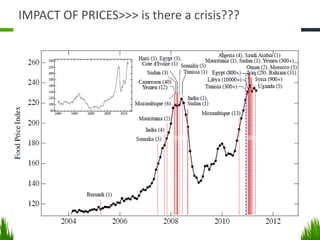
IMPACT OF PRICES>>> is there a crisis???
YES……. OR
Not really
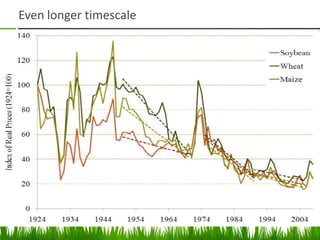
Even longer timescale
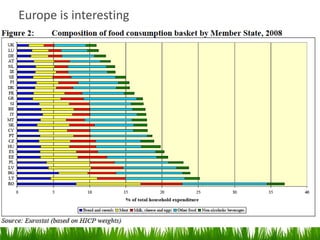
Europe is interesting
Alarm bells….. In all cases
• FAO: 2005: “The long-term downward trend in
agricultural commodity prices threatens the food security
of hundreds of millions of people in some of the world's
poorest developing countries where the sale of
commodities is often the only source of cash.”
• (IFPRI): “In 2007, longstanding disruptions to the world
food equation became widely evident and rapidly rising
food prices began to further threaten the food security of
poor people around the world. … The current food-price
crisis can have long-term, detrimental effects on peoples’
health and livelihoods, and can contribute to the further
impoverishment of many of the world’s poorest people.”
We are always miserable….
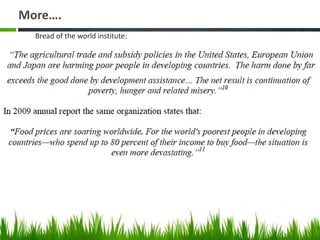
More….
Bread of the world institute:
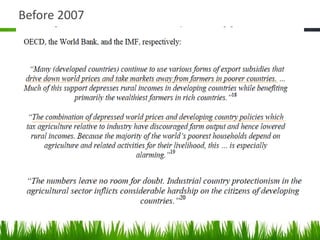
Before 2007
2007-2008
Changes in demand and
production
Impacts of climate change
Changes in consumption
Productivity growth… and more possible
But more
Needed!
MAIN IMPACTS…. Richer… more…. FAT (France)
Meat intake driven changes 1961-63, 2003-5
Changes EU 15
Food chain losses Feed to animal conversion of 2,9
Something missing?
Retail product standards?
Emissions is a problem with livestock
18% because
Of livestock
Overweight health care costs
Is there a role for agricultural policy??
• Difficult debate…
• Is diet an issue for agricultural policy… does
policy affect diets?
• How can we analyse this?
Closing debate on food:
Common beliefs
The Bio debate, your opinion on statements?
Bio products are safer
Bio products are healthier
Bio products can combat obesity
According to definition GMOs cannot be bio
products
Bio products fetch a higher price
Bio products ensure smaller farms are viable and
supports family farms
Labelling informs consumers
Safety
• Safety is not higher, but even be lower.
• Bio products may only be safer because farmers have
performed more stricter controls, but as bio expands
….?
• Pathogen risk should be higher in bio
• EU checks safety strongly of ALL products
Health
• Not clear. Maybe as residues of some products lower.
Produce may be of better quality
• A bad pizza is bad, even if organic components are in.
GMOs incompatible with BIO…. Why?
• Why? The labelling on GMOs is on a technological
process, not the product. Most products are
genetically modified in one way or another. Should we
look at process or product?
• This is not a globally accepted rule, but generated by
lobbyist. It is not in line with the original FAO definition
which only focuses on soil protection and fertility.
Some GMOs are proven to be less damaging than
conventional farming to the environment.
• One of the most common bio pesticides in Europe is a
toxic genetically modified dead bacteria, but that
degrades better and is less damaging.
• Wheat is an unnatural product, did not exist so long
ago.
• Most products are coming from genetic manipulation
of various types
• An approved biotech mechanism, not labeled as GM,
is, for example, particle bombardment to cause
mutations or chemical treatments safer? Probably
not, thus what are we regulating?
• By focusing on a technique and not on the products
we are causing considerable damage, wasting public
money and ignoring worse techniques and constant
technological change.
Bio fetches higher price
• While production is limited, yes, but much of it has
technologically developed and matches normal farming
in yield. Prices then fall.
• Big retailers are selling large and cheaper
• Some bio products are sold as conventional to keep
prices up of bio labelled products (Austrian milk case for
example).
Bio fosters small farms
• False: Bio needs more land and the bigger the better,
and farm sizes are increasing.
• Smaller farms need more intensive production to
survive or a strong brand name (bio is however
becoming banal)
Bio is better
Labelling
• People confuse labelling with a food safety warning.
Food safety standards are the same for all products.
• Border controls cost millions to detect GMOs… but
techniques only detect known GMOs, mainly
approved ones, GM products with non registered
genes go through.
• The EU wanted to label Biofuels from GM plants….?
Where is the DNA in the biofuel???
• Other oils from GM plants are labelled, but oil
contains no DNA and is not distinguishable… so what
are we labelling?
• On the other hand, cheese processed with modified
bacteria is not labelled GMO.
EU biotech policy
• Follows mini-max approach leading to a
religious rejection of a technological process
rather than the product. Despite strong food
safety standards GM technology is blocked also
for products with environmental and health
value (chemical use in Europe much higher in
many products)
• Environment, health and food safety are
confused and open discussions impossible
• But this is human nature: A Friend of mine
travels to Poland by car from Brussels, because
she is scared of dangers of plane and train
travel……….. and is a chain smoker….
We are very spoiled… and very
confused/manipulated
Avaaz

CEU lecture 6

  • 1.
    Jorge Nunez-Ferrer CEU Master courseEconomics Markets, prices and perceptions
  • 2.
    Subjects How are theyinterlinked? Drivers to demand changes Prices – Winners and losers The future?
  • 3.
  • 4.
    BASICS DRIVERS OF PRICESAND PRODUCTION ARE: • Population growth • Population wealth and change in food preferences • Production technologies • Market structures • Politics • Trade barriers, trade agreements • Climate
  • 5.
    Partial, bad, badlycommunicated analysis • Lobbies, groups, even analytical institutes confuse cause and effect and often contradict each other • Big temptation for researchers is to forget that correct analysis is not to find evidence that reinforces your convictions, but to test your hypothesis against facts – all facts. It is even better to search for evidence agaist your hypothesis.
  • 6.
    IMPACT OF PRICES>>>is there a crisis???
  • 7.
  • 8.
  • 9.
  • 10.
  • 11.
    Alarm bells….. Inall cases • FAO: 2005: “The long-term downward trend in agricultural commodity prices threatens the food security of hundreds of millions of people in some of the world's poorest developing countries where the sale of commodities is often the only source of cash.” • (IFPRI): “In 2007, longstanding disruptions to the world food equation became widely evident and rapidly rising food prices began to further threaten the food security of poor people around the world. … The current food-price crisis can have long-term, detrimental effects on peoples’ health and livelihoods, and can contribute to the further impoverishment of many of the world’s poorest people.”
  • 12.
    We are alwaysmiserable….
  • 13.
    More…. Bread of theworld institute:
  • 14.
  • 15.
  • 16.
    Changes in demandand production Impacts of climate change
  • 17.
  • 18.
    Productivity growth… andmore possible But more Needed!
  • 19.
    MAIN IMPACTS…. Richer…more…. FAT (France)
  • 20.
    Meat intake drivenchanges 1961-63, 2003-5
  • 21.
  • 22.
    Food chain lossesFeed to animal conversion of 2,9 Something missing? Retail product standards?
  • 23.
    Emissions is aproblem with livestock 18% because Of livestock
  • 24.
  • 25.
    Is there arole for agricultural policy?? • Difficult debate… • Is diet an issue for agricultural policy… does policy affect diets? • How can we analyse this?
  • 30.
    Closing debate onfood: Common beliefs The Bio debate, your opinion on statements? Bio products are safer Bio products are healthier Bio products can combat obesity According to definition GMOs cannot be bio products Bio products fetch a higher price Bio products ensure smaller farms are viable and supports family farms Labelling informs consumers
  • 31.
    Safety • Safety isnot higher, but even be lower. • Bio products may only be safer because farmers have performed more stricter controls, but as bio expands ….? • Pathogen risk should be higher in bio • EU checks safety strongly of ALL products Health • Not clear. Maybe as residues of some products lower. Produce may be of better quality • A bad pizza is bad, even if organic components are in.
  • 32.
    GMOs incompatible withBIO…. Why? • Why? The labelling on GMOs is on a technological process, not the product. Most products are genetically modified in one way or another. Should we look at process or product? • This is not a globally accepted rule, but generated by lobbyist. It is not in line with the original FAO definition which only focuses on soil protection and fertility. Some GMOs are proven to be less damaging than conventional farming to the environment. • One of the most common bio pesticides in Europe is a toxic genetically modified dead bacteria, but that degrades better and is less damaging.
  • 33.
    • Wheat isan unnatural product, did not exist so long ago. • Most products are coming from genetic manipulation of various types • An approved biotech mechanism, not labeled as GM, is, for example, particle bombardment to cause mutations or chemical treatments safer? Probably not, thus what are we regulating? • By focusing on a technique and not on the products we are causing considerable damage, wasting public money and ignoring worse techniques and constant technological change.
  • 34.
    Bio fetches higherprice • While production is limited, yes, but much of it has technologically developed and matches normal farming in yield. Prices then fall. • Big retailers are selling large and cheaper • Some bio products are sold as conventional to keep prices up of bio labelled products (Austrian milk case for example). Bio fosters small farms • False: Bio needs more land and the bigger the better, and farm sizes are increasing. • Smaller farms need more intensive production to survive or a strong brand name (bio is however becoming banal) Bio is better
  • 35.
    Labelling • People confuselabelling with a food safety warning. Food safety standards are the same for all products. • Border controls cost millions to detect GMOs… but techniques only detect known GMOs, mainly approved ones, GM products with non registered genes go through. • The EU wanted to label Biofuels from GM plants….? Where is the DNA in the biofuel??? • Other oils from GM plants are labelled, but oil contains no DNA and is not distinguishable… so what are we labelling? • On the other hand, cheese processed with modified bacteria is not labelled GMO.
  • 36.
    EU biotech policy •Follows mini-max approach leading to a religious rejection of a technological process rather than the product. Despite strong food safety standards GM technology is blocked also for products with environmental and health value (chemical use in Europe much higher in many products) • Environment, health and food safety are confused and open discussions impossible • But this is human nature: A Friend of mine travels to Poland by car from Brussels, because she is scared of dangers of plane and train travel……….. and is a chain smoker….
  • 37.
    We are veryspoiled… and very confused/manipulated Avaaz

Editor's Notes

  • #2 This presentation demonstrates the new capabilities of PowerPoint and it is best viewed in Slide Show. These slides are designed to give you great ideas for the presentations you’ll create in PowerPoint 2011! For more sample templates, click the File menu, and then click New From Template. Under Templates, click Presentations.