SURGICAL TECHNIQUES
IN CERVICAL SPINE
STABILIZATION
Manish Vaish
C1
C2
Dens
Zygapophyseal
joints
The articulation of the ATLANTOAXIAL
JOINT between the atlas (C1) and the
axis (C2) has a range of motion in the
transverse plane for rotation.
The DENS of C2 acts as a pivot
point for the rotation of C1.
The articulating surfaces of the two
vertebrae form the
ZYGAPOPHYSEAL (FACET) JOINTS
that allow flexion-extension, side
bending, and rotational movements.
Axial View
Transverse
ProcessBody
Sulcus for
Spinal Nerve
Lateral
Mass
Lamina
Pedicle
Superior
Articular Facet
Vertebral
Foramen
Bifid Spinous Process
Transverse
Foramen
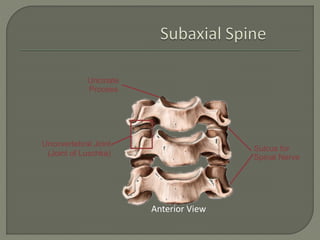
Sulcus for
Spinal Nerve
Uncinate
Process
Uncovertebral Joint
(Joint of Luschka)
Anterior View
45° to the axial plane
In the cervical region, the facet joints are flat
and oriented 45° to the horizontal. This means that
the cervical region has a significant range of motion
in the six degrees of freedom.
14year/male
After RTA in FEB 2011 and presented to FHN in
May 2011 with
Pain in neck movements which progressed to
inability to move neck
Quadriparesis
35 years/male H/O RTA admitted with
Painful neck movements
Difficulty in walking
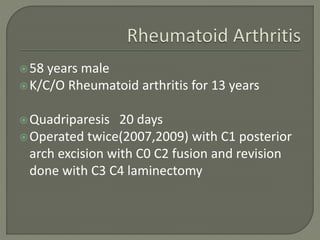
58 years male
K/C/O Rheumatoid arthritis for 13 years
Quadriparesis 20 days
Operated twice(2007,2009) with C1 posterior
arch excision with C0 C2 fusion and revision
done with C3 C4 laminectomy
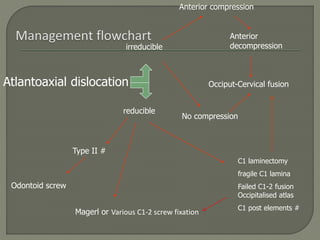
Atlantoaxial dislocation
reducible
irreducible
Type II #
Odontoid screw
Magerl or Various C1-2 screw fixation
Occiput-Cervical fusion
Anterior compression
Anterior
decompression
No compression
C1 laminectomy
fragile C1 lamina
Failed C1-2 fusion
Occipitalised atlas
C1 post elements #
Magerl transarticular Screws
C1 lateral mass screw
C2 pars screw
C2 pedicle screw
C2 laminar screws
Hybrid wire and screw fixation
Source: Medscape, MyAANS
Entry point in line with the medial edge of the
lamina origin
Direction of screws
The average length of screw adjacent to the
lamina is 1cm and within the lateral massis
upto 2 cm
The Harms technique
The entry point for placement of a C2 pedicle
screw was 2 mm from the medial border and 5
mm from the caudal border of the C2 articular
process.
The trajectory is at an angle of 20 to 30
degrees cranially, and in the transversal plane,
the screws were directed medially at an angle
of 20 to 25 degrees
Lateral mass
25º
Trans Artricular
45º
Pedicle
1mm medial
1-2 mm cephalad
• CT Scan
Madawi AA, Casey AT, Solanki GA, Tuite G, Veres R, Crockard HA :
Radiological and anatomical evaluation of the atlantoaxial transarticular
screw fixation technique. J Neurosurg 86 : 961-968, 1997
Image guided spinal surgery
C1-C2 TRANSARTICULAR SCREWS
LEFT C1-C2 RIGHT C1-C2
ENTRY POINT
TARGET POINT
Image guided spinal surgery
C1-C2 TRANSARTICULAR SCREWS
Destruction of C1 lateral mass/ fracture or
destroyed C2 pars interarticularis
Large Vertebral Artery groove
Irreducible subluxation
Aberrant Vertebral Artery
Occipitalized atlas (relative)
Following transoral odontoidectomy
(relative)
Mal position of screws
Implant failure
Spinal cord / dura/ 12th injury
Vertebral Artery injury
A C2 pars screw is placed in a trajectory similar
to that of a C1-C2 transarticular screw except
that it is much shorter
Screw length is typically 16 mm, stopping
short of the transverse foramen
.
 Because the trajectory of this technique is more superior and
medial than the transarticular screw fixation, potential risk of
vertebral artery injury is lower
 Intraoperative reduction of the C1-C2 complex can be
accomplished by direct manipulation of C1 and C2.
 The polyaxial screws can be joined to the occiput and subaxial
cervical spine.
 Temporary fixation of the C1-C2 complex is possible, because
this technique does not damage the C1-C2 facet joint
Wright NM : Posterior C2 fixation using
bilateral, crossing C2 laminar screws : case
series and technical note. J Spinal Disord Tech
17 :158-162, 2004
Leonard JR, Wright NM : Pediatric atlantoaxial
fixation with bilateral, crossing C-2
translaminar screws. Technical note. J
Neurosurg 104 : 59-63, 2006
Entry point spine-lamina junction
Directed towards lamina-facet junction
Average 30mm long
Roy-Camille
Variations in
entry point,
trajectory
An technique
lowest risk of
nerve root
injury
screw
</=15mm
 3 column fixation (A)
 Superior to lateral mass
screws (biomechanical)
 Preop CT: bones, verts,
nn.
 Enter lateral to center of
facet, close to post margin
of superior articular
surface
 Point of entry
decorticated with high
speed drill
 Angles vary (B, C)
 These three techniques provided equivalent
stability to the C1 to C2 complex in flexion-
extension and axial rotation
 C1 lateral mass-C2 laminar screw technique
provided slightly less stiffness than other
techniques in lateral bending
 pedicle screws provide the strongest fixation for
both initial and salvage applications. If they
should fail, lamina screws appear to provide
stronger and more reproducible fixation than pars
screws.
 Dissection is carried to the tips of the transverse processes
 Attention is given to the preservation of the most
cephalad facet capsule while all other soft tissue is
removed from the facet
 The peri-spinal musculature is retracted for intra-canal
work
 Appropriate laminotomies and/or laminectomy may be
performed
 Attention is now directed toward instrumentation of the
spine
The anatomy of the C2 is highly variable.
 It is essential to routinely perform a CT an
individually evaluate every screw tract to
provide the safest option.
 Knowledge of the various techniques
described are useful when dealing with
instability in the craniovertebral junction
THANKS VERY MUCH
Cervical spinepathology

Cervical spinepathology

  • 1.
    SURGICAL TECHNIQUES IN CERVICALSPINE STABILIZATION Manish Vaish
  • 3.
    C1 C2 Dens Zygapophyseal joints The articulation ofthe ATLANTOAXIAL JOINT between the atlas (C1) and the axis (C2) has a range of motion in the transverse plane for rotation. The DENS of C2 acts as a pivot point for the rotation of C1. The articulating surfaces of the two vertebrae form the ZYGAPOPHYSEAL (FACET) JOINTS that allow flexion-extension, side bending, and rotational movements.
  • 4.
    Axial View Transverse ProcessBody Sulcus for SpinalNerve Lateral Mass Lamina Pedicle Superior Articular Facet Vertebral Foramen Bifid Spinous Process Transverse Foramen
  • 5.
    Sulcus for Spinal Nerve Uncinate Process UncovertebralJoint (Joint of Luschka) Anterior View
  • 6.
    45° to theaxial plane In the cervical region, the facet joints are flat and oriented 45° to the horizontal. This means that the cervical region has a significant range of motion in the six degrees of freedom.
  • 9.
    14year/male After RTA inFEB 2011 and presented to FHN in May 2011 with Pain in neck movements which progressed to inability to move neck Quadriparesis
  • 11.
    35 years/male H/ORTA admitted with Painful neck movements Difficulty in walking
  • 18.
    58 years male K/C/ORheumatoid arthritis for 13 years Quadriparesis 20 days Operated twice(2007,2009) with C1 posterior arch excision with C0 C2 fusion and revision done with C3 C4 laminectomy
  • 25.
    Atlantoaxial dislocation reducible irreducible Type II# Odontoid screw Magerl or Various C1-2 screw fixation Occiput-Cervical fusion Anterior compression Anterior decompression No compression C1 laminectomy fragile C1 lamina Failed C1-2 fusion Occipitalised atlas C1 post elements #
  • 26.
    Magerl transarticular Screws C1lateral mass screw C2 pars screw C2 pedicle screw C2 laminar screws Hybrid wire and screw fixation
  • 28.
  • 29.
    Entry point inline with the medial edge of the lamina origin Direction of screws
  • 30.
    The average lengthof screw adjacent to the lamina is 1cm and within the lateral massis upto 2 cm
  • 31.
    The Harms technique Theentry point for placement of a C2 pedicle screw was 2 mm from the medial border and 5 mm from the caudal border of the C2 articular process. The trajectory is at an angle of 20 to 30 degrees cranially, and in the transversal plane, the screws were directed medially at an angle of 20 to 25 degrees
  • 32.
  • 35.
    • CT Scan MadawiAA, Casey AT, Solanki GA, Tuite G, Veres R, Crockard HA : Radiological and anatomical evaluation of the atlantoaxial transarticular screw fixation technique. J Neurosurg 86 : 961-968, 1997
  • 41.
    Image guided spinalsurgery C1-C2 TRANSARTICULAR SCREWS
  • 42.
    LEFT C1-C2 RIGHTC1-C2 ENTRY POINT TARGET POINT Image guided spinal surgery
  • 43.
    Image guided spinalsurgery C1-C2 TRANSARTICULAR SCREWS
  • 44.
    Destruction of C1lateral mass/ fracture or destroyed C2 pars interarticularis Large Vertebral Artery groove Irreducible subluxation Aberrant Vertebral Artery Occipitalized atlas (relative) Following transoral odontoidectomy (relative)
  • 45.
    Mal position ofscrews Implant failure Spinal cord / dura/ 12th injury Vertebral Artery injury
  • 49.
    A C2 parsscrew is placed in a trajectory similar to that of a C1-C2 transarticular screw except that it is much shorter Screw length is typically 16 mm, stopping short of the transverse foramen .
  • 51.
     Because thetrajectory of this technique is more superior and medial than the transarticular screw fixation, potential risk of vertebral artery injury is lower  Intraoperative reduction of the C1-C2 complex can be accomplished by direct manipulation of C1 and C2.  The polyaxial screws can be joined to the occiput and subaxial cervical spine.  Temporary fixation of the C1-C2 complex is possible, because this technique does not damage the C1-C2 facet joint
  • 52.
    Wright NM :Posterior C2 fixation using bilateral, crossing C2 laminar screws : case series and technical note. J Spinal Disord Tech 17 :158-162, 2004 Leonard JR, Wright NM : Pediatric atlantoaxial fixation with bilateral, crossing C-2 translaminar screws. Technical note. J Neurosurg 104 : 59-63, 2006
  • 53.
    Entry point spine-laminajunction Directed towards lamina-facet junction Average 30mm long
  • 55.
    Roy-Camille Variations in entry point, trajectory Antechnique lowest risk of nerve root injury screw </=15mm
  • 56.
     3 columnfixation (A)  Superior to lateral mass screws (biomechanical)  Preop CT: bones, verts, nn.  Enter lateral to center of facet, close to post margin of superior articular surface  Point of entry decorticated with high speed drill  Angles vary (B, C)
  • 57.
     These threetechniques provided equivalent stability to the C1 to C2 complex in flexion- extension and axial rotation  C1 lateral mass-C2 laminar screw technique provided slightly less stiffness than other techniques in lateral bending  pedicle screws provide the strongest fixation for both initial and salvage applications. If they should fail, lamina screws appear to provide stronger and more reproducible fixation than pars screws.
  • 58.
     Dissection iscarried to the tips of the transverse processes  Attention is given to the preservation of the most cephalad facet capsule while all other soft tissue is removed from the facet  The peri-spinal musculature is retracted for intra-canal work  Appropriate laminotomies and/or laminectomy may be performed  Attention is now directed toward instrumentation of the spine
  • 62.
    The anatomy ofthe C2 is highly variable.  It is essential to routinely perform a CT an individually evaluate every screw tract to provide the safest option.  Knowledge of the various techniques described are useful when dealing with instability in the craniovertebral junction
  • 63.