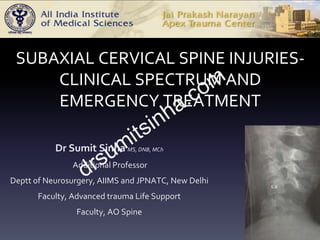
SUBAXIAL CERVICAL SPINE INJURIES-
CLINICAL SPECTRUM AND
EMERGENCY TREATMENT
Dr Sumit Sinha MS, DNB, MCh
Additional Professor
Deptt of Neurosurgery, AIIMS and JPNATC, New Delhi
Faculty, Advanced trauma Life Support
Faculty, AO Spine
SUBAXIAL CERVICAL SPINE INJURIES
Assessment of Cervical spine injuries
• AIRWAY+ CERVICAL SPINE IMMOBILIZATION
• BREATHING
• CIRCULATION
• DISABILITY
• EXPOSURE
2
SUBAXIAL CERVICAL SPINE INJURIES
NEXUS Low risk criteria
Cervical spine imaging recommended for all pts with trauma
EXCEPT
• No midline tenderness
• No intoxication
• Normal alertness
• No FND
• No other injuries
3
*Hoffman JR et al. Ann Emerg Med 1998;32:461-469
SUBAXIAL CERVICAL SPINE INJURIES
Indications for Surgery
• Unstable injuries
• Injuries with neurological deficits with proven
mechanical compression
• Inability to reduce dislocation by closed means
• To facilitate nursing care
4
SUBAXIAL CERVICAL SPINE INJURIES
INSTABILITY
White and Punjabi et al
• ‘the loss of the spine’s ability to maintain its patterns
of displacement under physiologic loads so there is no
initial or additional neurologic deficit, no major
deformity, and no incapacitating pain’
5
*A.A. White, M.M. Panjabi (Eds.), Clinical biomechanics of the spine, 2nd ed, JB
Lippincott, Philadelphia, PA, 1990.
SUBAXIAL CERVICAL SPINE INJURIES
INSTABILITY
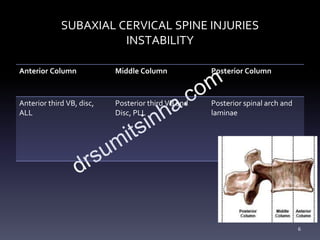
Anterior Column Middle Column Posterior Column
Anterior third VB, disc,
ALL
Posterior third VB and
Disc, PLL
Posterior spinal arch and
laminae
6
SUBAXIAL CERVICAL SPINE INJURIES
Classification systems
• Nicoll et al- functional outcomes
• Holdsworth et al- stable/ unstable- PLC integrity
• White and Punjabi- neurology, radiology, stretch test
• Allen et al- mechanistic
• Harris et al
• AO Spine
• CSISS
• SLIC
7
SUBAXIAL CERVICAL SPINE INJURIES
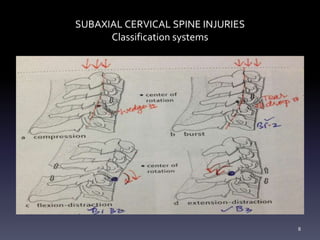
Classification systems
8
SUBAXIAL CERVICAL SPINE INJURIES
Classification systems
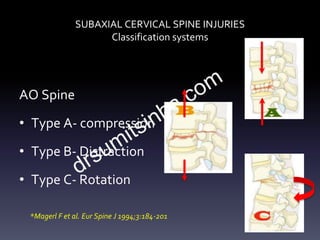
AO Spine
• Type A- compression
• Type B- Distraction
• Type C- Rotation
*Magerl F et al. Eur Spine J 1994;3:184-201
9
SUBAXIAL CERVICAL SPINE INJURIES
Classification systems
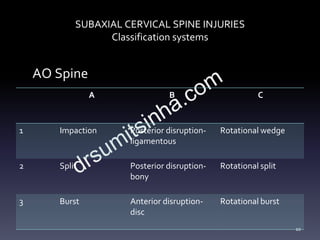
A B C
1 Impaction Posterior disruption-
ligamentous
Rotational wedge
2 Split Posterior disruption-
bony
Rotational split
3 Burst Anterior disruption-
disc
Rotational burst
AO Spine
10
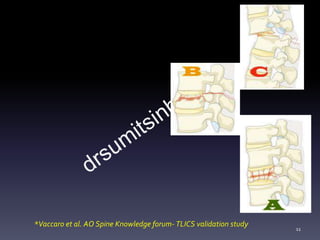
*Vaccaro et al. AO Spine Knowledge forum- TLICS validation study
11
SUBAXIAL CERVICAL SPINE INJURIES
Classification systems
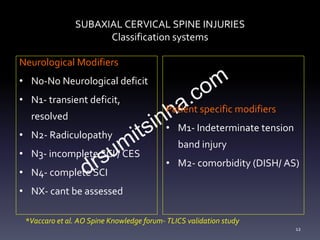
Neurological Modifiers
• N0-No Neurological deficit
• N1- transient deficit,
resolved
• N2- Radiculopathy
• N3- incomplete SCI / CES
• N4- complete SCI
• NX- cant be assessed
Patient specific modifiers
• M1- Indeterminate tension
band injury
• M2- comorbidity (DISH/ AS)
*Vaccaro et al. AO Spine Knowledge forum- TLICS validation study
12
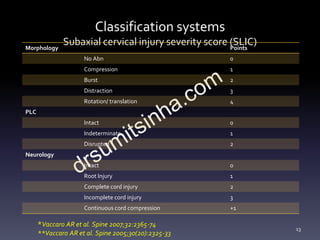
Classification systems
Subaxial cervical injury severity score (SLIC)
*Vaccaro AR et al. Spine 2007;32:2365-74
**Vaccaro AR et al. Spine 2005;30(20):2325-33
Morphology Points
No Abn 0
Compression 1
Burst 2
Distraction 3
Rotation/ translation 4
PLC
Intact 0
Indeterminate 1
Disrupted 2
Neurology
Intact 0
Root Injury 1
Complete cord injury 2
Incomplete cord injury 3
Continuous cord compression +1
13
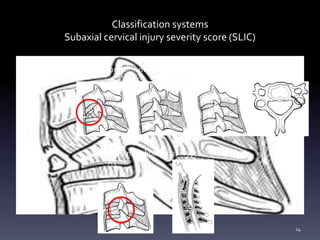
Classification systems
Subaxial cervical injury severity score (SLIC)
Burst morphology (2)- Type
A3
Compression morphology (1)- Type A1,A1
14
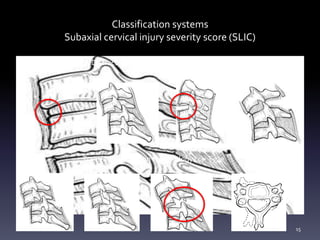
Classification systems
Subaxial cervical injury severity score (SLIC)
Translation/Rotation morphology (4)- Type
C
Distraction Morphology (3)- Type B1, B2, B3
15
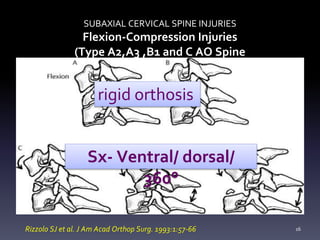
SUBAXIAL CERVICAL SPINE INJURIES
Flexion-Compression Injuries
(Type A2,A3 ,B1 and C AO Spine
SLIC- Compression/ Burst)
Rizzolo SJ et al. J Am Acad Orthop Surg. 1993:1:57-66
rigid orthosis
Sx- Ventral/ dorsal/
360°
16
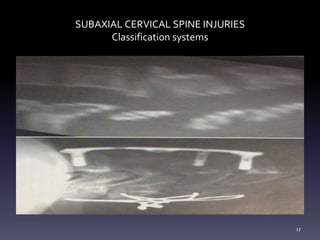
SUBAXIAL CERVICAL SPINE INJURIES
Classification systems
Flexion-Compression Injuries
17
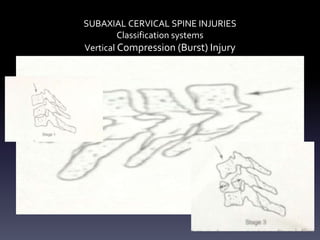
SUBAXIAL CERVICAL SPINE INJURIES
Classification systems
Vertical Compression (Burst) Injury
(Type A3 AO Spine/ SLIC- Compression/ Burst)
18
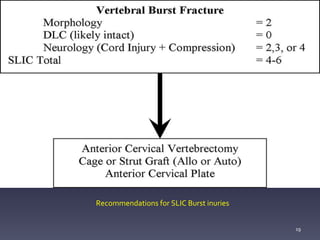
•
Recommendations for SLIC Burst inuries
19
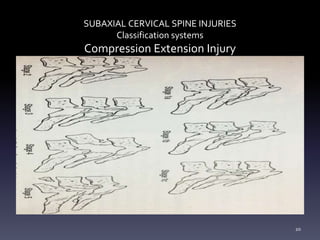
SUBAXIAL CERVICAL SPINE INJURIES
Classification systems
Compression Extension Injury
(Type B3, C AO Spine, SLIC- Distraction)
20
SUBAXIAL CERVICAL SPINE INJURIES
Classification systems
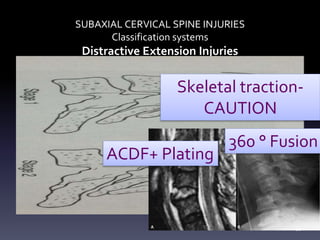
Distractive Extension Injuries
(Type B3, C AO Spine- SLIC- Distraction)
ACDF+ Plating
360 ° Fusion
Skeletal traction-
CAUTION
21
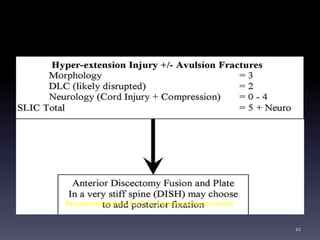
Recommendations for SLIC Hyperextension inuries
22
SUBAXIAL CERVICAL SPINE INJURIES
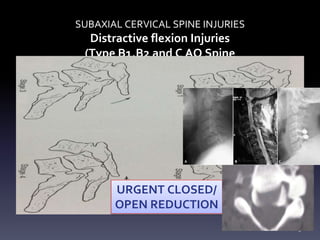
Distractive flexion Injuries
(Type B1,B2 and C AO Spine
SLIC- Translation/ Distraction)
23
URGENT CLOSED/
OPEN REDUCTION
Recommendations for SLIC Rotation/ translation inuries
24
SUBAXIAL CERVICAL SPINE INJURIES
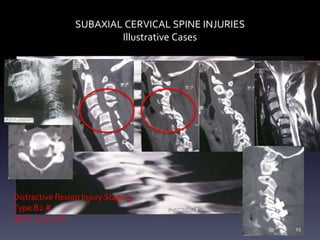
Illustrative Cases
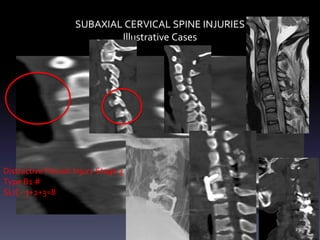
Distractive flexion Injury Stage 3
Type B2 #
SLIC- 3+2+2=7
25
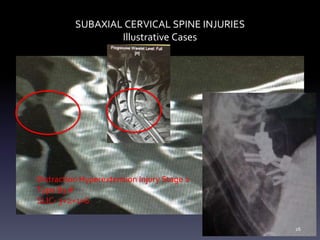
SUBAXIAL CERVICAL SPINE INJURIES
Illustrative Cases
Distraction Hyperextension Injury Stage 2
Type B3 #
SLIC- 3+2+1=6
26
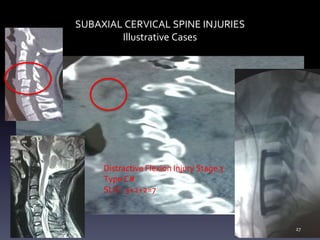
SUBAXIAL CERVICAL SPINE INJURIES
Illustrative Cases
Distractive Flexion Injury Stage 3
Type C#
SLIC- 3+2+2=7
27
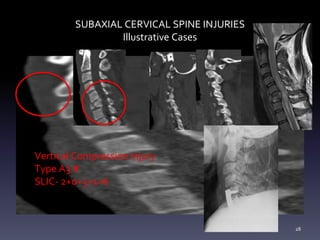
SUBAXIAL CERVICAL SPINE INJURIES
Illustrative Cases
Vertical Compression Injury
Type A3 #
SLIC- 2+0+3+1=6
28
SUBAXIAL CERVICAL SPINE INJURIES
Illustrative Cases
Distractive Flexion Injury Stage 3
Type B1 #
SLIC- 3+2+3=8
29
SUBAXIAL CERVICAL SPINE INJURIES
Illustrative Cases
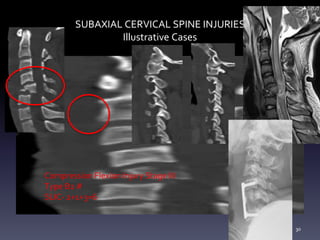
Compression Flexion Injury Stage III
Type B2 #
SLIC- 2+1+3=6
30
SUBAXIAL CERVICAL SPINE INJURIES
Illustrative Cases
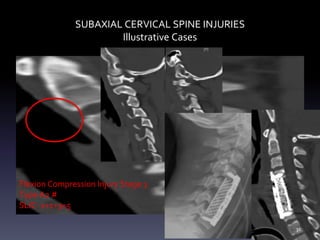
Flexion Compression Injury Stage 3
Type A2 #
SLIC- 1+1+3=5
31
SUBAXIAL CERVICAL SPINE INJURIES
Illustrative Cases
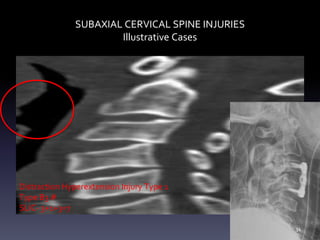
Distraction Hyperextension Injury Type 1
Type B3 #
SLIC- 3+1+3=7
32
SUBAXIAL CERVICAL SPINE INJURIES
TAKE HOME MESSAGE
• IMMOBILIZE C-Spine- Priority
• Rationalization of Radiography- 10% contiguous spine #
• Look for instability- Classify- Decompress and Reconstitute the
column which is disrupted
• Posterior column most important for stability- reconstitute
whenever disrupted
• EARLY SURGERY- ?? hours (Level III evidence)
• Urgent reduction of bilateral locked facets in incomplete
tetraplegia- (Level II evidence)- Closed OR open reduction- Role of
Pre-reduction MR ?
33
THANKYOU FOR YOUR ATTENTION
34

Subaxial Cervical Spine Injuries

  • 1.
    SUBAXIAL CERVICAL SPINEINJURIES- CLINICAL SPECTRUM AND EMERGENCY TREATMENT Dr Sumit Sinha MS, DNB, MCh Additional Professor Deptt of Neurosurgery, AIIMS and JPNATC, New Delhi Faculty, Advanced trauma Life Support Faculty, AO Spine
  • 2.
    SUBAXIAL CERVICAL SPINEINJURIES Assessment of Cervical spine injuries • AIRWAY+ CERVICAL SPINE IMMOBILIZATION • BREATHING • CIRCULATION • DISABILITY • EXPOSURE 2
  • 3.
    SUBAXIAL CERVICAL SPINEINJURIES NEXUS Low risk criteria Cervical spine imaging recommended for all pts with trauma EXCEPT • No midline tenderness • No intoxication • Normal alertness • No FND • No other injuries 3 *Hoffman JR et al. Ann Emerg Med 1998;32:461-469
  • 4.
    SUBAXIAL CERVICAL SPINEINJURIES Indications for Surgery • Unstable injuries • Injuries with neurological deficits with proven mechanical compression • Inability to reduce dislocation by closed means • To facilitate nursing care 4
  • 5.
    SUBAXIAL CERVICAL SPINEINJURIES INSTABILITY White and Punjabi et al • ‘the loss of the spine’s ability to maintain its patterns of displacement under physiologic loads so there is no initial or additional neurologic deficit, no major deformity, and no incapacitating pain’ 5 *A.A. White, M.M. Panjabi (Eds.), Clinical biomechanics of the spine, 2nd ed, JB Lippincott, Philadelphia, PA, 1990.
  • 6.
    SUBAXIAL CERVICAL SPINEINJURIES INSTABILITY Anterior Column Middle Column Posterior Column Anterior third VB, disc, ALL Posterior third VB and Disc, PLL Posterior spinal arch and laminae 6
  • 7.
    SUBAXIAL CERVICAL SPINEINJURIES Classification systems • Nicoll et al- functional outcomes • Holdsworth et al- stable/ unstable- PLC integrity • White and Punjabi- neurology, radiology, stretch test • Allen et al- mechanistic • Harris et al • AO Spine • CSISS • SLIC 7
  • 8.
    SUBAXIAL CERVICAL SPINEINJURIES Classification systems 8
  • 9.
    SUBAXIAL CERVICAL SPINEINJURIES Classification systems AO Spine • Type A- compression • Type B- Distraction • Type C- Rotation *Magerl F et al. Eur Spine J 1994;3:184-201 9
  • 10.
    SUBAXIAL CERVICAL SPINEINJURIES Classification systems A B C 1 Impaction Posterior disruption- ligamentous Rotational wedge 2 Split Posterior disruption- bony Rotational split 3 Burst Anterior disruption- disc Rotational burst AO Spine 10
  • 11.
    *Vaccaro et al.AO Spine Knowledge forum- TLICS validation study 11
  • 12.
    SUBAXIAL CERVICAL SPINEINJURIES Classification systems Neurological Modifiers • N0-No Neurological deficit • N1- transient deficit, resolved • N2- Radiculopathy • N3- incomplete SCI / CES • N4- complete SCI • NX- cant be assessed Patient specific modifiers • M1- Indeterminate tension band injury • M2- comorbidity (DISH/ AS) *Vaccaro et al. AO Spine Knowledge forum- TLICS validation study 12
  • 13.
    Classification systems Subaxial cervicalinjury severity score (SLIC) *Vaccaro AR et al. Spine 2007;32:2365-74 **Vaccaro AR et al. Spine 2005;30(20):2325-33 Morphology Points No Abn 0 Compression 1 Burst 2 Distraction 3 Rotation/ translation 4 PLC Intact 0 Indeterminate 1 Disrupted 2 Neurology Intact 0 Root Injury 1 Complete cord injury 2 Incomplete cord injury 3 Continuous cord compression +1 13
  • 14.
    Classification systems Subaxial cervicalinjury severity score (SLIC) Burst morphology (2)- Type A3 Compression morphology (1)- Type A1,A1 14
  • 15.
    Classification systems Subaxial cervicalinjury severity score (SLIC) Translation/Rotation morphology (4)- Type C Distraction Morphology (3)- Type B1, B2, B3 15
  • 16.
    SUBAXIAL CERVICAL SPINEINJURIES Flexion-Compression Injuries (Type A2,A3 ,B1 and C AO Spine SLIC- Compression/ Burst) Rizzolo SJ et al. J Am Acad Orthop Surg. 1993:1:57-66 rigid orthosis Sx- Ventral/ dorsal/ 360° 16
  • 17.
    SUBAXIAL CERVICAL SPINEINJURIES Classification systems Flexion-Compression Injuries 17
  • 18.
    SUBAXIAL CERVICAL SPINEINJURIES Classification systems Vertical Compression (Burst) Injury (Type A3 AO Spine/ SLIC- Compression/ Burst) 18
  • 19.
  • 20.
    SUBAXIAL CERVICAL SPINEINJURIES Classification systems Compression Extension Injury (Type B3, C AO Spine, SLIC- Distraction) 20
  • 21.
    SUBAXIAL CERVICAL SPINEINJURIES Classification systems Distractive Extension Injuries (Type B3, C AO Spine- SLIC- Distraction) ACDF+ Plating 360 ° Fusion Skeletal traction- CAUTION 21
  • 22.
    Recommendations for SLICHyperextension inuries 22
  • 23.
    SUBAXIAL CERVICAL SPINEINJURIES Distractive flexion Injuries (Type B1,B2 and C AO Spine SLIC- Translation/ Distraction) 23 URGENT CLOSED/ OPEN REDUCTION
  • 24.
    Recommendations for SLICRotation/ translation inuries 24
  • 25.
    SUBAXIAL CERVICAL SPINEINJURIES Illustrative Cases Distractive flexion Injury Stage 3 Type B2 # SLIC- 3+2+2=7 25
  • 26.
    SUBAXIAL CERVICAL SPINEINJURIES Illustrative Cases Distraction Hyperextension Injury Stage 2 Type B3 # SLIC- 3+2+1=6 26
  • 27.
    SUBAXIAL CERVICAL SPINEINJURIES Illustrative Cases Distractive Flexion Injury Stage 3 Type C# SLIC- 3+2+2=7 27
  • 28.
    SUBAXIAL CERVICAL SPINEINJURIES Illustrative Cases Vertical Compression Injury Type A3 # SLIC- 2+0+3+1=6 28
  • 29.
    SUBAXIAL CERVICAL SPINEINJURIES Illustrative Cases Distractive Flexion Injury Stage 3 Type B1 # SLIC- 3+2+3=8 29
  • 30.
    SUBAXIAL CERVICAL SPINEINJURIES Illustrative Cases Compression Flexion Injury Stage III Type B2 # SLIC- 2+1+3=6 30
  • 31.
    SUBAXIAL CERVICAL SPINEINJURIES Illustrative Cases Flexion Compression Injury Stage 3 Type A2 # SLIC- 1+1+3=5 31
  • 32.
    SUBAXIAL CERVICAL SPINEINJURIES Illustrative Cases Distraction Hyperextension Injury Type 1 Type B3 # SLIC- 3+1+3=7 32
  • 33.
    SUBAXIAL CERVICAL SPINEINJURIES TAKE HOME MESSAGE • IMMOBILIZE C-Spine- Priority • Rationalization of Radiography- 10% contiguous spine # • Look for instability- Classify- Decompress and Reconstitute the column which is disrupted • Posterior column most important for stability- reconstitute whenever disrupted • EARLY SURGERY- ?? hours (Level III evidence) • Urgent reduction of bilateral locked facets in incomplete tetraplegia- (Level II evidence)- Closed OR open reduction- Role of Pre-reduction MR ? 33
  • 34.
    THANKYOU FOR YOURATTENTION 34