Benefits of Certifications of
Teachers by Corporations
Valeri Anne Paul, Ed.D
Cynthia Sistek-Chandler, Ed.D
Associate Professor, National University
Introduction
Certifications by Corporations
● Apple Inc., Google, Microsoft Educator
Network, Discovery Education, Leading
Edge Certification (CUE and iNacol) and &
others
● Proof of competency (badges)
Certifications
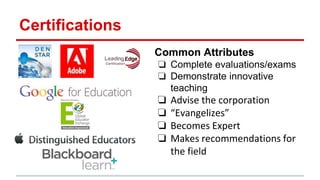
Common Attributes
❏ Complete evaluations/exams
❏ Demonstrate innovative
teaching
❏ Advise the corporation
❏ “Evangelizes”
❏ Becomes Expert
❏ Makes recommendations for
the field
One Certification
To become a Google Certified trainer, one needs
to pass six exams of Google Apps with a
high score and undergo a certain selection criteria
Qualifications
https://www.google.co.in/work/apps/education/resources/training-programs.html
Research Question
Do corporate certifications benefit
educators?
Study Description
• This study will use a sampling of certified
educators as part the research.
• The pilot study uses an instrument that is being
tested for validity and reliability.
• Pilot Survey
• 10 questions
Study Data
Type of Experience
8% Elementary
42% Secondary
17% District
21% Adult Ed/Higher Ed
6% County Office
6% Other
Respondents
Female 28%
Male 51%
Did not disclose 21%
Years of Experience
10+ Years 78%
6-10 Years 13%
3 - 5 Years 9%
1 - 2 Years 2%
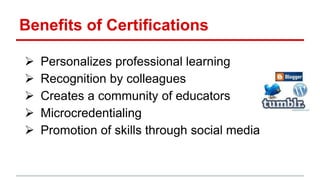
Benefits of Certifications
 Personalizes professional learning
 Recognition by colleagues
 Creates a community of educators
 Microcredentialing
 Promotion of skills through social media
Findings
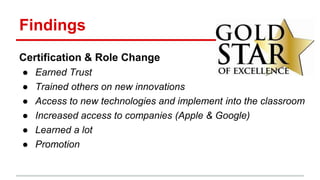
Certification & Role Change
● Earned Trust
● Trained others on new innovations
● Access to new technologies and implement into the classroom
● Increased access to companies (Apple & Google)
● Learned a lot
● Promotion
Findings
Leadership and Professional Development
96% Provided Ongoing PD Opportunities
4% Did not train others
Responses
It has sparked me to go
beyond what I am used
to and always seek to
grow and improve.
● Enrichment
● Professional Community
Collaboration
● Confidence
● Respect
● Risk taking
● Badge
…[T]his transformation is the worldwide
network of ADEs and GCTs that have
enriched my life personally and
professionally.
Recommendations and Next Steps
● More participation, larger sample size
● Deeper examination of the communities
● Identify benefits to corporations
● Present to corporations
● Further data analysis
References
Apple Distinguished Educator. (2014). Retrieved October 21, 2014, from
http://www.apple.com/education/apple-distinguished-educator/
Gamrat, C., H., Z., & Dudek J, P. K. (2014). Personalized workplace learning: An exploratory study on
digital badging within a teacher professional development program. - British Journal of Educational
Technology Y1 - 2014/11//, 45(6 M3 - Case Study), 1136-1148. doi: 10.1111/bjet.12200
Koehler, M. J., Mishra, P., & Cain, W. (2013). What Is Technological Pedagogical Content Knowledge
(TPACK)? Journal of Education, 193(3), 13-19.
Kumar, R. (1999). Research methodology : a step-by-step guide for beginners. London ; Thousand
Oaks, Calif.: Sage.
Microsoft Educator Network (2014) https://www.educatornetwork.com/Sites/Educators/Expert
Retrieved March 1, 2015
References
Matherson, L. H., Wilson, E. K., & Wright, V. H. (2014). Need TPACK? Embrace Sustained
Professional Development. Delta Kappa Gamma Bulletin, 81(1), 45-52.
Rogers, E. M. (2003) Diffusion of innovations (4th ed.). New York: Free Press.
Sandholtz, J. H. Ringstaff, C., & Dwyer, D. C. (1991). The relationship between technological
innovation and collegial interaction. In M. A. C Fallon (Ed.). American Educational Research
Association (pp. 1-20). Cupertino, CA: APPLE Classrooms of Tomorrow, Apple Computer, Inc.
Sandholtz, J. H., Ringstaff, C., & Dwyer, D. C. (1997). Teaching with technology: Creating student-
centered classrooms. New York: Teachers College Press.
Add to Our Study
Please participate
bit.ly/certteach
Questions?
Valeri Anne Paul, Ed.D
paul@pfmassoc.com
Cynthia Sistek-Chandler, Ed.D
cchandler@nu.edu

Benefits of Certifications by Corporations

  • 1.
    Benefits of Certificationsof Teachers by Corporations Valeri Anne Paul, Ed.D Cynthia Sistek-Chandler, Ed.D Associate Professor, National University
  • 2.
    Introduction Certifications by Corporations ●Apple Inc., Google, Microsoft Educator Network, Discovery Education, Leading Edge Certification (CUE and iNacol) and & others ● Proof of competency (badges)
  • 3.
    Certifications Common Attributes ❏ Completeevaluations/exams ❏ Demonstrate innovative teaching ❏ Advise the corporation ❏ “Evangelizes” ❏ Becomes Expert ❏ Makes recommendations for the field
  • 4.
    One Certification To becomea Google Certified trainer, one needs to pass six exams of Google Apps with a high score and undergo a certain selection criteria Qualifications https://www.google.co.in/work/apps/education/resources/training-programs.html
  • 5.
    Research Question Do corporatecertifications benefit educators?
  • 6.
    Study Description • Thisstudy will use a sampling of certified educators as part the research. • The pilot study uses an instrument that is being tested for validity and reliability. • Pilot Survey • 10 questions
  • 7.
    Study Data Type ofExperience 8% Elementary 42% Secondary 17% District 21% Adult Ed/Higher Ed 6% County Office 6% Other Respondents Female 28% Male 51% Did not disclose 21% Years of Experience 10+ Years 78% 6-10 Years 13% 3 - 5 Years 9% 1 - 2 Years 2%
  • 8.
    Benefits of Certifications Personalizes professional learning  Recognition by colleagues  Creates a community of educators  Microcredentialing  Promotion of skills through social media
  • 9.
    Findings Certification & RoleChange ● Earned Trust ● Trained others on new innovations ● Access to new technologies and implement into the classroom ● Increased access to companies (Apple & Google) ● Learned a lot ● Promotion
  • 10.
    Findings Leadership and ProfessionalDevelopment 96% Provided Ongoing PD Opportunities 4% Did not train others
  • 11.
    Responses It has sparkedme to go beyond what I am used to and always seek to grow and improve. ● Enrichment ● Professional Community Collaboration ● Confidence ● Respect ● Risk taking ● Badge …[T]his transformation is the worldwide network of ADEs and GCTs that have enriched my life personally and professionally.
  • 12.
    Recommendations and NextSteps ● More participation, larger sample size ● Deeper examination of the communities ● Identify benefits to corporations ● Present to corporations ● Further data analysis
  • 13.
    References Apple Distinguished Educator.(2014). Retrieved October 21, 2014, from http://www.apple.com/education/apple-distinguished-educator/ Gamrat, C., H., Z., & Dudek J, P. K. (2014). Personalized workplace learning: An exploratory study on digital badging within a teacher professional development program. - British Journal of Educational Technology Y1 - 2014/11//, 45(6 M3 - Case Study), 1136-1148. doi: 10.1111/bjet.12200 Koehler, M. J., Mishra, P., & Cain, W. (2013). What Is Technological Pedagogical Content Knowledge (TPACK)? Journal of Education, 193(3), 13-19. Kumar, R. (1999). Research methodology : a step-by-step guide for beginners. London ; Thousand Oaks, Calif.: Sage. Microsoft Educator Network (2014) https://www.educatornetwork.com/Sites/Educators/Expert Retrieved March 1, 2015
  • 14.
    References Matherson, L. H.,Wilson, E. K., & Wright, V. H. (2014). Need TPACK? Embrace Sustained Professional Development. Delta Kappa Gamma Bulletin, 81(1), 45-52. Rogers, E. M. (2003) Diffusion of innovations (4th ed.). New York: Free Press. Sandholtz, J. H. Ringstaff, C., & Dwyer, D. C. (1991). The relationship between technological innovation and collegial interaction. In M. A. C Fallon (Ed.). American Educational Research Association (pp. 1-20). Cupertino, CA: APPLE Classrooms of Tomorrow, Apple Computer, Inc. Sandholtz, J. H., Ringstaff, C., & Dwyer, D. C. (1997). Teaching with technology: Creating student- centered classrooms. New York: Teachers College Press.
  • 15.
    Add to OurStudy Please participate bit.ly/certteach
  • 16.
    Questions? Valeri Anne Paul,Ed.D paul@pfmassoc.com Cynthia Sistek-Chandler, Ed.D cchandler@nu.edu

Editor's Notes

  • #2 This paper introduces proposed research that is designed to examine the impact and effectiveness of certifications by corporations, such as Apple™ and Google™. A common attribute built into all these organized certifications of educators is that what develops is community of teachers who are trained and certified by the corporation. With the support of a built in community, do these teachers experience improvement of their teaching? This study explores the impact of these certifications through the lens of the teachers’ collegial interactions and use of these companies’ innovative products and services.
  • #3 Poll population. Descriptions of each. Mostly regional responses. What are the certifications? What we are no studying is academic certificates. Although some might offer optional graduate level credit from a higher education institution, these certifications are offered by companies who work in the education marketin. Collaboration? Community? Content Knowledge?
  • #4 According to the Apple Distinguished Educator (ADE) website (2014) 2,000 ADEs worldwide ~ 1500 Google™ Certified Educators (M. Wagner, personal communication, October 23, 2014). Discovery Education Network (DEN) reports 9,000 STAR DEN certified teachers (Emily Murn, personal communication, October 23, 2014).
  • #5 .
  • #8 Study data updated to reflect an N of 48 March, 2015