Best Practices with Media and Technology Marlo Gaddis and Jackie Pierson
Real results…
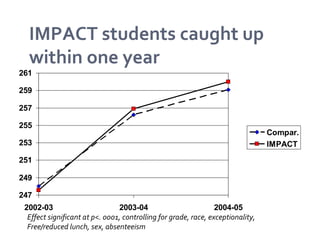
IMPACT students caught up within one year Effect significant at p<. 0001, controlling for grade, race, exceptionality, Free/reduced lunch, sex, absenteeism
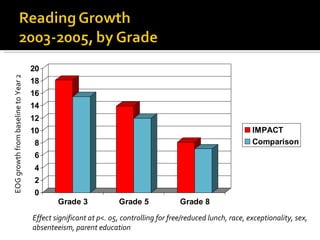
EOG growth from baseline to Year 2 Effect significant at p<. 05, controlling for free/reduced lunch, race, exceptionality, sex, absenteeism, parent education
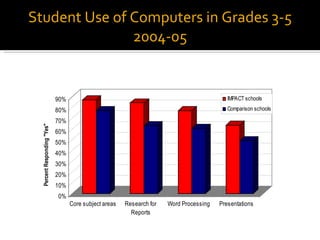
Student Use of Computers in Grades 3-5 2004-05
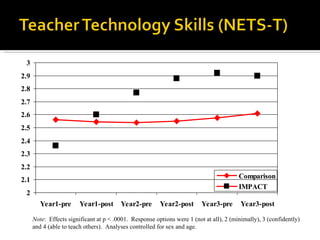
Note :  Effects significant at p < .0001.  Response options were 1 (not at all), 2 (minimally), 3 (confidently) and 4 (able to teach others).  Analyses controlled for sex and age.
 
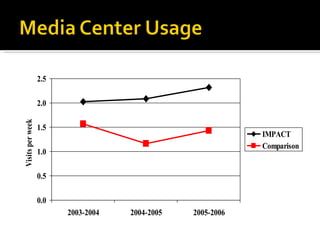
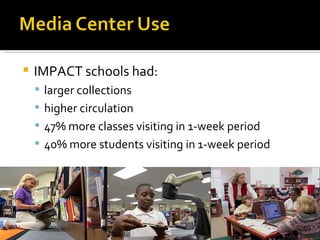
IMPACT schools had:  larger collections higher circulation 47% more classes visiting in 1-week period 40% more students visiting in 1-week period
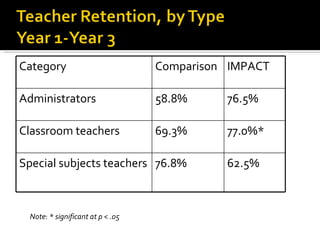
Note :  * significant at p < .05 Category Comparison IMPACT Administrators 58.8% 76.5% Classroom teachers 69.3% 77.0%* Special subjects teachers 76.8% 62.5%
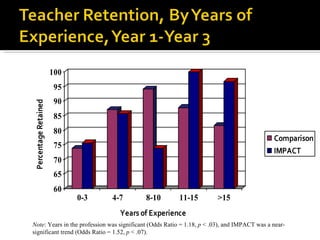
Note : Years in the profession was significant (Odds Ratio = 1.18,  p  < .03), and IMPACT was a near-significant trend (Odds Ratio = 1.52,  p  < .07).
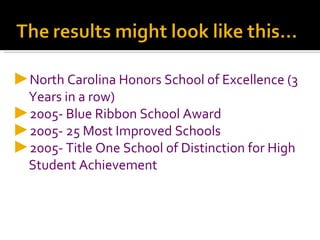
North Carolina Honors School of Excellence (3 Years in a row) 2005- Blue Ribbon School Award 2005- 25 Most Improved Schools 2005- Title One School of Distinction for High Student Achievement
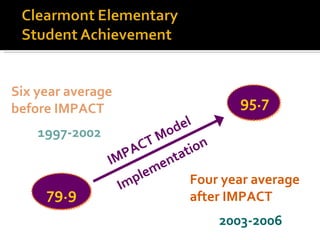
79.9 95.7 IMPACT Model Implementation Six year average before IMPACT 1997-2002 Four year average after IMPACT 2003-2006
&quot;IMPACT model produces independent learners and lifelong learners and fosters collaboration among teachers.&quot;
Leadership Personnel Flexible Access Collaboration Professional Development Evaluation Resources Parent-Community Involvement
 
Key Personnel Administration  Tech Facilitator Media Coordinator Media Assistant Tech Assistant/Technician
School Improvement Team MTAC Shared decision making Team process Teacher buy in Teacher retention
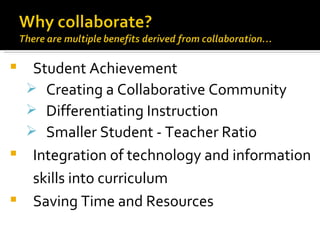
Student Achievement Creating a Collaborative Community Differentiating Instruction Smaller Student - Teacher Ratio Integration of technology and information skills into curriculum Saving Time and Resources
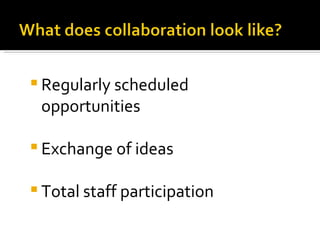
Regularly scheduled opportunities Exchange of ideas Total staff participation
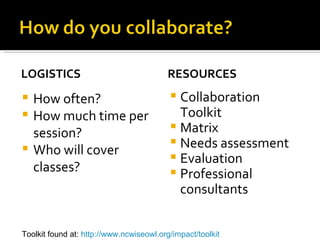
LOGISTICS How often? How much time per session? Who will cover classes? RESOURCES Collaboration Toolkit Matrix Needs assessment Evaluation  Professional consultants Toolkit found at:  http://www.ncwiseowl.org/impact/toolkit
 
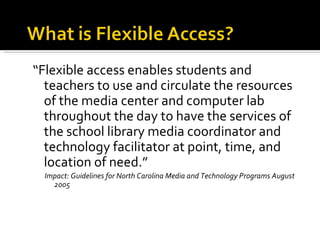
“ Flexible access enables students and teachers to use and circulate the resources of the media center and computer lab throughout the day to have the services of the school library media coordinator and technology facilitator at point, time, and location of need.” Impact: Guidelines for North Carolina Media and Technology Programs August 2005
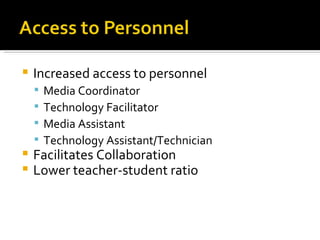
Increased access to personnel Media Coordinator Technology Facilitator Media Assistant Technology Assistant/Technician Facilitates Collaboration Lower teacher-student ratio
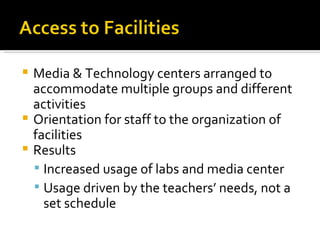
Media & Technology centers arranged to accommodate multiple groups and different activities Orientation for staff to the organization of facilities  Results Increased usage of labs and media center Usage driven by the teachers’ needs, not a set schedule
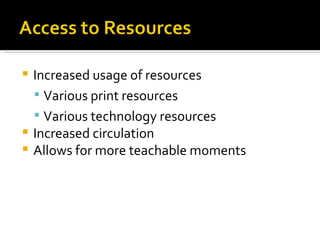
Increased usage of resources Various print resources Various technology resources Increased circulation Allows for more teachable moments
What steps should I take?
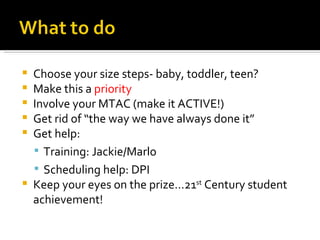
Choose your size steps- baby, toddler, teen? Make this a  priority Involve your MTAC (make it ACTIVE!) Get rid of “the way we have always done it” Get help: Training: Jackie/Marlo Scheduling help: DPI Keep your eyes on the prize…21 st  Century student achievement!
 

Making An Impact

  • 1.
    Best Practices withMedia and Technology Marlo Gaddis and Jackie Pierson
  • 2.
  • 3.
    IMPACT students caughtup within one year Effect significant at p<. 0001, controlling for grade, race, exceptionality, Free/reduced lunch, sex, absenteeism
  • 4.
    EOG growth frombaseline to Year 2 Effect significant at p<. 05, controlling for free/reduced lunch, race, exceptionality, sex, absenteeism, parent education
  • 5.
    Student Use ofComputers in Grades 3-5 2004-05
  • 6.
    Note : Effects significant at p < .0001. Response options were 1 (not at all), 2 (minimally), 3 (confidently) and 4 (able to teach others). Analyses controlled for sex and age.
  • 7.
  • 8.
    IMPACT schools had: larger collections higher circulation 47% more classes visiting in 1-week period 40% more students visiting in 1-week period
  • 9.
    Note : * significant at p < .05 Category Comparison IMPACT Administrators 58.8% 76.5% Classroom teachers 69.3% 77.0%* Special subjects teachers 76.8% 62.5%
  • 10.
    Note : Yearsin the profession was significant (Odds Ratio = 1.18, p < .03), and IMPACT was a near-significant trend (Odds Ratio = 1.52, p < .07).
  • 11.
    North Carolina HonorsSchool of Excellence (3 Years in a row) 2005- Blue Ribbon School Award 2005- 25 Most Improved Schools 2005- Title One School of Distinction for High Student Achievement
  • 12.
    79.9 95.7 IMPACTModel Implementation Six year average before IMPACT 1997-2002 Four year average after IMPACT 2003-2006
  • 13.
    &quot;IMPACT model producesindependent learners and lifelong learners and fosters collaboration among teachers.&quot;
  • 14.
    Leadership Personnel FlexibleAccess Collaboration Professional Development Evaluation Resources Parent-Community Involvement
  • 15.
  • 16.
    Key Personnel Administration Tech Facilitator Media Coordinator Media Assistant Tech Assistant/Technician
  • 17.
    School Improvement TeamMTAC Shared decision making Team process Teacher buy in Teacher retention
  • 18.
    Student Achievement Creatinga Collaborative Community Differentiating Instruction Smaller Student - Teacher Ratio Integration of technology and information skills into curriculum Saving Time and Resources
  • 19.
    Regularly scheduled opportunitiesExchange of ideas Total staff participation
  • 20.
    LOGISTICS How often?How much time per session? Who will cover classes? RESOURCES Collaboration Toolkit Matrix Needs assessment Evaluation Professional consultants Toolkit found at: http://www.ncwiseowl.org/impact/toolkit
  • 21.
  • 22.
    “ Flexible accessenables students and teachers to use and circulate the resources of the media center and computer lab throughout the day to have the services of the school library media coordinator and technology facilitator at point, time, and location of need.” Impact: Guidelines for North Carolina Media and Technology Programs August 2005
  • 23.
    Increased access topersonnel Media Coordinator Technology Facilitator Media Assistant Technology Assistant/Technician Facilitates Collaboration Lower teacher-student ratio
  • 24.
    Media & Technologycenters arranged to accommodate multiple groups and different activities Orientation for staff to the organization of facilities Results Increased usage of labs and media center Usage driven by the teachers’ needs, not a set schedule
  • 25.
    Increased usage ofresources Various print resources Various technology resources Increased circulation Allows for more teachable moments
  • 26.
  • 27.
    Choose your sizesteps- baby, toddler, teen? Make this a priority Involve your MTAC (make it ACTIVE!) Get rid of “the way we have always done it” Get help: Training: Jackie/Marlo Scheduling help: DPI Keep your eyes on the prize…21 st Century student achievement!
  • 28.