Program Lead & Faculty Advisor
George Beckwith, Ed. D.
gbeckwith@nu.edu
(951) 347-6091
EdTech Advisor, Cynthia Sistek-Chandler cchandler@nu.edu
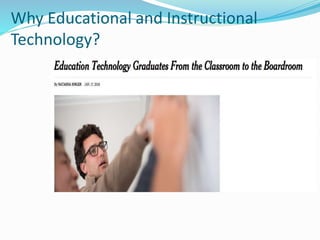
Why Educational and Instructional
Technology?
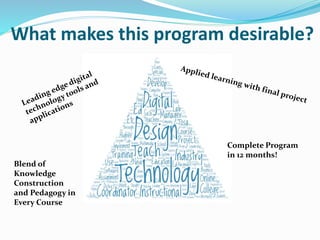
What makes this program desirable?
Blend of
Knowledge
Construction
and Pedagogy in
Every Course
Complete Program
in 12 months!
What are the skills acquired with
this degree program?
 If they teach, they can develop their lessons into engaging and
interactive multimedia and digital assignments that will hold the
interest of students and enhance their learning for the 21st century.
 If they design, develop, implement and/or teach online
training and academic courses for education and/or industry, they
will be able to successfully use the latest digital technology software
and methods for this digital world.
 If they seek self-improvement, they will know how to use all of the
time-management software, Internet and digital research tools, and
social network and related online communication and learning
systems.
Career Options
 Educational Technology Coordinator (K=12/Higher Ed)
 Technology Teacher on Special Assignment (TOSA-K12)
 Instructional Technology Coordinator (Business/Industry)
 Online Course Designer & Developer
 Instructional Designer (K through College)
 Computer Lab and/ Technology Manager (K-12)
 Digital/Technology Project Manager (such as implementing
new hardware, software, systems, etc. in a school district or company)
 Technology Leadership- Teaching and Training
Alumni 2012-
2014
Application Skills & Requirements
 Microsoft Office (Word, Excel, PowerPoint)
 Google Docs
 Moodle Course Management System (Provided)
 Adobe Dreamweaver (Creative Suite Cloud)
 Virtual Worlds (Second Life)
 High Speed Internet Connection
 Headset with Microphone & Web/Video Camera
Degree Requirements
Current Catalog: 45 credit hours (10 courses)
EDT 600A Technology Foundations
EDT 601 Instructional Design
EDT 605 Educational Theory & Technology
EDT 607 Media Based Learning Objects
EDT 609 Developing Online Courseware
EDT 613 Simulations & Virtual Reality
EDT 631 Media and Instruction
EDT 632 Technology & Leadership
EDT 693 Instructional Evaluation & Development
EDT 695 Capstone Project (2 months)
Program Learning Outcomes
1. Conduct an educational needs assessment using analysis of
subject matter, job/task, audience and context.
2. Apply learning theory, instructional theory, and interactive
communication theory using various technology methods across
disciplines.
3. Integrate interdisciplinary connections from technology,
psychology, and computer assisted interactive communications.
4. Construct an instructional module using appropriate theories and
methodologies.
5. Evaluate effective teaching methods for adult learners using
available technologies.
6. Evaluate the social, political, economic, and global implications of
web-based instruction.
7. Integrate multimedia elements into simulations, virtual worlds,
and learning objects.
Program Highlights
 In the last course of the program, students develop an
online class in Moodle, a Learning Management
System provided free by NU, in which they use all of
the skills and knowledge learned in the program to
develop an actual online class on an academic subject
of their choice.
 Many students, after graduation, have used their self-
developed online course to show, to potential
employers, the quality of their educational and
instructional technology skills—some have reported
that employers hired them based on seeing the
course.
Program Availability
 There are normally two starts every year in September and
February—this year the next start will be March, 2016, but
may have to be postposed to June 2016 due to current low
enrollment (currently 8 students).
 We are hoping the enrollment will increase before a
postponement decision has to be made in February.
 Further questions may be directed to Dr. George Beckwith
at gbeckwith@nu.edu
 Cell 951 347-6091 (Call or text)
Supplemental Information
EDT 600A Technology Foundations
•Exploration of four theoretical constructs:
learning theory, project design and
management, assessment and evaluation, and
the integration and application of digital tools.
• As a foundational course for EDT, students
conduct scholarly research and develop
technical skills while constructing and
contributing in an online learning community.
EDT 601 Instructional Design
•Overview and application of the instructional
design (ID) process.
• Topics include learning theories and how they
relate to ID, design of needs assessment,
analysis of subject matter content,
development of effective learning objectives,
design of instructional strategies, online
collaboration, integration of media-based
delivery systems, and assessment and
evaluation strategies.
EDT 605 Education Theory & Technology
•Provides a comprehensive overview of major
educational learning theories.
•Topics focus on using technology to support
these theories when designing web-based
courses, online learning communities,
collaborative learning environments (both
among students and between students and
their mentors), games and simulations, and
when constructing personal hypermedia tools
and resources.
EDT 607 Media Based Learning Objects
•Learners experience exploration and creation
of media-based learning objects for onsite and
online courses.
•Pedagogical foundations in digital media
authoring tools invite learners to research,
plan, create, and evaluate reusable learning
objects in classroom curriculum.
•Special focus is given to creating shared
content libraries and rich media for educational
products.
EDT 609 Developing Online Courseware
•Learners explore and employ a wide range of
online technologies to design and deliver
course content for distance education.
•Working directly with learner management
systems, learners map the path from learning
and instructional theory, instructional design,
and technological implementation to solid
curriculum development, content creation,
and engaging course facilitation.
EDT 613 Simulations & Virtual Reality
•Introduction to the use of simulated
environments as a component of
education/training programs.
•Topics include a historical review of simulation,
instructional design principles applied to virtual
reality as a tool for instruction, current
constraints in both stand-alone and networked
systems, and future possibilities for simulated
learning environments.
EDT 631 Media and Instruction
•Comprehensive overview of visual learning
techniques, skills, methods, and theories to
support and to enhance learning.
•Application of various digital media including
video, audio, and graphics for communicating
and for creating digital assets in an educational
or in a training context.
EDT 632 Technology and Leadership
•Information technology issues, networking,
and the convergence of media
(telecommunications, voice, video, and data)
will be contextualized through the lens of
educational leadership.
•Future technology leaders will address current
issues such as network security, digital ethics,
budgets, and the total cost of ownership as it
pertains to hardware and software.
EDT 693 Instructional Evaluation &
Development
• An exploration and application of alternative
theories and strategies for evaluating the
effectiveness of instructional programs.
• Applies usability framework, instruments,
approaches to student outcomes and assessment,
and continuous quality improvement strategies as
they apply to the design and improvement of
instructional systems.
• Capstone prospectus developed.
EDT 695 Capstone Project
•The final class in the MS in Educational and
Instructional Technology program.
•Under the supervision of a faculty member,
students complete a capstone project and
accompanying report.
•Students meet weekly via voice/web with a faculty
supervisor. Grading is by H, S, or U only.
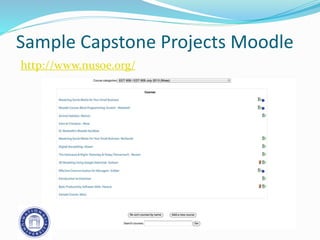
Sample Capstone Projects Moodle
http://www.nusoe.org/
End of Presentation
Questions?/Comments?

EdTechProgramNationalUniversity

  • 1.
    Program Lead &Faculty Advisor George Beckwith, Ed. D. gbeckwith@nu.edu (951) 347-6091 EdTech Advisor, Cynthia Sistek-Chandler cchandler@nu.edu
  • 2.
    Why Educational andInstructional Technology?
  • 3.
    What makes thisprogram desirable? Blend of Knowledge Construction and Pedagogy in Every Course Complete Program in 12 months!
  • 4.
    What are theskills acquired with this degree program?  If they teach, they can develop their lessons into engaging and interactive multimedia and digital assignments that will hold the interest of students and enhance their learning for the 21st century.  If they design, develop, implement and/or teach online training and academic courses for education and/or industry, they will be able to successfully use the latest digital technology software and methods for this digital world.  If they seek self-improvement, they will know how to use all of the time-management software, Internet and digital research tools, and social network and related online communication and learning systems.
  • 5.
    Career Options  EducationalTechnology Coordinator (K=12/Higher Ed)  Technology Teacher on Special Assignment (TOSA-K12)  Instructional Technology Coordinator (Business/Industry)  Online Course Designer & Developer  Instructional Designer (K through College)  Computer Lab and/ Technology Manager (K-12)  Digital/Technology Project Manager (such as implementing new hardware, software, systems, etc. in a school district or company)  Technology Leadership- Teaching and Training
  • 6.
  • 7.
    Application Skills &Requirements  Microsoft Office (Word, Excel, PowerPoint)  Google Docs  Moodle Course Management System (Provided)  Adobe Dreamweaver (Creative Suite Cloud)  Virtual Worlds (Second Life)  High Speed Internet Connection  Headset with Microphone & Web/Video Camera
  • 8.
    Degree Requirements Current Catalog:45 credit hours (10 courses) EDT 600A Technology Foundations EDT 601 Instructional Design EDT 605 Educational Theory & Technology EDT 607 Media Based Learning Objects EDT 609 Developing Online Courseware EDT 613 Simulations & Virtual Reality EDT 631 Media and Instruction EDT 632 Technology & Leadership EDT 693 Instructional Evaluation & Development EDT 695 Capstone Project (2 months)
  • 9.
    Program Learning Outcomes 1.Conduct an educational needs assessment using analysis of subject matter, job/task, audience and context. 2. Apply learning theory, instructional theory, and interactive communication theory using various technology methods across disciplines. 3. Integrate interdisciplinary connections from technology, psychology, and computer assisted interactive communications. 4. Construct an instructional module using appropriate theories and methodologies. 5. Evaluate effective teaching methods for adult learners using available technologies. 6. Evaluate the social, political, economic, and global implications of web-based instruction. 7. Integrate multimedia elements into simulations, virtual worlds, and learning objects.
  • 10.
    Program Highlights  Inthe last course of the program, students develop an online class in Moodle, a Learning Management System provided free by NU, in which they use all of the skills and knowledge learned in the program to develop an actual online class on an academic subject of their choice.  Many students, after graduation, have used their self- developed online course to show, to potential employers, the quality of their educational and instructional technology skills—some have reported that employers hired them based on seeing the course.
  • 11.
    Program Availability  Thereare normally two starts every year in September and February—this year the next start will be March, 2016, but may have to be postposed to June 2016 due to current low enrollment (currently 8 students).  We are hoping the enrollment will increase before a postponement decision has to be made in February.  Further questions may be directed to Dr. George Beckwith at gbeckwith@nu.edu  Cell 951 347-6091 (Call or text)
  • 12.
  • 13.
    EDT 600A TechnologyFoundations •Exploration of four theoretical constructs: learning theory, project design and management, assessment and evaluation, and the integration and application of digital tools. • As a foundational course for EDT, students conduct scholarly research and develop technical skills while constructing and contributing in an online learning community.
  • 14.
    EDT 601 InstructionalDesign •Overview and application of the instructional design (ID) process. • Topics include learning theories and how they relate to ID, design of needs assessment, analysis of subject matter content, development of effective learning objectives, design of instructional strategies, online collaboration, integration of media-based delivery systems, and assessment and evaluation strategies.
  • 15.
    EDT 605 EducationTheory & Technology •Provides a comprehensive overview of major educational learning theories. •Topics focus on using technology to support these theories when designing web-based courses, online learning communities, collaborative learning environments (both among students and between students and their mentors), games and simulations, and when constructing personal hypermedia tools and resources.
  • 16.
    EDT 607 MediaBased Learning Objects •Learners experience exploration and creation of media-based learning objects for onsite and online courses. •Pedagogical foundations in digital media authoring tools invite learners to research, plan, create, and evaluate reusable learning objects in classroom curriculum. •Special focus is given to creating shared content libraries and rich media for educational products.
  • 17.
    EDT 609 DevelopingOnline Courseware •Learners explore and employ a wide range of online technologies to design and deliver course content for distance education. •Working directly with learner management systems, learners map the path from learning and instructional theory, instructional design, and technological implementation to solid curriculum development, content creation, and engaging course facilitation.
  • 18.
    EDT 613 Simulations& Virtual Reality •Introduction to the use of simulated environments as a component of education/training programs. •Topics include a historical review of simulation, instructional design principles applied to virtual reality as a tool for instruction, current constraints in both stand-alone and networked systems, and future possibilities for simulated learning environments.
  • 19.
    EDT 631 Mediaand Instruction •Comprehensive overview of visual learning techniques, skills, methods, and theories to support and to enhance learning. •Application of various digital media including video, audio, and graphics for communicating and for creating digital assets in an educational or in a training context.
  • 20.
    EDT 632 Technologyand Leadership •Information technology issues, networking, and the convergence of media (telecommunications, voice, video, and data) will be contextualized through the lens of educational leadership. •Future technology leaders will address current issues such as network security, digital ethics, budgets, and the total cost of ownership as it pertains to hardware and software.
  • 21.
    EDT 693 InstructionalEvaluation & Development • An exploration and application of alternative theories and strategies for evaluating the effectiveness of instructional programs. • Applies usability framework, instruments, approaches to student outcomes and assessment, and continuous quality improvement strategies as they apply to the design and improvement of instructional systems. • Capstone prospectus developed.
  • 22.
    EDT 695 CapstoneProject •The final class in the MS in Educational and Instructional Technology program. •Under the supervision of a faculty member, students complete a capstone project and accompanying report. •Students meet weekly via voice/web with a faculty supervisor. Grading is by H, S, or U only.
  • 23.
    Sample Capstone ProjectsMoodle http://www.nusoe.org/
  • 24.

Editor's Notes

  • #2 The following presentation includes information about the program as well as connections to the field. Specific course information is contained in the supplemental slides.
  • #3 Judging by the number of learning apps available to classrooms around the country, the education technology market aimed at elementary through high schools is booming. There are more than 3,900 math and reading apps, classroom management Systems and other software services for schools in the United States, according to LearnTrials, a start-up that helps school districts assess and manage these tools.
  • #4 It increases the multimedia knowledge and skills of program graduates so that they will be able to use leading edge digital technology tools and applications in their work and in their daily lives. Our graduates work for colleges, universities, public agencies, health care organizations, who are moving their training and instruction to the WEB! All students create a final project which captures digital content for teaching, training, or for learning. The final project is an exemplar that in many cases has been the reason the candidate was hired for the desired job.
  • #7 Vance Bolinger, Military Trainer Diana Lynn Havens, Instructional Designer for Ashford U. JR Ginex-Orinion, TOSA Tustin USD, Google Certified Teacher and Training, Microsoft Innovative Educator Michael Tillyer, Technology Teacher on Special Assignment, iPad App Designer
  • #12 Ask Sandra Franco to support the value of the program. She is one of our graduates.