Leading to change:
educators at the forefront
of innovation in formal
education
Brian Holmes
Director
Education, Audiovisual & Culture
Executive Agency
2
Focus on learning

supported by an
educator
?
?



(Johnson et al., 2014)
Leading to change: educators at the forefront
of innovation in formal education
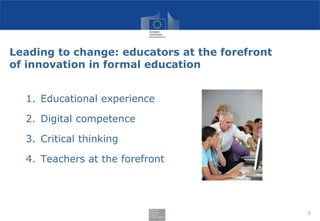
1. Educational experience
2. Digital competence
3. Critical thinking
4. Teachers at the forefront
3
http://www.slideshare.net/holmebn
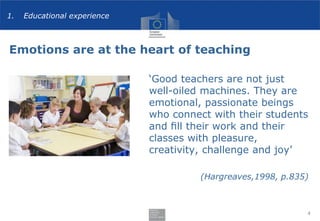
Emotions are at the heart of teaching
‘Good teachers are not just
well-oiled machines. They are
emotional, passionate beings
who connect with their students
and fill their work and their
classes with pleasure,
creativity, challenge and joy’
(Hargreaves,1998, p.835)
4
1. Educational experience
Teachers are the gatekeepers of innovation
Teachers’ motivation, attitudes
and propensity for change are
positively influenced by seeing
for themselves the impact of
innovation on their students’
learning; no more so than
when it concerns the use of
ICT.
(Holmes, 2013; Guskey, 2002;
Day and Sachs, 2004)
5
1. Educational experience
Sarine Brady
Teachers help ensure learning is critical
Teachers inspire, guide and challenge learners to look
beyond the present.
 Reflecting and understanding
 Encouraging metacognition, critical thinking and
competence development: from the what and the
how, to the why
 Engendering self-confidence, self-esteem and
respect for others
6
1. Educational experience
7
 Digital competence: the set of knowledge, skills and
attitudes needed for the confident and critical use
of technology.
 Framework covers five areas:
1. Information
2. Communication
3. Content creation
4. Safety
5. Problem solving
(Ferrari, Punie & Brečko, 2013)
DIGCOMP framework for Digital Competence
2. Digital competence
Keywords basic user:
Keywords advanced user:
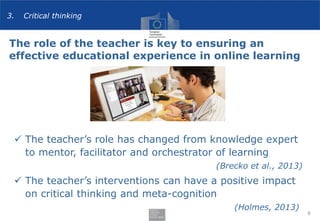
The role of the teacher is key to ensuring an
effective educational experience in online learning
8
 The teacher’s role has changed from knowledge expert
to mentor, facilitator and orchestrator of learning
(Brecko et al., 2013)
 The teacher’s interventions can have a positive impact
on critical thinking and meta-cognition
(Holmes, 2013)
3. Critical thinking
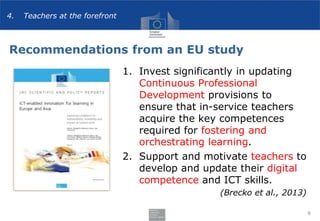
Recommendations from an EU study
1. Invest significantly in updating
Continuous Professional
Development provisions to
ensure that in-service teachers
acquire the key competences
required for fostering and
orchestrating learning.
2. Support and motivate teachers to
develop and update their digital
competence and ICT skills.
(Brecko et al., 2013)
9
4. Teachers at the forefront
Teaching and learning international survey
 Positive relation between professional development, collaborative
approaches, efficacy and satisfaction
 Teachers engaging in professional development more likely to use
innovative approaches
And yet
• Only 34% of teachers use ICT for projects or class work
(74% in Denmark – 18% in Finland)
• 51% of teachers have never observed other teachers’ classes and
17% have never taken part in collaborative professional development
10
4. Teachers at the forefront
TALIS 2013 survey in 11 countries:
BG, CZ, DK, ES, FR, IT, LV, PT, SE, SK and UK-ENG (EU, 2014)
Example: eTwinning initiative (1 of 2)
11
• eTwinning supports teachers and pupils to
collaborate across Europe
• Joint pedagogical projects
o Project-based inquiry learning for students
o Supported by teacher who is in complete control
o Collaborative and multidisciplinary
o Increases students’ autonomy and confidence
o Helps develop digital competence and other key
competences
www.eTwinning.net
4. Teachers at the forefront
Example: eTwinning initiative (2 of 2)
12
• Teachers’ Continuous Professional
Development e.g. ‘Learning Events’
o Short, intensive online sessions, in groups
o Focused on a theme, led by a subject expert
o Involve teachers in hands-on, non-formal learning
with peers
• A thriving community of teachers
o Peer learning and support
o Safe, respected and trusted environment
o Encourages teachers to innovate in their practice
www.eTwinning.net
4. Teachers at the forefront
In conclusion
13
Educators are the key to
mainstreaming technology in education
 They help ensure that online learning is
effective and leads to competence
development
 They are champions of innovation in
education, if they are convinced of the
benefits
 But they need support to develop their own
competence through Continuous
Professional Development
raysto
References
Brecko, B. N., Kampylis, P. & Punie, Y. (2014), Mainstreaming ICT-enabled innovation in education
and training in Europe: policy actions for sustainability, scalability and impact at system level,
Seville, JRC-IPTS. http://is.jrc.ec.europa.eu/pages/EAP/SCALECCR.html
Day, C. & Sachs, J. (2004), ‘Professionalism, performativity and empowerment : discourses in the
politics, policies and purposes of continuing professional development’, in Day, C. & Sachs, J.
(Eds.), International handbook on the continuing professional development of teachers. pp.3-
32, Maidenhead, Open University Press.
EU (2014) The teacher and learning international survey (TALIS) 2013, Brussels, European
Commission. http://ec.europa.eu/education/library/reports/2014/talis_en.pdf
Ferrari, A., Punie, Y., & Brečko, B. N. (2013), DIGCOMP: A Framework for Developing and
Understanding Digital Competence in Europe: Institute for Prospective Technological Studies
(IPTS), JRC, European Commission
Guskey, T. R. (2002), ‘Professional development and teacher change’, Teachers and Teaching:
Theory and Practice, 8 (3), pp.381 - 391.
Holmes, B. (2013), School Teachers' Continuous Professional Development in an Online Learning
Community: lessons from a case study of an eTwinning Learning Event. European Journal of
Education, 48(1), 97-112. http://dx.doi.org/10.1111/ejed.12015.
Johnson, L., Adams Becker, S., Estrada, V., Freeman, A., Kampylis, P., Vuorikari, R. & Punie, Y.
(2014) Horizon report Europe: 2014 schools edition, Luxembourg & Austin, Texas, Publications
Office of the European Union & The New Media Consortium
https://ec.europa.eu/jrc/sites/default/files/2014-nmc-horizon-report-eu-en_online.pdf
http://eacea.ec.europa.eu
eacea-info@ec.europa.eu
15

Leading to change: educators at the forefront of innovation in formal education

  • 1.
    Leading to change: educatorsat the forefront of innovation in formal education Brian Holmes Director Education, Audiovisual & Culture Executive Agency
  • 2.
    2 Focus on learning  supportedby an educator ? ?    (Johnson et al., 2014)
  • 3.
    Leading to change:educators at the forefront of innovation in formal education 1. Educational experience 2. Digital competence 3. Critical thinking 4. Teachers at the forefront 3 http://www.slideshare.net/holmebn
  • 4.
    Emotions are atthe heart of teaching ‘Good teachers are not just well-oiled machines. They are emotional, passionate beings who connect with their students and fill their work and their classes with pleasure, creativity, challenge and joy’ (Hargreaves,1998, p.835) 4 1. Educational experience
  • 5.
    Teachers are thegatekeepers of innovation Teachers’ motivation, attitudes and propensity for change are positively influenced by seeing for themselves the impact of innovation on their students’ learning; no more so than when it concerns the use of ICT. (Holmes, 2013; Guskey, 2002; Day and Sachs, 2004) 5 1. Educational experience Sarine Brady
  • 6.
    Teachers help ensurelearning is critical Teachers inspire, guide and challenge learners to look beyond the present.  Reflecting and understanding  Encouraging metacognition, critical thinking and competence development: from the what and the how, to the why  Engendering self-confidence, self-esteem and respect for others 6 1. Educational experience
  • 7.
    7  Digital competence:the set of knowledge, skills and attitudes needed for the confident and critical use of technology.  Framework covers five areas: 1. Information 2. Communication 3. Content creation 4. Safety 5. Problem solving (Ferrari, Punie & Brečko, 2013) DIGCOMP framework for Digital Competence 2. Digital competence Keywords basic user: Keywords advanced user:
  • 8.
    The role ofthe teacher is key to ensuring an effective educational experience in online learning 8  The teacher’s role has changed from knowledge expert to mentor, facilitator and orchestrator of learning (Brecko et al., 2013)  The teacher’s interventions can have a positive impact on critical thinking and meta-cognition (Holmes, 2013) 3. Critical thinking
  • 9.
    Recommendations from anEU study 1. Invest significantly in updating Continuous Professional Development provisions to ensure that in-service teachers acquire the key competences required for fostering and orchestrating learning. 2. Support and motivate teachers to develop and update their digital competence and ICT skills. (Brecko et al., 2013) 9 4. Teachers at the forefront
  • 10.
    Teaching and learninginternational survey  Positive relation between professional development, collaborative approaches, efficacy and satisfaction  Teachers engaging in professional development more likely to use innovative approaches And yet • Only 34% of teachers use ICT for projects or class work (74% in Denmark – 18% in Finland) • 51% of teachers have never observed other teachers’ classes and 17% have never taken part in collaborative professional development 10 4. Teachers at the forefront TALIS 2013 survey in 11 countries: BG, CZ, DK, ES, FR, IT, LV, PT, SE, SK and UK-ENG (EU, 2014)
  • 11.
    Example: eTwinning initiative(1 of 2) 11 • eTwinning supports teachers and pupils to collaborate across Europe • Joint pedagogical projects o Project-based inquiry learning for students o Supported by teacher who is in complete control o Collaborative and multidisciplinary o Increases students’ autonomy and confidence o Helps develop digital competence and other key competences www.eTwinning.net 4. Teachers at the forefront
  • 12.
    Example: eTwinning initiative(2 of 2) 12 • Teachers’ Continuous Professional Development e.g. ‘Learning Events’ o Short, intensive online sessions, in groups o Focused on a theme, led by a subject expert o Involve teachers in hands-on, non-formal learning with peers • A thriving community of teachers o Peer learning and support o Safe, respected and trusted environment o Encourages teachers to innovate in their practice www.eTwinning.net 4. Teachers at the forefront
  • 13.
    In conclusion 13 Educators arethe key to mainstreaming technology in education  They help ensure that online learning is effective and leads to competence development  They are champions of innovation in education, if they are convinced of the benefits  But they need support to develop their own competence through Continuous Professional Development raysto
  • 14.
    References Brecko, B. N.,Kampylis, P. & Punie, Y. (2014), Mainstreaming ICT-enabled innovation in education and training in Europe: policy actions for sustainability, scalability and impact at system level, Seville, JRC-IPTS. http://is.jrc.ec.europa.eu/pages/EAP/SCALECCR.html Day, C. & Sachs, J. (2004), ‘Professionalism, performativity and empowerment : discourses in the politics, policies and purposes of continuing professional development’, in Day, C. & Sachs, J. (Eds.), International handbook on the continuing professional development of teachers. pp.3- 32, Maidenhead, Open University Press. EU (2014) The teacher and learning international survey (TALIS) 2013, Brussels, European Commission. http://ec.europa.eu/education/library/reports/2014/talis_en.pdf Ferrari, A., Punie, Y., & Brečko, B. N. (2013), DIGCOMP: A Framework for Developing and Understanding Digital Competence in Europe: Institute for Prospective Technological Studies (IPTS), JRC, European Commission Guskey, T. R. (2002), ‘Professional development and teacher change’, Teachers and Teaching: Theory and Practice, 8 (3), pp.381 - 391. Holmes, B. (2013), School Teachers' Continuous Professional Development in an Online Learning Community: lessons from a case study of an eTwinning Learning Event. European Journal of Education, 48(1), 97-112. http://dx.doi.org/10.1111/ejed.12015. Johnson, L., Adams Becker, S., Estrada, V., Freeman, A., Kampylis, P., Vuorikari, R. & Punie, Y. (2014) Horizon report Europe: 2014 schools edition, Luxembourg & Austin, Texas, Publications Office of the European Union & The New Media Consortium https://ec.europa.eu/jrc/sites/default/files/2014-nmc-horizon-report-eu-en_online.pdf
  • 15.