D R . G . R E E N A P R A S O O N A
A S S T P R O F
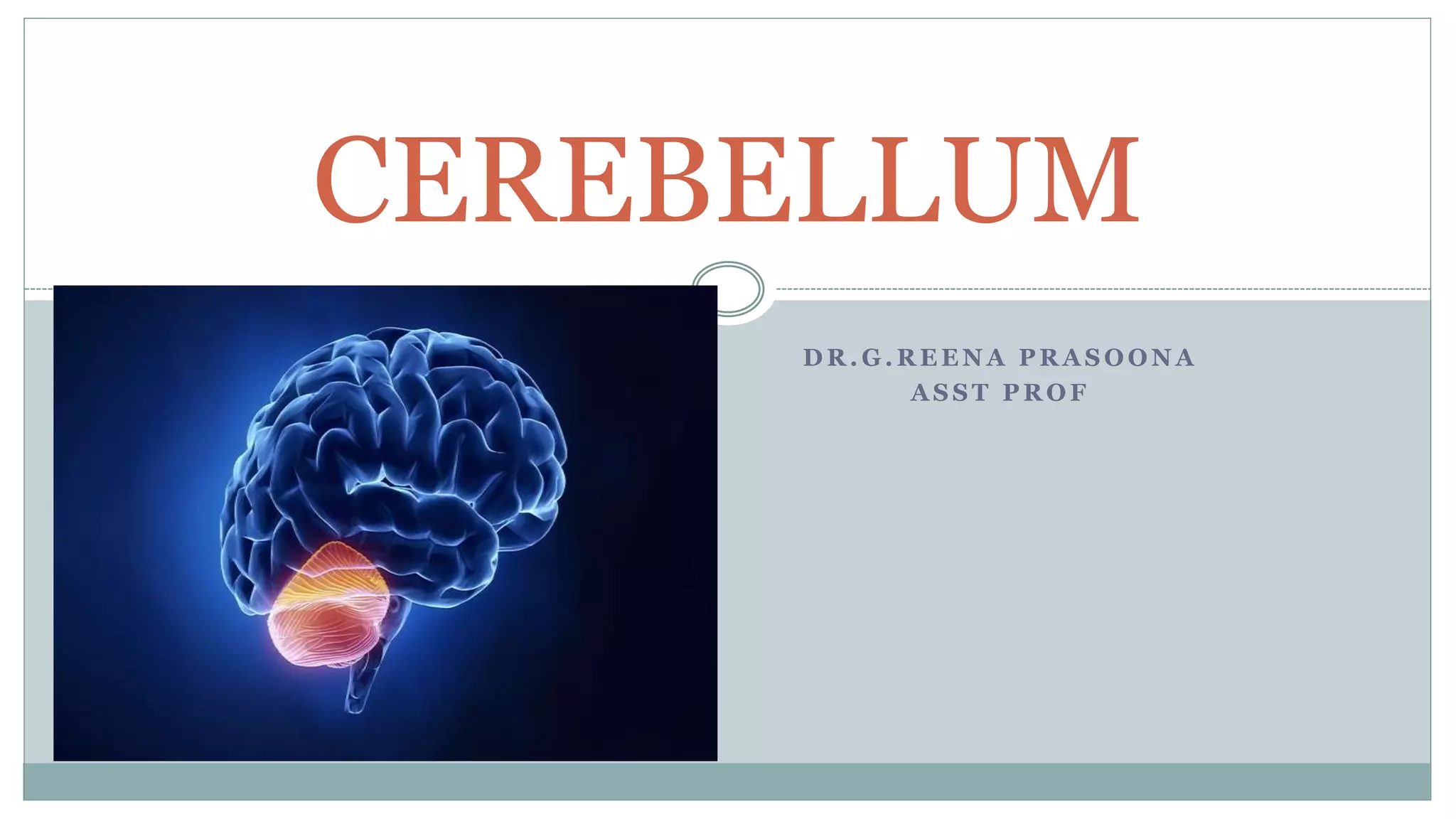
CEREBELLUM
On completion of study of this chapter: The student will be able to: (MUST KNOW)
1. Draw a schematic diagram to show the functional divisions of cerebellum with depiction of functions
of each division.
2. Name the afferent tracts carrying different kinds of sensory inputs to cerebellum.
3. Remember the arrangement of cells in different layers of cortex of cerebellum.
4. Name deep cerebellar nuclei in different divisions of cerebellum.
5. Appreciate the internal connections of cerebellum and how mossy fiber inputs and climbing fiber
inputs influence Purkinje cell output.
6. Understand the projection of deep cerebellar nuclei to the descending pathways.
7. List the functions of cerebellum and briefly describe each of them.
8. Describe the connections and functions of cerebellum.
9. List the features of cerebellar disorder.
10. Define ataxia and describe different clinical manifestations of ataxia.
11. List the cerebellar function tests.
The student may also be able to: (DESIRABLE TO KNOW)
1. Describe the details of connections and functions of cerebellum.
2. Explain the physiological basis of cerebellar disorder.
3. Describe cerebellar function tests.
LEARNING OBJECTIVES
Cerebellum literally means the “little brain.” Cerebellum is situated posterior to the brainstem.
Cerebellum is vital for regulation of posture and movement.
1. It receives inputs of almost all sensory modalities.
• From spinal cord, it receives proprioceptive inputs.
• It receives special sensory inputs from visual, auditory, and vestibular structures.
2. It projects to almost all areas of brain that are involved in control of motor activities.
3. cerebellum plays a critical role in motor control by integrating sensory and motor information
in the brain.
4. Cerebellum strongly influences all aspects of movement, starting from the rate, range, force, and
direction to the termination of movement.
• Hence, damage to cerebellum results in severe incoordination of movement.
5. Cerebellum directly projects to the brainstem nuclei that give rise to major descending
pathways.
• Therefore, damage to cerebellum results in severe postural abnormalities.
6. Cerebellum also regulates vestibulo-occular reflex and motor learning.
INTRODUCTION
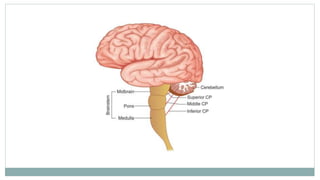
Cerebellum is located in the posterior cranial fossa, behind the brainstem.
1. It is connected to
midbrain through superior cerebellar peduncle,
Pons through middle cerebellar peduncle and to the
medulla through inferior cerebellar peduncle .
2. The surface area of cerebellum is about 75% of the cerebral cortex, but in weight it is only 10%
of the cortex. Thus, cerebellar cortical tissue is much folded.
3. There are two main fissures in the cerebellum that divides it into two major parts:
• The posterolateral fissure that separates flocculonodular lobe from rest of the cerebellum
• The primary fissure that separates the anterior lobe from the posterior lobe
CEREBELLAR ORGANIZATION
Functional Divisions and Functions of Cerebellum
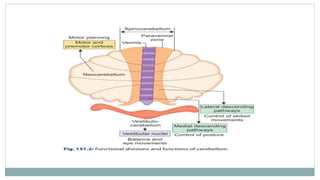
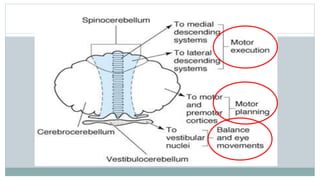
Functionally, cerebellum is divided into three major subdivisions: vestibulocerebellum,
spinocerebellum, and cerebrocerebellum.
Vestibulocerebellum
This is also called archicerebellum, as phylogenetically it is the oldest part.
1. It consists of flocculonodular lobe.
2. This part of cerebellum is called vestibulocerebellum for its extensive and reciprocal connection
with the vestibular nuclei.
3. It is concerned with equilibrium and learning induced changes in vestibulo-ocular reflex.
This is also called paleocerebellum, as it is intermediate in development.
1. It consists of the vermis and the paravermal regions of cerebellum.
2. It is called spinocerebellum, as it receives proprioceptive and other sensory inputs from all the
body parts through spinal cord.
3. It also receives inputs from the motor cortex, where motor planning is carried out.
• By comparing plan with performance, it smoothens and coordinates movement.
4. The vermal portion of spinocerebellum projects to the brainstem areas that control axial and
proximal limb muscles.
• Therefore, vermal spinocerebellum controls posture.
5. The paravermal region of spinocerebellum projects to the brainstem nuclei that influence distal
limb muscles.
• Therefore, paravermal spinocerebellum controls skilled voluntary movements.
SPINOCEREBELLUM
Cerebrocerebellum
This is also called neocerebellum, as it is newest phylogenetically.
1. It consists of the two main cerebellar hemispheres.
2. This is called cerebrocerebellum for its connections with the cortex.
3. Cortex projects to neocerebellum via the pontine nuclei; hence, this is also called
corticopontocerebellum.
4. As it interacts with the cortex, it is involved in planning and programming of the
movements.
Functional Histology
Cerebellum is divided into the outer cortex and the inner part containing deep cerebellar nuclei.
Cerebellar Cortex
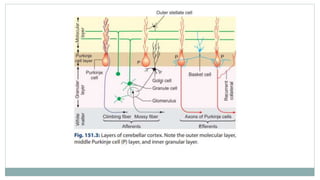
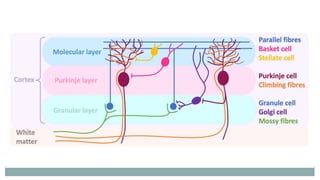
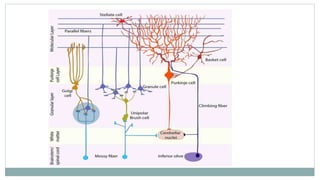
The cerebellar cortex has three layers: outer molecular layer, middle Purkinje cell layer, and inner
granular layer .
Molecular Layer: This layer contains interneurons that are basket cells and stellate cells.
Purkinje Cell Layer: This layer contains Purkinje cells.
1. Purkinje cells are the largest neurons with extensive dendritic branches.
2. Dendrites of Purkinje cells enter into the molecular layer. The axons of the interneurons of the
molecular layer project to the dendrites of the Purkinje cells.
3. Purkinje cells also receive inputs directly from the climbing fibers.
4. Purkinje cells are the only cells that project form the cortex of cerebellum to the deep cerebellar
nuclei. Thus, Purkinje cells are connecting links between cerebellar cortex and deep
cerebellar nuclei.
Granular Cell Layer: This layer contains granule cells and Golgi cells (interneurons).
1. The Golgi cells project to the granule cells and modify granular cell output.
2. The granule cells receive inputs from the mossy fibers and project to the Purkinje cells, basket
cells, stellate cells, and Golgi cells via parallel fibers.
Deep Cerebellar Nuclei
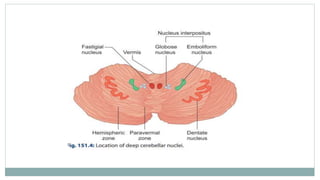
There are four deep cerebellar nuclei .
Nucleus Fastigius
The nucleus fastigius is present in the deep vermal portion of the cerebellum. The vermal cortical
portion of spinocerebellum projects to the fastigial nucleus.
Nucleus Globosus and Nucleus Emboliformis
The globose and emboliform nuclei are combinely known as nucleus interpositus. The paravermal
portion of spinocerebellum projects to nucleus interpositus
Nucleus Dentatus
This is present in the hemispheric portion of the cerebellum. It receives inputs from neocerebellum.
The name of the nucleus is “dentate” for its appearance, which has teeth-like serrated morphology.
The deep cerebellar nuclei project to the different parts of the brainstem and
Cerebellar Inputs
Cerebellum receives somatosensory inputs from almost all parts of the body and inputs of all sensory
modalities including special sensory inputs. The cerebellar afferents are:
1. Vestibulocerebellar tract: Through this tract cerebellum receives impulses directly from the
vestibular apparatus and also from the vestibular nuclei.
2. Dorsal spinocerebellar tract: This tract conveys proprioceptive and exteroceptive impulses from
different parts of the body to cerebellum.
3. Ventral spinocerebellar tract: This pathway also conveys proprioceptive and exteroceptive
impulses from different parts of the body.
4. Cuneocerebellar tract: This tract originates from lateral cuneate nucleus in the caudal medulla and
conveys proprioceptive inputs from head and neck.
5. Tectocerebellar tract: This tract conveys visual information from superior colliculus and auditory
information from inferior colliculus to the cerebellum.
6. Pontocerebellar tract: Impulses from motor cortex reach cerebellum via pontine nuclei.
7. Olivocerebellar tract: Proprioceptive inputs from the whole body reach cerebellum via inferior
olive.
• Inferior olivary nucleus is located in the rostral medulla that receives input from the vestibular
system, spinal cord, and cerebral cortex.
• It projects to cerebellum via climbing fibers.
CEREBELLAR CONNECTIONS
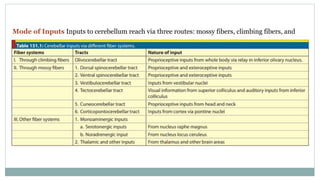
Mode of Inputs Inputs to cerebellum reach via three routes: mossy fibers, climbing fibers, and
other inputs
Mossy fiber inputs: Mossy fibers are major source of inputs to cerebellum. These fibers carry
direct proprioceptive inputs from all parts of the body and also convey input from
cerebral cortex. Mossy fibers project mainly to the granule cells.
Climbing fiber inputs: Climbing fibers convey inputs from inferior olivary nucleus to
cerebellum. Inferior olive receives proprioceptive input from all parts of the body. Climbing fibers
project to Purkinje cells of cerebellum.
Other inputs: Cerebellum receives monoaminergic inputs, and inputs from thalamus and other
parts of the brain. These fibers project to the deep cerebellar nuclei.
Cerebellar Outputs
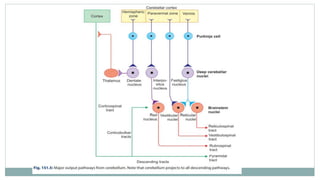
Different parts of cerebellum project to various descending pathways via deep cerebellar nuclei.
Deep cerebellar nuclei are the output pathway of cerebellum.
Output from Vestibulocerebellum
Vestibulocerebellum directly projects to the vestibular nuclei without any relay in the deep
cerebellar nuclei. Thus, vestibulocerebellum directly controls vestibulospinal tract activity.
Output from Spinocerebellum
1. The vermal portion of the spinocerebellum projects to fastigial nucleus, which in turn projects to
pontine reticular formation and vestibular nuclei in the brainstem.
• Thus, the vermal part of spinocerebellum controls the activity of pontine reticulospinal tract
and vestibulospinal tract.
2. The paravermal portion of the spinocerebellum projects to the nucleus interpositus, which in
turn projects to the red nucleus.
• Thus, the paravermal part of the spinocerebellum controls the activity of rubrospinal tract.
Output from Cerebrocerebellum
The cerebellar hemisphere projects to the dentate nucleus, which in turn projects to the motor
cortex via thalamus. Thus, cerebrocerebellum controls the activity of the corticospinal tract.
As different parts of the cerebellum project to all the motor nuclei in the brainstem and to the
motor cortex, cerebellum controls activities of all the descending pathways (corticospinal and
extrapyramidal systems). Therefore, diseases of the cerebellum affect both regulation of
posture and skilled voluntary movements.
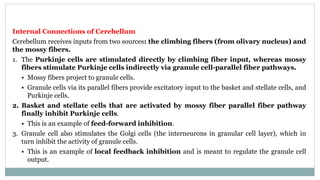
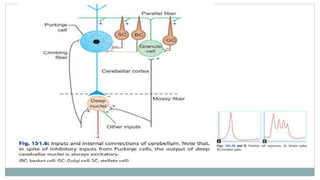
Internal Connections of Cerebellum
Cerebellum receives inputs from two sources: the climbing fibers (from olivary nucleus) and
the mossy fibers.
1. The Purkinje cells are stimulated directly by climbing fiber input, whereas mossy
fibers stimulate Purkinje cells indirectly via granule cell-parallel fiber pathways.
• Mossy fibers project to granule cells.
• Granule cells via its parallel fibers provide excitatory input to the basket and stellate cells, and
Purkinje cells.
2. Basket and stellate cells that are activated by mossy fiber parallel fiber pathway
finally inhibit Purkinje cells.
• This is an example of feed-forward inhibition.
3. Granule cell also stimulates the Golgi cells (the interneurons in granular cell layer), which in
turn inhibit the activity of granule cells.
• This is an example of local feedback inhibition and is meant to regulate the granule cell
output.
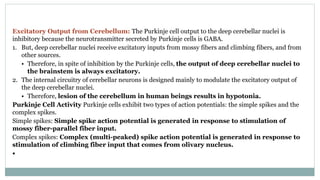
Excitatory Output from Cerebellum: The Purkinje cell output to the deep cerebellar nuclei is
inhibitory because the neurotransmitter secreted by Purkinje cells is GABA.
1. But, deep cerebellar nuclei receive excitatory inputs from mossy fibers and climbing fibers, and from
other sources.
• Therefore, in spite of inhibition by the Purkinje cells, the output of deep cerebellar nuclei to
the brainstem is always excitatory.
2. The internal circuitry of cerebellar neurons is designed mainly to modulate the excitatory output of
the deep cerebellar nuclei.
• Therefore, lesion of the cerebellum in human beings results in hypotonia.
Purkinje Cell Activity Purkinje cells exhibit two types of action potentials: the simple spikes and the
complex spikes.
Simple spikes: Simple spike action potential is generated in response to stimulation of
mossy fiber-parallel fiber input.
Complex spikes: Complex (multi-peaked) spike action potential is generated in response to
stimulation of climbing fiber input that comes from olivary nucleus.
•
1. Control of postural balance and equilibrium: This is the function of vestibulocerebellum,
which has extensive and reciprocal connection with the vestibular nuclei. Afferents from
vestibular apparatus in the inner ear project to vestibulocerebellum via vestibular nuclei.
2. Vestibulo-ocular reflex: Vestibulocerebellum is concerned with learning induced changes in
vestibulo-ocular reflex.
3. Smoothening and coordination of movement: This is the function of spinocerebellum that
receives proprioceptive and other sensory inputs from all the body parts through the spinal cord.
• It also receives inputs from the motor cortex, where motor planning is carried out.
• By comparing plan with performance, it smoothens and coordinates movement.
4. Control of posture: The vermal portion of spinocerebellum projects to the brainstem areas
that control axial and proximal limb muscles. Therefore, vermal spinocerebellum has profound
influence on posture.
5. Control of skilled voluntary movements: The paravermal region of spinocerebellum
projects to the brainstem nuclei that influence distal limb muscles. Therefore, paravermal
spinocerebellum controls skilled voluntary movements.
FUNCTIONS OF CEREBELLUM
• Cerebellum controls all aspects of movement starting from rate, range, force, and direction to
termination of movement. Although functionally cerebellum has three lobes (vestibulocerebellum,
spinocerebellum, and neocerebellum), they work in a coordinated and integrated manner, that
means it acts as “comparator of a servo mechanism.”
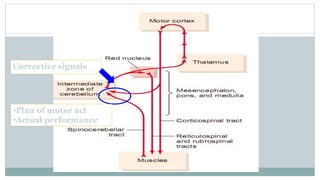
i. Cerebellum receives information from corticospinal output transmitted to the muscles,
receives proprioceptive inputs from muscles (via spinocerebellar tracts) that informs about
ongoing movements and position of the limbs, and also receives all special sensory inputs
(visual, auditory, and vestibular inputs).
• ii. Cerebellum projects to cortex via red nucleus and pontine nuclei.
• iii. Cerebellum coordinates all the cortical and spinal information and appropriately modifies the
ongoing movements via its influences on all descending pathways.
• iv. It sends error signal to the cortex for alteration in programming of the movement for any
desirable change in motor outputs to be achieved.
6.Planning and programming of the movements: This is
the function of neocerebellum that interacts with the
cortex.
• Hence, neocerebellum controls planning and programming of
the movements.
• Especially, planning of sequential movements is carried out
by hemispheric part of cerebellum that communicates with
premotor cortex and sensory cortex.
• Also, timing of the sequential movements is done by
cerebellar hemisphere. It controls and provides appropriate
timing for each succeeding movement.
7. Control of muscle tone and stretch reflexes: Cerebellum influences the activity of the
major descending medial system pathways through its output from fastigial nucleus, especially
the vestibulospinal and reticulospinal tracts.
• As vestibulospinal tract mainly controls α neuron activity and reticulospinal tract controls g
neuron activity in the spinal cord, cerebellum is one of the major sites of α-g co-linkage.
• In human beings, the output of deep cerebellar nuclei to the brainstem motor nuclei is
excitatory that facilitates muscle tone. Therefore, cerebellar disorder produces hypotonia.
• Though cerebellum has profound influence on all descending brainstem pathways, its
influence on stretch reflexes is minimal, except in some patients, pendular knee
jerk is elicited. Therefore, stretch reflexes remain usually normal in cerebellar
disorder.
•
8. Prevents overshoot and damps movements: There is tendency to overshoot, especially
when a movement (act) is done faster. But, intact cerebellum generates appropriate signals to
prevent the overshoot and tremor. This is the basic feature of a damping system.
9. Eyeball movement: The paraflocculus and pyramis of cerebellum are concerned with
movement of eyeball especially in upward direction.
• Stimulation of these parts of cerebellum causes upward eye movement of the ipsilateral side.
• Especially visual judgment of distance is the function of cerebellum, which is more developed
in monkeys.
10. Vestibular functions: For its dense and reciprocal connection with vestibular apparatus,
vestibulocerebellum is involved in control of all vestibular functions such as maintaining
balance during movement, execution of vestibuloocular reflex, vestibular postural reflexes, and
change in body posture and movement in response to head movement and acceleration.
•Plan of motor act
•Actual performance
Corrective signals
Diseases affecting flocculonodular lobe result in abnormalities in
maintaining equilibrium.
For example, stimulation of vestibulocerebellum or vestibular nuclei
leads to the motion sickness.
. Features of cerebellar disorder depend on the part of cerebellum
affected and whether the cortex or the deep cerebellar nuclei are
involved in the disease process.
Effects of lesion of one side cerebellar hemisphere manifest on the
ipsilateral side of the body.
CEREBELLAR DISORDERS
In general, cerebellar disorders have the following features:
1. No paralysis (voluntary movements are intact, though defective).
2. Usually, reflexes are normal, except that sometimes, pendular knee jerk is elicited.
3. No sensory deficit.
4. Hypotonia is a usual feature.
5. Ataxia:
6. If only cerebellar cortex is involved in the disease process, ataxia is temporary. But,
if the lesion involves deep cerebellar nuclei, the ataxia almost becomes permanent.
Ataxia manifests in the following forms:
i. Drunken gait: Unsteady and wide-base gait.
ii. Scanning speech: Ataxia involving muscles of speech manifests in the form of
scanning speech. Patient scans the syllables while speaking.
iii. . Dysmetria: When the patient attempts to touch an object, usually the hand
overshoots instead of reaching the target.
This is called dysmetria (inability to measure the length or distance). This is also called past
pointing.
iv. Intention tremor: Due to dysmetria, the corrective measures are immediately initiated, but
this time hand overshoots in the opposite direction. Repeated overshoot and re-correction result
in intention tremor (hand oscillating back and forth). Tremor is not seen at rest.
v. Rebound phenomenon: This results due to inability to put on brake (suddenly stop) of the
ongoing movement. For example, if the patient is asked to flex his limb against resistance and
then asked to stop immediately by withdrawing the resistance, he cannot stop, rather his arm
moves with a wide arc. This is called rebound phenomenon.
vi. Adiadochokinesia: The inability to perform alternate movements rapidly is called
adiadochokinesia. For example, the patient cannot perform supination and pronation rapidly.
vii. Decomposition of movement: Inability to perform movement that involves more than
one joint simultaneously. Therefore, cerebellar patient dissects such complex movement and
performs movement at each joint slowly and separately.
6. Inability to carry out long-term adjustment in motor response.
7. Defect in vestibulo-occular reflex leads to pathological nystagmus.
8. Charcot’s triad: Presence of nystagmus, intention
tremor, and scanning speech (or lalling speech like a baby)
together is called Charcot’s triad. This is seen in cerebellar
disorder and disseminated sclerosis that affects cerebellar functions.
9. Friedreich’s Ataxia: This is a form of hereditary ataxia in
which spinocerebellar tract degenerates producing the ataxia as
described above.
Cerebellar Function Tests
Many clinical tests detect cerebellar functions. These are:
1. Test for coordination In upper limbs: Finger-nose test, making circle in the air, etc. In lower
limbs:
Knee-heel test, walking on a straight line, etc.
2. Tests for postural stability To stand erect with feet closed but eyes open.
3. Assessment of various aspects of ataxia by eliciting different movements as described above.
4. Assessment of gait and speech.

cerebellum MBBS.pptx

  • 1.
    D R .G . R E E N A P R A S O O N A A S S T P R O F CEREBELLUM
  • 2.
    On completion ofstudy of this chapter: The student will be able to: (MUST KNOW) 1. Draw a schematic diagram to show the functional divisions of cerebellum with depiction of functions of each division. 2. Name the afferent tracts carrying different kinds of sensory inputs to cerebellum. 3. Remember the arrangement of cells in different layers of cortex of cerebellum. 4. Name deep cerebellar nuclei in different divisions of cerebellum. 5. Appreciate the internal connections of cerebellum and how mossy fiber inputs and climbing fiber inputs influence Purkinje cell output. 6. Understand the projection of deep cerebellar nuclei to the descending pathways. 7. List the functions of cerebellum and briefly describe each of them. 8. Describe the connections and functions of cerebellum. 9. List the features of cerebellar disorder. 10. Define ataxia and describe different clinical manifestations of ataxia. 11. List the cerebellar function tests. The student may also be able to: (DESIRABLE TO KNOW) 1. Describe the details of connections and functions of cerebellum. 2. Explain the physiological basis of cerebellar disorder. 3. Describe cerebellar function tests. LEARNING OBJECTIVES
  • 3.
    Cerebellum literally meansthe “little brain.” Cerebellum is situated posterior to the brainstem. Cerebellum is vital for regulation of posture and movement. 1. It receives inputs of almost all sensory modalities. • From spinal cord, it receives proprioceptive inputs. • It receives special sensory inputs from visual, auditory, and vestibular structures. 2. It projects to almost all areas of brain that are involved in control of motor activities. 3. cerebellum plays a critical role in motor control by integrating sensory and motor information in the brain. 4. Cerebellum strongly influences all aspects of movement, starting from the rate, range, force, and direction to the termination of movement. • Hence, damage to cerebellum results in severe incoordination of movement. 5. Cerebellum directly projects to the brainstem nuclei that give rise to major descending pathways. • Therefore, damage to cerebellum results in severe postural abnormalities. 6. Cerebellum also regulates vestibulo-occular reflex and motor learning. INTRODUCTION
  • 4.
    Cerebellum is locatedin the posterior cranial fossa, behind the brainstem. 1. It is connected to midbrain through superior cerebellar peduncle, Pons through middle cerebellar peduncle and to the medulla through inferior cerebellar peduncle . 2. The surface area of cerebellum is about 75% of the cerebral cortex, but in weight it is only 10% of the cortex. Thus, cerebellar cortical tissue is much folded. 3. There are two main fissures in the cerebellum that divides it into two major parts: • The posterolateral fissure that separates flocculonodular lobe from rest of the cerebellum • The primary fissure that separates the anterior lobe from the posterior lobe CEREBELLAR ORGANIZATION
  • 9.
    Functional Divisions andFunctions of Cerebellum Functionally, cerebellum is divided into three major subdivisions: vestibulocerebellum, spinocerebellum, and cerebrocerebellum. Vestibulocerebellum This is also called archicerebellum, as phylogenetically it is the oldest part. 1. It consists of flocculonodular lobe. 2. This part of cerebellum is called vestibulocerebellum for its extensive and reciprocal connection with the vestibular nuclei. 3. It is concerned with equilibrium and learning induced changes in vestibulo-ocular reflex.
  • 10.
    This is alsocalled paleocerebellum, as it is intermediate in development. 1. It consists of the vermis and the paravermal regions of cerebellum. 2. It is called spinocerebellum, as it receives proprioceptive and other sensory inputs from all the body parts through spinal cord. 3. It also receives inputs from the motor cortex, where motor planning is carried out. • By comparing plan with performance, it smoothens and coordinates movement. 4. The vermal portion of spinocerebellum projects to the brainstem areas that control axial and proximal limb muscles. • Therefore, vermal spinocerebellum controls posture. 5. The paravermal region of spinocerebellum projects to the brainstem nuclei that influence distal limb muscles. • Therefore, paravermal spinocerebellum controls skilled voluntary movements. SPINOCEREBELLUM
  • 11.
    Cerebrocerebellum This is alsocalled neocerebellum, as it is newest phylogenetically. 1. It consists of the two main cerebellar hemispheres. 2. This is called cerebrocerebellum for its connections with the cortex. 3. Cortex projects to neocerebellum via the pontine nuclei; hence, this is also called corticopontocerebellum. 4. As it interacts with the cortex, it is involved in planning and programming of the movements. Functional Histology Cerebellum is divided into the outer cortex and the inner part containing deep cerebellar nuclei.
  • 12.
    Cerebellar Cortex The cerebellarcortex has three layers: outer molecular layer, middle Purkinje cell layer, and inner granular layer . Molecular Layer: This layer contains interneurons that are basket cells and stellate cells. Purkinje Cell Layer: This layer contains Purkinje cells. 1. Purkinje cells are the largest neurons with extensive dendritic branches. 2. Dendrites of Purkinje cells enter into the molecular layer. The axons of the interneurons of the molecular layer project to the dendrites of the Purkinje cells. 3. Purkinje cells also receive inputs directly from the climbing fibers. 4. Purkinje cells are the only cells that project form the cortex of cerebellum to the deep cerebellar nuclei. Thus, Purkinje cells are connecting links between cerebellar cortex and deep cerebellar nuclei. Granular Cell Layer: This layer contains granule cells and Golgi cells (interneurons). 1. The Golgi cells project to the granule cells and modify granular cell output. 2. The granule cells receive inputs from the mossy fibers and project to the Purkinje cells, basket cells, stellate cells, and Golgi cells via parallel fibers.
  • 16.
    Deep Cerebellar Nuclei Thereare four deep cerebellar nuclei . Nucleus Fastigius The nucleus fastigius is present in the deep vermal portion of the cerebellum. The vermal cortical portion of spinocerebellum projects to the fastigial nucleus. Nucleus Globosus and Nucleus Emboliformis The globose and emboliform nuclei are combinely known as nucleus interpositus. The paravermal portion of spinocerebellum projects to nucleus interpositus Nucleus Dentatus This is present in the hemispheric portion of the cerebellum. It receives inputs from neocerebellum. The name of the nucleus is “dentate” for its appearance, which has teeth-like serrated morphology. The deep cerebellar nuclei project to the different parts of the brainstem and
  • 18.
    Cerebellar Inputs Cerebellum receivessomatosensory inputs from almost all parts of the body and inputs of all sensory modalities including special sensory inputs. The cerebellar afferents are: 1. Vestibulocerebellar tract: Through this tract cerebellum receives impulses directly from the vestibular apparatus and also from the vestibular nuclei. 2. Dorsal spinocerebellar tract: This tract conveys proprioceptive and exteroceptive impulses from different parts of the body to cerebellum. 3. Ventral spinocerebellar tract: This pathway also conveys proprioceptive and exteroceptive impulses from different parts of the body. 4. Cuneocerebellar tract: This tract originates from lateral cuneate nucleus in the caudal medulla and conveys proprioceptive inputs from head and neck. 5. Tectocerebellar tract: This tract conveys visual information from superior colliculus and auditory information from inferior colliculus to the cerebellum. 6. Pontocerebellar tract: Impulses from motor cortex reach cerebellum via pontine nuclei. 7. Olivocerebellar tract: Proprioceptive inputs from the whole body reach cerebellum via inferior olive. • Inferior olivary nucleus is located in the rostral medulla that receives input from the vestibular system, spinal cord, and cerebral cortex. • It projects to cerebellum via climbing fibers. CEREBELLAR CONNECTIONS
  • 19.
    Mode of InputsInputs to cerebellum reach via three routes: mossy fibers, climbing fibers, and other inputs
  • 20.
    Mossy fiber inputs:Mossy fibers are major source of inputs to cerebellum. These fibers carry direct proprioceptive inputs from all parts of the body and also convey input from cerebral cortex. Mossy fibers project mainly to the granule cells. Climbing fiber inputs: Climbing fibers convey inputs from inferior olivary nucleus to cerebellum. Inferior olive receives proprioceptive input from all parts of the body. Climbing fibers project to Purkinje cells of cerebellum. Other inputs: Cerebellum receives monoaminergic inputs, and inputs from thalamus and other parts of the brain. These fibers project to the deep cerebellar nuclei.
  • 21.
    Cerebellar Outputs Different partsof cerebellum project to various descending pathways via deep cerebellar nuclei. Deep cerebellar nuclei are the output pathway of cerebellum. Output from Vestibulocerebellum Vestibulocerebellum directly projects to the vestibular nuclei without any relay in the deep cerebellar nuclei. Thus, vestibulocerebellum directly controls vestibulospinal tract activity. Output from Spinocerebellum 1. The vermal portion of the spinocerebellum projects to fastigial nucleus, which in turn projects to pontine reticular formation and vestibular nuclei in the brainstem. • Thus, the vermal part of spinocerebellum controls the activity of pontine reticulospinal tract and vestibulospinal tract. 2. The paravermal portion of the spinocerebellum projects to the nucleus interpositus, which in turn projects to the red nucleus. • Thus, the paravermal part of the spinocerebellum controls the activity of rubrospinal tract.
  • 22.
    Output from Cerebrocerebellum Thecerebellar hemisphere projects to the dentate nucleus, which in turn projects to the motor cortex via thalamus. Thus, cerebrocerebellum controls the activity of the corticospinal tract. As different parts of the cerebellum project to all the motor nuclei in the brainstem and to the motor cortex, cerebellum controls activities of all the descending pathways (corticospinal and extrapyramidal systems). Therefore, diseases of the cerebellum affect both regulation of posture and skilled voluntary movements.
  • 24.
    Internal Connections ofCerebellum Cerebellum receives inputs from two sources: the climbing fibers (from olivary nucleus) and the mossy fibers. 1. The Purkinje cells are stimulated directly by climbing fiber input, whereas mossy fibers stimulate Purkinje cells indirectly via granule cell-parallel fiber pathways. • Mossy fibers project to granule cells. • Granule cells via its parallel fibers provide excitatory input to the basket and stellate cells, and Purkinje cells. 2. Basket and stellate cells that are activated by mossy fiber parallel fiber pathway finally inhibit Purkinje cells. • This is an example of feed-forward inhibition. 3. Granule cell also stimulates the Golgi cells (the interneurons in granular cell layer), which in turn inhibit the activity of granule cells. • This is an example of local feedback inhibition and is meant to regulate the granule cell output.
  • 25.
    Excitatory Output fromCerebellum: The Purkinje cell output to the deep cerebellar nuclei is inhibitory because the neurotransmitter secreted by Purkinje cells is GABA. 1. But, deep cerebellar nuclei receive excitatory inputs from mossy fibers and climbing fibers, and from other sources. • Therefore, in spite of inhibition by the Purkinje cells, the output of deep cerebellar nuclei to the brainstem is always excitatory. 2. The internal circuitry of cerebellar neurons is designed mainly to modulate the excitatory output of the deep cerebellar nuclei. • Therefore, lesion of the cerebellum in human beings results in hypotonia. Purkinje Cell Activity Purkinje cells exhibit two types of action potentials: the simple spikes and the complex spikes. Simple spikes: Simple spike action potential is generated in response to stimulation of mossy fiber-parallel fiber input. Complex spikes: Complex (multi-peaked) spike action potential is generated in response to stimulation of climbing fiber input that comes from olivary nucleus. •
  • 27.
    1. Control ofpostural balance and equilibrium: This is the function of vestibulocerebellum, which has extensive and reciprocal connection with the vestibular nuclei. Afferents from vestibular apparatus in the inner ear project to vestibulocerebellum via vestibular nuclei. 2. Vestibulo-ocular reflex: Vestibulocerebellum is concerned with learning induced changes in vestibulo-ocular reflex. 3. Smoothening and coordination of movement: This is the function of spinocerebellum that receives proprioceptive and other sensory inputs from all the body parts through the spinal cord. • It also receives inputs from the motor cortex, where motor planning is carried out. • By comparing plan with performance, it smoothens and coordinates movement. 4. Control of posture: The vermal portion of spinocerebellum projects to the brainstem areas that control axial and proximal limb muscles. Therefore, vermal spinocerebellum has profound influence on posture. 5. Control of skilled voluntary movements: The paravermal region of spinocerebellum projects to the brainstem nuclei that influence distal limb muscles. Therefore, paravermal spinocerebellum controls skilled voluntary movements. FUNCTIONS OF CEREBELLUM
  • 28.
    • Cerebellum controlsall aspects of movement starting from rate, range, force, and direction to termination of movement. Although functionally cerebellum has three lobes (vestibulocerebellum, spinocerebellum, and neocerebellum), they work in a coordinated and integrated manner, that means it acts as “comparator of a servo mechanism.” i. Cerebellum receives information from corticospinal output transmitted to the muscles, receives proprioceptive inputs from muscles (via spinocerebellar tracts) that informs about ongoing movements and position of the limbs, and also receives all special sensory inputs (visual, auditory, and vestibular inputs). • ii. Cerebellum projects to cortex via red nucleus and pontine nuclei. • iii. Cerebellum coordinates all the cortical and spinal information and appropriately modifies the ongoing movements via its influences on all descending pathways. • iv. It sends error signal to the cortex for alteration in programming of the movement for any desirable change in motor outputs to be achieved.
  • 29.
    6.Planning and programmingof the movements: This is the function of neocerebellum that interacts with the cortex. • Hence, neocerebellum controls planning and programming of the movements. • Especially, planning of sequential movements is carried out by hemispheric part of cerebellum that communicates with premotor cortex and sensory cortex. • Also, timing of the sequential movements is done by cerebellar hemisphere. It controls and provides appropriate timing for each succeeding movement.
  • 30.
    7. Control ofmuscle tone and stretch reflexes: Cerebellum influences the activity of the major descending medial system pathways through its output from fastigial nucleus, especially the vestibulospinal and reticulospinal tracts. • As vestibulospinal tract mainly controls α neuron activity and reticulospinal tract controls g neuron activity in the spinal cord, cerebellum is one of the major sites of α-g co-linkage. • In human beings, the output of deep cerebellar nuclei to the brainstem motor nuclei is excitatory that facilitates muscle tone. Therefore, cerebellar disorder produces hypotonia. • Though cerebellum has profound influence on all descending brainstem pathways, its influence on stretch reflexes is minimal, except in some patients, pendular knee jerk is elicited. Therefore, stretch reflexes remain usually normal in cerebellar disorder. •
  • 31.
    8. Prevents overshootand damps movements: There is tendency to overshoot, especially when a movement (act) is done faster. But, intact cerebellum generates appropriate signals to prevent the overshoot and tremor. This is the basic feature of a damping system. 9. Eyeball movement: The paraflocculus and pyramis of cerebellum are concerned with movement of eyeball especially in upward direction. • Stimulation of these parts of cerebellum causes upward eye movement of the ipsilateral side. • Especially visual judgment of distance is the function of cerebellum, which is more developed in monkeys. 10. Vestibular functions: For its dense and reciprocal connection with vestibular apparatus, vestibulocerebellum is involved in control of all vestibular functions such as maintaining balance during movement, execution of vestibuloocular reflex, vestibular postural reflexes, and change in body posture and movement in response to head movement and acceleration.
  • 32.
    •Plan of motoract •Actual performance Corrective signals
  • 33.
    Diseases affecting flocculonodularlobe result in abnormalities in maintaining equilibrium. For example, stimulation of vestibulocerebellum or vestibular nuclei leads to the motion sickness. . Features of cerebellar disorder depend on the part of cerebellum affected and whether the cortex or the deep cerebellar nuclei are involved in the disease process. Effects of lesion of one side cerebellar hemisphere manifest on the ipsilateral side of the body. CEREBELLAR DISORDERS
  • 34.
    In general, cerebellardisorders have the following features: 1. No paralysis (voluntary movements are intact, though defective). 2. Usually, reflexes are normal, except that sometimes, pendular knee jerk is elicited. 3. No sensory deficit. 4. Hypotonia is a usual feature. 5. Ataxia: 6. If only cerebellar cortex is involved in the disease process, ataxia is temporary. But, if the lesion involves deep cerebellar nuclei, the ataxia almost becomes permanent. Ataxia manifests in the following forms: i. Drunken gait: Unsteady and wide-base gait. ii. Scanning speech: Ataxia involving muscles of speech manifests in the form of scanning speech. Patient scans the syllables while speaking. iii. . Dysmetria: When the patient attempts to touch an object, usually the hand overshoots instead of reaching the target.
  • 35.
    This is calleddysmetria (inability to measure the length or distance). This is also called past pointing. iv. Intention tremor: Due to dysmetria, the corrective measures are immediately initiated, but this time hand overshoots in the opposite direction. Repeated overshoot and re-correction result in intention tremor (hand oscillating back and forth). Tremor is not seen at rest. v. Rebound phenomenon: This results due to inability to put on brake (suddenly stop) of the ongoing movement. For example, if the patient is asked to flex his limb against resistance and then asked to stop immediately by withdrawing the resistance, he cannot stop, rather his arm moves with a wide arc. This is called rebound phenomenon. vi. Adiadochokinesia: The inability to perform alternate movements rapidly is called adiadochokinesia. For example, the patient cannot perform supination and pronation rapidly. vii. Decomposition of movement: Inability to perform movement that involves more than one joint simultaneously. Therefore, cerebellar patient dissects such complex movement and performs movement at each joint slowly and separately.
  • 36.
    6. Inability tocarry out long-term adjustment in motor response. 7. Defect in vestibulo-occular reflex leads to pathological nystagmus. 8. Charcot’s triad: Presence of nystagmus, intention tremor, and scanning speech (or lalling speech like a baby) together is called Charcot’s triad. This is seen in cerebellar disorder and disseminated sclerosis that affects cerebellar functions. 9. Friedreich’s Ataxia: This is a form of hereditary ataxia in which spinocerebellar tract degenerates producing the ataxia as described above.
  • 37.
    Cerebellar Function Tests Manyclinical tests detect cerebellar functions. These are: 1. Test for coordination In upper limbs: Finger-nose test, making circle in the air, etc. In lower limbs: Knee-heel test, walking on a straight line, etc. 2. Tests for postural stability To stand erect with feet closed but eyes open. 3. Assessment of various aspects of ataxia by eliciting different movements as described above. 4. Assessment of gait and speech.