Ceramic nanocomposites in solid oxide fuel cells

Term paper presentation for the course of

Composite Materials

Metallurgical and Materials Engineering
IIT Kharagpur
SOLID OXIDE FUEL CELLS
•
•

Electrolyte is in solid state
Anode reaction:
H2 + O2-  H2O + 2e-

•

Cathode reaction:
1/2 O2+ 2e-O2-

overall reaction:H2 + 1/2 O2  H2O
Advantages:
• High energy efficiency and low
emission
• No need for precious metal
• High tolerance to impurities
SOFC COMPONENTS

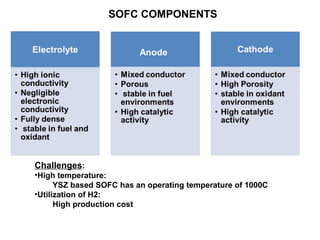
Challenges:
•High temperature:
YSZ based SOFC has an operating temperature of 1000C
•Utilization of H2:
High production cost
LOWERING OPERATION TEMPERATURE: COMPOSITE
ELECTROLYTES
A composite electrolyte is a multiphase membrane made of two or
more components to achieve an enhancement of the overall ionic
conductivity
LTSOFC (300600C) can be
achieved with
nanocomposite
materials

conductivities of

SDC–(Li 0.435 Na 0.315 K
0.25 )2 CO3 composite
electrolytes

(□) SDC (samarium doped
ceria)
(○) SDC–10 wt.% carbonate
(Δ) SDC–30 wt.% carbonate
(∇ ) SDC–50 wt.% carbonate
SDC-Na2Co3 ELECTROLYTE
•
•

core–shell nanocomposite material prepared by coprecipitation
SDC core and amorphous Na2CO3 shell in nanoscale

•

applied as electrolyte in low-temperature SOFC

• Peaks observed for CeO2
• Peaks absent for Na2CO3

Faceted irregular shaped particles <100nm
SDC-Na2Co3 ELECTROLYTE

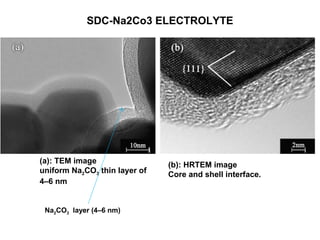
(a): TEM image
uniform Na2CO3 thin layer of
4–6 nm

Na2CO3 layer (4–6 nm)

(b): HRTEM image
Core and shell interface.
SDC-Na2Co3 ELECTROLYTE
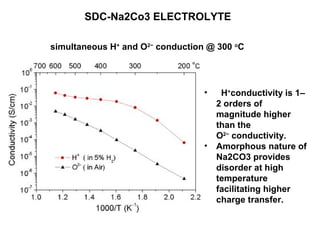
simultaneous H+ and O2− conduction @ 300 oC

•

•

H+conductivity is 1–
2 orders of
magnitude higher
than the
O2− conductivity.
Amorphous nature of
Na2CO3 provides
disorder at high
temperature
facilitating higher
charge transfer.
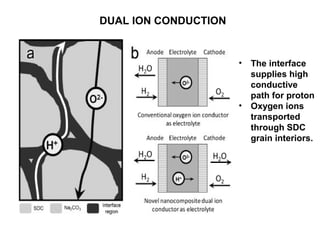
DUAL ION CONDUCTION

•

•

The interface
supplies high
conductive
path for proton
Oxygen ions
transported
through SDC
grain interiors.
MULTI-ION FLOW
NANOCOMPOSITE ELECTRODES
Function of anode :
1.Catalyse electrochemical oxidation of fuel
2.transfer the released charges to a current collector.
These electrode reactions can only occur at the oxide-ion
conductor/electronic conductor/gas three-phase boundary (TPB)
CuZn-NSDC ANODE
• fine particle size
distribution (50–
100 nm)
• adequate porosity
• well-connected Cu
and Zn.
• Enhanced
electronic
conductivity.
• SDC-Na2CO3 as
main oxygen ion
conductor.
CuZn-NSDC ANODE

Hexagonal Zn
atoms mixed
with 5 nm Cu
particles.
Interconnected
anode structure
enhances
diffusion.

Hexagonal Zn
(10 nm)
CONCLUSIONS
•

Use of SOFCS at low temperatures is possible with
nanocomposite materials which provide higher conduction.

•

for commercialization of this environment friendly technology,
development of cheaper materials for electrolyte and electrode
is imperative.
Use of crude hydrocarbon fuel is possible with SDC-carbonate.

•
REFERENCES
•

•

•

•

Rizwan Raza , Xiaodi Wang, Ying Ma, Bin Zhu, A nanostructure
anode (Cu0.2Zn0.8) for low-temperature solid oxide fuel cell at 400–
600 °C, Journal of Power Sources,Volume 195, Issue 24, 15
December 2010, Pages 8067–8070
Xiaodi Wanga, Ying Maa, Shanghua Li a, Abdel-Hady Kashyoutb,
Bin Zhuc, Mamoun Muhammeda, Ceria-based nanocomposite with
simultaneous proton and oxygen ion conductivity for lowtemperature solid oxide fuel cells, Journal of Power Sources 196
(2011) 2754–2758
Xiaodi Wang, Ying Mab, Rizwan Raza, Mamoun Muhammed, Bin
Zhu, Novel core–shell SDC/amorphous Na2CO3 nanocomposite
electrolyte for low-temperature SOFCs, Electrochemistry
Communications 10 (2008) 1617–1620
Yicheng Zhao, Chun Xia, Lijun Jia, Zhiming Wang, Hongjiao Li,
Jinshuai Yu, Yongdan Li*, Recent progress on solid oxide fuel cell:
Lowering temperature and utilizing non-hydrogen fuels,
international journal of hydrogen energy xxx (2013) 1-20

Ceramic nanocomposites in solid oxide fuel cells (SOFC)

  • 1.
    Ceramic nanocomposites insolid oxide fuel cells Term paper presentation for the course of Composite Materials Metallurgical and Materials Engineering IIT Kharagpur
  • 2.
    SOLID OXIDE FUELCELLS • • Electrolyte is in solid state Anode reaction: H2 + O2-  H2O + 2e- • Cathode reaction: 1/2 O2+ 2e-O2- overall reaction:H2 + 1/2 O2  H2O Advantages: • High energy efficiency and low emission • No need for precious metal • High tolerance to impurities
  • 3.
    SOFC COMPONENTS Challenges: •High temperature: YSZbased SOFC has an operating temperature of 1000C •Utilization of H2: High production cost
  • 4.
    LOWERING OPERATION TEMPERATURE:COMPOSITE ELECTROLYTES A composite electrolyte is a multiphase membrane made of two or more components to achieve an enhancement of the overall ionic conductivity LTSOFC (300600C) can be achieved with nanocomposite materials conductivities of SDC–(Li 0.435 Na 0.315 K 0.25 )2 CO3 composite electrolytes (□) SDC (samarium doped ceria) (○) SDC–10 wt.% carbonate (Δ) SDC–30 wt.% carbonate (∇ ) SDC–50 wt.% carbonate
  • 5.
    SDC-Na2Co3 ELECTROLYTE • • core–shell nanocompositematerial prepared by coprecipitation SDC core and amorphous Na2CO3 shell in nanoscale • applied as electrolyte in low-temperature SOFC • Peaks observed for CeO2 • Peaks absent for Na2CO3 Faceted irregular shaped particles <100nm
  • 6.
    SDC-Na2Co3 ELECTROLYTE (a): TEMimage uniform Na2CO3 thin layer of 4–6 nm Na2CO3 layer (4–6 nm) (b): HRTEM image Core and shell interface.
  • 7.
  • 8.
    SDC-Na2Co3 ELECTROLYTE simultaneous H+and O2− conduction @ 300 oC • • H+conductivity is 1– 2 orders of magnitude higher than the O2− conductivity. Amorphous nature of Na2CO3 provides disorder at high temperature facilitating higher charge transfer.
  • 9.
    DUAL ION CONDUCTION • • Theinterface supplies high conductive path for proton Oxygen ions transported through SDC grain interiors.
  • 10.
  • 11.
    NANOCOMPOSITE ELECTRODES Function ofanode : 1.Catalyse electrochemical oxidation of fuel 2.transfer the released charges to a current collector. These electrode reactions can only occur at the oxide-ion conductor/electronic conductor/gas three-phase boundary (TPB)
  • 12.
    CuZn-NSDC ANODE • fineparticle size distribution (50– 100 nm) • adequate porosity • well-connected Cu and Zn. • Enhanced electronic conductivity. • SDC-Na2CO3 as main oxygen ion conductor.
  • 13.
    CuZn-NSDC ANODE Hexagonal Zn atomsmixed with 5 nm Cu particles. Interconnected anode structure enhances diffusion. Hexagonal Zn (10 nm)
  • 14.
    CONCLUSIONS • Use of SOFCSat low temperatures is possible with nanocomposite materials which provide higher conduction. • for commercialization of this environment friendly technology, development of cheaper materials for electrolyte and electrode is imperative. Use of crude hydrocarbon fuel is possible with SDC-carbonate. •
  • 15.
    REFERENCES • • • • Rizwan Raza ,Xiaodi Wang, Ying Ma, Bin Zhu, A nanostructure anode (Cu0.2Zn0.8) for low-temperature solid oxide fuel cell at 400– 600 °C, Journal of Power Sources,Volume 195, Issue 24, 15 December 2010, Pages 8067–8070 Xiaodi Wanga, Ying Maa, Shanghua Li a, Abdel-Hady Kashyoutb, Bin Zhuc, Mamoun Muhammeda, Ceria-based nanocomposite with simultaneous proton and oxygen ion conductivity for lowtemperature solid oxide fuel cells, Journal of Power Sources 196 (2011) 2754–2758 Xiaodi Wang, Ying Mab, Rizwan Raza, Mamoun Muhammed, Bin Zhu, Novel core–shell SDC/amorphous Na2CO3 nanocomposite electrolyte for low-temperature SOFCs, Electrochemistry Communications 10 (2008) 1617–1620 Yicheng Zhao, Chun Xia, Lijun Jia, Zhiming Wang, Hongjiao Li, Jinshuai Yu, Yongdan Li*, Recent progress on solid oxide fuel cell: Lowering temperature and utilizing non-hydrogen fuels, international journal of hydrogen energy xxx (2013) 1-20

Editor's Notes

  • #3 TAKES PLACE DUE TO OXIDE ION CONDUCTION
  • #4 Challenges: High temperature(YSZ 1000C) Limit the selection of materials Increase cost and reduce the working life Utilization of H2: High production cost Safety problem in storage and transportation
  • #5 For commercialization of sofc reduction in op. temp. brought abt by composites
  • #6 Na2co3= amorphous
  • #7 uniform Na2CO3 thin layer of 4–6 nm The HRTEM image further displays the microstructure in Fig. 2b. The dominant lattice fringes are seen clearly in the core; the distance between parallel fringes is equal to the spacing of the {1 1 1} planes in SDC. No lattice fringe can be observed in Na2CO3 shell layer which further confirms that Na2CO3 is amorphous
  • #8 The amorphous nature may reflect increased disorder of the Na2CO3 regions/layers on the SDC surfaces at rising temperature. Therefore, it can better protect the active surface of SDC and interfaces in nanoscale, further likely promote the Na+–O2−interactions and facilitate the oxygen ion transportation through the interfacial mechanism  Compared with single phase electrolyte (SDC, YSZ), composite electrolyte contains more interface regions between the two constituent phases. The interface supplies high conductivity pathway for ionic conduction, which have the capacity to increase mobile ion concentration than that of the bulk. 
  • #9 Anode reactions: equation(1) H2 → 2H + 2e− equation(2) Cathode reactions: equation(3) (1/2)O2+2H+2e−→H2O equation(4)
  • #12 Therefore, efficient oxide-ion conductivity, electronic conductivity and porosity are required for the anode of the SOFCs
  • #13 well-connected CuZn nanoparticles and relatively high-content Zn phase in the composite electrode and anode enhanced the electronic conduction, which helped the H2 oxidation. The SDC-Na2CO3electrolyte particles served as the main oxygen ion conduction supplier.
  • #14 The microstructure revealed a large reaction site. Fig. 3 shows that 10-nm hexagonal Zn was thoroughly mixed with the 5-nm Cu particles, which was confirmed by the crystal lattice calculations from the high-resolution TEM images. This close-packed hexagonal interconnected anode structure facilitated the diffusion of fuel/oxidant to the interface of the electrolyte and electrodes. These results showed excellent agreement with the SEM and XRD particle size calculations. The pores between the particles ranged from 5 nm to 50 nm.