One-Step Process for
Solid Oxide Fuel Cell Fabrication
Thesis Defense
Christian Schumacher
12-16-02
Outline of Presentation
1. Process Motivation
2. Overview of Fuel Cells
3. Experimental Background
4. Experimental Results
5. Future Work
6. Conclusions
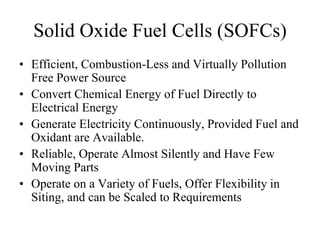
Solid Oxide Fuel Cells (SOFCs)
• Efficient, Combustion-Less and Virtually Pollution
Free Power Source
• Convert Chemical Energy of Fuel Directly to
Electrical Energy
• Generate Electricity Continuously, Provided Fuel and
Oxidant are Available.
• Reliable, Operate Almost Silently and Have Few
Moving Parts
• Operate on a Variety of Fuels, Offer Flexibility in
Siting, and can be Scaled to Requirements
Energy Generating Devices
a- Stack lifetime only, balance of plant ~ 20 yr.
After, http://energy.annualreviews.org/cgi/content/full/24/1/281
Energy Conversion
Method
Efficiency
[%]
Power
Range
[MW]
Lifetime
[Yrs]
Capital
Cost
[$/kW]
Gas Turbines 35-40 10-1000 >20 250-700
Molten-carbonate FC 50-55 1-100 5 a 1000
Thermal (Coal, oil, gas) 25-35 ~1000 >20 1500
Phosphoric Acid FC 40-45 0.2-10 5 a 1500
Hydroelectric 65 0.1-1000 >20 1500
Wind 75 0.1-1 >10 1500
Nuclear 35 ~1000 >20 2000
Magneto Hydrodynamic 40 0.1-100 >10 2000
Solid Oxide FC 50-70 1-100 5 a 1500- 3000
Photovoltaic 10 0.1-1 >10 5000
Least
Expensive
Most
Expensive
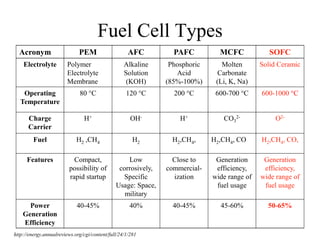
Fuel Cell Types
Acronym PEM AFC PAFC MCFC SOFC
Electrolyte Polymer
Electrolyte
Membrane
Alkaline
Solution
(KOH)
Phosphoric
Acid
(85%-100%)
Molten
Carbonate
(Li, K, Na)
Solid Ceramic
Operating
Temperature
80 °C 120 °C 200 °C 600-700 °C 600-1000 °C
Charge
Carrier
H+ OH- H+ CO3
2- O2-
Fuel H2 ,CH4 H2 H2,CH4, H2,CH4, CO H2,CH4, CO,
Features Compact,
possibility of
rapid startup
Low
corrosively,
Specific
Usage: Space,
military
Close to
commercial-
ization
Generation
efficiency,
wide range of
fuel usage
Generation
efficiency,
wide range of
fuel usage
Power
Generation
Efficiency
40-45% 40% 40-45% 45-60% 50-65%
http://energy.annualreviews.org/cgi/content/full/24/1/281
Capital Cost Cutting Required
• Order of magnitude reduction in cost will not be met by optimization
• Will need new processing techniques to meet these goals
http://energy.annualreviews.org/cgi/content/full/24/1/281
Comparison of System Expense
0
1000
2000
3000
4000
5000
Diesel Gas
Turbine
Power Generating Systems
Capital Cost
[$/kW]
United
Technology
Alkaline Fuel Cell
Siemens-
Westinghouse
Tubular
Fuel Cell
Overview of Fuel Cells
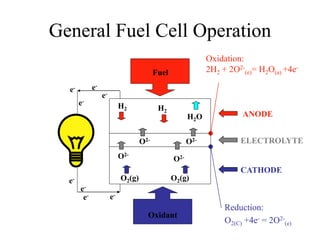
General Fuel Cell Operation
Oxidation:
2H2 + 2O2-
(e)= H2O(a) +4e-
Reduction:
O2(C) +4e- = 2O2-
(e)
ANODE
ELECTROLYTE
CATHODE
O2- O2-
H2
O2-
H2
O2-
O2(g) O2(g)
Oxidant
Fuel
e-
e-
e-
e-
e-
e-
H2O
e-
e-
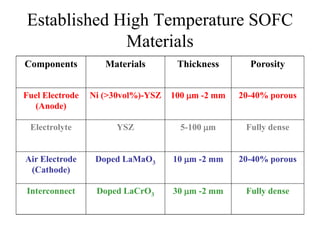
Established High Temperature SOFC
Materials
Components Materials Thickness Porosity
Fuel Electrode
(Anode)
Ni (>30vol%)-YSZ 100 m -2 mm 20-40% porous
Electrolyte YSZ 5-100 m Fully dense
Air Electrode
(Cathode)
Doped LaMaO3 10 m -2 mm 20-40% porous
Interconnect Doped LaCrO3 30 m -2 mm Fully dense
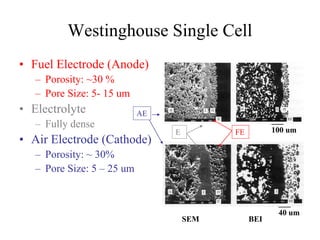
Westinghouse Single Cell
• Fuel Electrode (Anode)
– Porosity: ~30 %
– Pore Size: 5- 15 um
• Electrolyte
– Fully dense
• Air Electrode (Cathode)
– Porosity: ~ 30%
– Pore Size: 5 – 25 um
___
40 um
___
100 um
AE
E FE
BEISEM
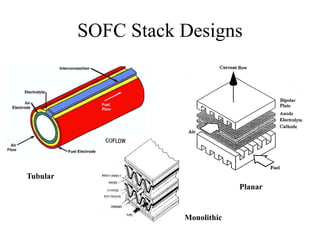
SOFC Stack Designs
Tubular
Monolithic
Planar
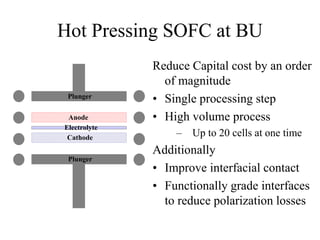
Hot Pressing SOFC at BU
Reduce Capital cost by an order
of magnitude
• Single processing step
• High volume process
– Up to 20 cells at one time
Additionally
• Improve interfacial contact
• Functionally grade interfaces
to reduce polarization losses
Anode
Cathode
Electrolyte
Plunger
Plunger
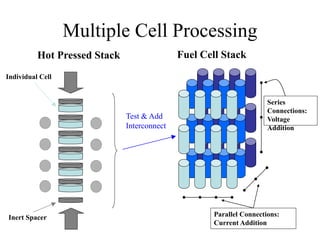
Multiple Cell Processing
Parallel Connections:
Current Addition
Series
Connections:
Voltage
Addition
Fuel Cell StackHot Pressed Stack
Individual Cell
Inert Spacer
Test & Add
Interconnect
Goals of Research
Develop the Knowledge to:
– Process a Single SOFC in One Step
While Maintaining the Correct Structure:
– Sufficiently Dense Electrolyte
– Porous Electrodes
– Continuous, Adherent Contact at Interfaces
Experimental Background
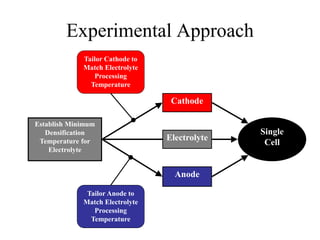
Experimental Approach
Cathode
Anode
Electrolyte
Tailor Anode to
Match Electrolyte
Processing
Temperature
Tailor Cathode to
Match Electrolyte
Processing
Temperature
Single
Cell
Establish Minimum
Densification
Temperature for
Electrolyte
Equipment Limits
0
500
1000
1500
2000
2500
3000
0 2000 4000 6000 8000 10 000 12 000
Pressure [psi]
Temperature[C]
High Pressure RegimeModerate Pressure Regime
Maximum HP Temperature
Maximum
Graphite
Compressive
Stress
Chemical Interaction Limits
MP: 1880 C
500
1000
1500
2000
2500
3000
Temperature[C]
ElectrolyteCathode Anode Interconnect
La
2
Zr
2
O
7
Formation
Mn
+2
Diffusion NiCrO
4
Formation
MP: 2660 C
MP: 1453 C
MP: 2510 C
MP: 1990 C
Established Sintering Cycles
500
700
900
1100
1300
1500
Temperature[C]
YSZ Air Sintered
Monolithic Fabrication Temperature
Interconnect
Nano YSZ Air Sintered
Ni 98% Density
NiO 57% Density
LSM 80% Density
500
700
900
1100
1300
1500
Temperature[C]
ElectrolyteCathode Anode
YSZ Air Sintered
Monolithic Fabrication Temperature
Nano YSZ Air Sintered
Ni 98% Density
NiO 57% Density
LSM 80% Density
Sintering & Hot Pressing Theory
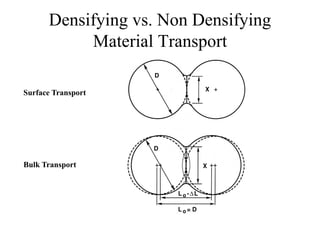
Densifying vs. Non Densifying
Material Transport
Surface Transport
Bulk Transport
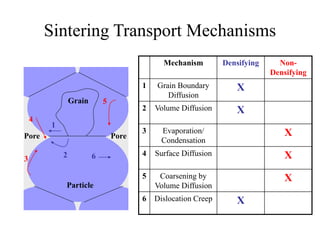
6
Grain
Particle
Pore Pore
1
3
4
5
2
Sintering Transport Mechanisms
Mechanism Densifying Non-
Densifying
1 Grain Boundary
Diffusion
X
2 Volume Diffusion X
3 Evaporation/
Condensation
X
4 Surface Diffusion X
5 Coarsening by
Volume Diffusion
X
6 Dislocation Creep X
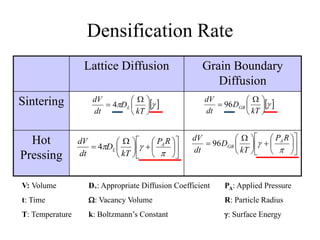
Densification Rate
V: Volume
t: Time
T: Temperature
D*: Appropriate Diffusion Coefficient
: Vacancy Volume
k: Boltzmann’s Constant
PA: Applied Pressure
R: Particle Radius
: Surface Energy
Lattice Diffusion Grain Boundary
Diffusion
Sintering
Hot
Pressing

















 



RP
kT
D
dt
dV A
L4
  




 

kT
D
dt
dV
L4

















 



RP
kT
D
dt
dV A
GB96
 




 

kT
D
dt
dV
GB96
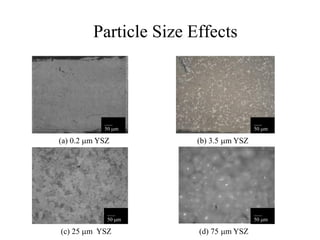
Particle Size Effects
___
50 m
___
50 m
___
50 m
___
50 m
(a) 0.2 m YSZ (b) 3.5 m YSZ
(c) 25 m YSZ (d) 75 m YSZ
1
10
100
1000
10000
100000
1000000
10000000
0.01 0.1 1 10 100 1000
Particle Radius [um]
Pressure[psi]
90% of Densification due to Applied Pressure 90% of Densification due to Particle Size
Pressure Dominated
Densification
Particle Size Dominated
Densification
Unity Line

RP
C
C a
rgySurfaceEne
essureApplied


 Pr

















 



RP
kT
DF
dt
dV A
**
Particle Size / Pressure Regime







RP
CCF
a
essureAppliedessureAppliedceDrivingForEquivalent

PrPr
Applied
Pressure
[psi]
Particle Size Radius [m]
0.01 0.1 1 10 100 1000
10 000
55 596 14 560 10 456 10 046 10 005 10 000
5000
50 596 9560 5456 5046 5005 5000
2500
48 096 7060 2956 2546 2505 2500
1000
46 596 5560 1456 1046 1005 1000
100
45 696 4660 556 145.6 104.6 100.5
Experimental Results
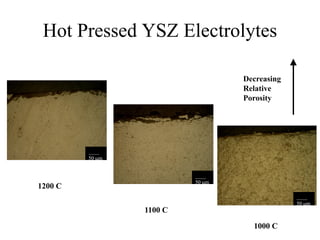
Hot Pressed YSZ Electrolytes
1200 C
1100 C
Decreasing
Relative
Porosity
1000 C
____
50 m
____
50 m
____
50 m
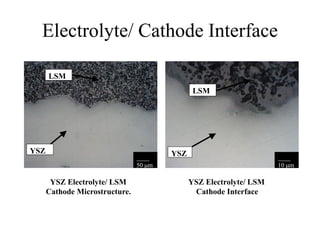
Electrolyte/ Cathode Interface
YSZ Electrolyte/ LSM
Cathode Microstructure.
YSZ Electrolyte/ LSM
Cathode Interface
____
50 m
____
10 m
LSM
YSZ
LSM
YSZ
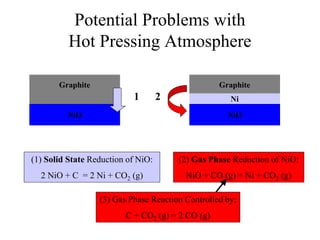
Potential Problems with
Hot Pressing Atmosphere
(3) Gas Phase Reaction Controlled by:
C + CO2 (g) = 2 CO (g)
(2) Gas Phase Reduction of NiO:
NiO + CO (g) = Ni + CO2 (g)
(1) Solid State Reduction of NiO:
2 NiO + C = 2 Ni + CO2 (g)
Graphite
NiO
Graphite
Ni
NiO
1 2
Equilibrium Oxygen Partial Pressures
1E-30
1E-24
1E-18
1E-12
1E-06
1
500 600 700 800 900 1000 1100 1200 1300 1400 1500
Temperature [C]
PartialPressureofOxygen
2Ni + O2(g) = 2NiO 2CO(g) + O2(g) = 2CO2(g) 2H2(g) + O2(g) = 2H2O(g)
NiO Stable
Ni Stable
P O2 = 1.17 x10 -9 (1100 C) P O2 = 3.55 x10 -13 (1100 C) P O2 = 8.70 x10 -17 (1100 C)
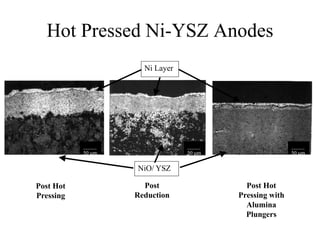
Hot Pressed Ni-YSZ Anodes
Post Hot
Pressing
Post
Reduction
Post Hot
Pressing with
Alumina
Plungers
_____
50 m
NiO/ YSZ
Ni Layer
_____
50 m
_____
50 m
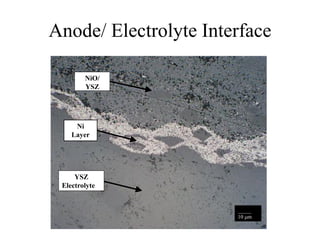
Anode/ Electrolyte Interface
YSZ
Electrolyte
NiO/
YSZ
Ni
Layer
_____
10 m
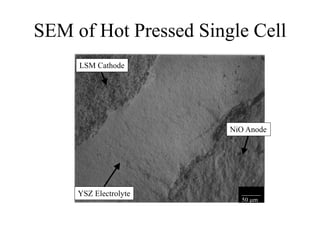
SEM of Hot Pressed Single Cell
LSM Cathode
YSZ Electrolyte
NiO Anode
______
50 m
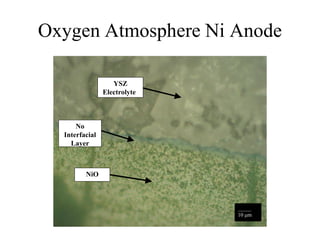
Oxygen Atmosphere Ni Anode
YSZ
Electrolyte
NiO
No
Interfacial
Layer
_____
10 m
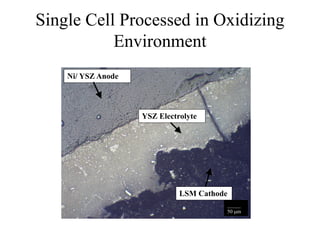
Single Cell Processed in Oxidizing
Environment
_____
50 m
YSZ Electrolyte
Ni/ YSZ Anode
LSM Cathode
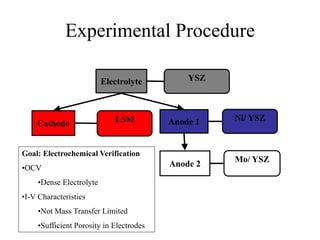
Experimental Procedure
Electrolyte
Cathode Anode 1
Anode 2
LSM Ni/ YSZ
Mo/ YSZ
YSZ
Goal: Electrochemical Verification
•OCV
•Dense Electrolyte
•I-V Characteristics
•Not Mass Transfer Limited
•Sufficient Porosity in Electrodes
Anode 2 [Mo-YSZ] / Electrolyte
Interface
YSZ Electrolyte
Mo/ YSZ Anode
Poor Adherence
_____
50 m
•Excessive Porosity
•Poor Adherence
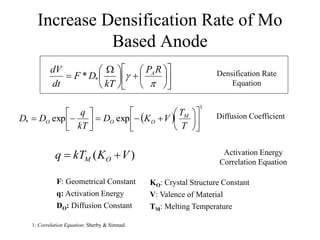
Increase Densification Rate of Mo
Based Anode

















 



RP
kT
DF
dt
dV A
**
 
1
* expexp 


















T
T
VKD
kT
q
DD M
OOO
)( VKkTq OM 
Densification Rate
Equation
Diffusion Coefficient
Activation Energy
Correlation Equation
KO: Crystal Structure Constant
V: Valence of Material
TM: Melting Temperature
F: Geometrical Constant
q: Activation Energy
DO: Diffusion Constant
1: Correlation Equation: Sherby & Simnad.
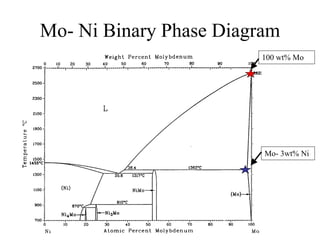
Mo- Ni Binary Phase Diagram
Mo- 3wt% Ni
100 wt% Mo
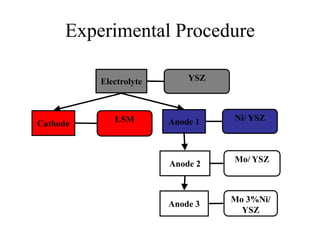
Experimental Procedure
Electrolyte
Cathode Anode 1
Anode 2
Anode 3
LSM Ni/ YSZ
Mo/ YSZ
Mo 3%Ni/
YSZ
YSZ
Anode 3 [Mo-3wt% Ni] / Electrolyte
Interface
_______
50 m
YSZ Electrolyte
Mo/ YSZ Anode
Adequate Adherence
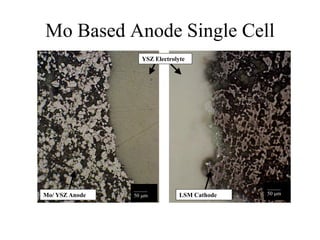
Mo Based Anode Single Cell
YSZ Electrolyte
Mo/ YSZ Anode LSM Cathode
_____
50 m
_____
50 m
Conclusions
• Successfully Developed A Single Step Process
for SOFC Fabrication
• Process Maintains the Correct Structure:
– Sufficiently Dense Electrolyte
– Porous Electrodes
– Continuous, Adherent Contact at Interfaces
Future Work
• Production of Testable Cells
• Electrochemical Verification
• Multi-Cell Production Scale –Up
Acknowledgements
• DOE for Financial Support
• Prof. Sarin, Prof. Pal, Prof. Gopalan
• Dr. Chris Manning
• Earl Geary, Helmut Lingertatt, Bob Sjostrom
Questions?
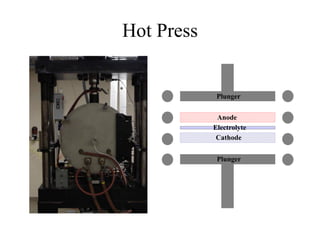
Hot Press
Anode
Cathode
Electrolyte
Plunger
Plunger
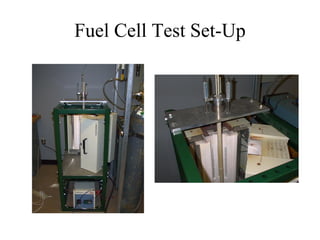
Fuel Cell Test Set-Up
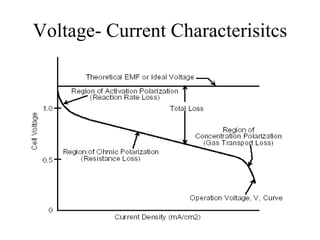
Voltage- Current Characterisitcs
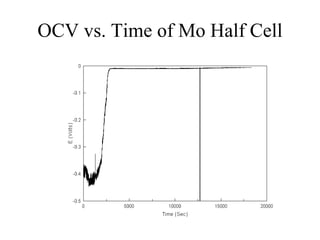
OCV vs. Time of Mo Half Cell
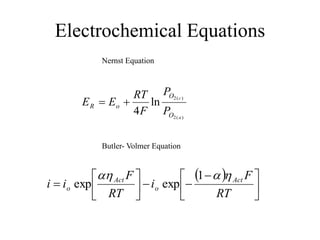
Electrochemical Equations
 





 







RT
F
i
RT
F
ii Act
o
Act
o
 1
expexp
)(2
)(2
ln
4 a
c
O
O
oR
P
P
F
RT
EE 
Nernst Equation
Butler- Volmer Equation
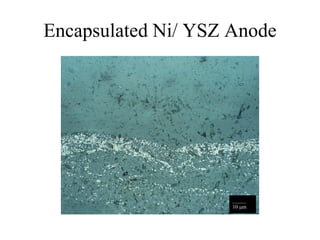
Encapsulated Ni/ YSZ Anode
_____
10 m
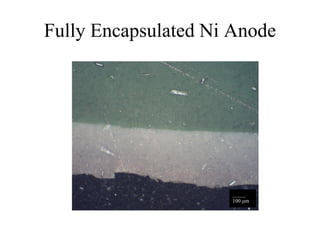
Fully Encapsulated Ni Anode
_____
100 m
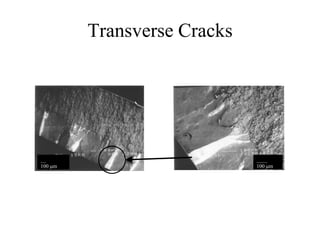
Transverse Cracks
__
100 m
____
100 m
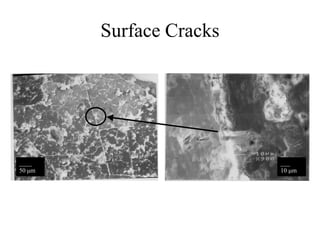
Surface Cracks
____
50 m
___
10 m

Thesis Defense Presentation ONE-STEP PROCESS FOR SOLID OXIDE FUEL CELL FABRICATION

  • 1.
    One-Step Process for SolidOxide Fuel Cell Fabrication Thesis Defense Christian Schumacher 12-16-02
  • 2.
    Outline of Presentation 1.Process Motivation 2. Overview of Fuel Cells 3. Experimental Background 4. Experimental Results 5. Future Work 6. Conclusions
  • 3.
    Solid Oxide FuelCells (SOFCs) • Efficient, Combustion-Less and Virtually Pollution Free Power Source • Convert Chemical Energy of Fuel Directly to Electrical Energy • Generate Electricity Continuously, Provided Fuel and Oxidant are Available. • Reliable, Operate Almost Silently and Have Few Moving Parts • Operate on a Variety of Fuels, Offer Flexibility in Siting, and can be Scaled to Requirements
  • 4.
    Energy Generating Devices a-Stack lifetime only, balance of plant ~ 20 yr. After, http://energy.annualreviews.org/cgi/content/full/24/1/281 Energy Conversion Method Efficiency [%] Power Range [MW] Lifetime [Yrs] Capital Cost [$/kW] Gas Turbines 35-40 10-1000 >20 250-700 Molten-carbonate FC 50-55 1-100 5 a 1000 Thermal (Coal, oil, gas) 25-35 ~1000 >20 1500 Phosphoric Acid FC 40-45 0.2-10 5 a 1500 Hydroelectric 65 0.1-1000 >20 1500 Wind 75 0.1-1 >10 1500 Nuclear 35 ~1000 >20 2000 Magneto Hydrodynamic 40 0.1-100 >10 2000 Solid Oxide FC 50-70 1-100 5 a 1500- 3000 Photovoltaic 10 0.1-1 >10 5000 Least Expensive Most Expensive
  • 5.
    Fuel Cell Types AcronymPEM AFC PAFC MCFC SOFC Electrolyte Polymer Electrolyte Membrane Alkaline Solution (KOH) Phosphoric Acid (85%-100%) Molten Carbonate (Li, K, Na) Solid Ceramic Operating Temperature 80 °C 120 °C 200 °C 600-700 °C 600-1000 °C Charge Carrier H+ OH- H+ CO3 2- O2- Fuel H2 ,CH4 H2 H2,CH4, H2,CH4, CO H2,CH4, CO, Features Compact, possibility of rapid startup Low corrosively, Specific Usage: Space, military Close to commercial- ization Generation efficiency, wide range of fuel usage Generation efficiency, wide range of fuel usage Power Generation Efficiency 40-45% 40% 40-45% 45-60% 50-65% http://energy.annualreviews.org/cgi/content/full/24/1/281
  • 6.
    Capital Cost CuttingRequired • Order of magnitude reduction in cost will not be met by optimization • Will need new processing techniques to meet these goals http://energy.annualreviews.org/cgi/content/full/24/1/281 Comparison of System Expense 0 1000 2000 3000 4000 5000 Diesel Gas Turbine Power Generating Systems Capital Cost [$/kW] United Technology Alkaline Fuel Cell Siemens- Westinghouse Tubular Fuel Cell
  • 7.
  • 8.
    General Fuel CellOperation Oxidation: 2H2 + 2O2- (e)= H2O(a) +4e- Reduction: O2(C) +4e- = 2O2- (e) ANODE ELECTROLYTE CATHODE O2- O2- H2 O2- H2 O2- O2(g) O2(g) Oxidant Fuel e- e- e- e- e- e- H2O e- e-
  • 9.
    Established High TemperatureSOFC Materials Components Materials Thickness Porosity Fuel Electrode (Anode) Ni (>30vol%)-YSZ 100 m -2 mm 20-40% porous Electrolyte YSZ 5-100 m Fully dense Air Electrode (Cathode) Doped LaMaO3 10 m -2 mm 20-40% porous Interconnect Doped LaCrO3 30 m -2 mm Fully dense
  • 10.
    Westinghouse Single Cell •Fuel Electrode (Anode) – Porosity: ~30 % – Pore Size: 5- 15 um • Electrolyte – Fully dense • Air Electrode (Cathode) – Porosity: ~ 30% – Pore Size: 5 – 25 um ___ 40 um ___ 100 um AE E FE BEISEM
  • 11.
  • 12.
    Hot Pressing SOFCat BU Reduce Capital cost by an order of magnitude • Single processing step • High volume process – Up to 20 cells at one time Additionally • Improve interfacial contact • Functionally grade interfaces to reduce polarization losses Anode Cathode Electrolyte Plunger Plunger
  • 13.
    Multiple Cell Processing ParallelConnections: Current Addition Series Connections: Voltage Addition Fuel Cell StackHot Pressed Stack Individual Cell Inert Spacer Test & Add Interconnect
  • 14.
    Goals of Research Developthe Knowledge to: – Process a Single SOFC in One Step While Maintaining the Correct Structure: – Sufficiently Dense Electrolyte – Porous Electrodes – Continuous, Adherent Contact at Interfaces
  • 15.
  • 16.
    Experimental Approach Cathode Anode Electrolyte Tailor Anodeto Match Electrolyte Processing Temperature Tailor Cathode to Match Electrolyte Processing Temperature Single Cell Establish Minimum Densification Temperature for Electrolyte
  • 17.
    Equipment Limits 0 500 1000 1500 2000 2500 3000 0 20004000 6000 8000 10 000 12 000 Pressure [psi] Temperature[C] High Pressure RegimeModerate Pressure Regime Maximum HP Temperature Maximum Graphite Compressive Stress
  • 18.
    Chemical Interaction Limits MP:1880 C 500 1000 1500 2000 2500 3000 Temperature[C] ElectrolyteCathode Anode Interconnect La 2 Zr 2 O 7 Formation Mn +2 Diffusion NiCrO 4 Formation MP: 2660 C MP: 1453 C MP: 2510 C MP: 1990 C
  • 19.
    Established Sintering Cycles 500 700 900 1100 1300 1500 Temperature[C] YSZAir Sintered Monolithic Fabrication Temperature Interconnect Nano YSZ Air Sintered Ni 98% Density NiO 57% Density LSM 80% Density 500 700 900 1100 1300 1500 Temperature[C] ElectrolyteCathode Anode YSZ Air Sintered Monolithic Fabrication Temperature Nano YSZ Air Sintered Ni 98% Density NiO 57% Density LSM 80% Density
  • 20.
    Sintering & HotPressing Theory
  • 21.
    Densifying vs. NonDensifying Material Transport Surface Transport Bulk Transport
  • 22.
    6 Grain Particle Pore Pore 1 3 4 5 2 Sintering TransportMechanisms Mechanism Densifying Non- Densifying 1 Grain Boundary Diffusion X 2 Volume Diffusion X 3 Evaporation/ Condensation X 4 Surface Diffusion X 5 Coarsening by Volume Diffusion X 6 Dislocation Creep X
  • 23.
    Densification Rate V: Volume t:Time T: Temperature D*: Appropriate Diffusion Coefficient : Vacancy Volume k: Boltzmann’s Constant PA: Applied Pressure R: Particle Radius : Surface Energy Lattice Diffusion Grain Boundary Diffusion Sintering Hot Pressing                       RP kT D dt dV A L4           kT D dt dV L4                       RP kT D dt dV A GB96          kT D dt dV GB96
  • 24.
    Particle Size Effects ___ 50m ___ 50 m ___ 50 m ___ 50 m (a) 0.2 m YSZ (b) 3.5 m YSZ (c) 25 m YSZ (d) 75 m YSZ
  • 25.
    1 10 100 1000 10000 100000 1000000 10000000 0.01 0.1 110 100 1000 Particle Radius [um] Pressure[psi] 90% of Densification due to Applied Pressure 90% of Densification due to Particle Size Pressure Dominated Densification Particle Size Dominated Densification Unity Line  RP C C a rgySurfaceEne essureApplied    Pr                       RP kT DF dt dV A **
  • 26.
    Particle Size /Pressure Regime        RP CCF a essureAppliedessureAppliedceDrivingForEquivalent  PrPr Applied Pressure [psi] Particle Size Radius [m] 0.01 0.1 1 10 100 1000 10 000 55 596 14 560 10 456 10 046 10 005 10 000 5000 50 596 9560 5456 5046 5005 5000 2500 48 096 7060 2956 2546 2505 2500 1000 46 596 5560 1456 1046 1005 1000 100 45 696 4660 556 145.6 104.6 100.5
  • 27.
  • 28.
    Hot Pressed YSZElectrolytes 1200 C 1100 C Decreasing Relative Porosity 1000 C ____ 50 m ____ 50 m ____ 50 m
  • 29.
    Electrolyte/ Cathode Interface YSZElectrolyte/ LSM Cathode Microstructure. YSZ Electrolyte/ LSM Cathode Interface ____ 50 m ____ 10 m LSM YSZ LSM YSZ
  • 30.
    Potential Problems with HotPressing Atmosphere (3) Gas Phase Reaction Controlled by: C + CO2 (g) = 2 CO (g) (2) Gas Phase Reduction of NiO: NiO + CO (g) = Ni + CO2 (g) (1) Solid State Reduction of NiO: 2 NiO + C = 2 Ni + CO2 (g) Graphite NiO Graphite Ni NiO 1 2
  • 31.
    Equilibrium Oxygen PartialPressures 1E-30 1E-24 1E-18 1E-12 1E-06 1 500 600 700 800 900 1000 1100 1200 1300 1400 1500 Temperature [C] PartialPressureofOxygen 2Ni + O2(g) = 2NiO 2CO(g) + O2(g) = 2CO2(g) 2H2(g) + O2(g) = 2H2O(g) NiO Stable Ni Stable P O2 = 1.17 x10 -9 (1100 C) P O2 = 3.55 x10 -13 (1100 C) P O2 = 8.70 x10 -17 (1100 C)
  • 32.
    Hot Pressed Ni-YSZAnodes Post Hot Pressing Post Reduction Post Hot Pressing with Alumina Plungers _____ 50 m NiO/ YSZ Ni Layer _____ 50 m _____ 50 m
  • 33.
  • 34.
    SEM of HotPressed Single Cell LSM Cathode YSZ Electrolyte NiO Anode ______ 50 m
  • 35.
    Oxygen Atmosphere NiAnode YSZ Electrolyte NiO No Interfacial Layer _____ 10 m
  • 36.
    Single Cell Processedin Oxidizing Environment _____ 50 m YSZ Electrolyte Ni/ YSZ Anode LSM Cathode
  • 37.
    Experimental Procedure Electrolyte Cathode Anode1 Anode 2 LSM Ni/ YSZ Mo/ YSZ YSZ Goal: Electrochemical Verification •OCV •Dense Electrolyte •I-V Characteristics •Not Mass Transfer Limited •Sufficient Porosity in Electrodes
  • 38.
    Anode 2 [Mo-YSZ]/ Electrolyte Interface YSZ Electrolyte Mo/ YSZ Anode Poor Adherence _____ 50 m •Excessive Porosity •Poor Adherence
  • 39.
    Increase Densification Rateof Mo Based Anode                       RP kT DF dt dV A **   1 * expexp                    T T VKD kT q DD M OOO )( VKkTq OM  Densification Rate Equation Diffusion Coefficient Activation Energy Correlation Equation KO: Crystal Structure Constant V: Valence of Material TM: Melting Temperature F: Geometrical Constant q: Activation Energy DO: Diffusion Constant 1: Correlation Equation: Sherby & Simnad.
  • 40.
    Mo- Ni BinaryPhase Diagram Mo- 3wt% Ni 100 wt% Mo
  • 41.
    Experimental Procedure Electrolyte Cathode Anode1 Anode 2 Anode 3 LSM Ni/ YSZ Mo/ YSZ Mo 3%Ni/ YSZ YSZ
  • 42.
    Anode 3 [Mo-3wt%Ni] / Electrolyte Interface _______ 50 m YSZ Electrolyte Mo/ YSZ Anode Adequate Adherence
  • 43.
    Mo Based AnodeSingle Cell YSZ Electrolyte Mo/ YSZ Anode LSM Cathode _____ 50 m _____ 50 m
  • 44.
    Conclusions • Successfully DevelopedA Single Step Process for SOFC Fabrication • Process Maintains the Correct Structure: – Sufficiently Dense Electrolyte – Porous Electrodes – Continuous, Adherent Contact at Interfaces
  • 45.
    Future Work • Productionof Testable Cells • Electrochemical Verification • Multi-Cell Production Scale –Up
  • 46.
    Acknowledgements • DOE forFinancial Support • Prof. Sarin, Prof. Pal, Prof. Gopalan • Dr. Chris Manning • Earl Geary, Helmut Lingertatt, Bob Sjostrom
  • 47.
  • 50.
  • 51.
  • 52.
  • 53.
    OCV vs. Timeof Mo Half Cell
  • 54.
    Electrochemical Equations                RT F i RT F ii Act o Act o  1 expexp )(2 )(2 ln 4 a c O O oR P P F RT EE  Nernst Equation Butler- Volmer Equation
  • 55.
    Encapsulated Ni/ YSZAnode _____ 10 m
  • 56.
    Fully Encapsulated NiAnode _____ 100 m
  • 57.
  • 58.