Thinking and Writing Like a Scientist:
Claims Evidence Reasoning - CER
Big Idea 13: Forces and Changes in
Motion
Claim Evidence Reasoning
CER
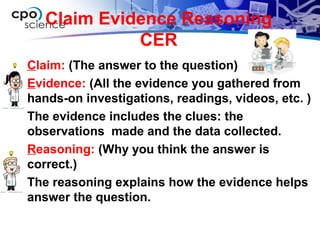
Claim: (The answer to the question)
Evidence: (All the evidence you gathered from
hands-on investigations, readings, videos, etc. )
The evidence includes the clues: the
observations made and the data collected.
Reasoning: (Why you think the answer is
correct.)
The reasoning explains how the evidence helps
answer the question.
Getting Started
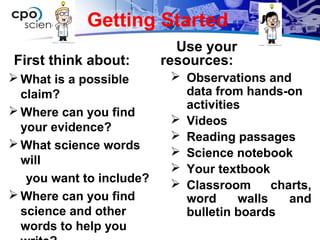
First think about:
 What is a possible
claim?
 Where can you find
your evidence?
 What science words
will
you want to include?
 Where can you find
science and other
words to help you
Use your
resources:
 Observations and
data from hands-on
activities
 Videos
 Reading passages
 Science notebook
 Your textbook
 Classroom charts,
word walls and
bulletin boards
Writing Scaffolds
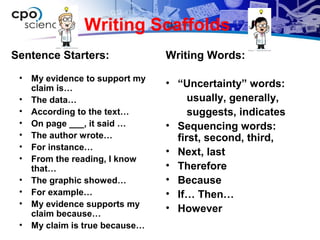
Sentence Starters:
• My evidence to support my
claim is…
• The data…
• According to the text…
• On page ___, it said …
• The author wrote…
• For instance…
• From the reading, I know
that…
• The graphic showed…
• For example…
• My evidence supports my
claim because…
• My claim is true because…
Writing Words:
• “Uncertainty” words:
usually, generally,
suggests, indicates
• Sequencing words:
first, second, third,
• Next, last
• Therefore
• Because
• If… Then…
• However
Claim Evidence Reasoning
(CER)
Assignment Part 1
•Find force and motion investigation notes in your
journal.
•Watch the Discovery video: Friction
•Do the Discovery Exploration: Changing the Speed
of Motion.
•Last read the articles: Zamboni and Now That’s Fast.
Be prepared to use evidence from what you investigated, read, heard
and saw to support your answer to one of the following questions:
1. How does the force of friction change the motion of
an object?
2. How do different forces cause objects to change
speed?
Claim Evidence Reasoning
(CER)
Assignment Part 2: Complete the following in
your notebook:
My Question:
How does the force of friction change the
motion of an object?
Evidence: (Record all the evidence you gathered from
investigations, readings, and videos.)
Claim: (The answer to the question chosen.)
Reasoning: (Use the evidence to help explain why you
think the answer is correct.)

Cer power point

  • 2.
    Thinking and WritingLike a Scientist: Claims Evidence Reasoning - CER Big Idea 13: Forces and Changes in Motion
  • 3.
    Claim Evidence Reasoning CER Claim:(The answer to the question) Evidence: (All the evidence you gathered from hands-on investigations, readings, videos, etc. ) The evidence includes the clues: the observations made and the data collected. Reasoning: (Why you think the answer is correct.) The reasoning explains how the evidence helps answer the question.
  • 4.
    Getting Started First thinkabout:  What is a possible claim?  Where can you find your evidence?  What science words will you want to include?  Where can you find science and other words to help you Use your resources:  Observations and data from hands-on activities  Videos  Reading passages  Science notebook  Your textbook  Classroom charts, word walls and bulletin boards
  • 5.
    Writing Scaffolds Sentence Starters: •My evidence to support my claim is… • The data… • According to the text… • On page ___, it said … • The author wrote… • For instance… • From the reading, I know that… • The graphic showed… • For example… • My evidence supports my claim because… • My claim is true because… Writing Words: • “Uncertainty” words: usually, generally, suggests, indicates • Sequencing words: first, second, third, • Next, last • Therefore • Because • If… Then… • However
  • 6.
    Claim Evidence Reasoning (CER) AssignmentPart 1 •Find force and motion investigation notes in your journal. •Watch the Discovery video: Friction •Do the Discovery Exploration: Changing the Speed of Motion. •Last read the articles: Zamboni and Now That’s Fast. Be prepared to use evidence from what you investigated, read, heard and saw to support your answer to one of the following questions: 1. How does the force of friction change the motion of an object? 2. How do different forces cause objects to change speed?
  • 7.
    Claim Evidence Reasoning (CER) AssignmentPart 2: Complete the following in your notebook: My Question: How does the force of friction change the motion of an object? Evidence: (Record all the evidence you gathered from investigations, readings, and videos.) Claim: (The answer to the question chosen.) Reasoning: (Use the evidence to help explain why you think the answer is correct.)

Editor's Notes

  • #4 CER Anchor Chart
  • #5 CER anchor chart: Ask students how they think they should get started. Ask what is a possible claim? Ask students what resources they have that will help them? If necessary, point out the anchor charts, word walls, and notes / activities in their science notebooks. Say let’s see how a textbook page can help. See next slide.
  • #6 CER Anchor Charts
  • #7 Explore, Explain, Evaluate
  • #8 Explain, Evaluate