Motion and Force
• Chapter Twelve: Distance, Time, and
Speed
• Chapter Thirteen: Forces
• Chapter Fourteen: Force and Motion
Chapter Thirteen: Forces
• 13.1 Forces
• 13.2 Addition of Forces
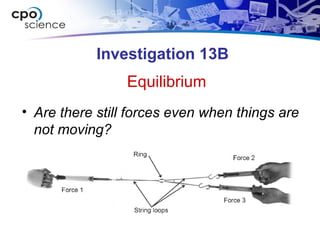
Investigation 13B
• Are there still forces even when things are
not moving?
Equilibrium
13.2 Addition of vectors
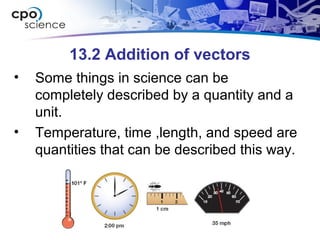
• Some things in science can be
completely described by a quantity and a
unit.
• Temperature, time ,length, and speed are
quantities that can be described this way.
13.2 Addition of vectors
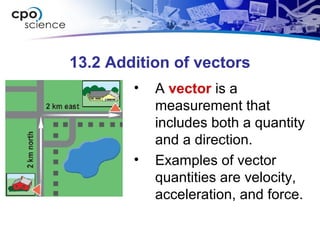
• A vector is a
measurement that
includes both a quantity
and a direction.
• Examples of vector
quantities are velocity,
acceleration, and force.
13.2 The force vector
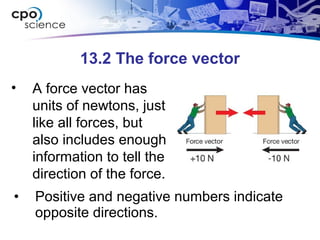
• A force vector has
units of newtons, just
like all forces, but
also includes enough
information to tell the
direction of the force.
• Positive and negative numbers indicate
opposite directions.
13.2 Addition of vectors
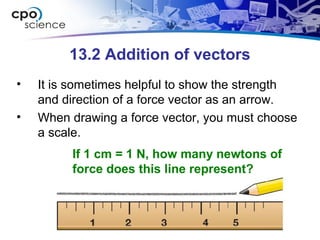
• It is sometimes helpful to show the strength
and direction of a force vector as an arrow.
• When drawing a force vector, you must choose
a scale.
If 1 cm = 1 N, how many newtons of
force does this line represent?
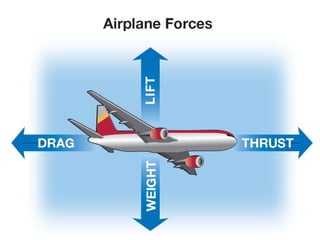
13.2 Adding force vectors
• To figure out if or how an object will
move, we look at ALL of the forces
acting on it.
• Four forces act on a plane:
1. weight
2. drag (air friction)
3. the thrust of the engines, and
4. the lift force caused by the flow of air over
the wings.
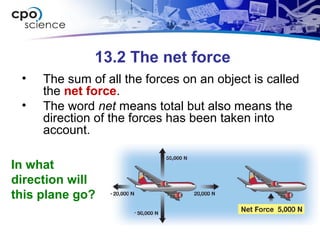
13.2 The net force
• The sum of all the forces on an object is called
the net force.
• The word net means total but also means the
direction of the forces has been taken into
account.
In what
direction will
this plane go?
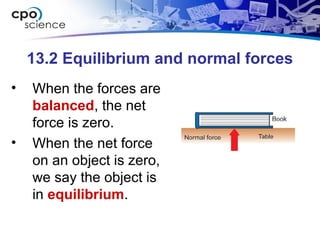
13.2 Equilibrium and normal forces
• When the forces are
balanced, the net
force is zero.
• When the net force
on an object is zero,
we say the object is
in equilibrium.
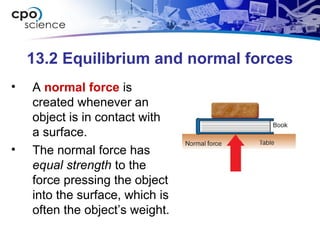
13.2 Equilibrium and normal forces
• A normal force is
created whenever an
object is in contact with
a surface.
• The normal force has
equal strength to the
force pressing the object
into the surface, which is
often the object’s weight.
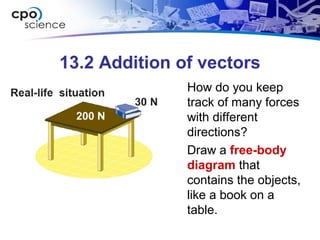
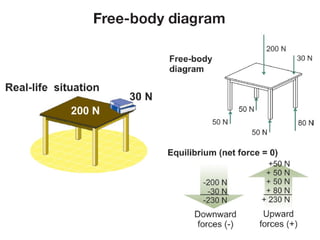
13.2 Addition of vectors
• How do you keep
track of many forces
with different
directions?
• Draw a free-body
diagram that
contains the objects,
like a book on a
table.
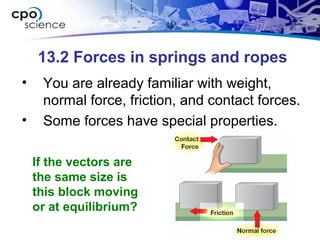
13.2 Forces in springs and ropes
• You are already familiar with weight,
normal force, friction, and contact forces.
• Some forces have special properties.
If the vectors are
the same size is
this block moving
or at equilibrium?
13.2 Forces in springs and ropes
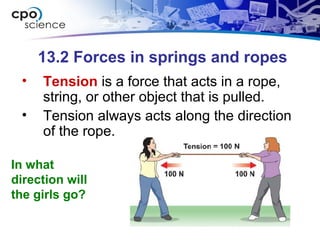
• Tension is a force that acts in a rope,
string, or other object that is pulled.
• Tension always acts along the direction
of the rope.
In what
direction will
the girls go?
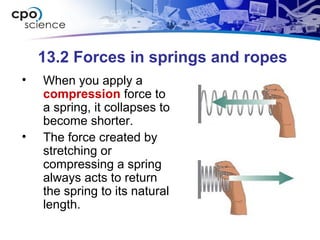
13.2 Forces in springs and ropes
• When you apply a
compression force to
a spring, it collapses to
become shorter.
• The force created by
stretching or
compressing a spring
always acts to return
the spring to its natural
length.
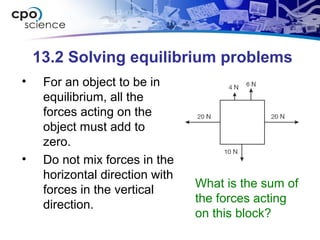
13.2 Solving equilibrium problems
• For an object to be in
equilibrium, all the
forces acting on the
object must add to
zero.
• Do not mix forces in the
horizontal direction with
forces in the vertical
direction.
What is the sum of
the forces acting
on this block?
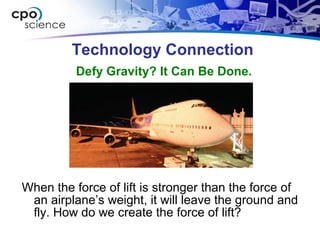
Technology Connection
Defy Gravity? It Can Be Done.
When the force of lift is stronger than the force of
an airplane’s weight, it will leave the ground and
fly. How do we create the force of lift?

Ch13 forcessection2

  • 2.
    Motion and Force •Chapter Twelve: Distance, Time, and Speed • Chapter Thirteen: Forces • Chapter Fourteen: Force and Motion
  • 3.
    Chapter Thirteen: Forces •13.1 Forces • 13.2 Addition of Forces
  • 4.
    Investigation 13B • Arethere still forces even when things are not moving? Equilibrium
  • 5.
    13.2 Addition ofvectors • Some things in science can be completely described by a quantity and a unit. • Temperature, time ,length, and speed are quantities that can be described this way.
  • 6.
    13.2 Addition ofvectors • A vector is a measurement that includes both a quantity and a direction. • Examples of vector quantities are velocity, acceleration, and force.
  • 7.
    13.2 The forcevector • A force vector has units of newtons, just like all forces, but also includes enough information to tell the direction of the force. • Positive and negative numbers indicate opposite directions.
  • 8.
    13.2 Addition ofvectors • It is sometimes helpful to show the strength and direction of a force vector as an arrow. • When drawing a force vector, you must choose a scale. If 1 cm = 1 N, how many newtons of force does this line represent?
  • 9.
    13.2 Adding forcevectors • To figure out if or how an object will move, we look at ALL of the forces acting on it. • Four forces act on a plane: 1. weight 2. drag (air friction) 3. the thrust of the engines, and 4. the lift force caused by the flow of air over the wings.
  • 11.
    13.2 The netforce • The sum of all the forces on an object is called the net force. • The word net means total but also means the direction of the forces has been taken into account. In what direction will this plane go?
  • 12.
    13.2 Equilibrium andnormal forces • When the forces are balanced, the net force is zero. • When the net force on an object is zero, we say the object is in equilibrium.
  • 13.
    13.2 Equilibrium andnormal forces • A normal force is created whenever an object is in contact with a surface. • The normal force has equal strength to the force pressing the object into the surface, which is often the object’s weight.
  • 14.
    13.2 Addition ofvectors • How do you keep track of many forces with different directions? • Draw a free-body diagram that contains the objects, like a book on a table.
  • 16.
    13.2 Forces insprings and ropes • You are already familiar with weight, normal force, friction, and contact forces. • Some forces have special properties. If the vectors are the same size is this block moving or at equilibrium?
  • 17.
    13.2 Forces insprings and ropes • Tension is a force that acts in a rope, string, or other object that is pulled. • Tension always acts along the direction of the rope. In what direction will the girls go?
  • 18.
    13.2 Forces insprings and ropes • When you apply a compression force to a spring, it collapses to become shorter. • The force created by stretching or compressing a spring always acts to return the spring to its natural length.
  • 19.
    13.2 Solving equilibriumproblems • For an object to be in equilibrium, all the forces acting on the object must add to zero. • Do not mix forces in the horizontal direction with forces in the vertical direction. What is the sum of the forces acting on this block?
  • 20.
    Technology Connection Defy Gravity?It Can Be Done. When the force of lift is stronger than the force of an airplane’s weight, it will leave the ground and fly. How do we create the force of lift?