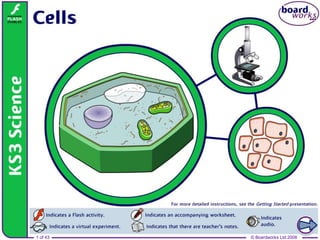
1 of 43 © Boardworks Ltd 2008
2 of 43 © Boardworks Ltd 2008
What are living things made of?
Cells work together to carry out the seven life processes
that are needed for an organism to stay alive.
Other organisms are multicellular – they are made
up of many types of cells. Can you think of some
examples of unicellular and multicellular organisms?
Some organisms are
unicellular – they are
made up of only one cell.
Cells are the building
blocks of life – they come
in all shapes and sizes.
3 of 43 © Boardworks Ltd 2008
What are the seven life processes?
4 of 43 © Boardworks Ltd 2008
What is a cell?
Animal and plant cells come in different shapes and sizes,
but they all have three basic features.
Plant cells also have some extra features that make them
different to animal cells.
cell membrane
cytoplasm
nucleus
animal cell plant cell
5 of 43 © Boardworks Ltd 2008
A typical animal cell
6 of 43 © Boardworks Ltd 2008
The parts of a typical animal cell
7 of 43 © Boardworks Ltd 2008
A typical plant cell
8 of 43 © Boardworks Ltd 2008
The parts of a typical plant cell
9 of 43 © Boardworks Ltd 2008
Comparing animal and plant cells
10 of 43 © Boardworks Ltd 2008
What shape is a cell?
Cells are not flat; they are usually three-dimensional (3D).
Most cells have three basic parts: the nucleus, cytoplasm
and cell membrane. They may also contain other small
structures called organelles, that perform specific jobs.
But the 3D shape of the cell is determined by its location
in the body and the job that it does.
11 of 43 © Boardworks Ltd 2008
Do all cells look the same?
Cells can be different shapes and sizes and also have
different functions. This is because they are specialized.
The shape of a cell is related to its function. Where do you
see this idea in sport?
Why are the players in a
rugby team often different
shapes and sizes?
The players in a rugby team
are different shapes and sizes
because each player does a
different job for the team.
Like rugby players, cells are different shapes and sizes
because they perform different jobs.
12 of 43 © Boardworks Ltd 2008
Whose cell is it anyway?
13 of 43 © Boardworks Ltd 2008
Parts of a microscope
14 of 43 © Boardworks Ltd 2008
From cell to organism
All living things are made up of cells. The appearance of
each living thing is the result of the types of cell that it is
made up of and how these cells are organized.
15 of 43 © Boardworks Ltd 2008
How is the body like a school?
To understand how the body is organized, think about all the
different people that work in a school to make it function.
Everybody in the school needs to know where they should be
and what they are doing for the school to function properly.
Everybody does a different job – they have different skills
and equipment to help them do their job.
 teachers and teaching assistants
 caretakers and cleaners
 dinner ladies and bus drivers
 governors and office workers
16 of 43 © Boardworks Ltd 2008
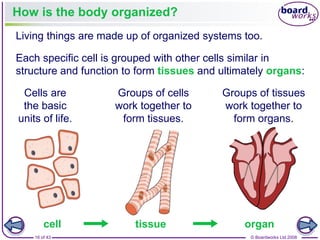
How is the body organized?
Living things are made up of organized systems too.
Each specific cell is grouped with other cells similar in
structure and function to form tissues and ultimately organs:
Groups of tissues
work together to
form organs.
Groups of cells
work together to
form tissues.
Cells are
the basic
units of life.
cell tissue organ

Cells

  • 1.
    1 of 43© Boardworks Ltd 2008
  • 2.
    2 of 43© Boardworks Ltd 2008 What are living things made of? Cells work together to carry out the seven life processes that are needed for an organism to stay alive. Other organisms are multicellular – they are made up of many types of cells. Can you think of some examples of unicellular and multicellular organisms? Some organisms are unicellular – they are made up of only one cell. Cells are the building blocks of life – they come in all shapes and sizes.
  • 3.
    3 of 43© Boardworks Ltd 2008 What are the seven life processes?
  • 4.
    4 of 43© Boardworks Ltd 2008 What is a cell? Animal and plant cells come in different shapes and sizes, but they all have three basic features. Plant cells also have some extra features that make them different to animal cells. cell membrane cytoplasm nucleus animal cell plant cell
  • 5.
    5 of 43© Boardworks Ltd 2008 A typical animal cell
  • 6.
    6 of 43© Boardworks Ltd 2008 The parts of a typical animal cell
  • 7.
    7 of 43© Boardworks Ltd 2008 A typical plant cell
  • 8.
    8 of 43© Boardworks Ltd 2008 The parts of a typical plant cell
  • 9.
    9 of 43© Boardworks Ltd 2008 Comparing animal and plant cells
  • 10.
    10 of 43© Boardworks Ltd 2008 What shape is a cell? Cells are not flat; they are usually three-dimensional (3D). Most cells have three basic parts: the nucleus, cytoplasm and cell membrane. They may also contain other small structures called organelles, that perform specific jobs. But the 3D shape of the cell is determined by its location in the body and the job that it does.
  • 11.
    11 of 43© Boardworks Ltd 2008 Do all cells look the same? Cells can be different shapes and sizes and also have different functions. This is because they are specialized. The shape of a cell is related to its function. Where do you see this idea in sport? Why are the players in a rugby team often different shapes and sizes? The players in a rugby team are different shapes and sizes because each player does a different job for the team. Like rugby players, cells are different shapes and sizes because they perform different jobs.
  • 12.
    12 of 43© Boardworks Ltd 2008 Whose cell is it anyway?
  • 13.
    13 of 43© Boardworks Ltd 2008 Parts of a microscope
  • 14.
    14 of 43© Boardworks Ltd 2008 From cell to organism All living things are made up of cells. The appearance of each living thing is the result of the types of cell that it is made up of and how these cells are organized.
  • 15.
    15 of 43© Boardworks Ltd 2008 How is the body like a school? To understand how the body is organized, think about all the different people that work in a school to make it function. Everybody in the school needs to know where they should be and what they are doing for the school to function properly. Everybody does a different job – they have different skills and equipment to help them do their job.  teachers and teaching assistants  caretakers and cleaners  dinner ladies and bus drivers  governors and office workers
  • 16.
    16 of 43© Boardworks Ltd 2008 How is the body organized? Living things are made up of organized systems too. Each specific cell is grouped with other cells similar in structure and function to form tissues and ultimately organs: Groups of tissues work together to form organs. Groups of cells work together to form tissues. Cells are the basic units of life. cell tissue organ

Editor's Notes

  • #2 Boardworks KS3 Science 2008 Cells
  • #3 Boardworks KS3 Science 2008 Cells
  • #4 Boardworks KS3 Science 2008 Cells
  • #5 Boardworks KS3 Science 2008 Cells
  • #6 Boardworks KS3 Science 2008 Cells
  • #7 Boardworks KS3 Science 2008 Cells
  • #8 Boardworks KS3 Science 2008 Cells
  • #9 Boardworks KS3 Science 2008 Cells
  • #10 Boardworks KS3 Science 2008 Cells
  • #11 Boardworks KS3 Science 2008 Cells
  • #12 Boardworks KS3 Science 2008 Cells
  • #13 Boardworks KS3 Science 2008 Cells
  • #14 Boardworks KS3 Science 2008 Cells
  • #15 Boardworks KS3 Science 2008 Cells
  • #16 Boardworks KS3 Science 2008 Cells
  • #17 Boardworks KS3 Science 2008 Cells