1
CEPH DATA SERVICES
IN A MULTI- AND HYBRID CLOUD WORLD
Sage Weil - Red Hat
OpenStack Summit - 2018.11.15
2
● Ceph
● Data services
● Block
● File
● Object
● Edge
● Future
OUTLINE
3
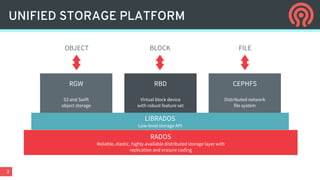
UNIFIED STORAGE PLATFORM
RGW
S3 and Swift
object storage
LIBRADOS
Low-level storage API
RADOS
Reliable, elastic, highly-available distributed storage layer with
replication and erasure coding
RBD
Virtual block device
with robust feature set
CEPHFS
Distributed network
file system
OBJECT BLOCK FILE
4
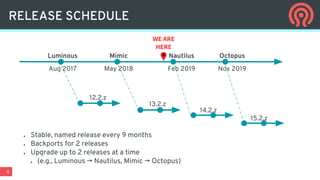
RELEASE SCHEDULE
12.2.z
13.2.z
Luminous
Aug 2017
Mimic
May 2018
WE ARE
HERE
● Stable, named release every 9 months
● Backports for 2 releases
● Upgrade up to 2 releases at a time
● (e.g., Luminous → Nautilus, Mimic → Octopus)
14.2.z
Nautilus
Feb 2019
15.2.z
Octopus
Nov 2019
5
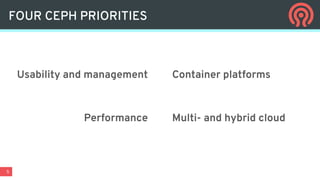
FOUR CEPH PRIORITIES
Usability and management
Performance
Container platforms
Multi- and hybrid cloud
6
MOTIVATION - DATA SERVICES
7
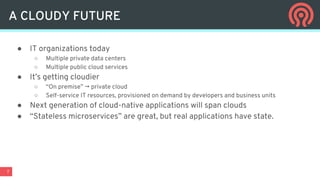
A CLOUDY FUTURE
● IT organizations today
○ Multiple private data centers
○ Multiple public cloud services
● It’s getting cloudier
○ “On premise” → private cloud
○ Self-service IT resources, provisioned on demand by developers and business units
● Next generation of cloud-native applications will span clouds
● “Stateless microservices” are great, but real applications have state.
8
● Data placement and portability
○ Where should I store this data?
○ How can I move this data set to a new tier or new site?
○ Seamlessly, without interrupting applications?
● Introspection
○ What data am I storing? For whom? Where? For how long?
○ Search, metrics, insights
● Policy-driven data management
○ Lifecycle management
○ Conformance: constrain placement, retention, etc. (e.g., HIPAA, GPDR)
○ Optimize placement based on cost or performance
○ Automation
DATA SERVICES
9
● Data sets are tied to applications
○ When the data moves, the application often should (or must) move too
● Container platforms are key
○ Automated application (re)provisioning
○ “Operators” to manage coordinated migration of state and applications that consume it
MORE THAN JUST DATA
10
● Multi-tier
○ Different storage for different data
● Mobility
○ Move an application and its data between sites with minimal (or no) availability interruption
○ Maybe an entire site, but usually a small piece of a site
● Disaster recovery
○ Tolerate a site-wide failure; reinstantiate data and app in a new site quickly
○ Point-in-time consistency with bounded latency (bounded data loss)
● Stretch
○ Tolerate site outage without compromising data availability
○ Synchronous replication (no data loss) or async replication (different consistency model)
● Edge
○ Small (e.g., telco POP) and/or semi-connected sites (e.g., autonomous vehicle)
DATA USE SCENARIOS
11
BLOCK STORAGE
12
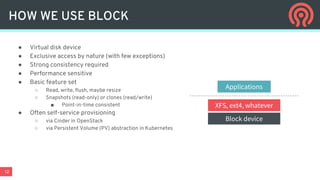
HOW WE USE BLOCK
● Virtual disk device
● Exclusive access by nature (with few exceptions)
● Strong consistency required
● Performance sensitive
● Basic feature set
○ Read, write, flush, maybe resize
○ Snapshots (read-only) or clones (read/write)
■ Point-in-time consistent
● Often self-service provisioning
○ via Cinder in OpenStack
○ via Persistent Volume (PV) abstraction in Kubernetes
Block device
XFS, ext4, whatever
Applications
13
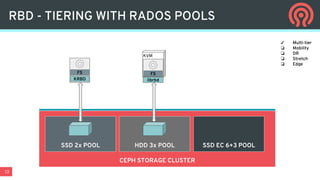
RBD - TIERING WITH RADOS POOLS
CEPH STORAGE CLUSTER
SSD 2x POOL HDD 3x POOL SSD EC 6+3 POOL
FSFS
KRBD librbd
✓ Multi-tier
❏ Mobility
❏ DR
❏ Stretch
❏ Edge
KVM
14
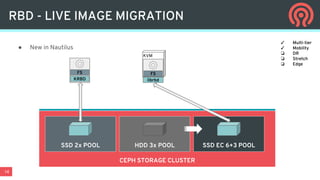
RBD - LIVE IMAGE MIGRATION
CEPH STORAGE CLUSTER
SSD 2x POOL HDD 3x POOL SSD EC 6+3 POOL
FSFS
KRBD librbd
✓ Multi-tier
✓ Mobility
❏ DR
❏ Stretch
❏ Edge
KVM
● New in Nautilus
15
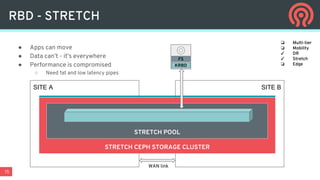
SITE BSITE A
RBD - STRETCH
STRETCH CEPH STORAGE CLUSTER
STRETCH POOL
FS
KRBD
WAN link
❏ Multi-tier
❏ Mobility
✓ DR
✓ Stretch
❏ Edge
● Apps can move
● Data can’t - it’s everywhere
● Performance is compromised
○ Need fat and low latency pipes
16
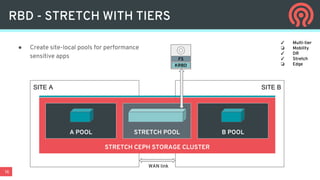
SITE BSITE A
RBD - STRETCH WITH TIERS
STRETCH CEPH STORAGE CLUSTER
STRETCH POOL
FS
KRBD
WAN link
✓ Multi-tier
❏ Mobility
✓ DR
✓ Stretch
❏ Edge
● Create site-local pools for performance
sensitive apps
A POOL B POOL
17
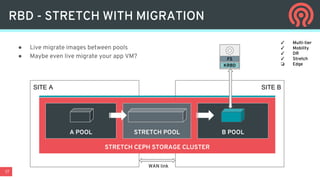
SITE BSITE A
RBD - STRETCH WITH MIGRATION
STRETCH CEPH STORAGE CLUSTER
STRETCH POOL
WAN link
✓ Multi-tier
✓ Mobility
✓ DR
✓ Stretch
❏ Edge
● Live migrate images between pools
● Maybe even live migrate your app VM?
A POOL B POOL
FS
KRBD
18
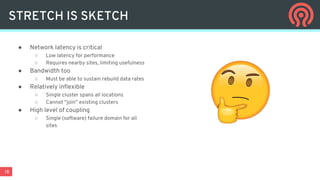
● Network latency is critical
○ Low latency for performance
○ Requires nearby sites, limiting usefulness
● Bandwidth too
○ Must be able to sustain rebuild data rates
● Relatively inflexible
○ Single cluster spans all locations
○ Cannot “join” existing clusters
● High level of coupling
○ Single (software) failure domain for all
sites
STRETCH IS SKETCH
19
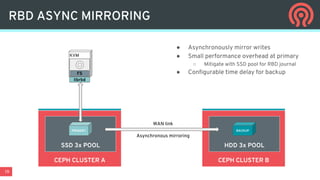
RBD ASYNC MIRRORING
CEPH CLUSTER A
SSD 3x POOL
PRIMARY
CEPH CLUSTER B
HDD 3x POOL
BACKUP
WAN link
Asynchronous mirroring
FS
librbd
● Asynchronously mirror writes
● Small performance overhead at primary
○ Mitigate with SSD pool for RBD journal
● Configurable time delay for backup
KVM
20
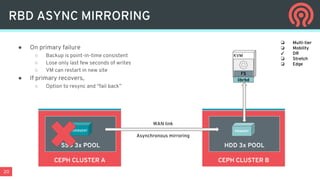
● On primary failure
○ Backup is point-in-time consistent
○ Lose only last few seconds of writes
○ VM can restart in new site
● If primary recovers,
○ Option to resync and “fail back”
RBD ASYNC MIRRORING
CEPH CLUSTER A
SSD 3x POOL
CEPH CLUSTER B
HDD 3x POOL
WAN link
Asynchronous mirroring
FS
librbd
DIVERGENT PRIMARY
❏ Multi-tier
❏ Mobility
✓ DR
❏ Stretch
❏ Edge
KVM
21
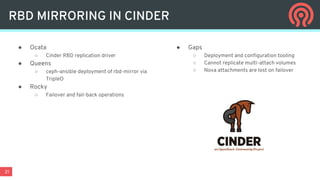
● Ocata
○ Cinder RBD replication driver
● Queens
○ ceph-ansible deployment of rbd-mirror via
TripleO
● Rocky
○ Failover and fail-back operations
● Gaps
○ Deployment and configuration tooling
○ Cannot replicate multi-attach volumes
○ Nova attachments are lost on failover
RBD MIRRORING IN CINDER
22
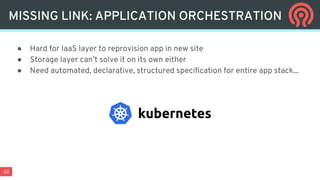
● Hard for IaaS layer to reprovision app in new site
● Storage layer can’t solve it on its own either
● Need automated, declarative, structured specification for entire app stack...
MISSING LINK: APPLICATION ORCHESTRATION
23
FILE STORAGE
24
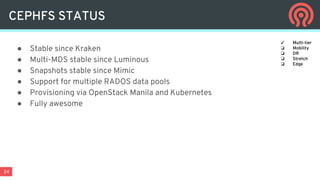
● Stable since Kraken
● Multi-MDS stable since Luminous
● Snapshots stable since Mimic
● Support for multiple RADOS data pools
● Provisioning via OpenStack Manila and Kubernetes
● Fully awesome
CEPHFS STATUS
✓ Multi-tier
❏ Mobility
❏ DR
❏ Stretch
❏ Edge
25
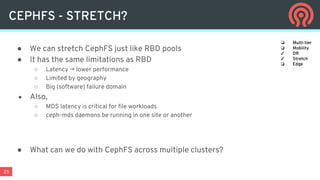
● We can stretch CephFS just like RBD pools
● It has the same limitations as RBD
○ Latency → lower performance
○ Limited by geography
○ Big (software) failure domain
● Also,
○ MDS latency is critical for file workloads
○ ceph-mds daemons be running in one site or another
● What can we do with CephFS across multiple clusters?
CEPHFS - STRETCH?
❏ Multi-tier
❏ Mobility
✓ DR
✓ Stretch
❏ Edge
26
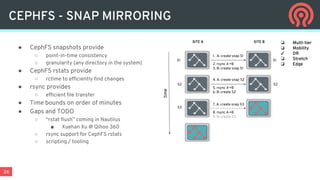
7. A: create snap S3
● CephFS snapshots provide
○ point-in-time consistency
○ granularity (any directory in the system)
● CephFS rstats provide
○ rctime to efficiently find changes
● rsync provides
○ efficient file transfer
● Time bounds on order of minutes
● Gaps and TODO
○ “rstat flush” coming in Nautilus
■ Xuehan Xu @ Qihoo 360
○ rsync support for CephFS rstats
○ scripting / tooling
CEPHFS - SNAP MIRRORING
❏ Multi-tier
❏ Mobility
✓ DR
❏ Stretch
❏ Edge
time
1. A: create snap S1
2. rsync A→B
3. B: create snap S1
4. A: create snap S2
5. rsync A→B
6. B: create S2
8. rsync A→B
9. B: create S3
S1
S2
S3
S1
S2
SITE A SITE B
27
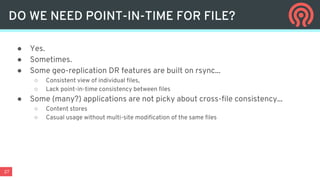
● Yes.
● Sometimes.
● Some geo-replication DR features are built on rsync...
○ Consistent view of individual files,
○ Lack point-in-time consistency between files
● Some (many?) applications are not picky about cross-file consistency...
○ Content stores
○ Casual usage without multi-site modification of the same files
DO WE NEED POINT-IN-TIME FOR FILE?
28
● Many humans love Dropbox / NextCloud / etc.
○ Ad hoc replication of directories to any computer
○ Archive of past revisions of every file
○ Offline access to files is extremely convenient and fast
● Disconnected operation and asynchronous replication leads to conflicts
○ Usually a pop-up in GUI
● Automated conflict resolution is usually good enough
○ e.g., newest timestamp wins
○ Humans are happy if they can rollback to archived revisions when necessary
● A possible future direction:
○ Focus less on avoiding/preventing conflicts…
○ Focus instead on ability to rollback to past revisions…
CASE IN POINT: HUMANS
29
● Do we need point-in-time consistency for file systems?
● Where does the consistency requirement come in?
BACK TO APPLICATIONS
30
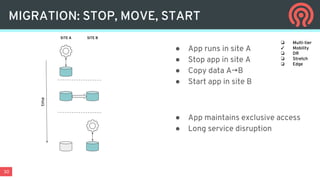
MIGRATION: STOP, MOVE, START
time
● App runs in site A
● Stop app in site A
● Copy data A→B
● Start app in site B
● App maintains exclusive access
● Long service disruption
SITE A SITE B
❏ Multi-tier
✓ Mobility
❏ DR
❏ Stretch
❏ Edge
31
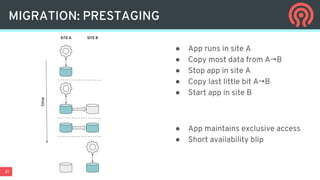
MIGRATION: PRESTAGING
time
● App runs in site A
● Copy most data from A→B
● Stop app in site A
● Copy last little bit A→B
● Start app in site B
● App maintains exclusive access
● Short availability blip
SITE A SITE B
32
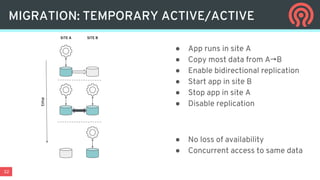
MIGRATION: TEMPORARY ACTIVE/ACTIVE
● App runs in site A
● Copy most data from A→B
● Enable bidirectional replication
● Start app in site B
● Stop app in site A
● Disable replication
● No loss of availability
● Concurrent access to same data
SITE A SITE B
time
33
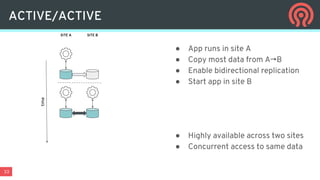
ACTIVE/ACTIVE
● App runs in site A
● Copy most data from A→B
● Enable bidirectional replication
● Start app in site B
● Highly available across two sites
● Concurrent access to same data
SITE A SITE B
time
34
● We don’t have general-purpose bidirectional file replication
● It is hard to resolve conflicts for any POSIX operation
○ Sites A and B both modify the same file
○ Site A renames /a → /b/a while Site B: renames /b → /a/b
● But applications can only go active/active if they are cooperative
○ i.e., they carefully avoid such conflicts
○ e.g., mostly-static directory structure + last writer wins
● So we could do it if we simplify the data model...
● But wait, that sounds a bit like object storage...
BIDIRECTIONAL FILE REPLICATION?
35
OBJECT STORAGE
36
WHY IS OBJECT SO GREAT?
● Based on HTTP
○ Interoperates well with web caches, proxies, CDNs, ...
● Atomic object replacement
○ PUT on a large object atomically replaces prior version
○ Trivial conflict resolution (last writer wins)
○ Lack of overwrites makes erasure coding easy
● Flat namespace
○ No multi-step traversal to find your data
○ Easy to scale horizontally
● No rename
○ Vastly simplified implementation
37
● File is not going away, and will be critical
○ Half a century of legacy applications
○ It’s genuinely useful
● Block is not going away, and is also critical infrastructure
○ Well suited for exclusive-access storage users (boot devices, etc)
○ Performs better than file due to local consistency management, ordering etc.
● Most new data will land in objects
○ Cat pictures, surveillance video, telemetry, medical imaging, genome data
○ Next generation of cloud native applications will be architected around object
THE FUTURE IS… OBJECTY
38
RGW FEDERATION MODEL
● Zone
○ Collection RADOS pools storing data
○ Set of RGW daemons serving that content
● ZoneGroup
○ Collection of Zones with a replication relationship
○ Active/Passive[/…] or Active/Active
● Namespace
○ Independent naming for users and buckets
○ All ZoneGroups and Zones replicate user and
bucket index pool
○ One Zone serves as the leader to handle User and
Bucket creations/deletions
● Failover is driven externally
○ Human (?) operators decide when to write off a
master, resynchronize
Namespace
ZoneGroup
Zone
39
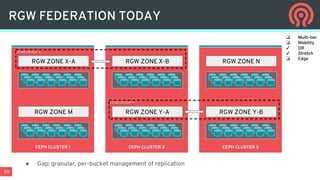
RGW FEDERATION TODAY
CEPH CLUSTER 1 CEPH CLUSTER 2 CEPH CLUSTER 3
RGW ZONE M
ZONEGROUP Y
RGW ZONE Y-A RGW ZONE Y-B
ZONEGROUP X
RGW ZONE X-A RGW ZONE X-B RGW ZONE N
❏ Multi-tier
❏ Mobility
✓ DR
✓ Stretch
❏ Edge
● Gap: granular, per-bucket management of replication
40
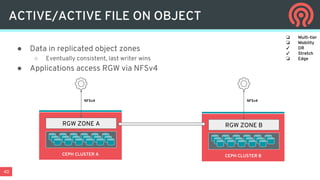
ACTIVE/ACTIVE FILE ON OBJECT
CEPH CLUSTER A
RGW ZONE A
CEPH CLUSTER B
RGW ZONE B
● Data in replicated object zones
○ Eventually consistent, last writer wins
● Applications access RGW via NFSv4
NFSv4 NFSv4
❏ Multi-tier
❏ Mobility
✓ DR
✓ Stretch
❏ Edge
41
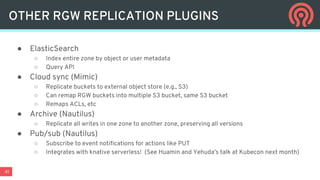
● ElasticSearch
○ Index entire zone by object or user metadata
○ Query API
● Cloud sync (Mimic)
○ Replicate buckets to external object store (e.g., S3)
○ Can remap RGW buckets into multiple S3 bucket, same S3 bucket
○ Remaps ACLs, etc
● Archive (Nautilus)
○ Replicate all writes in one zone to another zone, preserving all versions
● Pub/sub (Nautilus)
○ Subscribe to event notifications for actions like PUT
○ Integrates with knative serverless! (See Huamin and Yehuda’s talk at Kubecon next month)
OTHER RGW REPLICATION PLUGINS
42
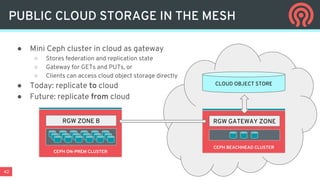
PUBLIC CLOUD STORAGE IN THE MESH
CEPH ON-PREM CLUSTER
CEPH BEACHHEAD CLUSTER
RGW ZONE B RGW GATEWAY ZONE
CLOUD OBJECT STORE
● Mini Ceph cluster in cloud as gateway
○ Stores federation and replication state
○ Gateway for GETs and PUTs, or
○ Clients can access cloud object storage directly
● Today: replicate to cloud
● Future: replicate from cloud
43
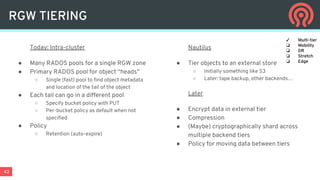
Today: Intra-cluster
● Many RADOS pools for a single RGW zone
● Primary RADOS pool for object “heads”
○ Single (fast) pool to find object metadata
and location of the tail of the object
● Each tail can go in a different pool
○ Specify bucket policy with PUT
○ Per-bucket policy as default when not
specified
● Policy
○ Retention (auto-expire)
RGW TIERING
Nautilus
● Tier objects to an external store
○ Initially something like S3
○ Later: tape backup, other backends…
Later
● Encrypt data in external tier
● Compression
● (Maybe) cryptographically shard across
multiple backend tiers
● Policy for moving data between tiers
✓ Multi-tier
❏ Mobility
❏ DR
❏ Stretch
❏ Edge
44
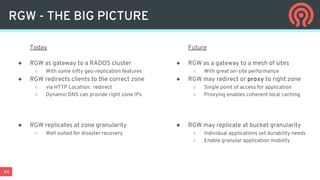
Today
● RGW as gateway to a RADOS cluster
○ With some nifty geo-replication features
● RGW redirects clients to the correct zone
○ via HTTP Location: redirect
○ Dynamic DNS can provide right zone IPs
● RGW replicates at zone granularity
○ Well suited for disaster recovery
RGW - THE BIG PICTURE
Future
● RGW as a gateway to a mesh of sites
○ With great on-site performance
● RGW may redirect or proxy to right zone
○ Single point of access for application
○ Proxying enables coherent local caching
● RGW may replicate at bucket granularity
○ Individual applications set durability needs
○ Enable granular application mobility
45 CEPH AT THE THE EDGE
46
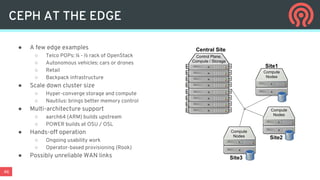
CEPH AT THE EDGE
● A few edge examples
○ Telco POPs: ¼ - ½ rack of OpenStack
○ Autonomous vehicles: cars or drones
○ Retail
○ Backpack infrastructure
● Scale down cluster size
○ Hyper-converge storage and compute
○ Nautilus: brings better memory control
● Multi-architecture support
○ aarch64 (ARM) builds upstream
○ POWER builds at OSU / OSL
● Hands-off operation
○ Ongoing usability work
○ Operator-based provisioning (Rook)
● Possibly unreliable WAN links
Control Plane,
Compute / Storage
Compute
Nodes
Compute
Nodes
Compute
Nodes
Central Site
Site1
Site2
Site3
47
● Block: async mirror edge volumes to central site
○ For DR purposes
● Data producers
○ Write generated data into objects in local RGW zone
○ Upload to central site when connectivity allows
○ Perhaps with some local pre-processing first
● Data consumers
○ Access to global data set via RGW (as a “mesh gateway”)
○ Local caching of a subset of the data
● We’re most interested in object-based edge scenarios
DATA AT THE EDGE
❏ Multi-tier
❏ Mobility
❏ DR
❏ Stretch
✓ Edge
48
KUBERNETES
49
WHY ALL THE KUBERNETES TALK?
● True mobility is a partnership between orchestrator and storage
● Kubernetes is an emerging leader in application orchestration
● Persistent Volumes
○ Basic Ceph drivers in Kubernetes, ceph-csi on the way
○ Rook for automating Ceph cluster deployment and operation, hyperconverged
● Object
○ Trivial provisioning of RGW via Rook
○ Coming soon: on-demand, dynamic provisioning of Object Buckets and User (via Rook)
○ Consistent developer experience across different object backends (RGW, S3, minio, etc.)
50
BRINGING IT ALL TOGETHER...
51
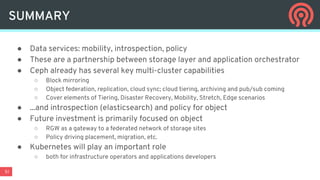
SUMMARY
● Data services: mobility, introspection, policy
● These are a partnership between storage layer and application orchestrator
● Ceph already has several key multi-cluster capabilities
○ Block mirroring
○ Object federation, replication, cloud sync; cloud tiering, archiving and pub/sub coming
○ Cover elements of Tiering, Disaster Recovery, Mobility, Stretch, Edge scenarios
● ...and introspection (elasticsearch) and policy for object
● Future investment is primarily focused on object
○ RGW as a gateway to a federated network of storage sites
○ Policy driving placement, migration, etc.
● Kubernetes will play an important role
○ both for infrastructure operators and applications developers
52
THANK YOU
https://ceph.io/
sage@redhat.com
@liewegas

Ceph data services in a multi- and hybrid cloud world

  • 1.
    1 CEPH DATA SERVICES INA MULTI- AND HYBRID CLOUD WORLD Sage Weil - Red Hat OpenStack Summit - 2018.11.15
  • 2.
    2 ● Ceph ● Dataservices ● Block ● File ● Object ● Edge ● Future OUTLINE
  • 3.
    3 UNIFIED STORAGE PLATFORM RGW S3and Swift object storage LIBRADOS Low-level storage API RADOS Reliable, elastic, highly-available distributed storage layer with replication and erasure coding RBD Virtual block device with robust feature set CEPHFS Distributed network file system OBJECT BLOCK FILE
  • 4.
    4 RELEASE SCHEDULE 12.2.z 13.2.z Luminous Aug 2017 Mimic May2018 WE ARE HERE ● Stable, named release every 9 months ● Backports for 2 releases ● Upgrade up to 2 releases at a time ● (e.g., Luminous → Nautilus, Mimic → Octopus) 14.2.z Nautilus Feb 2019 15.2.z Octopus Nov 2019
  • 5.
    5 FOUR CEPH PRIORITIES Usabilityand management Performance Container platforms Multi- and hybrid cloud
  • 6.
  • 7.
    7 A CLOUDY FUTURE ●IT organizations today ○ Multiple private data centers ○ Multiple public cloud services ● It’s getting cloudier ○ “On premise” → private cloud ○ Self-service IT resources, provisioned on demand by developers and business units ● Next generation of cloud-native applications will span clouds ● “Stateless microservices” are great, but real applications have state.
  • 8.
    8 ● Data placementand portability ○ Where should I store this data? ○ How can I move this data set to a new tier or new site? ○ Seamlessly, without interrupting applications? ● Introspection ○ What data am I storing? For whom? Where? For how long? ○ Search, metrics, insights ● Policy-driven data management ○ Lifecycle management ○ Conformance: constrain placement, retention, etc. (e.g., HIPAA, GPDR) ○ Optimize placement based on cost or performance ○ Automation DATA SERVICES
  • 9.
    9 ● Data setsare tied to applications ○ When the data moves, the application often should (or must) move too ● Container platforms are key ○ Automated application (re)provisioning ○ “Operators” to manage coordinated migration of state and applications that consume it MORE THAN JUST DATA
  • 10.
    10 ● Multi-tier ○ Differentstorage for different data ● Mobility ○ Move an application and its data between sites with minimal (or no) availability interruption ○ Maybe an entire site, but usually a small piece of a site ● Disaster recovery ○ Tolerate a site-wide failure; reinstantiate data and app in a new site quickly ○ Point-in-time consistency with bounded latency (bounded data loss) ● Stretch ○ Tolerate site outage without compromising data availability ○ Synchronous replication (no data loss) or async replication (different consistency model) ● Edge ○ Small (e.g., telco POP) and/or semi-connected sites (e.g., autonomous vehicle) DATA USE SCENARIOS
  • 11.
  • 12.
    12 HOW WE USEBLOCK ● Virtual disk device ● Exclusive access by nature (with few exceptions) ● Strong consistency required ● Performance sensitive ● Basic feature set ○ Read, write, flush, maybe resize ○ Snapshots (read-only) or clones (read/write) ■ Point-in-time consistent ● Often self-service provisioning ○ via Cinder in OpenStack ○ via Persistent Volume (PV) abstraction in Kubernetes Block device XFS, ext4, whatever Applications
  • 13.
    13 RBD - TIERINGWITH RADOS POOLS CEPH STORAGE CLUSTER SSD 2x POOL HDD 3x POOL SSD EC 6+3 POOL FSFS KRBD librbd ✓ Multi-tier ❏ Mobility ❏ DR ❏ Stretch ❏ Edge KVM
  • 14.
    14 RBD - LIVEIMAGE MIGRATION CEPH STORAGE CLUSTER SSD 2x POOL HDD 3x POOL SSD EC 6+3 POOL FSFS KRBD librbd ✓ Multi-tier ✓ Mobility ❏ DR ❏ Stretch ❏ Edge KVM ● New in Nautilus
  • 15.
    15 SITE BSITE A RBD- STRETCH STRETCH CEPH STORAGE CLUSTER STRETCH POOL FS KRBD WAN link ❏ Multi-tier ❏ Mobility ✓ DR ✓ Stretch ❏ Edge ● Apps can move ● Data can’t - it’s everywhere ● Performance is compromised ○ Need fat and low latency pipes
  • 16.
    16 SITE BSITE A RBD- STRETCH WITH TIERS STRETCH CEPH STORAGE CLUSTER STRETCH POOL FS KRBD WAN link ✓ Multi-tier ❏ Mobility ✓ DR ✓ Stretch ❏ Edge ● Create site-local pools for performance sensitive apps A POOL B POOL
  • 17.
    17 SITE BSITE A RBD- STRETCH WITH MIGRATION STRETCH CEPH STORAGE CLUSTER STRETCH POOL WAN link ✓ Multi-tier ✓ Mobility ✓ DR ✓ Stretch ❏ Edge ● Live migrate images between pools ● Maybe even live migrate your app VM? A POOL B POOL FS KRBD
  • 18.
    18 ● Network latencyis critical ○ Low latency for performance ○ Requires nearby sites, limiting usefulness ● Bandwidth too ○ Must be able to sustain rebuild data rates ● Relatively inflexible ○ Single cluster spans all locations ○ Cannot “join” existing clusters ● High level of coupling ○ Single (software) failure domain for all sites STRETCH IS SKETCH
  • 19.
    19 RBD ASYNC MIRRORING CEPHCLUSTER A SSD 3x POOL PRIMARY CEPH CLUSTER B HDD 3x POOL BACKUP WAN link Asynchronous mirroring FS librbd ● Asynchronously mirror writes ● Small performance overhead at primary ○ Mitigate with SSD pool for RBD journal ● Configurable time delay for backup KVM
  • 20.
    20 ● On primaryfailure ○ Backup is point-in-time consistent ○ Lose only last few seconds of writes ○ VM can restart in new site ● If primary recovers, ○ Option to resync and “fail back” RBD ASYNC MIRRORING CEPH CLUSTER A SSD 3x POOL CEPH CLUSTER B HDD 3x POOL WAN link Asynchronous mirroring FS librbd DIVERGENT PRIMARY ❏ Multi-tier ❏ Mobility ✓ DR ❏ Stretch ❏ Edge KVM
  • 21.
    21 ● Ocata ○ CinderRBD replication driver ● Queens ○ ceph-ansible deployment of rbd-mirror via TripleO ● Rocky ○ Failover and fail-back operations ● Gaps ○ Deployment and configuration tooling ○ Cannot replicate multi-attach volumes ○ Nova attachments are lost on failover RBD MIRRORING IN CINDER
  • 22.
    22 ● Hard forIaaS layer to reprovision app in new site ● Storage layer can’t solve it on its own either ● Need automated, declarative, structured specification for entire app stack... MISSING LINK: APPLICATION ORCHESTRATION
  • 23.
  • 24.
    24 ● Stable sinceKraken ● Multi-MDS stable since Luminous ● Snapshots stable since Mimic ● Support for multiple RADOS data pools ● Provisioning via OpenStack Manila and Kubernetes ● Fully awesome CEPHFS STATUS ✓ Multi-tier ❏ Mobility ❏ DR ❏ Stretch ❏ Edge
  • 25.
    25 ● We canstretch CephFS just like RBD pools ● It has the same limitations as RBD ○ Latency → lower performance ○ Limited by geography ○ Big (software) failure domain ● Also, ○ MDS latency is critical for file workloads ○ ceph-mds daemons be running in one site or another ● What can we do with CephFS across multiple clusters? CEPHFS - STRETCH? ❏ Multi-tier ❏ Mobility ✓ DR ✓ Stretch ❏ Edge
  • 26.
    26 7. A: createsnap S3 ● CephFS snapshots provide ○ point-in-time consistency ○ granularity (any directory in the system) ● CephFS rstats provide ○ rctime to efficiently find changes ● rsync provides ○ efficient file transfer ● Time bounds on order of minutes ● Gaps and TODO ○ “rstat flush” coming in Nautilus ■ Xuehan Xu @ Qihoo 360 ○ rsync support for CephFS rstats ○ scripting / tooling CEPHFS - SNAP MIRRORING ❏ Multi-tier ❏ Mobility ✓ DR ❏ Stretch ❏ Edge time 1. A: create snap S1 2. rsync A→B 3. B: create snap S1 4. A: create snap S2 5. rsync A→B 6. B: create S2 8. rsync A→B 9. B: create S3 S1 S2 S3 S1 S2 SITE A SITE B
  • 27.
    27 ● Yes. ● Sometimes. ●Some geo-replication DR features are built on rsync... ○ Consistent view of individual files, ○ Lack point-in-time consistency between files ● Some (many?) applications are not picky about cross-file consistency... ○ Content stores ○ Casual usage without multi-site modification of the same files DO WE NEED POINT-IN-TIME FOR FILE?
  • 28.
    28 ● Many humanslove Dropbox / NextCloud / etc. ○ Ad hoc replication of directories to any computer ○ Archive of past revisions of every file ○ Offline access to files is extremely convenient and fast ● Disconnected operation and asynchronous replication leads to conflicts ○ Usually a pop-up in GUI ● Automated conflict resolution is usually good enough ○ e.g., newest timestamp wins ○ Humans are happy if they can rollback to archived revisions when necessary ● A possible future direction: ○ Focus less on avoiding/preventing conflicts… ○ Focus instead on ability to rollback to past revisions… CASE IN POINT: HUMANS
  • 29.
    29 ● Do weneed point-in-time consistency for file systems? ● Where does the consistency requirement come in? BACK TO APPLICATIONS
  • 30.
    30 MIGRATION: STOP, MOVE,START time ● App runs in site A ● Stop app in site A ● Copy data A→B ● Start app in site B ● App maintains exclusive access ● Long service disruption SITE A SITE B ❏ Multi-tier ✓ Mobility ❏ DR ❏ Stretch ❏ Edge
  • 31.
    31 MIGRATION: PRESTAGING time ● Appruns in site A ● Copy most data from A→B ● Stop app in site A ● Copy last little bit A→B ● Start app in site B ● App maintains exclusive access ● Short availability blip SITE A SITE B
  • 32.
    32 MIGRATION: TEMPORARY ACTIVE/ACTIVE ●App runs in site A ● Copy most data from A→B ● Enable bidirectional replication ● Start app in site B ● Stop app in site A ● Disable replication ● No loss of availability ● Concurrent access to same data SITE A SITE B time
  • 33.
    33 ACTIVE/ACTIVE ● App runsin site A ● Copy most data from A→B ● Enable bidirectional replication ● Start app in site B ● Highly available across two sites ● Concurrent access to same data SITE A SITE B time
  • 34.
    34 ● We don’thave general-purpose bidirectional file replication ● It is hard to resolve conflicts for any POSIX operation ○ Sites A and B both modify the same file ○ Site A renames /a → /b/a while Site B: renames /b → /a/b ● But applications can only go active/active if they are cooperative ○ i.e., they carefully avoid such conflicts ○ e.g., mostly-static directory structure + last writer wins ● So we could do it if we simplify the data model... ● But wait, that sounds a bit like object storage... BIDIRECTIONAL FILE REPLICATION?
  • 35.
  • 36.
    36 WHY IS OBJECTSO GREAT? ● Based on HTTP ○ Interoperates well with web caches, proxies, CDNs, ... ● Atomic object replacement ○ PUT on a large object atomically replaces prior version ○ Trivial conflict resolution (last writer wins) ○ Lack of overwrites makes erasure coding easy ● Flat namespace ○ No multi-step traversal to find your data ○ Easy to scale horizontally ● No rename ○ Vastly simplified implementation
  • 37.
    37 ● File isnot going away, and will be critical ○ Half a century of legacy applications ○ It’s genuinely useful ● Block is not going away, and is also critical infrastructure ○ Well suited for exclusive-access storage users (boot devices, etc) ○ Performs better than file due to local consistency management, ordering etc. ● Most new data will land in objects ○ Cat pictures, surveillance video, telemetry, medical imaging, genome data ○ Next generation of cloud native applications will be architected around object THE FUTURE IS… OBJECTY
  • 38.
    38 RGW FEDERATION MODEL ●Zone ○ Collection RADOS pools storing data ○ Set of RGW daemons serving that content ● ZoneGroup ○ Collection of Zones with a replication relationship ○ Active/Passive[/…] or Active/Active ● Namespace ○ Independent naming for users and buckets ○ All ZoneGroups and Zones replicate user and bucket index pool ○ One Zone serves as the leader to handle User and Bucket creations/deletions ● Failover is driven externally ○ Human (?) operators decide when to write off a master, resynchronize Namespace ZoneGroup Zone
  • 39.
    39 RGW FEDERATION TODAY CEPHCLUSTER 1 CEPH CLUSTER 2 CEPH CLUSTER 3 RGW ZONE M ZONEGROUP Y RGW ZONE Y-A RGW ZONE Y-B ZONEGROUP X RGW ZONE X-A RGW ZONE X-B RGW ZONE N ❏ Multi-tier ❏ Mobility ✓ DR ✓ Stretch ❏ Edge ● Gap: granular, per-bucket management of replication
  • 40.
    40 ACTIVE/ACTIVE FILE ONOBJECT CEPH CLUSTER A RGW ZONE A CEPH CLUSTER B RGW ZONE B ● Data in replicated object zones ○ Eventually consistent, last writer wins ● Applications access RGW via NFSv4 NFSv4 NFSv4 ❏ Multi-tier ❏ Mobility ✓ DR ✓ Stretch ❏ Edge
  • 41.
    41 ● ElasticSearch ○ Indexentire zone by object or user metadata ○ Query API ● Cloud sync (Mimic) ○ Replicate buckets to external object store (e.g., S3) ○ Can remap RGW buckets into multiple S3 bucket, same S3 bucket ○ Remaps ACLs, etc ● Archive (Nautilus) ○ Replicate all writes in one zone to another zone, preserving all versions ● Pub/sub (Nautilus) ○ Subscribe to event notifications for actions like PUT ○ Integrates with knative serverless! (See Huamin and Yehuda’s talk at Kubecon next month) OTHER RGW REPLICATION PLUGINS
  • 42.
    42 PUBLIC CLOUD STORAGEIN THE MESH CEPH ON-PREM CLUSTER CEPH BEACHHEAD CLUSTER RGW ZONE B RGW GATEWAY ZONE CLOUD OBJECT STORE ● Mini Ceph cluster in cloud as gateway ○ Stores federation and replication state ○ Gateway for GETs and PUTs, or ○ Clients can access cloud object storage directly ● Today: replicate to cloud ● Future: replicate from cloud
  • 43.
    43 Today: Intra-cluster ● ManyRADOS pools for a single RGW zone ● Primary RADOS pool for object “heads” ○ Single (fast) pool to find object metadata and location of the tail of the object ● Each tail can go in a different pool ○ Specify bucket policy with PUT ○ Per-bucket policy as default when not specified ● Policy ○ Retention (auto-expire) RGW TIERING Nautilus ● Tier objects to an external store ○ Initially something like S3 ○ Later: tape backup, other backends… Later ● Encrypt data in external tier ● Compression ● (Maybe) cryptographically shard across multiple backend tiers ● Policy for moving data between tiers ✓ Multi-tier ❏ Mobility ❏ DR ❏ Stretch ❏ Edge
  • 44.
    44 Today ● RGW asgateway to a RADOS cluster ○ With some nifty geo-replication features ● RGW redirects clients to the correct zone ○ via HTTP Location: redirect ○ Dynamic DNS can provide right zone IPs ● RGW replicates at zone granularity ○ Well suited for disaster recovery RGW - THE BIG PICTURE Future ● RGW as a gateway to a mesh of sites ○ With great on-site performance ● RGW may redirect or proxy to right zone ○ Single point of access for application ○ Proxying enables coherent local caching ● RGW may replicate at bucket granularity ○ Individual applications set durability needs ○ Enable granular application mobility
  • 45.
    45 CEPH ATTHE THE EDGE
  • 46.
    46 CEPH AT THEEDGE ● A few edge examples ○ Telco POPs: ¼ - ½ rack of OpenStack ○ Autonomous vehicles: cars or drones ○ Retail ○ Backpack infrastructure ● Scale down cluster size ○ Hyper-converge storage and compute ○ Nautilus: brings better memory control ● Multi-architecture support ○ aarch64 (ARM) builds upstream ○ POWER builds at OSU / OSL ● Hands-off operation ○ Ongoing usability work ○ Operator-based provisioning (Rook) ● Possibly unreliable WAN links Control Plane, Compute / Storage Compute Nodes Compute Nodes Compute Nodes Central Site Site1 Site2 Site3
  • 47.
    47 ● Block: asyncmirror edge volumes to central site ○ For DR purposes ● Data producers ○ Write generated data into objects in local RGW zone ○ Upload to central site when connectivity allows ○ Perhaps with some local pre-processing first ● Data consumers ○ Access to global data set via RGW (as a “mesh gateway”) ○ Local caching of a subset of the data ● We’re most interested in object-based edge scenarios DATA AT THE EDGE ❏ Multi-tier ❏ Mobility ❏ DR ❏ Stretch ✓ Edge
  • 48.
  • 49.
    49 WHY ALL THEKUBERNETES TALK? ● True mobility is a partnership between orchestrator and storage ● Kubernetes is an emerging leader in application orchestration ● Persistent Volumes ○ Basic Ceph drivers in Kubernetes, ceph-csi on the way ○ Rook for automating Ceph cluster deployment and operation, hyperconverged ● Object ○ Trivial provisioning of RGW via Rook ○ Coming soon: on-demand, dynamic provisioning of Object Buckets and User (via Rook) ○ Consistent developer experience across different object backends (RGW, S3, minio, etc.)
  • 50.
    50 BRINGING IT ALLTOGETHER...
  • 51.
    51 SUMMARY ● Data services:mobility, introspection, policy ● These are a partnership between storage layer and application orchestrator ● Ceph already has several key multi-cluster capabilities ○ Block mirroring ○ Object federation, replication, cloud sync; cloud tiering, archiving and pub/sub coming ○ Cover elements of Tiering, Disaster Recovery, Mobility, Stretch, Edge scenarios ● ...and introspection (elasticsearch) and policy for object ● Future investment is primarily focused on object ○ RGW as a gateway to a federated network of storage sites ○ Policy driving placement, migration, etc. ● Kubernetes will play an important role ○ both for infrastructure operators and applications developers
  • 52.