Scale Testing RHCS with
10,000,000,000+ Objects
Karan Singh
Sr. Solution Architect
Cloud Storage & Data Services BU
1
2
Rare View cluster with 10B Objects
3
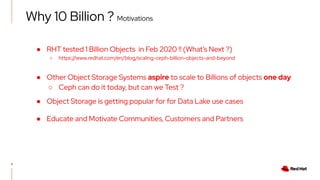
● RHT tested 1 Billion Objects in Feb 2020 !! (What’s Next ?)
○ https://www.redhat.com/en/blog/scaling-ceph-billion-objects-and-beyond
Why 10 Billion ? Motivations
● Other Object Storage Systems aspire to scale to Billions of objects one day
○ Ceph can do it today, but can we Test ?
● Object Storage is getting popular for for Data Lake use cases
● Educate and Motivate Communities, Customers and Partners
“RHCS delivered Deterministic Performance
at scale for both Small and Large object size workloads”
4
Executive Summary
5
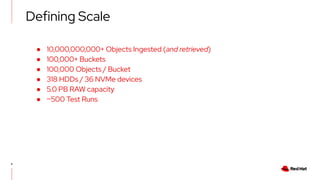
● 10,000,000,000+ Objects Ingested (and retrieved)
● 100,000+ Buckets
● 100,000 Objects / Bucket
● 318 HDDs / 36 NVMe devices
● 5.0 PB RAW capacity
● ~500 Test Runs
Defining Scale
6
● 6 x RHCS Nodes
○ 53 x 16TB HDDs
■ Seagate Exos E 4U106
○ 6 x Intel QLC 7.6 TB
○ 2 x Intel Xeon Gold 6152
○ 256GB
○ 2 x 25GbE
● 6 x Client Nodes
○ 2 x 25GbE
HW & SW Inventory
● RHEL 8.1
● RHCS 4.1
○ Containerized Deployment
○ 2 x RGWs per RHCS node
○ EC 4+2
○ S3 Access Mode
○ 100K Objects / Bucket
● COSBench for workload generation
○ 6 x Drivers
○ 12 x Workers
■ 64 x Threads each
7
Test Lab Architecture
RHCS 4.1 Cluster
2 x 25 Gb
Mellanox MSN2010
COSBench Workers
2 x 25 Gb
2 x 25 Gb
2 x 25 Gb
2 x 25 Gb
2 x 25 Gb
2 x 25 Gb
2 x 25 Gb
25 GbE Bonded Ports
• Isolated Network
2 x 25 Gb
2
x 25
Gb
2 x 25 Gb
2 x 25 Gb
Internet10 GbE Mgmt. Ports
8
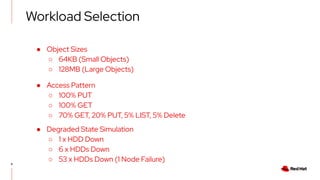
● Object Sizes
○ 64KB (Small Objects)
○ 128MB (Large Objects)
Workload Selection
● Access Pattern
○ 100% PUT
○ 100% GET
○ 70% GET, 20% PUT, 5% LIST, 5% Delete
● Degraded State Simulation
○ 1 x HDD Down
○ 6 x HDDs Down
○ 53 x HDDs Down (1 Node Failure)
9
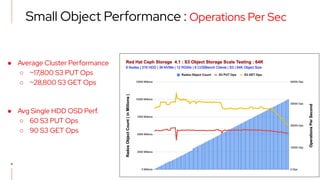
Small Object Performance : Operations Per Sec
● Average Cluster Performance
○ ~17,800 S3 PUT Ops
○ ~28,800 S3 GET Ops
● Avg Single HDD OSD Perf.
○ 60 S3 PUT Ops
○ 90 S3 GET Ops
10
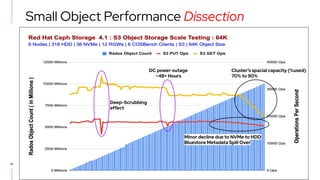
Small Object Performance Dissection
Deep-Scrubbing
effect
Cluster’s spacial capacity (%used)
70% to 90%
Minor decline due to NVMe to HDD
Bluestore Metadata Spill Over
DC power outage
~48+ Hours
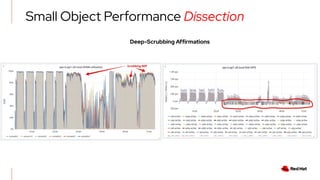
Deep-Scrubbing Affirmations
Small Object Performance Dissection
12
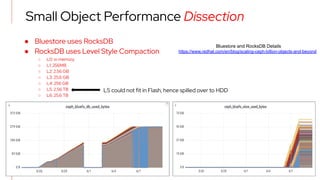
Small Object Performance Dissection
● Bluestore uses RocksDB
● RocksDB uses Level Style Compaction
○ L0: in memory
○ L1: 256MB
○ L2: 2.56 GB
○ L3: 25.6 GB
○ L4: 256 GB
○ L5: 2.56 TB
○ L6: 25.6 TB
L5 could not fit in Flash, hence spilled over to HDD
Bluestore and RocksDB Details
https://www.redhat.com/en/blog/scaling-ceph-billion-objects-and-beyond
13
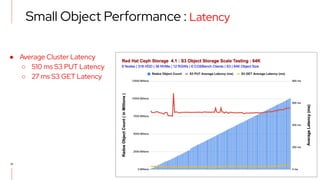
Small Object Performance : Latency
● Average Cluster Latency
○ 510 ms S3 PUT Latency
○ 27 ms S3 GET Latency
14
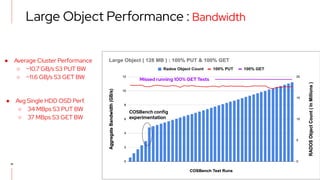
Large Object Performance : Bandwidth
COSBench config
experimentation
Missed running 100% GET Tests
● Average Cluster Performance
○ ~10.7 GB/s S3 PUT BW
○ ~11.6 GB/s S3 GET BW
● Avg Single HDD OSD Perf.
○ 34 MBps S3 PUT BW
○ 37 MBps S3 GET BW
15
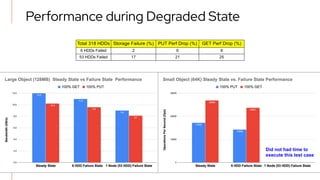
Performance during Degraded State
Did not had time to
execute this test case
Total 318 HDDs Storage Failure (%) PUT Perf Drop (%) GET Perf Drop (%)
6 HDDs Failed 2 6 8
53 HDDs Failed 17 21 25
16
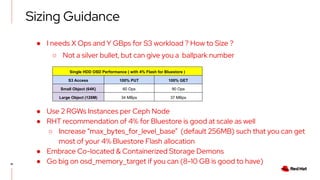
● I needs X Ops and Y GBps for S3 workload ? How to Size ?
Sizing Guidance
Single HDD OSD Performance ( with 4% Flash for Bluestore )
S3 Access 100% PUT 100% GET
Small Object (64K) 60 Ops 90 Ops
Large Object (128M) 34 MBps 37 MBps
● Use 2 RGWs Instances per Ceph Node
● RHT recommendation of 4% for Bluestore is good at scale as well
○ Increase “max_bytes_for_level_base” (default 256MB) such that you can get
most of your 4% Bluestore Flash allocation
● Embrace Co-located & Containerized Storage Demons
● Go big on osd_memory_target if you can (8-10 GB is good to have)
○ Not a silver bullet, but can give you a ballpark number
17
● Our testing showed RHCS achieving deterministic performance at scale for
both Small and Large Object sizes, PUT and GET operations, before hitting
resource saturation, capacity limits
● Performance during failure scenarios found to be acceptable
Summary
● Undoubtedly RHCS can scale a lot more than what we tested
○ 10 Billion objects are just Tested Maximum, This is NOT A LIMIT
Download the full performance report http://red.ht/10billion
linkedin.com/company/red-hat
youtube.com/user/RedHatVideos
facebook.com/redhatinc
twitter.com/RedHat
18
Red Hat is the world’s leading provider of enterprise
open source software solutions. Award-winning
support, training, and consulting services make
Red Hat a trusted adviser to the Fortune 500.
Thank you
Download the full performance report at
http://red.ht/10billion

Ceph scale testing with 10 Billion Objects

  • 1.
    Scale Testing RHCSwith 10,000,000,000+ Objects Karan Singh Sr. Solution Architect Cloud Storage & Data Services BU 1
  • 2.
    2 Rare View clusterwith 10B Objects
  • 3.
    3 ● RHT tested1 Billion Objects in Feb 2020 !! (What’s Next ?) ○ https://www.redhat.com/en/blog/scaling-ceph-billion-objects-and-beyond Why 10 Billion ? Motivations ● Other Object Storage Systems aspire to scale to Billions of objects one day ○ Ceph can do it today, but can we Test ? ● Object Storage is getting popular for for Data Lake use cases ● Educate and Motivate Communities, Customers and Partners
  • 4.
    “RHCS delivered DeterministicPerformance at scale for both Small and Large object size workloads” 4 Executive Summary
  • 5.
    5 ● 10,000,000,000+ ObjectsIngested (and retrieved) ● 100,000+ Buckets ● 100,000 Objects / Bucket ● 318 HDDs / 36 NVMe devices ● 5.0 PB RAW capacity ● ~500 Test Runs Defining Scale
  • 6.
    6 ● 6 xRHCS Nodes ○ 53 x 16TB HDDs ■ Seagate Exos E 4U106 ○ 6 x Intel QLC 7.6 TB ○ 2 x Intel Xeon Gold 6152 ○ 256GB ○ 2 x 25GbE ● 6 x Client Nodes ○ 2 x 25GbE HW & SW Inventory ● RHEL 8.1 ● RHCS 4.1 ○ Containerized Deployment ○ 2 x RGWs per RHCS node ○ EC 4+2 ○ S3 Access Mode ○ 100K Objects / Bucket ● COSBench for workload generation ○ 6 x Drivers ○ 12 x Workers ■ 64 x Threads each
  • 7.
    7 Test Lab Architecture RHCS4.1 Cluster 2 x 25 Gb Mellanox MSN2010 COSBench Workers 2 x 25 Gb 2 x 25 Gb 2 x 25 Gb 2 x 25 Gb 2 x 25 Gb 2 x 25 Gb 2 x 25 Gb 25 GbE Bonded Ports • Isolated Network 2 x 25 Gb 2 x 25 Gb 2 x 25 Gb 2 x 25 Gb Internet10 GbE Mgmt. Ports
  • 8.
    8 ● Object Sizes ○64KB (Small Objects) ○ 128MB (Large Objects) Workload Selection ● Access Pattern ○ 100% PUT ○ 100% GET ○ 70% GET, 20% PUT, 5% LIST, 5% Delete ● Degraded State Simulation ○ 1 x HDD Down ○ 6 x HDDs Down ○ 53 x HDDs Down (1 Node Failure)
  • 9.
    9 Small Object Performance: Operations Per Sec ● Average Cluster Performance ○ ~17,800 S3 PUT Ops ○ ~28,800 S3 GET Ops ● Avg Single HDD OSD Perf. ○ 60 S3 PUT Ops ○ 90 S3 GET Ops
  • 10.
    10 Small Object PerformanceDissection Deep-Scrubbing effect Cluster’s spacial capacity (%used) 70% to 90% Minor decline due to NVMe to HDD Bluestore Metadata Spill Over DC power outage ~48+ Hours
  • 11.
  • 12.
    12 Small Object PerformanceDissection ● Bluestore uses RocksDB ● RocksDB uses Level Style Compaction ○ L0: in memory ○ L1: 256MB ○ L2: 2.56 GB ○ L3: 25.6 GB ○ L4: 256 GB ○ L5: 2.56 TB ○ L6: 25.6 TB L5 could not fit in Flash, hence spilled over to HDD Bluestore and RocksDB Details https://www.redhat.com/en/blog/scaling-ceph-billion-objects-and-beyond
  • 13.
    13 Small Object Performance: Latency ● Average Cluster Latency ○ 510 ms S3 PUT Latency ○ 27 ms S3 GET Latency
  • 14.
    14 Large Object Performance: Bandwidth COSBench config experimentation Missed running 100% GET Tests ● Average Cluster Performance ○ ~10.7 GB/s S3 PUT BW ○ ~11.6 GB/s S3 GET BW ● Avg Single HDD OSD Perf. ○ 34 MBps S3 PUT BW ○ 37 MBps S3 GET BW
  • 15.
    15 Performance during DegradedState Did not had time to execute this test case Total 318 HDDs Storage Failure (%) PUT Perf Drop (%) GET Perf Drop (%) 6 HDDs Failed 2 6 8 53 HDDs Failed 17 21 25
  • 16.
    16 ● I needsX Ops and Y GBps for S3 workload ? How to Size ? Sizing Guidance Single HDD OSD Performance ( with 4% Flash for Bluestore ) S3 Access 100% PUT 100% GET Small Object (64K) 60 Ops 90 Ops Large Object (128M) 34 MBps 37 MBps ● Use 2 RGWs Instances per Ceph Node ● RHT recommendation of 4% for Bluestore is good at scale as well ○ Increase “max_bytes_for_level_base” (default 256MB) such that you can get most of your 4% Bluestore Flash allocation ● Embrace Co-located & Containerized Storage Demons ● Go big on osd_memory_target if you can (8-10 GB is good to have) ○ Not a silver bullet, but can give you a ballpark number
  • 17.
    17 ● Our testingshowed RHCS achieving deterministic performance at scale for both Small and Large Object sizes, PUT and GET operations, before hitting resource saturation, capacity limits ● Performance during failure scenarios found to be acceptable Summary ● Undoubtedly RHCS can scale a lot more than what we tested ○ 10 Billion objects are just Tested Maximum, This is NOT A LIMIT Download the full performance report http://red.ht/10billion
  • 18.
    linkedin.com/company/red-hat youtube.com/user/RedHatVideos facebook.com/redhatinc twitter.com/RedHat 18 Red Hat isthe world’s leading provider of enterprise open source software solutions. Award-winning support, training, and consulting services make Red Hat a trusted adviser to the Fortune 500. Thank you Download the full performance report at http://red.ht/10billion