WHAT’S NEW IN LUMINOUS AND BEYOND
SAGE WEIL – RED HAT
2017.11.06
2
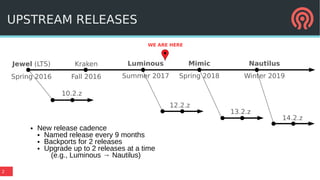
UPSTREAM RELEASES
Jewel (LTS)
Spring 2016
Kraken
Fall 2016
Luminous
Summer 2017
12.2.z
10.2.z
14.2.z
WE ARE HERE
Mimic
Spring 2018
Nautilus
Winter 2019
13.2.z
● New release cadence
● Named release every 9 months
● Backports for 2 releases
● Upgrade up to 2 releases at a time
(e.g., Luminous → Nautilus)
3 LUMINOUS
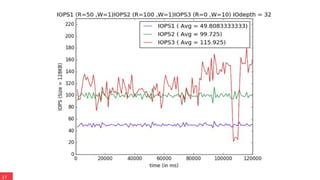
4
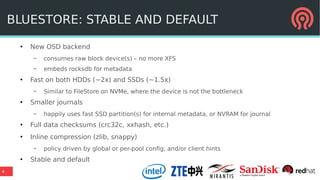
BLUESTORE: STABLE AND DEFAULT
●
New OSD backend
– consumes raw block device(s) – no more XFS
– embeds rocksdb for metadata
●
Fast on both HDDs (~2x) and SSDs (~1.5x)
– Similar to FileStore on NVMe, where the device is not the bottleneck
●
Smaller journals
– happily uses fast SSD partition(s) for internal metadata, or NVRAM for journal
●
Full data checksums (crc32c, xxhash, etc.)
●
Inline compression (zlib, snappy)
– policy driven by global or per-pool config, and/or client hints
●
Stable and default
5
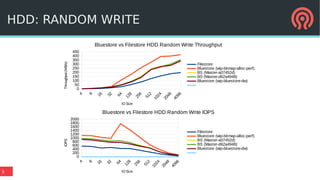
HDD: RANDOM WRITE
4 8 16 32 64
128
256
512
1024
2048
4096
0
50
100
150
200
250
300
350
400
450
Bluestore vs Filestore HDD Random Write Throughput
Filestore
Bluestore (wip-bitmap-alloc-perf)
BS (Master-a07452d)
BS (Master-d62a4948)
Bluestore (wip-bluestore-dw)
IO Size
Throughput(MB/s)
4 8 16 32 64
128
256
512
1024
2048
4096
0
200
400
600
800
1000
1200
1400
1600
1800
2000
Bluestore vs Filestore HDD Random Write IOPS
Filestore
Bluestore (wip-bitmap-alloc-perf)
BS (Master-a07452d)
BS (Master-d62a4948)
Bluestore (wip-bluestore-dw)
IO Size
IOPS
6
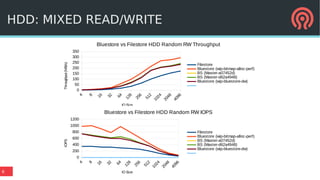
HDD: MIXED READ/WRITE
4 8 16 32 64
128
256
512
1024
2048
4096
0
50
100
150
200
250
300
350
Bluestore vs Filestore HDD Random RW Throughput
Filestore
Bluestore (wip-bitmap-alloc-perf)
BS (Master-a07452d)
BS (Master-d62a4948)
Bluestore (wip-bluestore-dw)
IO Size
Throughput(MB/s)
4 8 16 32 64
128
256
512
1024
2048
4096
0
200
400
600
800
1000
1200
Bluestore vs Filestore HDD Random RW IOPS
Filestore
Bluestore (wip-bitmap-alloc-perf)
BS (Master-a07452d)
BS (Master-d62a4948)
Bluestore (wip-bluestore-dw)
IO Size
IOPS
7
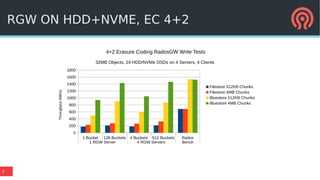
RGW ON HDD+NVME, EC 4+2
1 Bucket 128 Buckets 4 Buckets 512 Buckets Rados
1 RGW Server 4 RGW Servers Bench
0
200
400
600
800
1000
1200
1400
1600
1800
4+2 Erasure Coding RadosGW Write Tests
32MB Objects, 24 HDD/NVMe OSDs on 4 Servers, 4 Clients
Filestore 512KB Chunks
Filestore 4MB Chunks
Bluestore 512KB Chunks
Bluestore 4MB Chunks
Throughput(MB/s)
8
RBD OVER ERASURE CODED POOLS
●
aka erasure code overwrites
●
requires BlueStore to perform reasonably
●
significant improvement in efficiency over 3x replication
– 2+2 → 2x 4+2 → 1.5x
●
small writes slower than replication
– early testing showed 4+2 is about half as fast as 3x replication
●
large writes faster than replication
– less IO to device
●
implementation still does the “simple” thing
– all writes update a full stripe
9
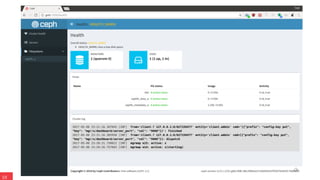
CEPH-MGR
●
ceph-mgr
– new management daemon to supplement ceph-mon (monitor)
– easier integration point for python management logic
– integrated metrics
●
ceph-mon scaling
– offload pg stats from mon to mgr
– validated 10K OSD deployment (“Big Bang III” @ CERN)
●
restful: new REST API
●
prometheus, influx, zabbix
●
dashboard: built-in web dashboard
– webby equivalent of 'ceph -s'
M G
???
(time for new iconography)
10
11
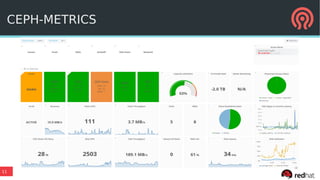
CEPH-METRICS
12
ASYNCMESSENGER
●
new network Messenger implementation
– event driven
– fixed-size thread pool
●
RDMA backend (ibverbs)
– built by default
– limited testing, but seems stable!
●
DPDK backend
– prototype!
13
PERFECTLY BALANCED OSDS (FINALLY!)
●
CRUSH choose_args
– alternate weight sets for individual rules
– fixes two problems
●
imbalance – run numeric optimization to adjust weights to balance PG
distribution for a pool (or cluster)
●
multipick anomaly – adjust weights per position to correct for low-
weighted devices (e.g., mostly empty rack)
– backward compatible ‘compat weight-set’ for imbalance only
●
pg up-map
– explicitly map individual PGs to specific devices in OSDMap
– requires luminous+ clients
●
Automagic, courtesy of ceph-mgr ‘balancer’ module
– ceph balancer mode crush-compat
– ceph balancer on
14
RADOS MISC
●
CRUSH device classes
– mark OSDs with class (hdd, ssd, etc)
– out-of-box rules to map to specific class of devices within the
same hierarchy
●
streamlined disk replacement
●
require_min_compat_client – simpler, safer configuration
●
annotated/documented config options
●
client backoff on stuck PGs or objects
●
better EIO handling
●
peering and recovery speedups
●
fast OSD failure detection
15
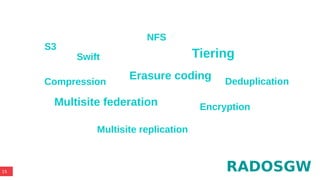
S3
Swift
Erasure coding
Multisite federation
Multisite replication
NFS
Encryption
Tiering
Deduplication
RADOSGW
Compression
16
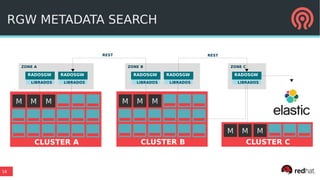
ZONE CZONE B
RGW METADATA SEARCH
RADOSGW
LIBRADOS
M
CLUSTER A
MM M
CLUSTER B
MM
RADOSGW RADOSGW RADOSGW
LIBRADOS LIBRADOS LIBRADOS
REST
RADOSGW
LIBRADOS
M
CLUSTER C
MM
REST
ZONE A
17
RGW MISC
●
NFS gateway
– NFSv4 and v3
– full object access (not general purpose!)
●
dynamic bucket index sharding
– automatic (finally!)
●
inline compression
●
encryption
– follows S3 encryption APIs
●
S3 and Swift API odds and ends
RADOSGW
LIBRADOS
18
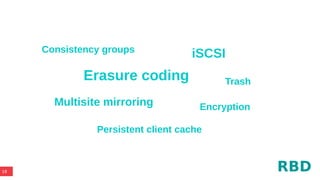
Erasure coding
Multisite mirroring
Persistent client cache
Consistency groups
Encryption
iSCSI
Trash
RBD
19
RBD
●
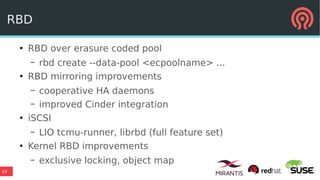
RBD over erasure coded pool
– rbd create --data-pool <ecpoolname> ...
●
RBD mirroring improvements
– cooperative HA daemons
– improved Cinder integration
●
iSCSI
– LIO tcmu-runner, librbd (full feature set)
●
Kernel RBD improvements
– exclusive locking, object map
20
CEPHFS
●
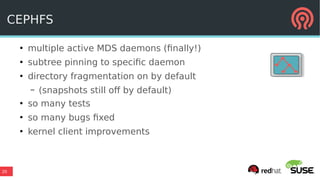
multiple active MDS daemons (finally!)
●
subtree pinning to specific daemon
●
directory fragmentation on by default
– (snapshots still off by default)
●
so many tests
●
so many bugs fixed
●
kernel client improvements
21 MIMIC
22
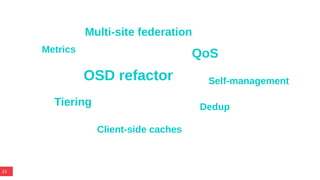
OSD refactor
Tiering
Client-side caches
Metrics
Dedup
QoS
Self-management
Multi-site federation
23
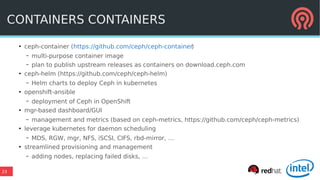
CONTAINERS CONTAINERS
●
ceph-container (https://github.com/ceph/ceph-container)
– multi-purpose container image
– plan to publish upstream releases as containers on download.ceph.com
●
ceph-helm (https://github.com/ceph/ceph-helm)
– Helm charts to deploy Ceph in kubernetes
●
openshift-ansible
– deployment of Ceph in OpenShift
●
mgr-based dashboard/GUI
– management and metrics (based on ceph-metrics, https://github.com/ceph/ceph-metrics)
●
leverage kubernetes for daemon scheduling
– MDS, RGW, mgr, NFS, iSCSI, CIFS, rbd-mirror, …
●
streamlined provisioning and management
– adding nodes, replacing failed disks, …
24
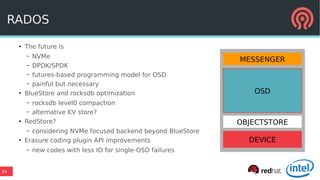
RADOS
●
The future is
– NVMe
– DPDK/SPDK
– futures-based programming model for OSD
– painful but necessary
●
BlueStore and rocksdb optimization
– rocksdb level0 compaction
– alternative KV store?
●
RedStore?
– considering NVMe focused backend beyond BlueStore
●
Erasure coding plugin API improvements
– new codes with less IO for single-OSD failures
DEVICE
OSD
OBJECTSTORE
MESSENGER
25
EASE OF USE ODDS AND ENDS
●
centralized config management
– all config on mons – no more ceph.conf
– ceph config …
●
PG autoscaling
– less reliance on operator to pick right
values
●
progress bars
– recovery, rebalancing, etc.
●
async recovery
– fewer high-latency outliers during recovery
26
QUALITY OF SERVICE
●
Ongoing background development
– dmclock distributed QoS queuing
– minimum reservations and priority weighting
●
Range of policies
– IO type (background, client)
– pool-based
– client-based
●
Theory is complex
●
Prototype is promising, despite simplicity
●
Basics will land in Mimic
27
28
CEPH STORAGE CLUSTER
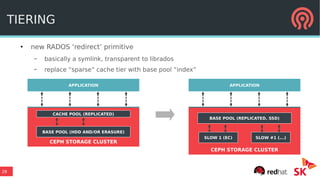
TIERING
●
new RADOS ‘redirect’ primitive
– basically a symlink, transparent to librados
– replace “sparse” cache tier with base pool “index”
APPLICATION
BASE POOL (REPLICATED, SSD)
APPLICATION
CACHE POOL (REPLICATED)
BASE POOL (HDD AND/OR ERASURE)
CEPH STORAGE CLUSTER
SLOW 1 (EC) SLOW #1 (...)
29
CEPH STORAGE CLUSTER
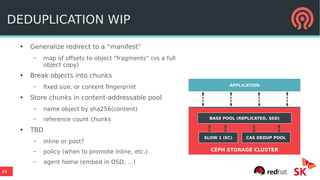
DEDUPLICATION WIP
●
Generalize redirect to a “manifest”
– map of offsets to object “fragments” (vs a full
object copy)
●
Break objects into chunks
– fixed size, or content fingerprint
●
Store chunks in content-addressable pool
– name object by sha256(content)
– reference count chunks
●
TBD
– inline or post?
– policy (when to promote inline, etc.)
– agent home (embed in OSD, …)
APPLICATION
BASE POOL (REPLICATED, SSD)
SLOW 1 (EC) CAS DEDUP POOL
30
CephFS
●
Integrated NFS gateway management
– HA nfs-ganesha service
– API configurable, integrated with Manila
●
snapshots!
●
quota for kernel client
31
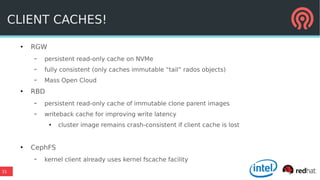
CLIENT CACHES!
●
RGW
– persistent read-only cache on NVMe
– fully consistent (only caches immutable “tail” rados objects)
– Mass Open Cloud
●
RBD
– persistent read-only cache of immutable clone parent images
– writeback cache for improving write latency
●
cluster image remains crash-consistent if client cache is lost
●
CephFS
– kernel client already uses kernel fscache facility
32
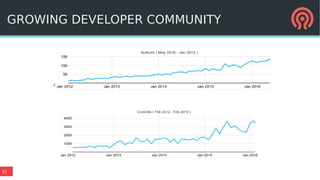
GROWING DEVELOPER COMMUNITY
33
●
Red Hat
●
Mirantis
●
SUSE
●
ZTE
●
China Mobile
●
XSky
●
Digiware
●
Intel
●
Kylin Cloud
●
Easystack
●
Istuary Innovation Group
●
Quantum
●
Mellanox
●
H3C
●
Quantum
●
UnitedStack
●
Deutsche Telekom
●
Reliance Jio Infocomm
●
OVH
●
Alibaba
●
DreamHost
●
CERN
GROWING DEVELOPER COMMUNITY
34
●
Red Hat
●
Mirantis
●
SUSE
●
ZTE
●
China Mobile
●
XSky
●
Digiware
●
Intel
●
Kylin Cloud
●
Easystack
●
Istuary Innovation Group
●
Quantum
●
Mellanox
●
H3C
●
Quantum
●
UnitedStack
●
Deutsche Telekom
●
Reliance Jio Infocomm
●
OVH
●
Alibaba
●
DreamHost
●
CERN
OPENSTACK VENDORS
35
●
Red Hat
●
Mirantis
●
SUSE
●
ZTE
●
China Mobile
●
XSky
●
Digiware
●
Intel
●
Kylin Cloud
●
Easystack
●
Istuary Innovation Group
●
Quantum
●
Mellanox
●
H3C
●
Quantum
●
UnitedStack
●
Deutsche Telekom
●
Reliance Jio Infocomm
●
OVH
●
Alibaba
●
DreamHost
●
CERN
CLOUD OPERATORS
36
●
Red Hat
●
Mirantis
●
SUSE
●
ZTE
●
China Mobile
●
XSky
●
Digiware
●
Intel
●
Kylin Cloud
●
Easystack
●
Istuary Innovation Group
●
Quantum
●
Mellanox
●
H3C
●
Quantum
●
UnitedStack
●
Deutsche Telekom
●
Reliance Jio Infocomm
●
OVH
●
Alibaba
●
DreamHost
●
CERN
HARDWARE AND SOLUTION VENDORS
37
●
Red Hat
●
Mirantis
●
SUSE
●
ZTE
●
China Mobile
●
XSky
●
Digiware
●
Intel
●
Kylin Cloud
●
Easystack
●
Istuary Innovation Group
●
Quantum
●
Mellanox
●
H3C
●
Quantum
●
UnitedStack
●
Deutsche Telekom
●
Reliance Jio Infocomm
●
OVH
●
Alibaba
●
DreamHost
●
CERN
???
38
●
Mailing list and IRC
– http://ceph.com/IRC
●
Ceph Developer Monthly
– first Weds of every month
– video conference (Bluejeans)
– alternating APAC- and EMEA-
friendly times
●
Github
– https://github.com/ceph/
●
Ceph Days
– http://ceph.com/cephdays/
●
Meetups
– http://ceph.com/meetups
●
Ceph Tech Talks
– http://ceph.com/ceph-tech-talks/
●
‘Ceph’ Youtube channel
– (google it)
●
Twitter
– @ceph
GET INVOLVED
CEPHALOCON APAC
2018.03.22 and 23
BEIJING, CHINA
THANK YOU!
Sage Weil
CEPH ARCHITECT
sage@redhat.com
@liewegas

What's new in Luminous and Beyond

  • 1.
    WHAT’S NEW INLUMINOUS AND BEYOND SAGE WEIL – RED HAT 2017.11.06
  • 2.
    2 UPSTREAM RELEASES Jewel (LTS) Spring2016 Kraken Fall 2016 Luminous Summer 2017 12.2.z 10.2.z 14.2.z WE ARE HERE Mimic Spring 2018 Nautilus Winter 2019 13.2.z ● New release cadence ● Named release every 9 months ● Backports for 2 releases ● Upgrade up to 2 releases at a time (e.g., Luminous → Nautilus)
  • 3.
  • 4.
    4 BLUESTORE: STABLE ANDDEFAULT ● New OSD backend – consumes raw block device(s) – no more XFS – embeds rocksdb for metadata ● Fast on both HDDs (~2x) and SSDs (~1.5x) – Similar to FileStore on NVMe, where the device is not the bottleneck ● Smaller journals – happily uses fast SSD partition(s) for internal metadata, or NVRAM for journal ● Full data checksums (crc32c, xxhash, etc.) ● Inline compression (zlib, snappy) – policy driven by global or per-pool config, and/or client hints ● Stable and default
  • 5.
    5 HDD: RANDOM WRITE 48 16 32 64 128 256 512 1024 2048 4096 0 50 100 150 200 250 300 350 400 450 Bluestore vs Filestore HDD Random Write Throughput Filestore Bluestore (wip-bitmap-alloc-perf) BS (Master-a07452d) BS (Master-d62a4948) Bluestore (wip-bluestore-dw) IO Size Throughput(MB/s) 4 8 16 32 64 128 256 512 1024 2048 4096 0 200 400 600 800 1000 1200 1400 1600 1800 2000 Bluestore vs Filestore HDD Random Write IOPS Filestore Bluestore (wip-bitmap-alloc-perf) BS (Master-a07452d) BS (Master-d62a4948) Bluestore (wip-bluestore-dw) IO Size IOPS
  • 6.
    6 HDD: MIXED READ/WRITE 48 16 32 64 128 256 512 1024 2048 4096 0 50 100 150 200 250 300 350 Bluestore vs Filestore HDD Random RW Throughput Filestore Bluestore (wip-bitmap-alloc-perf) BS (Master-a07452d) BS (Master-d62a4948) Bluestore (wip-bluestore-dw) IO Size Throughput(MB/s) 4 8 16 32 64 128 256 512 1024 2048 4096 0 200 400 600 800 1000 1200 Bluestore vs Filestore HDD Random RW IOPS Filestore Bluestore (wip-bitmap-alloc-perf) BS (Master-a07452d) BS (Master-d62a4948) Bluestore (wip-bluestore-dw) IO Size IOPS
  • 7.
    7 RGW ON HDD+NVME,EC 4+2 1 Bucket 128 Buckets 4 Buckets 512 Buckets Rados 1 RGW Server 4 RGW Servers Bench 0 200 400 600 800 1000 1200 1400 1600 1800 4+2 Erasure Coding RadosGW Write Tests 32MB Objects, 24 HDD/NVMe OSDs on 4 Servers, 4 Clients Filestore 512KB Chunks Filestore 4MB Chunks Bluestore 512KB Chunks Bluestore 4MB Chunks Throughput(MB/s)
  • 8.
    8 RBD OVER ERASURECODED POOLS ● aka erasure code overwrites ● requires BlueStore to perform reasonably ● significant improvement in efficiency over 3x replication – 2+2 → 2x 4+2 → 1.5x ● small writes slower than replication – early testing showed 4+2 is about half as fast as 3x replication ● large writes faster than replication – less IO to device ● implementation still does the “simple” thing – all writes update a full stripe
  • 9.
    9 CEPH-MGR ● ceph-mgr – new managementdaemon to supplement ceph-mon (monitor) – easier integration point for python management logic – integrated metrics ● ceph-mon scaling – offload pg stats from mon to mgr – validated 10K OSD deployment (“Big Bang III” @ CERN) ● restful: new REST API ● prometheus, influx, zabbix ● dashboard: built-in web dashboard – webby equivalent of 'ceph -s' M G ??? (time for new iconography)
  • 10.
  • 11.
  • 12.
    12 ASYNCMESSENGER ● new network Messengerimplementation – event driven – fixed-size thread pool ● RDMA backend (ibverbs) – built by default – limited testing, but seems stable! ● DPDK backend – prototype!
  • 13.
    13 PERFECTLY BALANCED OSDS(FINALLY!) ● CRUSH choose_args – alternate weight sets for individual rules – fixes two problems ● imbalance – run numeric optimization to adjust weights to balance PG distribution for a pool (or cluster) ● multipick anomaly – adjust weights per position to correct for low- weighted devices (e.g., mostly empty rack) – backward compatible ‘compat weight-set’ for imbalance only ● pg up-map – explicitly map individual PGs to specific devices in OSDMap – requires luminous+ clients ● Automagic, courtesy of ceph-mgr ‘balancer’ module – ceph balancer mode crush-compat – ceph balancer on
  • 14.
    14 RADOS MISC ● CRUSH deviceclasses – mark OSDs with class (hdd, ssd, etc) – out-of-box rules to map to specific class of devices within the same hierarchy ● streamlined disk replacement ● require_min_compat_client – simpler, safer configuration ● annotated/documented config options ● client backoff on stuck PGs or objects ● better EIO handling ● peering and recovery speedups ● fast OSD failure detection
  • 15.
    15 S3 Swift Erasure coding Multisite federation Multisitereplication NFS Encryption Tiering Deduplication RADOSGW Compression
  • 16.
    16 ZONE CZONE B RGWMETADATA SEARCH RADOSGW LIBRADOS M CLUSTER A MM M CLUSTER B MM RADOSGW RADOSGW RADOSGW LIBRADOS LIBRADOS LIBRADOS REST RADOSGW LIBRADOS M CLUSTER C MM REST ZONE A
  • 17.
    17 RGW MISC ● NFS gateway –NFSv4 and v3 – full object access (not general purpose!) ● dynamic bucket index sharding – automatic (finally!) ● inline compression ● encryption – follows S3 encryption APIs ● S3 and Swift API odds and ends RADOSGW LIBRADOS
  • 18.
    18 Erasure coding Multisite mirroring Persistentclient cache Consistency groups Encryption iSCSI Trash RBD
  • 19.
    19 RBD ● RBD over erasurecoded pool – rbd create --data-pool <ecpoolname> ... ● RBD mirroring improvements – cooperative HA daemons – improved Cinder integration ● iSCSI – LIO tcmu-runner, librbd (full feature set) ● Kernel RBD improvements – exclusive locking, object map
  • 20.
    20 CEPHFS ● multiple active MDSdaemons (finally!) ● subtree pinning to specific daemon ● directory fragmentation on by default – (snapshots still off by default) ● so many tests ● so many bugs fixed ● kernel client improvements
  • 21.
  • 22.
  • 23.
    23 CONTAINERS CONTAINERS ● ceph-container (https://github.com/ceph/ceph-container) –multi-purpose container image – plan to publish upstream releases as containers on download.ceph.com ● ceph-helm (https://github.com/ceph/ceph-helm) – Helm charts to deploy Ceph in kubernetes ● openshift-ansible – deployment of Ceph in OpenShift ● mgr-based dashboard/GUI – management and metrics (based on ceph-metrics, https://github.com/ceph/ceph-metrics) ● leverage kubernetes for daemon scheduling – MDS, RGW, mgr, NFS, iSCSI, CIFS, rbd-mirror, … ● streamlined provisioning and management – adding nodes, replacing failed disks, …
  • 24.
    24 RADOS ● The future is –NVMe – DPDK/SPDK – futures-based programming model for OSD – painful but necessary ● BlueStore and rocksdb optimization – rocksdb level0 compaction – alternative KV store? ● RedStore? – considering NVMe focused backend beyond BlueStore ● Erasure coding plugin API improvements – new codes with less IO for single-OSD failures DEVICE OSD OBJECTSTORE MESSENGER
  • 25.
    25 EASE OF USEODDS AND ENDS ● centralized config management – all config on mons – no more ceph.conf – ceph config … ● PG autoscaling – less reliance on operator to pick right values ● progress bars – recovery, rebalancing, etc. ● async recovery – fewer high-latency outliers during recovery
  • 26.
    26 QUALITY OF SERVICE ● Ongoingbackground development – dmclock distributed QoS queuing – minimum reservations and priority weighting ● Range of policies – IO type (background, client) – pool-based – client-based ● Theory is complex ● Prototype is promising, despite simplicity ● Basics will land in Mimic
  • 27.
  • 28.
    28 CEPH STORAGE CLUSTER TIERING ● newRADOS ‘redirect’ primitive – basically a symlink, transparent to librados – replace “sparse” cache tier with base pool “index” APPLICATION BASE POOL (REPLICATED, SSD) APPLICATION CACHE POOL (REPLICATED) BASE POOL (HDD AND/OR ERASURE) CEPH STORAGE CLUSTER SLOW 1 (EC) SLOW #1 (...)
  • 29.
    29 CEPH STORAGE CLUSTER DEDUPLICATIONWIP ● Generalize redirect to a “manifest” – map of offsets to object “fragments” (vs a full object copy) ● Break objects into chunks – fixed size, or content fingerprint ● Store chunks in content-addressable pool – name object by sha256(content) – reference count chunks ● TBD – inline or post? – policy (when to promote inline, etc.) – agent home (embed in OSD, …) APPLICATION BASE POOL (REPLICATED, SSD) SLOW 1 (EC) CAS DEDUP POOL
  • 30.
    30 CephFS ● Integrated NFS gatewaymanagement – HA nfs-ganesha service – API configurable, integrated with Manila ● snapshots! ● quota for kernel client
  • 31.
    31 CLIENT CACHES! ● RGW – persistentread-only cache on NVMe – fully consistent (only caches immutable “tail” rados objects) – Mass Open Cloud ● RBD – persistent read-only cache of immutable clone parent images – writeback cache for improving write latency ● cluster image remains crash-consistent if client cache is lost ● CephFS – kernel client already uses kernel fscache facility
  • 32.
  • 33.
    33 ● Red Hat ● Mirantis ● SUSE ● ZTE ● China Mobile ● XSky ● Digiware ● Intel ● KylinCloud ● Easystack ● Istuary Innovation Group ● Quantum ● Mellanox ● H3C ● Quantum ● UnitedStack ● Deutsche Telekom ● Reliance Jio Infocomm ● OVH ● Alibaba ● DreamHost ● CERN GROWING DEVELOPER COMMUNITY
  • 34.
    34 ● Red Hat ● Mirantis ● SUSE ● ZTE ● China Mobile ● XSky ● Digiware ● Intel ● KylinCloud ● Easystack ● Istuary Innovation Group ● Quantum ● Mellanox ● H3C ● Quantum ● UnitedStack ● Deutsche Telekom ● Reliance Jio Infocomm ● OVH ● Alibaba ● DreamHost ● CERN OPENSTACK VENDORS
  • 35.
    35 ● Red Hat ● Mirantis ● SUSE ● ZTE ● China Mobile ● XSky ● Digiware ● Intel ● KylinCloud ● Easystack ● Istuary Innovation Group ● Quantum ● Mellanox ● H3C ● Quantum ● UnitedStack ● Deutsche Telekom ● Reliance Jio Infocomm ● OVH ● Alibaba ● DreamHost ● CERN CLOUD OPERATORS
  • 36.
    36 ● Red Hat ● Mirantis ● SUSE ● ZTE ● China Mobile ● XSky ● Digiware ● Intel ● KylinCloud ● Easystack ● Istuary Innovation Group ● Quantum ● Mellanox ● H3C ● Quantum ● UnitedStack ● Deutsche Telekom ● Reliance Jio Infocomm ● OVH ● Alibaba ● DreamHost ● CERN HARDWARE AND SOLUTION VENDORS
  • 37.
    37 ● Red Hat ● Mirantis ● SUSE ● ZTE ● China Mobile ● XSky ● Digiware ● Intel ● KylinCloud ● Easystack ● Istuary Innovation Group ● Quantum ● Mellanox ● H3C ● Quantum ● UnitedStack ● Deutsche Telekom ● Reliance Jio Infocomm ● OVH ● Alibaba ● DreamHost ● CERN ???
  • 38.
    38 ● Mailing list andIRC – http://ceph.com/IRC ● Ceph Developer Monthly – first Weds of every month – video conference (Bluejeans) – alternating APAC- and EMEA- friendly times ● Github – https://github.com/ceph/ ● Ceph Days – http://ceph.com/cephdays/ ● Meetups – http://ceph.com/meetups ● Ceph Tech Talks – http://ceph.com/ceph-tech-talks/ ● ‘Ceph’ Youtube channel – (google it) ● Twitter – @ceph GET INVOLVED
  • 39.
  • 40.
    THANK YOU! Sage Weil CEPHARCHITECT sage@redhat.com @liewegas