OUR VISION FOR OPEN UNIFIED CLOUD STORAGE
SAGE WEIL – RED HAT
OPENSTACK SUMMIT BARCELONA – 2016.10.27
2
● Now
– why we develop ceph
– why it's open
– why it's unified
– hardware
– openstack
– why not ceph
● Later
– roadmap highlights
– the road ahead
– community
OUTLINE
3
JEWEL
4
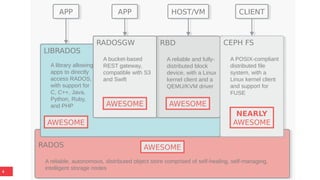
RADOS
A reliable, autonomous, distributed object store comprised of self-healing, self-managing,
intelligent storage nodes
RADOS
A reliable, autonomous, distributed object store comprised of self-healing, self-managing,
intelligent storage nodes
LIBRADOS
A library allowing
apps to directly
access RADOS,
with support for
C, C++, Java,
Python, Ruby,
and PHP
LIBRADOS
A library allowing
apps to directly
access RADOS,
with support for
C, C++, Java,
Python, Ruby,
and PHP
RBD
A reliable and fully-
distributed block
device, with a Linux
kernel client and a
QEMU/KVM driver
RBD
A reliable and fully-
distributed block
device, with a Linux
kernel client and a
QEMU/KVM driver
RADOSGW
A bucket-based
REST gateway,
compatible with S3
and Swift
RADOSGW
A bucket-based
REST gateway,
compatible with S3
and Swift
APPAPP APPAPP HOST/VMHOST/VM CLIENTCLIENT
CEPH FS
A POSIX-compliant
distributed file
system, with a
Linux kernel client
and support for
FUSE
CEPH FS
A POSIX-compliant
distributed file
system, with a
Linux kernel client
and support for
FUSE
NEARLY
AWESOME
AWESOMEAWESOME
AWESOME
AWESOME
5
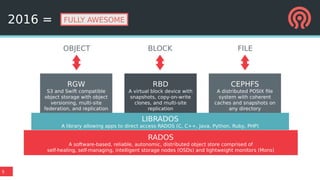
2016 =
RGW
S3 and Swift compatible
object storage with object
versioning, multi-site
federation, and replication
LIBRADOS
A library allowing apps to direct access RADOS (C, C++, Java, Python, Ruby, PHP)
RADOS
A software-based, reliable, autonomic, distributed object store comprised of
self-healing, self-managing, intelligent storage nodes (OSDs) and lightweight monitors (Mons)
RBD
A virtual block device with
snapshots, copy-on-write
clones, and multi-site
replication
CEPHFS
A distributed POSIX file
system with coherent
caches and snapshots on
any directory
OBJECT BLOCK FILE
FULLY AWESOME
6
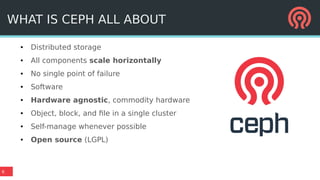
WHAT IS CEPH ALL ABOUT
● Distributed storage
● All components scale horizontally
● No single point of failure
● Software
● Hardware agnostic, commodity hardware
● Object, block, and file in a single cluster
● Self-manage whenever possible
● Open source (LGPL)
7
WHY OPEN SOURCE
● Avoid software vendor lock-in
● Avoid hardware lock-in
– and enable hybrid deployments
● Lower total cost of ownership
● Transparency
● Self-support
● Add, improve, or extend
8
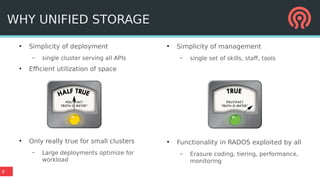
WHY UNIFIED STORAGE
●
Simplicity of deployment
– single cluster serving all APIs
●
Efficient utilization of storage
●
Simplicity of management
– single set of management skills, staff, tools
...is that really true?
9
WHY UNIFIED STORAGE
●
Simplicity of deployment
– single cluster serving all APIs
●
Efficient utilization of space
●
Only really true for small clusters
– Large deployments optimize for
workload
●
Simplicity of management
– single set of skills, staff, tools
●
Functionality in RADOS exploited by all
– Erasure coding, tiering, performance,
monitoring
10
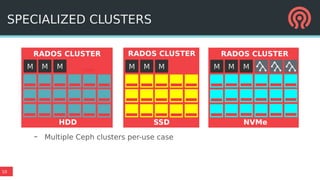
SPECIALIZED CLUSTERS
SSD
M M M
RADOS CLUSTER
NVMeSSDHDD
– Multiple Ceph clusters per-use case
RADOS CLUSTERRADOS CLUSTER
MM M M MM
11
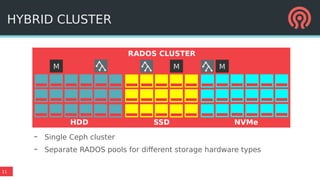
HYBRID CLUSTER
SSD
M M M
RADOS CLUSTER
NVMeSSDHDD
– Single Ceph cluster
– Separate RADOS pools for different storage hardware types
12
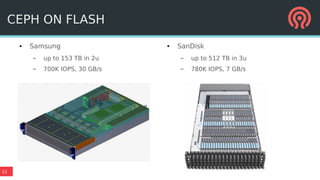
CEPH ON FLASH
● Samsung
– up to 153 TB in 2u
– 700K IOPS, 30 GB/s
● SanDisk
– up to 512 TB in 3u
– 780K IOPS, 7 GB/s
13
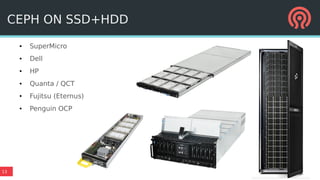
CEPH ON SSD+HDD
● SuperMicro
● Dell
● HP
● Quanta / QCT
● Fujitsu (Eternus)
● Penguin OCP
14
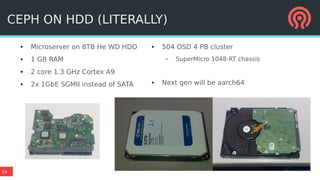
● Microserver on 8TB He WD HDD
● 1 GB RAM
● 2 core 1.3 GHz Cortex A9
● 2x 1GbE SGMII instead of SATA
● 504 OSD 4 PB cluster
– SuperMicro 1048-RT chassis
● Next gen will be aarch64
CEPH ON HDD (LITERALLY)
15
FOSS → FAST AND OPEN INNOVATION
● Free and open source software (FOSS)
– enables innovation in software
– ideal testbed for new hardware architectures
● Proprietary software platforms are full of friction
– harder to modify, experiment with closed-source code
– require business partnerships and NDAs to be negotiated
– dual investment (of time and/or $$$) from both parties
16
PERSISTENT MEMORY
● Persistent (non-volatile) RAM is coming
– e.g., 3D X-Point from Intel/Micron any year now
– (and NV-DIMMs are a bit $$$ but already here)
● These are going to be
– fast (~1000x), dense (~10x), high-endurance (~1000x)
– expensive (~1/2 the cost of DRAM)
– disruptive
● Intel
– PMStore – OSD prototype backend targetting 3D-Xpoint
– NVM-L (pmem.io/nvml)
17
CREATE THE ECOSYSTEM
TO BECOME THE LINUX
OF DISTRIBUTED STORAGE
OPEN COLLABORATIVE GENERAL PURPOSE
18
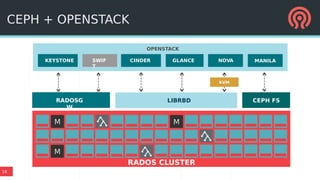
KEYSTONE SWIF
T
CINDER NOVAGLANCE
LIBRBD
OPENSTACK
CEPH FS
M M
M
RADOS CLUSTER
KVM
CEPH + OPENSTACK
MANILA
RADOSG
W
19
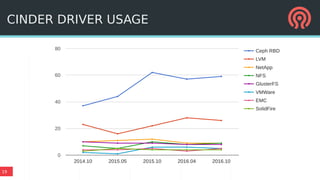
CINDER DRIVER USAGE
20
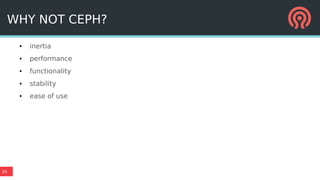
WHY NOT CEPH?
● inertia
● performance
● functionality
● stability
● ease of use
21
WHAT ARE WE DOING ABOUT IT?
22
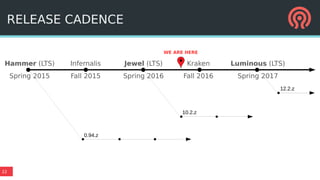
Hammer (LTS)
Spring 2015
Jewel (LTS)
Spring 2016
Infernalis
Fall 2015
Kraken
Fall 2016
Luminous (LTS)
Spring 2017
WE ARE HERE
RELEASE CADENCERELEASE CADENCE
10.2.z
12.2.z
0.94.z
23 KRAKEN
24
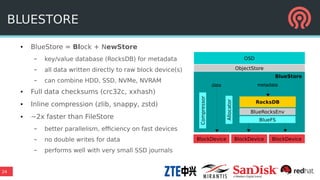
● BlueStore = Block + NewStore
– key/value database (RocksDB) for metadata
– all data written directly to raw block device(s)
– can combine HDD, SSD, NVMe, NVRAM
● Full data checksums (crc32c, xxhash)
● Inline compression (zlib, snappy, zstd)
● ~2x faster than FileStore
– better parallelism, efficiency on fast devices
– no double writes for data
– performs well with very small SSD journals
BLUESTORE
BlueStore
BlueFS
RocksDB
BlockDeviceBlockDeviceBlockDevice
BlueRocksEnv
data metadata
Allocator
ObjectStore
Compressor
OSD
25
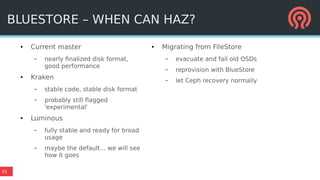
● Current master
– nearly finalized disk format,
good performance
● Kraken
– stable code, stable disk format
– probably still flagged
'experimental'
● Luminous
– fully stable and ready for broad
usage
– maybe the default... we will see
how it goes
BLUESTORE – WHEN CAN HAZ?
● Migrating from FileStore
– evacuate and fail old OSDs
– reprovision with BlueStore
– let Ceph recovery normally
26
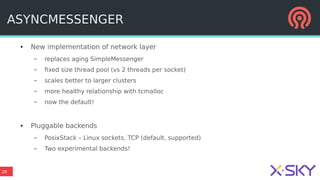
● New implementation of network layer
– replaces aging SimpleMessenger
– fixed size thread pool (vs 2 threads per socket)
– scales better to larger clusters
– more healthy relationship with tcmalloc
– now the default!
● Pluggable backends
– PosixStack – Linux sockets, TCP (default, supported)
– Two experimental backends!
ASYNCMESSENGER
27
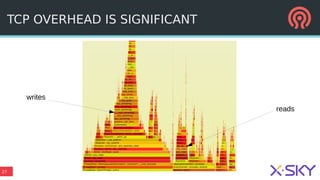
TCP OVERHEAD IS SIGNIFICANT
writes
reads
28
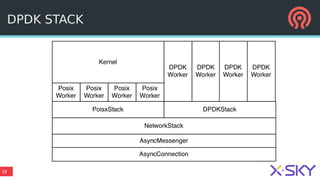
DPDK STACK
29
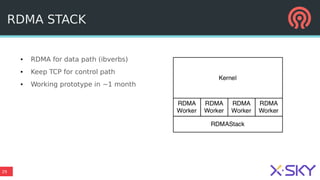
RDMA STACK
● RDMA for data path (ibverbs)
● Keep TCP for control path
● Working prototype in ~1 month
30 LUMINOUS
31
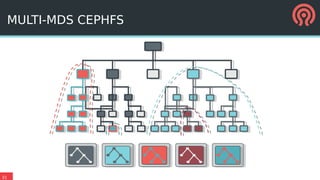
MULTI-MDS CEPHFS
32
ERASURE CODE OVERWRITES
● Current EC RADOS pools are append only
– simple, stable suitable for RGW, or behind a cache tier
● EC overwrites will allow RBD and CephFS to consume EC pools directly
● It's hard
– implementation requires two-phase commit
– complex to avoid full-stripe update for small writes
– relies on efficient implementation of “move ranges” operation by BlueStore
● It will be huge
– tremendous impact on TCO
– make RBD great again
33
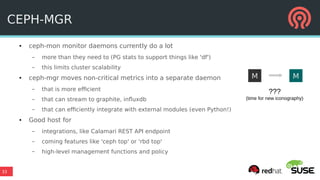
CEPH-MGR
● ceph-mon monitor daemons currently do a lot
– more than they need to (PG stats to support things like 'df')
– this limits cluster scalability
● ceph-mgr moves non-critical metrics into a separate daemon
– that is more efficient
– that can stream to graphite, influxdb
– that can efficiently integrate with external modules (even Python!)
● Good host for
– integrations, like Calamari REST API endpoint
– coming features like 'ceph top' or 'rbd top'
– high-level management functions and policy
M M
???
(time for new iconography)
34
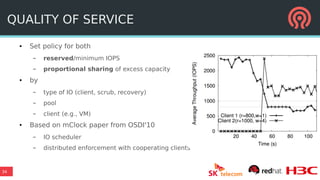
QUALITY OF SERVICE
● Set policy for both
– reserved/minimum IOPS
– proportional sharing of excess capacity
● by
– type of IO (client, scrub, recovery)
– pool
– client (e.g., VM)
● Based on mClock paper from OSDI'10
– IO scheduler
– distributed enforcement with cooperating clients
35
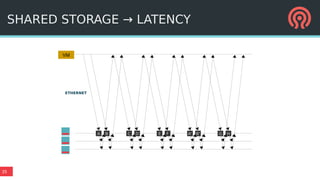
A B C D E F A' B' G H
VM
SHARED STORAGE → LATENCY
ETHERNET
36
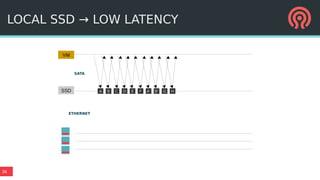
VM
LOCAL SSD → LOW LATENCY
A B C D E F A' B' G HSSD
SATA
ETHERNET
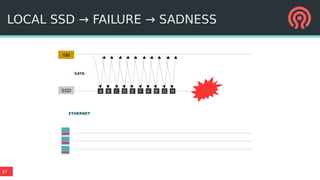
37
VM
LOCAL SSD → FAILURE → SADNESS
A B C D E F A' B' G HSSD
SATA
ETHERNET
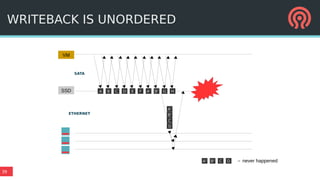
38
VM
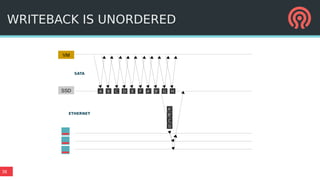
WRITEBACK IS UNORDERED
A B C D E F A' B' G HSSD
SATA
ETHERNET
A'
B'
C
D
39
VM
WRITEBACK IS UNORDERED
A B C D E F A' B' G HSSD
SATA
ETHERNET
A'
B'
C
D
A' B' C D → never happened
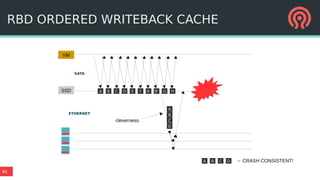
40
VM
RBD ORDERED WRITEBACK CACHE
A B C D E F A' B' G HSSD
SATA
ETHERNET
A B C D → CRASH CONSISTENT!
A
B
C
D
cleverness
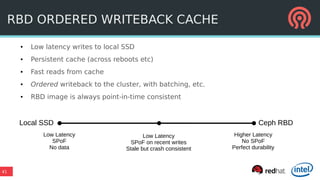
41
● Low latency writes to local SSD
● Persistent cache (across reboots etc)
● Fast reads from cache
● Ordered writeback to the cluster, with batching, etc.
● RBD image is always point-in-time consistent
RBD ORDERED WRITEBACK CACHE
Low Latency
SPoF
No data
Local SSD Ceph RBD
Higher Latency
No SPoF
Perfect durability
Low Latency
SPoF on recent writes
Stale but crash consistent
42
IN THE FUTURE
MOST BYTES WILL BE STORED
IN OBJECTS
43
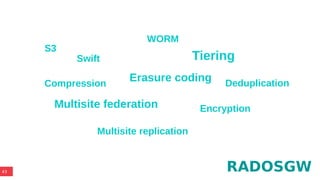
S3
Swift
Erasure coding
Multisite federation
Multisite replication
WORM
Encryption
Tiering
Deduplication
RADOSGW
Compression
44
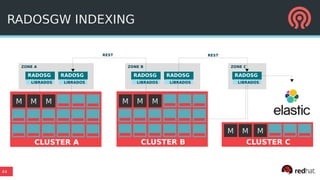
ZONE CZONE B
RADOSGW INDEXING
RADOSG
WLIBRADOS
M
CLUSTER A
MM M
CLUSTER B
MM
RADOSG
W
RADOSG
W
RADOSG
WLIBRADOS LIBRADOS LIBRADOS
REST
RADOSG
WLIBRADOS
M
CLUSTER C
MM
REST
ZONE A
45
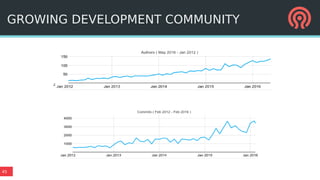
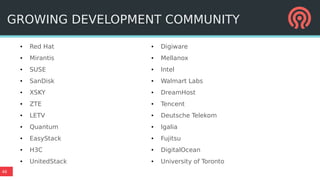
GROWING DEVELOPMENT COMMUNITY
46
● Red Hat
● Mirantis
● SUSE
● SanDisk
● XSKY
● ZTE
● LETV
● Quantum
● EasyStack
● H3C
● UnitedStack
● Digiware
● Mellanox
● Intel
● Walmart Labs
● DreamHost
● Tencent
● Deutsche Telekom
● Igalia
● Fujitsu
● DigitalOcean
● University of Toronto
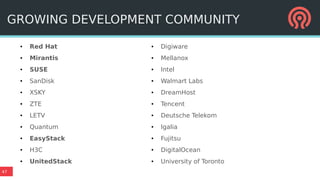
GROWING DEVELOPMENT COMMUNITY
47
● Red Hat
● Mirantis
● SUSE
● SanDisk
● XSKY
● ZTE
● LETV
● Quantum
● EasyStack
● H3C
● UnitedStack
● Digiware
● Mellanox
● Intel
● Walmart Labs
● DreamHost
● Tencent
● Deutsche Telekom
● Igalia
● Fujitsu
● DigitalOcean
● University of Toronto
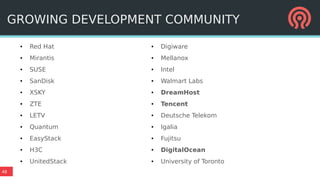
GROWING DEVELOPMENT COMMUNITY
48
● Red Hat
● Mirantis
● SUSE
● SanDisk
● XSKY
● ZTE
● LETV
● Quantum
● EasyStack
● H3C
● UnitedStack
● Digiware
● Mellanox
● Intel
● Walmart Labs
● DreamHost
● Tencent
● Deutsche Telekom
● Igalia
● Fujitsu
● DigitalOcean
● University of Toronto
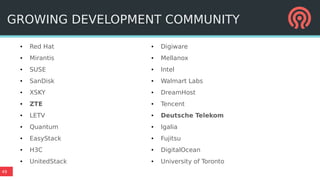
GROWING DEVELOPMENT COMMUNITY
49
● Red Hat
● Mirantis
● SUSE
● SanDisk
● XSKY
● ZTE
● LETV
● Quantum
● EasyStack
● H3C
● UnitedStack
● Digiware
● Mellanox
● Intel
● Walmart Labs
● DreamHost
● Tencent
● Deutsche Telekom
● Igalia
● Fujitsu
● DigitalOcean
● University of Toronto
GROWING DEVELOPMENT COMMUNITY
50
● Red Hat
● Mirantis
● SUSE
● SanDisk
● XSKY
● ZTE
● LETV
● Quantum
● EasyStack
● H3C
● UnitedStack
● Digiware
● Mellanox
● Intel
● Walmart Labs
● DreamHost
● Tencent
● Deutsche Telekom
● Igalia
● Fujitsu
● DigitalOcean
● University of Toronto
GROWING DEVELOPMENT COMMUNITY
51
● Red Hat
● Mirantis
● SUSE
● SanDisk
● XSKY
● ZTE
● LETV
● Quantum
● EasyStack
● H3C
● UnitedStack
● Digiware
● Mellanox
● Intel
● Walmart Labs
● DreamHost
● Tencent
● Deutsche Telekom
● Igalia
● Fujitsu
● DigitalOcean
● University of Toronto
GROWING DEVELOPMENT COMMUNITY
52
● Nobody should have to use proprietary storage systems out of necessity
● The best storage solution should be an open source solution
● Ceph is growing up, but we're not done yet
– performance, scalability, features, ease of use
● We are highly motivated
TAKEAWAYS
53
Operator
● File bugs
http://tracker.ceph.com/
● Document
http://github.com/ceph/ceph
● Blog
● Build a relationship with the core
team
Developer
● Fix bugs
● Help design missing functionality
● Implement missing functionality
● Integrate
● Help make it easier to use
● Participate in monthly Ceph
Developer Meetings
– video chat, EMEA- and APAC-
friendly times
HOW TO HELP
THANK YOU!
Sage Weil
CEPH PRINCIPAL ARCHITECT
sage@redhat.com
@liewegas

Ceph, Now and Later: Our Plan for Open Unified Cloud Storage

  • 1.
    OUR VISION FOROPEN UNIFIED CLOUD STORAGE SAGE WEIL – RED HAT OPENSTACK SUMMIT BARCELONA – 2016.10.27
  • 2.
    2 ● Now – whywe develop ceph – why it's open – why it's unified – hardware – openstack – why not ceph ● Later – roadmap highlights – the road ahead – community OUTLINE
  • 3.
  • 4.
    4 RADOS A reliable, autonomous,distributed object store comprised of self-healing, self-managing, intelligent storage nodes RADOS A reliable, autonomous, distributed object store comprised of self-healing, self-managing, intelligent storage nodes LIBRADOS A library allowing apps to directly access RADOS, with support for C, C++, Java, Python, Ruby, and PHP LIBRADOS A library allowing apps to directly access RADOS, with support for C, C++, Java, Python, Ruby, and PHP RBD A reliable and fully- distributed block device, with a Linux kernel client and a QEMU/KVM driver RBD A reliable and fully- distributed block device, with a Linux kernel client and a QEMU/KVM driver RADOSGW A bucket-based REST gateway, compatible with S3 and Swift RADOSGW A bucket-based REST gateway, compatible with S3 and Swift APPAPP APPAPP HOST/VMHOST/VM CLIENTCLIENT CEPH FS A POSIX-compliant distributed file system, with a Linux kernel client and support for FUSE CEPH FS A POSIX-compliant distributed file system, with a Linux kernel client and support for FUSE NEARLY AWESOME AWESOMEAWESOME AWESOME AWESOME
  • 5.
    5 2016 = RGW S3 andSwift compatible object storage with object versioning, multi-site federation, and replication LIBRADOS A library allowing apps to direct access RADOS (C, C++, Java, Python, Ruby, PHP) RADOS A software-based, reliable, autonomic, distributed object store comprised of self-healing, self-managing, intelligent storage nodes (OSDs) and lightweight monitors (Mons) RBD A virtual block device with snapshots, copy-on-write clones, and multi-site replication CEPHFS A distributed POSIX file system with coherent caches and snapshots on any directory OBJECT BLOCK FILE FULLY AWESOME
  • 6.
    6 WHAT IS CEPHALL ABOUT ● Distributed storage ● All components scale horizontally ● No single point of failure ● Software ● Hardware agnostic, commodity hardware ● Object, block, and file in a single cluster ● Self-manage whenever possible ● Open source (LGPL)
  • 7.
    7 WHY OPEN SOURCE ●Avoid software vendor lock-in ● Avoid hardware lock-in – and enable hybrid deployments ● Lower total cost of ownership ● Transparency ● Self-support ● Add, improve, or extend
  • 8.
    8 WHY UNIFIED STORAGE ● Simplicityof deployment – single cluster serving all APIs ● Efficient utilization of storage ● Simplicity of management – single set of management skills, staff, tools ...is that really true?
  • 9.
    9 WHY UNIFIED STORAGE ● Simplicityof deployment – single cluster serving all APIs ● Efficient utilization of space ● Only really true for small clusters – Large deployments optimize for workload ● Simplicity of management – single set of skills, staff, tools ● Functionality in RADOS exploited by all – Erasure coding, tiering, performance, monitoring
  • 10.
    10 SPECIALIZED CLUSTERS SSD M MM RADOS CLUSTER NVMeSSDHDD – Multiple Ceph clusters per-use case RADOS CLUSTERRADOS CLUSTER MM M M MM
  • 11.
    11 HYBRID CLUSTER SSD M MM RADOS CLUSTER NVMeSSDHDD – Single Ceph cluster – Separate RADOS pools for different storage hardware types
  • 12.
    12 CEPH ON FLASH ●Samsung – up to 153 TB in 2u – 700K IOPS, 30 GB/s ● SanDisk – up to 512 TB in 3u – 780K IOPS, 7 GB/s
  • 13.
    13 CEPH ON SSD+HDD ●SuperMicro ● Dell ● HP ● Quanta / QCT ● Fujitsu (Eternus) ● Penguin OCP
  • 14.
    14 ● Microserver on8TB He WD HDD ● 1 GB RAM ● 2 core 1.3 GHz Cortex A9 ● 2x 1GbE SGMII instead of SATA ● 504 OSD 4 PB cluster – SuperMicro 1048-RT chassis ● Next gen will be aarch64 CEPH ON HDD (LITERALLY)
  • 15.
    15 FOSS → FASTAND OPEN INNOVATION ● Free and open source software (FOSS) – enables innovation in software – ideal testbed for new hardware architectures ● Proprietary software platforms are full of friction – harder to modify, experiment with closed-source code – require business partnerships and NDAs to be negotiated – dual investment (of time and/or $$$) from both parties
  • 16.
    16 PERSISTENT MEMORY ● Persistent(non-volatile) RAM is coming – e.g., 3D X-Point from Intel/Micron any year now – (and NV-DIMMs are a bit $$$ but already here) ● These are going to be – fast (~1000x), dense (~10x), high-endurance (~1000x) – expensive (~1/2 the cost of DRAM) – disruptive ● Intel – PMStore – OSD prototype backend targetting 3D-Xpoint – NVM-L (pmem.io/nvml)
  • 17.
    17 CREATE THE ECOSYSTEM TOBECOME THE LINUX OF DISTRIBUTED STORAGE OPEN COLLABORATIVE GENERAL PURPOSE
  • 18.
    18 KEYSTONE SWIF T CINDER NOVAGLANCE LIBRBD OPENSTACK CEPHFS M M M RADOS CLUSTER KVM CEPH + OPENSTACK MANILA RADOSG W
  • 19.
  • 20.
    20 WHY NOT CEPH? ●inertia ● performance ● functionality ● stability ● ease of use
  • 21.
    21 WHAT ARE WEDOING ABOUT IT?
  • 22.
    22 Hammer (LTS) Spring 2015 Jewel(LTS) Spring 2016 Infernalis Fall 2015 Kraken Fall 2016 Luminous (LTS) Spring 2017 WE ARE HERE RELEASE CADENCERELEASE CADENCE 10.2.z 12.2.z 0.94.z
  • 23.
  • 24.
    24 ● BlueStore =Block + NewStore – key/value database (RocksDB) for metadata – all data written directly to raw block device(s) – can combine HDD, SSD, NVMe, NVRAM ● Full data checksums (crc32c, xxhash) ● Inline compression (zlib, snappy, zstd) ● ~2x faster than FileStore – better parallelism, efficiency on fast devices – no double writes for data – performs well with very small SSD journals BLUESTORE BlueStore BlueFS RocksDB BlockDeviceBlockDeviceBlockDevice BlueRocksEnv data metadata Allocator ObjectStore Compressor OSD
  • 25.
    25 ● Current master –nearly finalized disk format, good performance ● Kraken – stable code, stable disk format – probably still flagged 'experimental' ● Luminous – fully stable and ready for broad usage – maybe the default... we will see how it goes BLUESTORE – WHEN CAN HAZ? ● Migrating from FileStore – evacuate and fail old OSDs – reprovision with BlueStore – let Ceph recovery normally
  • 26.
    26 ● New implementationof network layer – replaces aging SimpleMessenger – fixed size thread pool (vs 2 threads per socket) – scales better to larger clusters – more healthy relationship with tcmalloc – now the default! ● Pluggable backends – PosixStack – Linux sockets, TCP (default, supported) – Two experimental backends! ASYNCMESSENGER
  • 27.
    27 TCP OVERHEAD ISSIGNIFICANT writes reads
  • 28.
  • 29.
    29 RDMA STACK ● RDMAfor data path (ibverbs) ● Keep TCP for control path ● Working prototype in ~1 month
  • 30.
  • 31.
  • 32.
    32 ERASURE CODE OVERWRITES ●Current EC RADOS pools are append only – simple, stable suitable for RGW, or behind a cache tier ● EC overwrites will allow RBD and CephFS to consume EC pools directly ● It's hard – implementation requires two-phase commit – complex to avoid full-stripe update for small writes – relies on efficient implementation of “move ranges” operation by BlueStore ● It will be huge – tremendous impact on TCO – make RBD great again
  • 33.
    33 CEPH-MGR ● ceph-mon monitordaemons currently do a lot – more than they need to (PG stats to support things like 'df') – this limits cluster scalability ● ceph-mgr moves non-critical metrics into a separate daemon – that is more efficient – that can stream to graphite, influxdb – that can efficiently integrate with external modules (even Python!) ● Good host for – integrations, like Calamari REST API endpoint – coming features like 'ceph top' or 'rbd top' – high-level management functions and policy M M ??? (time for new iconography)
  • 34.
    34 QUALITY OF SERVICE ●Set policy for both – reserved/minimum IOPS – proportional sharing of excess capacity ● by – type of IO (client, scrub, recovery) – pool – client (e.g., VM) ● Based on mClock paper from OSDI'10 – IO scheduler – distributed enforcement with cooperating clients
  • 35.
    35 A B CD E F A' B' G H VM SHARED STORAGE → LATENCY ETHERNET
  • 36.
    36 VM LOCAL SSD →LOW LATENCY A B C D E F A' B' G HSSD SATA ETHERNET
  • 37.
    37 VM LOCAL SSD →FAILURE → SADNESS A B C D E F A' B' G HSSD SATA ETHERNET
  • 38.
    38 VM WRITEBACK IS UNORDERED AB C D E F A' B' G HSSD SATA ETHERNET A' B' C D
  • 39.
    39 VM WRITEBACK IS UNORDERED AB C D E F A' B' G HSSD SATA ETHERNET A' B' C D A' B' C D → never happened
  • 40.
    40 VM RBD ORDERED WRITEBACKCACHE A B C D E F A' B' G HSSD SATA ETHERNET A B C D → CRASH CONSISTENT! A B C D cleverness
  • 41.
    41 ● Low latencywrites to local SSD ● Persistent cache (across reboots etc) ● Fast reads from cache ● Ordered writeback to the cluster, with batching, etc. ● RBD image is always point-in-time consistent RBD ORDERED WRITEBACK CACHE Low Latency SPoF No data Local SSD Ceph RBD Higher Latency No SPoF Perfect durability Low Latency SPoF on recent writes Stale but crash consistent
  • 42.
    42 IN THE FUTURE MOSTBYTES WILL BE STORED IN OBJECTS
  • 43.
    43 S3 Swift Erasure coding Multisite federation Multisitereplication WORM Encryption Tiering Deduplication RADOSGW Compression
  • 44.
    44 ZONE CZONE B RADOSGWINDEXING RADOSG WLIBRADOS M CLUSTER A MM M CLUSTER B MM RADOSG W RADOSG W RADOSG WLIBRADOS LIBRADOS LIBRADOS REST RADOSG WLIBRADOS M CLUSTER C MM REST ZONE A
  • 45.
  • 46.
    46 ● Red Hat ●Mirantis ● SUSE ● SanDisk ● XSKY ● ZTE ● LETV ● Quantum ● EasyStack ● H3C ● UnitedStack ● Digiware ● Mellanox ● Intel ● Walmart Labs ● DreamHost ● Tencent ● Deutsche Telekom ● Igalia ● Fujitsu ● DigitalOcean ● University of Toronto GROWING DEVELOPMENT COMMUNITY
  • 47.
    47 ● Red Hat ●Mirantis ● SUSE ● SanDisk ● XSKY ● ZTE ● LETV ● Quantum ● EasyStack ● H3C ● UnitedStack ● Digiware ● Mellanox ● Intel ● Walmart Labs ● DreamHost ● Tencent ● Deutsche Telekom ● Igalia ● Fujitsu ● DigitalOcean ● University of Toronto GROWING DEVELOPMENT COMMUNITY
  • 48.
    48 ● Red Hat ●Mirantis ● SUSE ● SanDisk ● XSKY ● ZTE ● LETV ● Quantum ● EasyStack ● H3C ● UnitedStack ● Digiware ● Mellanox ● Intel ● Walmart Labs ● DreamHost ● Tencent ● Deutsche Telekom ● Igalia ● Fujitsu ● DigitalOcean ● University of Toronto GROWING DEVELOPMENT COMMUNITY
  • 49.
    49 ● Red Hat ●Mirantis ● SUSE ● SanDisk ● XSKY ● ZTE ● LETV ● Quantum ● EasyStack ● H3C ● UnitedStack ● Digiware ● Mellanox ● Intel ● Walmart Labs ● DreamHost ● Tencent ● Deutsche Telekom ● Igalia ● Fujitsu ● DigitalOcean ● University of Toronto GROWING DEVELOPMENT COMMUNITY
  • 50.
    50 ● Red Hat ●Mirantis ● SUSE ● SanDisk ● XSKY ● ZTE ● LETV ● Quantum ● EasyStack ● H3C ● UnitedStack ● Digiware ● Mellanox ● Intel ● Walmart Labs ● DreamHost ● Tencent ● Deutsche Telekom ● Igalia ● Fujitsu ● DigitalOcean ● University of Toronto GROWING DEVELOPMENT COMMUNITY
  • 51.
    51 ● Red Hat ●Mirantis ● SUSE ● SanDisk ● XSKY ● ZTE ● LETV ● Quantum ● EasyStack ● H3C ● UnitedStack ● Digiware ● Mellanox ● Intel ● Walmart Labs ● DreamHost ● Tencent ● Deutsche Telekom ● Igalia ● Fujitsu ● DigitalOcean ● University of Toronto GROWING DEVELOPMENT COMMUNITY
  • 52.
    52 ● Nobody shouldhave to use proprietary storage systems out of necessity ● The best storage solution should be an open source solution ● Ceph is growing up, but we're not done yet – performance, scalability, features, ease of use ● We are highly motivated TAKEAWAYS
  • 53.
    53 Operator ● File bugs http://tracker.ceph.com/ ●Document http://github.com/ceph/ceph ● Blog ● Build a relationship with the core team Developer ● Fix bugs ● Help design missing functionality ● Implement missing functionality ● Integrate ● Help make it easier to use ● Participate in monthly Ceph Developer Meetings – video chat, EMEA- and APAC- friendly times HOW TO HELP
  • 54.
    THANK YOU! Sage Weil CEPHPRINCIPAL ARCHITECT sage@redhat.com @liewegas