BLUESTORE: A NEW, FASTER STORAGE BACKEND
FOR CEPH
SAGE WEIL
VAULT – 2016.04.21
2
OUTLINE
●
Ceph background and context
– FileStore, and why POSIX failed us
– NewStore – a hybrid approach
●
BlueStore – a new Ceph OSD backend
– Metadata
– Data
● Performance
●
Upcoming changes
●
Summary
MOTIVATION
4
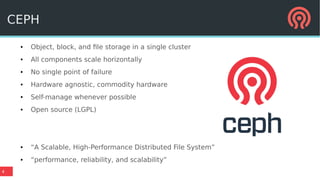
CEPH
● Object, block, and file storage in a single cluster
● All components scale horizontally
● No single point of failure
● Hardware agnostic, commodity hardware
● Self-manage whenever possible
● Open source (LGPL)
● “A Scalable, High-Performance Distributed File System”
● “performance, reliability, and scalability”
5
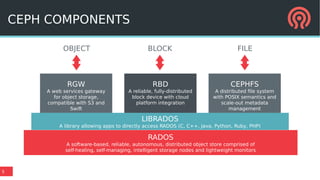
CEPH COMPONENTS
RGW
A web services gateway
for object storage,
compatible with S3 and
Swift
LIBRADOS
A library allowing apps to directly access RADOS (C, C++, Java, Python, Ruby, PHP)
RADOS
A software-based, reliable, autonomous, distributed object store comprised of
self-healing, self-managing, intelligent storage nodes and lightweight monitors
RBD
A reliable, fully-distributed
block device with cloud
platform integration
CEPHFS
A distributed file system
with POSIX semantics and
scale-out metadata
management
OBJECT BLOCK FILE
6
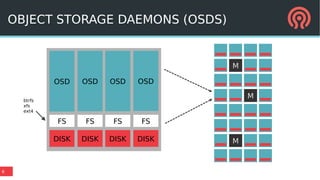
OBJECT STORAGE DAEMONS (OSDS)
FS
DISK
OSD
DISK
OSD
FS
DISK
OSD
FS
DISK
OSD
FS
btrfs
xfs
ext4
M
M
M
7
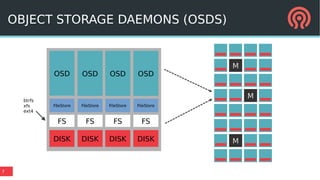
OBJECT STORAGE DAEMONS (OSDS)
FS
DISK
OSD
DISK
OSD
FS
DISK
OSD
FS
DISK
OSD
FS
btrfs
xfs
ext4
M
M
M
FileStore FileStoreFileStoreFileStore
8
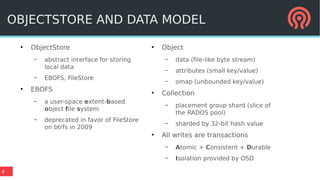
●
ObjectStore
– abstract interface for storing
local data
– EBOFS, FileStore
●
EBOFS
– a user-space extent-based
object file system
– deprecated in favor of FileStore
on btrfs in 2009
●
Object
– data (file-like byte stream)
– attributes (small key/value)
– omap (unbounded key/value)
●
Collection
– placement group shard (slice of
the RADOS pool)
– sharded by 32-bit hash value
●
All writes are transactions
– Atomic + Consistent + Durable
– Isolation provided by OSD
OBJECTSTORE AND DATA MODEL
9
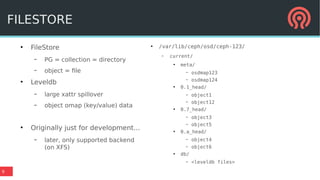
●
FileStore
– PG = collection = directory
– object = file
●
Leveldb
– large xattr spillover
– object omap (key/value) data
●
Originally just for development...
– later, only supported backend
(on XFS)
●
/var/lib/ceph/osd/ceph-123/
– current/
●
meta/
– osdmap123
– osdmap124
●
0.1_head/
– object1
– object12
●
0.7_head/
– object3
– object5
●
0.a_head/
– object4
– object6
●
db/
– <leveldb files>
FILESTORE
10
● OSD carefully manages
consistency of its data
● All writes are transactions
– we need A+C+D; OSD provides I
● Most are simple
– write some bytes to object (file)
– update object attribute (file
xattr)
– append to update log (leveldb
insert)
...but others are arbitrarily
large/complex
[
{
"op_name": "write",
"collection": "0.6_head",
"oid": "#0:73d87003:::benchmark_data_gnit_10346_object23:head#",
"length": 4194304,
"offset": 0,
"bufferlist length": 4194304
},
{
"op_name": "setattrs",
"collection": "0.6_head",
"oid": "#0:73d87003:::benchmark_data_gnit_10346_object23:head#",
"attr_lens": {
"_": 269,
"snapset": 31
}
},
{
"op_name": "omap_setkeys",
"collection": "0.6_head",
"oid": "#0:60000000::::head#",
"attr_lens": {
"0000000005.00000000000000000006": 178,
"_info": 847
}
}
]
POSIX FAILS: TRANSACTIONS
11
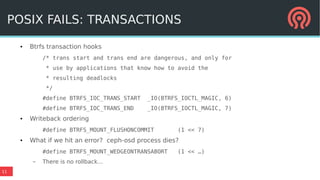
POSIX FAILS: TRANSACTIONS
● Btrfs transaction hooks
/* trans start and trans end are dangerous, and only for
* use by applications that know how to avoid the
* resulting deadlocks
*/
#define BTRFS_IOC_TRANS_START _IO(BTRFS_IOCTL_MAGIC, 6)
#define BTRFS_IOC_TRANS_END _IO(BTRFS_IOCTL_MAGIC, 7)
● Writeback ordering
#define BTRFS_MOUNT_FLUSHONCOMMIT (1 << 7)
● What if we hit an error? ceph-osd process dies?
#define BTRFS_MOUNT_WEDGEONTRANSABORT (1 << …)
– There is no rollback...
POSIX FAILS: TRANSACTIONS
12
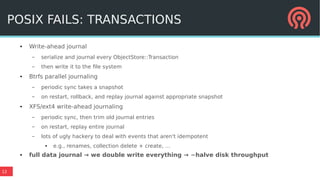
POSIX FAILS: TRANSACTIONS
● Write-ahead journal
– serialize and journal every ObjectStore::Transaction
– then write it to the file system
● Btrfs parallel journaling
– periodic sync takes a snapshot
– on restart, rollback, and replay journal against appropriate snapshot
● XFS/ext4 write-ahead journaling
– periodic sync, then trim old journal entries
– on restart, replay entire journal
– lots of ugly hackery to deal with events that aren't idempotent
● e.g., renames, collection delete + create, …
● full data journal → we double write everything → ~halve disk throughput
POSIX FAILS: TRANSACTIONS
13
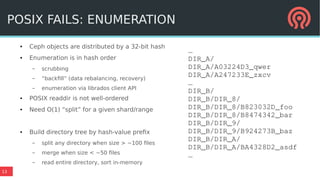
POSIX FAILS: ENUMERATION
● Ceph objects are distributed by a 32-bit hash
● Enumeration is in hash order
– scrubbing
– “backfill” (data rebalancing, recovery)
– enumeration via librados client API
● POSIX readdir is not well-ordered
● Need O(1) “split” for a given shard/range
● Build directory tree by hash-value prefix
– split any directory when size > ~100 files
– merge when size < ~50 files
– read entire directory, sort in-memory
…
DIR_A/
DIR_A/A03224D3_qwer
DIR_A/A247233E_zxcv
…
DIR_B/
DIR_B/DIR_8/
DIR_B/DIR_8/B823032D_foo
DIR_B/DIR_8/B8474342_bar
DIR_B/DIR_9/
DIR_B/DIR_9/B924273B_baz
DIR_B/DIR_A/
DIR_B/DIR_A/BA4328D2_asdf
… 
NEWSTORE
15
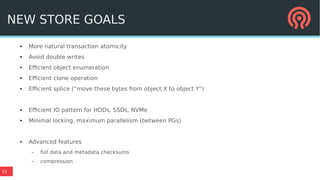
NEW STORE GOALS
● More natural transaction atomicity
● Avoid double writes
● Efficient object enumeration
● Efficient clone operation
● Efficient splice (“move these bytes from object X to object Y”)
● Efficient IO pattern for HDDs, SSDs, NVMe
● Minimal locking, maximum parallelism (between PGs)
● Advanced features
– full data and metadata checksums
– compression
16
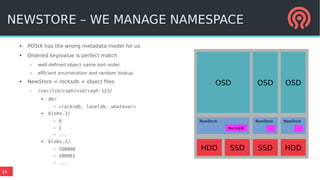
NEWSTORE – WE MANAGE NAMESPACE
● POSIX has the wrong metadata model for us
● Ordered key/value is perfect match
– well-defined object name sort order
– efficient enumeration and random lookup
● NewStore = rocksdb + object files
– /var/lib/ceph/osd/ceph-123/
● db/
– <rocksdb, leveldb, whatever>
● blobs.1/
– 0
– 1
– ...
● blobs.2/
– 100000
– 100001
– ...
HDD
OSD
SSD SSD
OSD
HDD
OSD
NewStore NewStore NewStore
RocksDBRocksDB
17
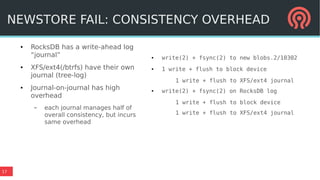
● RocksDB has a write-ahead log
“journal”
● XFS/ext4(/btrfs) have their own
journal (tree-log)

● Journal-on-journal has high
overhead
– each journal manages half of
overall consistency, but incurs
same overhead
● write(2) + fsync(2) to new blobs.2/10302
● 1 write + flush to block device
1 write + flush to XFS/ext4 journal
● write(2) + fsync(2) on RocksDB log
1 write + flush to block device
1 write + flush to XFS/ext4 journal
NEWSTORE FAIL: CONSISTENCY OVERHEAD
18
● We can't overwrite a POSIX file as part of a atomic transaction
● Writing overwrite data to a new file means many files for each object
● Write-ahead logging?
– put overwrite data in a “WAL” records in RocksDB
– commit atomically with transaction
– then overwrite original file data
– but we're back to a double-write of overwrites...
● Performance sucks again
● Overwrites dominate RBD block workloads
NEWSTORE FAIL: ATOMICITY NEEDS WAL
BLUESTORE
20
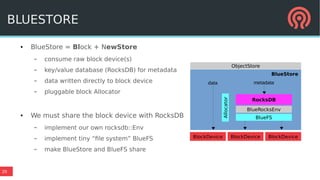
● BlueStore = Block + NewStore
– consume raw block device(s)
– key/value database (RocksDB) for metadata
– data written directly to block device
– pluggable block Allocator
● We must share the block device with RocksDB
– implement our own rocksdb::Env
– implement tiny “file system” BlueFS
– make BlueStore and BlueFS share
BLUESTORE
BlueStore
BlueFS
RocksDB
BlockDeviceBlockDeviceBlockDevice
BlueRocksEnv
data metadata
Allocator
ObjectStore
21
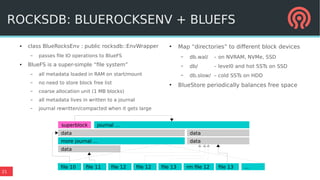
ROCKSDB: BLUEROCKSENV + BLUEFS
● class BlueRocksEnv : public rocksdb::EnvWrapper
– passes file IO operations to BlueFS
● BlueFS is a super-simple “file system”
– all metadata loaded in RAM on start/mount
– no need to store block free list
– coarse allocation unit (1 MB blocks)
– all metadata lives in written to a journal
– journal rewritten/compacted when it gets large
superblock journal …
more journal …
data
data
data
data
file 10 file 11 file 12 file 12 file 13 rm file 12 file 13 ...
●
Map “directories” to different block devices
– db.wal/ – on NVRAM, NVMe, SSD
– db/ – level0 and hot SSTs on SSD
– db.slow/ – cold SSTs on HDD
●
BlueStore periodically balances free space
22
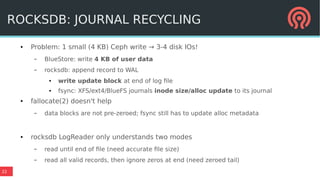
ROCKSDB: JOURNAL RECYCLING
● Problem: 1 small (4 KB) Ceph write → 3-4 disk IOs!
– BlueStore: write 4 KB of user data
– rocksdb: append record to WAL
● write update block at end of log file
● fsync: XFS/ext4/BlueFS journals inode size/alloc update to its journal
● fallocate(2) doesn't help
– data blocks are not pre-zeroed; fsync still has to update alloc metadata
● rocksdb LogReader only understands two modes
– read until end of file (need accurate file size)
– read all valid records, then ignore zeros at end (need zeroed tail)
23
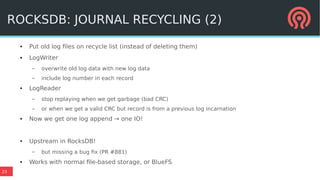
ROCKSDB: JOURNAL RECYCLING (2)
● Put old log files on recycle list (instead of deleting them)
● LogWriter
– overwrite old log data with new log data
– include log number in each record
● LogReader
– stop replaying when we get garbage (bad CRC)
– or when we get a valid CRC but record is from a previous log incarnation
● Now we get one log append → one IO!
● Upstream in RocksDB!
– but missing a bug fix (PR #881)
● Works with normal file-based storage, or BlueFS
METADATA
25
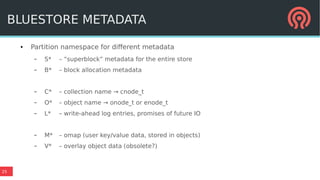
BLUESTORE METADATA
● Partition namespace for different metadata
– S* – “superblock” metadata for the entire store
– B* – block allocation metadata
– C* – collection name → cnode_t
– O* – object name → onode_t or enode_t
– L* – write-ahead log entries, promises of future IO
– M* – omap (user key/value data, stored in objects)
– V* – overlay object data (obsolete?)
26
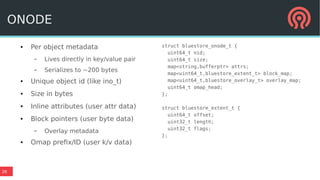
● Per object metadata
– Lives directly in key/value pair
– Serializes to ~200 bytes
● Unique object id (like ino_t)
● Size in bytes
● Inline attributes (user attr data)
● Block pointers (user byte data)
– Overlay metadata
● Omap prefix/ID (user k/v data)
struct bluestore_onode_t {
uint64_t nid;
uint64_t size;
map<string,bufferptr> attrs;
map<uint64_t,bluestore_extent_t> block_map;
map<uint64_t,bluestore_overlay_t> overlay_map;
uint64_t omap_head;
};
struct bluestore_extent_t {
uint64_t offset;
uint32_t length;
uint32_t flags;
};
ONODE
27
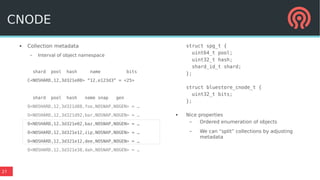
● Collection metadata
– Interval of object namespace
shard pool hash name bits
C<NOSHARD,12,3d321e00> “12.e123d3” = <25>
shard pool hash name snap gen
O<NOSHARD,12,3d321d88,foo,NOSNAP,NOGEN> = …
O<NOSHARD,12,3d321d92,bar,NOSNAP,NOGEN> = …
O<NOSHARD,12,3d321e02,baz,NOSNAP,NOGEN> = …
O<NOSHARD,12,3d321e12,zip,NOSNAP,NOGEN> = …
O<NOSHARD,12,3d321e12,dee,NOSNAP,NOGEN> = …
O<NOSHARD,12,3d321e38,dah,NOSNAP,NOGEN> = …
struct spg_t {
uint64_t pool;
uint32_t hash;
shard_id_t shard;
};
struct bluestore_cnode_t {
uint32_t bits;
};
● Nice properties
– Ordered enumeration of objects
– We can “split” collections by adjusting
metadata
CNODE
28
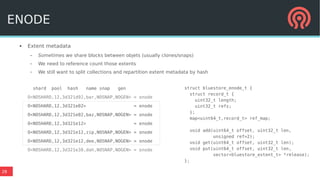
● Extent metadata
– Sometimes we share blocks between objets (usually clones/snaps)
– We need to reference count those extents
– We still want to split collections and repartition extent metadata by hash
shard pool hash name snap gen
O<NOSHARD,12,3d321d92,bar,NOSNAP,NOGEN> = onode
O<NOSHARD,12,3d321e02> = enode
O<NOSHARD,12,3d321e02,baz,NOSNAP,NOGEN> = onode
O<NOSHARD,12,3d321e12> = enode
O<NOSHARD,12,3d321e12,zip,NOSNAP,NOGEN> = onode
O<NOSHARD,12,3d321e12,dee,NOSNAP,NOGEN> = onode
O<NOSHARD,12,3d321e38,dah,NOSNAP,NOGEN> = onode
struct bluestore_enode_t {
struct record_t {
uint32_t length;
uint32_t refs;
};
map<uint64_t,record_t> ref_map;
void add(uint64_t offset, uint32_t len,
unsigned ref=2);
void get(uint64_t offset, uint32_t len);
void put(uint64_t offset, uint32_t len,
vector<bluestore_extent_t> *release);
};
ENODE
DATA PATH
30
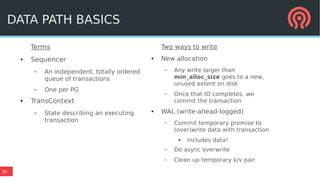
Terms
● Sequencer
– An independent, totally ordered
queue of transactions
– One per PG
● TransContext
– State describing an executing
transaction
DATA PATH BASICS
Two ways to write
● New allocation
– Any write larger than
min_alloc_size goes to a new,
unused extent on disk
– Once that IO completes, we
commit the transaction
● WAL (write-ahead-logged)
– Commit temporary promise to
(over)write data with transaction
● includes data!
– Do async overwrite
– Clean up temporary k/v pair
31
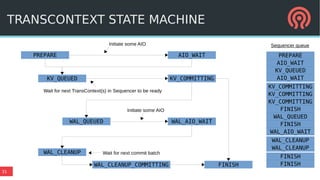
TRANSCONTEXT STATE MACHINE
PREPARE AIO_WAIT
KV_QUEUED KV_COMMITTING
WAL_QUEUED WAL_AIO_WAIT
FINISH
WAL_CLEANUP
Initiate some AIO
Wait for next TransContext(s) in Sequencer to be ready
PREPARE
AIO_WAIT
KV_QUEUED
AIO_WAIT
KV_COMMITTING
KV_COMMITTING
KV_COMMITTING
FINISH
WAL_QUEUEDWAL_QUEUED
FINISH
WAL_AIO_WAIT
WAL_CLEANUP
WAL_CLEANUP
Sequencer queue
Initiate some AIO
Wait for next commit batch
FINISH
FINISHWAL_CLEANUP_COMMITTING
32
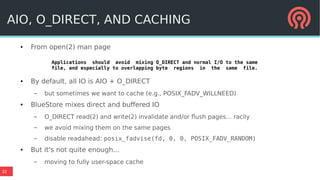
● From open(2) man page
● By default, all IO is AIO + O_DIRECT
– but sometimes we want to cache (e.g., POSIX_FADV_WILLNEED)
● BlueStore mixes direct and buffered IO
– O_DIRECT read(2) and write(2) invalidate and/or flush pages... racily
– we avoid mixing them on the same pages
– disable readahead: posix_fadvise(fd, 0, 0, POSIX_FADV_RANDOM)
● But it's not quite enough...
– moving to fully user-space cache
AIO, O_DIRECT, AND CACHING
Applications should avoid mixing O_DIRECT and normal I/O to the same
file, and especially to overlapping byte regions in the same file.
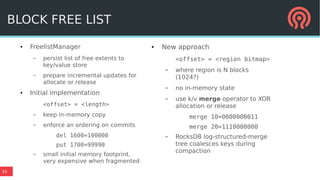
33
● FreelistManager
– persist list of free extents to
key/value store
– prepare incremental updates for
allocate or release
● Initial implementation
<offset> = <length>
– keep in-memory copy
– enforce an ordering on commits
del 1600=100000
put 1700=99990
– small initial memory footprint,
very expensive when fragmented
● New approach
<offset> = <region bitmap>
– where region is N blocks
(1024?)
– no in-memory state
– use k/v merge operator to XOR
allocation or release
merge 10=0000000011
merge 20=1110000000
– RocksDB log-structured-merge
tree coalesces keys during
compaction
BLOCK FREE LIST
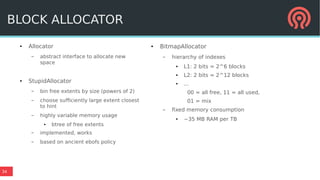
34
● Allocator
– abstract interface to allocate new
space
● StupidAllocator
– bin free extents by size (powers of 2)
– choose sufficiently large extent closest
to hint
– highly variable memory usage
● btree of free extents
– implemented, works
– based on ancient ebofs policy
● BitmapAllocator
– hierarchy of indexes
● L1: 2 bits = 2^6 blocks
● L2: 2 bits = 2^12 blocks
● ...
00 = all free, 11 = all used,
01 = mix
– fixed memory consumption
● ~35 MB RAM per TB
BLOCK ALLOCATOR
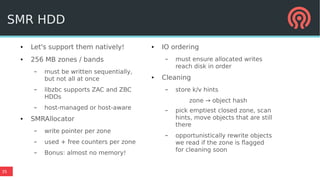
35
● Let's support them natively!
● 256 MB zones / bands
– must be written sequentially,
but not all at once
– libzbc supports ZAC and ZBC
HDDs
– host-managed or host-aware
● SMRAllocator
– write pointer per zone
– used + free counters per zone
– Bonus: almost no memory!
● IO ordering
– must ensure allocated writes
reach disk in order
● Cleaning
– store k/v hints
zone → object hash
– pick emptiest closed zone, scan
hints, move objects that are still
there
– opportunistically rewrite objects
we read if the zone is flagged
for cleaning soon
SMR HDD
FANCY STUFF
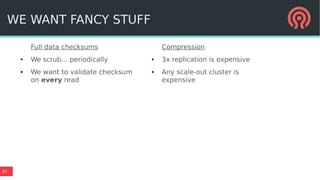
37
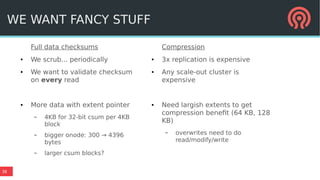
Full data checksums
● We scrub... periodically
● We want to validate checksum
on every read
Compression
● 3x replication is expensive
● Any scale-out cluster is
expensive
WE WANT FANCY STUFF
38
Full data checksums
● We scrub... periodically
● We want to validate checksum
on every read
● More data with extent pointer
– 4KB for 32-bit csum per 4KB
block
– bigger onode: 300 → 4396
bytes
– larger csum blocks?
Compression
● 3x replication is expensive
● Any scale-out cluster is
expensive
● Need largish extents to get
compression benefit (64 KB, 128
KB)
– overwrites need to do
read/modify/write
WE WANT FANCY STUFF
39
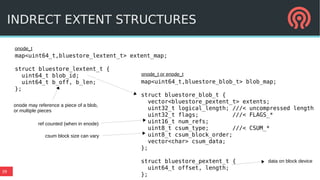
INDRECT EXTENT STRUCTURES
map<uint64_t,bluestore_lextent_t> extent_map;
struct bluestore_lextent_t {
uint64_t blob_id;
uint64_t b_off, b_len;
};
map<uint64_t,bluestore_blob_t> blob_map;
struct bluestore_blob_t {
vector<bluestore_pextent_t> extents;
uint32_t logical_length; ///< uncompressed length
uint32_t flags; ///< FLAGS_*
uint16_t num_refs;
uint8_t csum_type; ///< CSUM_*
uint8_t csum_block_order;
vector<char> csum_data;
};
struct bluestore_pextent_t {
uint64_t offset, length;
};
onode_t
onode_t or enode_t
data on block device
onode may reference a piece of a blob,
or multiple pieces
csum block size can vary
ref counted (when in enode)
PERFORMANCE
41
0
50
100
150
200
250
300
350
400
450
500
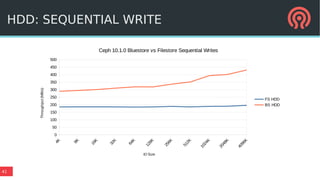
Ceph 10.1.0 Bluestore vs Filestore Sequential Writes
FS HDD
BS HDD
IO Size
Throughput(MB/s)
HDD: SEQUENTIAL WRITE
42
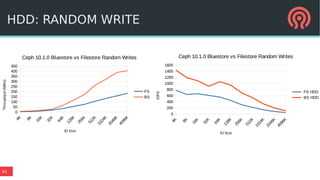
HDD: RANDOM WRITE
0
50
100
150
200
250
300
350
400
450
Ceph 10.1.0 Bluestore vs Filestore Random Writes
FS HDD
BS HDD
IO Size
Throughput(MB/s)
0
200
400
600
800
1000
1200
1400
1600
Ceph 10.1.0 Bluestore vs Filestore Random Writes
FS HDD
BS HDD
IO Size
IOPS
43
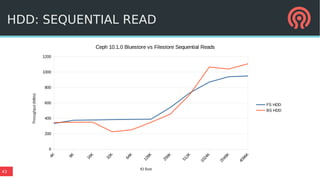
HDD: SEQUENTIAL READ
0
200
400
600
800
1000
1200
Ceph 10.1.0 Bluestore vs Filestore Sequential Reads
FS HDD
BS HDD
IO Size
Throughput(MB/s)
44
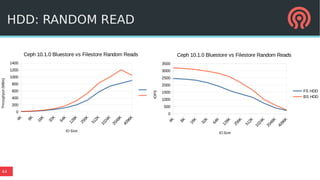
HDD: RANDOM READ
0
200
400
600
800
1000
1200
1400
Ceph 10.1.0 Bluestore vs Filestore Random Reads
FS HDD
BS HDD
IO Size
Throughput(MB/s)
0
500
1000
1500
2000
2500
3000
3500
Ceph 10.1.0 Bluestore vs Filestore Random Reads
FS HDD
BS HDD
IO Size
IOPS
45
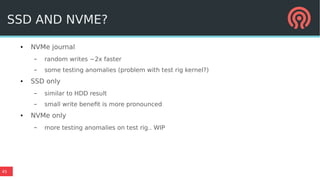
SSD AND NVME?
● NVMe journal
– random writes ~2x faster
– some testing anomalies (problem with test rig kernel?)
● SSD only
– similar to HDD result
– small write benefit is more pronounced
● NVMe only
– more testing anomalies on test rig.. WIP
46
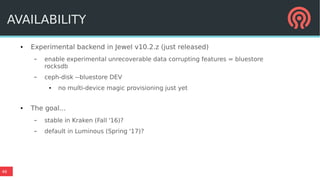
AVAILABILITY
● Experimental backend in Jewel v10.2.z (just released)
– enable experimental unrecoverable data corrupting features = bluestore
rocksdb
– ceph-disk --bluestore DEV
● no multi-device magic provisioning just yet
● The goal...
– stable in Kraken (Fall '16)?
– default in Luminous (Spring '17)?
47
SUMMARY
● Ceph is great
● POSIX was poor choice for storing objects
● Our new BlueStore backend is awesome
● RocksDB rocks and was easy to embed
● Log recycling speeds up commits (now upstream)
● Delayed merge will help too (coming soon)
THANK YOU!
Sage Weil
CEPH PRINCIPAL ARCHITECT
sage@redhat.com
@liewegas

BlueStore: a new, faster storage backend for Ceph

  • 1.
    BLUESTORE: A NEW,FASTER STORAGE BACKEND FOR CEPH SAGE WEIL VAULT – 2016.04.21
  • 2.
    2 OUTLINE ● Ceph background andcontext – FileStore, and why POSIX failed us – NewStore – a hybrid approach ● BlueStore – a new Ceph OSD backend – Metadata – Data ● Performance ● Upcoming changes ● Summary
  • 3.
  • 4.
    4 CEPH ● Object, block,and file storage in a single cluster ● All components scale horizontally ● No single point of failure ● Hardware agnostic, commodity hardware ● Self-manage whenever possible ● Open source (LGPL) ● “A Scalable, High-Performance Distributed File System” ● “performance, reliability, and scalability”
  • 5.
    5 CEPH COMPONENTS RGW A webservices gateway for object storage, compatible with S3 and Swift LIBRADOS A library allowing apps to directly access RADOS (C, C++, Java, Python, Ruby, PHP) RADOS A software-based, reliable, autonomous, distributed object store comprised of self-healing, self-managing, intelligent storage nodes and lightweight monitors RBD A reliable, fully-distributed block device with cloud platform integration CEPHFS A distributed file system with POSIX semantics and scale-out metadata management OBJECT BLOCK FILE
  • 6.
    6 OBJECT STORAGE DAEMONS(OSDS) FS DISK OSD DISK OSD FS DISK OSD FS DISK OSD FS btrfs xfs ext4 M M M
  • 7.
    7 OBJECT STORAGE DAEMONS(OSDS) FS DISK OSD DISK OSD FS DISK OSD FS DISK OSD FS btrfs xfs ext4 M M M FileStore FileStoreFileStoreFileStore
  • 8.
    8 ● ObjectStore – abstract interfacefor storing local data – EBOFS, FileStore ● EBOFS – a user-space extent-based object file system – deprecated in favor of FileStore on btrfs in 2009 ● Object – data (file-like byte stream) – attributes (small key/value) – omap (unbounded key/value) ● Collection – placement group shard (slice of the RADOS pool) – sharded by 32-bit hash value ● All writes are transactions – Atomic + Consistent + Durable – Isolation provided by OSD OBJECTSTORE AND DATA MODEL
  • 9.
    9 ● FileStore – PG =collection = directory – object = file ● Leveldb – large xattr spillover – object omap (key/value) data ● Originally just for development... – later, only supported backend (on XFS) ● /var/lib/ceph/osd/ceph-123/ – current/ ● meta/ – osdmap123 – osdmap124 ● 0.1_head/ – object1 – object12 ● 0.7_head/ – object3 – object5 ● 0.a_head/ – object4 – object6 ● db/ – <leveldb files> FILESTORE
  • 10.
    10 ● OSD carefullymanages consistency of its data ● All writes are transactions – we need A+C+D; OSD provides I ● Most are simple – write some bytes to object (file) – update object attribute (file xattr) – append to update log (leveldb insert) ...but others are arbitrarily large/complex [ { "op_name": "write", "collection": "0.6_head", "oid": "#0:73d87003:::benchmark_data_gnit_10346_object23:head#", "length": 4194304, "offset": 0, "bufferlist length": 4194304 }, { "op_name": "setattrs", "collection": "0.6_head", "oid": "#0:73d87003:::benchmark_data_gnit_10346_object23:head#", "attr_lens": { "_": 269, "snapset": 31 } }, { "op_name": "omap_setkeys", "collection": "0.6_head", "oid": "#0:60000000::::head#", "attr_lens": { "0000000005.00000000000000000006": 178, "_info": 847 } } ] POSIX FAILS: TRANSACTIONS
  • 11.
    11 POSIX FAILS: TRANSACTIONS ●Btrfs transaction hooks /* trans start and trans end are dangerous, and only for * use by applications that know how to avoid the * resulting deadlocks */ #define BTRFS_IOC_TRANS_START _IO(BTRFS_IOCTL_MAGIC, 6) #define BTRFS_IOC_TRANS_END _IO(BTRFS_IOCTL_MAGIC, 7) ● Writeback ordering #define BTRFS_MOUNT_FLUSHONCOMMIT (1 << 7) ● What if we hit an error? ceph-osd process dies? #define BTRFS_MOUNT_WEDGEONTRANSABORT (1 << …) – There is no rollback... POSIX FAILS: TRANSACTIONS
  • 12.
    12 POSIX FAILS: TRANSACTIONS ●Write-ahead journal – serialize and journal every ObjectStore::Transaction – then write it to the file system ● Btrfs parallel journaling – periodic sync takes a snapshot – on restart, rollback, and replay journal against appropriate snapshot ● XFS/ext4 write-ahead journaling – periodic sync, then trim old journal entries – on restart, replay entire journal – lots of ugly hackery to deal with events that aren't idempotent ● e.g., renames, collection delete + create, … ● full data journal → we double write everything → ~halve disk throughput POSIX FAILS: TRANSACTIONS
  • 13.
    13 POSIX FAILS: ENUMERATION ●Ceph objects are distributed by a 32-bit hash ● Enumeration is in hash order – scrubbing – “backfill” (data rebalancing, recovery) – enumeration via librados client API ● POSIX readdir is not well-ordered ● Need O(1) “split” for a given shard/range ● Build directory tree by hash-value prefix – split any directory when size > ~100 files – merge when size < ~50 files – read entire directory, sort in-memory … DIR_A/ DIR_A/A03224D3_qwer DIR_A/A247233E_zxcv … DIR_B/ DIR_B/DIR_8/ DIR_B/DIR_8/B823032D_foo DIR_B/DIR_8/B8474342_bar DIR_B/DIR_9/ DIR_B/DIR_9/B924273B_baz DIR_B/DIR_A/ DIR_B/DIR_A/BA4328D2_asdf … 
  • 14.
  • 15.
    15 NEW STORE GOALS ●More natural transaction atomicity ● Avoid double writes ● Efficient object enumeration ● Efficient clone operation ● Efficient splice (“move these bytes from object X to object Y”) ● Efficient IO pattern for HDDs, SSDs, NVMe ● Minimal locking, maximum parallelism (between PGs) ● Advanced features – full data and metadata checksums – compression
  • 16.
    16 NEWSTORE – WEMANAGE NAMESPACE ● POSIX has the wrong metadata model for us ● Ordered key/value is perfect match – well-defined object name sort order – efficient enumeration and random lookup ● NewStore = rocksdb + object files – /var/lib/ceph/osd/ceph-123/ ● db/ – <rocksdb, leveldb, whatever> ● blobs.1/ – 0 – 1 – ... ● blobs.2/ – 100000 – 100001 – ... HDD OSD SSD SSD OSD HDD OSD NewStore NewStore NewStore RocksDBRocksDB
  • 17.
    17 ● RocksDB hasa write-ahead log “journal” ● XFS/ext4(/btrfs) have their own journal (tree-log) ● Journal-on-journal has high overhead – each journal manages half of overall consistency, but incurs same overhead ● write(2) + fsync(2) to new blobs.2/10302 ● 1 write + flush to block device 1 write + flush to XFS/ext4 journal ● write(2) + fsync(2) on RocksDB log 1 write + flush to block device 1 write + flush to XFS/ext4 journal NEWSTORE FAIL: CONSISTENCY OVERHEAD
  • 18.
    18 ● We can'toverwrite a POSIX file as part of a atomic transaction ● Writing overwrite data to a new file means many files for each object ● Write-ahead logging? – put overwrite data in a “WAL” records in RocksDB – commit atomically with transaction – then overwrite original file data – but we're back to a double-write of overwrites... ● Performance sucks again ● Overwrites dominate RBD block workloads NEWSTORE FAIL: ATOMICITY NEEDS WAL
  • 19.
  • 20.
    20 ● BlueStore =Block + NewStore – consume raw block device(s) – key/value database (RocksDB) for metadata – data written directly to block device – pluggable block Allocator ● We must share the block device with RocksDB – implement our own rocksdb::Env – implement tiny “file system” BlueFS – make BlueStore and BlueFS share BLUESTORE BlueStore BlueFS RocksDB BlockDeviceBlockDeviceBlockDevice BlueRocksEnv data metadata Allocator ObjectStore
  • 21.
    21 ROCKSDB: BLUEROCKSENV +BLUEFS ● class BlueRocksEnv : public rocksdb::EnvWrapper – passes file IO operations to BlueFS ● BlueFS is a super-simple “file system” – all metadata loaded in RAM on start/mount – no need to store block free list – coarse allocation unit (1 MB blocks) – all metadata lives in written to a journal – journal rewritten/compacted when it gets large superblock journal … more journal … data data data data file 10 file 11 file 12 file 12 file 13 rm file 12 file 13 ... ● Map “directories” to different block devices – db.wal/ – on NVRAM, NVMe, SSD – db/ – level0 and hot SSTs on SSD – db.slow/ – cold SSTs on HDD ● BlueStore periodically balances free space
  • 22.
    22 ROCKSDB: JOURNAL RECYCLING ●Problem: 1 small (4 KB) Ceph write → 3-4 disk IOs! – BlueStore: write 4 KB of user data – rocksdb: append record to WAL ● write update block at end of log file ● fsync: XFS/ext4/BlueFS journals inode size/alloc update to its journal ● fallocate(2) doesn't help – data blocks are not pre-zeroed; fsync still has to update alloc metadata ● rocksdb LogReader only understands two modes – read until end of file (need accurate file size) – read all valid records, then ignore zeros at end (need zeroed tail)
  • 23.
    23 ROCKSDB: JOURNAL RECYCLING(2) ● Put old log files on recycle list (instead of deleting them) ● LogWriter – overwrite old log data with new log data – include log number in each record ● LogReader – stop replaying when we get garbage (bad CRC) – or when we get a valid CRC but record is from a previous log incarnation ● Now we get one log append → one IO! ● Upstream in RocksDB! – but missing a bug fix (PR #881) ● Works with normal file-based storage, or BlueFS
  • 24.
  • 25.
    25 BLUESTORE METADATA ● Partitionnamespace for different metadata – S* – “superblock” metadata for the entire store – B* – block allocation metadata – C* – collection name → cnode_t – O* – object name → onode_t or enode_t – L* – write-ahead log entries, promises of future IO – M* – omap (user key/value data, stored in objects) – V* – overlay object data (obsolete?)
  • 26.
    26 ● Per objectmetadata – Lives directly in key/value pair – Serializes to ~200 bytes ● Unique object id (like ino_t) ● Size in bytes ● Inline attributes (user attr data) ● Block pointers (user byte data) – Overlay metadata ● Omap prefix/ID (user k/v data) struct bluestore_onode_t { uint64_t nid; uint64_t size; map<string,bufferptr> attrs; map<uint64_t,bluestore_extent_t> block_map; map<uint64_t,bluestore_overlay_t> overlay_map; uint64_t omap_head; }; struct bluestore_extent_t { uint64_t offset; uint32_t length; uint32_t flags; }; ONODE
  • 27.
    27 ● Collection metadata –Interval of object namespace shard pool hash name bits C<NOSHARD,12,3d321e00> “12.e123d3” = <25> shard pool hash name snap gen O<NOSHARD,12,3d321d88,foo,NOSNAP,NOGEN> = … O<NOSHARD,12,3d321d92,bar,NOSNAP,NOGEN> = … O<NOSHARD,12,3d321e02,baz,NOSNAP,NOGEN> = … O<NOSHARD,12,3d321e12,zip,NOSNAP,NOGEN> = … O<NOSHARD,12,3d321e12,dee,NOSNAP,NOGEN> = … O<NOSHARD,12,3d321e38,dah,NOSNAP,NOGEN> = … struct spg_t { uint64_t pool; uint32_t hash; shard_id_t shard; }; struct bluestore_cnode_t { uint32_t bits; }; ● Nice properties – Ordered enumeration of objects – We can “split” collections by adjusting metadata CNODE
  • 28.
    28 ● Extent metadata –Sometimes we share blocks between objets (usually clones/snaps) – We need to reference count those extents – We still want to split collections and repartition extent metadata by hash shard pool hash name snap gen O<NOSHARD,12,3d321d92,bar,NOSNAP,NOGEN> = onode O<NOSHARD,12,3d321e02> = enode O<NOSHARD,12,3d321e02,baz,NOSNAP,NOGEN> = onode O<NOSHARD,12,3d321e12> = enode O<NOSHARD,12,3d321e12,zip,NOSNAP,NOGEN> = onode O<NOSHARD,12,3d321e12,dee,NOSNAP,NOGEN> = onode O<NOSHARD,12,3d321e38,dah,NOSNAP,NOGEN> = onode struct bluestore_enode_t { struct record_t { uint32_t length; uint32_t refs; }; map<uint64_t,record_t> ref_map; void add(uint64_t offset, uint32_t len, unsigned ref=2); void get(uint64_t offset, uint32_t len); void put(uint64_t offset, uint32_t len, vector<bluestore_extent_t> *release); }; ENODE
  • 29.
  • 30.
    30 Terms ● Sequencer – Anindependent, totally ordered queue of transactions – One per PG ● TransContext – State describing an executing transaction DATA PATH BASICS Two ways to write ● New allocation – Any write larger than min_alloc_size goes to a new, unused extent on disk – Once that IO completes, we commit the transaction ● WAL (write-ahead-logged) – Commit temporary promise to (over)write data with transaction ● includes data! – Do async overwrite – Clean up temporary k/v pair
  • 31.
    31 TRANSCONTEXT STATE MACHINE PREPAREAIO_WAIT KV_QUEUED KV_COMMITTING WAL_QUEUED WAL_AIO_WAIT FINISH WAL_CLEANUP Initiate some AIO Wait for next TransContext(s) in Sequencer to be ready PREPARE AIO_WAIT KV_QUEUED AIO_WAIT KV_COMMITTING KV_COMMITTING KV_COMMITTING FINISH WAL_QUEUEDWAL_QUEUED FINISH WAL_AIO_WAIT WAL_CLEANUP WAL_CLEANUP Sequencer queue Initiate some AIO Wait for next commit batch FINISH FINISHWAL_CLEANUP_COMMITTING
  • 32.
    32 ● From open(2)man page ● By default, all IO is AIO + O_DIRECT – but sometimes we want to cache (e.g., POSIX_FADV_WILLNEED) ● BlueStore mixes direct and buffered IO – O_DIRECT read(2) and write(2) invalidate and/or flush pages... racily – we avoid mixing them on the same pages – disable readahead: posix_fadvise(fd, 0, 0, POSIX_FADV_RANDOM) ● But it's not quite enough... – moving to fully user-space cache AIO, O_DIRECT, AND CACHING Applications should avoid mixing O_DIRECT and normal I/O to the same file, and especially to overlapping byte regions in the same file.
  • 33.
    33 ● FreelistManager – persistlist of free extents to key/value store – prepare incremental updates for allocate or release ● Initial implementation <offset> = <length> – keep in-memory copy – enforce an ordering on commits del 1600=100000 put 1700=99990 – small initial memory footprint, very expensive when fragmented ● New approach <offset> = <region bitmap> – where region is N blocks (1024?) – no in-memory state – use k/v merge operator to XOR allocation or release merge 10=0000000011 merge 20=1110000000 – RocksDB log-structured-merge tree coalesces keys during compaction BLOCK FREE LIST
  • 34.
    34 ● Allocator – abstractinterface to allocate new space ● StupidAllocator – bin free extents by size (powers of 2) – choose sufficiently large extent closest to hint – highly variable memory usage ● btree of free extents – implemented, works – based on ancient ebofs policy ● BitmapAllocator – hierarchy of indexes ● L1: 2 bits = 2^6 blocks ● L2: 2 bits = 2^12 blocks ● ... 00 = all free, 11 = all used, 01 = mix – fixed memory consumption ● ~35 MB RAM per TB BLOCK ALLOCATOR
  • 35.
    35 ● Let's supportthem natively! ● 256 MB zones / bands – must be written sequentially, but not all at once – libzbc supports ZAC and ZBC HDDs – host-managed or host-aware ● SMRAllocator – write pointer per zone – used + free counters per zone – Bonus: almost no memory! ● IO ordering – must ensure allocated writes reach disk in order ● Cleaning – store k/v hints zone → object hash – pick emptiest closed zone, scan hints, move objects that are still there – opportunistically rewrite objects we read if the zone is flagged for cleaning soon SMR HDD
  • 36.
  • 37.
    37 Full data checksums ●We scrub... periodically ● We want to validate checksum on every read Compression ● 3x replication is expensive ● Any scale-out cluster is expensive WE WANT FANCY STUFF
  • 38.
    38 Full data checksums ●We scrub... periodically ● We want to validate checksum on every read ● More data with extent pointer – 4KB for 32-bit csum per 4KB block – bigger onode: 300 → 4396 bytes – larger csum blocks? Compression ● 3x replication is expensive ● Any scale-out cluster is expensive ● Need largish extents to get compression benefit (64 KB, 128 KB) – overwrites need to do read/modify/write WE WANT FANCY STUFF
  • 39.
    39 INDRECT EXTENT STRUCTURES map<uint64_t,bluestore_lextent_t>extent_map; struct bluestore_lextent_t { uint64_t blob_id; uint64_t b_off, b_len; }; map<uint64_t,bluestore_blob_t> blob_map; struct bluestore_blob_t { vector<bluestore_pextent_t> extents; uint32_t logical_length; ///< uncompressed length uint32_t flags; ///< FLAGS_* uint16_t num_refs; uint8_t csum_type; ///< CSUM_* uint8_t csum_block_order; vector<char> csum_data; }; struct bluestore_pextent_t { uint64_t offset, length; }; onode_t onode_t or enode_t data on block device onode may reference a piece of a blob, or multiple pieces csum block size can vary ref counted (when in enode)
  • 40.
  • 41.
    41 0 50 100 150 200 250 300 350 400 450 500 Ceph 10.1.0 Bluestorevs Filestore Sequential Writes FS HDD BS HDD IO Size Throughput(MB/s) HDD: SEQUENTIAL WRITE
  • 42.
    42 HDD: RANDOM WRITE 0 50 100 150 200 250 300 350 400 450 Ceph10.1.0 Bluestore vs Filestore Random Writes FS HDD BS HDD IO Size Throughput(MB/s) 0 200 400 600 800 1000 1200 1400 1600 Ceph 10.1.0 Bluestore vs Filestore Random Writes FS HDD BS HDD IO Size IOPS
  • 43.
    43 HDD: SEQUENTIAL READ 0 200 400 600 800 1000 1200 Ceph10.1.0 Bluestore vs Filestore Sequential Reads FS HDD BS HDD IO Size Throughput(MB/s)
  • 44.
    44 HDD: RANDOM READ 0 200 400 600 800 1000 1200 1400 Ceph10.1.0 Bluestore vs Filestore Random Reads FS HDD BS HDD IO Size Throughput(MB/s) 0 500 1000 1500 2000 2500 3000 3500 Ceph 10.1.0 Bluestore vs Filestore Random Reads FS HDD BS HDD IO Size IOPS
  • 45.
    45 SSD AND NVME? ●NVMe journal – random writes ~2x faster – some testing anomalies (problem with test rig kernel?) ● SSD only – similar to HDD result – small write benefit is more pronounced ● NVMe only – more testing anomalies on test rig.. WIP
  • 46.
    46 AVAILABILITY ● Experimental backendin Jewel v10.2.z (just released) – enable experimental unrecoverable data corrupting features = bluestore rocksdb – ceph-disk --bluestore DEV ● no multi-device magic provisioning just yet ● The goal... – stable in Kraken (Fall '16)? – default in Luminous (Spring '17)?
  • 47.
    47 SUMMARY ● Ceph isgreat ● POSIX was poor choice for storing objects ● Our new BlueStore backend is awesome ● RocksDB rocks and was easy to embed ● Log recycling speeds up commits (now upstream) ● Delayed merge will help too (coming soon)
  • 48.
    THANK YOU! Sage Weil CEPHPRINCIPAL ARCHITECT sage@redhat.com @liewegas