BLUESTORE: A NEW STORAGE BACKEND FOR CEPH –
ONE YEAR IN
SAGE WEIL
2017.03.23
2
OUTLINE
● Ceph background and context
– FileStore, and why POSIX failed us
● BlueStore – a new Ceph OSD backend
● Performance
● Recent challenges
● Future
● Status and availability
● Summary
MOTIVATION
4
CEPH
● Object, block, and file storage in a single cluster
● All components scale horizontally
● No single point of failure
● Hardware agnostic, commodity hardware
● Self-manage whenever possible
● Open source (LGPL)
● “A Scalable, High-Performance Distributed File System”
● “performance, reliability, and scalability”
5
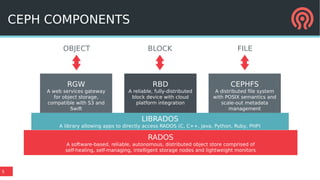
CEPH COMPONENTS
RGW
A web services gateway
for object storage,
compatible with S3 and
Swift
LIBRADOS
A library allowing apps to directly access RADOS (C, C++, Java, Python, Ruby, PHP)
RADOS
A software-based, reliable, autonomous, distributed object store comprised of
self-healing, self-managing, intelligent storage nodes and lightweight monitors
RBD
A reliable, fully-distributed
block device with cloud
platform integration
CEPHFS
A distributed file system
with POSIX semantics and
scale-out metadata
management
OBJECT BLOCK FILE
6
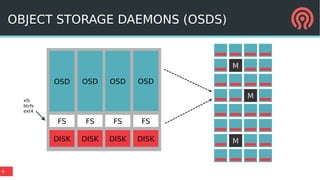
OBJECT STORAGE DAEMONS (OSDS)
FS
DISK
OSD
DISK
OSD
FS
DISK
OSD
FS
DISK
OSD
FS
xfs
btrfs
ext4
M
M
M
7
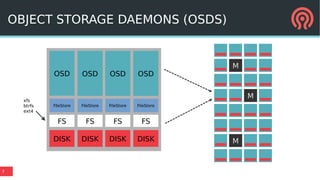
OBJECT STORAGE DAEMONS (OSDS)
FS
DISK
OSD
DISK
OSD
FS
DISK
OSD
FS
DISK
OSD
FS
xfs
btrfs
ext4
M
M
M
FileStore FileStoreFileStoreFileStore
8
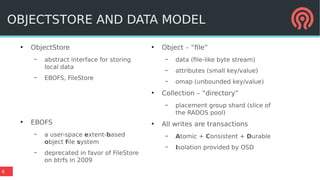
●
ObjectStore
– abstract interface for storing
local data
– EBOFS, FileStore
●
EBOFS
– a user-space extent-based
object file system
– deprecated in favor of FileStore
on btrfs in 2009
●
Object – “file”
– data (file-like byte stream)
– attributes (small key/value)
– omap (unbounded key/value)
●
Collection – “directory”
– placement group shard (slice of
the RADOS pool)
●
All writes are transactions
– Atomic + Consistent + Durable
– Isolation provided by OSD
OBJECTSTORE AND DATA MODEL
9
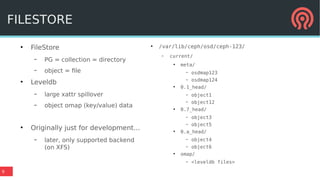
●
FileStore
– PG = collection = directory
– object = file
●
Leveldb
– large xattr spillover
– object omap (key/value) data
●
Originally just for development...
– later, only supported backend
(on XFS)
●
/var/lib/ceph/osd/ceph-123/
– current/
●
meta/
– osdmap123
– osdmap124
●
0.1_head/
– object1
– object12
●
0.7_head/
– object3
– object5
●
0.a_head/
– object4
– object6
●
omap/
– <leveldb files>
FILESTORE
10
● Most transactions are simple
– write some bytes to object (file)
– update object attribute (file
xattr)
– append to update log (kv insert)
...but others are arbitrarily
large/complex
● Serialize and write-ahead txn to
journal for atomicity
– We double-write everything!
– Lots of ugly hackery to make
replayed events idempotent
[
{
"op_name": "write",
"collection": "0.6_head",
"oid": "#0:73d87003:::benchmark_data_gnit_10346_object23:head#",
"length": 4194304,
"offset": 0,
"bufferlist length": 4194304
},
{
"op_name": "setattrs",
"collection": "0.6_head",
"oid": "#0:73d87003:::benchmark_data_gnit_10346_object23:head#",
"attr_lens": {
"_": 269,
"snapset": 31
}
},
{
"op_name": "omap_setkeys",
"collection": "0.6_head",
"oid": "#0:60000000::::head#",
"attr_lens": {
"0000000005.00000000000000000006": 178,
"_info": 847
}
}
]
POSIX FAILS: TRANSACTIONS
11
POSIX FAILS: ENUMERATION
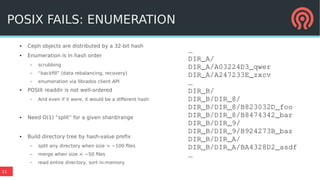
● Ceph objects are distributed by a 32-bit hash
● Enumeration is in hash order
– scrubbing
– “backfill” (data rebalancing, recovery)
– enumeration via librados client API
● POSIX readdir is not well-ordered
– And even if it were, it would be a different hash
● Need O(1) “split” for a given shard/range
● Build directory tree by hash-value prefix
– split any directory when size > ~100 files
– merge when size < ~50 files
– read entire directory, sort in-memory
…
DIR_A/
DIR_A/A03224D3_qwer
DIR_A/A247233E_zxcv
…
DIR_B/
DIR_B/DIR_8/
DIR_B/DIR_8/B823032D_foo
DIR_B/DIR_8/B8474342_bar
DIR_B/DIR_9/
DIR_B/DIR_9/B924273B_baz
DIR_B/DIR_A/
DIR_B/DIR_A/BA4328D2_asdf
…
12
THE HEADACHES CONTINUE
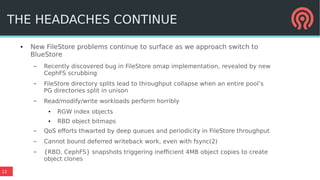
● New FileStore problems continue to surface as we approach switch to
BlueStore
– Recently discovered bug in FileStore omap implementation, revealed by new
CephFS scrubbing
– FileStore directory splits lead to throughput collapse when an entire pool’s
PG directories split in unison
– Read/modify/write workloads perform horribly
● RGW index objects
● RBD object bitmaps
– QoS efforts thwarted by deep queues and periodicity in FileStore throughput
– Cannot bound deferred writeback work, even with fsync(2)
– {RBD, CephFS} snapshots triggering inefficient 4MB object copies to create
object clones
BLUESTORE
14
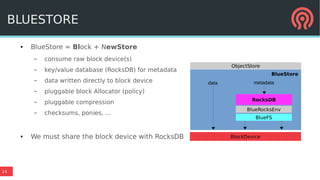
● BlueStore = Block + NewStore
– consume raw block device(s)
– key/value database (RocksDB) for metadata
– data written directly to block device
– pluggable block Allocator (policy)
– pluggable compression
– checksums, ponies, ...
● We must share the block device with RocksDB
BLUESTORE
BlueStore
BlueFS
RocksDB
BlueRocksEnv
data metadata
ObjectStore
BlockDevice
15
ROCKSDB: BLUEROCKSENV + BLUEFS
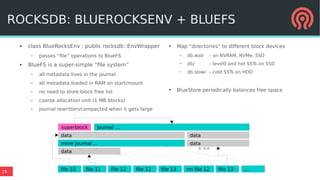
● class BlueRocksEnv : public rocksdb::EnvWrapper
– passes “file” operations to BlueFS
● BlueFS is a super-simple “file system”
– all metadata lives in the journal
– all metadata loaded in RAM on start/mount
– no need to store block free list
– coarse allocation unit (1 MB blocks)
– journal rewritten/compacted when it gets large
superblock journal …
more journal …
data
data
data
data
file 10 file 11 file 12 file 12 file 13 rm file 12 file 13 ...
●
Map “directories” to different block devices
– db.wal/ – on NVRAM, NVMe, SSD
– db/ – level0 and hot SSTs on SSD
– db.slow/ – cold SSTs on HDD
●
BlueStore periodically balances free space
16
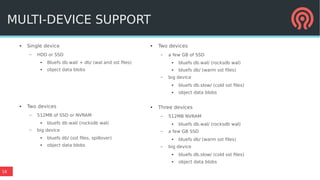
● Single device
– HDD or SSD
● Bluefs db.wal/ + db/ (wal and sst files)
● object data blobs
● Two devices
– 512MB of SSD or NVRAM
● bluefs db.wal/ (rocksdb wal)
– big device
● bluefs db/ (sst files, spillover)
● object data blobs
MULTI-DEVICE SUPPORT
● Two devices
– a few GB of SSD
● bluefs db.wal/ (rocksdb wal)
● bluefs db/ (warm sst files)
– big device
● bluefs db.slow/ (cold sst files)
● object data blobs
● Three devices
– 512MB NVRAM
● bluefs db.wal/ (rocksdb wal)
– a few GB SSD
● bluefs db/ (warm sst files)
– big device
● bluefs db.slow/ (cold sst files)
● object data blobs
METADATA
18
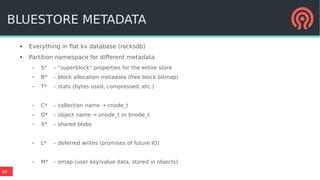
BLUESTORE METADATA
● Everything in flat kv database (rocksdb)
● Partition namespace for different metadata
– S* – “superblock” properties for the entire store
– B* – block allocation metadata (free block bitmap)
– T* – stats (bytes used, compressed, etc.)
– C* – collection name → cnode_t
– O* – object name → onode_t or bnode_t
– X* – shared blobs
– L* – deferred writes (promises of future IO)
– M* – omap (user key/value data, stored in objects)
19
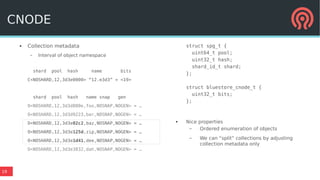
● Collection metadata
– Interval of object namespace
shard pool hash name bits
C<NOSHARD,12,3d3e0000> “12.e3d3” = <19>
shard pool hash name snap gen
O<NOSHARD,12,3d3d880e,foo,NOSNAP,NOGEN> = …
O<NOSHARD,12,3d3d9223,bar,NOSNAP,NOGEN> = …
O<NOSHARD,12,3d3e02c2,baz,NOSNAP,NOGEN> = …
O<NOSHARD,12,3d3e125d,zip,NOSNAP,NOGEN> = …
O<NOSHARD,12,3d3e1d41,dee,NOSNAP,NOGEN> = …
O<NOSHARD,12,3d3e3832,dah,NOSNAP,NOGEN> = …
struct spg_t {
uint64_t pool;
uint32_t hash;
shard_id_t shard;
};
struct bluestore_cnode_t {
uint32_t bits;
};
● Nice properties
– Ordered enumeration of objects
– We can “split” collections by adjusting
collection metadata only
CNODE
20
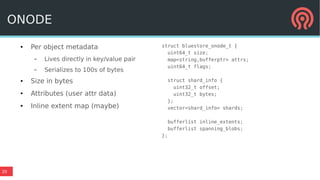
● Per object metadata
– Lives directly in key/value pair
– Serializes to 100s of bytes
● Size in bytes
● Attributes (user attr data)
● Inline extent map (maybe)
struct bluestore_onode_t {
uint64_t size;
map<string,bufferptr> attrs;
uint64_t flags;
struct shard_info {
uint32_t offset;
uint32_t bytes;
};
vector<shard_info> shards;
bufferlist inline_extents;
bufferlist spanning_blobs;
};
ONODE
21
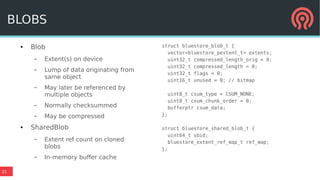
● Blob
– Extent(s) on device
– Lump of data originating from
same object
– May later be referenced by
multiple objects
– Normally checksummed
– May be compressed
● SharedBlob
– Extent ref count on cloned
blobs
– In-memory buffer cache
BLOBS
struct bluestore_blob_t {
vector<bluestore_pextent_t> extents;
uint32_t compressed_length_orig = 0;
uint32_t compressed_length = 0;
uint32_t flags = 0;
uint16_t unused = 0; // bitmap
uint8_t csum_type = CSUM_NONE;
uint8_t csum_chunk_order = 0;
bufferptr csum_data;
};
struct bluestore_shared_blob_t {
uint64_t sbid;
bluestore_extent_ref_map_t ref_map;
};
22
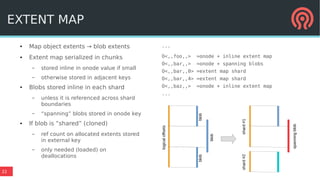
● Map object extents → blob extents
● Extent map serialized in chunks
– stored inline in onode value if small
– otherwise stored in adjacent keys
● Blobs stored inline in each shard
– unless it is referenced across shard
boundaries
– “spanning” blobs stored in onode key
● If blob is “shared” (cloned)
– ref count on allocated extents stored
in external key
– only needed (loaded) on
deallocations
EXTENT MAP
...
O<,,foo,,> =onode + inline extent map
O<,,bar,,> =onode + spanning blobs
O<,,bar,,0> =extent map shard
O<,,bar,,4> =extent map shard
O<,,baz,,> =onode + inline extent map
...
logicaloffsets
blob
blob
blob
shard#1shard#2
spanningblob
DATA PATH
24
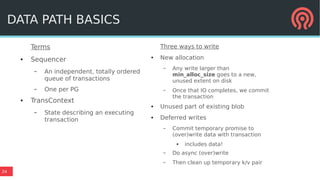
Terms
● Sequencer
– An independent, totally ordered
queue of transactions
– One per PG
● TransContext
– State describing an executing
transaction
DATA PATH BASICS
Three ways to write
● New allocation
– Any write larger than
min_alloc_size goes to a new,
unused extent on disk
– Once that IO completes, we commit
the transaction
● Unused part of existing blob
● Deferred writes
– Commit temporary promise to
(over)write data with transaction
● includes data!
– Do async (over)write
– Then clean up temporary k/v pair
25
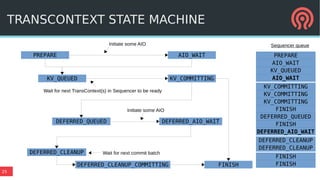
TRANSCONTEXT STATE MACHINE
PREPARE AIO_WAIT
KV_QUEUED KV_COMMITTING
DEFERRED_QUEUED DEFERRED_AIO_WAIT
FINISH
DEFERRED_CLEANUP
Initiate some AIO
Wait for next TransContext(s) in Sequencer to be ready
Sequencer queue
Initiate some AIO
Wait for next commit batch
DEFERRED_AIO_WAIT
DEFERRED_CLEANUP
DEFERRED_CLEANUP
PREPARE
AIO_WAIT
KV_QUEUED
AIO_WAIT
KV_COMMITTING
KV_COMMITTING
KV_COMMITTING
FINISH
WAL_QUEUEDDEFERRED_QUEUED
FINISH
FINISH
FINISHDEFERRED_CLEANUP_COMMITTING
26
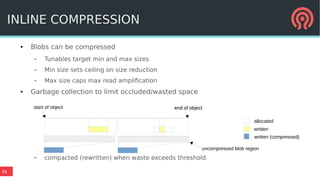
● Blobs can be compressed
– Tunables target min and max sizes
– Min size sets ceiling on size reduction
– Max size caps max read amplification
● Garbage collection to limit occluded/wasted space
– compacted (rewritten) when waste exceeds threshold
INLINE COMPRESSION
allocated
written
written (compressed)
start of object end of objectend of object
uncompressed blob region
27
● OnodeSpace per collection
– in-memory ghobject_t → Onode map of decoded onodes
● BufferSpace for in-memory blobs
– all in-flight writes
– may contain cached on-disk data
● Both buffers and onodes have lifecycles linked to a Cache
– LRUCache – trivial LRU
– TwoQCache – implements 2Q cache replacement algorithm (default)
● Cache is sharded for parallelism
– Collection → shard mapping matches OSD's op_wq
– same CPU context that processes client requests will touch the LRU/2Q lists
– aio completion execution not yet sharded – TODO?
IN-MEMORY CACHE
PERFORMANCE
29
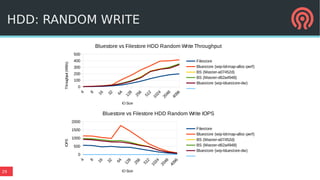
HDD: RANDOM WRITE
4 8 16 32 64
128
256
512
1024
2048
4096
0
100
200
300
400
500
Bluestore vs Filestore HDD Random Write Throughput
Filestore
Bluestore (wip-bitmap-alloc-perf)
BS (Master-a07452d)
BS (Master-d62a4948)
Bluestore (wip-bluestore-dw)
IO Size
Throughput(MB/s)
4 8 16 32 64
128
256
512
1024
2048
4096
0
500
1000
1500
2000
Bluestore vs Filestore HDD Random Write IOPS
Filestore
Bluestore (wip-bitmap-alloc-perf)
BS (Master-a07452d)
BS (Master-d62a4948)
Bluestore (wip-bluestore-dw)
IO Size
IOPS
30
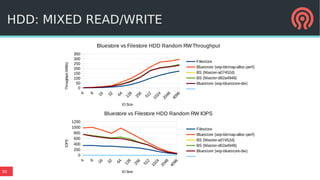
HDD: MIXED READ/WRITE
4 8 16 32 64
128
256
512
1024
2048
4096
0
50
100
150
200
250
300
350
Bluestore vs Filestore HDD Random RWThroughput
Filestore
Bluestore (wip-bitmap-alloc-perf)
BS (Master-a07452d)
BS (Master-d62a4948)
Bluestore (wip-bluestore-dw)
IO Size
Throughput(MB/s)
4 8 16 32 64
128
256
512
1024
2048
4096
0
200
400
600
800
1000
1200
Bluestore vs Filestore HDD Random RW IOPS
Filestore
Bluestore (wip-bitmap-alloc-perf)
BS (Master-a07452d)
BS (Master-d62a4948)
Bluestore (wip-bluestore-dw)
IO Size
IOPS
31
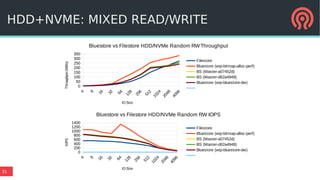
HDD+NVME: MIXED READ/WRITE
4 8 16 32 64
128
256
512
1024
2048
4096
0
50
100
150
200
250
300
350
Bluestore vs Filestore HDD/NVMe Random RWThroughput
Filestore
Bluestore (wip-bitmap-alloc-perf)
BS (Master-a07452d)
BS (Master-d62a4948)
Bluestore (wip-bluestore-dw)
IO Size
Throughput(MB/s)
4 8 16 32 64
128
256
512
1024
2048
4096
0
200
400
600
800
1000
1200
1400
Bluestore vs Filestore HDD/NVMe Random RW IOPS
Filestore
Bluestore (wip-bitmap-alloc-perf)
BS (Master-a07452d)
BS (Master-d62a4948)
Bluestore (wip-bluestore-dw)
IO Size
IOPS
32
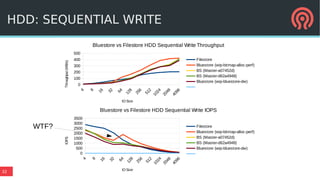
HDD: SEQUENTIAL WRITE
4 8 16 32 64
128
256
512
1024
2048
4096
0
100
200
300
400
500
Bluestore vs Filestore HDD Sequential Write Throughput
Filestore
Bluestore (wip-bitmap-alloc-perf)
BS (Master-a07452d)
BS (Master-d62a4948)
Bluestore (wip-bluestore-dw)
IO Size
Throughput(MB/s)
4 8 16 32 64
128
256
512
1024
2048
4096
0
500
1000
1500
2000
2500
3000
3500
Bluestore vs Filestore HDD Sequential Write IOPS
Filestore
Bluestore (wip-bitmap-alloc-perf)
BS (Master-a07452d)
BS (Master-d62a4948)
Bluestore (wip-bluestore-dw)
IO Size
IOPS
WTF?
33
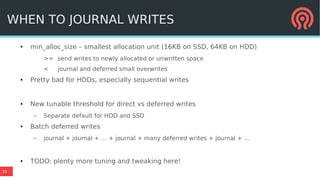
WHEN TO JOURNAL WRITES
● min_alloc_size – smallest allocation unit (16KB on SSD, 64KB on HDD)
>= send writes to newly allocated or unwritten space
< journal and deferred small overwrites
● Pretty bad for HDDs, especially sequential writes
● New tunable threshold for direct vs deferred writes
– Separate default for HDD and SSD
● Batch deferred writes
– journal + journal + … + journal + many deferred writes + journal + …
● TODO: plenty more tuning and tweaking here!
34
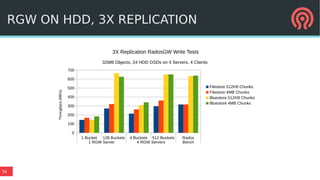
RGW ON HDD, 3X REPLICATION
1 Bucket 128 Buckets 4 Buckets 512 Buckets Rados
1 RGW Server 4 RGW Servers Bench
0
100
200
300
400
500
600
700
3X Replication RadosGW Write Tests
32MB Objects, 24 HDD OSDs on 4 Servers, 4 Clients
Filestore 512KB Chunks
Filestore 4MB Chunks
Bluestore 512KB Chunks
Bluestore 4MB Chunks
Throughput(MB/s)
35
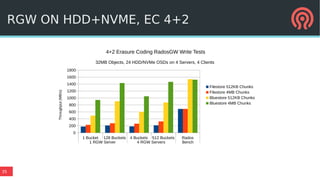
RGW ON HDD+NVME, EC 4+2
1 Bucket 128 Buckets 4 Buckets 512 Buckets Rados
1 RGW Server 4 RGW Servers Bench
0
200
400
600
800
1000
1200
1400
1600
1800
4+2 Erasure Coding RadosGW Write Tests
32MB Objects, 24 HDD/NVMe OSDs on 4 Servers, 4 Clients
Filestore 512KB Chunks
Filestore 4MB Chunks
Bluestore 512KB Chunks
Bluestore 4MB Chunks
Throughput(MB/s)
36
ERASURE CODE OVERWRITES
● Luminous allows overwrites of EC objects
– Requires two-phase commit to avoid “RAID-hole” like failure conditions
– OSD creates rollback objects
● clone_range $extent to temporary object
● write $extent with overwrite data
● clone[_range] marks blobs immutable, creates SharedBlob record
– Future small overwrites to this blob disallowed; new allocation
– Overhead of SharedBlob ref-counting record
● TODO: un-share and restore mutability in EC case
– Either hack since (in general) all references are in cache
– Or general un-sharing solution (if it doesn’t incur any additional cost)
37
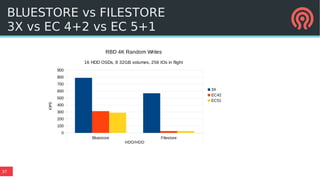
BLUESTORE vs FILESTORE
3X vs EC 4+2 vs EC 5+1
Bluestore Filestore
HDD/HDD
0
100
200
300
400
500
600
700
800
900
RBD 4K Random Writes
16 HDD OSDs, 8 32GB volumes, 256 IOs in flight
3X
EC42
EC51
IOPS
OTHER CHALLENGES
39
USERSPACE CACHE
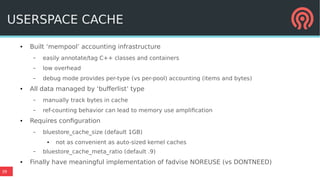
● Built ‘mempool’ accounting infrastructure
– easily annotate/tag C++ classes and containers
– low overhead
– debug mode provides per-type (vs per-pool) accounting (items and bytes)
● All data managed by ‘bufferlist’ type
– manually track bytes in cache
– ref-counting behavior can lead to memory use amplification
● Requires configuration
– bluestore_cache_size (default 1GB)
● not as convenient as auto-sized kernel caches
– bluestore_cache_meta_ratio (default .9)
● Finally have meaningful implementation of fadvise NOREUSE (vs DONTNEED)
40
MEMORY EFFICIENCY
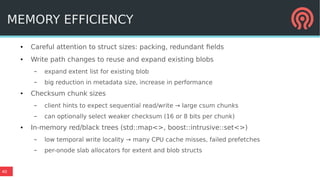
● Careful attention to struct sizes: packing, redundant fields
● Write path changes to reuse and expand existing blobs
– expand extent list for existing blob
– big reduction in metadata size, increase in performance
● Checksum chunk sizes
– client hints to expect sequential read/write → large csum chunks
– can optionally select weaker checksum (16 or 8 bits per chunk)
● In-memory red/black trees (std::map<>, boost::intrusive::set<>)
– low temporal write locality → many CPU cache misses, failed prefetches
– per-onode slab allocators for extent and blob structs
41
ROCKSDB
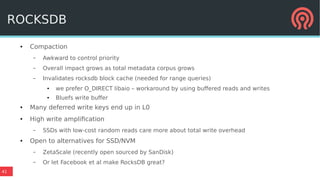
● Compaction
– Awkward to control priority
– Overall impact grows as total metadata corpus grows
– Invalidates rocksdb block cache (needed for range queries)
● we prefer O_DIRECT libaio – workaround by using buffered reads and writes
● Bluefs write buffer
● Many deferred write keys end up in L0
● High write amplification
– SSDs with low-cost random reads care more about total write overhead
● Open to alternatives for SSD/NVM
– ZetaScale (recently open sourced by SanDisk)
– Or let Facebook et al make RocksDB great?
FUTURE
43
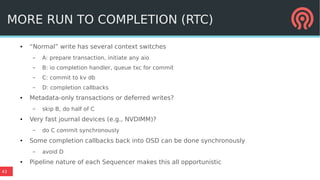
MORE RUN TO COMPLETION (RTC)
● “Normal” write has several context switches
– A: prepare transaction, initiate any aio
– B: io completion handler, queue txc for commit
– C: commit to kv db
– D: completion callbacks
● Metadata-only transactions or deferred writes?
– skip B, do half of C
● Very fast journal devices (e.g., NVDIMM)?
– do C commit synchronously
● Some completion callbacks back into OSD can be done synchronously
– avoid D
● Pipeline nature of each Sequencer makes this all opportunistic
44
SMR
● Described high-level strategy at Vault’16
– GSoC project
● Recent work shows less-horrible performance on DM-SMR
– Evolving ext4 for shingled disks (FAST’17, Vault’17)
– “Keep metadata in journal, avoid random writes”
● Still plan SMR-specific allocator/freelist implementation
– Tracking released extents in each zone useless
– Need reverse map to identify remaining objects
– Clean least-full zones
● Some speculation that this will be good strategy for non-SMR devices too
45
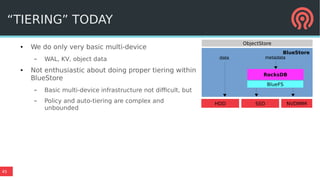
“TIERING” TODAY
● We do only very basic multi-device
– WAL, KV, object data
● Not enthusiastic about doing proper tiering within
BlueStore
– Basic multi-device infrastructure not difficult, but
– Policy and auto-tiering are complex and
unbounded
BlueStore
BlueFS
RocksDB
data metadata
ObjectStore
HDD SSD NVDIMM
46
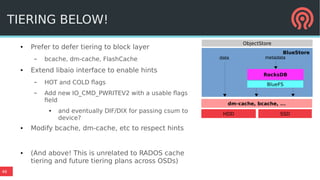
TIERING BELOW!
● Prefer to defer tiering to block layer
– bcache, dm-cache, FlashCache
● Extend libaio interface to enable hints
– HOT and COLD flags
– Add new IO_CMD_PWRITEV2 with a usable flags
field
● and eventually DIF/DIX for passing csum to
device?
● Modify bcache, dm-cache, etc to respect hints
● (And above! This is unrelated to RADOS cache
tiering and future tiering plans across OSDs)
BlueStore
BlueFS
RocksDB
data metadata
ObjectStore
HDD SSD
dm-cache, bcache, ...
47
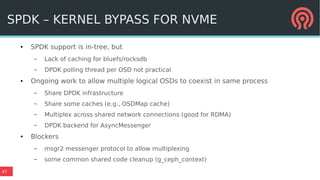
SPDK – KERNEL BYPASS FOR NVME
● SPDK support is in-tree, but
– Lack of caching for bluefs/rocksdb
– DPDK polling thread per OSD not practical
● Ongoing work to allow multiple logical OSDs to coexist in same process
– Share DPDK infrastructure
– Share some caches (e.g., OSDMap cache)
– Multiplex across shared network connections (good for RDMA)
– DPDK backend for AsyncMessenger
● Blockers
– msgr2 messenger protocol to allow multiplexing
– some common shared code cleanup (g_ceph_context)
STATUS
49
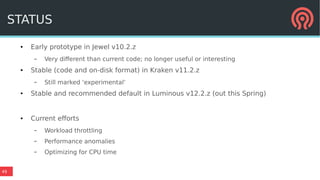
STATUS
● Early prototype in Jewel v10.2.z
– Very different than current code; no longer useful or interesting
● Stable (code and on-disk format) in Kraken v11.2.z
– Still marked ‘experimental’
● Stable and recommended default in Luminous v12.2.z (out this Spring)
● Current efforts
– Workload throttling
– Performance anomalies
– Optimizing for CPU time
50
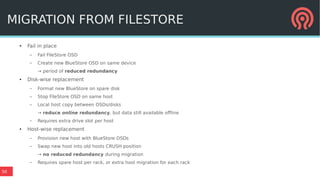
MIGRATION FROM FILESTORE
●
Fail in place
– Fail FileStore OSD
– Create new BlueStore OSD on same device
→ period of reduced redundancy
● Disk-wise replacement
– Format new BlueStore on spare disk
– Stop FileStore OSD on same host
– Local host copy between OSDs/disks
→ reduce online redundancy, but data still available offline
– Requires extra drive slot per host
● Host-wise replacement
– Provision new host with BlueStore OSDs
– Swap new host into old hosts CRUSH position
→ no reduced redundancy during migration
– Requires spare host per rack, or extra host migration for each rack
51
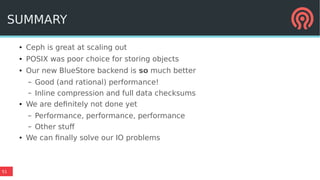
SUMMARY
● Ceph is great at scaling out
● POSIX was poor choice for storing objects
● Our new BlueStore backend is so much better
– Good (and rational) performance!
– Inline compression and full data checksums
● We are definitely not done yet
– Performance, performance, performance
– Other stuff
● We can finally solve our IO problems
52
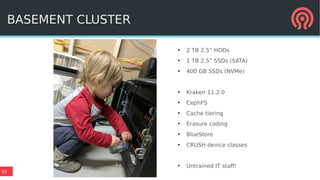
●
2 TB 2.5” HDDs
●
1 TB 2.5” SSDs (SATA)
●
400 GB SSDs (NVMe)
●
Kraken 11.2.0
●
CephFS
●
Cache tiering
●
Erasure coding
●
BlueStore
●
CRUSH device classes
●
Untrained IT staff!
BASEMENT CLUSTER
THANK YOU!
Sage Weil
CEPH PRINCIPAL ARCHITECT
sage@redhat.com
@liewegas
54
● FreelistManager
– persist list of free extents to
key/value store
– prepare incremental updates for
allocate or release
● Initial implementation
– extent-based
<offset> = <length>
– kept in-memory copy
– small initial memory footprint,
very expensive when fragmented
– imposed ordering constraint on
commits :(
● Newer bitmap-based approach
<offset> = <region bitmap>
– where region is N blocks
● 128 blocks = 8 bytes
– use k/v merge operator to XOR
allocation or release
merge 10=0000000011
merge 20=1110000000
– RocksDB log-structured-merge
tree coalesces keys during
compaction
– no in-memory state or ordering
BLOCK FREE LIST
55
● Allocator
– abstract interface to allocate blocks
● StupidAllocator
– extent-based
– bin free extents by size (powers of 2)
– choose sufficiently large extent
closest to hint
– highly variable memory usage
● btree of free extents
– implemented, works
– based on ancient ebofs policy
● BitmapAllocator
– hierarchy of indexes
● L1: 2 bits = 2^6 blocks
● L2: 2 bits = 2^12 blocks
● ...
00 = all free, 11 = all used,
01 = mix
– fixed memory consumption
● ~35 MB RAM per TB
BLOCK ALLOCATOR
56
● We scrub... periodically
– window before we detect error
– we may read bad data
– we may not be sure which copy
is bad
● We want to validate checksum
on every read
● Blobs include csum metadata
– crc32c (default), xxhash{64,32}
● Overhead
– 32-bit csum metadata for 4MB
object and 4KB blocks = 4KB
– larger csum blocks (compression!)
– smaller csums
● crc32c_8 or 16
● IO hints
– seq read + write → big chunks
– compression → big chunks
● Per-pool policy
CHECKSUMS

BlueStore, A New Storage Backend for Ceph, One Year In

  • 1.
    BLUESTORE: A NEWSTORAGE BACKEND FOR CEPH – ONE YEAR IN SAGE WEIL 2017.03.23
  • 2.
    2 OUTLINE ● Ceph backgroundand context – FileStore, and why POSIX failed us ● BlueStore – a new Ceph OSD backend ● Performance ● Recent challenges ● Future ● Status and availability ● Summary
  • 3.
  • 4.
    4 CEPH ● Object, block,and file storage in a single cluster ● All components scale horizontally ● No single point of failure ● Hardware agnostic, commodity hardware ● Self-manage whenever possible ● Open source (LGPL) ● “A Scalable, High-Performance Distributed File System” ● “performance, reliability, and scalability”
  • 5.
    5 CEPH COMPONENTS RGW A webservices gateway for object storage, compatible with S3 and Swift LIBRADOS A library allowing apps to directly access RADOS (C, C++, Java, Python, Ruby, PHP) RADOS A software-based, reliable, autonomous, distributed object store comprised of self-healing, self-managing, intelligent storage nodes and lightweight monitors RBD A reliable, fully-distributed block device with cloud platform integration CEPHFS A distributed file system with POSIX semantics and scale-out metadata management OBJECT BLOCK FILE
  • 6.
    6 OBJECT STORAGE DAEMONS(OSDS) FS DISK OSD DISK OSD FS DISK OSD FS DISK OSD FS xfs btrfs ext4 M M M
  • 7.
    7 OBJECT STORAGE DAEMONS(OSDS) FS DISK OSD DISK OSD FS DISK OSD FS DISK OSD FS xfs btrfs ext4 M M M FileStore FileStoreFileStoreFileStore
  • 8.
    8 ● ObjectStore – abstract interfacefor storing local data – EBOFS, FileStore ● EBOFS – a user-space extent-based object file system – deprecated in favor of FileStore on btrfs in 2009 ● Object – “file” – data (file-like byte stream) – attributes (small key/value) – omap (unbounded key/value) ● Collection – “directory” – placement group shard (slice of the RADOS pool) ● All writes are transactions – Atomic + Consistent + Durable – Isolation provided by OSD OBJECTSTORE AND DATA MODEL
  • 9.
    9 ● FileStore – PG =collection = directory – object = file ● Leveldb – large xattr spillover – object omap (key/value) data ● Originally just for development... – later, only supported backend (on XFS) ● /var/lib/ceph/osd/ceph-123/ – current/ ● meta/ – osdmap123 – osdmap124 ● 0.1_head/ – object1 – object12 ● 0.7_head/ – object3 – object5 ● 0.a_head/ – object4 – object6 ● omap/ – <leveldb files> FILESTORE
  • 10.
    10 ● Most transactionsare simple – write some bytes to object (file) – update object attribute (file xattr) – append to update log (kv insert) ...but others are arbitrarily large/complex ● Serialize and write-ahead txn to journal for atomicity – We double-write everything! – Lots of ugly hackery to make replayed events idempotent [ { "op_name": "write", "collection": "0.6_head", "oid": "#0:73d87003:::benchmark_data_gnit_10346_object23:head#", "length": 4194304, "offset": 0, "bufferlist length": 4194304 }, { "op_name": "setattrs", "collection": "0.6_head", "oid": "#0:73d87003:::benchmark_data_gnit_10346_object23:head#", "attr_lens": { "_": 269, "snapset": 31 } }, { "op_name": "omap_setkeys", "collection": "0.6_head", "oid": "#0:60000000::::head#", "attr_lens": { "0000000005.00000000000000000006": 178, "_info": 847 } } ] POSIX FAILS: TRANSACTIONS
  • 11.
    11 POSIX FAILS: ENUMERATION ●Ceph objects are distributed by a 32-bit hash ● Enumeration is in hash order – scrubbing – “backfill” (data rebalancing, recovery) – enumeration via librados client API ● POSIX readdir is not well-ordered – And even if it were, it would be a different hash ● Need O(1) “split” for a given shard/range ● Build directory tree by hash-value prefix – split any directory when size > ~100 files – merge when size < ~50 files – read entire directory, sort in-memory … DIR_A/ DIR_A/A03224D3_qwer DIR_A/A247233E_zxcv … DIR_B/ DIR_B/DIR_8/ DIR_B/DIR_8/B823032D_foo DIR_B/DIR_8/B8474342_bar DIR_B/DIR_9/ DIR_B/DIR_9/B924273B_baz DIR_B/DIR_A/ DIR_B/DIR_A/BA4328D2_asdf …
  • 12.
    12 THE HEADACHES CONTINUE ●New FileStore problems continue to surface as we approach switch to BlueStore – Recently discovered bug in FileStore omap implementation, revealed by new CephFS scrubbing – FileStore directory splits lead to throughput collapse when an entire pool’s PG directories split in unison – Read/modify/write workloads perform horribly ● RGW index objects ● RBD object bitmaps – QoS efforts thwarted by deep queues and periodicity in FileStore throughput – Cannot bound deferred writeback work, even with fsync(2) – {RBD, CephFS} snapshots triggering inefficient 4MB object copies to create object clones
  • 13.
  • 14.
    14 ● BlueStore =Block + NewStore – consume raw block device(s) – key/value database (RocksDB) for metadata – data written directly to block device – pluggable block Allocator (policy) – pluggable compression – checksums, ponies, ... ● We must share the block device with RocksDB BLUESTORE BlueStore BlueFS RocksDB BlueRocksEnv data metadata ObjectStore BlockDevice
  • 15.
    15 ROCKSDB: BLUEROCKSENV +BLUEFS ● class BlueRocksEnv : public rocksdb::EnvWrapper – passes “file” operations to BlueFS ● BlueFS is a super-simple “file system” – all metadata lives in the journal – all metadata loaded in RAM on start/mount – no need to store block free list – coarse allocation unit (1 MB blocks) – journal rewritten/compacted when it gets large superblock journal … more journal … data data data data file 10 file 11 file 12 file 12 file 13 rm file 12 file 13 ... ● Map “directories” to different block devices – db.wal/ – on NVRAM, NVMe, SSD – db/ – level0 and hot SSTs on SSD – db.slow/ – cold SSTs on HDD ● BlueStore periodically balances free space
  • 16.
    16 ● Single device –HDD or SSD ● Bluefs db.wal/ + db/ (wal and sst files) ● object data blobs ● Two devices – 512MB of SSD or NVRAM ● bluefs db.wal/ (rocksdb wal) – big device ● bluefs db/ (sst files, spillover) ● object data blobs MULTI-DEVICE SUPPORT ● Two devices – a few GB of SSD ● bluefs db.wal/ (rocksdb wal) ● bluefs db/ (warm sst files) – big device ● bluefs db.slow/ (cold sst files) ● object data blobs ● Three devices – 512MB NVRAM ● bluefs db.wal/ (rocksdb wal) – a few GB SSD ● bluefs db/ (warm sst files) – big device ● bluefs db.slow/ (cold sst files) ● object data blobs
  • 17.
  • 18.
    18 BLUESTORE METADATA ● Everythingin flat kv database (rocksdb) ● Partition namespace for different metadata – S* – “superblock” properties for the entire store – B* – block allocation metadata (free block bitmap) – T* – stats (bytes used, compressed, etc.) – C* – collection name → cnode_t – O* – object name → onode_t or bnode_t – X* – shared blobs – L* – deferred writes (promises of future IO) – M* – omap (user key/value data, stored in objects)
  • 19.
    19 ● Collection metadata –Interval of object namespace shard pool hash name bits C<NOSHARD,12,3d3e0000> “12.e3d3” = <19> shard pool hash name snap gen O<NOSHARD,12,3d3d880e,foo,NOSNAP,NOGEN> = … O<NOSHARD,12,3d3d9223,bar,NOSNAP,NOGEN> = … O<NOSHARD,12,3d3e02c2,baz,NOSNAP,NOGEN> = … O<NOSHARD,12,3d3e125d,zip,NOSNAP,NOGEN> = … O<NOSHARD,12,3d3e1d41,dee,NOSNAP,NOGEN> = … O<NOSHARD,12,3d3e3832,dah,NOSNAP,NOGEN> = … struct spg_t { uint64_t pool; uint32_t hash; shard_id_t shard; }; struct bluestore_cnode_t { uint32_t bits; }; ● Nice properties – Ordered enumeration of objects – We can “split” collections by adjusting collection metadata only CNODE
  • 20.
    20 ● Per objectmetadata – Lives directly in key/value pair – Serializes to 100s of bytes ● Size in bytes ● Attributes (user attr data) ● Inline extent map (maybe) struct bluestore_onode_t { uint64_t size; map<string,bufferptr> attrs; uint64_t flags; struct shard_info { uint32_t offset; uint32_t bytes; }; vector<shard_info> shards; bufferlist inline_extents; bufferlist spanning_blobs; }; ONODE
  • 21.
    21 ● Blob – Extent(s)on device – Lump of data originating from same object – May later be referenced by multiple objects – Normally checksummed – May be compressed ● SharedBlob – Extent ref count on cloned blobs – In-memory buffer cache BLOBS struct bluestore_blob_t { vector<bluestore_pextent_t> extents; uint32_t compressed_length_orig = 0; uint32_t compressed_length = 0; uint32_t flags = 0; uint16_t unused = 0; // bitmap uint8_t csum_type = CSUM_NONE; uint8_t csum_chunk_order = 0; bufferptr csum_data; }; struct bluestore_shared_blob_t { uint64_t sbid; bluestore_extent_ref_map_t ref_map; };
  • 22.
    22 ● Map objectextents → blob extents ● Extent map serialized in chunks – stored inline in onode value if small – otherwise stored in adjacent keys ● Blobs stored inline in each shard – unless it is referenced across shard boundaries – “spanning” blobs stored in onode key ● If blob is “shared” (cloned) – ref count on allocated extents stored in external key – only needed (loaded) on deallocations EXTENT MAP ... O<,,foo,,> =onode + inline extent map O<,,bar,,> =onode + spanning blobs O<,,bar,,0> =extent map shard O<,,bar,,4> =extent map shard O<,,baz,,> =onode + inline extent map ... logicaloffsets blob blob blob shard#1shard#2 spanningblob
  • 23.
  • 24.
    24 Terms ● Sequencer – Anindependent, totally ordered queue of transactions – One per PG ● TransContext – State describing an executing transaction DATA PATH BASICS Three ways to write ● New allocation – Any write larger than min_alloc_size goes to a new, unused extent on disk – Once that IO completes, we commit the transaction ● Unused part of existing blob ● Deferred writes – Commit temporary promise to (over)write data with transaction ● includes data! – Do async (over)write – Then clean up temporary k/v pair
  • 25.
    25 TRANSCONTEXT STATE MACHINE PREPAREAIO_WAIT KV_QUEUED KV_COMMITTING DEFERRED_QUEUED DEFERRED_AIO_WAIT FINISH DEFERRED_CLEANUP Initiate some AIO Wait for next TransContext(s) in Sequencer to be ready Sequencer queue Initiate some AIO Wait for next commit batch DEFERRED_AIO_WAIT DEFERRED_CLEANUP DEFERRED_CLEANUP PREPARE AIO_WAIT KV_QUEUED AIO_WAIT KV_COMMITTING KV_COMMITTING KV_COMMITTING FINISH WAL_QUEUEDDEFERRED_QUEUED FINISH FINISH FINISHDEFERRED_CLEANUP_COMMITTING
  • 26.
    26 ● Blobs canbe compressed – Tunables target min and max sizes – Min size sets ceiling on size reduction – Max size caps max read amplification ● Garbage collection to limit occluded/wasted space – compacted (rewritten) when waste exceeds threshold INLINE COMPRESSION allocated written written (compressed) start of object end of objectend of object uncompressed blob region
  • 27.
    27 ● OnodeSpace percollection – in-memory ghobject_t → Onode map of decoded onodes ● BufferSpace for in-memory blobs – all in-flight writes – may contain cached on-disk data ● Both buffers and onodes have lifecycles linked to a Cache – LRUCache – trivial LRU – TwoQCache – implements 2Q cache replacement algorithm (default) ● Cache is sharded for parallelism – Collection → shard mapping matches OSD's op_wq – same CPU context that processes client requests will touch the LRU/2Q lists – aio completion execution not yet sharded – TODO? IN-MEMORY CACHE
  • 28.
  • 29.
    29 HDD: RANDOM WRITE 48 16 32 64 128 256 512 1024 2048 4096 0 100 200 300 400 500 Bluestore vs Filestore HDD Random Write Throughput Filestore Bluestore (wip-bitmap-alloc-perf) BS (Master-a07452d) BS (Master-d62a4948) Bluestore (wip-bluestore-dw) IO Size Throughput(MB/s) 4 8 16 32 64 128 256 512 1024 2048 4096 0 500 1000 1500 2000 Bluestore vs Filestore HDD Random Write IOPS Filestore Bluestore (wip-bitmap-alloc-perf) BS (Master-a07452d) BS (Master-d62a4948) Bluestore (wip-bluestore-dw) IO Size IOPS
  • 30.
    30 HDD: MIXED READ/WRITE 48 16 32 64 128 256 512 1024 2048 4096 0 50 100 150 200 250 300 350 Bluestore vs Filestore HDD Random RWThroughput Filestore Bluestore (wip-bitmap-alloc-perf) BS (Master-a07452d) BS (Master-d62a4948) Bluestore (wip-bluestore-dw) IO Size Throughput(MB/s) 4 8 16 32 64 128 256 512 1024 2048 4096 0 200 400 600 800 1000 1200 Bluestore vs Filestore HDD Random RW IOPS Filestore Bluestore (wip-bitmap-alloc-perf) BS (Master-a07452d) BS (Master-d62a4948) Bluestore (wip-bluestore-dw) IO Size IOPS
  • 31.
    31 HDD+NVME: MIXED READ/WRITE 48 16 32 64 128 256 512 1024 2048 4096 0 50 100 150 200 250 300 350 Bluestore vs Filestore HDD/NVMe Random RWThroughput Filestore Bluestore (wip-bitmap-alloc-perf) BS (Master-a07452d) BS (Master-d62a4948) Bluestore (wip-bluestore-dw) IO Size Throughput(MB/s) 4 8 16 32 64 128 256 512 1024 2048 4096 0 200 400 600 800 1000 1200 1400 Bluestore vs Filestore HDD/NVMe Random RW IOPS Filestore Bluestore (wip-bitmap-alloc-perf) BS (Master-a07452d) BS (Master-d62a4948) Bluestore (wip-bluestore-dw) IO Size IOPS
  • 32.
    32 HDD: SEQUENTIAL WRITE 48 16 32 64 128 256 512 1024 2048 4096 0 100 200 300 400 500 Bluestore vs Filestore HDD Sequential Write Throughput Filestore Bluestore (wip-bitmap-alloc-perf) BS (Master-a07452d) BS (Master-d62a4948) Bluestore (wip-bluestore-dw) IO Size Throughput(MB/s) 4 8 16 32 64 128 256 512 1024 2048 4096 0 500 1000 1500 2000 2500 3000 3500 Bluestore vs Filestore HDD Sequential Write IOPS Filestore Bluestore (wip-bitmap-alloc-perf) BS (Master-a07452d) BS (Master-d62a4948) Bluestore (wip-bluestore-dw) IO Size IOPS WTF?
  • 33.
    33 WHEN TO JOURNALWRITES ● min_alloc_size – smallest allocation unit (16KB on SSD, 64KB on HDD) >= send writes to newly allocated or unwritten space < journal and deferred small overwrites ● Pretty bad for HDDs, especially sequential writes ● New tunable threshold for direct vs deferred writes – Separate default for HDD and SSD ● Batch deferred writes – journal + journal + … + journal + many deferred writes + journal + … ● TODO: plenty more tuning and tweaking here!
  • 34.
    34 RGW ON HDD,3X REPLICATION 1 Bucket 128 Buckets 4 Buckets 512 Buckets Rados 1 RGW Server 4 RGW Servers Bench 0 100 200 300 400 500 600 700 3X Replication RadosGW Write Tests 32MB Objects, 24 HDD OSDs on 4 Servers, 4 Clients Filestore 512KB Chunks Filestore 4MB Chunks Bluestore 512KB Chunks Bluestore 4MB Chunks Throughput(MB/s)
  • 35.
    35 RGW ON HDD+NVME,EC 4+2 1 Bucket 128 Buckets 4 Buckets 512 Buckets Rados 1 RGW Server 4 RGW Servers Bench 0 200 400 600 800 1000 1200 1400 1600 1800 4+2 Erasure Coding RadosGW Write Tests 32MB Objects, 24 HDD/NVMe OSDs on 4 Servers, 4 Clients Filestore 512KB Chunks Filestore 4MB Chunks Bluestore 512KB Chunks Bluestore 4MB Chunks Throughput(MB/s)
  • 36.
    36 ERASURE CODE OVERWRITES ●Luminous allows overwrites of EC objects – Requires two-phase commit to avoid “RAID-hole” like failure conditions – OSD creates rollback objects ● clone_range $extent to temporary object ● write $extent with overwrite data ● clone[_range] marks blobs immutable, creates SharedBlob record – Future small overwrites to this blob disallowed; new allocation – Overhead of SharedBlob ref-counting record ● TODO: un-share and restore mutability in EC case – Either hack since (in general) all references are in cache – Or general un-sharing solution (if it doesn’t incur any additional cost)
  • 37.
    37 BLUESTORE vs FILESTORE 3Xvs EC 4+2 vs EC 5+1 Bluestore Filestore HDD/HDD 0 100 200 300 400 500 600 700 800 900 RBD 4K Random Writes 16 HDD OSDs, 8 32GB volumes, 256 IOs in flight 3X EC42 EC51 IOPS
  • 38.
  • 39.
    39 USERSPACE CACHE ● Built‘mempool’ accounting infrastructure – easily annotate/tag C++ classes and containers – low overhead – debug mode provides per-type (vs per-pool) accounting (items and bytes) ● All data managed by ‘bufferlist’ type – manually track bytes in cache – ref-counting behavior can lead to memory use amplification ● Requires configuration – bluestore_cache_size (default 1GB) ● not as convenient as auto-sized kernel caches – bluestore_cache_meta_ratio (default .9) ● Finally have meaningful implementation of fadvise NOREUSE (vs DONTNEED)
  • 40.
    40 MEMORY EFFICIENCY ● Carefulattention to struct sizes: packing, redundant fields ● Write path changes to reuse and expand existing blobs – expand extent list for existing blob – big reduction in metadata size, increase in performance ● Checksum chunk sizes – client hints to expect sequential read/write → large csum chunks – can optionally select weaker checksum (16 or 8 bits per chunk) ● In-memory red/black trees (std::map<>, boost::intrusive::set<>) – low temporal write locality → many CPU cache misses, failed prefetches – per-onode slab allocators for extent and blob structs
  • 41.
    41 ROCKSDB ● Compaction – Awkwardto control priority – Overall impact grows as total metadata corpus grows – Invalidates rocksdb block cache (needed for range queries) ● we prefer O_DIRECT libaio – workaround by using buffered reads and writes ● Bluefs write buffer ● Many deferred write keys end up in L0 ● High write amplification – SSDs with low-cost random reads care more about total write overhead ● Open to alternatives for SSD/NVM – ZetaScale (recently open sourced by SanDisk) – Or let Facebook et al make RocksDB great?
  • 42.
  • 43.
    43 MORE RUN TOCOMPLETION (RTC) ● “Normal” write has several context switches – A: prepare transaction, initiate any aio – B: io completion handler, queue txc for commit – C: commit to kv db – D: completion callbacks ● Metadata-only transactions or deferred writes? – skip B, do half of C ● Very fast journal devices (e.g., NVDIMM)? – do C commit synchronously ● Some completion callbacks back into OSD can be done synchronously – avoid D ● Pipeline nature of each Sequencer makes this all opportunistic
  • 44.
    44 SMR ● Described high-levelstrategy at Vault’16 – GSoC project ● Recent work shows less-horrible performance on DM-SMR – Evolving ext4 for shingled disks (FAST’17, Vault’17) – “Keep metadata in journal, avoid random writes” ● Still plan SMR-specific allocator/freelist implementation – Tracking released extents in each zone useless – Need reverse map to identify remaining objects – Clean least-full zones ● Some speculation that this will be good strategy for non-SMR devices too
  • 45.
    45 “TIERING” TODAY ● Wedo only very basic multi-device – WAL, KV, object data ● Not enthusiastic about doing proper tiering within BlueStore – Basic multi-device infrastructure not difficult, but – Policy and auto-tiering are complex and unbounded BlueStore BlueFS RocksDB data metadata ObjectStore HDD SSD NVDIMM
  • 46.
    46 TIERING BELOW! ● Preferto defer tiering to block layer – bcache, dm-cache, FlashCache ● Extend libaio interface to enable hints – HOT and COLD flags – Add new IO_CMD_PWRITEV2 with a usable flags field ● and eventually DIF/DIX for passing csum to device? ● Modify bcache, dm-cache, etc to respect hints ● (And above! This is unrelated to RADOS cache tiering and future tiering plans across OSDs) BlueStore BlueFS RocksDB data metadata ObjectStore HDD SSD dm-cache, bcache, ...
  • 47.
    47 SPDK – KERNELBYPASS FOR NVME ● SPDK support is in-tree, but – Lack of caching for bluefs/rocksdb – DPDK polling thread per OSD not practical ● Ongoing work to allow multiple logical OSDs to coexist in same process – Share DPDK infrastructure – Share some caches (e.g., OSDMap cache) – Multiplex across shared network connections (good for RDMA) – DPDK backend for AsyncMessenger ● Blockers – msgr2 messenger protocol to allow multiplexing – some common shared code cleanup (g_ceph_context)
  • 48.
  • 49.
    49 STATUS ● Early prototypein Jewel v10.2.z – Very different than current code; no longer useful or interesting ● Stable (code and on-disk format) in Kraken v11.2.z – Still marked ‘experimental’ ● Stable and recommended default in Luminous v12.2.z (out this Spring) ● Current efforts – Workload throttling – Performance anomalies – Optimizing for CPU time
  • 50.
    50 MIGRATION FROM FILESTORE ● Failin place – Fail FileStore OSD – Create new BlueStore OSD on same device → period of reduced redundancy ● Disk-wise replacement – Format new BlueStore on spare disk – Stop FileStore OSD on same host – Local host copy between OSDs/disks → reduce online redundancy, but data still available offline – Requires extra drive slot per host ● Host-wise replacement – Provision new host with BlueStore OSDs – Swap new host into old hosts CRUSH position → no reduced redundancy during migration – Requires spare host per rack, or extra host migration for each rack
  • 51.
    51 SUMMARY ● Ceph isgreat at scaling out ● POSIX was poor choice for storing objects ● Our new BlueStore backend is so much better – Good (and rational) performance! – Inline compression and full data checksums ● We are definitely not done yet – Performance, performance, performance – Other stuff ● We can finally solve our IO problems
  • 52.
    52 ● 2 TB 2.5”HDDs ● 1 TB 2.5” SSDs (SATA) ● 400 GB SSDs (NVMe) ● Kraken 11.2.0 ● CephFS ● Cache tiering ● Erasure coding ● BlueStore ● CRUSH device classes ● Untrained IT staff! BASEMENT CLUSTER
  • 53.
    THANK YOU! Sage Weil CEPHPRINCIPAL ARCHITECT sage@redhat.com @liewegas
  • 54.
    54 ● FreelistManager – persistlist of free extents to key/value store – prepare incremental updates for allocate or release ● Initial implementation – extent-based <offset> = <length> – kept in-memory copy – small initial memory footprint, very expensive when fragmented – imposed ordering constraint on commits :( ● Newer bitmap-based approach <offset> = <region bitmap> – where region is N blocks ● 128 blocks = 8 bytes – use k/v merge operator to XOR allocation or release merge 10=0000000011 merge 20=1110000000 – RocksDB log-structured-merge tree coalesces keys during compaction – no in-memory state or ordering BLOCK FREE LIST
  • 55.
    55 ● Allocator – abstractinterface to allocate blocks ● StupidAllocator – extent-based – bin free extents by size (powers of 2) – choose sufficiently large extent closest to hint – highly variable memory usage ● btree of free extents – implemented, works – based on ancient ebofs policy ● BitmapAllocator – hierarchy of indexes ● L1: 2 bits = 2^6 blocks ● L2: 2 bits = 2^12 blocks ● ... 00 = all free, 11 = all used, 01 = mix – fixed memory consumption ● ~35 MB RAM per TB BLOCK ALLOCATOR
  • 56.
    56 ● We scrub...periodically – window before we detect error – we may read bad data – we may not be sure which copy is bad ● We want to validate checksum on every read ● Blobs include csum metadata – crc32c (default), xxhash{64,32} ● Overhead – 32-bit csum metadata for 4MB object and 4KB blocks = 4KB – larger csum blocks (compression!) – smaller csums ● crc32c_8 or 16 ● IO hints – seq read + write → big chunks – compression → big chunks ● Per-pool policy CHECKSUMS